


 Скачать презентацию History of Health Care Learning Targets
dad2cee01dd26e20f04f5b9241faee0d.ppt
- Количество слайдов: 38
 History of Health Care
 Learning Targets • I can identify medical/health care milestones that have led to advances in health care.
 4000 BC – 3000 BC Primitive Times n n Tribal witch doctors treated illness with ceremonies Herbs and plants used as medicines (morphine and digitalis) Trepanation or trephining (surgically removing a piece of bone from the skull) Average life span was 20 years
 3000 BC – 300 BC Ancient Egyptians Physicians were priests n Bloodletting or leeches used as medical treatment n Average life span was 20 -30 years n
 1700 BC – AD 220 Ancient Chinese n n n Believed in the need to treat the whole body by curing the spirit and nourishing the body Used therapies such as acupuncture Average life span was 20 -30 years
 1200 BC – 200 BC Ancient Greeks n n First to observe the human body and the effects of disease – led to modern medical sciences. Used therapies such as massage, art therapy, and herbal treatment Stressed diet and exercise as ways to prevent disease Average life span was 25 -35 years
 753 BC – AD 410 Ancient Romans n n n First to organize medical care by providing care for injured soldiers First public health and sanitation systems by building sewers Life span was 25 -35 years
 AD 400 – AD 800 Dark Ages Emphasis on study of medicine was prohibited n Average life span was 20 -30 years n
 AD 800 – AD 1400 Middle Ages n n n Bubonic Plague killed 75% of population in Europe and Asia Major diseases included smallpox, diptheria, tuberculosis, typhoid, the plaque, and malaria Average life span was 20 -35 years
 AD 1350 – AD 1650 Renaissance Dissection of body led to increased understanding of anatomy and physiology n Invention of printing press allowed medical knowledge to be shared n First anatomy book was published by Andreas Vesalius (1514 -1564) n Average life span was 30 -40 years n
 16 th and 17 th Centuries n n Cause of disease still not known – many people died from infections Invention of the microscope allowed physicians to see disease-causing organisms. Apothecaries (early pharmacists) made, prescribed, and sold medications Average life span 35 -45 years
 18 th Century Gabriel Fahrenheit (1686 -1736) created the first mercury thermometer n John Hunter (1728 -1793), established scientific surgical procedures and introduced tube feeding n Benjamin Franklin invented bifocals n Average life span 40 -50 years n
 19 th Century n n n Rapid advancements due to discoveries of microorganisms, anesthesia, and vaccinations Infection control developed once microorganisms were associated with disease Formal training for nurses began Women became active participants in health care Average life span 40 -60 years
 20 th Century n n Increased knowledge about the role of blood in the body ABO blood groups discovered Found out how white blood cells protect against disease New medications were developed n n Insulin discovered and used to treat diabetes Antibiotics developed to fight infections Vaccines were developed New machines developed n n n Kidney Dialysis Machine Heart Lung Machine Surgical and diagnostic techniques developed to cure once fatal conditions
 20 th Century (continued) n n n n Organ Transplants Test tube babies Implanted first artificial heart Health Care Plans developed to help pay the cost of care Medicare and Medicaid marked the entry of the federal government into the health care arena HMOs provided an alternative to private insurance Hospice organized
 21 st Century n n n The first totally implantable artificial heart was placed in a patient in Louisville, Ky. In 2001 The threat of bioterrorism lead to smallpox vaccination of the military and first responders in 2002 The Netherlands became the first country in the world to legalize euthanasia in 2002
 21 st Century n n Stem cells were used in the treatments of disease early in the 2000’s and lead to increased research in the treatment of cancer and other diseases President George W. Bush approved federal funding for research using only existing lines of embryonic stem cells in 2001 Advanced Cell Technology announced it cloned a human embryo in 2001 but the embryo did not survive The U. S. FDA approved the use of the abortion pill RU-486 IN 200
 21 st Century n n The standards for Privacy of Individually Identifiable Health Information, required under the Health Insurance Portability and Accountability Act (HIPPA) of 1996, went into effect in 2003 Vaccinations for cervical cancer and herpes zoster (shingles) in 2006
 Potential for 21 st Century Cures for AIDS, cancer, and heart disease n Genetic manipulation to prevent inherited disease n Nerves in the brain and spinal cord are regenerated to prevent paralysis n Antibiotics are developed that do not allow pathogens to develop resistance n Average life span 90 -100 years n
 Individual Contributions
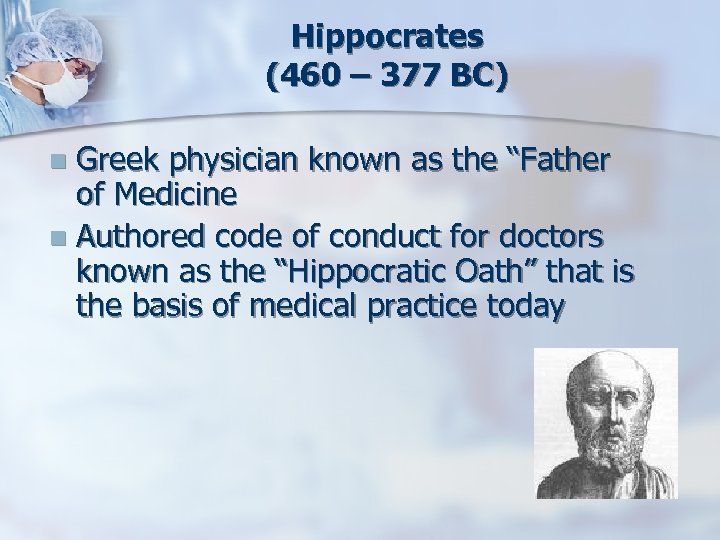 Hippocrates (460 – 377 BC) Greek physician known as the “Father of Medicine n Authored code of conduct for doctors known as the “Hippocratic Oath” that is the basis of medical practice today n
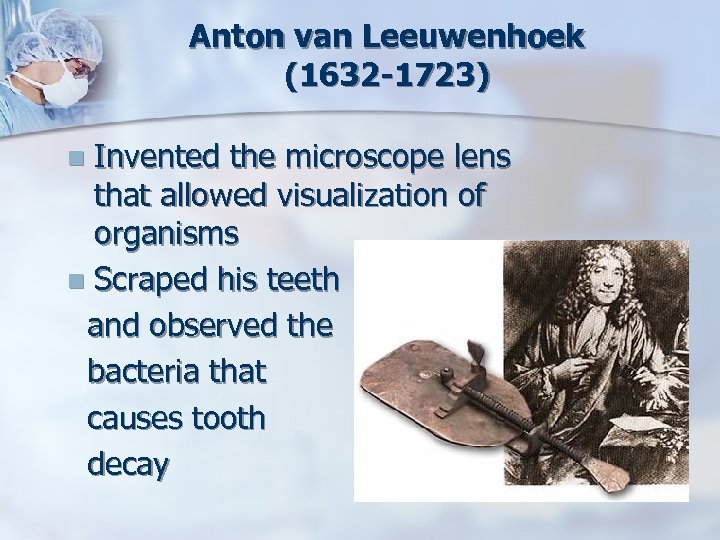 Anton van Leeuwenhoek (1632 -1723) Invented the microscope lens that allowed visualization of organisms n Scraped his teeth and observed the bacteria that causes tooth decay n
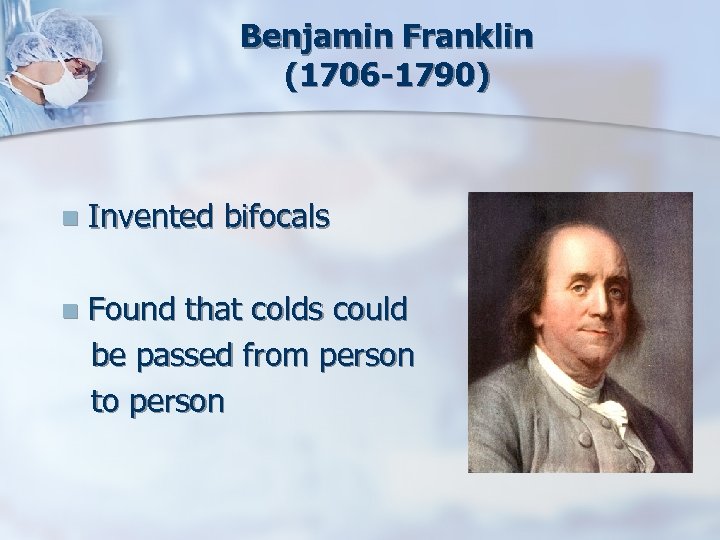 Benjamin Franklin (1706 -1790) n Invented bifocals n Found that colds could be passed from person to person
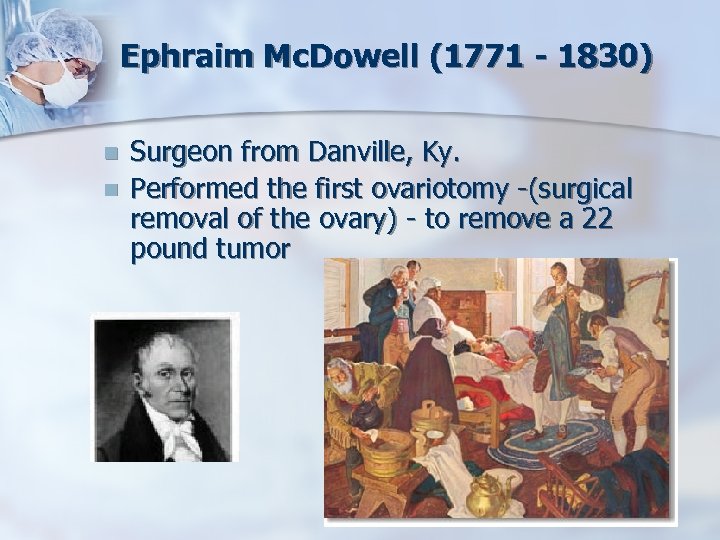 Ephraim Mc. Dowell (1771 - 1830) n n Surgeon from Danville, Ky. Performed the first ovariotomy -(surgical removal of the ovary) - to remove a 22 pound tumor
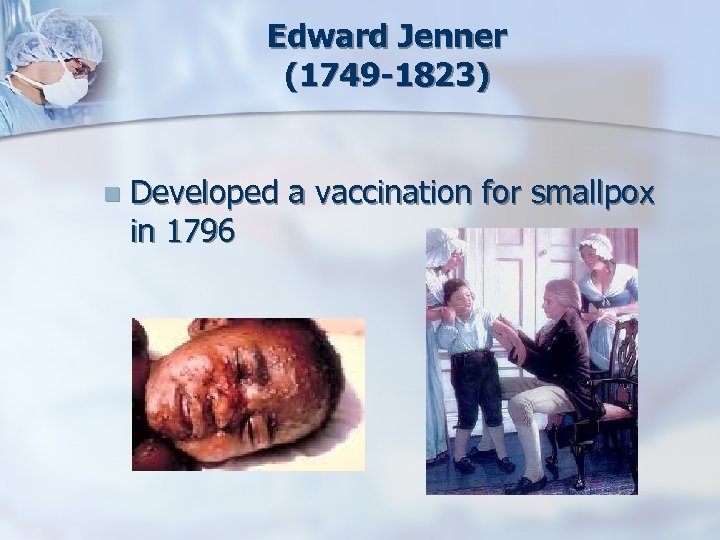 Edward Jenner (1749 -1823) n Developed a vaccination for smallpox in 1796
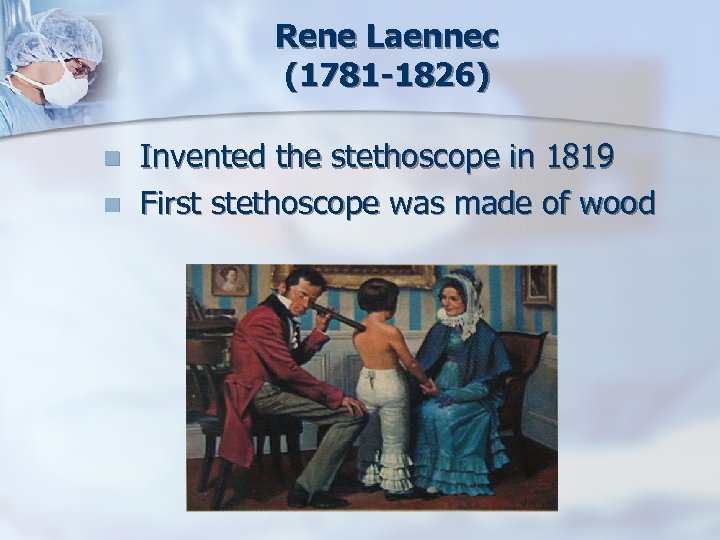 Rene Laennec (1781 -1826) n n Invented the stethoscope in 1819 First stethoscope was made of wood
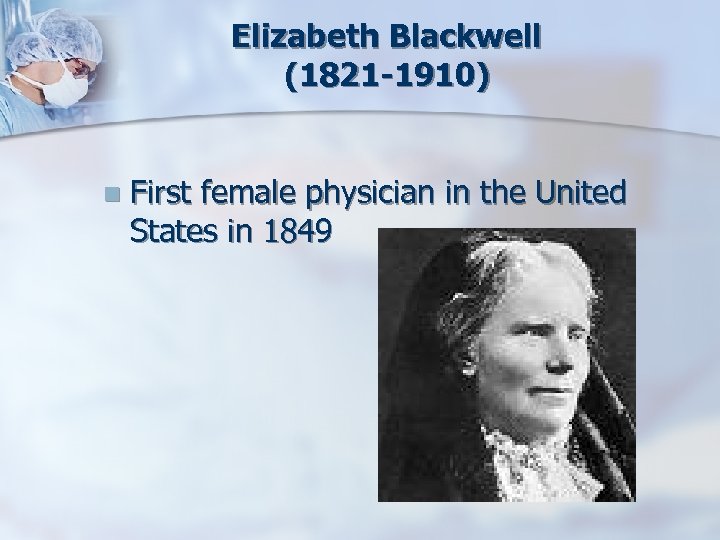 Elizabeth Blackwell (1821 -1910) n First female physician in the United States in 1849
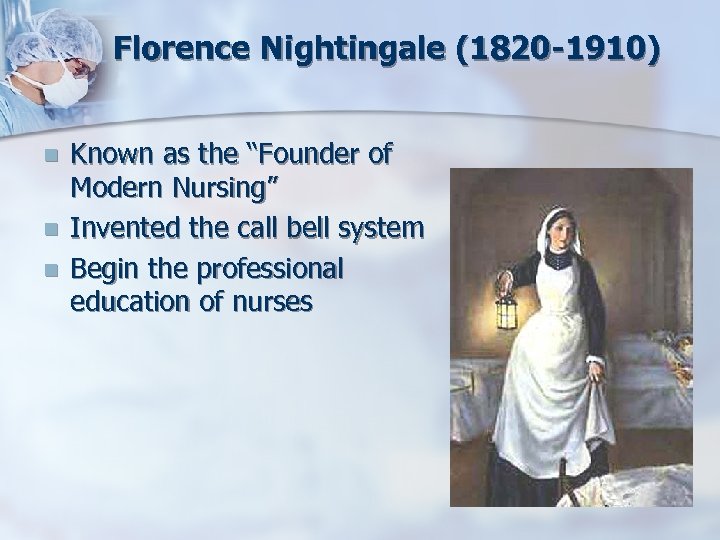 Florence Nightingale (1820 -1910) n n n Known as the “Founder of Modern Nursing” Invented the call bell system Begin the professional education of nurses
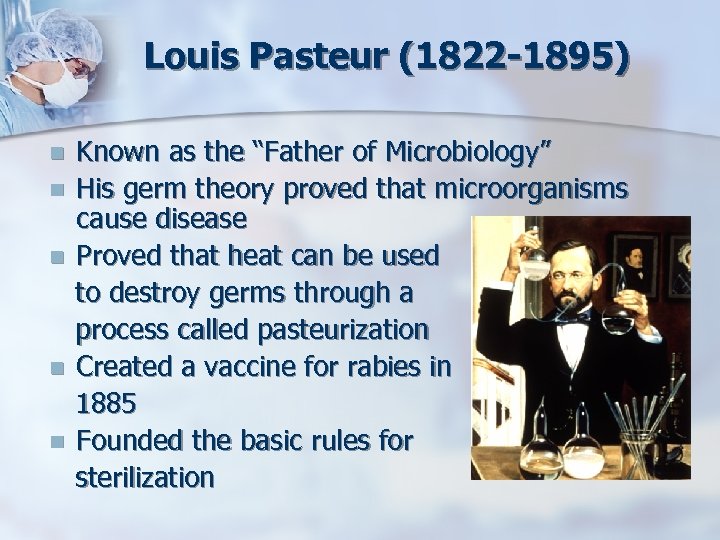 Louis Pasteur (1822 -1895) n n n Known as the “Father of Microbiology” His germ theory proved that microorganisms cause disease Proved that heat can be used to destroy germs through a process called pasteurization Created a vaccine for rabies in 1885 Founded the basic rules for sterilization
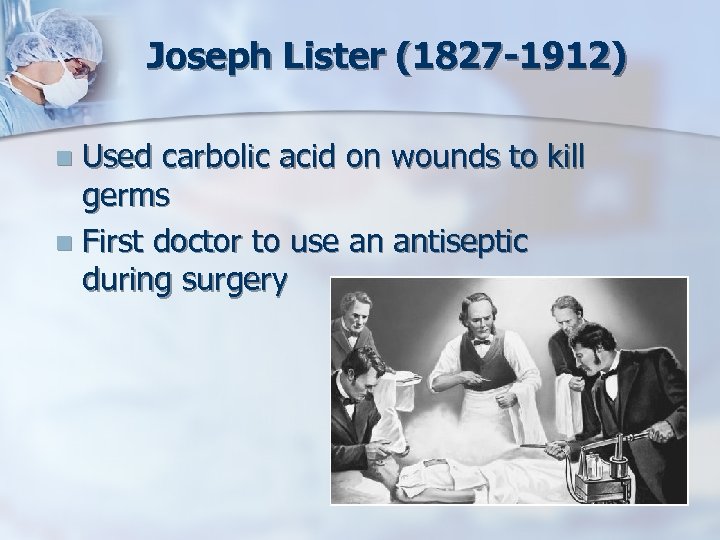 Joseph Lister (1827 -1912) Used carbolic acid on wounds to kill germs n First doctor to use an antiseptic during surgery n
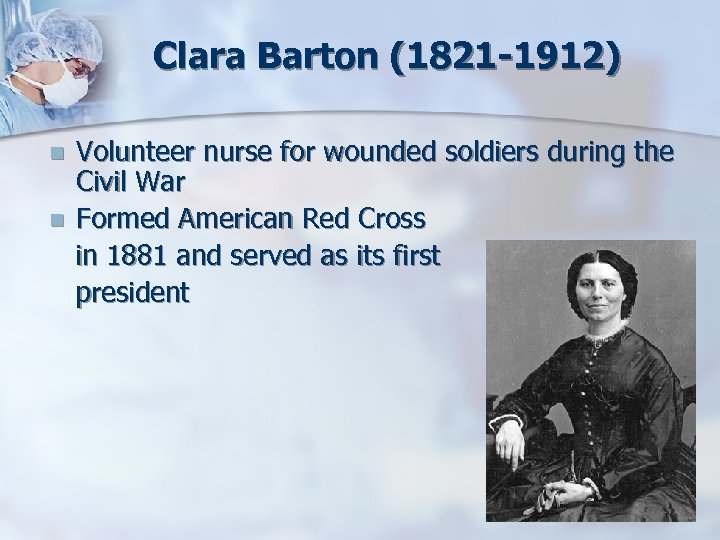 Clara Barton (1821 -1912) n n Volunteer nurse for wounded soldiers during the Civil War Formed American Red Cross in 1881 and served as its first president
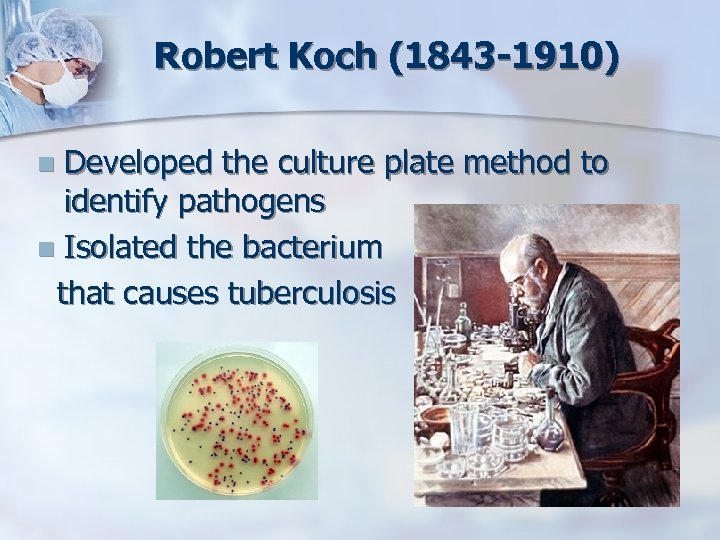 Robert Koch (1843 -1910) Developed the culture plate method to identify pathogens n Isolated the bacterium that causes tuberculosis n
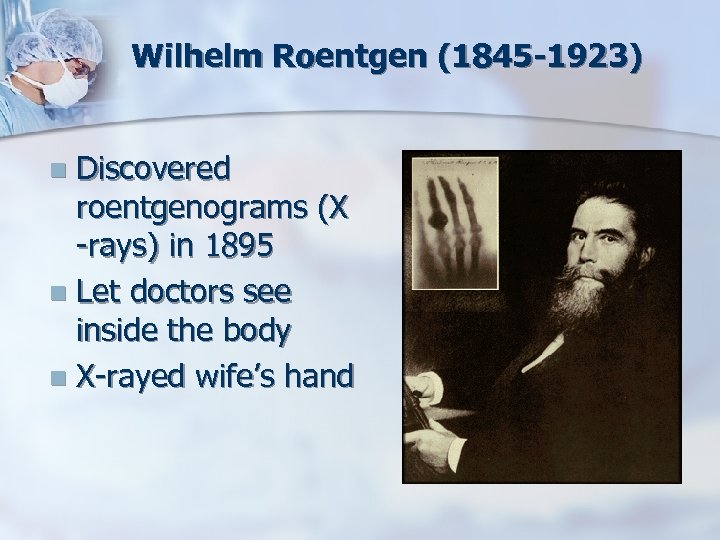 Wilhelm Roentgen (1845 -1923) Discovered roentgenograms (X -rays) in 1895 n Let doctors see inside the body n X-rayed wife’s hand n
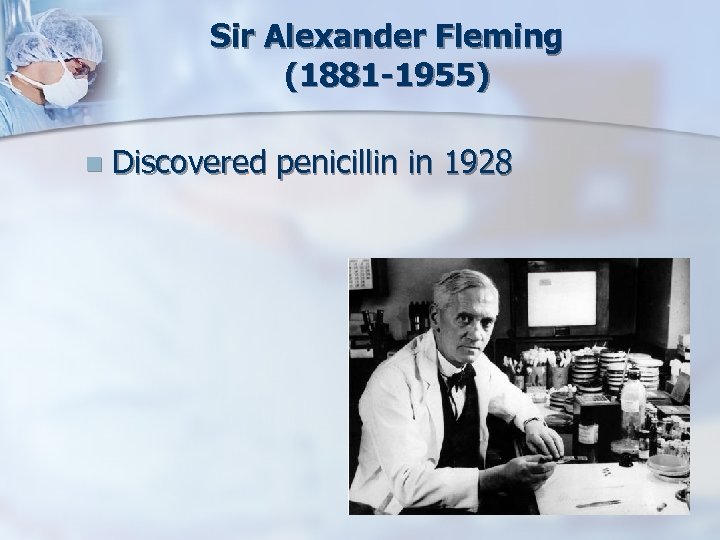 Sir Alexander Fleming (1881 -1955) n Discovered penicillin in 1928
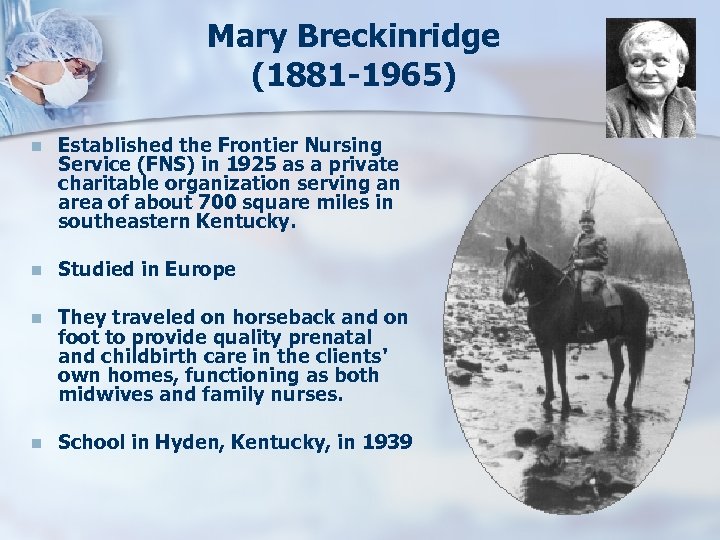 Mary Breckinridge (1881 -1965) n Established the Frontier Nursing Service (FNS) in 1925 as a private charitable organization serving an area of about 700 square miles in southeastern Kentucky. n Studied in Europe n They traveled on horseback and on foot to provide quality prenatal and childbirth care in the clients' own homes, functioning as both midwives and family nurses. n School in Hyden, Kentucky, in 1939
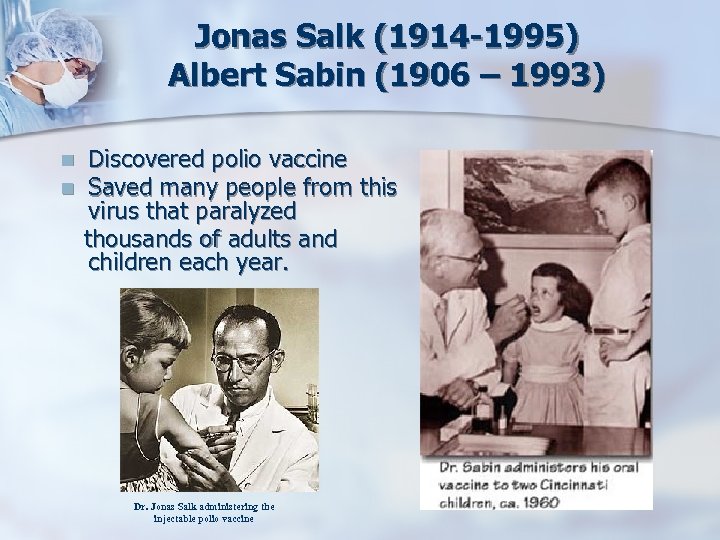 Jonas Salk (1914 -1995) Albert Sabin (1906 – 1993) n n Discovered polio vaccine Saved many people from this virus that paralyzed thousands of adults and children each year. Dr. Jonas Salk administering the injectable polio vaccine
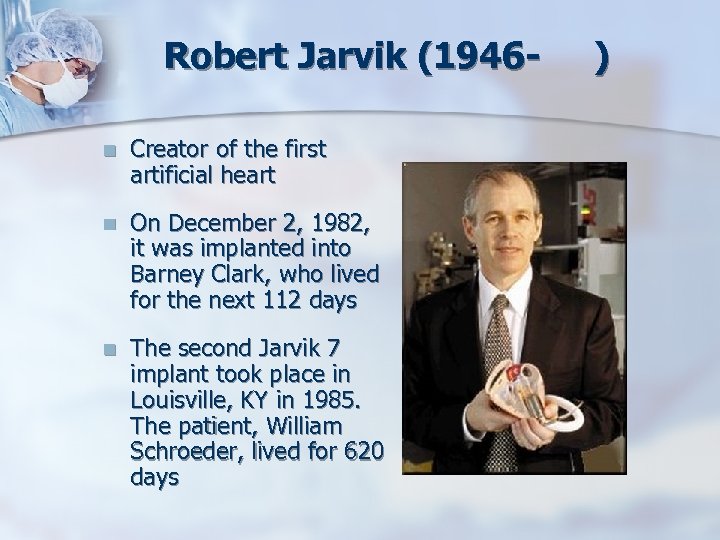 Robert Jarvik (1946 n Creator of the first artificial heart n On December 2, 1982, it was implanted into Barney Clark, who lived for the next 112 days n The second Jarvik 7 implant took place in Louisville, KY in 1985. The patient, William Schroeder, lived for 620 days )
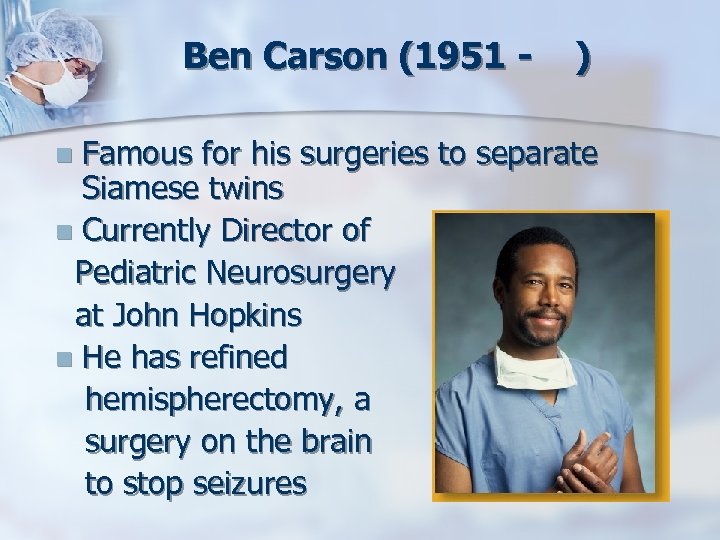 Ben Carson (1951 - ) Famous for his surgeries to separate Siamese twins n Currently Director of Pediatric Neurosurgery at John Hopkins n He has refined hemispherectomy, a surgery on the brain to stop seizures n