


 Скачать презентацию History of fishing World s Fisheries 1 Stone
c263923e3abc545bc0bcaa920ba70a28.ppt
- Количество слайдов: 45
 History of fishing, World’s Fisheries 1
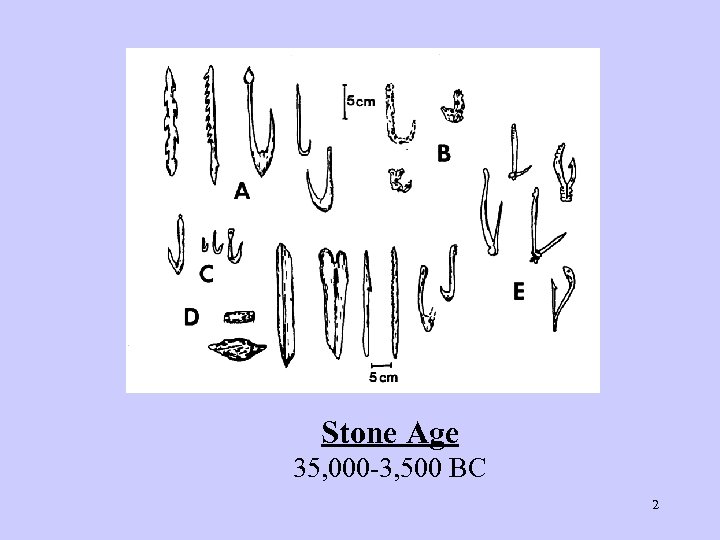 Stone Age 35, 000 -3, 500 BC 2
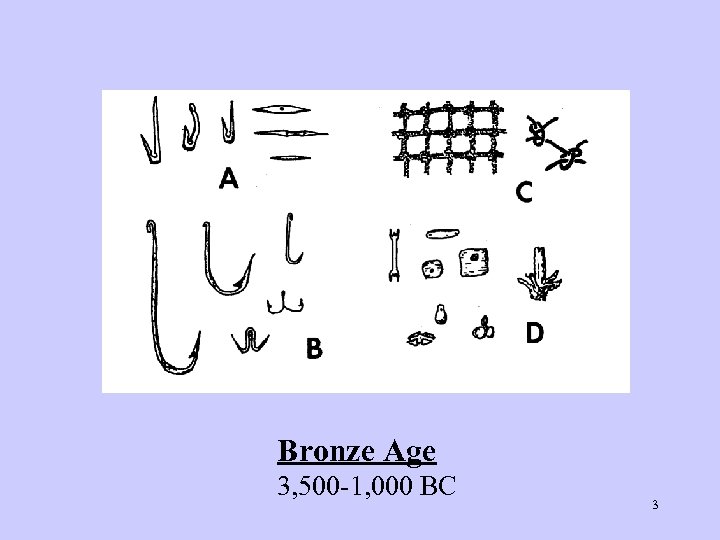 Bronze Age 3, 500 -1, 000 BC 3
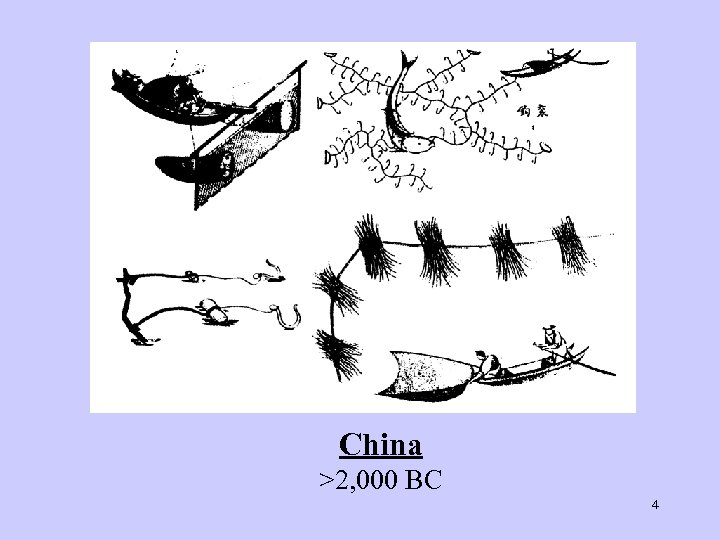 China >2, 000 BC 4
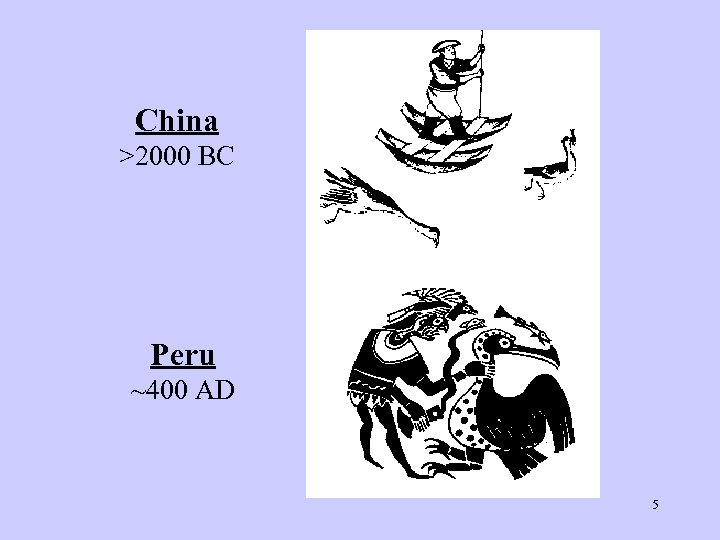 China >2000 BC Peru ~400 AD 5
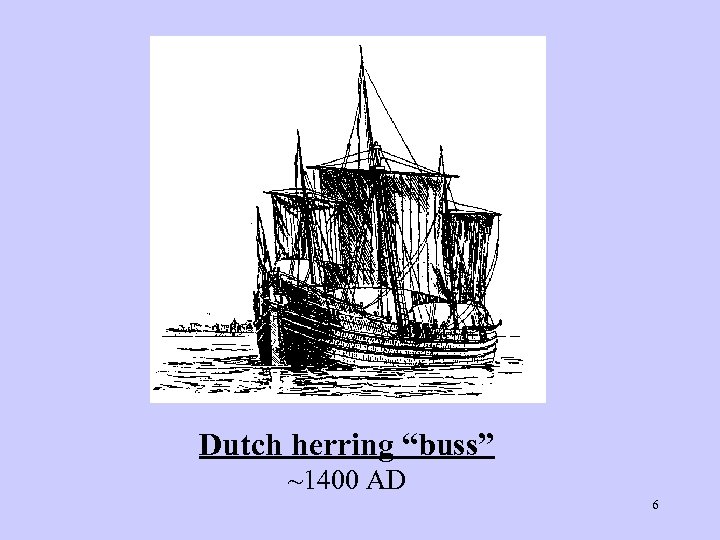 Dutch herring “buss” ~1400 AD 6
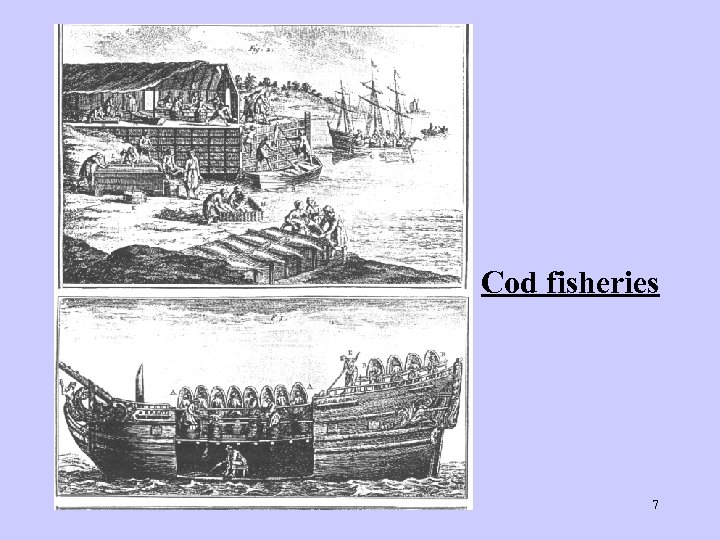 Cod fisheries 7
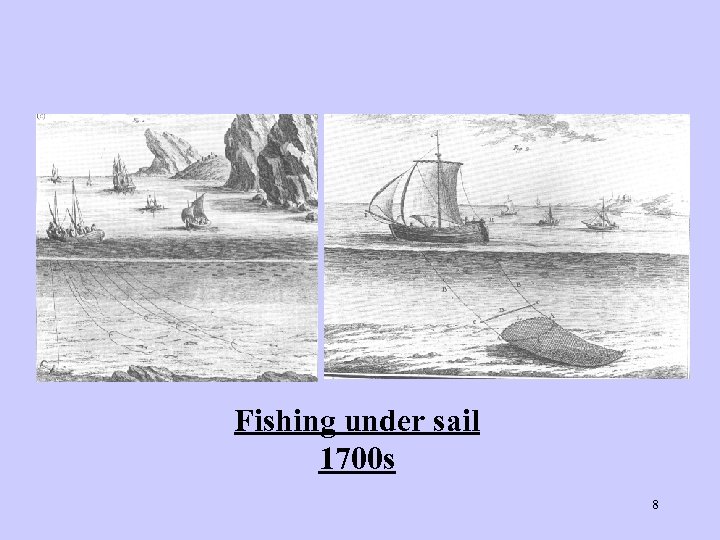 Fishing under sail 1700 s 8
 First industrialization of fisheries (1870 s-1950) • More extensive markets because of the industrial revolution (Europe & N. America) • Method of capture mechanized with the introduction of the steam trawler. Catches increased because their value exceeded the cost of mechanization (i. e. the cost of coal) • First signals of fish decline (N. Sea, Cape Hatteras to Gulf of St. Lawrence, Pacific northwest between Seattle and the Aleutians) 9
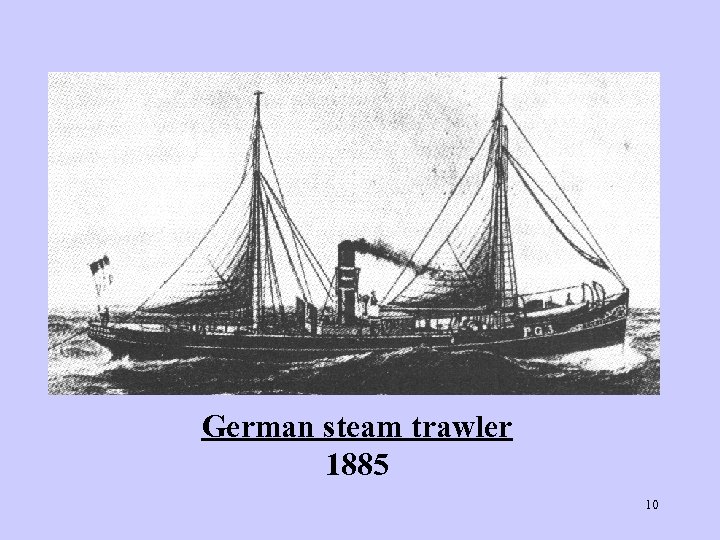 German steam trawler 1885 10
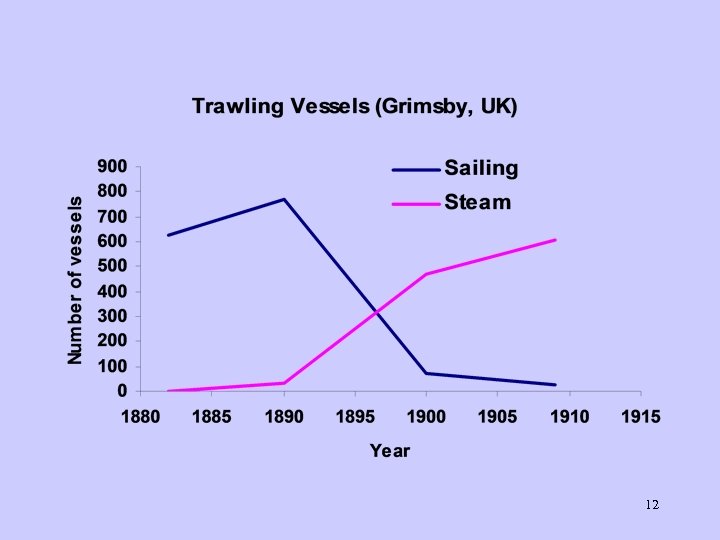
 Steam Trawlers: First Industrialization of Fisheries • First puddle tugs towed the sailing smacks to sea (1860) • First steam trawlers were built in 1881, 34 m long, steamed at 16. 6 kph (10. 3 mph) • Burned 4 t of coal/ day • CAUGHT 4 x that by a sailing smack (ship) • Independent of weather 11
 12
12
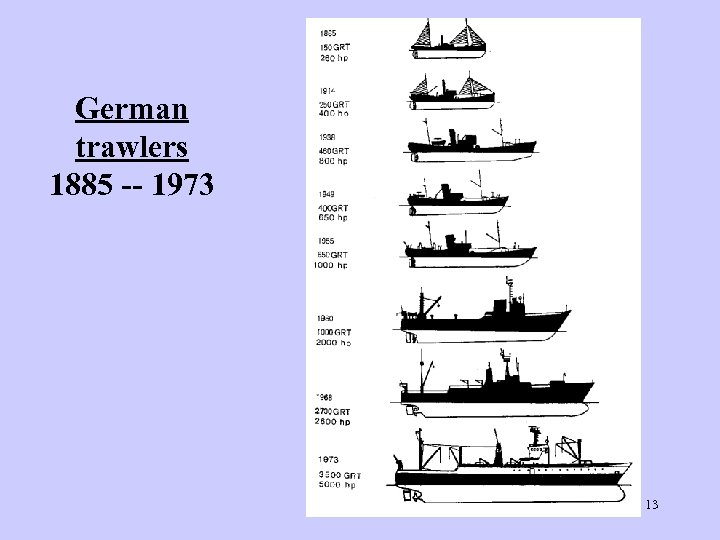 German trawlers 1885 -- 1973 13
 Consequences of the First Industrialization • Efficiency of fish capture increased by a factor of 4 • Stock density declined in the North Sea • Single boating was replaced by fleeting (PROFIT SPENT TO BUY ANOTHER BOAT!!!) • Vessels steamed further to find high catches • Fish remained longer on ice before sale 14
 The beginnings of fishery science 15
 Reasons for fluctuations in abundance • Displeasure of the gods • Wickedness of the people • Whims of the fish themselves • Changes in currents/climates • Impacts of fishing 16
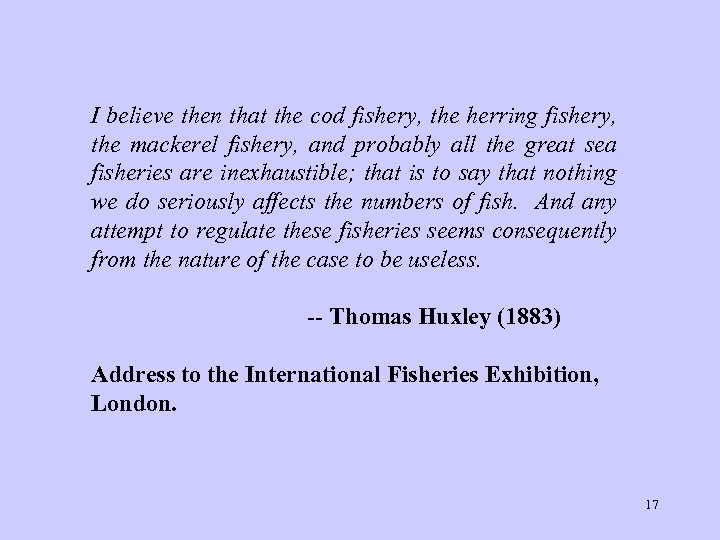 I believe then that the cod fishery, the herring fishery, the mackerel fishery, and probably all the great sea fisheries are inexhaustible; that is to say that nothing we do seriously affects the numbers of fish. And any attempt to regulate these fisheries seems consequently from the nature of the case to be useless. -- Thomas Huxley (1883) Address to the International Fisheries Exhibition, London. 17
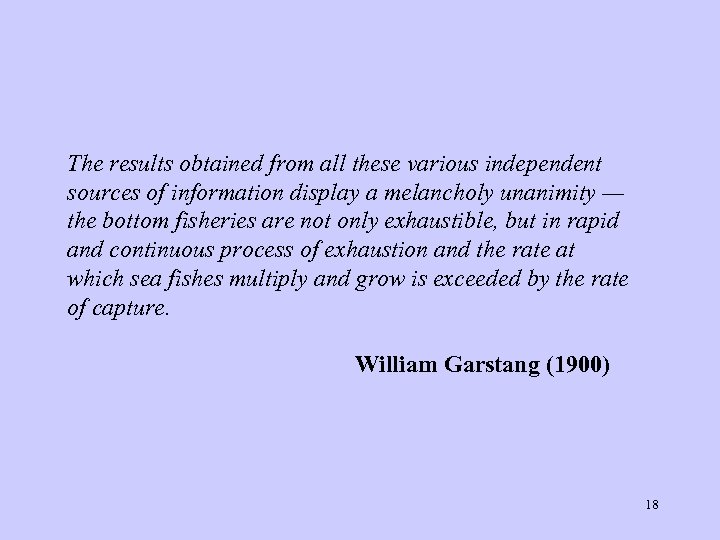 The results obtained from all these various independent sources of information display a melancholy unanimity — the bottom fisheries are not only exhaustible, but in rapid and continuous process of exhaustion and the rate at which sea fishes multiply and grow is exceeded by the rate of capture. William Garstang (1900) 18
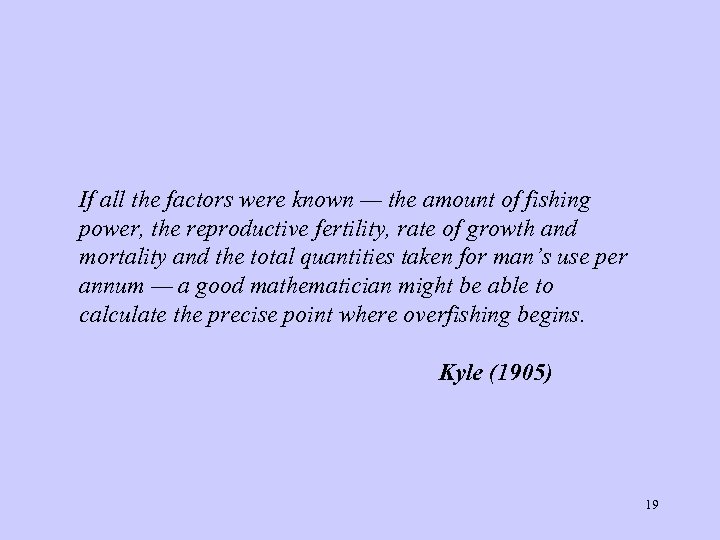 If all the factors were known — the amount of fishing power, the reproductive fertility, rate of growth and mortality and the total quantities taken for man’s use per annum — a good mathematician might be able to calculate the precise point where overfishing begins. Kyle (1905) 19
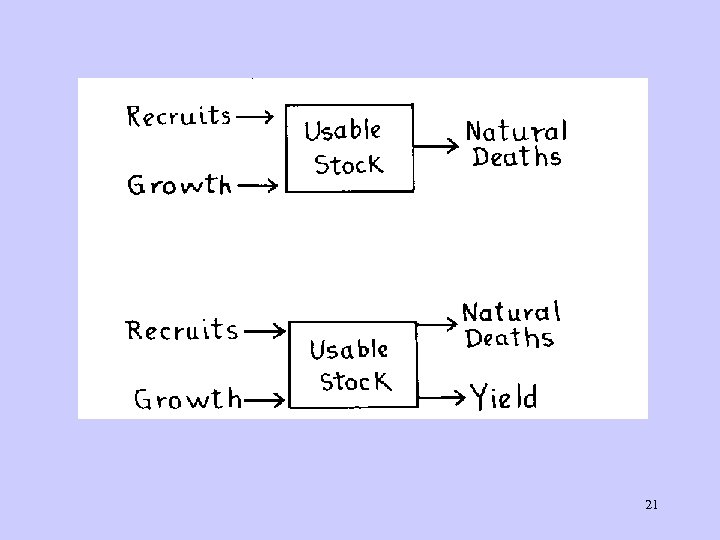
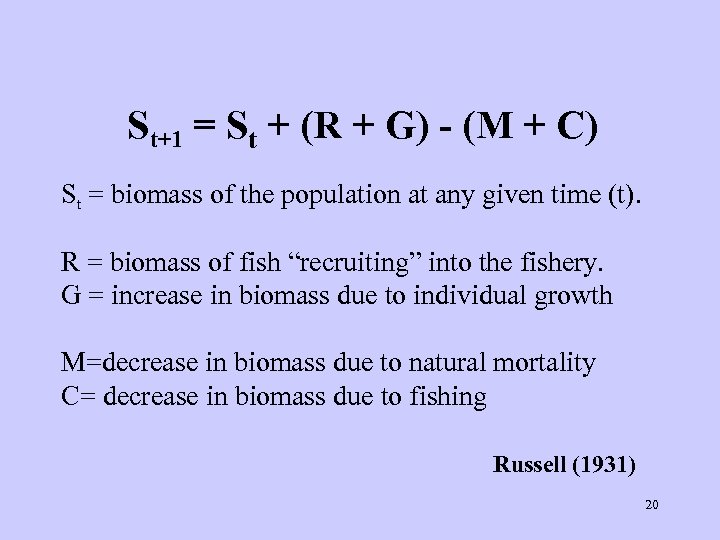 St+1 = St + (R + G) - (M + C) St = biomass of the population at any given time (t). R = biomass of fish “recruiting” into the fishery. G = increase in biomass due to individual growth M=decrease in biomass due to natural mortality C= decrease in biomass due to fishing Russell (1931) 20
 21
21
 World Fisheries: An Overview • Global trends, 1950 -2008 – Are the world’s oceans overfished? – Contribution of fisheries to global economy – Dependence on fish for animal protein • Fishery statistics – Sources – Limitations 22
 Statistics Source United Nations -- Food and Agriculture Organization (FAO) Downloadable statistical databases (FISHSTAT+, FAOSTAT/ WAICENT) Yearbooks of Fishery Statistics Time Span: 1950 -”Present” Languages: English, French & Spanish Two Volumes (a) Catches and landings (~700 p. ) Quantities (weights or numbers) (b) Commodities (selected quantities & values; ~200 p. ) Disposition (fresh, frozen, cured, canned) Trade: Import-Export 23
 FAO Fishery Statistics: What are they Nominal catches = Live weight of organisms obtained Landings = Weight whether or not gutted, headed, or reduced (e. g. , oil-meal) “…of freshwater, brackish, and marine species of fish, crustaceans, mollusks, and other aquatic animals and plants, killed, caught, trapped, collected, bred or cultivated for all commercial, industrial recreational and subsistence purposes. ” 1080 50 9 Species Items (species, genus, family level) Species Groups (flatfishes, tunas, etc. ) Divisions (e. g. , marine fishes, mollusks, etc. ) 24
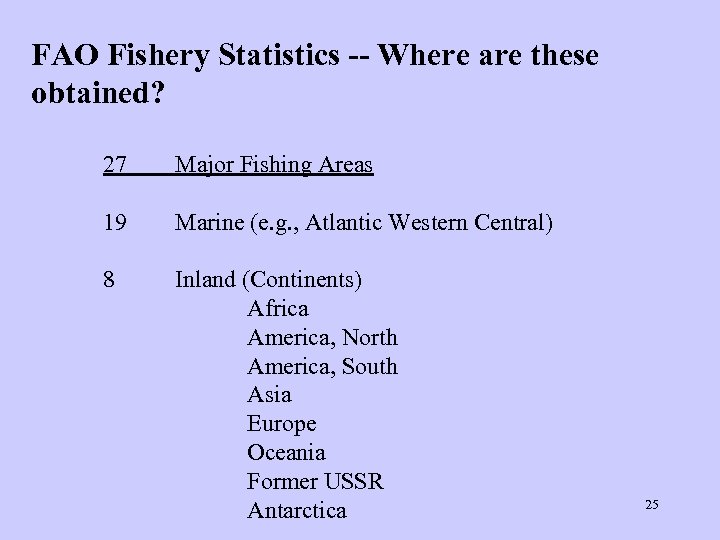 FAO Fishery Statistics -- Where are these obtained? 27 Major Fishing Areas 19 Marine (e. g. , Atlantic Western Central) 8 Inland (Continents) Africa America, North America, South Asia Europe Oceania Former USSR Antarctica 25
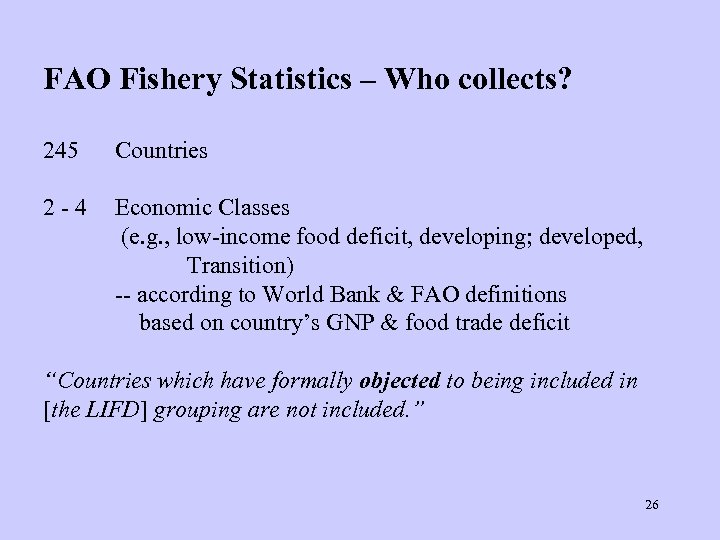 FAO Fishery Statistics – Who collects? 245 Countries 2 -4 Economic Classes (e. g. , low-income food deficit, developing; developed, Transition) -- according to World Bank & FAO definitions based on country’s GNP & food trade deficit “Countries which have formally objected to being included in [the LIFD] grouping are not included. ” 26
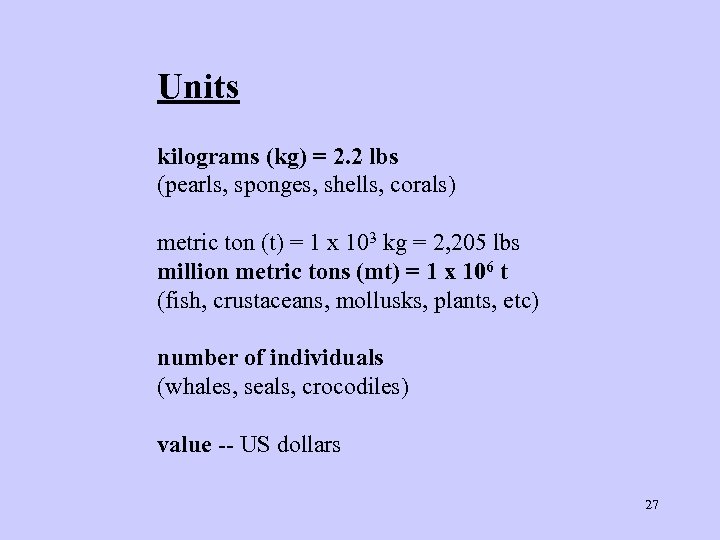 Units kilograms (kg) = 2. 2 lbs (pearls, sponges, shells, corals) metric ton (t) = 1 x 10³ kg = 2, 205 lbs million metric tons (mt) = 1 x 10⁶ t (fish, crustaceans, mollusks, plants, etc) number of individuals (whales, seals, crocodiles) value -- US dollars 27
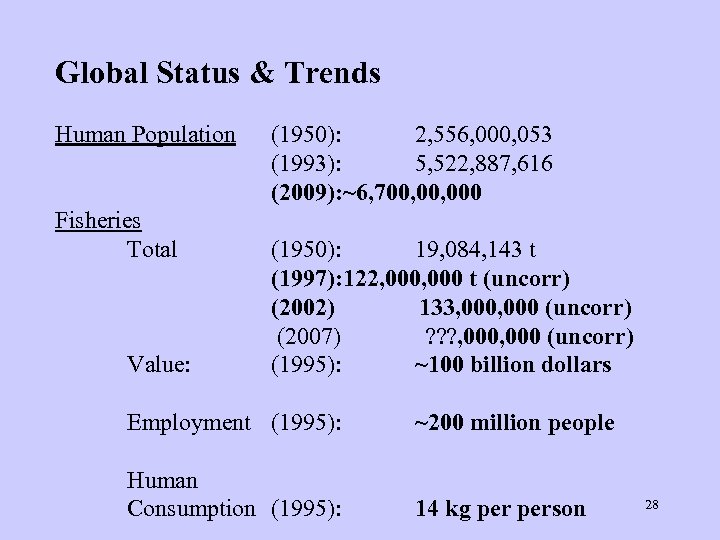 Global Status & Trends Human Population Fisheries Total Value: (1950): 2, 556, 000, 053 (1993): 5, 522, 887, 616 (2009): ~6, 700, 000 (1950): 19, 084, 143 t (1997): 122, 000 t (uncorr) (2002) 133, 000 (uncorr) (2007) ? ? ? , 000 (uncorr) (1995): ~100 billion dollars Employment (1995): ~200 million people Human Consumption (1995): 14 kg person 28
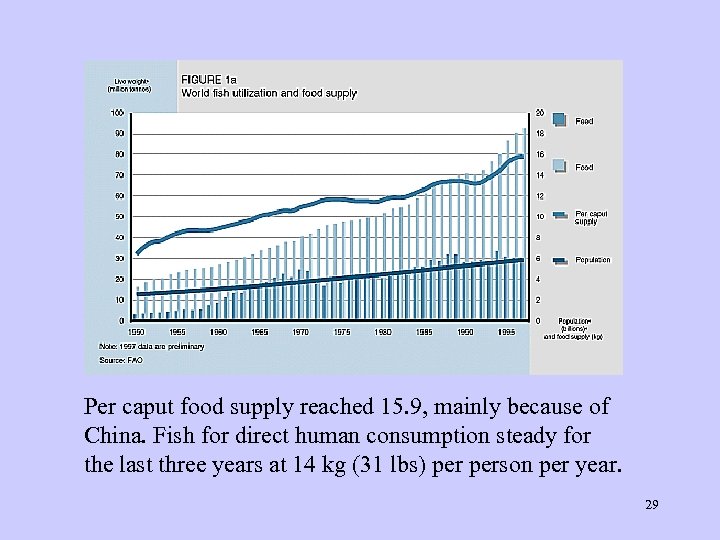 Per caput food supply reached 15. 9, mainly because of China. Fish for direct human consumption steady for the last three years at 14 kg (31 lbs) person per year. 29
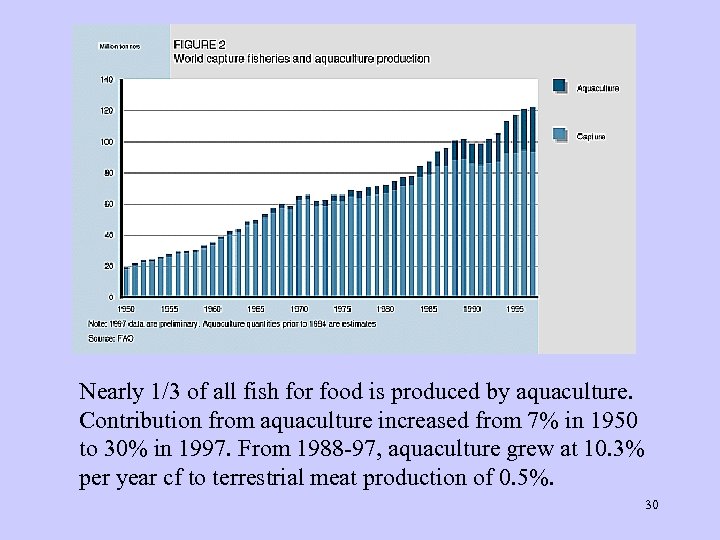 Nearly 1/3 of all fish for food is produced by aquaculture. Contribution from aquaculture increased from 7% in 1950 to 30% in 1997. From 1988 -97, aquaculture grew at 10. 3% per year cf to terrestrial meat production of 0. 5%. 30
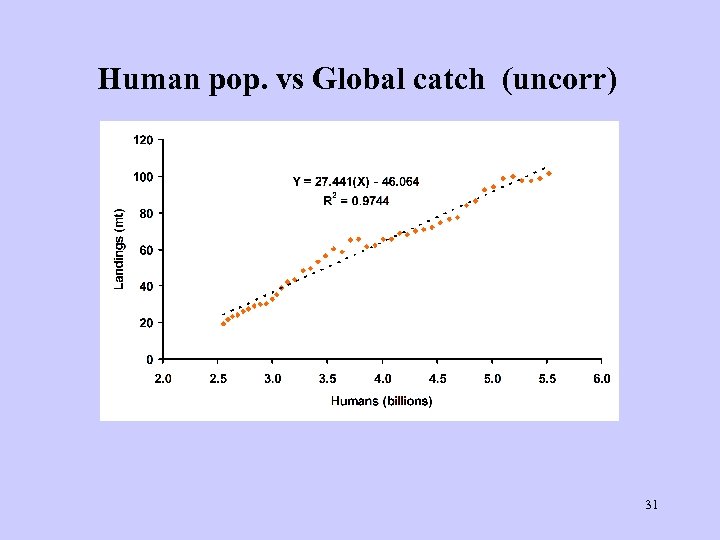 Human pop. vs Global catch (uncorr) 31
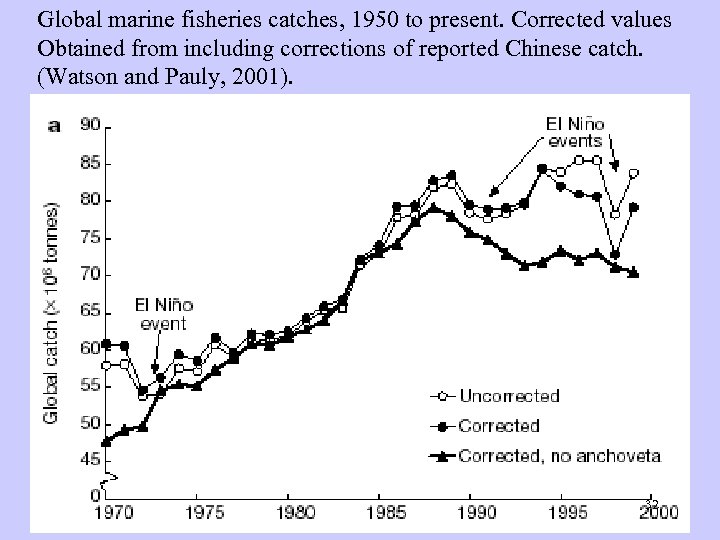 Global marine fisheries catches, 1950 to present. Corrected values Obtained from including corrections of reported Chinese catch. (Watson and Pauly, 2001). 32
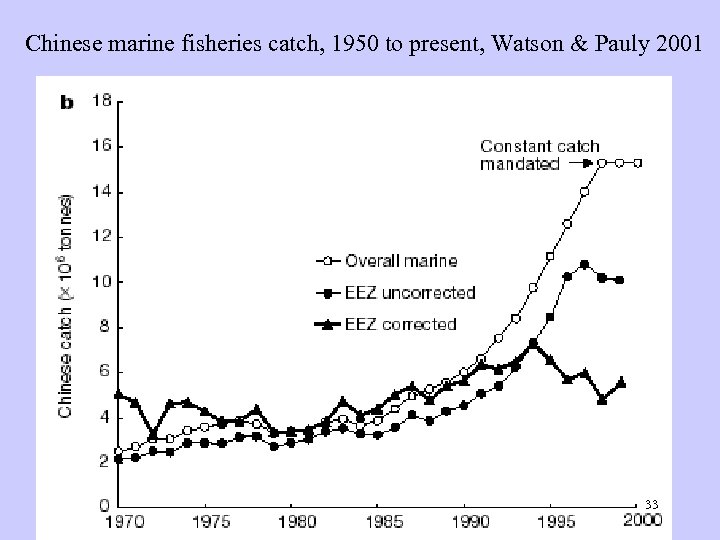 Chinese marine fisheries catch, 1950 to present, Watson & Pauly 2001 33
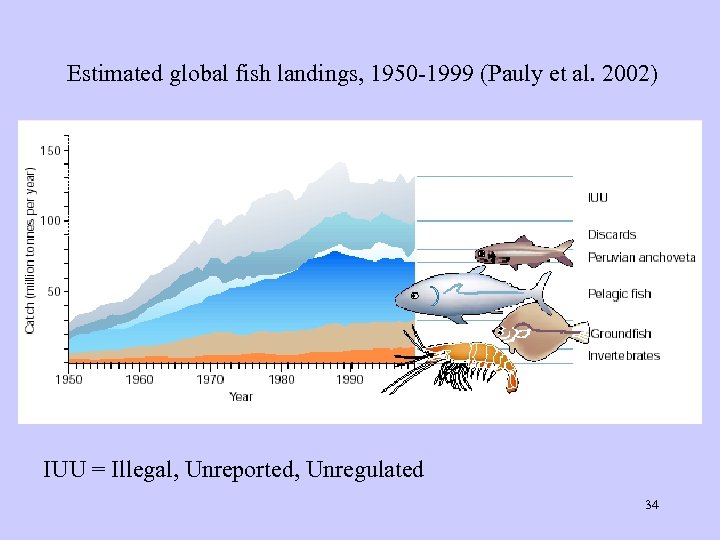 Estimated global fish landings, 1950 -1999 (Pauly et al. 2002) IUU = Illegal, Unreported, Unregulated 34
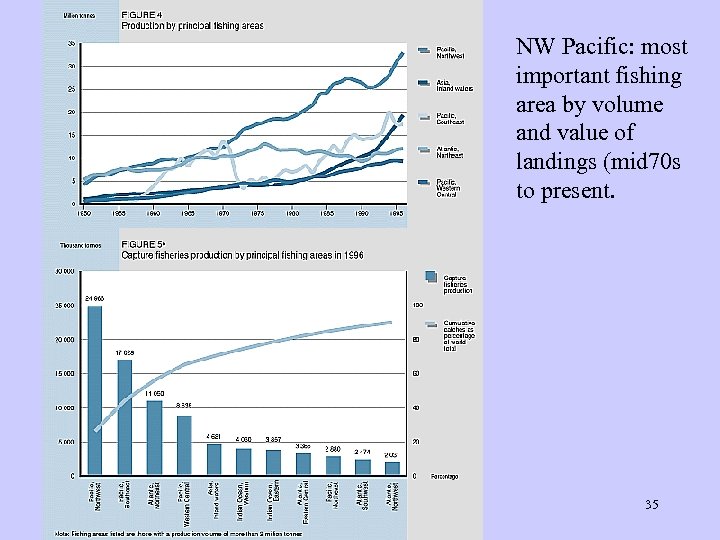 NW Pacific: most important fishing area by volume and value of landings (mid 70 s to present. 35
 State of marine fish resources • NW Atlantic, SE Atlantic, E Central Atlantic: MSY 1 -2 decades ago and on the decline • NE Atlantic, SW Atlantic, W Central Atlantic, E Central Pacific – MSY few years ago; slight decline or stable • E & W Indian Ocean, W Central Pacific and NW Pacific –increasing trend but information base is poor 36
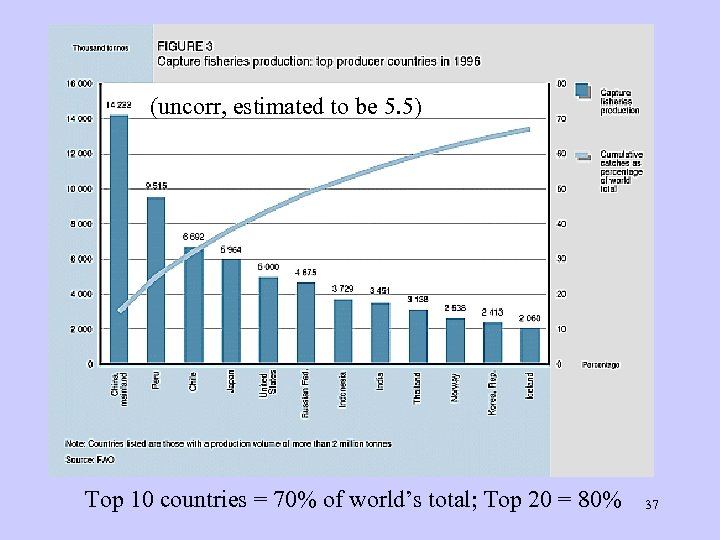 (uncorr, estimated to be 5. 5) Top 10 countries = 70% of world’s total; Top 20 = 80% 37
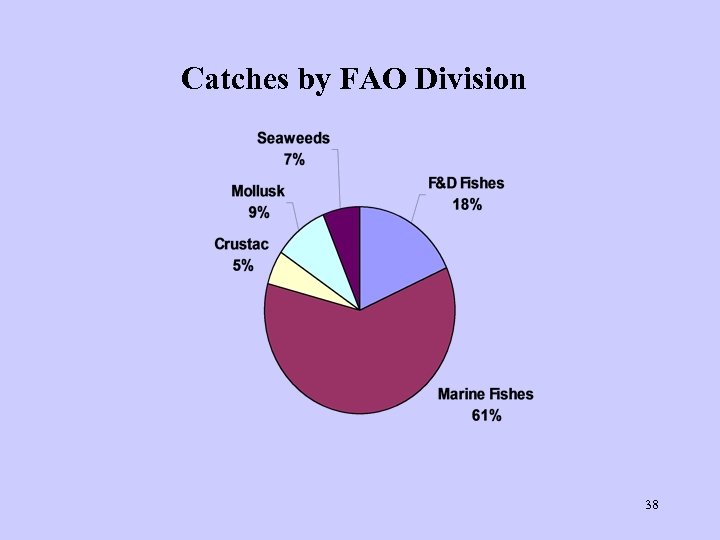 Catches by FAO Division 38
 39
39
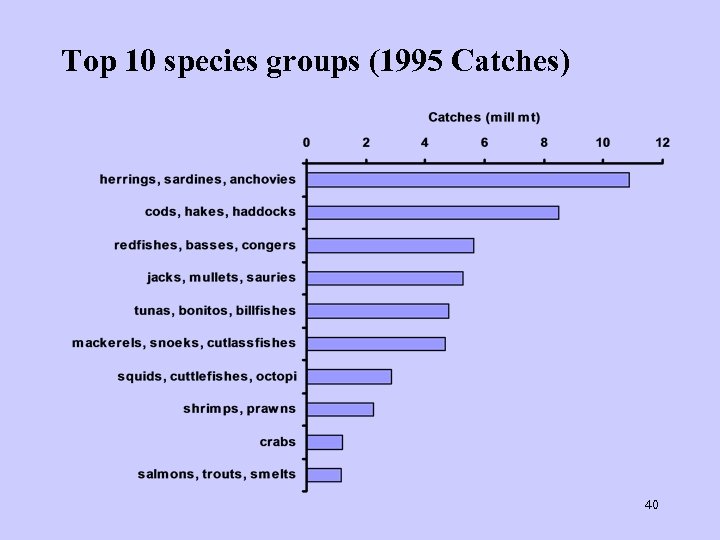 Top 10 species groups (1995 Catches) 40
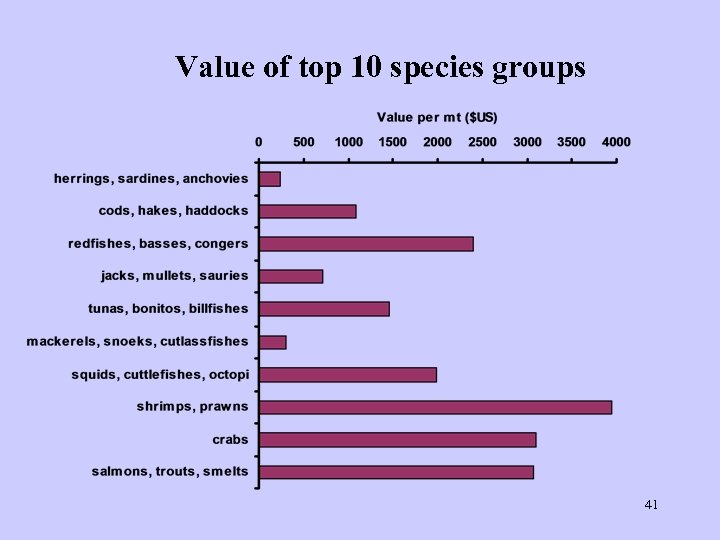 Value of top 10 species groups 41
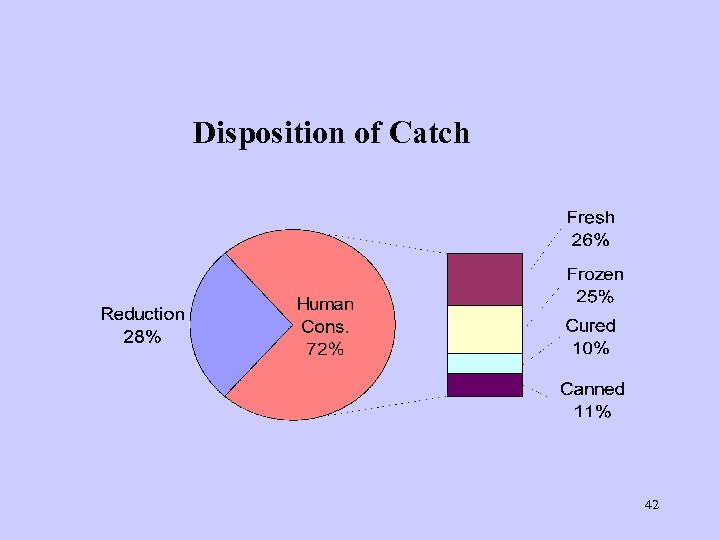 Disposition of Catch 42
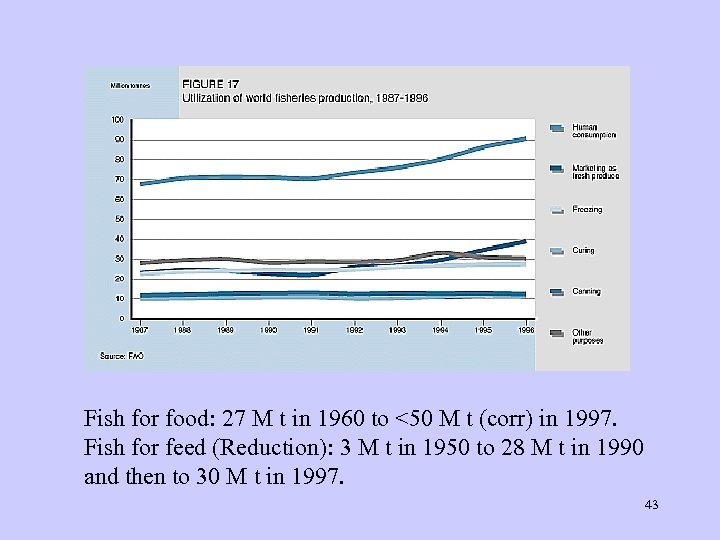 Fish for food: 27 M t in 1960 to <50 M t (corr) in 1997. Fish for feed (Reduction): 3 M t in 1950 to 28 M t in 1990 and then to 30 M t in 1997. 43
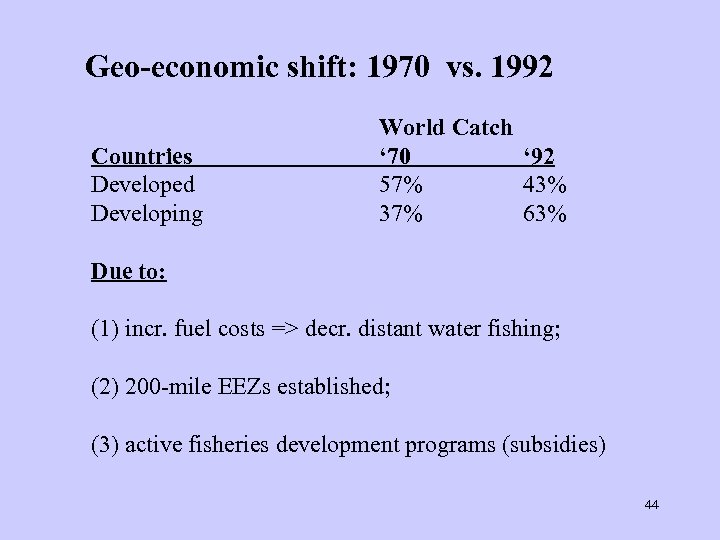 Geo-economic shift: 1970 vs. 1992 Countries Developed Developing World Catch ‘ 70 ‘ 92 57% 43% 37% 63% Due to: (1) incr. fuel costs => decr. distant water fishing; (2) 200 -mile EEZs established; (3) active fisheries development programs (subsidies) 44
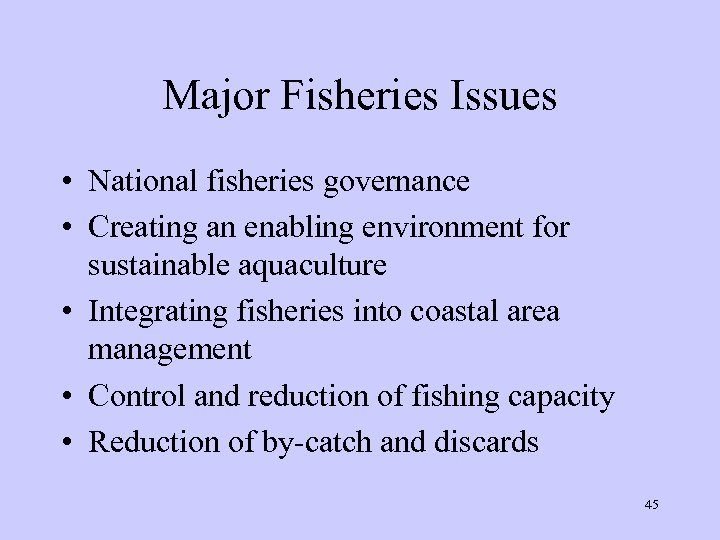 Major Fisheries Issues • National fisheries governance • Creating an enabling environment for sustainable aquaculture • Integrating fisheries into coastal area management • Control and reduction of fishing capacity • Reduction of by-catch and discards 45