


 Скачать презентацию History of EMS Data We can date
d30171d6d624e74eba8b71bbce6a2442.ppt
- Количество слайдов: 70
 History of EMS Data • We can date it back to the “modern age of EMS” – 1966: Accidental Death and Disability “A review of ambulance services in the United States indicates a paucity of information and a limited framework for the collection of data on and the evaluation of current ambulance services. ” (Page 13)
 More Recent History? – 2003: The EMS Outcomes Evaluation Project: “No local, state, or federal databases were suitable for use due to inconsistent data definitions, inconsistent data formatting, and variation in inclusion criteria. ” (Page 8) http: //www. nhtsa. dot. gov/people/injury/emsoutcomes 03/
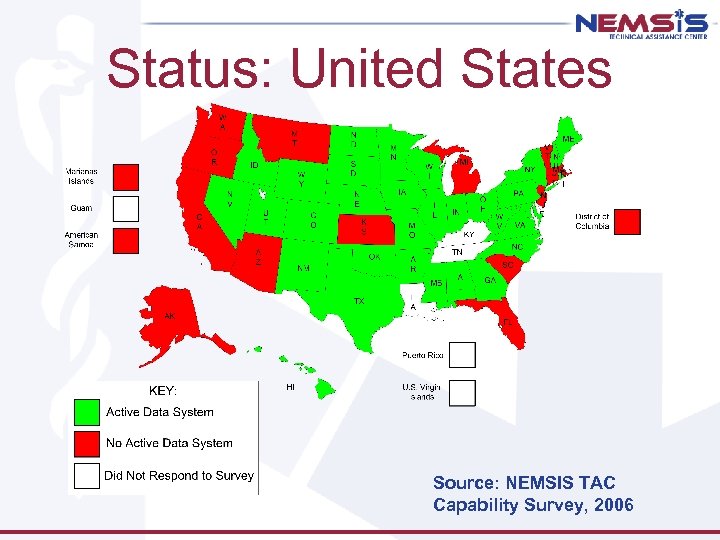 Status: United States Source: NEMSIS TAC Capability Survey, 2006
 So What Happened In Between? • Largest event happened in 1992 -1993 – The NHTSA EMS Data Elements Version 1 • Great try, the spirit was there • Too loose of a standard • EMS relatively uneducated to the potential of computer technology
 Enter the NEMSIS Project • Late 90’s, the National Association of State EMS Directors decided there was a NEED for uniform data collection
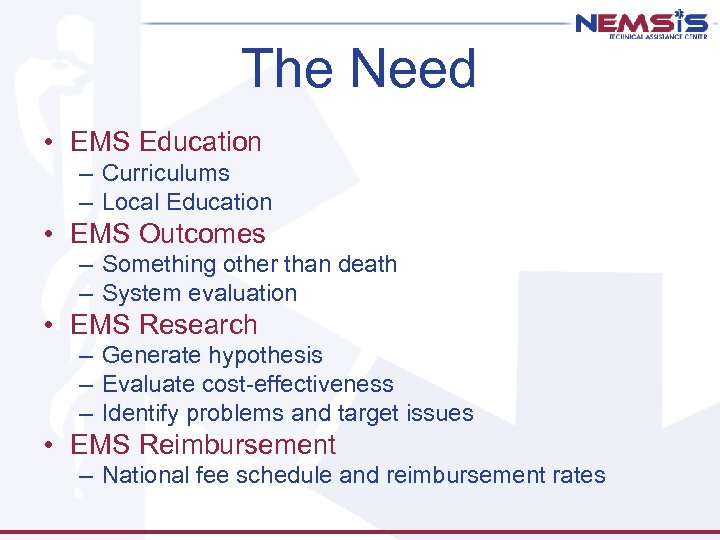 The Need • EMS Education – Curriculums – Local Education • EMS Outcomes – Something other than death – System evaluation • EMS Research – Generate hypothesis – Evaluate cost-effectiveness – Identify problems and target issues • EMS Reimbursement – National fee schedule and reimbursement rates
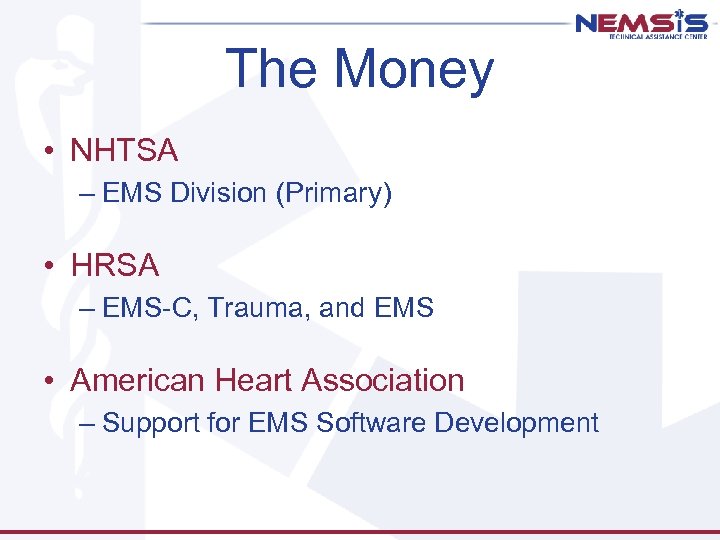 The Money • NHTSA – EMS Division (Primary) • HRSA – EMS-C, Trauma, and EMS • American Heart Association – Support for EMS Software Development
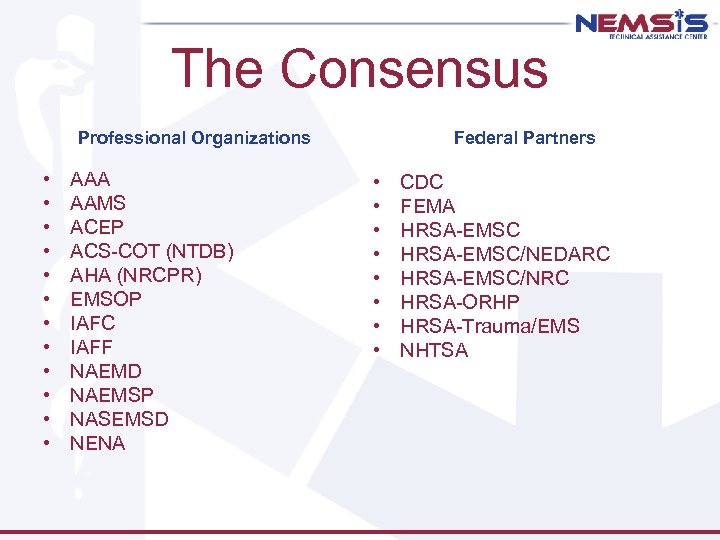 The Consensus Professional Organizations • • • AAA AAMS ACEP ACS-COT (NTDB) AHA (NRCPR) EMSOP IAFC IAFF NAEMD NAEMSP NASEMSD NENA Federal Partners • • CDC FEMA HRSA-EMSC/NEDARC HRSA-EMSC/NRC HRSA-ORHP HRSA-Trauma/EMS NHTSA
 This Desire… • Turned into the revision of the National EMS Dataset • More than just a dictionary – Why each element exists – What each element’s purpose and use – How to store and send the data – How they interact with each other
 Overview of the NEMSIS Standard
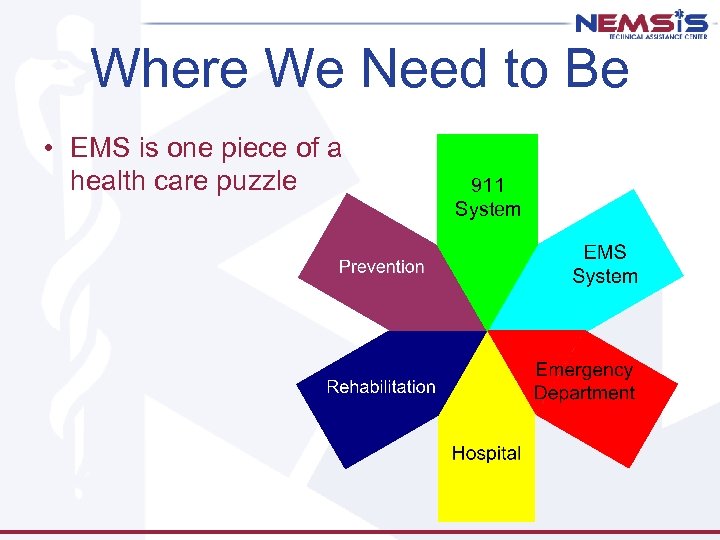 Where We Need to Be • EMS is one piece of a health care puzzle 911 System
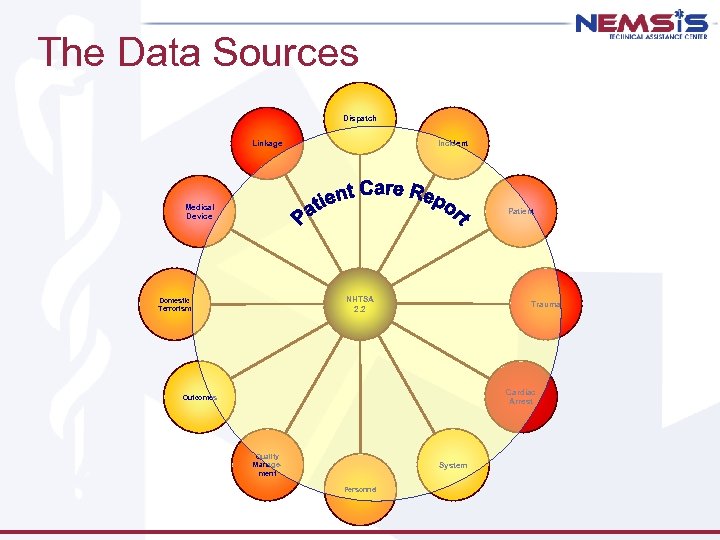 The Data Sources Dispatch Incident Linkage Medical Device Patient NHTSA 2. 2 Domestic Terrorism Trauma Cardiac Arrest Outcomes Quality Management System Personnel
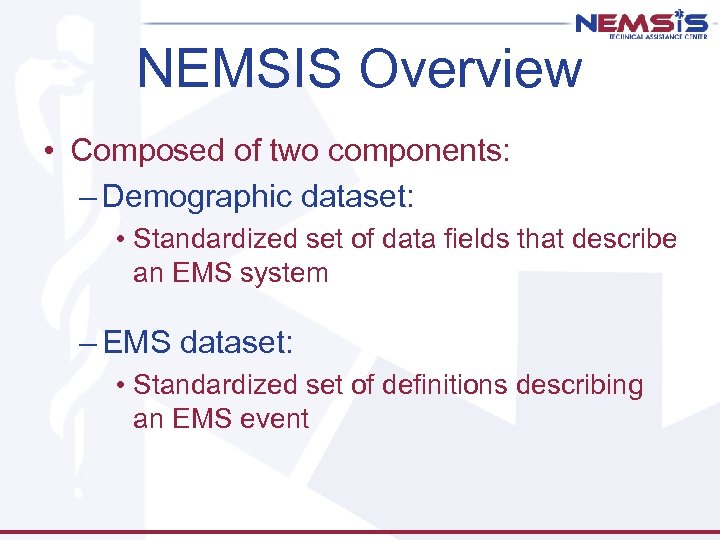 NEMSIS Overview • Composed of two components: – Demographic dataset: • Standardized set of data fields that describe an EMS system – EMS dataset: • Standardized set of definitions describing an EMS event
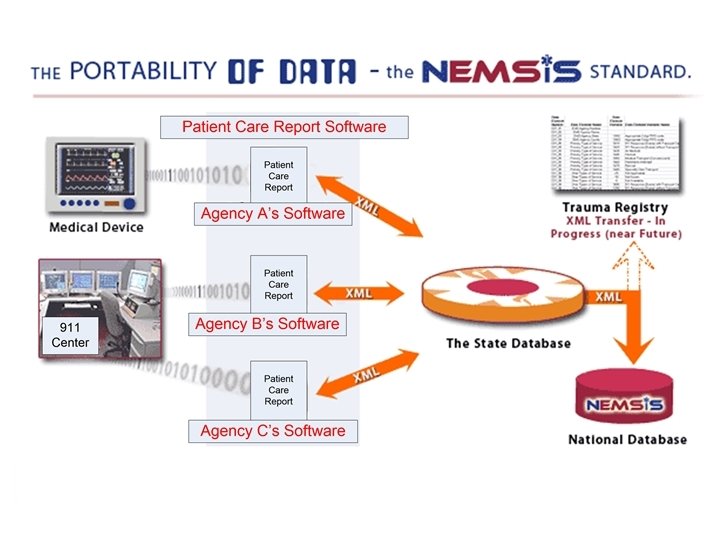
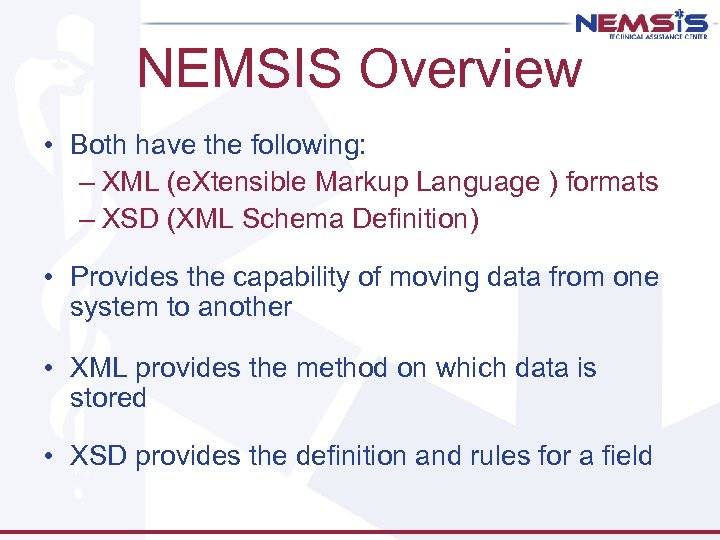 NEMSIS Overview • Both have the following: – XML (e. Xtensible Markup Language ) formats – XSD (XML Schema Definition) • Provides the capability of moving data from one system to another • XML provides the method on which data is stored • XSD provides the definition and rules for a field
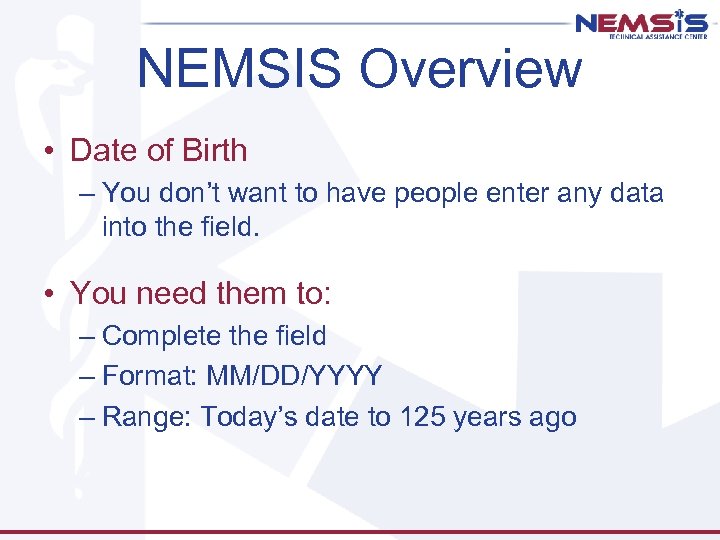 NEMSIS Overview • Date of Birth – You don’t want to have people enter any data into the field. • You need them to: – Complete the field – Format: MM/DD/YYYY – Range: Today’s date to 125 years ago
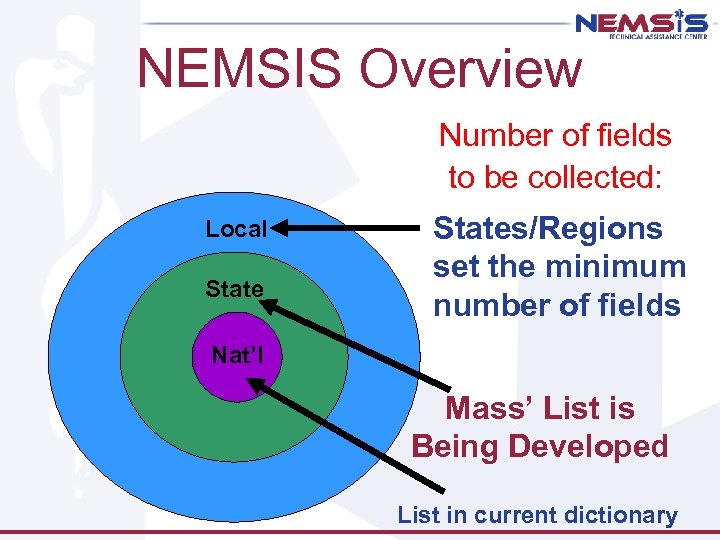 NEMSIS Overview Number of fields to be collected: Local States/Regions set the minimum number of fields Nat’l Mass’ List is Being Developed List in current dictionary
 Why? Portability! • Portability means: – Ease of movement of the data – Commonality of the elements to be moved – Software vendors developing applications that can be used across the country
 What Happened With The Original NEMSIS Project?
 Success! • The Standard was adopted • A pilot “national” EMS database was created • Software Vendors are moving to the new standard • National Effort
 The Standard • Over 400 different elements to choose from – No, you don’t have to enter all for each run – Choices, choices – A State’s data dictionary will be smaller • A standard that will be seen throughout the country – No other healthcare provider is even close
 Pilot National Database • One of the final deliverables for the NEMSIS Pilot Project • Four states with an existing data system were to provide 30 k reports to Dr. Mears – Delaware – Minnesota – Mississippi – North Carolina
 Pilot National Database • Three out of four states provided data • The data were combined into a common database and a query engine was built – First time that EMS data was combined from multiple states – If this could be done, then there should be limited issues with scaling to accept the entire nation
 Software Vendors • Estimated to be over 70 EMS software vendors in the nation • As of March 24, twenty vendors have entered the compliance certification process – Certifications will be awarded in early June – An number of vendors are going for the Gold standard
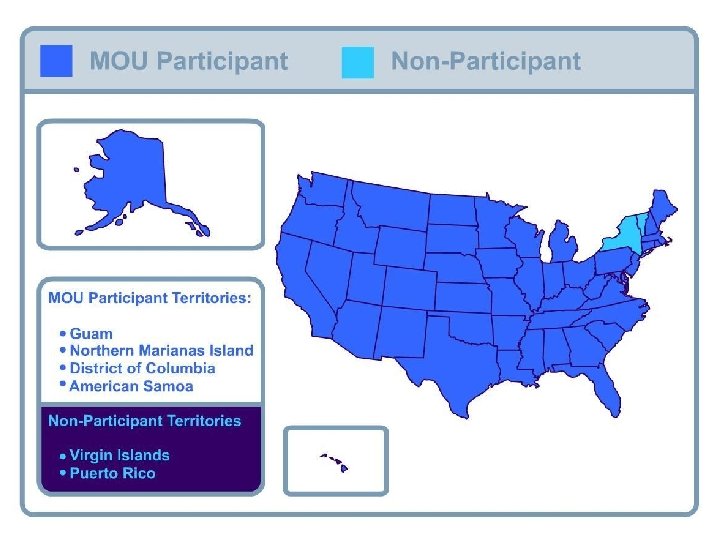
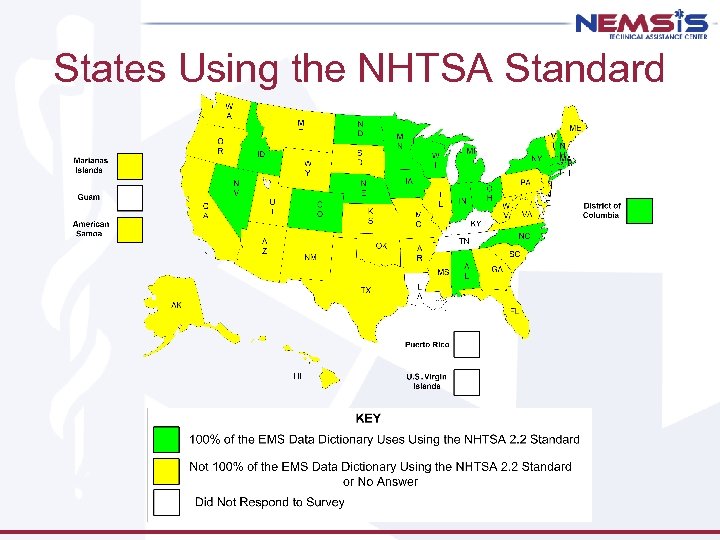 States Using the NHTSA Standard
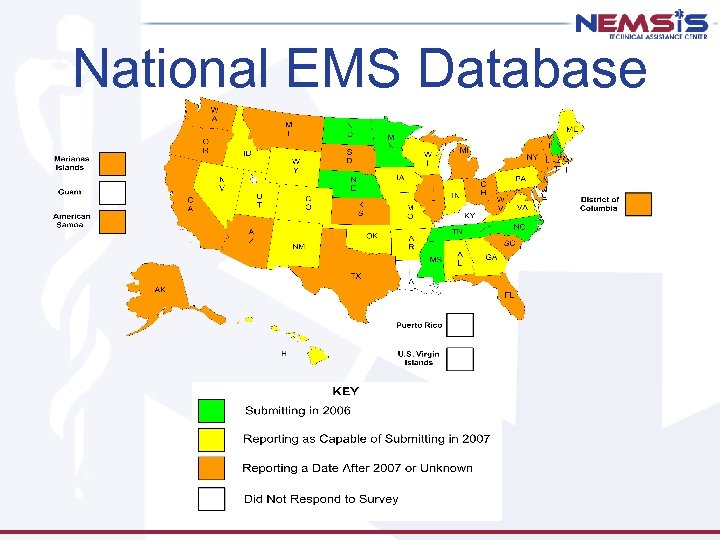 National EMS Database
 Part Two • The Next Steps: – Federal Support – NEMSIS TAC – Software Compliancy – NEMSIS Freeware, etc. – National EMS Database
 Federal Support • Already discussed about the Federal commitment to the new process • NHTSA, HRSA, CDC have all made a financial and political commitment to the cause • Here’s how…
 Federal Support • Provided money to establish a NEMSIS Technical Assistance Center – $600 k year one – Possibly $1 million for Year Two – Talk about providing more money • NHTSA has established a funding source for states who are making a NEMSIS system
 Other Funding Source • The Federal Register published that 34. 5 million will be offered each year over the next 4 years to States – Non-competitive – $300, 000 - $500, 000 per application • The “catch” is tying NEMSIS in with traffic crash data
 NEMSIS TAC • The TAC picked up the work at the end of the Pilot phase of NEMSIS (Sept 2005) – University of Utah received the grant – Utah contracted with University of North Carolina to continue their efforts • The Goal is to collect data from States and Territories to create the National EMS Database
 NEMSIS TAC • Simple goal, complicated objectives • This means that the TAC will be offering assistance to: – States – Local EMS agencies – Software developers
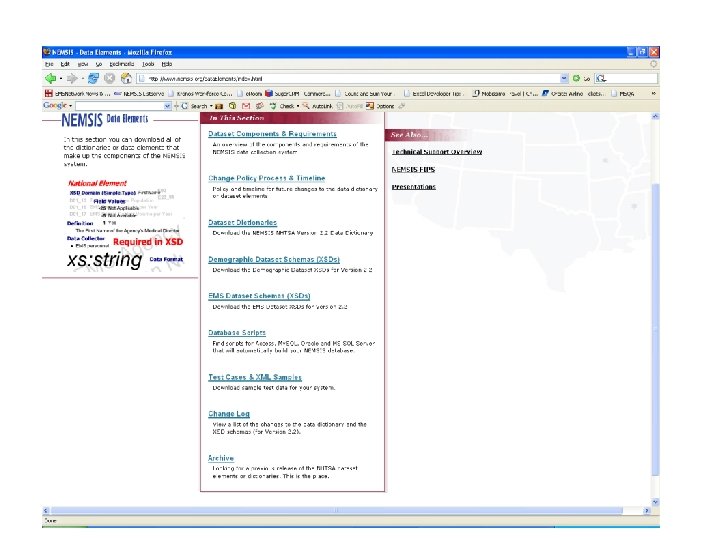
 NEMSIS TAC Resources • • www. nemsis. org Reference Documents Communication and Public Education Maintain Dataset and XSD Development Tools Direct Technical Assistance National Database Development Other
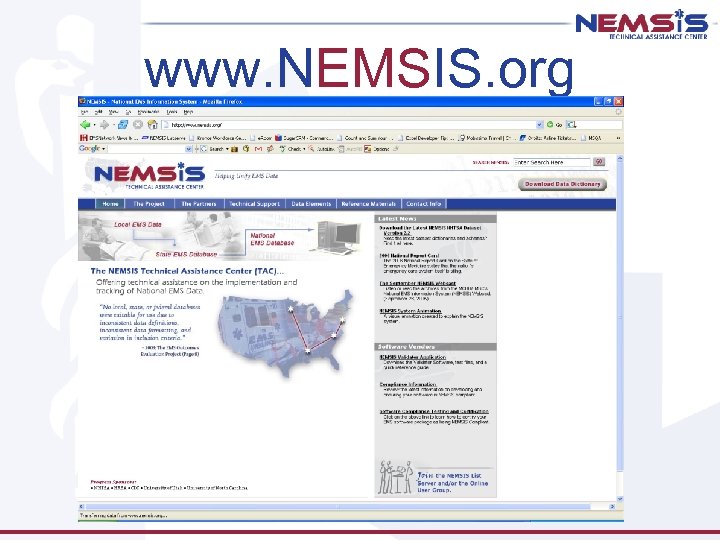 www. NEMSIS. org
 Software Compliancy • On March 1, 2006, the TAC began testing software developers for compliance • At the end of March there were over 15 applicants (multiple software packages too) • There are two levels of compliance: – Gold – Silver
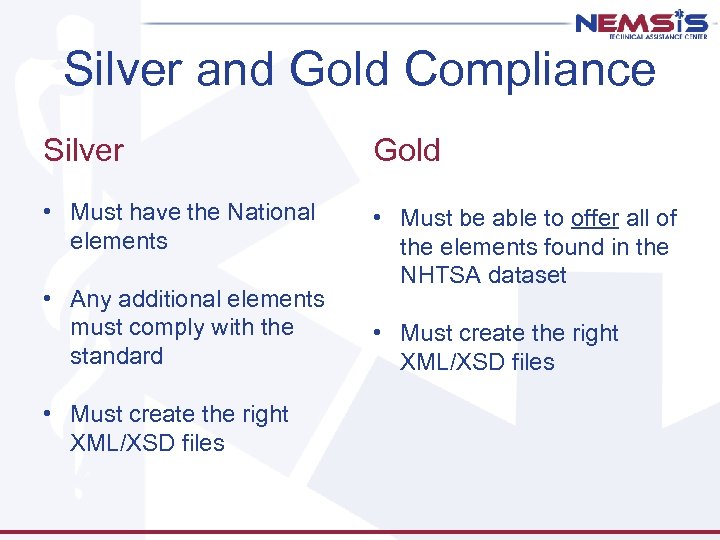 Silver and Gold Compliance Silver Gold • Must have the National elements • Must be able to offer all of the elements found in the NHTSA dataset • Any additional elements must comply with the standard • Must create the right XML/XSD files
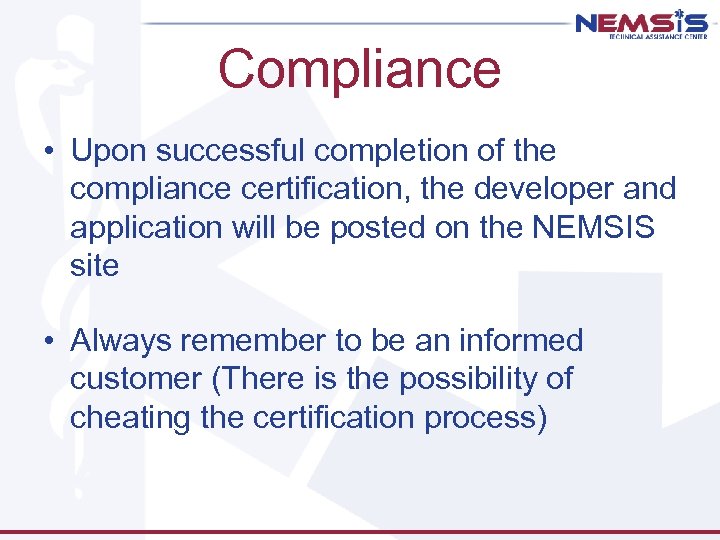 Compliance • Upon successful completion of the compliance certification, the developer and application will be posted on the NEMSIS site • Always remember to be an informed customer (There is the possibility of cheating the certification process)
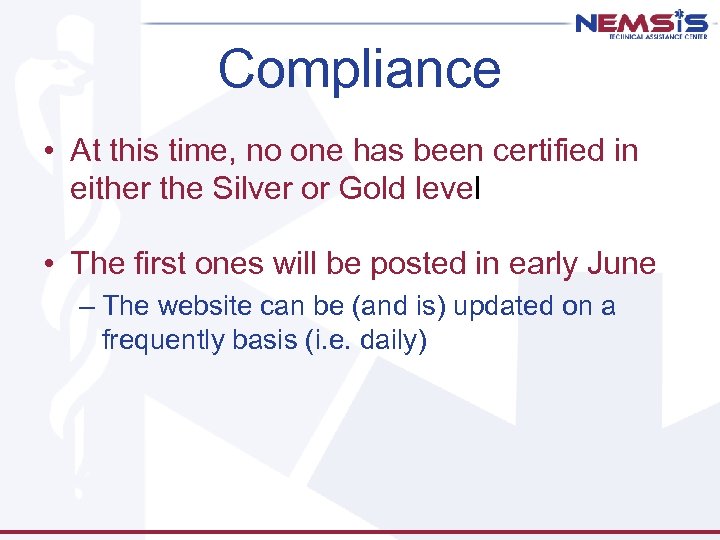 Compliance • At this time, no one has been certified in either the Silver or Gold level • The first ones will be posted in early June – The website can be (and is) updated on a frequently basis (i. e. daily)
 National EMS Database • 2006 - Five states will be submitting data – North Carolina – Minnesota – New Hampshire – Mississippi – Nebraska, North Dakota, or Tennessee • The TAC will collect the data for the NCSA
 National EMS Database • The TAC will also design the reporting system to extract data • This reporting section will analyze data from a national, state, and local level • The TAC is creating 10 report sections for the National EMS Database
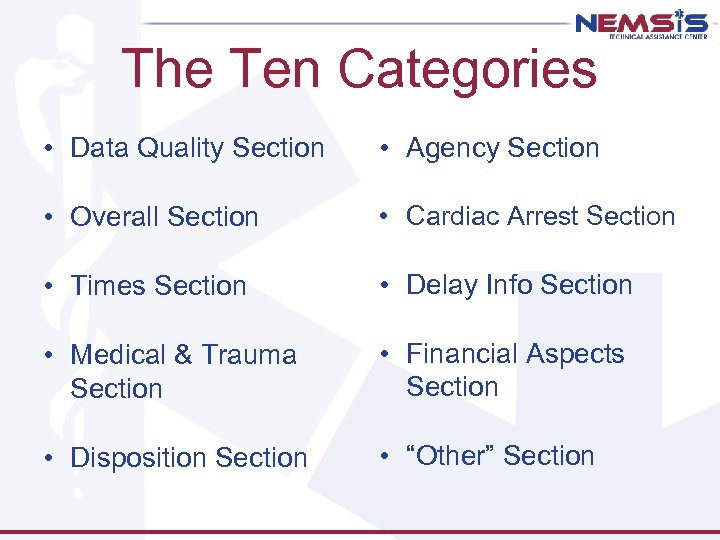 The Ten Categories • Data Quality Section • Agency Section • Overall Section • Cardiac Arrest Section • Times Section • Delay Info Section • Medical & Trauma Section • Financial Aspects Section • Disposition Section • “Other” Section
 The Reporting System • Plans call for: – Canned Reports – User-defined Reports – Logic built into the reporting section – A quality score for each report – Multiple output formats • Screen, PDF, etc.
 Let’s Go Over the Fields
 What is in it for You? • Performance Improvement Initiatives • National Trauma Registry, etc. • Data Element Recommendations • Massachusetts' needs
 Performance Improvement • More Money Parts 1 & 2 • Changing the Business Logic – Protocol Development (Evidence-based) – Time Related Analysis & Interventions – Capability & Consistency – Dynamic Unit Deployment
 More Money, Part 1 • Situation: – Volunteer EMS need money to survive – Saw data system as an unfunded mandate • Truth: – Cost of computer, printer, internet: $1, 400 – Yearly cost: About $250 – Time to complete reports: Unknown cost
 More Money • Results: – EMS entered agreement with billing company – Virtually eliminated the “EMS secretary” position – It did take longer to write a patient care report – Revenue increased for the agencies – Turnaround time for $$ was faster
 Advantages of Electronic • Completeness check (edit check) – Can’t bill unless to have the information • Not applicable data is hidden • Electronic means closer to invoicing – Invoices should be mailed within 72 hours from the time of service* *Prehospital Care Administration, pg 386
 More Money Pt. 2 • University of North Carolina is combining their system with money from a Duke Endowment • The Performance Improvement Center will analyze EMS data to determine: – What resources are needed – How much $$ an agency could use
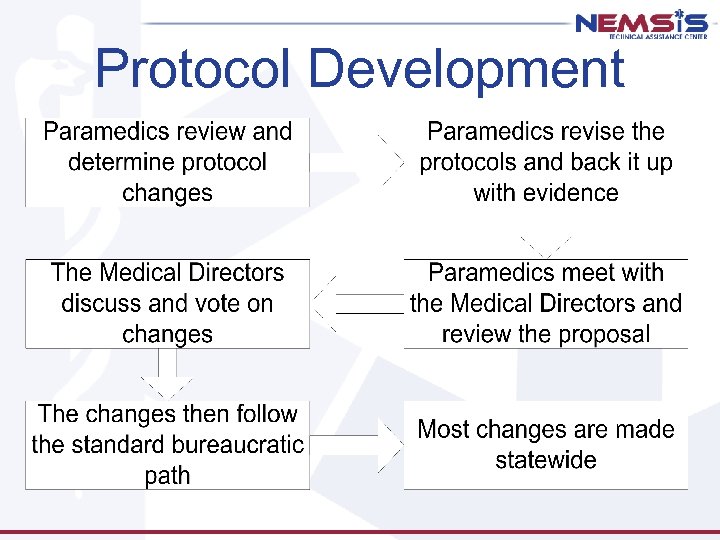 Protocol Development
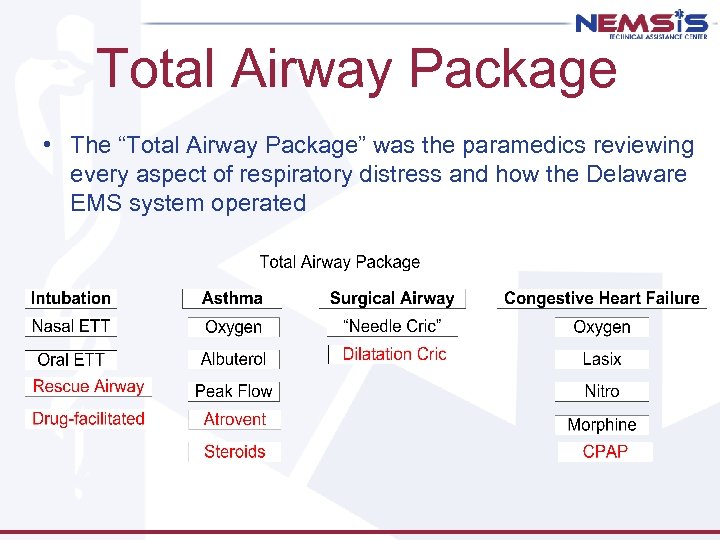 Total Airway Package • The “Total Airway Package” was the paramedics reviewing every aspect of respiratory distress and how the Delaware EMS system operated
 Total Airway Package • CPAP: Changed the respiratory emergency world in Delaware – How would you like to turn a CHF patient around in 5 minutes? – Decreased Nasal ETT attempts = More patients successfully intubated
 NEMSIS = Improved Services • Mainly because: – We will have more data – We will have consistent data – We will be able to put computers to work – The local efforts will turn into national ones
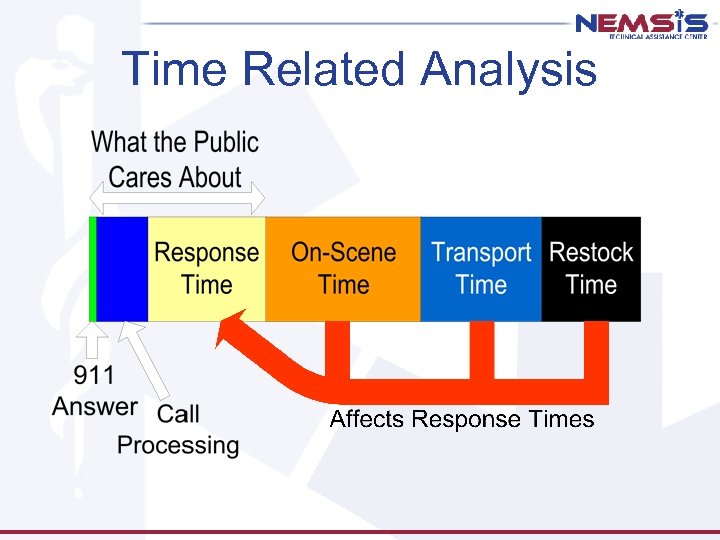 Time Related Analysis
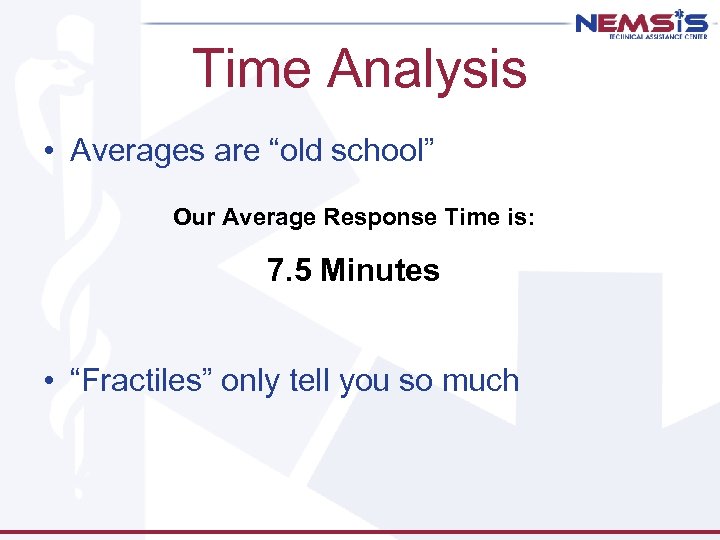 Time Analysis • Averages are “old school” Our Average Response Time is: 7. 5 Minutes • “Fractiles” only tell you so much
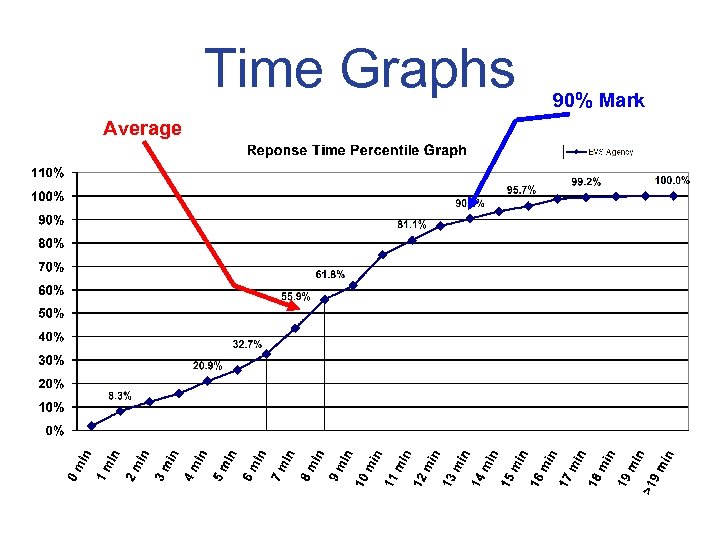 Time Graphs Average 90% Mark
 Interventions • The same can be said about EMS interventions – We have inconsistent definitions – We have inconsistent protocols – We have inconsistent equipment – We have inconsistent way to measure
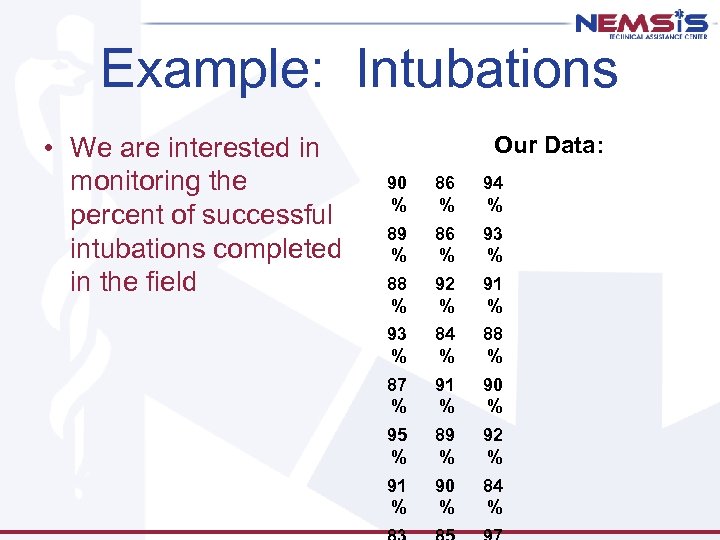 Example: Intubations • We are interested in monitoring the percent of successful intubations completed in the field Our Data: 90 % 86 % 94 % 89 % 86 % 93 % 88 % 92 % 91 % 93 % 84 % 88 % 87 % 91 % 90 % 95 % 89 % 92 % 91 % 90 % 84 %
 Capable and Consistent • The argument has been: – “Who should say what is good for one location is good for another? ” • The logic has been that each EMS agency is different – Service area – Types of organization and providers – Patients, hospitals, equipment, etc.
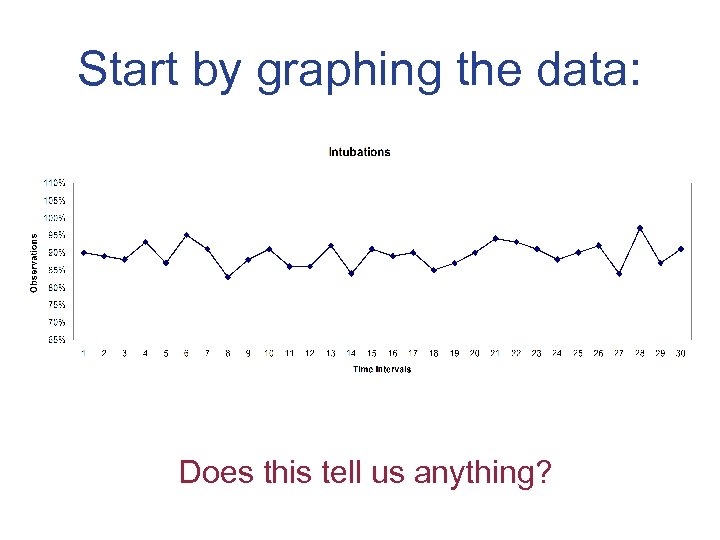 Start by graphing the data: Does this tell us anything?
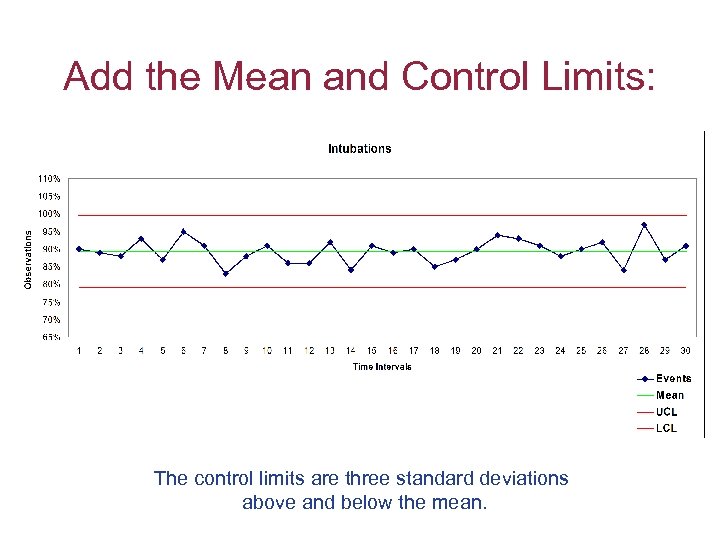 Add the Mean and Control Limits: The control limits are three standard deviations above and below the mean.
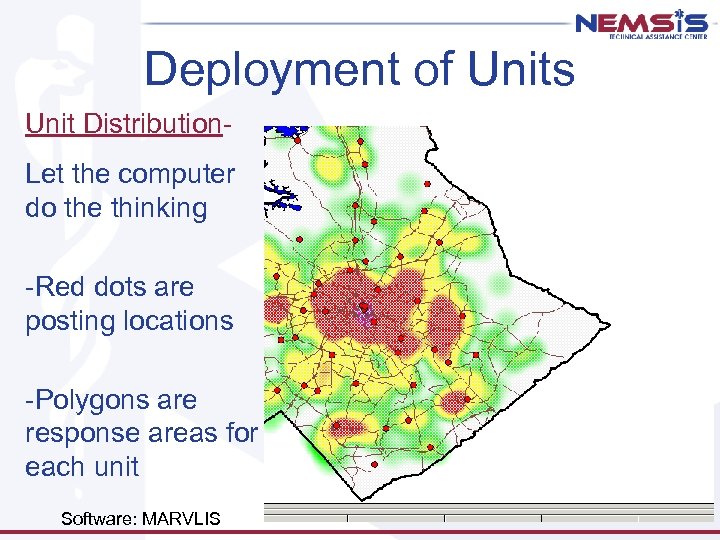 Deployment of Units Unit Distribution. Let the computer do the thinking -Red dots are posting locations -Polygons are response areas for each unit Software: MARVLIS
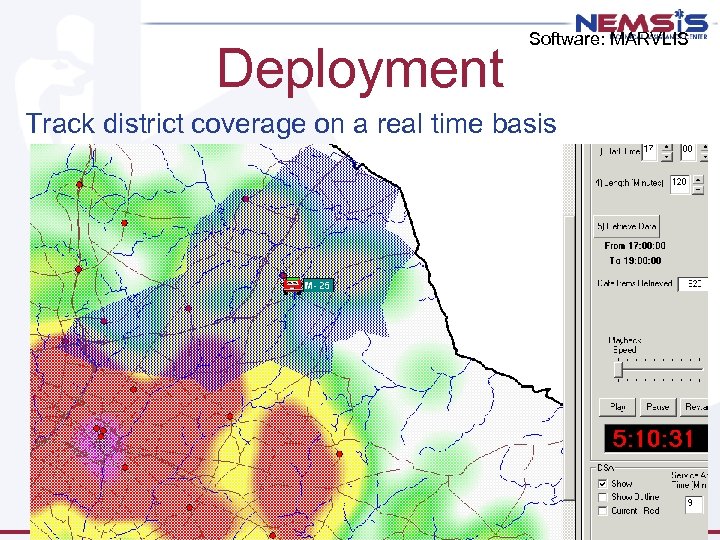 Deployment Software: MARVLIS Track district coverage on a real time basis
 National Trauma Registry • Currently being re-written and in the final stages • Great news: About 40% of the TR dataset’s elements come from the NEMSIS dataset – Electronic highway (two-way) for data to be submitted to hospitals and back
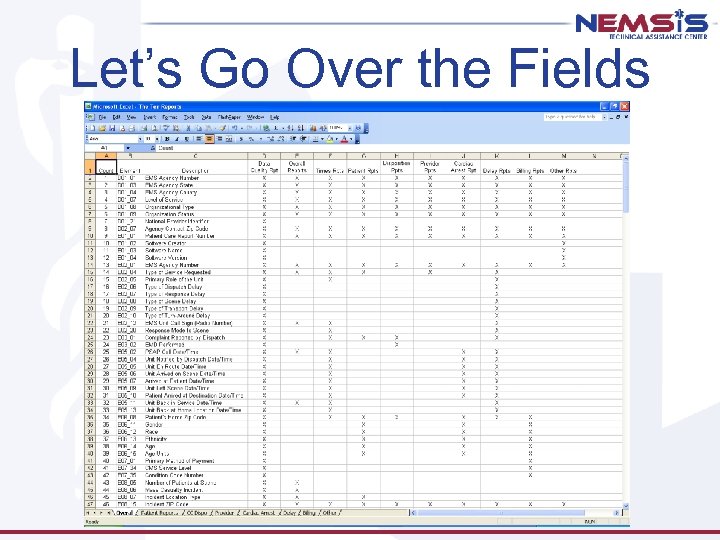
 Data Element Recommendation • This is not an “official” list • Some of the potential elements you can use from the NEMSIS dataset • Let’s go over it
 What are Massachusetts’ Needs?
 Any Other Questions?
 T H A N K Y O U