


 Скачать презентацию HISTORY OF ASTRONOMY A Short History of
0668da400d7db7990d279b7759a909f3.ppt
- Количество слайдов: 18
 HISTORY OF ASTRONOMY
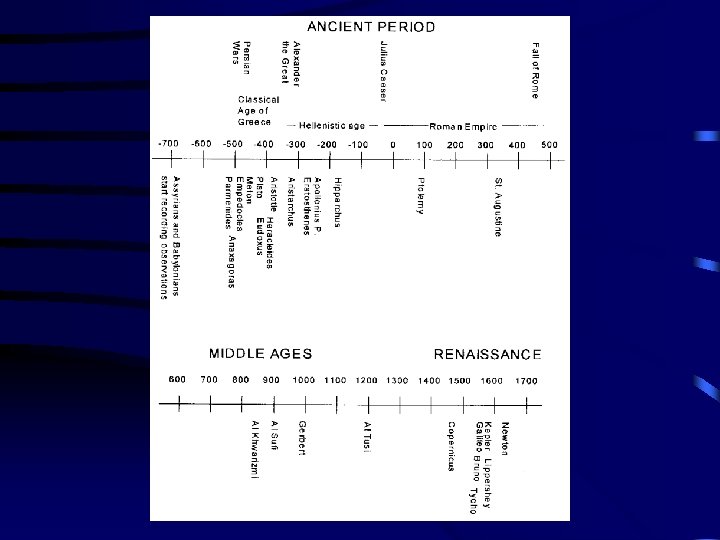
 A Short History of Astronomy • Ancient (before 500 BC) – Egyptians, Babylonians, Mayans, Incas, Chinese • Classical Antiquity (500 BC-500 AD) – Greeks, Romans: Plato, Aristotle, Ptolemy • Middle Ages (500 -1450 AD) – Arabic astronomers • Renaissance (1450 -1550 AD) – Copernicus • Baroque (1550 -1700 AD) – Brahe, Kepler, Galilei, Newton
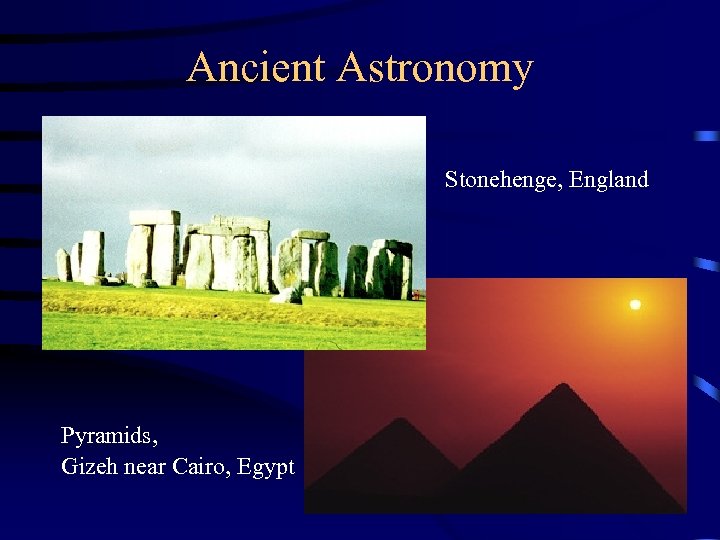 Ancient Astronomy Stonehenge, England Pyramids, Gizeh near Cairo, Egypt
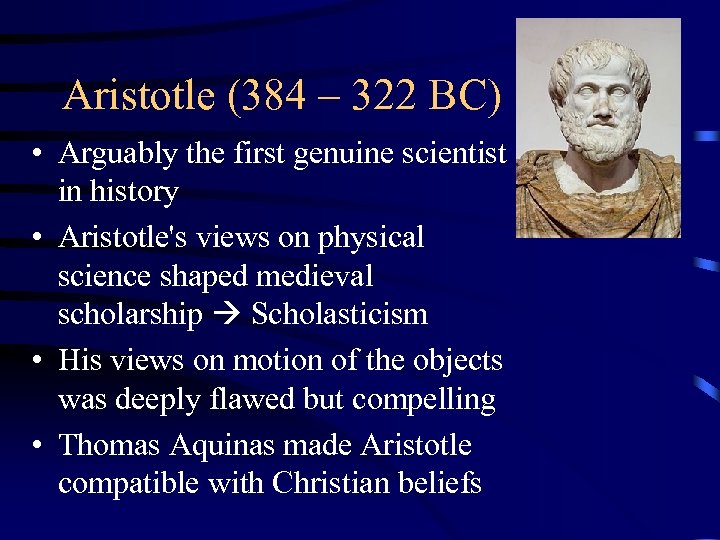 Aristotle (384 – 322 BC) • Arguably the first genuine scientist in history • Aristotle's views on physical science shaped medieval scholarship Scholasticism • His views on motion of the objects was deeply flawed but compelling • Thomas Aquinas made Aristotle compatible with Christian beliefs
 Physics and Metaphysics • Aristotle’s “Physics” (Greek: Φυσικὴ ἀκρόασις or physikes akroasis; Latin: Physica) is one of the foundational books of science and philosophy • His book on philosophy is called Metaphysics (Greek: τὰ μετὰ τὰ φυσικά) – beyond physics
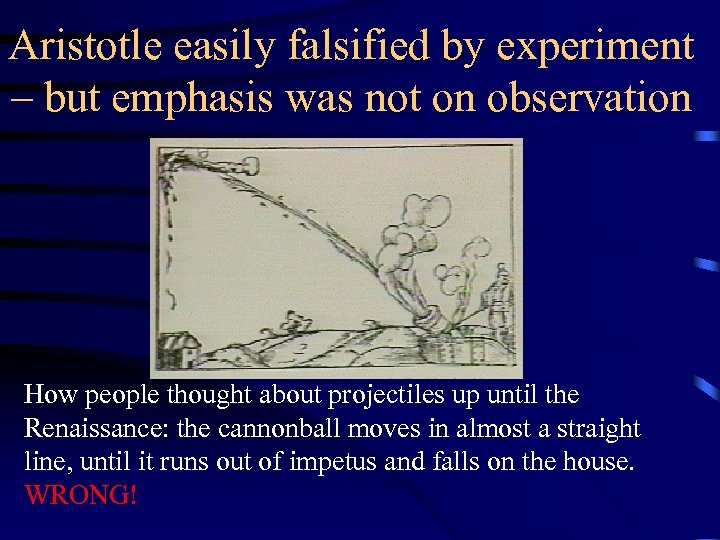 Aristotle easily falsified by experiment – but emphasis was not on observation How people thought about projectiles up until the Renaissance: the cannonball moves in almost a straight line, until it runs out of impetus and falls on the house. WRONG!
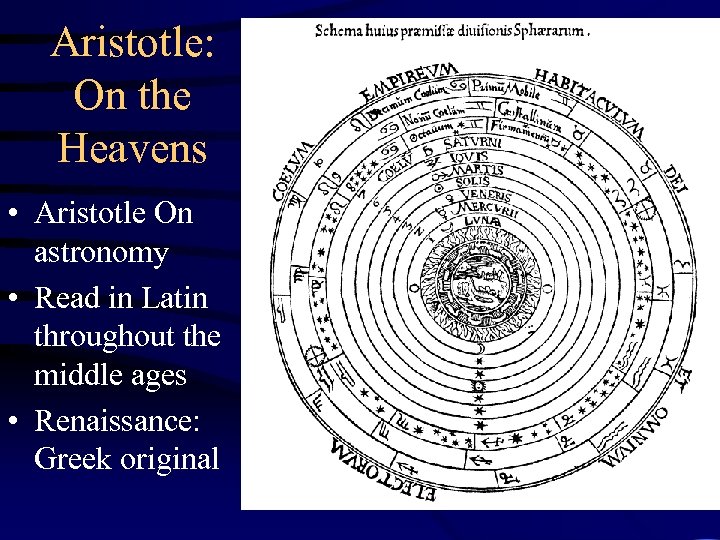 Aristotle: On the Heavens • Aristotle On astronomy • Read in Latin throughout the middle ages • Renaissance: Greek original
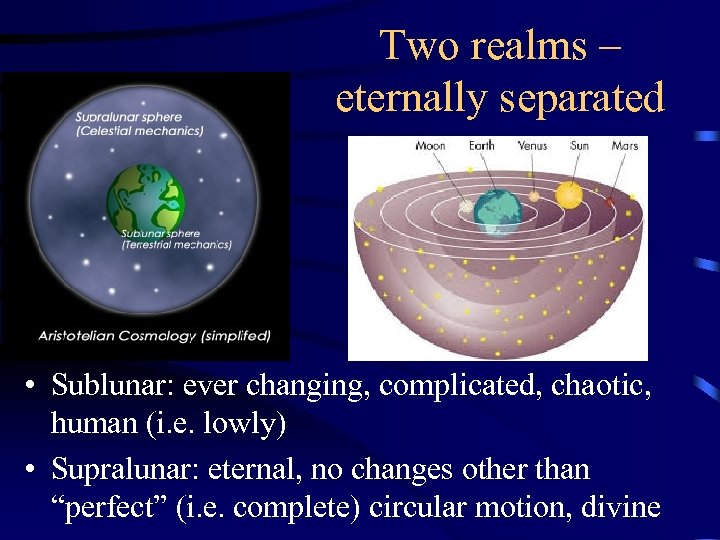 Two realms – eternally separated • Sublunar: ever changing, complicated, chaotic, human (i. e. lowly) • Supralunar: eternal, no changes other than “perfect” (i. e. complete) circular motion, divine
 The Grand Mystification of the Cosmos • Aristotle’s thoughts ossified and prevented progress • Disempowerment of the inquisitive mind – Trapped in a realm of chaos, what can we do? – There is no connection of what goes on on Earth and in the heavens, so how can we find out? – We are lowly, how can we ask divine questions or question the word of God?
 Progress in the Hellenistic Period • Not classical antiquity, i. e. Hellenic • Geographic shift from Athens, Greece to Alexandria, Egypt (at this point part of the Greek-speaking part of the Roman Empire) – Aristarchus (310 – 230 BC) – Archimedes (c. 287 BC – c. 212 BC) – Eratosthenes (276 – 194 BC) – Hipparchus (190 – 120 BC) – Ptolemy (90 – 168 AD)
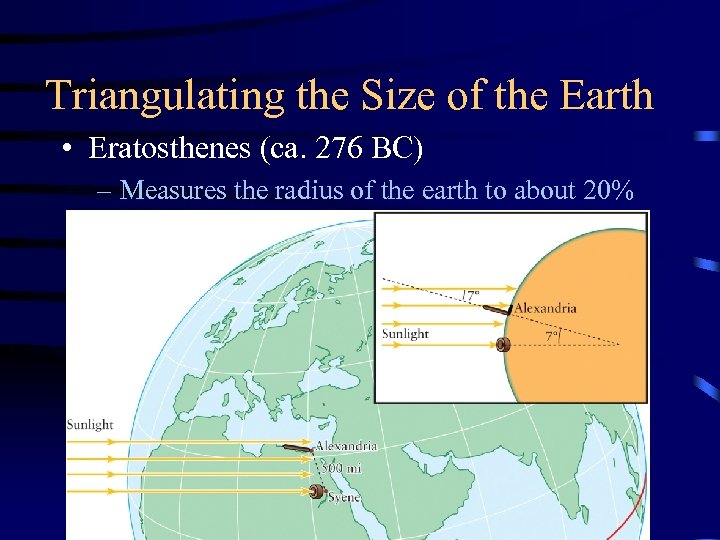 Triangulating the Size of the Earth • Eratosthenes (ca. 276 BC) – Measures the radius of the earth to about 20%
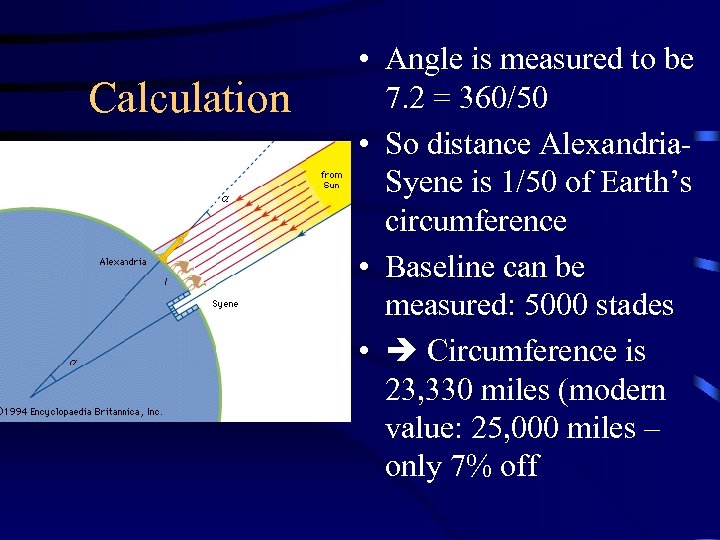 Calculation • Angle is measured to be 7. 2 = 360/50 • So distance Alexandria. Syene is 1/50 of Earth’s circumference • Baseline can be measured: 5000 stades • Circumference is 23, 330 miles (modern value: 25, 000 miles – only 7% off
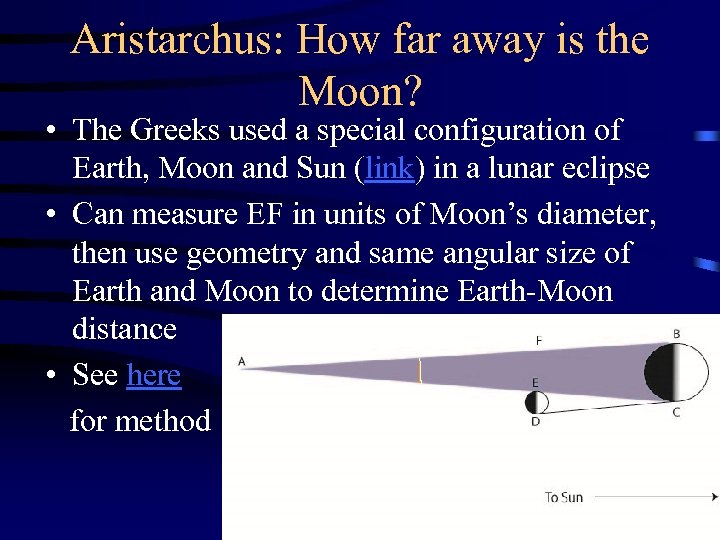 Aristarchus: How far away is the Moon? • The Greeks used a special configuration of Earth, Moon and Sun (link) in a lunar eclipse • Can measure EF in units of Moon’s diameter, then use geometry and same angular size of Earth and Moon to determine Earth-Moon distance • See here for method
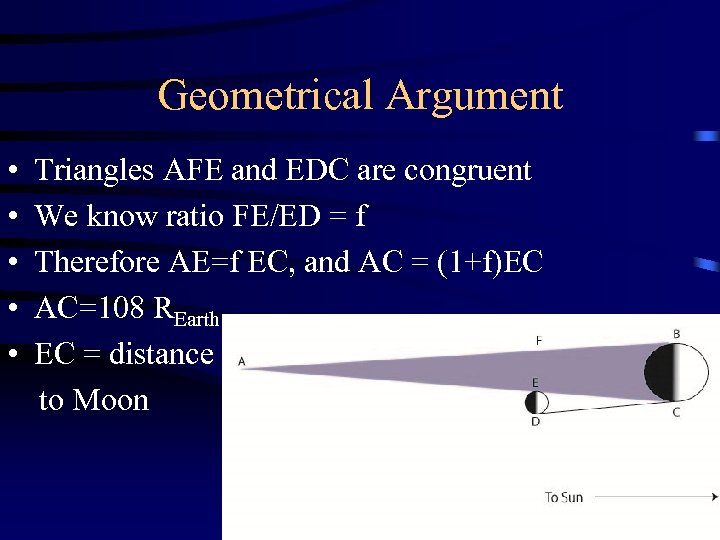 Geometrical Argument • Triangles AFE and EDC are congruent • We know ratio FE/ED = f • Therefore AE=f EC, and AC = (1+f)EC • AC=108 REarth • EC = distance to Moon
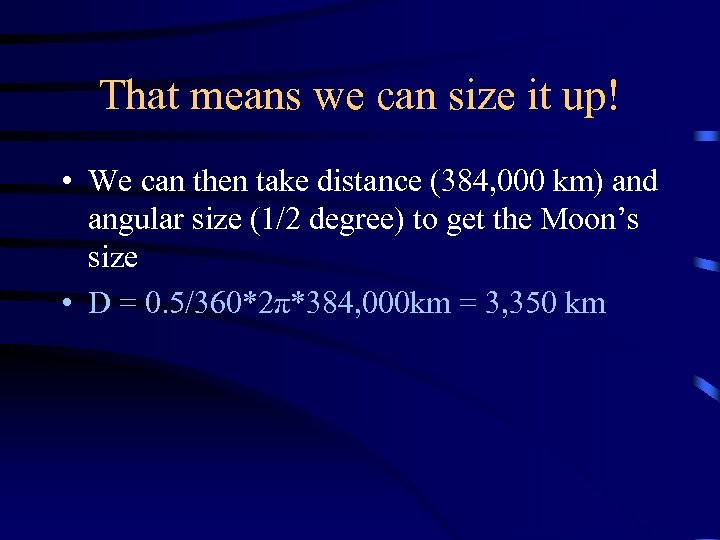 That means we can size it up! • We can then take distance (384, 000 km) and angular size (1/2 degree) to get the Moon’s size • D = 0. 5/360*2π*384, 000 km = 3, 350 km
 How far away is the Sun? • This is much harder to measure! • The Greeks came up with a lower limit, showing that the Sun is much further away than the Moon • Consequence: it is much bigger than the Moon • We know from eclipses: if the Sun is X times bigger, it must be X times farther away
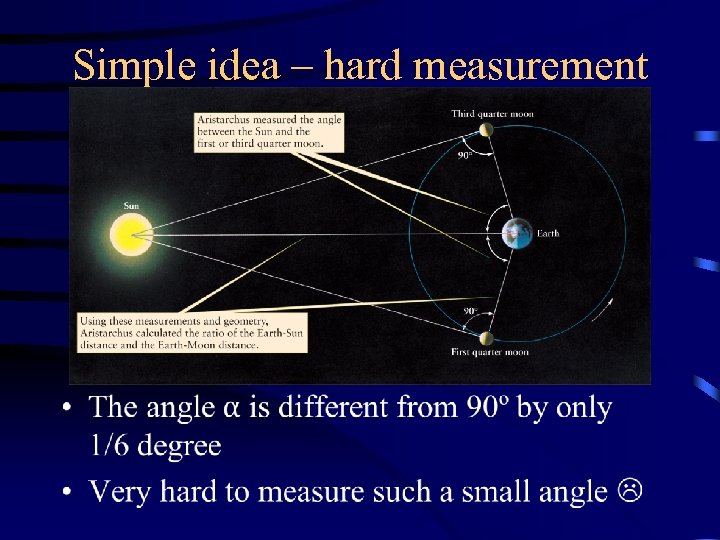 Simple idea – hard measurement •