


 Скачать презентацию History and futures of computer gaming CS 370
631543ed9e50c3bac2f6759aae462508.ppt
- Количество слайдов: 27
 History and futures of computer gaming CS 370 -- Computer Game Design Ken Forbus Spring, 2003
 Some advice for the party • • Do setup early Always have someone at your game Make sure that both Rob and I see it Have fun!
 Question: How will computer gaming evolve? • To see forward, start by looking backward • What constraints are shaping the system? • Overview – Brief history of computer gaming – Forces on the industry – Some questions designers are struggling with
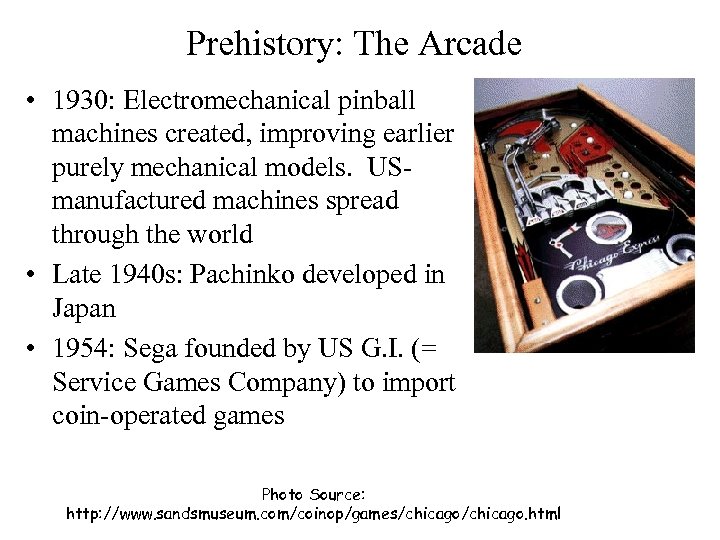 Prehistory: The Arcade • 1930: Electromechanical pinball machines created, improving earlier purely mechanical models. USmanufactured machines spread through the world • Late 1940 s: Pachinko developed in Japan • 1954: Sega founded by US G. I. (= Service Games Company) to import coin-operated games Photo Source: http: //www. sandsmuseum. com/coinop/games/chicago. html
 1960’s -- early 1970’s: The first computer games • Ran on mainframe computers • Generate music – amplifier hooked to register bit – AM radio near right part of the machine • Space. War developed on MIT PDP-1 – Main use of AI Lab’s PDP-6 on nights and weekends • ASCII-based Star Trek games – Can find their descendents today in BASIC bargain bins • 1975: William Crowther developed Adventure, first text-based adventure game (KA-10)
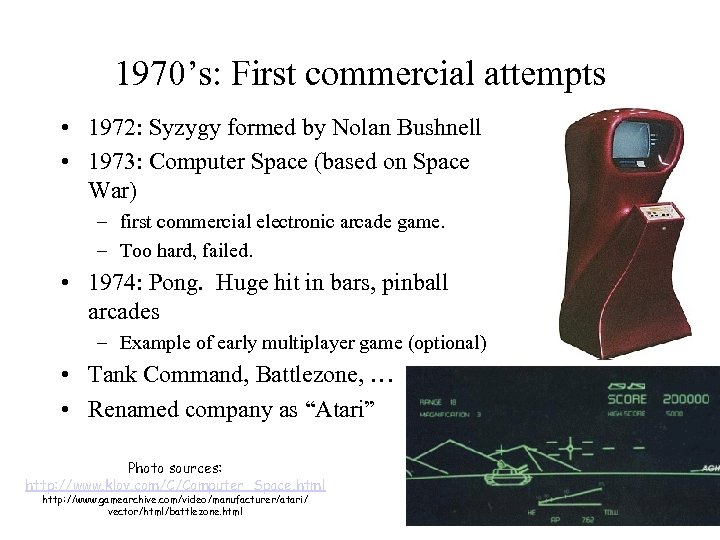 1970’s: First commercial attempts • 1972: Syzygy formed by Nolan Bushnell • 1973: Computer Space (based on Space War) – first commercial electronic arcade game. – Too hard, failed. • 1974: Pong. Huge hit in bars, pinball arcades – Example of early multiplayer game (optional) • Tank Command, Battlezone, … • Renamed company as “Atari” Photo sources: http: //www. klov. com/C/Computer_Space. html http: //www. gamearchive. com/video/manufacturer/atari/ vector/html/battlezone. html
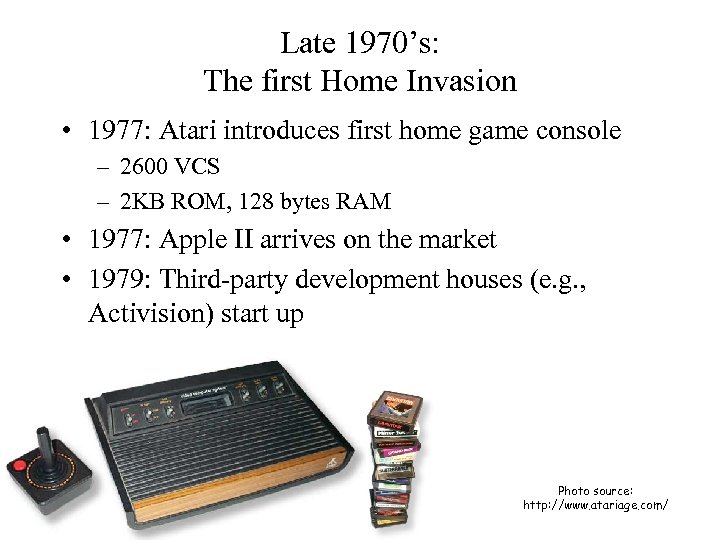 Late 1970’s: The first Home Invasion • 1977: Atari introduces first home game console – 2600 VCS – 2 KB ROM, 128 bytes RAM • 1977: Apple II arrives on the market • 1979: Third-party development houses (e. g. , Activision) start up Photo source: http: //www. atariage. com/
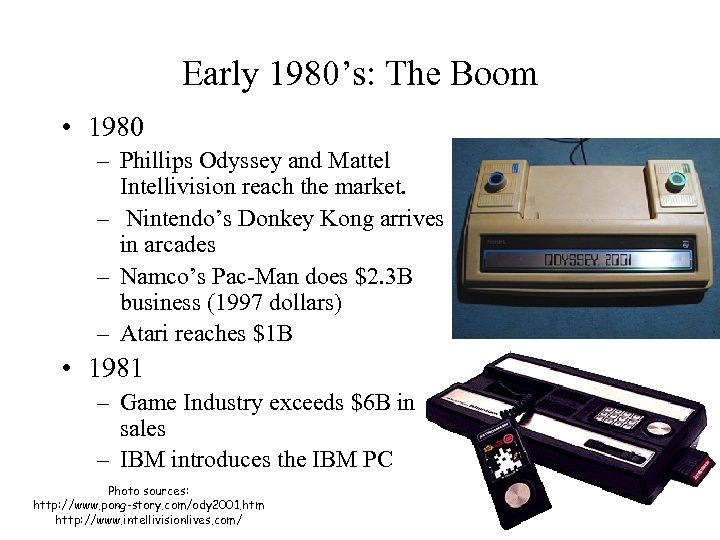 Early 1980’s: The Boom • 1980 – Phillips Odyssey and Mattel Intellivision reach the market. – Nintendo’s Donkey Kong arrives in arcades – Namco’s Pac-Man does $2. 3 B business (1997 dollars) – Atari reaches $1 B • 1981 – Game Industry exceeds $6 B in sales – IBM introduces the IBM PC Photo sources: http: //www. pong-story. com/ody 2001. htm http: //www. intellivisionlives. com/
 1981 -1982: The Crash • Atari sales down 50%, loses money – Market flooded with poor quality games – Buys license for E. T. for $22 M • Game companies targeting home computers form – Electronic Arts, Sierra On-Line, Broderbund • Mattel loses $225 M from Intellivision – Wipes out profits from previous four years • 1984: – Industry drops to below $800 M – Apple introduces the Macintosh
 Late 1980 s: Struggling back to life • 1985: – Nintendo introduces NES to US • Strict software control, restricts companies to producing 5 games/year – Atari tries for comeback with 16 -bit ST – Commodore ships Amiga, designed to support games • Bad marketing kills it, although it lives on as an orphan • 1986: Sega ships Sega Master Console system – Fails due to lack of developer buy-in • 1987: – Electronic Arts releases its first in-house game – More games show up for IBM PC
 Early 1990 s: Resurgence • 1989 – Sega Genesis released, fueled by EA sports titles – Nintendo’s Super Mario Brothers 3 sells 11 M copies • 1990: Amiga, Atari ST die • 1991: Nintendo launches Super-NES (16 bit) • 1992: – PC gaming explodes – Nintendo sales reach $7 B ($4. 7 B in US); higher profits than all US movie and TV studios combined
 Turn of the century • Nintendo N 64 – Home SGI machine • Play. Station 2 – “Emotion engine” • Dreamcast born and dies – It’s the games, dummy • Microsoft Xbox struggles – Will direct. X rule? • Renaissance in PC Gaming – Many titles, large sales, creative use of peripherals • Apple improves its support for games
 The serpent in the garden: Economics • Why aren’t games as big a form of entertainment as – – Movies? Television? Sports? Horse racing?
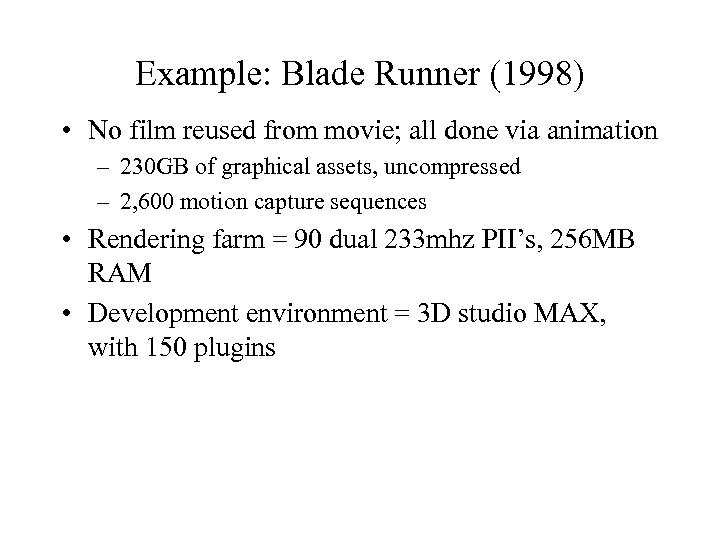 Example: Blade Runner (1998) • No film reused from movie; all done via animation – 230 GB of graphical assets, uncompressed – 2, 600 motion capture sequences • Rendering farm = 90 dual 233 mhz PII’s, 256 MB RAM • Development environment = 3 D studio MAX, with 150 plugins
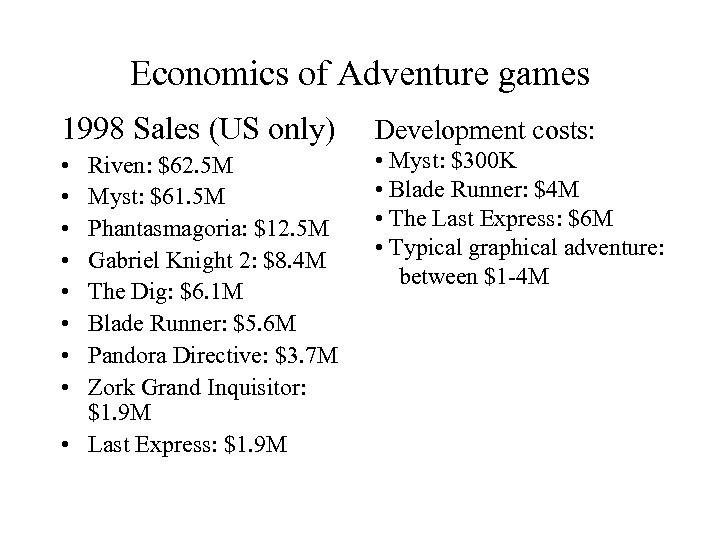 Economics of Adventure games 1998 Sales (US only) Development costs: • • • Myst: $300 K • Blade Runner: $4 M • The Last Express: $6 M • Typical graphical adventure: between $1 -4 M Riven: $62. 5 M Myst: $61. 5 M Phantasmagoria: $12. 5 M Gabriel Knight 2: $8. 4 M The Dig: $6. 1 M Blade Runner: $5. 6 M Pandora Directive: $3. 7 M Zork Grand Inquisitor: $1. 9 M • Last Express: $1. 9 M
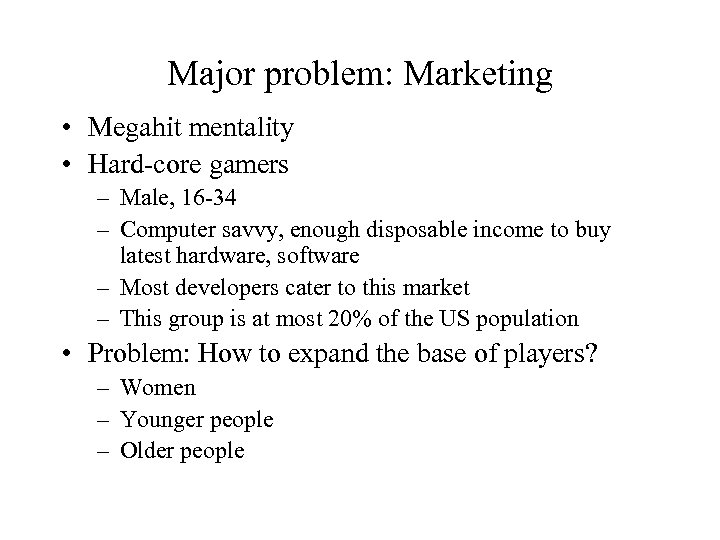 Major problem: Marketing • Megahit mentality • Hard-core gamers – Male, 16 -34 – Computer savvy, enough disposable income to buy latest hardware, software – Most developers cater to this market – This group is at most 20% of the US population • Problem: How to expand the base of players? – Women – Younger people – Older people
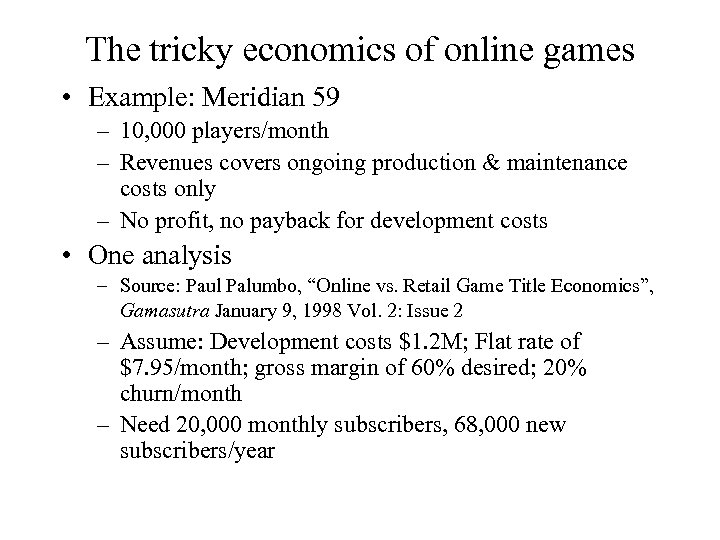 The tricky economics of online games • Example: Meridian 59 – 10, 000 players/month – Revenues covers ongoing production & maintenance costs only – No profit, no payback for development costs • One analysis – Source: Paul Palumbo, “Online vs. Retail Game Title Economics”, Gamasutra January 9, 1998 Vol. 2: Issue 2 – Assume: Development costs $1. 2 M; Flat rate of $7. 95/month; gross margin of 60% desired; 20% churn/month – Need 20, 000 monthly subscribers, 68, 000 new subscribers/year
 Online gaming = Service industry • Source: Jessica Mulligan, “Online Gaming: Why won’t they come” Gamasutra Vol 2: Issue 9, Feb 27, 1998 • Potential market huge: 2. 5 M hardcore gamers with net work access, but most games have about 10 K • Claim: Successful games focus on customer service – 90% of the work occurs after the game is deployed. – Having sysops who resolve disputes and fix bugs on the spot essential to success
 Model perturbations yield possible trends • Implementation possibilities expanding – Moore’s Law continues, at least for a while • Richer models now possible – Which expands opportunities for immersion • New kinds of stories can be told – New generativity in imagined worlds – Multiparticipant stories
 Some questions game designers are grappling with
 How might stories evolve?
 Will lifelike animation kill full-motion video?
 Will inverse kinematics kill motion capture?
 Is 2 D versus 3 D like B&W/Color or like animation/live action?
 How to exploit new modalities? • Speech I/O becoming reasonable – More developers are shipping text to speech, limited recognition capabilities • Vision input around the corner? – Potential applications? • Helmets, and gloves and sensors?
 What can we do to improve game AI? • “AI code gets big -- 1000, 2000 lines” (speaker at 1998 GDC) • “Games are going to become AI-bound” – Brian Schmidt, Xbox project manager
 What game(s) would you like to see?