 Скачать презентацию Historisches Institut Network of European Archival Educators Marburg
13c0ffa2b8c926a76a61c115620f6392.ppt
- Количество слайдов: 23



Historisches Institut Network of European Archival Educators Marburg 2008: How to Teach Records Management in a Country with two Different Traditions Dr. Gaby Knoch-Mund MAS AIS University of Berne, Switzerland
Records Management in Switzerland Historisches Institut • Is there a tradition ? Are there two traditions ? • The need for Records Management • Records Management in an interdisciplinary and intercultural curriculum • Evaluation and perspectives
Historisches Institut One tradition or several traditions and archival education in Switzerland 1. German and French influence 2. Tradition or not ? External influence and voluntary acceptance 3. Building one tradition through education
Traditions Historisches Institut • Typical Swiss: Federalism Particularism Individual solutions (not to follow a school) ü German influence • Provenienzprinzip. Registraturplan. • Aktenkunde does not exist. • Separation current files or records / archives (becomes obsolete). Vorarchiv / Archiv. Primary / secondary value ü French influence • Séries, archivage dans l‘administration • Documentation • Calendrier de conservation
Finally a tradition ? Historisches Institut Ø Theoretical foundation of practical application through archival appraisal und Life cycle and Kontinuummodel Ø RM as the method to reconciliate various „traditions“ Ø Standards: a basis of common understanding ISO-DIN norm 15489 (Records Management) Mo. Req 2 (Model Requirements Specification for the Management of Electronic Records); ISO 23081 (RM processes / Metadata for records); OAIS (Open archival information system / ISO 14721) Ø Intercultural approach as an important and enriching element not to found a common tradition, but to develop a common best practice
From MAS AIS to MAS ALIS: Archival, library and information science Historisches Institut • Master of advanced studies in archival, library and information science Ø RM is a new subject for librarians, far from • • • their daily practice and experience, but a common concern: Need to manage an organisation Private archives and library archives Comprehension for standardisation Data transfer, Networks Information value Process-based models as a chance
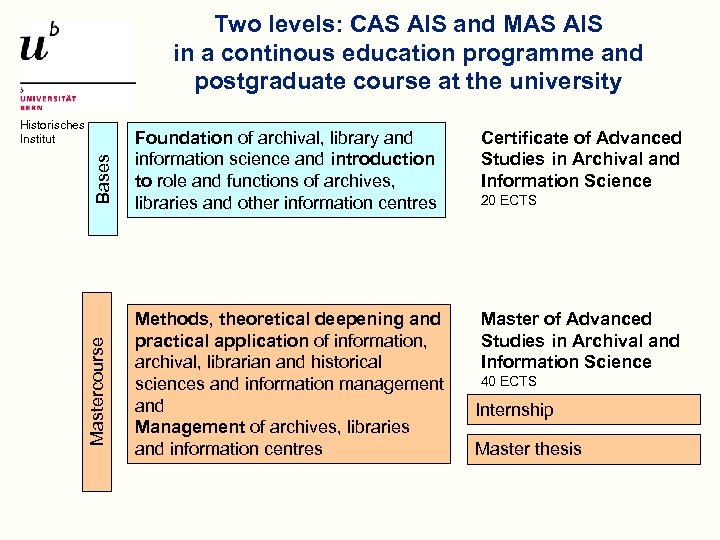
Two levels: CAS AIS and MAS AIS in a continous education programme and postgraduate course at the university Mastercourse Bases Historisches Institut Foundation of archival, library and information science and introduction to role and functions of archives, libraries and other information centres Certificate of Advanced Studies in Archival and Information Science Methods, theoretical deepening and practical application of information, archival, librarian and historical sciences and information management and Management of archives, libraries and information centres Master of Advanced Studies in Archival and Information Science 20 ECTS 40 ECTS Internship Master thesis
What do we teach ? Historisches Institut • Two modules (each 40 teaching lessons; homework, text-study, group work, presentations and papers) • RM I/II out of twelve teaching modules • Teaching separately from the two modules on archival and librarian key competencies • Teaching content: Knowledge Management and Records Management as main subjects of Information management • Director of modules: Peter Toebak Co-Director and representative of the directing board MAS AIS: Niklaus Bütikofer
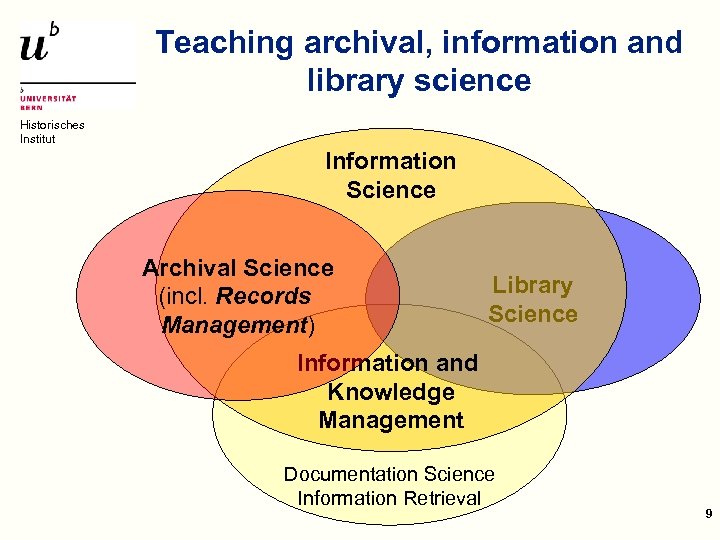
Teaching archival, information and library science Historisches Institut Information Science Archival Science (incl. Records Management) Library Science Information and Knowledge Management Documentation Science Information Retrieval 9
RM – module I: Introduction and basic principles Historisches Institut • Learning outcomes: – Theoretical foundation and state of the art of Knowledge, Information and Records Management – Role of knowledge, information and records in an organisation – Life cycle of business information in the context of processes of their creation and use: analysis and comprehension – Instruments of Records Management • Objectifs : – Connaître les fondements théoriques principaux et l‘état de la recherche en matière de gestion du savoir, gestion de l‘information et gestion documentaire – Connaître le rôle du savoir, des informations et des documents dans une organisation – Acquérir une vue d‘ensemble du cycle de vie complet des informations dans une organisation ainsi que la capacité de les analyser dans le contexte des processus où elles sont produites et utilisées – Les instruments de la gestion documentaire
RM – module II: Theoretical deepening and practical application Historisches Institut • Learning outcomes: - Application of Knowledge, Information and Records Management in archives, libraries and other information centres - Information and Records Management in an organisation: audit, functions; developping on strategic, technical and functional level • Objectifs: - Connaître les possibilités d'utilisation de la gestion du savoir, de l'information et de la gestion documentaire (Records Management) dans les domaines de compétences et d'action des institutions I+D - Pouvoir déterminer l'utilité de la gestion de l'information et de la gestion documentaire (Records management) pour une organisation, les mettre en œuvre et les développer aussi bien au niveau stratégique qu'au niveau technique et opérationnel
Teaching Content: Main topics in RM I Historisches Institut Ø • • Introduction to RM with terminology Theory of information and communication Information-Management, Knowledge-Management Aims of RM Types of business information and data in an organisation • Authenticity Ø Information-processes: capture, classification, arranging records to subject files (Dossierbildung), structuration of series, persistence and integrity of case files • Life cycle and records continuum-concepts • Analysis and planning of the need of business information • Systems of classification (Ordnungssysteme) Ø Legal and juridical context of information and RM • Records management policy (Organisationsvorschriften), RM audit
Teaching Content: Main topics in RM II Historisches Institut • • • Content und Records Management Systems Functional and technical requirements Metadata for RM Databasis and application in RM e. Business und e. Government Information Audit Records Management Marketing Knowledge Management Business Continuity Management and Information Market Ø Case studies: - International organisation (International Red cross) - Private companies (insurance, University hospital, Novartis) - Public administration (town archive) - Content Management und RM-products
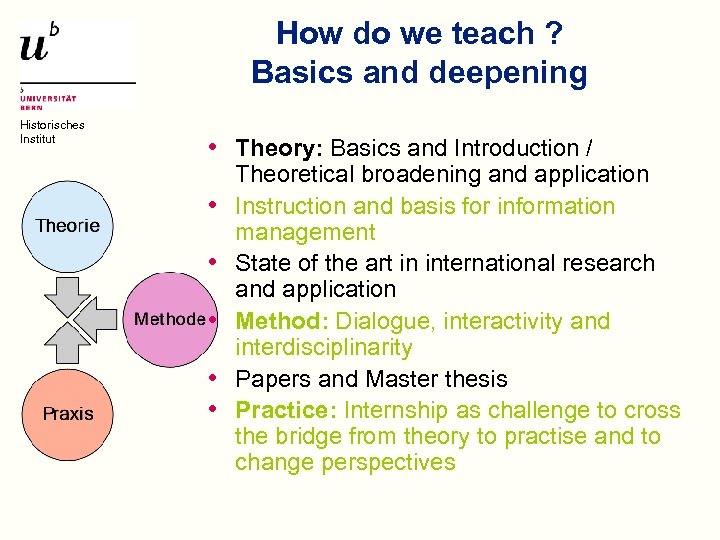
How do we teach ? Basics and deepening Historisches Institut • Theory: Basics and Introduction / • • • Theoretical broadening and application Instruction and basis for information management State of the art in international research and application Method: Dialogue, interactivity and interdisciplinarity Papers and Master thesis Practice: Internship as challenge to cross the bridge from theory to practise and to change perspectives
RM and interdisciplinarity ? Historisches Institut • Is Records Management a major issue for an interdisciplinary curriculum ? • YES • Arguments: Business administration (Geschäftsverwaltung) and archive, data migration and preservation, life cycle und records continuum concerns institutions of different types and branches, public as well as private. Ø Students‘ evaluation: RM is a new and most important subject; high and positive evaluation
Historisches Institut Appraisal and Records Management as key competencies in archives and libraries • Library: acquisition and acquirement / destruction • Archives: prospective appraisal and acquisition Ø Überlieferungsbildung (memory and stock building) becomes a common concern
Überlieferungsbildung Historisches Institut Überlieferungsbildung in the context of philosophy and politics of remembrance / culture of commemoration / Erinnerungs- und Gedächtniskultur) 1. To remember means to select / selective retention 2. To select with technological impact and inspite of technique 3. To build a collective memory in the era of information
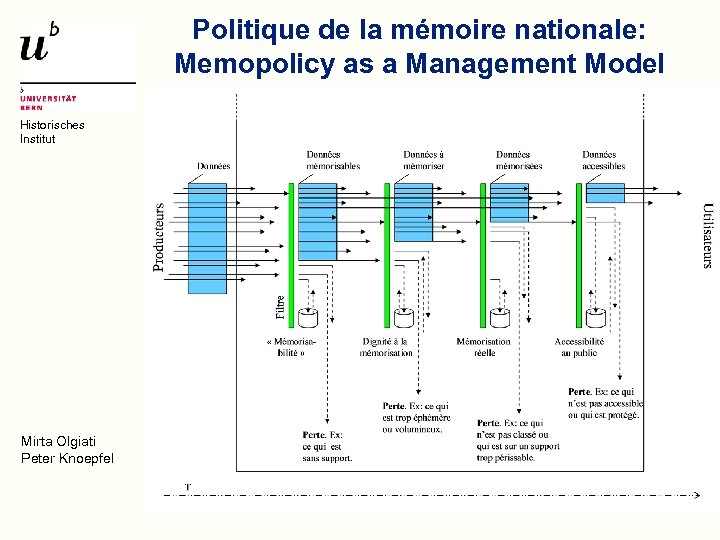
Politique de la mémoire nationale: Memopolicy as a Management Model Historisches Institut Mirta Olgiati Peter Knoepfel
Memopolicy and „Service public“ ü Efficient administration and Historisches Institut memory-institutions with Memopolicy • Contribution to constitutional legality: responsibility / Good Governance • Contribution to democracy: Accessability / Legitimation • Contribution for orientation: Information for research, culture, identity, active memory • Contribution for economy: Basis for economic activities Cf. A. Kellerhals (MAS AIS, february 2008)
Summary I: General competencies to build up and to enlarge in the MAS AIS Historisches Institut 1. Knowing the information objects 2. Analysing their structure and context of creation, 3. 4. 5. 6. use and preservation in order to fulfill the required professional functions Participating in the design, construction and maintenance of information systems Understanding, performing, analysing and developing methods and procedures in records management, archiving and librarianship Understanding, acting within, and influencing the relationship towards the societal, political, economical, cultural and juridical context Heading and managing an unit in an archive, library or information center
Summary II: Position and challenges Historisches Institut • RM is a key function in our programme • RM is a challenge for archivists, librarians, and the new profile of an information manager • RM is important from the beginning of and throughout the life cycle • RM needs quality management • RM is influenced by the expectations of the users in the business units and the archivists • RM builds a bridge from Business informatics to Information centres
Summary III: RM and our interdisciplinary academic approach Historisches Institut • Theory based and interdisciplinary studies • Importance of standards in an international context • RM in the context of general management of IT-technology and the policy of memory • RM on the difficult way to perceive convergences between archives and libraries • To qualify the students. To meet the need of the employers and the demand of the market Ø Multilingual and interdisciplinary approach for archives, libraries and information centers
Contact and information Historisches Institut Contact: Ø Dr. Gaby Knoch-Mund gaby. knoch-mund@hist. unibe. ch Ø Prof. Dr. Christoph Graf christoph. graf@hist. unibe. ch More information: Ø www. archivwissenschaft. ch (in Deutsch) Ø www. archivistique. ch (en français) 23
Скачать презентацию Historisches Institut Network of European Archival Educators Marburg
13c0ffa2b8c926a76a61c115620f6392.ppt