


 Скачать презентацию Historical Philosophical and Theoretical Foundations of Leadership Thought
October 2016 lecture series.pptx
- Количество слайдов: 55
 Historical, Philosophical and Theoretical Foundations of Leadership Thought MSc ‘Leadership in the Interconnected World’ October 2016 Associate Professor Paul Aitken PSNRU - Faculty of Philosophy and Sociology
 Objectives for this week: • Begin to understand our own PERSONAL historical, philosophical and theoretical foundations of LEADERSHIP THOUGHT (with an insight into Paul’s own learnings so far) • Learn about the PURPOSE and IMPLICATIONS of studying ‘Leadership in the Interconnected World’ • Clarification and some early exploration of the CRITICAL SUBJECT MATTER required for your STUDIES • Discussion about your next steps
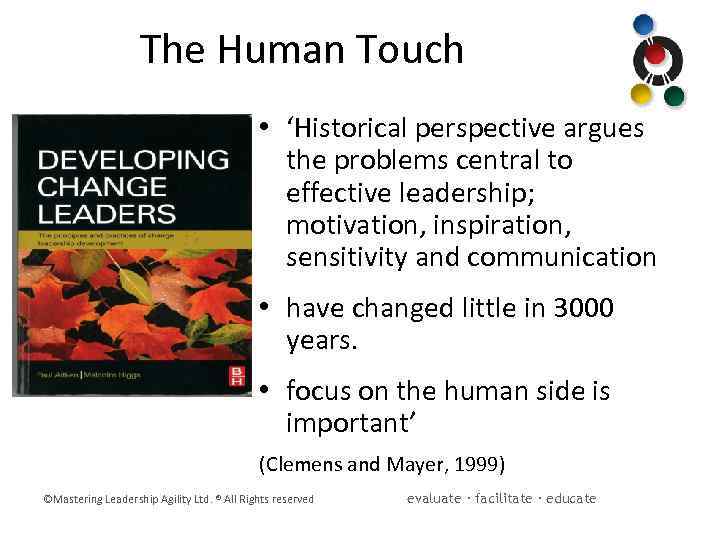 The Human Touch • ‘Historical perspective argues the problems central to effective leadership; motivation, inspiration, sensitivity and communication • have changed little in 3000 years. • focus on the human side is important’ (Clemens and Mayer, 1999) ©Mastering Leadership Agility Ltd. ® All Rights reserved evaluate · facilitate · educate
 REQUIRED TEXTBOOKS & KEY ACADEMIC PAPER • ‘Developing Change Leaders: the Principles and Practices of Change Leadership Development’ (Aitken & Higgs, 2010) • ‘Humanism in Business’ (Cambridge University Press, 2009) • ‘The Values Challenge for Developing Ethical Leadership: Research and Practice Agenda for Values-Based Leadership. ’ (Aitken & Lichtenstein) 6 th Developing Leadership Capacity Conference, 7 -9 July, 2014, Lancaster University Management School, UK. ©Mastering Leadership Agility Ltd. ® All Rights reserved evaluate · facilitate · educate
 DEFINITIONS Leader: A person occupying a noticeable public role, with personal responsibility for building something or someone Leadership: A social interaction process creating two-way influence to produce a collective sense of direction, which can be collaboratively implemented Stewardship: A moral contribution to preserving and enhancing any aspect of any life on earth Mutualism: Humans in nature and nature in humans; progress towards a common reciprocal ‘humanity’ Unity: A ‘sustainable’ connectedness between people (and between humans and the natural world), regardless of diversity (in personal histories, philosophies and theories) Personal Values: Individual drivers of focus, motivation and action ©Mastering Leadership Agility Ltd. ® All Rights reserved evaluate · facilitate · educate
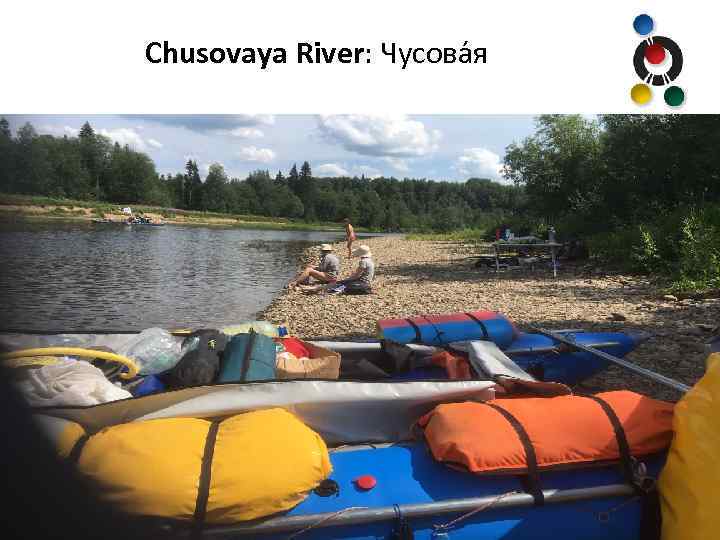 Chusovaya River: Чусова я ©Mastering Leadership Agility Ltd. ® All Rights reserved evaluate · facilitate · educate
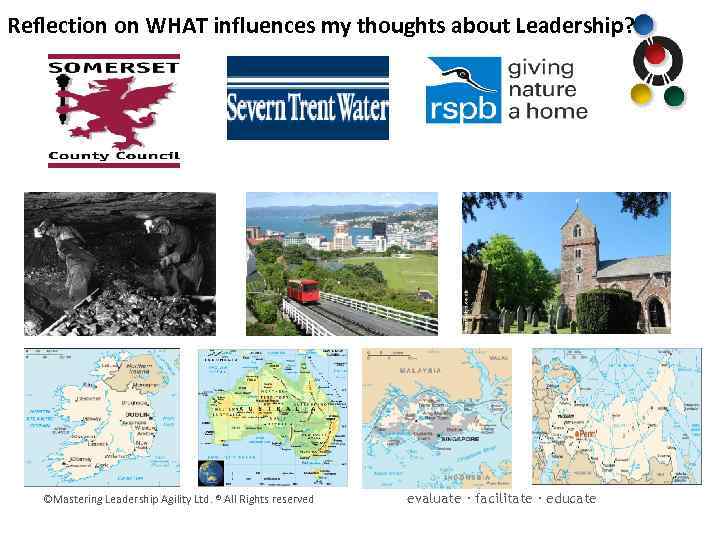 Reflection on WHAT influences my thoughts about Leadership? ©Mastering Leadership Agility Ltd. ® All Rights reserved evaluate · facilitate · educate
 “Values are a silent power for understanding interpersonal and organisational life. Because they are at the core of people’s personality, values influence the choices they make, people they trust, the appeals they respond to, and the way they invest their time and energy. In turbulent times values give a sense of direction amid conflicting views and demands”. Posner and Schmidt (1994) ©Mastering Leadership Agility Ltd. ® All Rights reserved evaluate · facilitate · educate
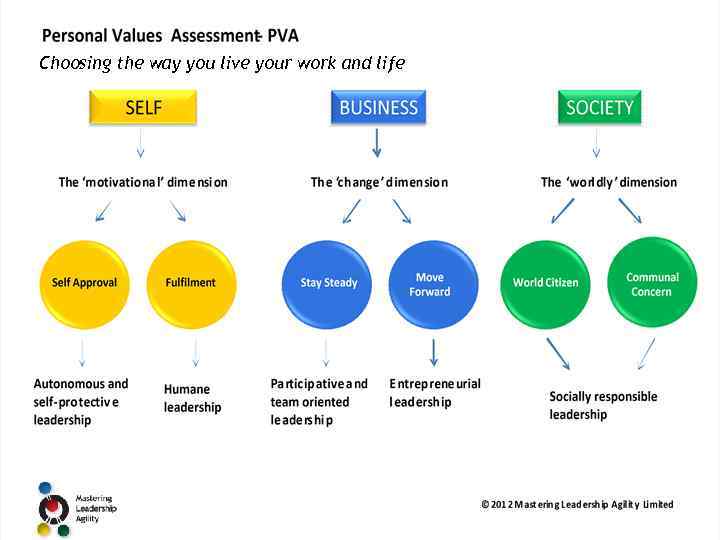 Choosing the way you live your work and life
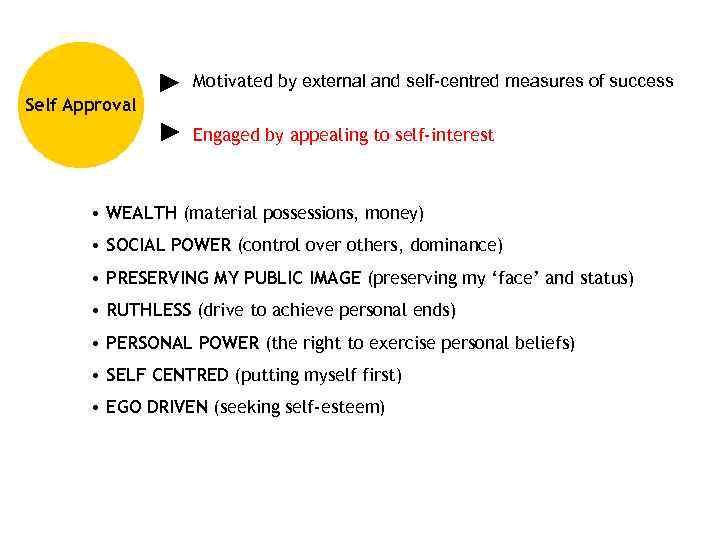 Motivated by external and self-centred measures of success Self Approval Engaged by appealing to self-interest • WEALTH (material possessions, money) • SOCIAL POWER (control over others, dominance) • PRESERVING MY PUBLIC IMAGE (preserving my ‘face’ and status) • RUTHLESS (drive to achieve personal ends) • PERSONAL POWER (the right to exercise personal beliefs) • SELF CENTRED (putting myself first) • EGO DRIVEN (seeking self-esteem)
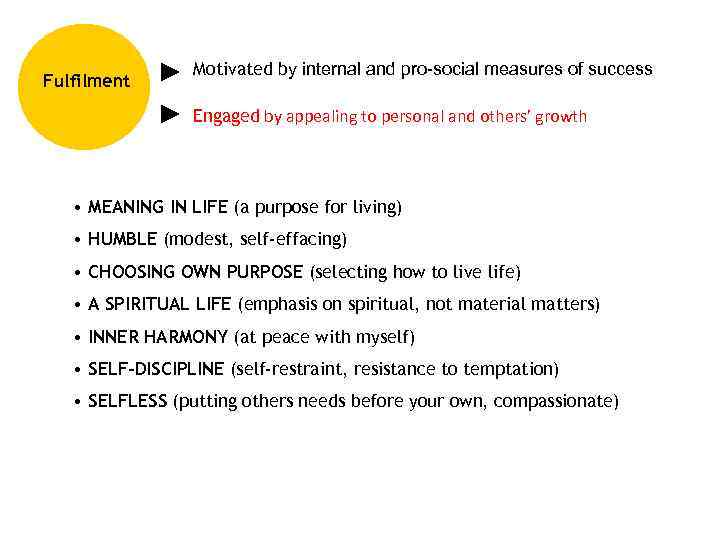 Fulfilment Motivated by internal and pro-social measures of success Engaged by appealing to personal and others’ growth • MEANING IN LIFE (a purpose for living) • HUMBLE (modest, self-effacing) • CHOOSING OWN PURPOSE (selecting how to live life) • A SPIRITUAL LIFE (emphasis on spiritual, not material matters) • INNER HARMONY (at peace with myself) • SELF-DISCIPLINE (self-restraint, resistance to temptation) • SELFLESS (putting others needs before your own, compassionate)
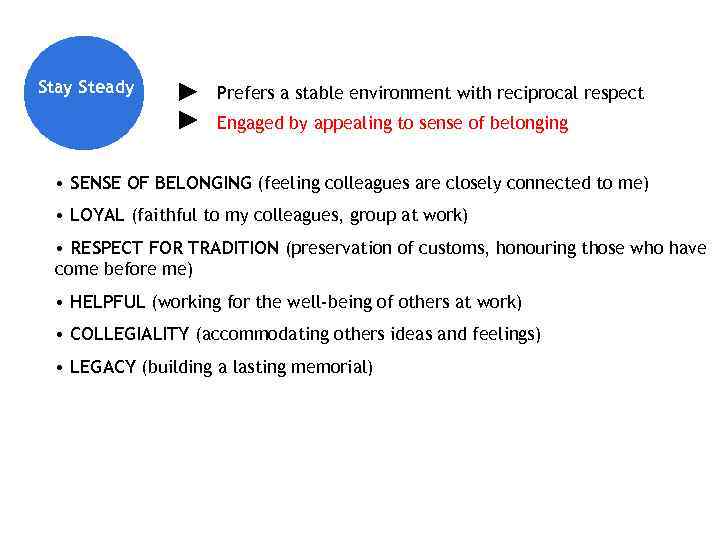 Stay Steady Prefers a stable environment with reciprocal respect Engaged by appealing to sense of belonging • SENSE OF BELONGING (feeling colleagues are closely connected to me) • LOYAL (faithful to my colleagues, group at work) • RESPECT FOR TRADITION (preservation of customs, honouring those who have come before me) • HELPFUL (working for the well-being of others at work) • COLLEGIALITY (accommodating others ideas and feelings) • LEGACY (building a lasting memorial)
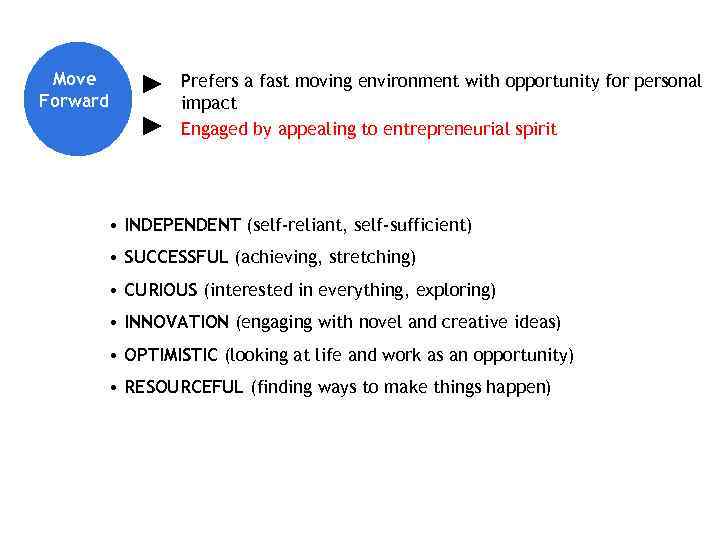 Move Forward Prefers a fast moving environment with opportunity for personal impact Engaged by appealing to entrepreneurial spirit • INDEPENDENT (self-reliant, self-sufficient) • SUCCESSFUL (achieving, stretching) • CURIOUS (interested in everything, exploring) • INNOVATION (engaging with novel and creative ideas) • OPTIMISTIC (looking at life and work as an opportunity) • RESOURCEFUL (finding ways to make things happen)
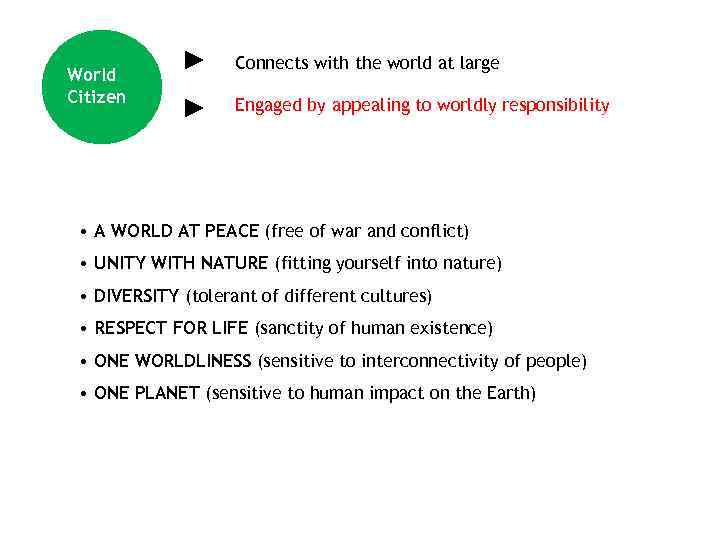 World Citizen Connects with the world at large Engaged by appealing to worldly responsibility • A WORLD AT PEACE (free of war and conflict) • UNITY WITH NATURE (fitting yourself into nature) • DIVERSITY (tolerant of different cultures) • RESPECT FOR LIFE (sanctity of human existence) • ONE WORLDLINESS (sensitive to interconnectivity of people) • ONE PLANET (sensitive to human impact on the Earth)
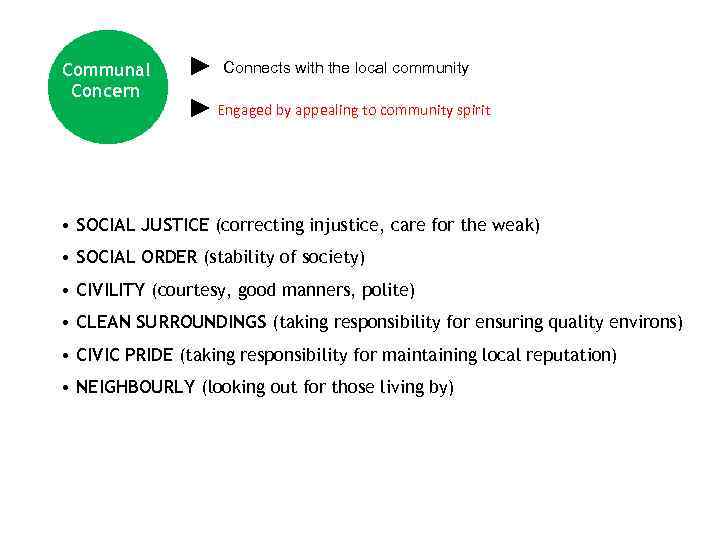 Communal Concern Connects with the local community Engaged by appealing to community spirit • SOCIAL JUSTICE (correcting injustice, care for the weak) • SOCIAL ORDER (stability of society) • CIVILITY (courtesy, good manners, polite) • CLEAN SURROUNDINGS (taking responsibility for ensuring quality environs) • CIVIC PRIDE (taking responsibility for maintaining local reputation) • NEIGHBOURLY (looking out for those living by)
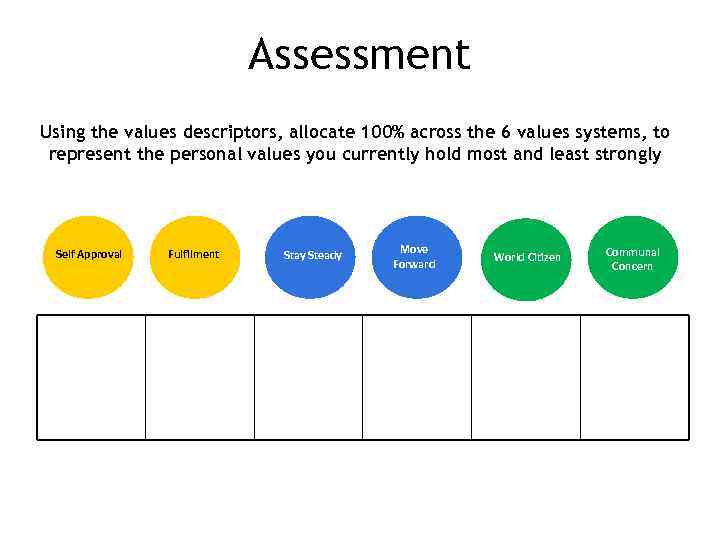 Assessment Using the values descriptors, allocate 100% across the 6 values systems, to represent the personal values you currently hold most and least strongly Self Approval Fulfilment Stay Steady Move Forward World Citizen Communal Concern
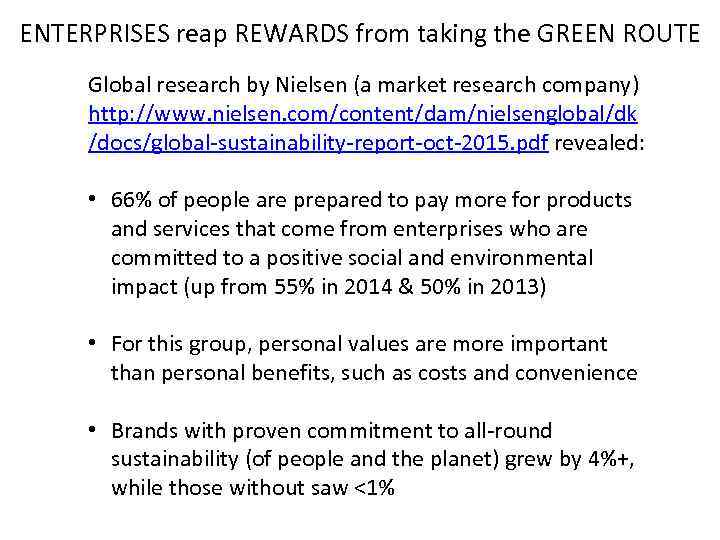 ENTERPRISES reap REWARDS from taking the GREEN ROUTE Global research by Nielsen (a market research company) http: //www. nielsen. com/content/dam/nielsenglobal/dk /docs/global-sustainability-report-oct-2015. pdf revealed: • 66% of people are prepared to pay more for products and services that come from enterprises who are committed to a positive social and environmental impact (up from 55% in 2014 & 50% in 2013) • For this group, personal values are more important than personal benefits, such as costs and convenience • Brands with proven commitment to all-round sustainability (of people and the planet) grew by 4%+, while those without saw <1%
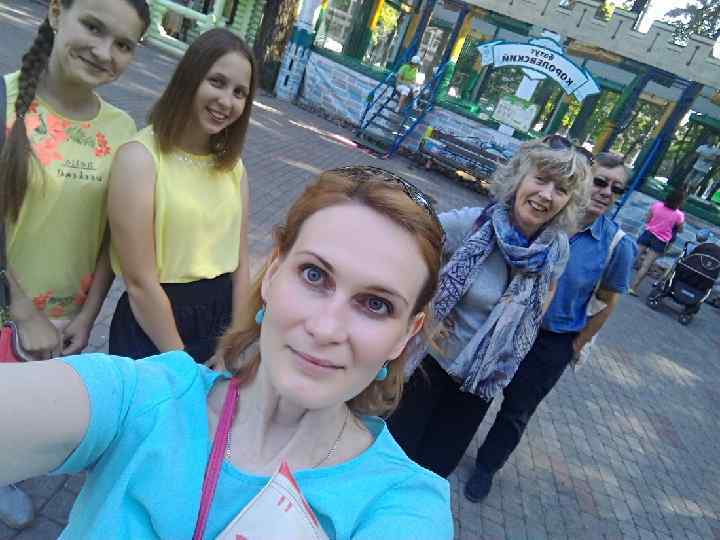
 MAJOR ‘PERSONAL VALUES’ DISCONNECTS IN THE INTERCONNECTED WORLD, REVEALED IN: Material Consumerism and Life Purpose Humans and the Natural World Rich and Poor Enterprise Owners and Employees Our Home Culture and Other Cultures (Gertrude Bell film) • Remote Communication and Personal Bonds • Men and Women • • • ©Mastering Leadership Agility Ltd. ® All Rights reserved evaluate · facilitate · educate
 ©Mastering Leadership Agility Ltd. ® All Rights reserved evaluate · facilitate · educate
 3 EDUCATIONAL IMPACTS OF RICH v POOR (Brown, C. , 2016) • Material deprivation and the social exclusion that results from it • Alien culture of schooling • Friendship as a means of including and excluding ©Mastering Leadership Agility Ltd. ® All Rights reserved evaluate · facilitate · educate
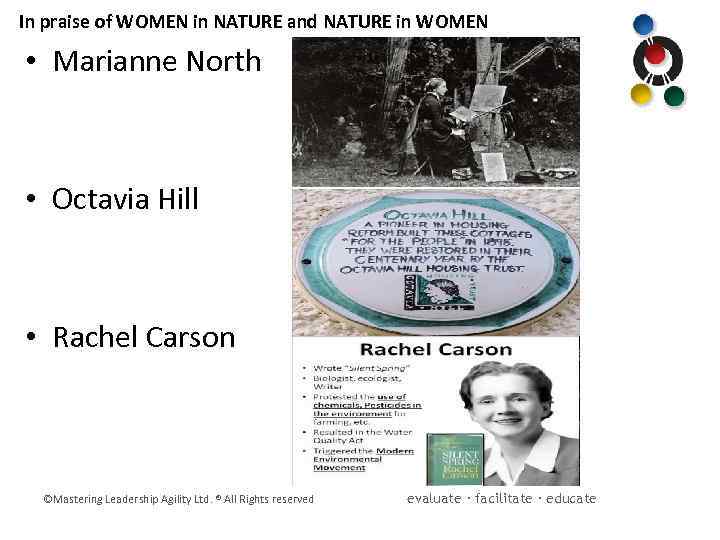 In praise of WOMEN in NATURE and NATURE in WOMEN • Marianne North • Octavia Hill • Rachel Carson ©Mastering Leadership Agility Ltd. ® All Rights reserved evaluate · facilitate · educate
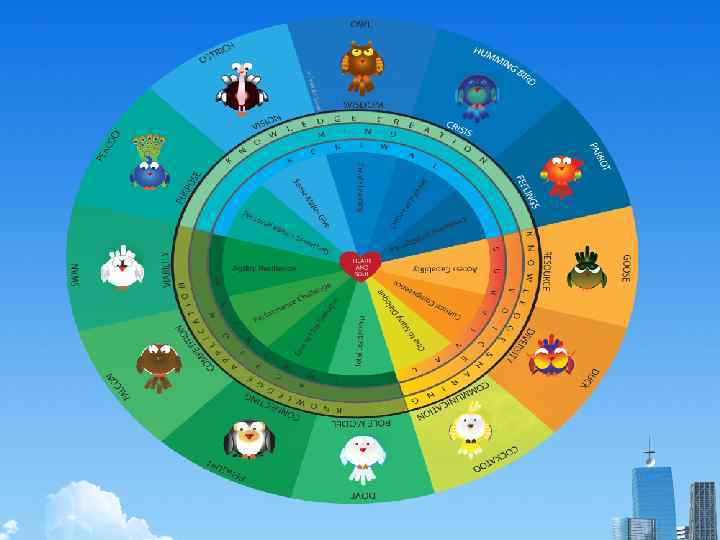
 CAREER BIRDS - MISSION • Preparing the unprepared, through 12 leadership PRACTICES, • to create and convert talent for holding a position of maximum opportunity, • which delivers a SUSTAINABLE life, career, enterprise and community.
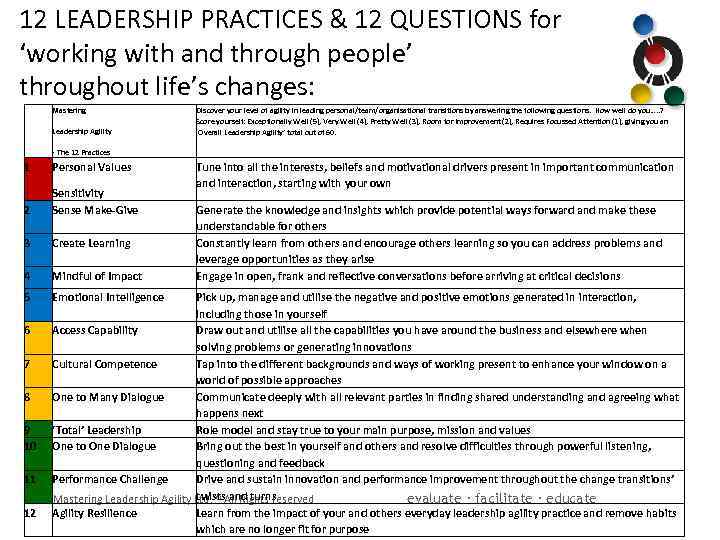 12 LEADERSHIP PRACTICES & 12 QUESTIONS for ‘working with and through people’ throughout life’s changes: Mastering Leadership Agility Discover your level of agility in leading personal/team/organisational transitions by answering the following questions. How well do you…. . ? Score yourself: Exceptionally Well (5), Very Well (4), Pretty Well (3), Room for Improvement (2), Requires Focussed Attention (1), giving you an ‘Overall Leadership Agility’ total out of 60. - The 12 Practices 1 Personal Values 2 Sensitivity Sense Make-Give 3 Create Learning 4 Mindful of Impact 5 Emotional Intelligence Tune into all the interests, beliefs and motivational drivers present in important communication and interaction, starting with your own Generate the knowledge and insights which provide potential ways forward and make these understandable for others Constantly learn from others and encourage others learning so you can address problems and leverage opportunities as they arise Engage in open, frank and reflective conversations before arriving at critical decisions Pick up, manage and utilise the negative and positive emotions generated in interaction, including those in yourself 6 Access Capability Draw out and utilise all the capabilities you have around the business and elsewhere when solving problems or generating innovations 7 Cultural Competence Tap into the different backgrounds and ways of working present to enhance your window on a world of possible approaches 8 One to Many Dialogue Communicate deeply with all relevant parties in finding shared understanding and agreeing what happens next 9 ‘Total’ Leadership Role model and stay true to your main purpose, mission and values 10 One to One Dialogue Bring out the best in yourself and others and resolve difficulties through powerful listening, questioning and feedback 11 Performance Challenge Drive and sustain innovation and performance improvement throughout the change transitions’ twists and turns ©Mastering Leadership Agility Ltd. ® All Rights reserved evaluate · facilitate · educate 12 Agility Resilience Learn from the impact of your and others everyday leadership agility practice and remove habits which are no longer fit for purpose
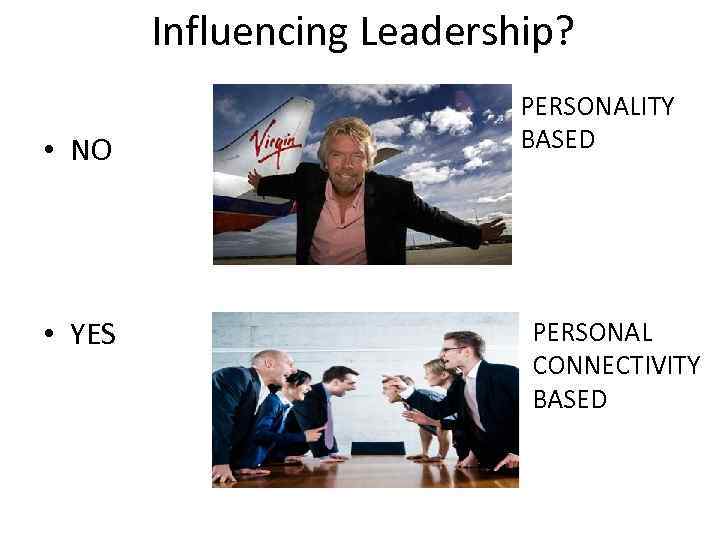 Influencing Leadership? • NO • YES PERSONALITY BASED PERSONAL CONNECTIVITY BASED
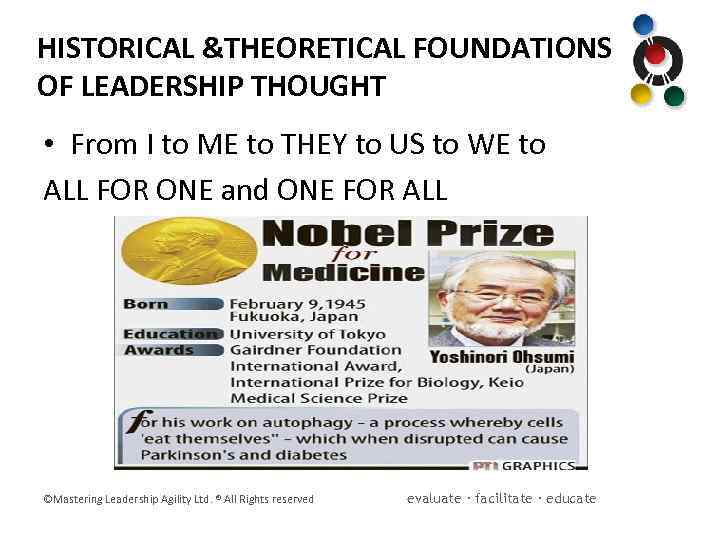 HISTORICAL &THEORETICAL FOUNDATIONS OF LEADERSHIP THOUGHT • From I to ME to THEY to US to WE to ALL FOR ONE and ONE FOR ALL ©Mastering Leadership Agility Ltd. ® All Rights reserved evaluate · facilitate · educate
 I - Leader • Leader centric approach & studies For example: http: //www. emeraldinsight. com/doi/pdfplus/10. 1108/03090590510591085 http: //www. sciencedirect. com/science/article/pii/S 0263786309000970 (the power of ‘INFLUENCE’) ©Mastering Leadership Agility Ltd. ® All Rights reserved evaluate · facilitate · educate
 ME - Leader • CHARISMATIC focus For example: http: //www. sciencedirect. com/science/article/pii/1048984395900268 http: //spr. sagepub. com/content/19/6/797. short http: //amr. aom. org/content/12/4/637. short ©Mastering Leadership Agility Ltd. ® All Rights reserved evaluate · facilitate · educate
 THEY – Leader/s • Near and far leaders For example: http: //www. sciencedirect. com/science/article/pii/S 1048984312000689 https: //books. google. co. uk/books? hl=en&lr=&id=d. Q 7 c. Ib 8 w. Qf. MC&oi=fnd&pg=PA 39& dq=NEAR+AND+FAR+LEADERS+SHAMIR&ots=Jrv. Ghxcnq&sig=50 h. Ttr. OBEGuxv 6 m 5 u. As. LM 1 NDdo#v=onepage&q=NEAR%20 AND%20 FAR%20 LEADERS%20 SHAMIR&f=false ©Mastering Leadership Agility Ltd. ® All Rights reserved evaluate · facilitate · educate
 US - Leader. SHIP • GROUP or SHARED COLLECTIVE concept For example: http: //www. sciencedirect. com/science/article/pii/S 1048984306000397 http: //amj. aom. org/content/44/4/809. short http: //www. sciencedirect. com/science/article/pii/S 1048984309001787 https: //books. google. co. uk/books? hl=en&lr=&id=YG 3 GIEez 5 d 4 C&oi=fnd&pg=PR 11&d q=SHARED+LEADERSHIP&ots=y. Fn 1 Fo. Tui&sig=us. Bw 9 BW 9 adsk. Fx. A_Nca 7 se. Pg. DRk#v=onepage&q=SHARED%20 LEADERSHIP&f= false ©Mastering Leadership Agility Ltd. ® All Rights reserved evaluate · facilitate · educate
 WE - Leader. SHIP • Transactional v Transformational ‘togetherness’ for coping with SHORT-TERM CHANGE and Leadership Agility as a way to sustainably engage with ON-GOING CHANGE For example: http: //go. galegroup. com/ps/anonymous? id=GALE%7 CA 8201994&sid=google. Scholar&v=2. 1 &it=r&linkaccess=fulltext&issn=00902616&p=AONE&sw=w&auth. Count=1&is. Anonymous. En try=true http: //s 3. amazonaws. com/academia. edu. documents/38404263/Transactional_and_Transf ormational_Leadership_Article_1987. pdf? AWSAccess. Key. Id=AKIAJ 56 TQJRTWSMTNPEA&Ex pires=1475757792&Signature=i. HG 3 Saea 7 v 3 P%2 Flty. Qox 1 IRip. EHE%3 D&response-contentdisposition=inline%3 B%20 filename%3 DTransactional_and_Transformational_Leade. pdf ©Mastering Leadership Agility Ltd. ® All Rights reserved evaluate · facilitate · educate
 ALL FOR ONE and ONE FOR ALL - Leader. SHIP • AGILE SUSTAINABLE MUTUALISM SYSTEMS for dealing with constant, continuing and complex VALUES-LADEN CHANGE • Abstract for 6 th Developing Leadership Capacity Conference, 7 -9 July, 2014, Lancaster University Management School: “The Values Challenge for Developing Ethical Leadership: Research and Practice Agenda for Values-Based Leadership. ” (Aitken & Lichtenstein) ©Mastering Leadership Agility Ltd. ® All Rights reserved evaluate · facilitate · educate
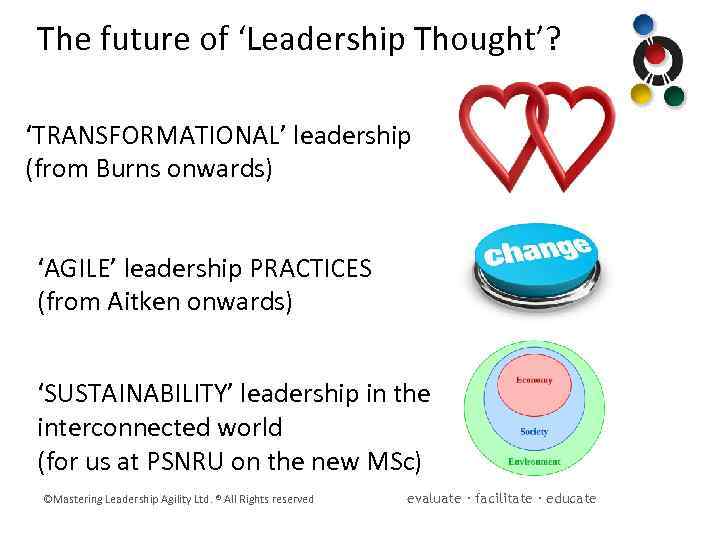 The future of ‘Leadership Thought’? ‘TRANSFORMATIONAL’ leadership (from Burns onwards) ‘AGILE’ leadership PRACTICES (from Aitken onwards) ‘SUSTAINABILITY’ leadership in the interconnected world (for us at PSNRU on the new MSc) ©Mastering Leadership Agility Ltd. ® All Rights reserved evaluate · facilitate · educate
 Leadership as Purpose • Purpose is central to a good human life – happiness comes from fidelity to a worthy purpose – the absence or disconnection with, or perceived worthless nature of a purpose, will lead to unhappiness within an individual • Societal notion of purpose – a worthy idea and activity, the benefit of which is beyond the individual http: //hajoonchang. net/category/book-reviews/23 -things/
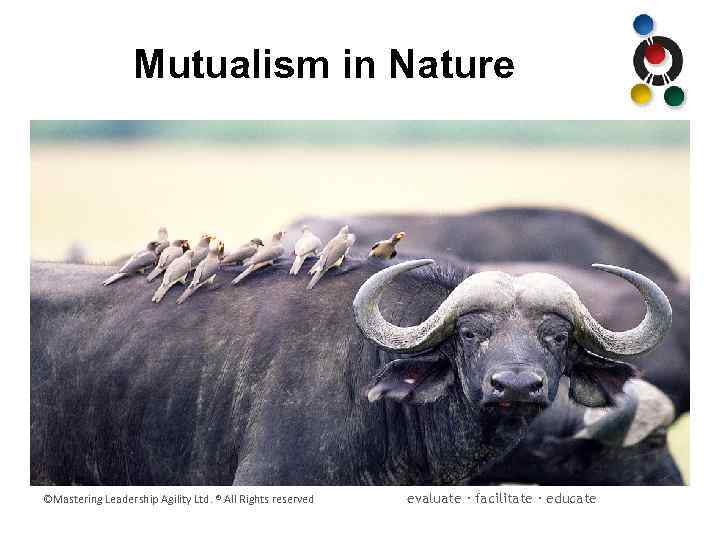 Mutualism in Nature ©Mastering Leadership Agility Ltd. ® All Rights reserved evaluate · facilitate · educate
 Purpose of Organisations • Who gains, who loses? ‘Symbiotic’ relationships (wikipedia): In ecology, commensalism is a class of relationship between two organisms where one organism benefits and for the other it is neutral (there is no harm or benefit). There are two other types of association: mutualism (where both organisms benefit) and parasitism (one organism benefits and the other one is harmed) ©Mastering Leadership Agility Ltd. ® All Rights reserved evaluate · facilitate · educate
 The nature of EMPLOYEMENT RELATIONSHIPS CONTRACT v COVENANT • Some discussion of the word “covenant” and its meaning would be helpful for many people of the 21 st-century. It is similar in meaning to the idea of “contract”, although the two words are not perfectly synonymous, and the differences between them are significant. • In the ancient middle east (in which the Bible was written), a covenant was a formal agreement that caused (or implied) several things: • 1. First, a covenant defined (or sometimes created) a relationship. This relationship might be between a king and his vassal states, between a deity and his nation, between two humans, etc. • 2. Some covenants are conditional (if one party does A, then the other party will do B), just as with a present-day contract. But generally, ancient covenants are unconditional (each party commits to a certain action, regardless of whether the other party keeps the covenant). [1] [2] • 3. Covenants often included the slaughter of animals as a symbol of their significance. • 4. Unlike present-day contracts, covenants often carried no expiration date. Thus the parties were understood to be bound by the covenant until death (or forever, in the case of covenants with God). • 5. A contract is enforced by the civil government; a covenant is regulated by God. • 6. A contract involves the exchange of property or actions; a covenant binds two parties together personally. ©Mastering Leadership Agility Ltd. ® All Rights reserved evaluate · facilitate · educate
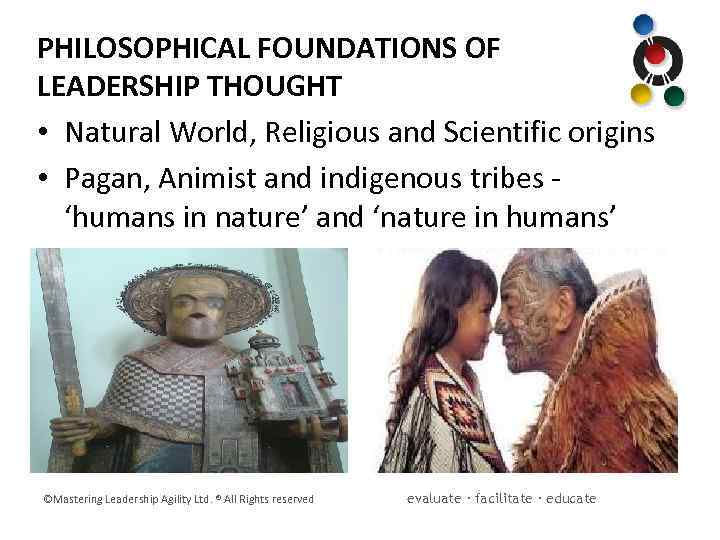 PHILOSOPHICAL FOUNDATIONS OF LEADERSHIP THOUGHT • Natural World, Religious and Scientific origins • Pagan, Animist and indigenous tribes - ‘humans in nature’ and ‘nature in humans’ ©Mastering Leadership Agility Ltd. ® All Rights reserved evaluate · facilitate · educate
 Philosophical Position Source of values-considered leadership thought Objectivist Moral norms from an external source (e. g. Ten Commandments; Aristotle; Socrates) Subjectivist Existential; wholly proscribed by the individual (e. g. Nietzsche, 1887; Sartre, 1953) Integrationist Personal values as motivational sources of human behaviour that underpin the actions of individuals within groups (e. g. Parsons and Shils, 1951; Allport, 1955; Maslow, 1970; Rokeach, 1973, 1979; Schwartz, 1996). Source: Frondizi (1971); Hall (1997) Proposition: Values-based leadership development, using an ‘Integrationist’ viewpoint of values as motivational sources of human behaviour that underpins leaders’ social influence, is more useable for learning and change, than the ‘Objectivist’ view of moral development proscribed by an external force, or from a ‘Subjectivist’ view, which ignores social reciprocity?
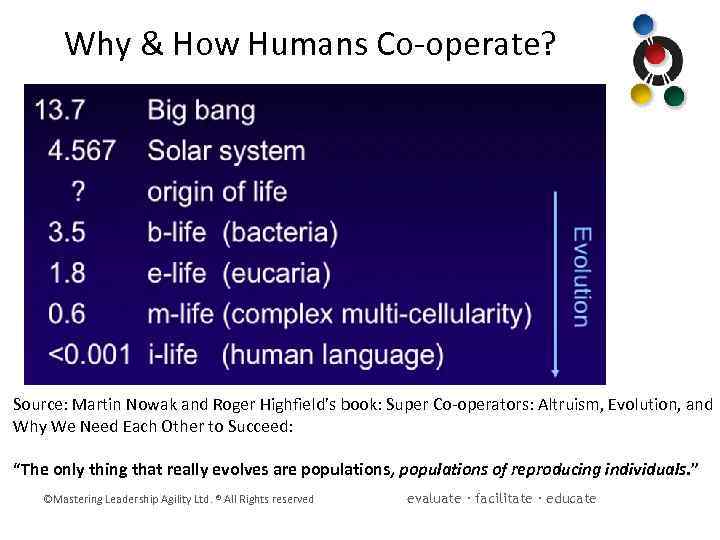 Why & How Humans Co-operate? Source: Martin Nowak and Roger Highfield’s book: Super Co-operators: Altruism, Evolution, and Why We Need Each Other to Succeed: “The only thing that really evolves are populations, populations of reproducing individuals. ” ©Mastering Leadership Agility Ltd. ® All Rights reserved evaluate · facilitate · educate
 The ‘Ascent of Man’ – Jacob Bronowski • Lower than the Angels: Evolution of man from proto-ape to the modern form 400, 000 years ago. • The Harvest of the Seasons: early human migration, agriculture and the first settlements, and war. • The Grain in the Stone: Tools, and the development of architecture and sculpture. • The Hidden Structure: Fire, metals and alchemy. • Music of the Spheres: The language of numbers and mathematics. • The Starry Messenger: Galileo's universe and the implications of his trial on the shift to "northern" science. • The Majestic Clockwork: Explores Newton and Einstein's laws. • The Drive for Power: the Industrial Revolution and the (continuing) effect on everyday life. ©Mastering Leadership Agility Ltd. ® All Rights reserved evaluate · facilitate · educate
 So, language in general (discourse and our implicit discourse analysis in particular) shapes our thoughts about leadership! • What’s the most interesting that’s happened in the last 600 million years? The origin of human language • That’s right. It’s the most important evolutionary event since the rise of complex, multi-cellular life • That’s because for the first time on Earth, it enabled a new mode of evolution that was no longer tied to genetics, but ideas • That was the birth of cultural evolution; where survival of the family and community depended on gaining mutual advantage amongst its group members for food, defence and group based social activities (see Stonehenge above) ©Mastering Leadership Agility Ltd. ® All Rights reserved evaluate · facilitate · educate
 Discourse & Social Construction of Reality HOWEVER, “In all my subsequent work on the evolution of cooperation, it’s the same story. Cooperation is never here to stay. Cooperation is there for some time. Then the system breaks down and you have to rebuild it. ” (Nowak) • The sociologist Keller developed his widely recognised 'Sociology of Knowledge Approach to Discourse’ (SKAD) • Following Berger & Luckmann, Keller argues our sense of reality in everyday life and the meaning of every objects, actions and events (such as LEADERSHIP) are the product of a permanent, routinised interaction • SKAD has been developed as a scientific perspective enabling understand of the processes within 'The Social Construction of Reality' from all aspects of social life; by combining Foucault's theories of discourse and power, with Berger/Luckmann’s theory of knowledge. ©Mastering Leadership Agility Ltd. ® All Rights reserved evaluate · facilitate · educate
 Arriving at our own Meaning of Leadership? Shaped by the stories we still hear about, or are told about, from the lives of (mainly male): • philosophers • military heroes • national or community heroes • high profile industrialists • religious/spiritual sages And, most recently, contemporary business MEDIA messages (mainly from stock market quoted) descriptions of; what successful leadership looks like and is measured by? ©Mastering Leadership Agility Ltd. ® All Rights reserved evaluate · facilitate · educate
 BUSINESS MEDIA’s DOMINATION of DISCOURSE re: leaders and leadership https: //www. researchgate. net/profile/Howard_Aldrich/publication/247501457_I nvisible_entrepreneursthe_neglect_of_women_business_owners_by_mass_medi a_and_scholarly_journals_in_the_USA/links/0 a 85 e 5339 b 31 a 1 ad 5 a 000000. pdf • ANDROCENTRISM • MULTINATIONAL PLC SHAREHOLDER COMPANIES • ONLY ONE FORM OF OWNERSHIP PROJECTED • NO ROOM FOR LOCALISM • MARY CATO – BIO-REGOINAL DEVELOPMENT ©Mastering Leadership Agility Ltd. ® All Rights reserved evaluate · facilitate · educate
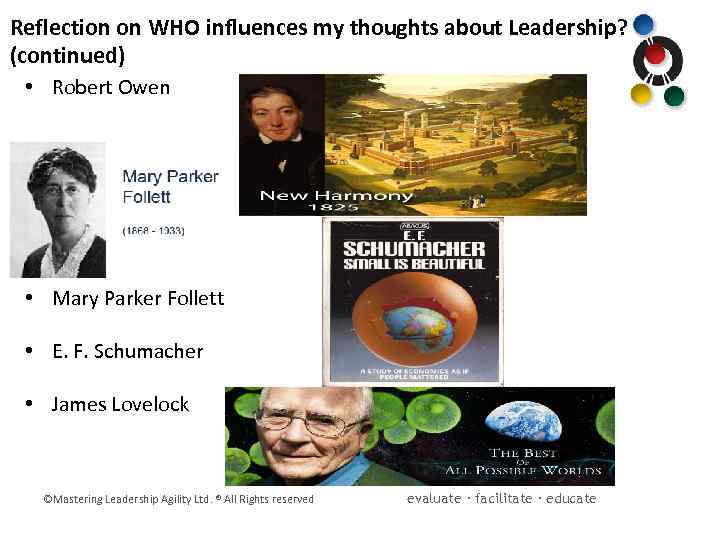 Reflection on WHO influences my thoughts about Leadership? (continued) • Robert Owen • Mary Parker Follett • E. F. Schumacher • James Lovelock ©Mastering Leadership Agility Ltd. ® All Rights reserved evaluate · facilitate · educate
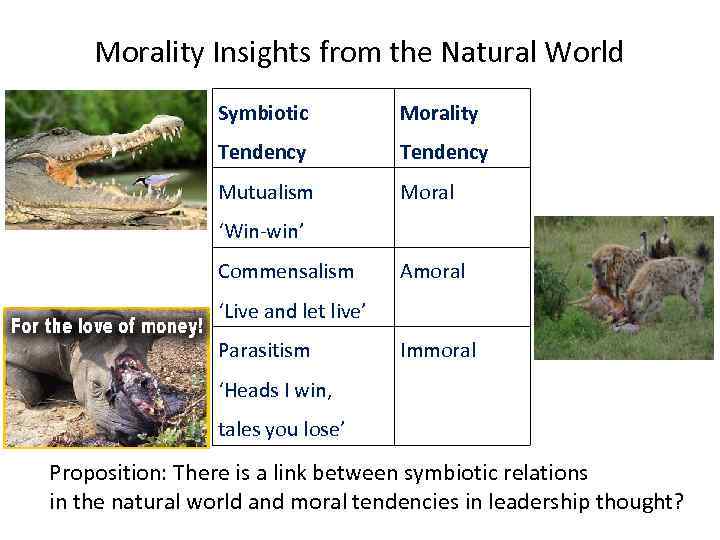 Morality Insights from the Natural World Symbiotic Morality Tendency Mutualism Moral ‘Win-win’ Commensalism Amoral ‘Live and let live’ Parasitism Immoral ‘Heads I win, tales you lose’ Proposition: There is a link between symbiotic relations in the natural world and moral tendencies in leadership thought?
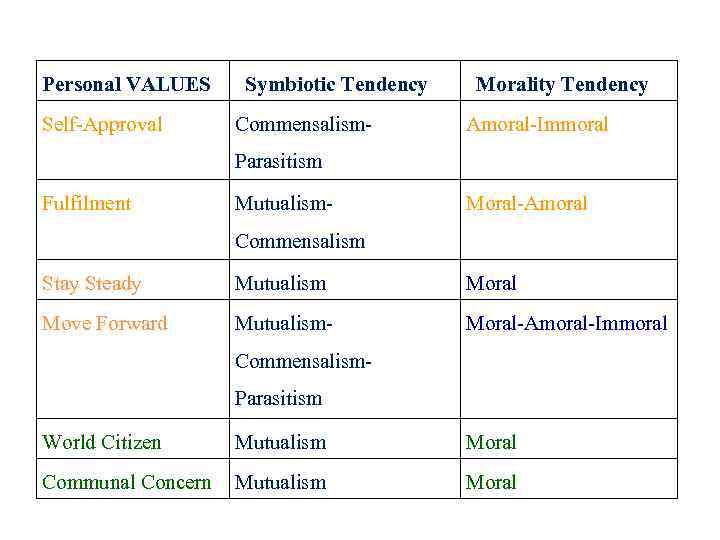 Personal VALUES Self-Approval Symbiotic Tendency Commensalism- Morality Tendency Amoral-Immoral Parasitism Fulfilment Mutualism- Moral-Amoral Commensalism Stay Steady Mutualism Moral Move Forward Mutualism- Moral-Amoral-Immoral Commensalism. Parasitism World Citizen Mutualism Moral Communal Concern Mutualism Moral
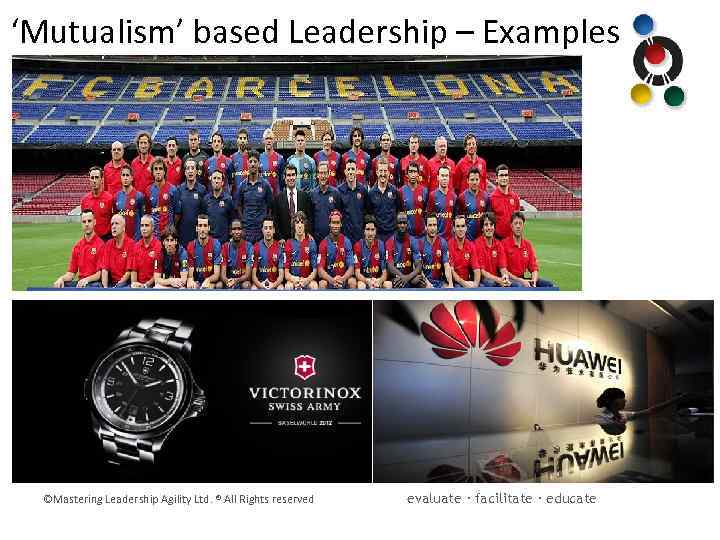 ‘Mutualism’ based Leadership – Examples ©Mastering Leadership Agility Ltd. ® All Rights reserved evaluate · facilitate · educate
 B Corps are for-profit companies certified by the non-profit B Lab to meet rigorous standards of social and environmental performance, accountability, and transparency Requiring companies to meet social sustainability and environmental performance standards, meet accountability standards, and to be transparent to the public according to the score they receive on the assessment. 50
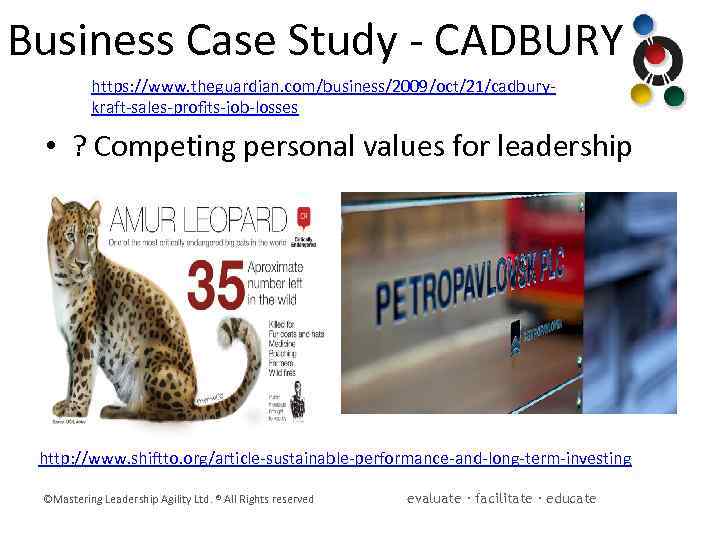 Business Case Study - CADBURY https: //www. theguardian. com/business/2009/oct/21/cadburykraft-sales-profits-job-losses • ? Competing personal values for leadership http: //www. shiftto. org/article-sustainable-performance-and-long-term-investing ©Mastering Leadership Agility Ltd. ® All Rights reserved evaluate · facilitate · educate
 https: //www. bu. edu/wcp/Papers/Poli. Demt. htm on SUSTAINABLE DEVELOPMENT PHILOSOPHY IN RUSSIA • Ja. Mil'ner-Irinin's study Etika ili printsy istinnoj chelovechnosti (Ethics or The Principles of a True Humanity) The author presented a normative system that he held to be universally valid and timeless. Harking back to the early days of German Idealism, Mil'ner-Irinin urged being true to one's conscience as a moral principle. However, he claimed he deduced his deontology from human social nature rather than from the idea of rationality (as in Kant). ©Mastering Leadership Agility Ltd. ® All Rights reserved evaluate · facilitate · educate
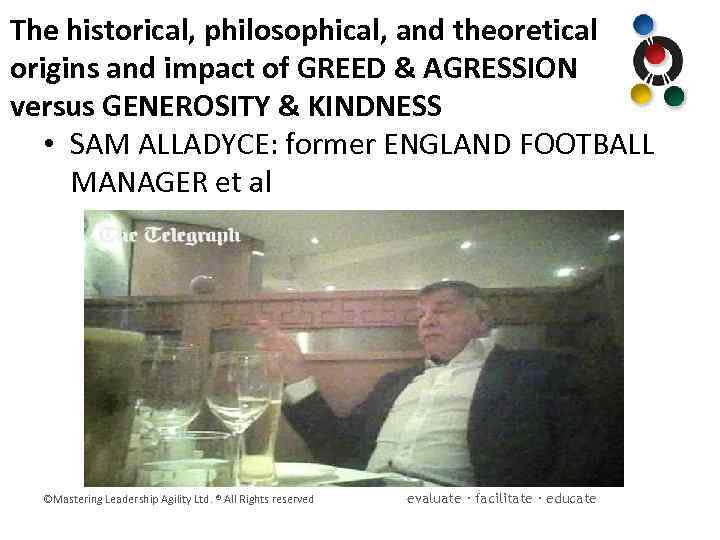 The historical, philosophical, and theoretical origins and impact of GREED & AGRESSION versus GENEROSITY & KINDNESS • SAM ALLADYCE: former ENGLAND FOOTBALL MANAGER et al ©Mastering Leadership Agility Ltd. ® All Rights reserved evaluate · facilitate · educate
 The Role of Education and Knowledge Generation-Exchange in Developing ‘Leadership for the Interconnected World’ • Critical Thinking (beyond the dominant 1980’s Business School’s ‘economic man’ view) • Multi-Disciplinary Thinking (history, philosophy, psychology, sociology, economics, ecology; we’ve forgotten how ideas join up in the study of human nature within the natural world) • Multi-Cultural Thinking (our discourse is already shaped by the media, our local context and ‘indirect’ world view) • Systems Thinking (all living things are connected and need to support each other, for both sustainable enterprise and life in general) • Values Thinking (understanding our unconscious drivers and prejudices, which influence our thoughts about leadership) • Reflective Thinking (about all of the above, and on the potential impacts of our leadership decisions and actions on all living matter, including us) ©Mastering Leadership Agility Ltd. ® All Rights reserved evaluate · facilitate · educate
 Next Steps: continuing our progress towards a new moral ontology of leadership, and developing the 12 leadership practices to implement it. Any questions pazhalsta? ©Mastering Leadership Agility Ltd. ® All Rights reserved evaluate · facilitate · educate