


 Скачать презентацию Historical Linguistics Change reconstruction LING 400 Winter 2010
904e0f2e65af4540f78a93b252043de0.ppt
- Количество слайдов: 26
 Historical Linguistics: Change, reconstruction LING 400 Winter 2010
 Overview n Reconstruction – Time-depth – Conversative vs. innovative languages – Reconstruction and prehistory n More historical change – Morphological, morphosyntactic – Semantic For further learning about historical linguistics: LING 454 please turn off your cell phone
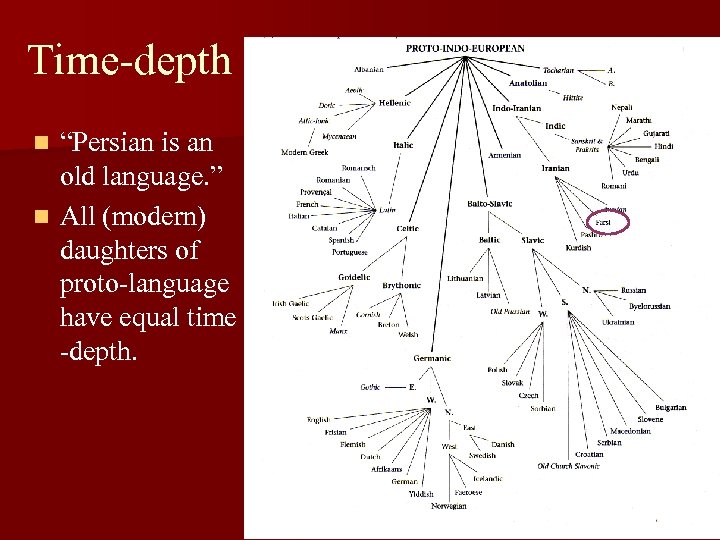 Time-depth “Persian is an old language. ” n All (modern) daughters of proto-language have equal time -depth. n
 Time-depth n Proto-Indo-European: 5000 -6000 years ago – Proto-Germanic: 2500 -3500 n Oldest IE written documents – Hittite 1300 B. C. – Sanskrit 1200 B. C. – Greek 1000 B. C. (Mycenean earlier)
 Reconstruction n The comparative method – assemble cognates – deduce proto-form, meaning n “Reconstructible” – Not necessarily attested in all branches – *ēg w- ‘drink’ § Hittite § Latin ēbrius ‘drunk’
![A cognate set n n n n Sanskrit [snuʂā ] ‘daughter-in-law’ Old English [snoru]](https://present5.com/presentation/904e0f2e65af4540f78a93b252043de0/image-6.jpg "A cognate set n n n n Sanskrit [snuʂā ] ‘daughter-in-law’ Old English [snoru]") A cognate set n n n n Sanskrit [snuʂā ] ‘daughter-in-law’ Old English [snoru] ‘daughter-in-law’ Old Church Slavonic [snŭxa] ‘daughter-in-law’ Latin [nurus] ‘daughter-in-law’ Greek [nuós] ‘daughter-in-law’ Armenian [nu] ‘bride, daughter-in-law’ Albanian [nuse] ‘bride’
A cognate set n n n n Sanskrit [snuʂā ] ‘daughter-in-law’ Old English [snoru] ‘daughter-in-law’ Old Church Slavonic [snŭxa] ‘daughter-in-law’ Latin [nurus] ‘daughter-in-law’ Greek [nuós] ‘daughter-in-law’ Armenian [nu] ‘bride, daughter-in-law’ Albanian [nuse] ‘bride’
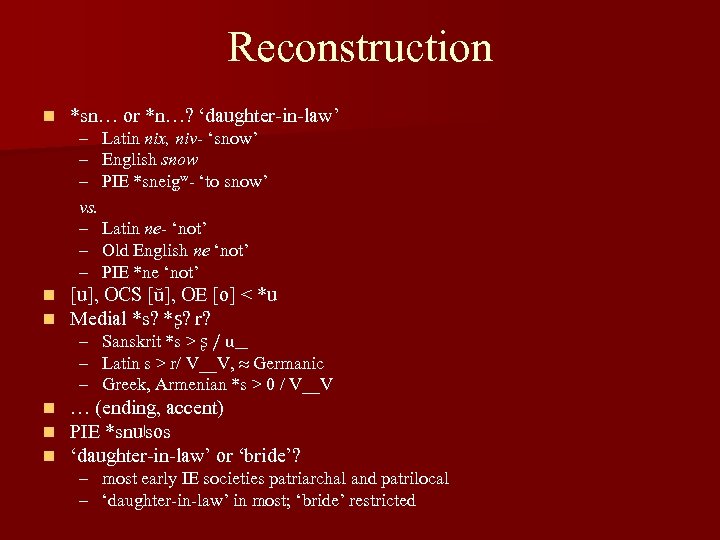 Reconstruction n *sn… or *n…? ‘daughter-in-law’ – Latin nix, niv- ‘snow’ – English snow – PIE *sneigw- ‘to snow’ vs. – Latin ne- ‘not’ – Old English ne ‘not’ – PIE *ne ‘not’ n n [u], OCS [ŭ], OE [o] < *u Medial *s? *ʂ? r? – Sanskrit *s > ʂ / u__ – Latin s > r/ V__V, Germanic – Greek, Armenian *s > 0 / V__V n n n … (ending, accent) PIE *snu|sos ‘daughter-in-law’ or ‘bride’? – most early IE societies patriarchal and patrilocal – ‘daughter-in-law’ in most; ‘bride’ restricted
![Conservative vs. innovative n Sanskrit [snuʂā ] < *snu|sos – conserves [sn], [u]; accent](https://present5.com/presentation/904e0f2e65af4540f78a93b252043de0/image-8.jpg "Conservative vs. innovative n Sanskrit [snuʂā ] < *snu|sos – conserves [sn], [u]; accent") Conservative vs. innovative n Sanskrit [snuʂā ] < *snu|sos – conserves [sn], [u]; accent – innovates *s > ʂ / u__ n Albanian [nuse] ‘bride’ – conserves [u], medial [s] – innovates *s > 0 / __n, semantics
Conservative vs. innovative n Sanskrit [snuʂā ] < *snu|sos – conserves [sn], [u]; accent – innovates *s > ʂ / u__ n Albanian [nuse] ‘bride’ – conserves [u], medial [s] – innovates *s > 0 / __n, semantics
 Reconstruction and prehistory n Calvert Watkins: ‘the lexicon of a language remains the single most effective way of approaching and understanding the culture of its speakers…The reconstruction of vocabulary can offer a fuller, more interesting view of the culture of a prehistoric people than archaeology precisely because it includes nonmaterial culture. ’
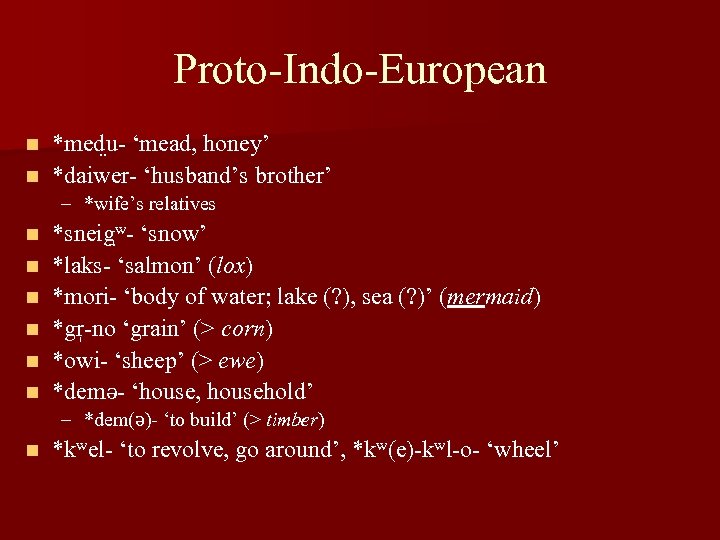 Proto-Indo-European *med u- ‘mead, honey’ un *daiwer- ‘husband’s brother’ n – *wife’s relatives n n n *sneigw- ‘snow’ *laks- ‘salmon’ (lox) *mori- ‘body of water; lake (? ), sea (? )’ (mermaid) *gr -no ‘grain’ (> corn) -no *owi- ‘sheep’ (> ewe) *demə- ‘house, household’ – *dem(ə)- ‘to build’ (> timber) n *kwel- ‘to revolve, go around’, *kw(e)-kwl-o- ‘wheel’
 Historical linguistics n 1786 Sir William Jones observed similarities between Sanskrit, Ancient Greek, Latin, Gothic, Celtic, Old Persian n 19 th century: reconstruction of PIE n 20 th century on – Hittite, Tocharian – Comparative method applicable elsewhere
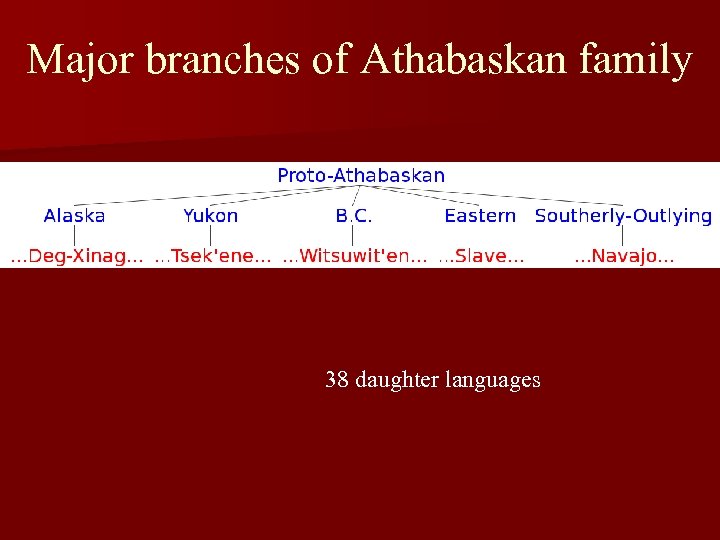 Major branches of Athabaskan family 38 daughter languages
 Language change n Languages may change on various levels – phonetics, phonology – morphology – syntax – semantics
![Morphemes disappear PA Deg Xinag ‘man’s daughter’ *-tsheʔ -[tθhɑʔ] ‘arm’ *-qɑ : neʔ -[qon]](https://present5.com/presentation/904e0f2e65af4540f78a93b252043de0/image-14.jpg "Morphemes disappear PA Deg Xinag ‘man’s daughter’ *-tsheʔ -[tθhɑʔ] ‘arm’ *-qɑ : neʔ -[qon]") Morphemes disappear PA Deg Xinag ‘man’s daughter’ *-tsheʔ -[tθhɑʔ] ‘arm’ *-qɑ : neʔ -[qon] : ne Witsuwit’en -[tshɛʔ] -- Tsek’ene --[kònèʔ]
Morphemes disappear PA Deg Xinag ‘man’s daughter’ *-tsheʔ -[tθhɑʔ] ‘arm’ *-qɑ : neʔ -[qon] : ne Witsuwit’en -[tshɛʔ] -- Tsek’ene --[kònèʔ]
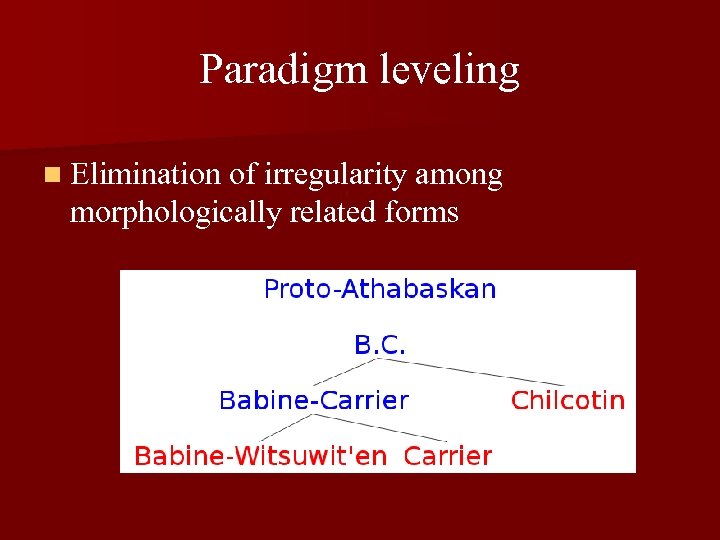 Paradigm leveling n Elimination of irregularity among morphologically related forms
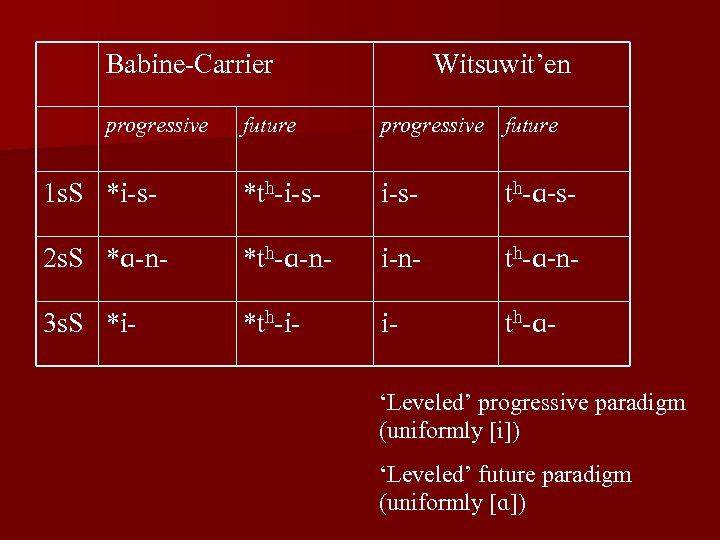 Babine-Carrier progressive Witsuwit’en future progressive future 1 s. S *i-s- *th-i-s- th-ɑ-s- 2 s. S *ɑ-n- *th-ɑ-n- i-n- th-ɑ-n- 3 s. S *i- *th-i- i- th-ɑ- ‘Leveled’ progressive paradigm (uniformly [i]) ‘Leveled’ future paradigm (uniformly [ɑ])
![Semantic change Reduction (hyponym formation) Proto-Athabaskan Tsek’ene n *-ʁəm ‘snore, growl’ -[hxõ h] ‘snore’](https://present5.com/presentation/904e0f2e65af4540f78a93b252043de0/image-17.jpg "Semantic change Reduction (hyponym formation) Proto-Athabaskan Tsek’ene n *-ʁəm ‘snore, growl’ -[hxõ h] ‘snore’") Semantic change Reduction (hyponym formation) Proto-Athabaskan Tsek’ene n *-ʁəm ‘snore, growl’ -[hxõ h] ‘snore’ h] n n Witsuwit’en n *-ntɑ : c ‘dance’ : c -[ntec] ‘(white people) dance’
Semantic change Reduction (hyponym formation) Proto-Athabaskan Tsek’ene n *-ʁəm ‘snore, growl’ -[hxõ h] ‘snore’ h] n n Witsuwit’en n *-ntɑ : c ‘dance’ : c -[ntec] ‘(white people) dance’
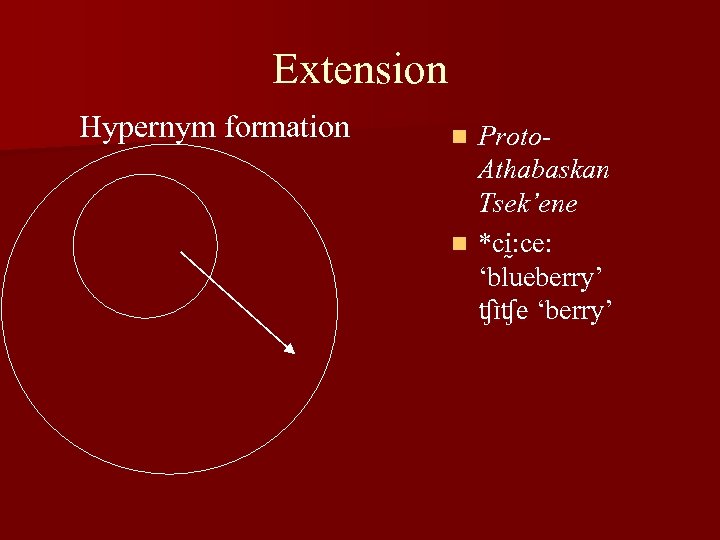 Extension Hypernym formation Proto. Athabaskan Tsek’ene n *ci : ce: ‘blueberry’ ʧɪ ʧe ‘berry’ n
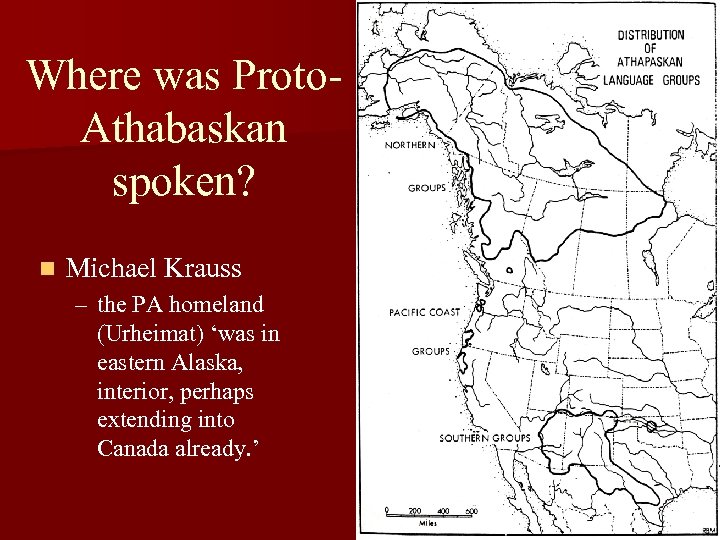 Where was Proto. Athabaskan spoken? n Michael Krauss – the PA homeland (Urheimat) ‘was in eastern Alaska, interior, perhaps extending into Canada already. ’
 Considerations n Deep vs. shallow differentiation n Location of related languages n Reconstructed vocabulary
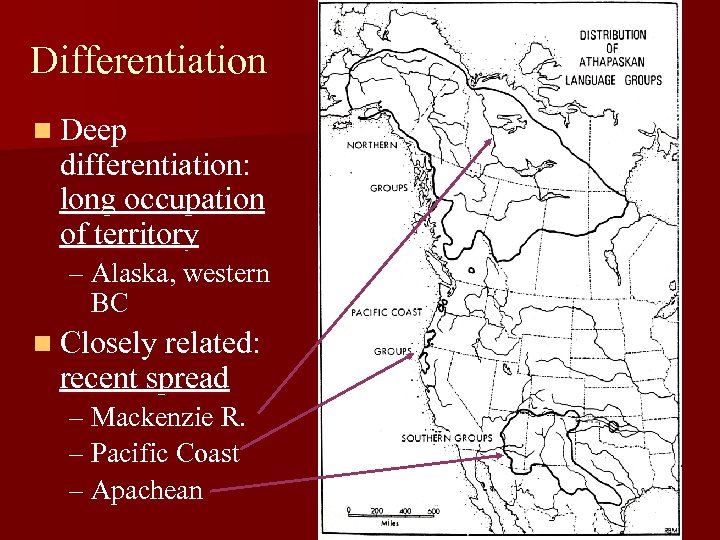 Differentiation n Deep differentiation: long occupation of territory – Alaska, western BC n Closely related: recent spread – Mackenzie R. – Pacific Coast – Apachean
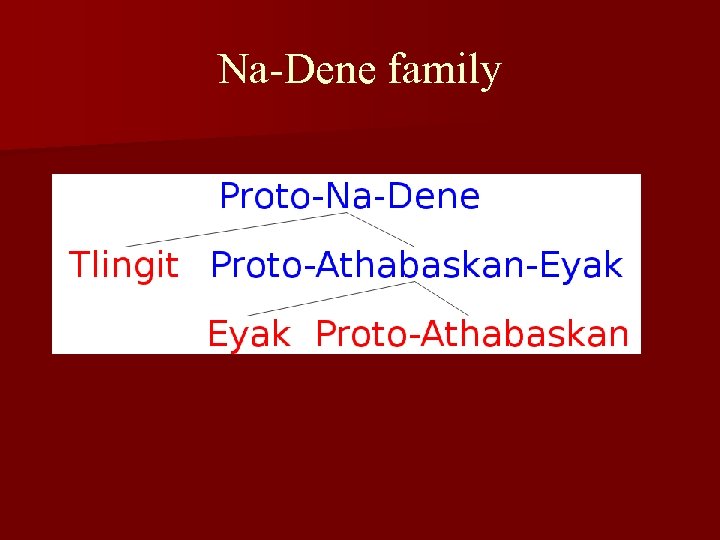 Na-Dene family
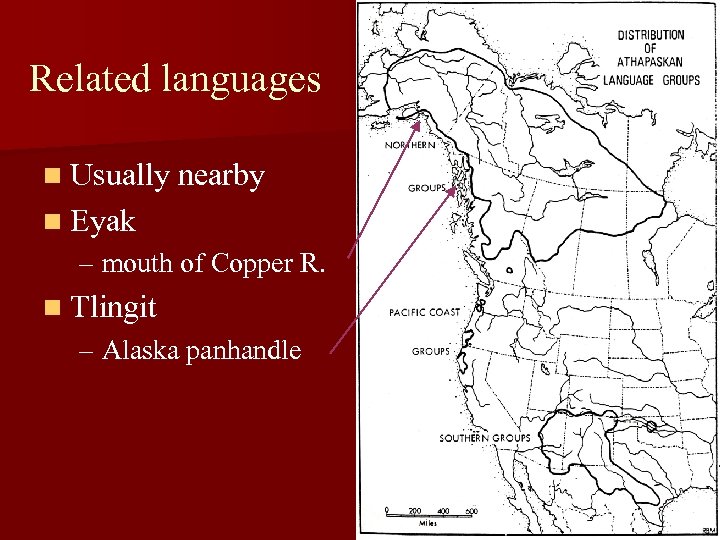 Related languages n Usually nearby n Eyak – mouth of Copper R. n Tlingit – Alaska panhandle
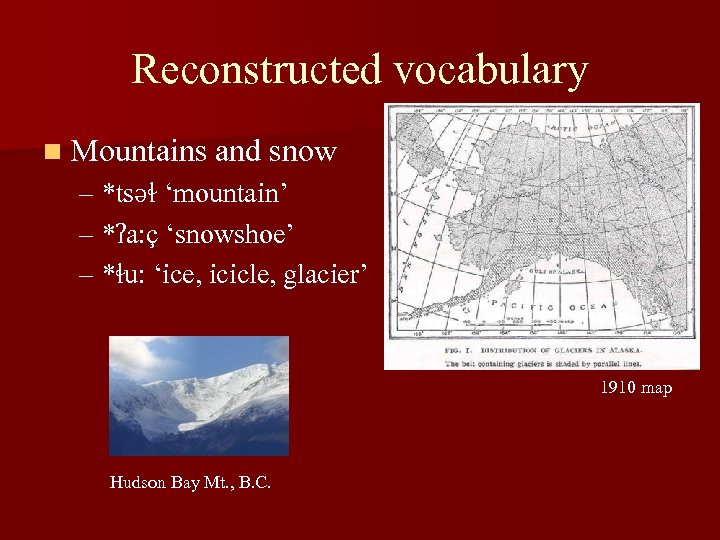 Reconstructed vocabulary n Mountains and snow – *tsəɬ ‘mountain’ – *ʔa: ç ‘snowshoe’ – *ɬu: ‘ice, icicle, glacier’ 1910 map Hudson Bay Mt. , B. C.
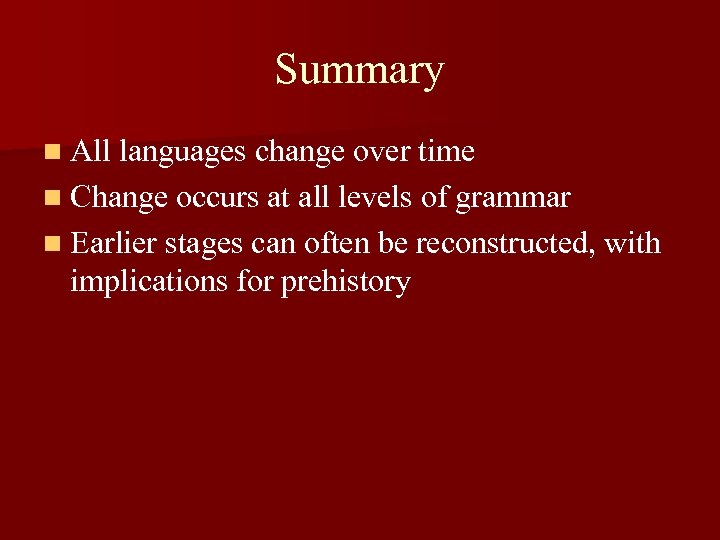 Summary n All languages change over time n Change occurs at all levels of grammar n Earlier stages can often be reconstructed, with implications for prehistory
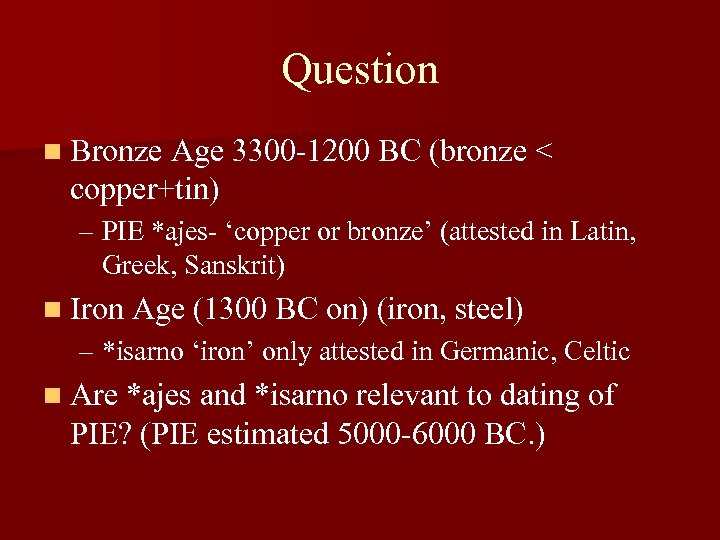 Question n Bronze Age 3300 -1200 BC (bronze < copper+tin) – PIE *ajes- ‘copper or bronze’ (attested in Latin, Greek, Sanskrit) n Iron Age (1300 BC on) (iron, steel) – *isarno ‘iron’ only attested in Germanic, Celtic n Are *ajes and *isarno relevant to dating of PIE? (PIE estimated 5000 -6000 BC. )