


 Скачать презентацию Historical and Scientific Foundation of Friction Skin Identification
bf098a3184f171319a6bb1aab959ba9d.ppt
- Количество слайдов: 30
 Historical and Scientific Foundation of Friction Skin Identification
 Created as a supplement to chapter 4 of Fingerprint Identification, by William Leo ©Copyright 2004 All rights reserved William Leo
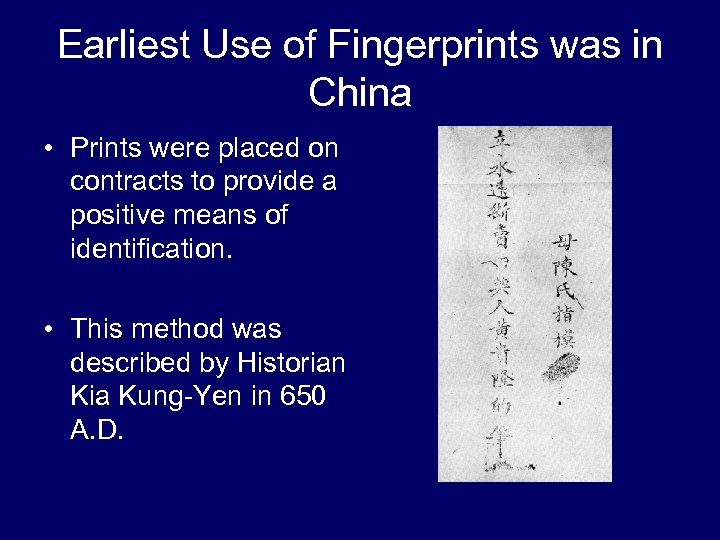 Earliest Use of Fingerprints was in China • Prints were placed on contracts to provide a positive means of identification. • This method was described by Historian Kia Kung-Yen in 650 A. D.
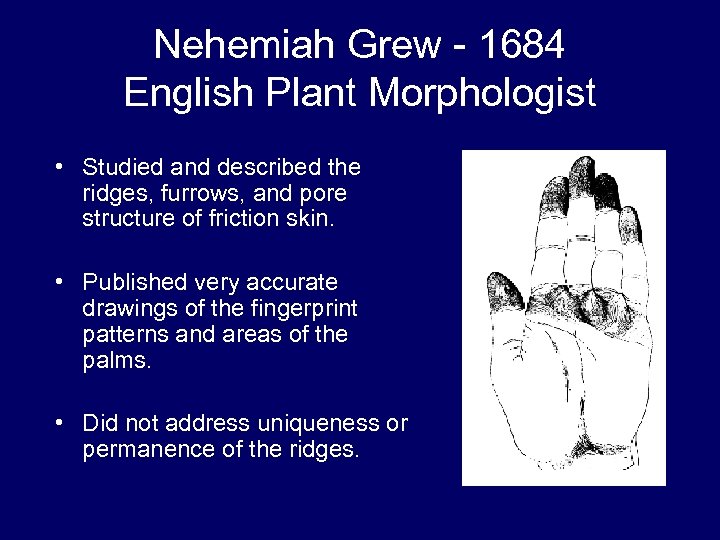 Nehemiah Grew - 1684 English Plant Morphologist • Studied and described the ridges, furrows, and pore structure of friction skin. • Published very accurate drawings of the fingerprint patterns and areas of the palms. • Did not address uniqueness or permanence of the ridges.
 Marcello Malphighi - 1685 Professor at University of Bologna • Used a microscope for the first time to examine friction skin and made observations as to its structure. • Did not address uniqueness or permanence of friction ridges. • Malpighian Layer of skin names after him, for his research contributions.
 Dr. J. C. A. Mayer • 1788 – Authored a book human anatomy and anatomical illustrations. The book is one of the earliest recordings supporting the uniqueness of fingerprints. • The book included drawings of friction skin and this still valid statement:
 “Although the arrangements of skin ridges is never duplicated in two persons, nevertheless the similarities are closer among some individuals. In others the differences are marked, yet in spite of their peculiarities of arrangement all have certain likeness. ” This statement has been verified by all other medical and scientific researcher of friction skin since!
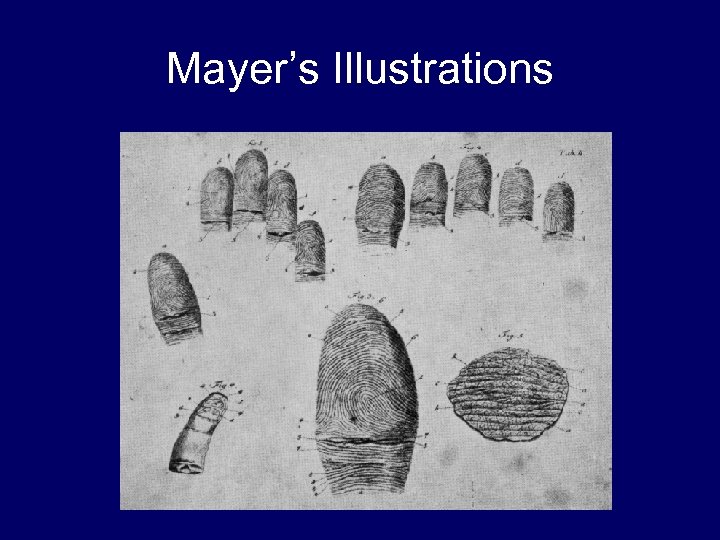 Mayer’s Illustrations
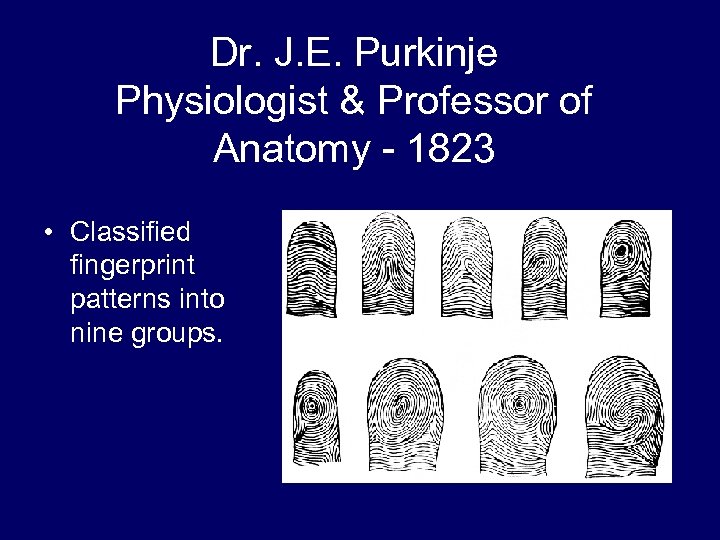 Dr. J. E. Purkinje Physiologist & Professor of Anatomy - 1823 • Classified fingerprint patterns into nine groups.
 Hermann Welcker German Anthropologist • Conducted first study into the permanence of friction ridges. • 34 years study from 1856 to 1897
 Dr. Henry Faulds Medical Doctor & Scientific Researcher • In 1880 wrote a letter that was published in the British Scientific Journal “Nature”. • Noted his research that fingerprints were permanent & unique. • Stated that prints left at crime scenes could lead to the scientific identification of criminals.
 Sir Francis Galton British Scientist and Anthropologist • Wrote first book on fingerprints in 1892. • Included his research into the uniqueness and permanence of fingerprints. • Educated at Cambridge University and studied mathematical probability under Dr. L. A. J. Quetelet. • Published first statistical study supporting the uniqueness of fingerprints.
 The Galton Details as Described in his text
 Galton’s Statistical Study - 1892 • Found that the statistical chance of a single duplicate fingerprint was 1 in 64 Billion. • Today’s Earth population is 5 to 6 Billion. • Study was reviewed in the publication Genetics, in 1995, was found to be still valid, but conservative in its statistical assessment!
 Sir William Herschel late 1800’s • Made observations that fingerprints were permanent and unique. • While a magistrate in India, used fingerprints for identification purposes. • Made the longest study into the permanence of friction ridges – 57 years!
 Inez Whipple – 1904 Professor of Biology • Published paper titled, “The Ventral Surface of the Mammalian Chiridium – with Special Reference to the Conditions Found in Man”. • This paper is the foundation of modern scientific knowledge of how friction skin is formed and why all areas of friction skin are unique.
 St. Louis World’s Fair 1904 & Meeting of the IACP • Sgt John Ferrier, of Scotland Yard, was assigned to the fair to guard the British Crown Jewels. • During his free time, he taught classes in fingerprint identification to attendees of the Int. Assoc. of Chiefs of Police Conference at the fair. • This resulted in the forming of fingerprint ID bureaus in the United States.
 Juan Vucetich -- Argentina • Developed a fingerprint classification system in 1891. System was used in most Spanish speaking countries until replacement with AFIS. • Vucetich solved a double murder (Rojas Murders) with bloody partial prints found at the scene in 1892.
 Sir Edward Henry - England • Developed the Henry System of fingerprint classification used for over 100 years in most English speaking countries. • Published his book Classification and Uses of Fingerprint in 1900. • Text included his research and statistical study demonstrating the uniqueness of fingerprints
 United States Navy • In 1907, the Navy was the first branch of service to adopt fingerprints for identification. • Using an acid etching, placed thumb prints on back of dog tags. • Soon after all branches of the military adopted fingerprint identification.
 People v. Jennings 254 Ill. 534 • First court acceptance of fingerprint identification in the United States in 1911. • Illinois State Supreme Court opinion: “We are disposed to hold from the evidence of four witnesses and from the writings we have referred to on the subject, that there is a scientific basis for the system of fingerprint identification. ”
 Dr. Harris Wilder Professor of Zoology • Along with Bret Wentworth published the textbook Personal Identification in 1918. • Book discussed their and other’s extensive research into the formation of friction skin, which explains why all areas of friction skin are unique. • Their Statistical study showed the chance of a duplicate single partial print was one in one quadrillion, nine hundred & fifty three trillion --- , or hundreds of times the population of the Earth.
 Federal Bureau of Investigation • Established the Identification Bureau in 1924 with 10, 000 fingerprint cards. • Today, the files have grown to approximately 50 million and is computerized. • Thousands of identification are made daily!
 Doctors Harold Cummins Ph. D. and & Charles Midlo M. D. Professors of Human Anatomy Tulane University • Wrote the text, Finger Prints, Palms, and Soles in 1943 and updated it in 1960. • Contains their extensive research into the formation and uniqueness of friction skin. • Text also included their and others statistical studies that support the uniqueness of friction skin.
 Alfred Hale, Ph. D. Professor of Anatomy, Tulane Univ. • 1952, published research paper titled: Morphogenesis of Volar Skin in the Human Fetus. • Explains differential growth or why fingerprints are randomly formed.
 Dr. Michio Okajima Medical Doctor, Japan • 1976 – Published his research paper titled: Dermal and Epidermal Structures of the Volar Skin. • His research verified and supports the knowledge that all areas of friction skin are unique and permanent.
 Dr. William Babler Professor of Biology Indiana University • 1980 to Present • Published a number of research papers explaining how friction skin is formed and why it is unique. • Testified at the first “Daubert hearing” in 1999 to the uniqueness of each individual friction ridge.
 Fingerprint Computers • First Automated Fingerprint Identification Systems (AFIS) went on line in the 1970’s. • Everyday, millions upon millions of partial prints are searched through these systems, resulting in thousands of identification a day. • Despite billions of searches to find matching prints over twenty-five years, no two different prints have been found to be alike.
 INTERPOL • “The axiom that not two persons have the same fingerprints is already firmly based. With the comparison of billions of prints per day, the opposite is never found, so the uniqueness is constantly confirmed in an unprecedented way. ” From the report of Interpol European Expert Group of Fingerprint conference, May 2000
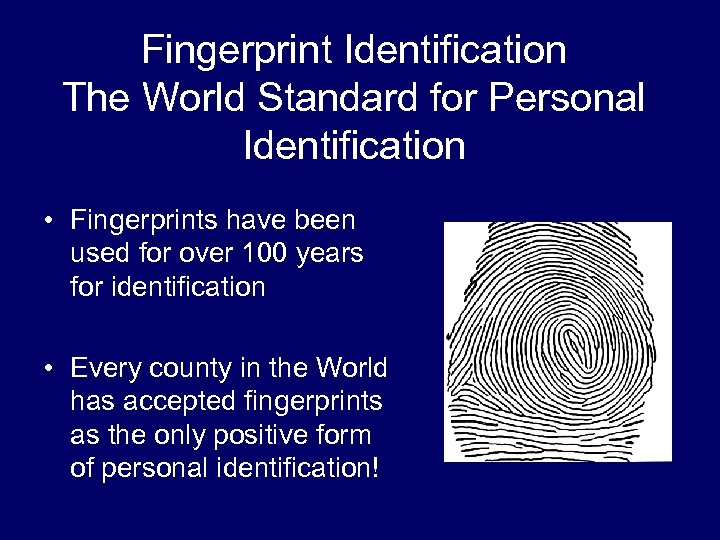 Fingerprint Identification The World Standard for Personal Identification • Fingerprints have been used for over 100 years for identification • Every county in the World has accepted fingerprints as the only positive form of personal identification!