


 Скачать презентацию Histological findings of femoral heads from patients with
e357133229b97faef49a815492085593.ppt
- Количество слайдов: 26
 Histological findings of femoral heads from patients with Gaucher disease treated with enzyme replacement Ehud Lebel MD, Deborah Elstein Ph. D, Ari Zimran MD, Constantine Reinus MD, Ariel Peleg BA, Gail Amir MB Ch. B. Dept. of Orthopaedic Surgery, Institute of Pathology, & Gaucher Clinic Shaare Zedek Medical Center, Jerusalem, Israel EWGGD 6 -2012 Paris FRANCE 1
 Disclosure Dr. Lebel has no financial or other constraints that may have impacted the results reported in this presentation 2
 Osteonecrosis (ON) in Gaucher disease • A common problem, adversely affects Qo. L • ~10% of int’l registry patients report ON [Khan et al, 2012] • Most common joints: – Hip, Shoulder, Knee, Ankle • Etiology: bone infarction • Consequence: joint destruction 61 y old, female 3
![Approach to osteonecrosis • Prevention? – Early ERT? YES[Mistry et al, 2009] – Core](https://present5.com/presentation/e357133229b97faef49a815492085593/image-4.jpg "Approach to osteonecrosis • Prevention? – Early ERT? YES[Mistry et al, 2009] – Core") Approach to osteonecrosis • Prevention? – Early ERT? YES[Mistry et al, 2009] – Core decompression? NO [Lebel et al, 2009] • Post Osteonecrosis – Total hip arthroplasty? Beneficial [Goldblatt et al 1998 and others] – ERT to decrease complications? Questionable [Donaldson et al, 2011] 35 y old male 4 y post-op 4
Approach to osteonecrosis • Prevention? – Early ERT? YES[Mistry et al, 2009] – Core decompression? NO [Lebel et al, 2009] • Post Osteonecrosis – Total hip arthroplasty? Beneficial [Goldblatt et al 1998 and others] – ERT to decrease complications? Questionable [Donaldson et al, 2011] 35 y old male 4 y post-op 4
 Can we do better? Risk reduction Improve management of ON • Prone genotypes? • Begin ERT early to protect from ON? • Refrain from splenectomy? • Can ERT improve Qo. L after ON? • Can ERT delay joint degeneration? • Is ON reversible? • Should we postpone THR until bony change is seen? [Fleshner er al, 1991] [Bubbar et al, 2009] 5
 Should we use histology-based evaluation? • Bone biopsies • Evaluation of retrieved specimens during THR Sliced retrieved femur head 6
 OR seek for other modalities? Imaging based workup 1. Plain radiographs [Rossi et al, 2011] 2. Bone density [Pastores et al 1996] 3. MR based modalities – – – Rosenthal et al [1986] Terk et al [2000] Dusseldorf [Poll et al, 2001] Vertebral Disc Ratio [Vlieger et al, 2002] Bone Marrow Burden Score [Maas et al, 2003] QCSI [Johnson et al, 1996] 7
 What is new • 2 years ago we presented our preliminary results • (EWGGD 2010, Köln Germany) • We know have an improved system for evaluation of bone specimens 8
 Our revised approach • Systematic detection of: A new systematic – Cellular components histological evaluation using – Gross architecture an expert pathologist’s – Necrosis pre-determined – Signs of bone classification system of bony regenerative activity characteristics (Prof. Gail Amir, Unit of Bone Pathology) 9
 Stage 1: bony milieu characteristics % of surface with Gaucher cell infiltrate in bone BONE MARROW 10
 Stage 2: detection of necrosis & arthritis 1. Presence of necrotic bone (yes/no) 2. Evidence of arthritic changes (yes/no) cartilage necrotic bone 11
 Stage 3: evidence of reparative activity 1 Osteoblastic rimming (grade 0 -3) 12
 Stage 3: evidence of reparative activity 2 Presence of remodeling lines (grade 0 -3) 13
 Stage 3: evidence of reparative activity 3 Apposition of new bone (grade 0 -3) New bone Dead bone 14
 What can we learn from bone biopsies? 1. Correlation with disease qualifiers 2. Correlation with of treatment 15
 Study cohort Interventions Personal data • 22 patients / 26 specimens – 2 pts had >1 specimen • 9 Females; 13 Males • Mean SSI=12. 7 (range: 6 -27) • Age (at operation): 17 -66 years • N 370 S/N 370 S: 12 (55%) • N 370 S/Other: 10 (45%) • • • Splenectomized: 17 (77%) ERT pre-surgery: 16 (73%) ON before start ERT: 6 (27%) ERT Duration: 1 -16 years Dosage: 15 -30 Units/kg/EOW 16
 Results 17
 Results 1: Bony milieu characteristics • Osteonecrotic bone: – 19/26 (73%) specimens – 7 (27%) specimens had no remnants of necrotic bone • Osteoarthritic changes: – Evident in all specimens containing cartilage 18
 Results 2: degree of Gaucher cell infiltration • Infiltrate seen in 20%-95% of histological specimen NO CORRELATION with – age of patient – type of mutation – Splenectomy A TREND was detected between duration of ERT and lesser % infiltrate (Spearman’s rho 4. 07) 19
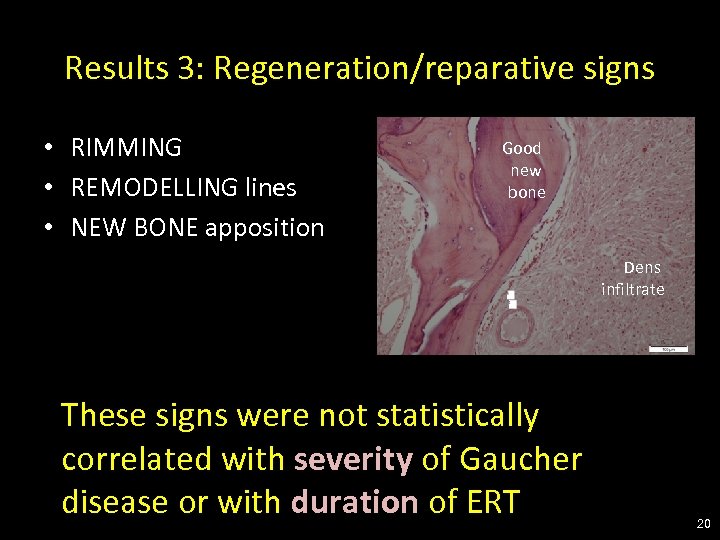 Results 3: Regeneration/reparative signs • RIMMING • REMODELLING lines • NEW BONE apposition Good new bone Dens infiltrate These signs were not statistically correlated with severity of Gaucher disease or with duration of ERT 20
 Limitations of current study • This is a retrospective study – Specimens were not prepared specifically for this study – Sampling of femoral head was limited to “regions of interest” – Special stains could not be used • Femur head (esp. after osteonecrosis) may not be representative – The necrotic event might change bony vasculature – This region may be less reactive to ERT – There are known differences between regions of bone 21
 What have we learned? 22
 1. Universal description of bone histology is needed A systematic evaluation score of bone biopsy in Gaucher-disease IS CRUCIAL for standardized description Necrosis and OA infiltrate Bone regeneration 23
 2. Do not delay intervention!! • There is no justification to postpone SURGICAL intervention until “IMPROVEMENT” occurs with ERT; • We have seen virtually no complications postsurgery and rare loosening event 24
 3. A non-invasive bone evaluation modality is needed • An imaging study, that would be correlated to biopsy results should be sought • This modality should help to monitor bony tissue reaction to ERT • MRI-based modality is probably the most appropriate 25
 Thank you Ehud Lebel MD (Orthopedic surgeon) lebel@szmc. org. il 26