


 Скачать презентацию Histoire naturelle de l infection organisme hôte colonisation défenses
6f350e3ebd0b54500018c62a95e6e59c.ppt
- Количество слайдов: 26
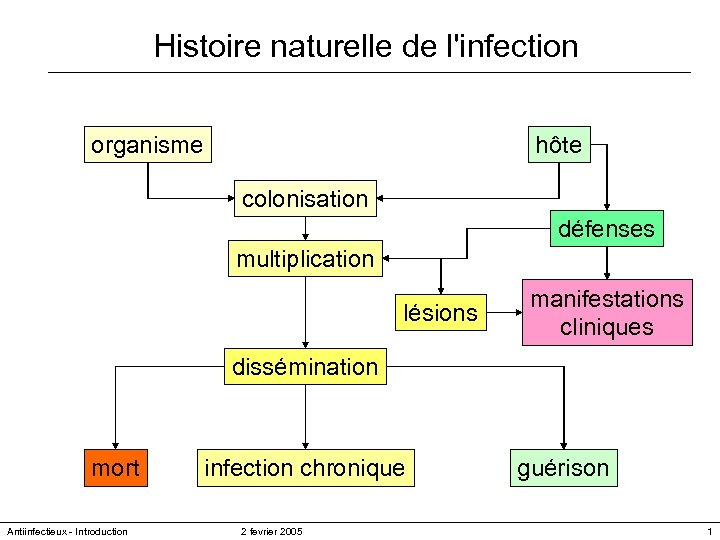 Histoire naturelle de l'infection organisme hôte colonisation défenses multiplication lésions manifestations cliniques dissémination mort Antiinfectieux - Introduction infection chronique 2 fevrier 2005 guérison 1
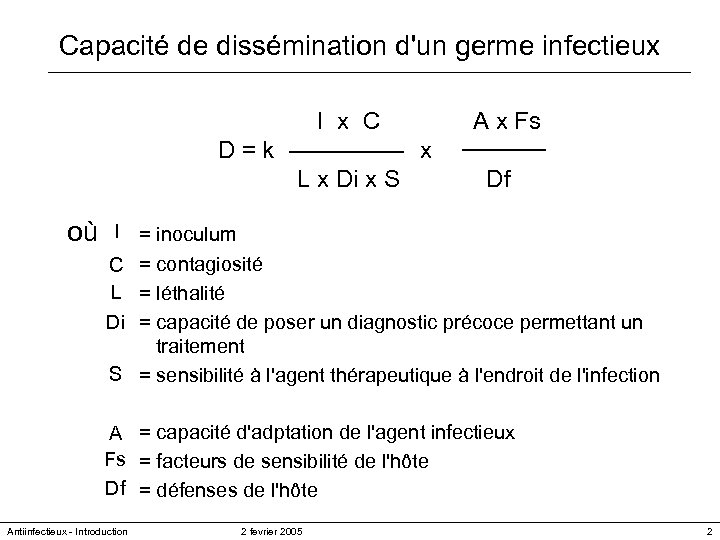 Capacité de dissémination d'un germe infectieux I x C D=k x L x Di x S où A x Fs Df I = inoculum C = contagiosité L = léthalité Di = capacité de poser un diagnostic précoce permettant un traitement S = sensibilité à l'agent thérapeutique à l'endroit de l'infection A = capacité d'adptation de l'agent infectieux Fs = facteurs de sensibilité de l'hôte Df = défenses de l'hôte Antiinfectieux - Introduction 2 fevrier 2005 2
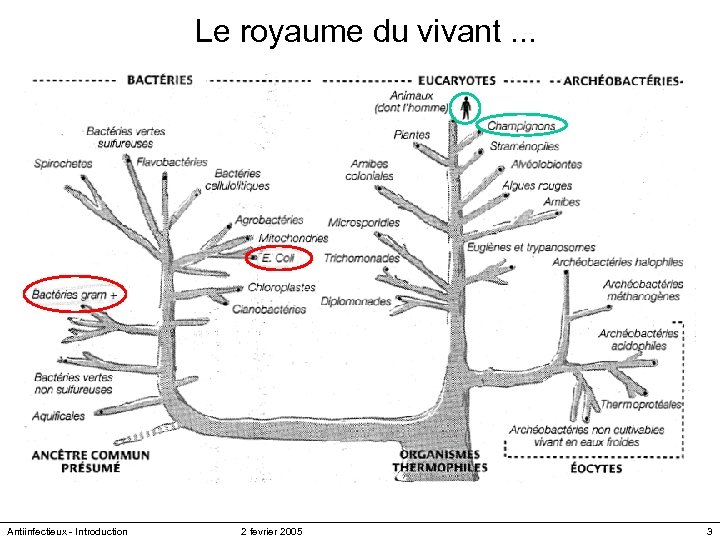 Le royaume du vivant. . . Antiinfectieux - Introduction 2 fevrier 2005 3
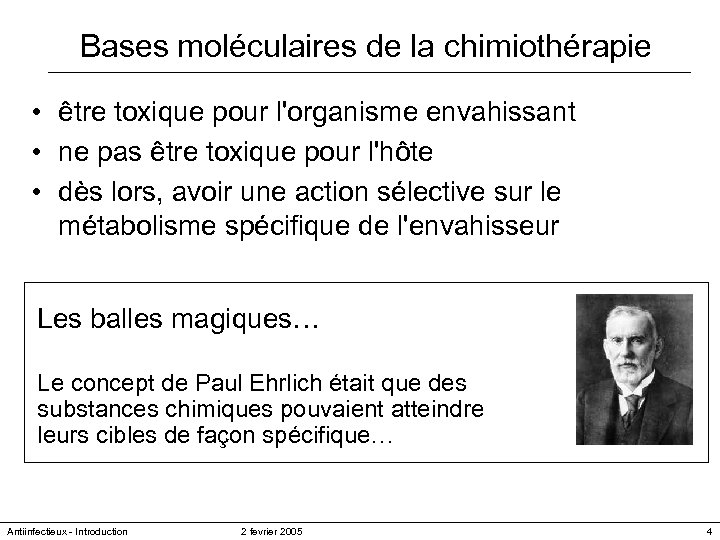 Bases moléculaires de la chimiothérapie • être toxique pour l'organisme envahissant • ne pas être toxique pour l'hôte • dès lors, avoir une action sélective sur le métabolisme spécifique de l'envahisseur Les balles magiques… Le concept de Paul Ehrlich était que des substances chimiques pouvaient atteindre leurs cibles de façon spécifique… Antiinfectieux - Introduction 2 fevrier 2005 4
 Quelles sont les cibles ? – classe I: métabolisme général è difficile. . . – classe II: métabolisme propre des micromolécules è parfois. . . – classe III: métabolisme propre des macromolécules è le plus fréquent … Antiinfectieux - Introduction 2 fevrier 2005 5
 Exemple de cibles. . . • classe II – synthèse de l'acide folique • sulfamides, pyrimétamine. . . – synthèse des pyrimidines • fluorouracil • classe II – synthèse du peptidoglycan • -lactames, glycopeptides, … – synthèse protéique • macrolides, aminoglycosides, lincosaminides, phénicolés … – métabolisme des ac. nucléiques • fluoroquinolones, ansamycines, . . . Antiinfectieux - Introduction 2 fevrier 2005 6
 Résistance. . . • est un phénomène naturel propre à tout ensemble d'êtres vivants soumis à une pression visant à les détruire. . . • résulte de l'acquisition de gènes (transmission / mutations) permettant, par leurs produits, d'échapper à l'agent destructeur • se transmet facilement entre bactéries – plasmides – transposons Antiinfectieux - Introduction 2 fevrier 2005 7
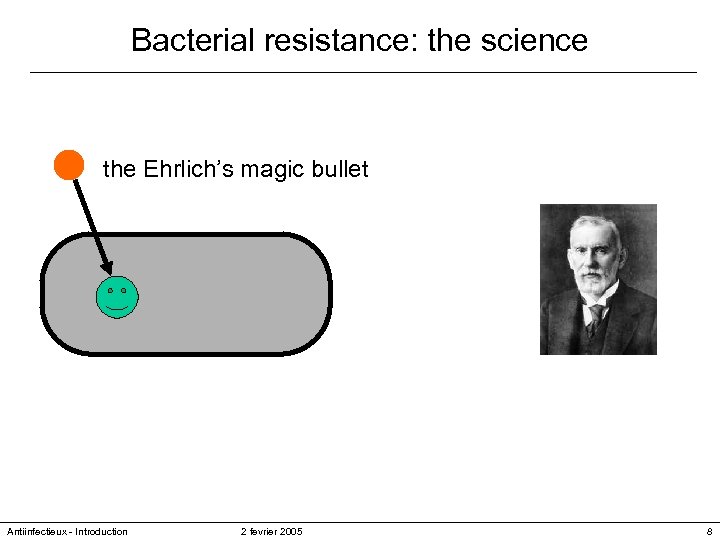 Bacterial resistance: the science the Ehrlich’s magic bullet Once upon a time, there was an happy bacteria. . . Antiinfectieux - Introduction 2 fevrier 2005 8
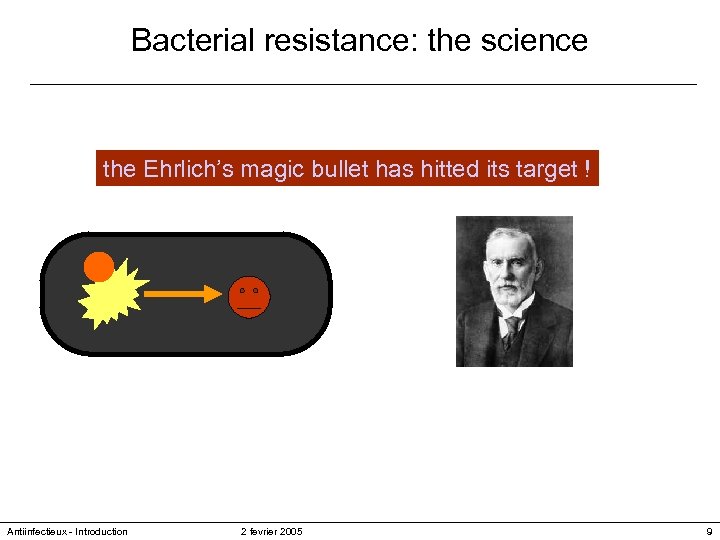 Bacterial resistance: the science the Ehrlich’s magic bullet has hitted its target ! And Ehrlich won … for a time. . . Antiinfectieux - Introduction 2 fevrier 2005 9
 Bacterial resistance: the science But only for a time. . . But only for a time… Antiinfectieux - Introduction 2 fevrier 2005 10
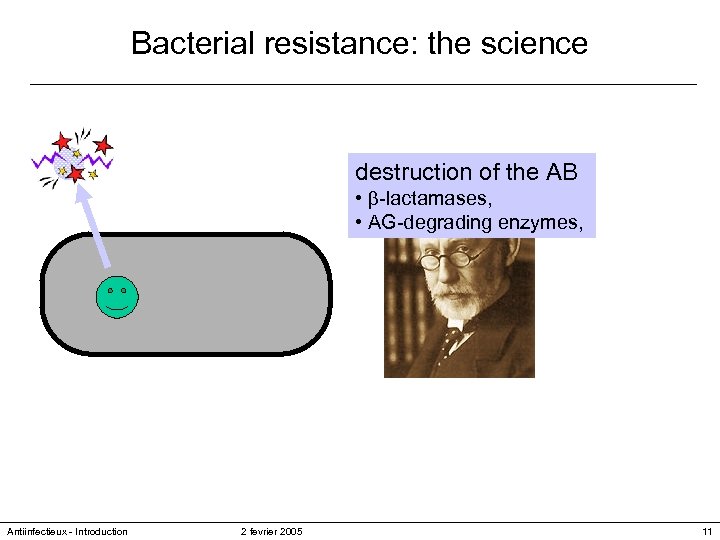 Bacterial resistance: the science What have we seen in less than 100 years. . . destruction of the AB • -lactamases, • AG-degrading enzymes, Antiinfectieux - Introduction 2 fevrier 2005 11
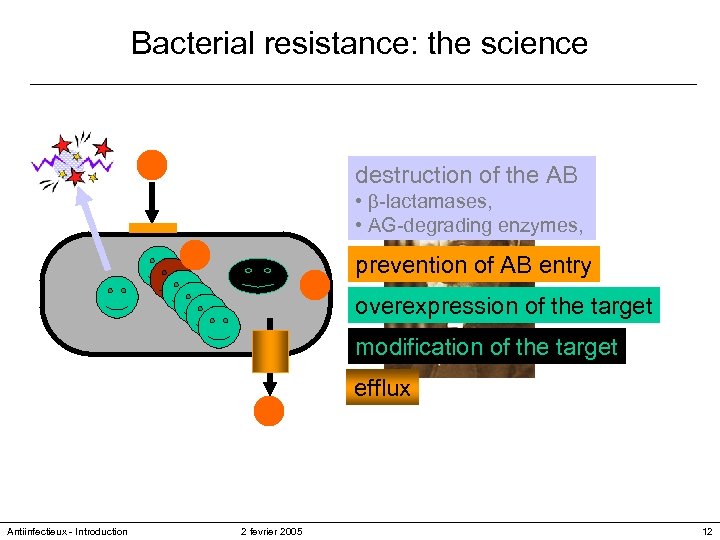 Bacterial resistance: the science What have we seen in less than 100 years. . . destruction of the AB • -lactamases, • AG-degrading enzymes, prevention of AB entry overexpression of the target modification of the target efflux Antiinfectieux - Introduction 2 fevrier 2005 12
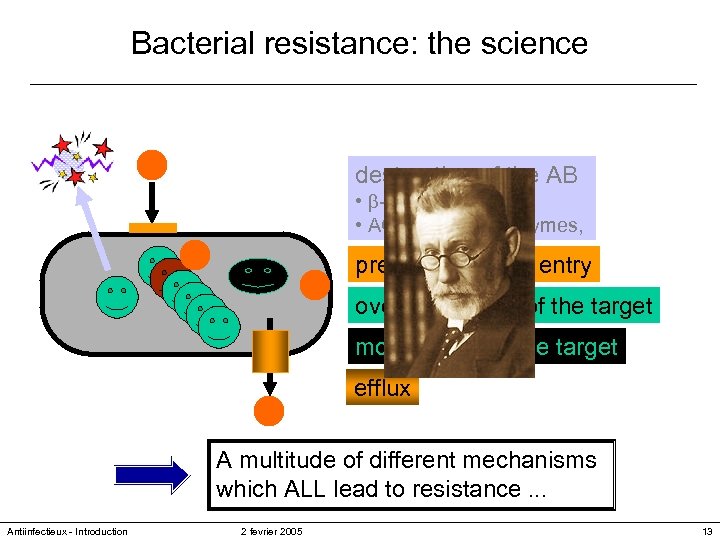 Bacterial resistance: the science What have we seen in less than 100 years. . . destruction of the AB • -lactamases, • AG-degrading enzymes, prevention of AB entry overexpression of the target modification of the target efflux A multitude of different mechanisms which ALL lead to resistance. . . Antiinfectieux - Introduction 2 fevrier 2005 13
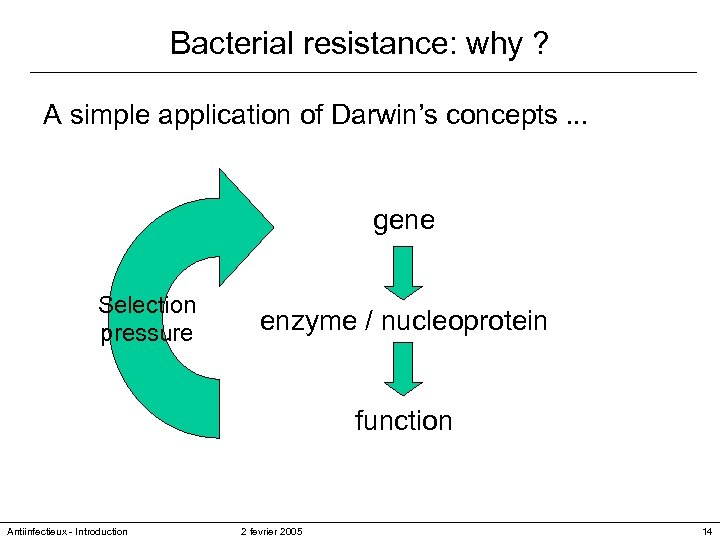 Bacterial resistance: why ? A simple application of Darwin’s concepts. . . gene Selection pressure enzyme / nucleoprotein function Antiinfectieux - Introduction 2 fevrier 2005 14
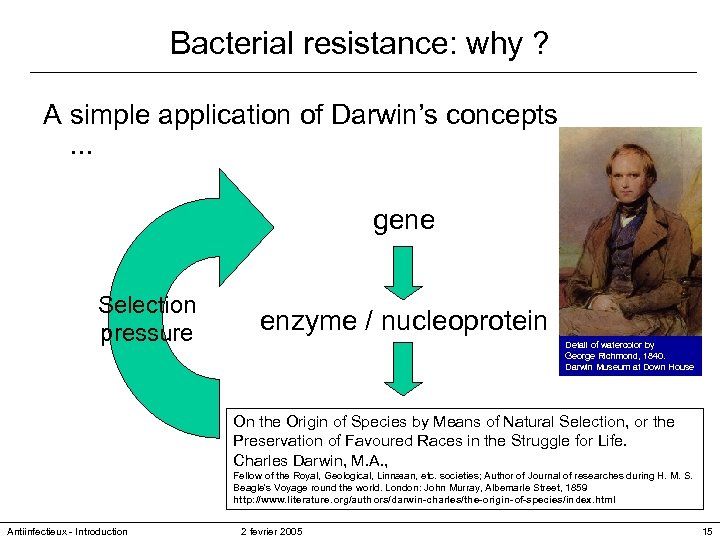 Bacterial resistance: why ? A simple application of Darwin’s concepts. . . gene Selection pressure enzyme / nucleoprotein Detail of watercolor by George Richmond, 1840. Darwin Museum at Down House function On the Origin of Species by Means of Natural Selection, or the Preservation of Favoured Races in the Struggle for Life. Charles Darwin, M. A. , Fellow of the Royal, Geological, Linnæan, etc. societies; Author of Journal of researches during H. M. S. Beagle's Voyage round the world. London: John Murray, Albemarle Street, 1859 http: //www. literature. org/authors/darwin-charles/the-origin-of-species/index. html Antiinfectieux - Introduction 2 fevrier 2005 15
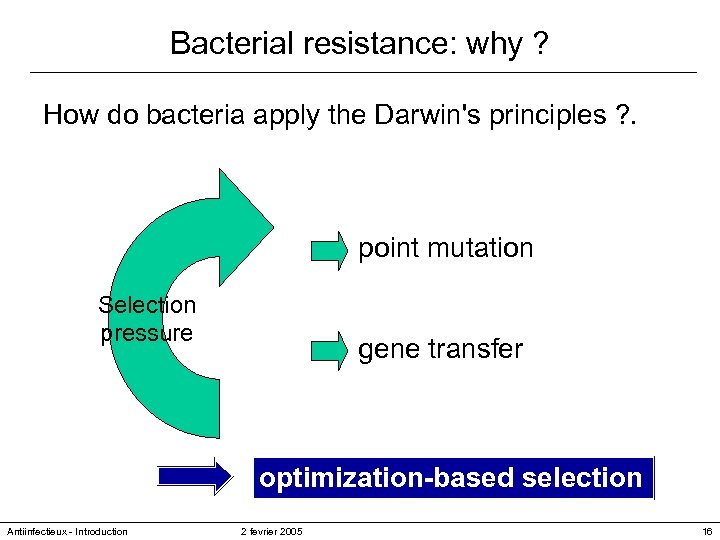 Bacterial resistance: why ? How do bacteria apply the Darwin's principles ? . - “ do it your-self “ point mutation Selection pressure - or “ buy it “ gene transfer - but always do it for the "best" optimization-based selection Antiinfectieux - Introduction 2 fevrier 2005 16
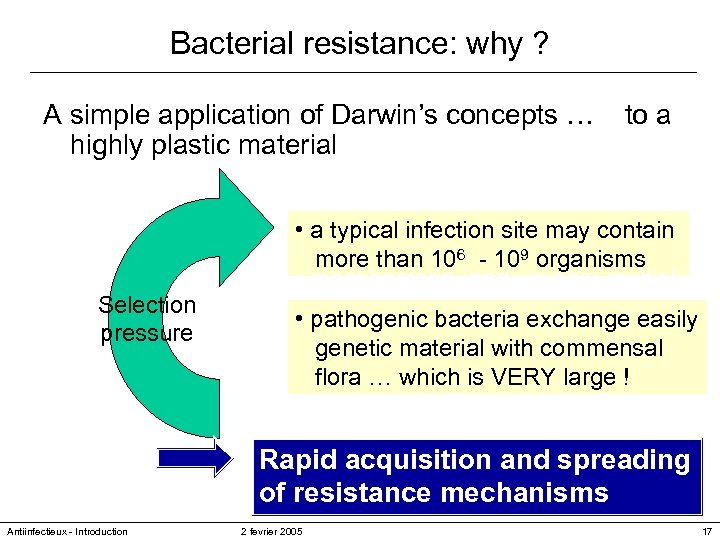 Bacterial resistance: why ? A simple application of Darwin’s concepts … highly plastic material Selection pressure to a • a typical infection site may contain more than 106 - 109 organisms • most bacteria (and viruses) multiply VERY fast bacteria exchange easily • pathogenic (20 min…) … and spread genetic material with commensal flora … which is VERY large ! Rapid acquisition and spreading of resistance mechanisms Antiinfectieux - Introduction 2 fevrier 2005 17
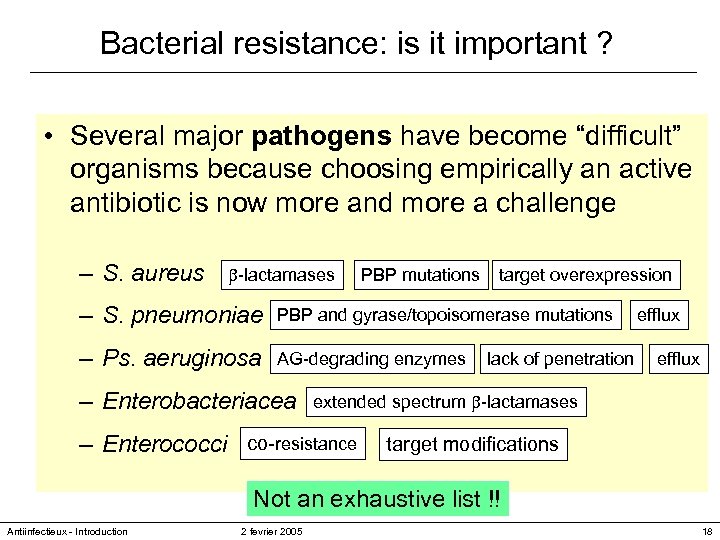 Bacterial resistance: is it important ? • Several major pathogens have become “difficult” organisms because choosing empirically an active antibiotic is now more and more a challenge – S. aureus -lactamases PBP mutations target overexpression – S. pneumoniae PBP and gyrase/topoisomerase mutations – Ps. aeruginosa AG-degrading enzymes – Enterobacteriacea lack of penetration efflux extended spectrum -lactamases – Enterococci co-resistance target modifications Not an exhaustive list !! Antiinfectieux - Introduction 2 fevrier 2005 18
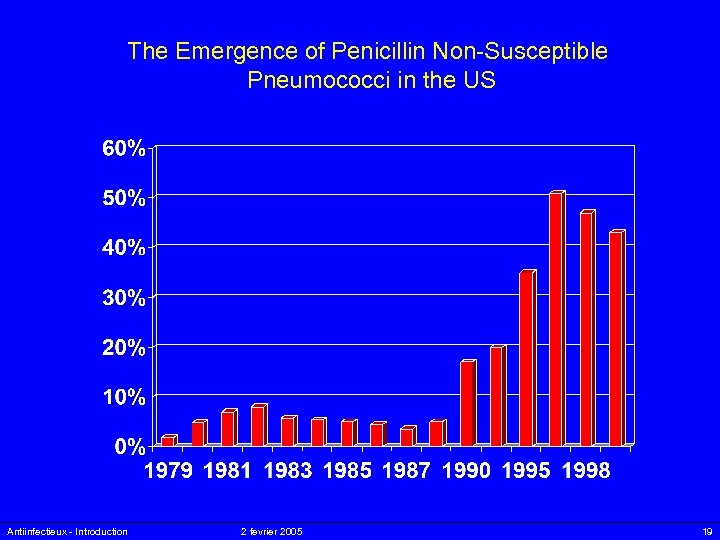 The Emergence of Penicillin Non-Susceptible Pneumococci in the US Antiinfectieux - Introduction 2 fevrier 2005 19
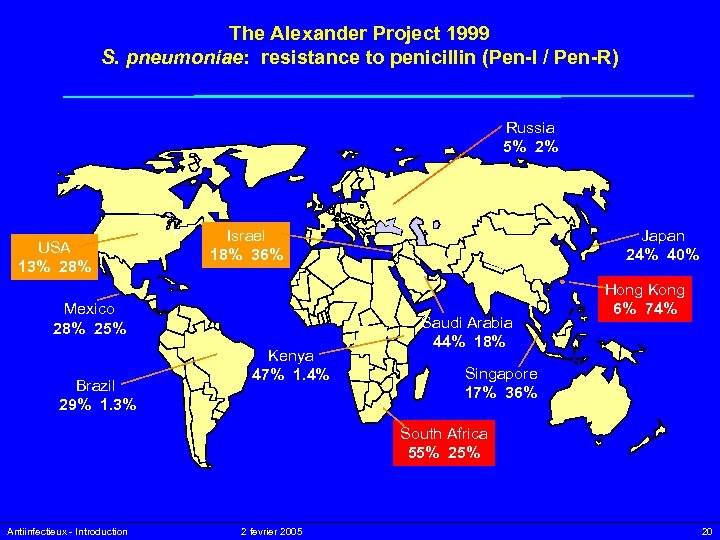 The Alexander Project 1999 S. pneumoniae: resistance to penicillin (Pen-I / Pen-R) Russia 5% 2% USA 13% 28% Israel 18% 36% Mexico 28% 25% Brazil 29% 1. 3% Kenya 47% 1. 4% Japan 24% 40% Saudi Arabia 44% 18% Hong Kong 6% 74% Singapore 17% 36% South Africa 55% 25% Antiinfectieux - Introduction 2 fevrier 2005 20
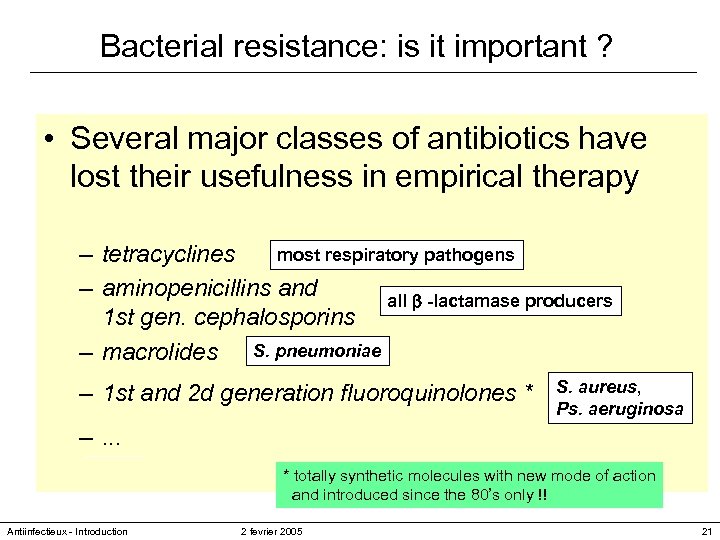 Bacterial resistance: is it important ? • Several major classes of antibiotics have lost their usefulness in empirical therapy most respiratory pathogens – tetracyclines – aminopenicillins and all -lactamase producers 1 st gen. cephalosporins – macrolides S. pneumoniae – 1 st and 2 d generation fluoroquinolones * S. aureus, Ps. aeruginosa –. . . * totally synthetic molecules with new mode of action and introduced since the 80’s only !! Antiinfectieux - Introduction 2 fevrier 2005 21
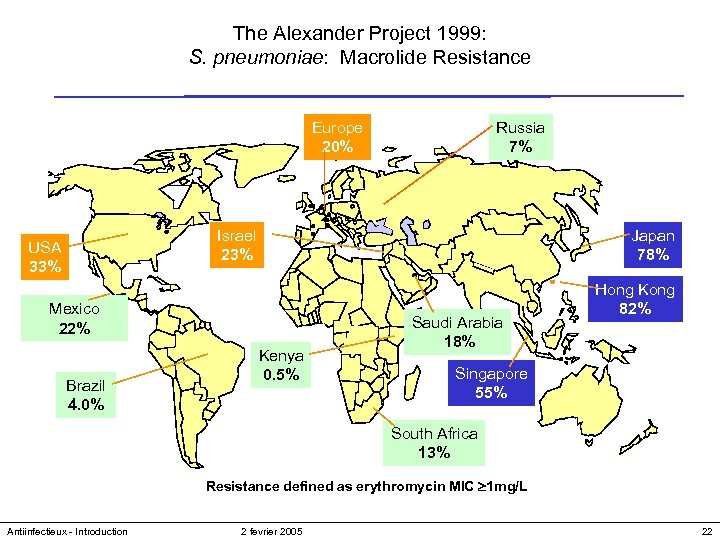 The Alexander Project 1999: S. pneumoniae: Macrolide Resistance Europe 20% Russia 7% Israel 23% USA 33% Japan 78% Mexico 22% Brazil 4. 0% Kenya 0. 5% Saudi Arabia 18% Hong Kong 82% Singapore 55% South Africa 13% Resistance defined as erythromycin MIC ³ 1 mg/L Antiinfectieux - Introduction 2 fevrier 2005 22
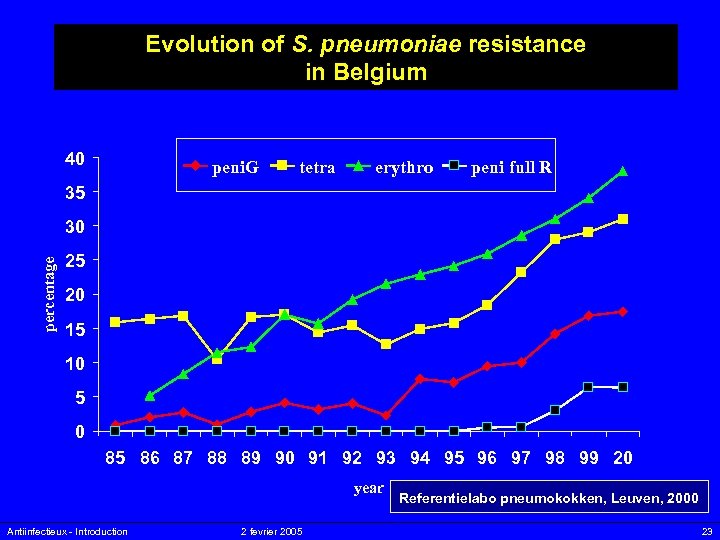 Evolution of S. pneumoniae resistance in Belgium 40 peni. G tetra erythro peni full R 35 percentage 30 25 20 15 10 5 0 85 86 87 88 89 90 91 92 93 94 95 96 97 98 99 20 year Antiinfectieux - Introduction 2 fevrier 2005 Referentielabo pneumokokken, Leuven, 2000 23
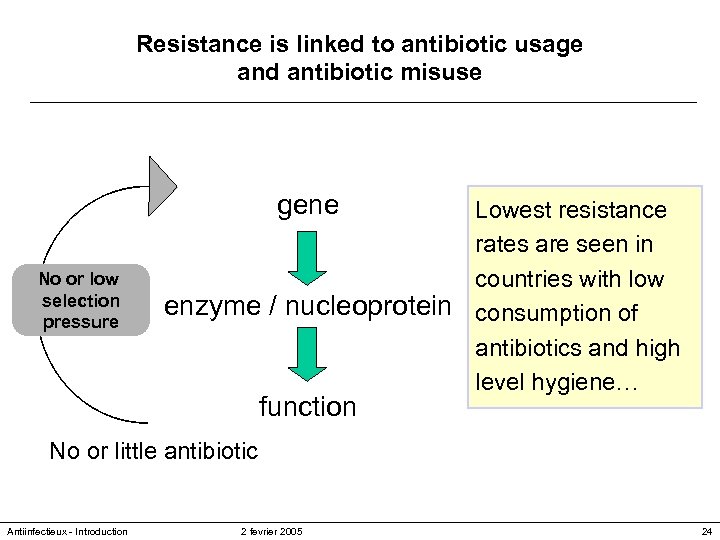 Resistance is linked to antibiotic usage and antibiotic misuse gene No or low selection pressure Lowest resistance rates are seen in countries with low enzyme / nucleoprotein consumption of antibiotics and high level hygiene… function No or little antibiotic Antiinfectieux - Introduction 2 fevrier 2005 24
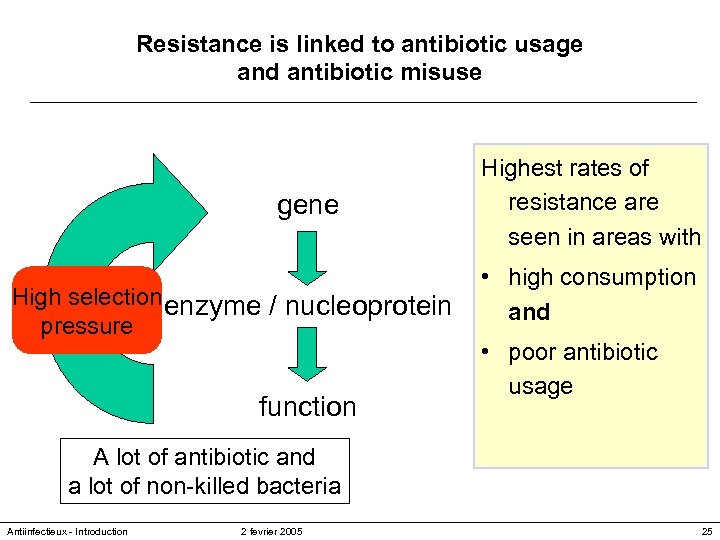 Resistance is linked to antibiotic usage and antibiotic misuse gene High selection enzyme / nucleoprotein pressure function Highest rates of resistance are seen in areas with • high consumption and • poor antibiotic usage A lot of antibiotic and a lot of non-killed bacteria Antiinfectieux - Introduction 2 fevrier 2005 25
 Paramètres utiles pour mesurer l'activité des antibiotiques • • Antiinfectieux - Introduction CMI / CMB synergie / antagonisme effet post-antibiotique pharmacodynamie 2 fevrier 2005 26