 Скачать презентацию Hints and Principles for Computer System Design Butler
69c05c925f33df8aac1f4d3b09a7c580.ppt
- Количество слайдов: 23



Hints and Principles for Computer System Design Butler Lampson Microsoft Research University of Cambridge May 26, 2015 1
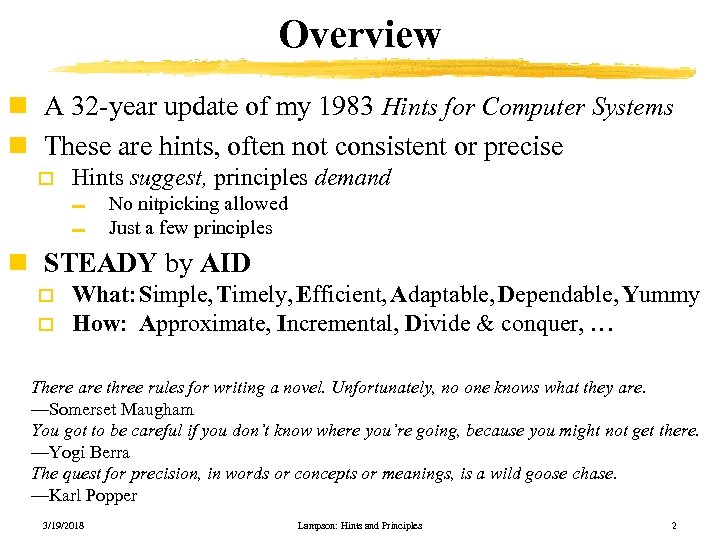
Overview n A 32 -year update of my 1983 Hints for Computer Systems n These are hints, often not consistent or precise o Hints suggest, principles demand ▬ ▬ No nitpicking allowed Just a few principles n STEADY by AID o o What: Simple, Timely, Efficient, Adaptable, Dependable, Yummy How: Approximate, Incremental, Divide & conquer, … There are three rules for writing a novel. Unfortunately, no one knows what they are. —Somerset Maugham You got to be careful if you don’t know where you’re going, because you might not get there. —Yogi Berra The quest for precision, in words or concepts or meanings, is a wild goose chase. —Karl Popper 3/19/2018 Lampson: Hints and Principles 2
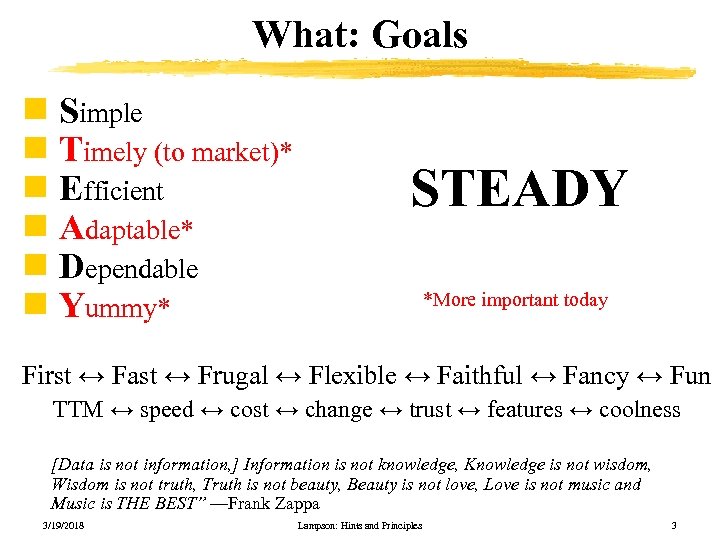
What: Goals n Simple n Timely (to market)* n Efficient n Adaptable* n Dependable n Yummy* STEADY *More important today First ↔ Fast ↔ Frugal ↔ Flexible ↔ Faithful ↔ Fancy ↔ Fun TTM ↔ speed ↔ cost ↔ change ↔ trust ↔ features ↔ coolness [Data is not information, ] Information is not knowledge, Knowledge is not wisdom, Wisdom is not truth, Truth is not beauty, Beauty is not love, Love is not music and Music is THE BEST” —Frank Zappa 3/19/2018 Lampson: Hints and Principles 3
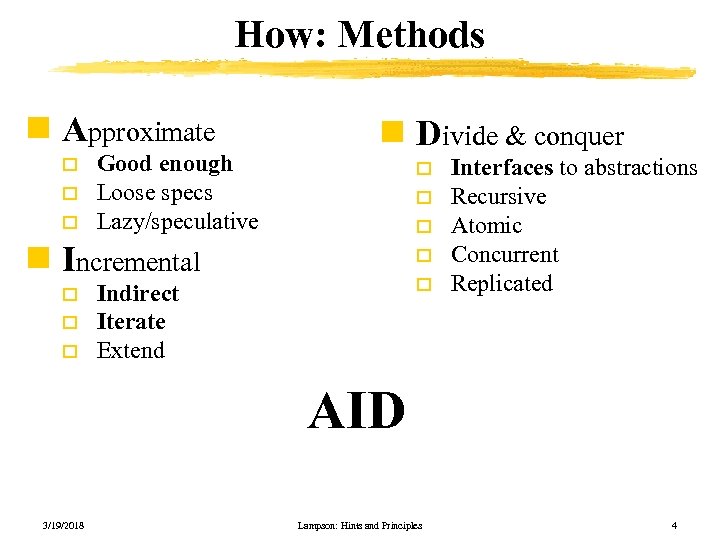
How: Methods n Approximate o o o Good enough Loose specs Lazy/speculative n Divide & conquer o o o n Incremental o o o Indirect Iterate Extend Interfaces to abstractions Recursive Atomic Concurrent Replicated AID 3/19/2018 Lampson: Hints and Principles 4
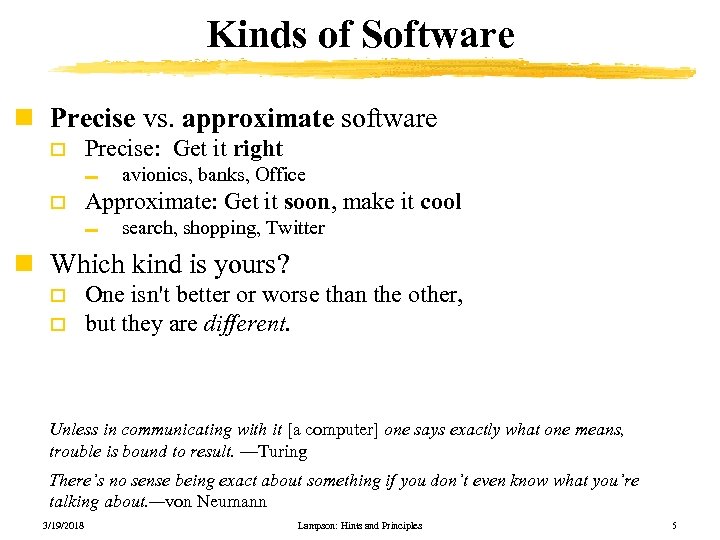
Kinds of Software n Precise vs. approximate software o Precise: Get it right ▬ o avionics, banks, Office Approximate: Get it soon, make it cool ▬ search, shopping, Twitter n Which kind is yours? o o One isn't better or worse than the other, but they are different. Unless in communicating with it [a computer] one says exactly what one means, trouble is bound to result. —Turing There’s no sense being exact about something if you don’t even know what you’re talking about. —von Neumann 3/19/2018 Lampson: Hints and Principles 5
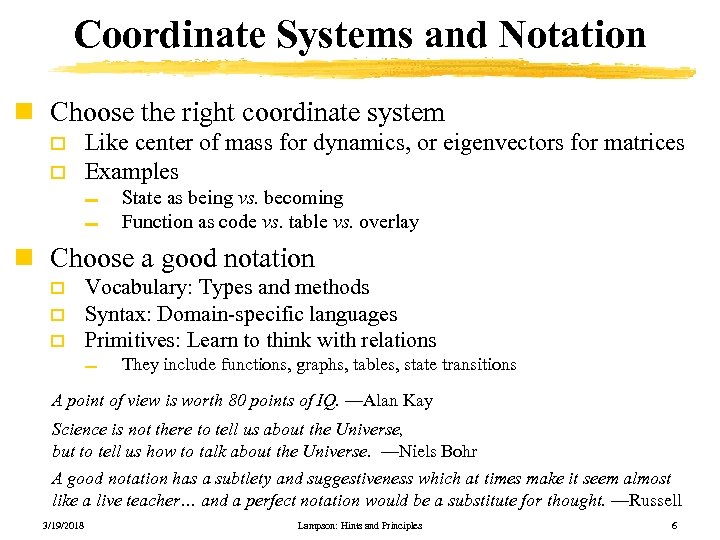
Coordinate Systems and Notation n Choose the right coordinate system o o Like center of mass for dynamics, or eigenvectors for matrices Examples ▬ ▬ State as being vs. becoming Function as code vs. table vs. overlay n Choose a good notation o o o Vocabulary: Types and methods Syntax: Domain-specific languages Primitives: Learn to think with relations ▬ They include functions, graphs, tables, state transitions A point of view is worth 80 points of IQ. —Alan Kay Science is not there to tell us about the Universe, but to tell us how to talk about the Universe. —Niels Bohr A good notation has a subtlety and suggestiveness which at times make it seem almost like a live teacher… and a perfect notation would be a substitute for thought. —Russell 3/19/2018 Lampson: Hints and Principles 6
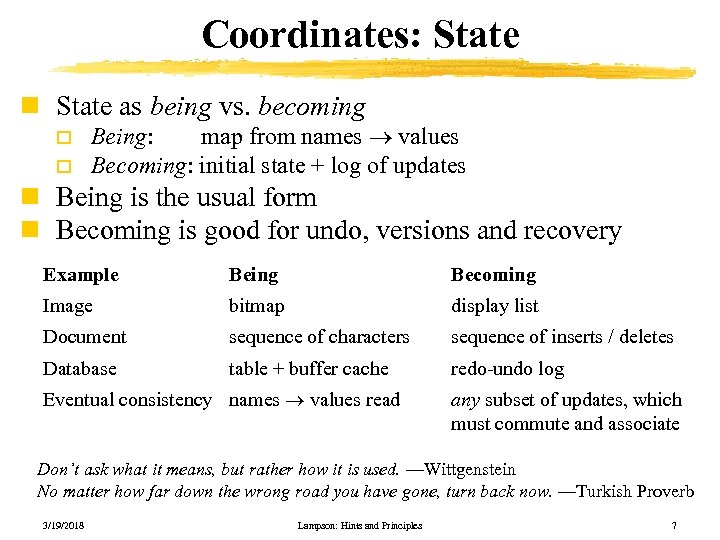
Coordinates: State n State as being vs. becoming o o Being: map from names values Becoming: initial state + log of updates n Being is the usual form n Becoming is good for undo, versions and recovery Example Being Becoming Image bitmap display list Document sequence of characters sequence of inserts / deletes Database table + buffer cache redo-undo log Eventual consistency names values read any subset of updates, which must commute and associate Don’t ask what it means, but rather how it is used. —Wittgenstein No matter how far down the wrong road you have gone, turn back now. —Turkish Proverb 3/19/2018 Lampson: Hints and Principles 7
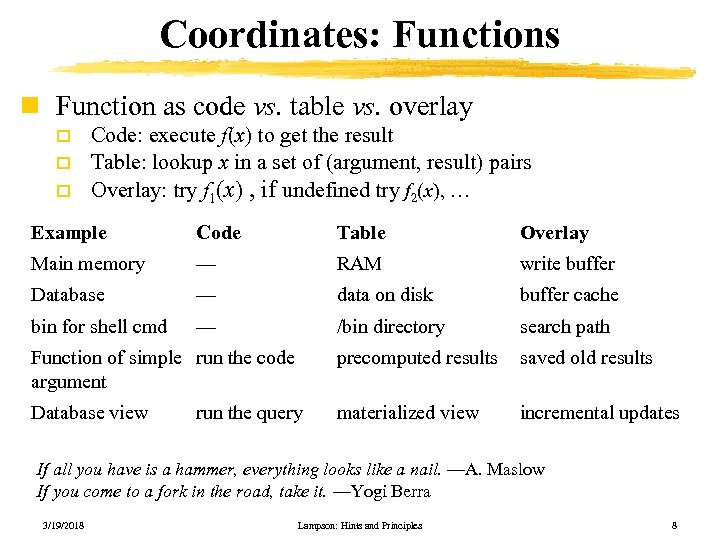
Coordinates: Functions n Function as code vs. table vs. overlay o o o Code: execute f(x) to get the result Table: lookup x in a set of (argument, result) pairs Overlay: try f 1(x) , if undefined try f 2(x), … Example Code Table Overlay Main memory — RAM write buffer Database — data on disk buffer cache bin for shell cmd — /bin directory search path Function of simple run the code argument precomputed results saved old results Database view materialized view incremental updates run the query If all you have is a hammer, everything looks like a nail. —A. Maslow If you come to a fork in the road, take it. —Yogi Berra 3/19/2018 Lampson: Hints and Principles 8
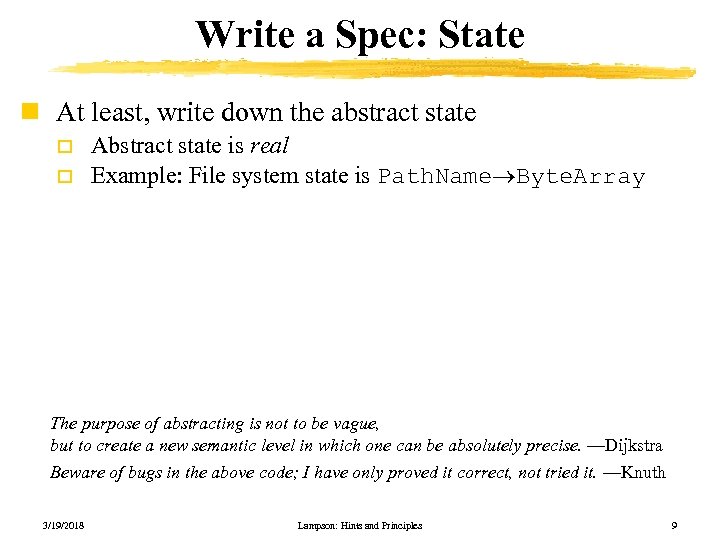
Write a Spec: State n At least, write down the abstract state o o Abstract state is real Example: File system state is Path. Name Byte. Array The purpose of abstracting is not to be vague, but to create a new semantic level in which one can be absolutely precise. —Dijkstra Beware of bugs in the above code; I have only proved it correct, not tried it. —Knuth 3/19/2018 Lampson: Hints and Principles 9
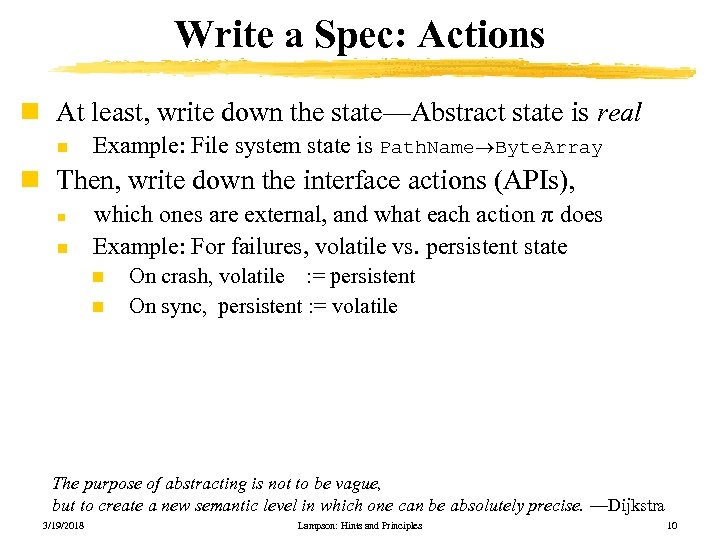
Write a Spec: Actions n At least, write down the state—Abstract state is real n Example: File system state is Path. Name Byte. Array n Then, write down the interface actions (APIs), n n which ones are external, and what each action π does Example: For failures, volatile vs. persistent state n n On crash, volatile : = persistent On sync, persistent : = volatile The purpose of abstracting is not to be vague, but to create a new semantic level in which one can be absolutely precise. —Dijkstra 3/19/2018 Lampson: Hints and Principles 10
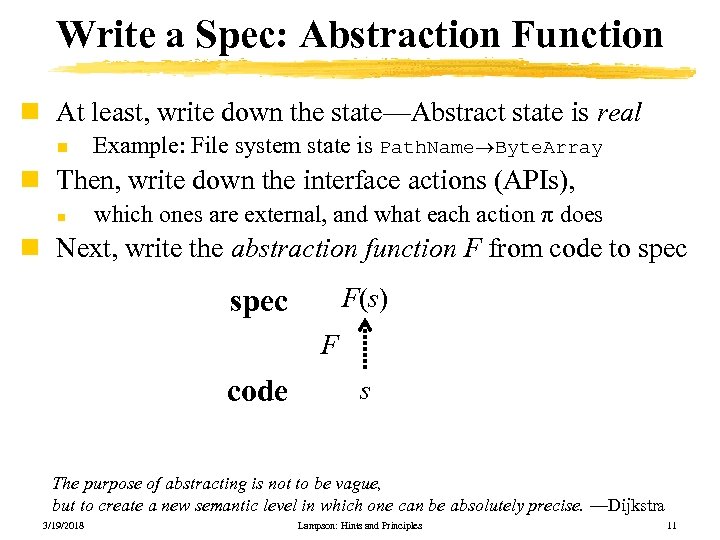
Write a Spec: Abstraction Function n At least, write down the state—Abstract state is real n Example: File system state is Path. Name Byte. Array n Then, write down the interface actions (APIs), n which ones are external, and what each action π does n Next, write the abstraction function F from code to spec F(s) F code s The purpose of abstracting is not to be vague, but to create a new semantic level in which one can be absolutely precise. —Dijkstra 3/19/2018 Lampson: Hints and Principles 11
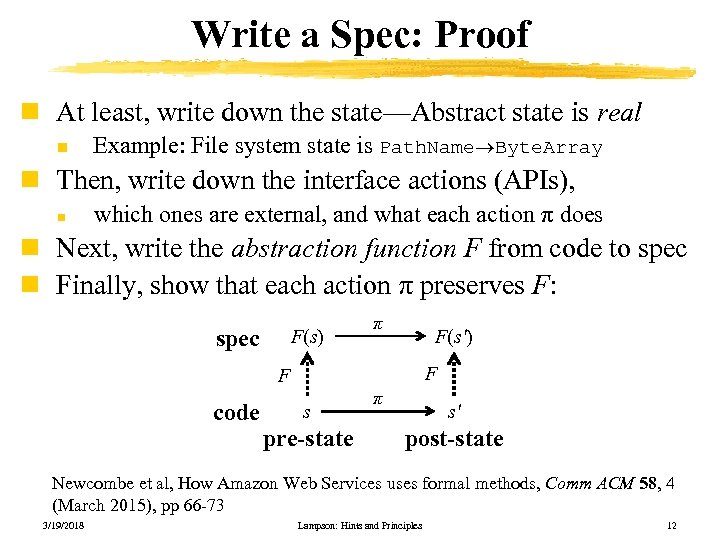
Write a Spec: Proof n At least, write down the state—Abstract state is real n Example: File system state is Path. Name Byte. Array n Then, write down the interface actions (APIs), n which ones are external, and what each action π does n Next, write the abstraction function F from code to spec n Finally, show that each action π preserves F: spec F(s) π F(s') F F code s pre-state π s' post-state Newcombe et al, How Amazon Web Services uses formal methods, Comm ACM 58, 4 (March 2015), pp 66 -73 3/19/2018 Lampson: Hints and Principles 12
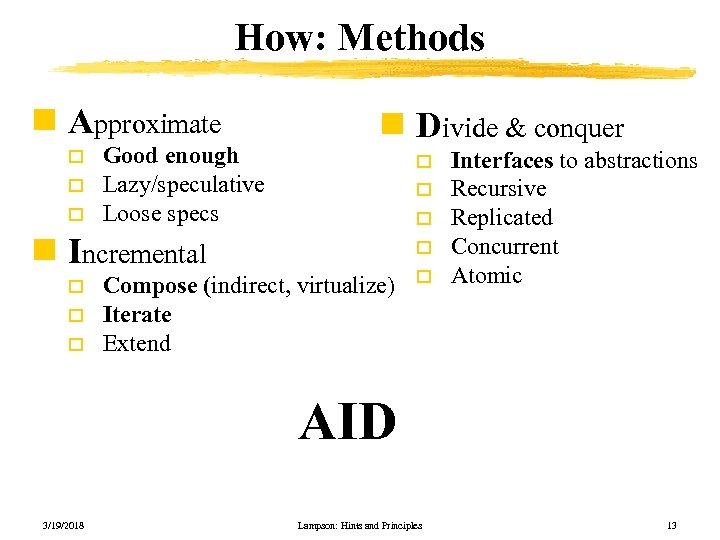
How: Methods n Approximate o o o Good enough Lazy/speculative Loose specs n Divide & conquer o o o n Incremental o o Compose (indirect, virtualize) Iterate Extend o Interfaces to abstractions Recursive Replicated Concurrent Atomic AID 3/19/2018 Lampson: Hints and Principles 13
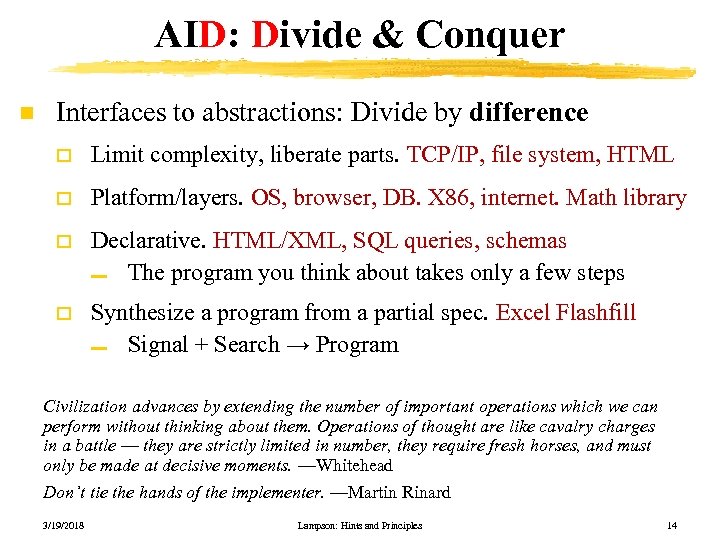
AID: Divide & Conquer n Interfaces to abstractions: Divide by difference o Limit complexity, liberate parts. TCP/IP, file system, HTML o Platform/layers. OS, browser, DB. X 86, internet. Math library o Declarative. HTML/XML, SQL queries, schemas ▬ The program you think about takes only a few steps o Synthesize a program from a partial spec. Excel Flashfill ▬ Signal + Search → Program Civilization advances by extending the number of important operations which we can perform without thinking about them. Operations of thought are like cavalry charges in a battle — they are strictly limited in number, they require fresh horses, and must only be made at decisive moments. —Whitehead Don’t tie the hands of the implementer. —Martin Rinard 3/19/2018 Lampson: Hints and Principles 14
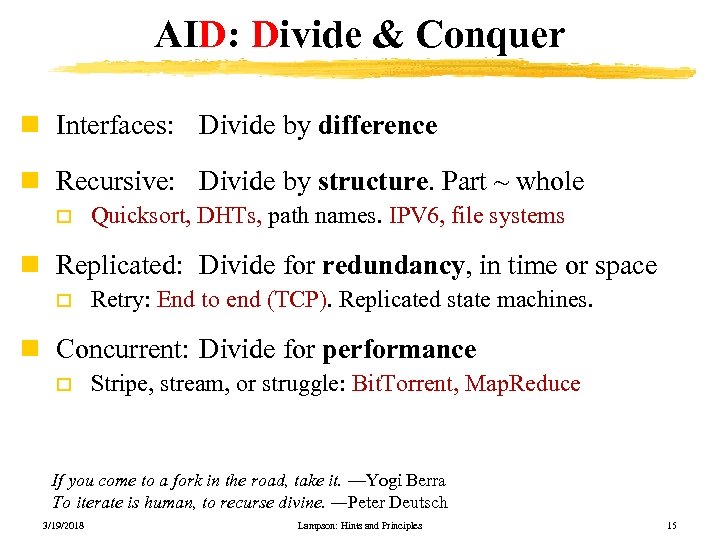
AID: Divide & Conquer n Interfaces: Divide by difference n Recursive: Divide by structure. Part ~ whole o Quicksort, DHTs, path names. IPV 6, file systems n Replicated: Divide for redundancy, in time or space o Retry: End to end (TCP). Replicated state machines. n Concurrent: Divide for performance o Stripe, stream, or struggle: Bit. Torrent, Map. Reduce If you come to a fork in the road, take it. —Yogi Berra To iterate is human, to recurse divine. —Peter Deutsch 3/19/2018 Lampson: Hints and Principles 15
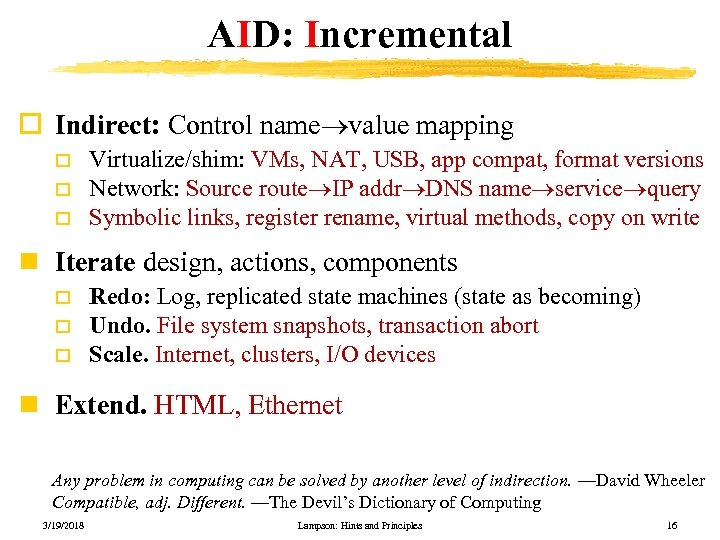
AID: Incremental o Indirect: Control name value mapping o o o Virtualize/shim: VMs, NAT, USB, app compat, format versions Network: Source route IP addr DNS name service query Symbolic links, register rename, virtual methods, copy on write n Iterate design, actions, components o o o Redo: Log, replicated state machines (state as becoming) Undo. File system snapshots, transaction abort Scale. Internet, clusters, I/O devices n Extend. HTML, Ethernet Any problem in computing can be solved by another level of indirection. —David Wheeler Compatible, adj. Different. —The Devil’s Dictionary of Computing 3/19/2018 Lampson: Hints and Principles 16
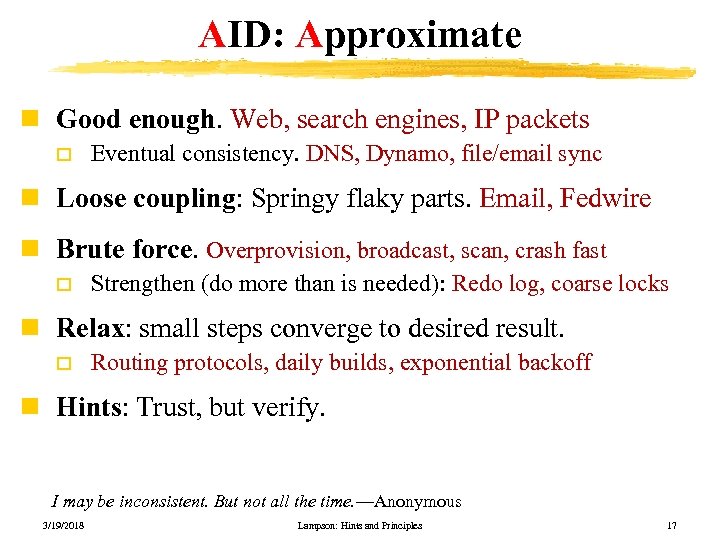
AID: Approximate n Good enough. Web, search engines, IP packets o Eventual consistency. DNS, Dynamo, file/email sync n Loose coupling: Springy flaky parts. Email, Fedwire n Brute force. Overprovision, broadcast, scan, crash fast o Strengthen (do more than is needed): Redo log, coarse locks n Relax: small steps converge to desired result. o Routing protocols, daily builds, exponential backoff n Hints: Trust, but verify. I may be inconsistent. But not all the time. —Anonymous 3/19/2018 Lampson: Hints and Principles 17
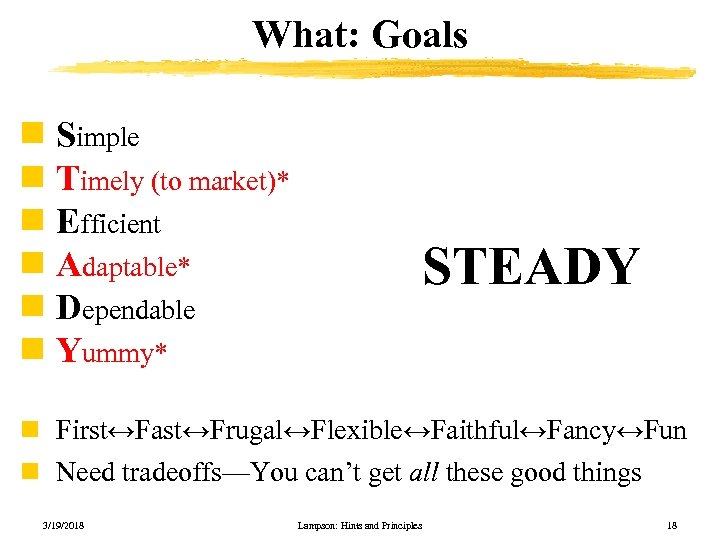
What: Goals n Simple n Timely (to market)* n Efficient n Adaptable* n Dependable n Yummy* STEADY n First↔Fast↔Frugal↔Flexible↔Faithful↔Fancy↔Fun n Need tradeoffs—You can’t get all these good things 3/19/2018 Lampson: Hints and Principles 18
STEADY: Simple, Timely n Simple is important because we can’t do much o Simple enough? I can still understand it ▬ o But when it evolves, only abstraction and interfaces can save me Simple is hard, often not rewarded—“That’s obvious. ” ▬ Why didn’t computer scientists invent the web? n Timely: Good enough is good enough o o The web is successful because it doesn’t have to work. Learn what customers really want—Iterative development Less is more. —Browning Everything should be as simple as possible, but no simpler. —Einstein I’m sorry I wrote you such a long letter; I didn’t have time to write a short one. —Pascal The best is the enemy of the good. —Voltaire If you don’t think too good, don’t think too much. —Ted Williams And the users exclaimed with a laugh and a taunt, “It's just what we asked for but not what we want. ” —Anonymous 3/19/2018 Lampson: Hints and Principles 19
STEADY: Efficient, Adaptable n Efficient has two faces: for the implementer, for the client o o Not unrelated: the client wants it fast and cheap enough Efficient enough, not optimal n Adaptable–Plan for success o Evolution/scaling: Successful systems live a long time ▬ o 2015 PC = 100, 000 Xerox Alto, Web grew from 100 users to 109 Incremental update: Big things change a little at a time An efficient program is an exercise in logical brinkmanship. —Dijkstra I see how it [the phone] works. It rings, and you have to get up. —Degas That, Sir, is the good of counting. It brings everything to a certainty, which before floated in the mind indefinitely. —Samuel Johnson Success is never final. —Churchill APL is like a diamond; Lisp is like a ball of mud. —Joel Moses 3/19/2018 Lampson: Hints and Principles 20
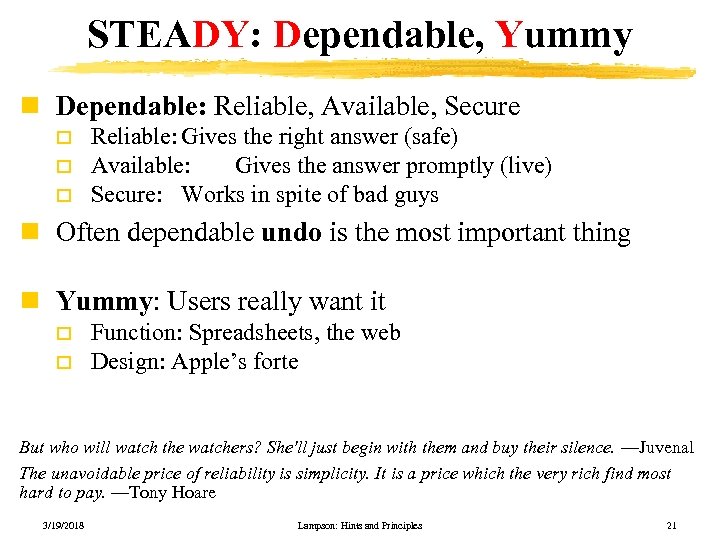
STEADY: Dependable, Yummy n Dependable: Reliable, Available, Secure o o o Reliable: Gives the right answer (safe) Available: Gives the answer promptly (live) Secure: Works in spite of bad guys n Often dependable undo is the most important thing n Yummy: Users really want it o o Function: Spreadsheets, the web Design: Apple’s forte But who will watch the watchers? She'll just begin with them and buy their silence. —Juvenal The unavoidable price of reliability is simplicity. It is a price which the very rich find most hard to pay. —Tony Hoare 3/19/2018 Lampson: Hints and Principles 21
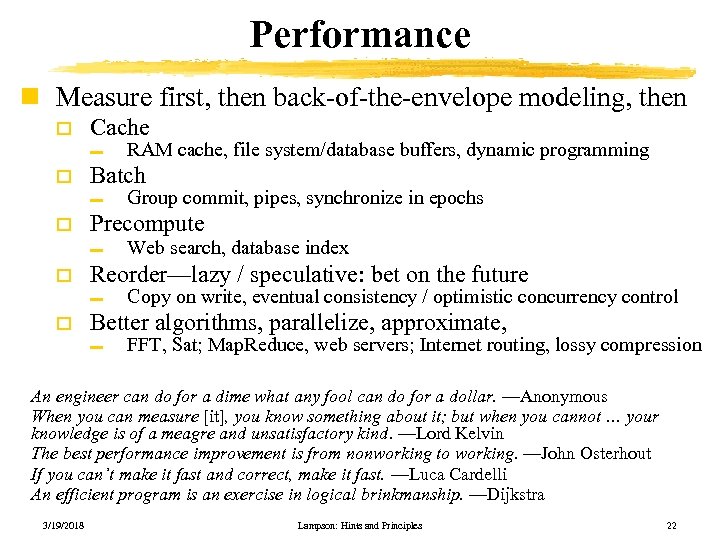
Performance n Measure first, then back-of-the-envelope modeling, then o Cache ▬ o Batch ▬ o Web search, database index Reorder—lazy / speculative: bet on the future ▬ o Group commit, pipes, synchronize in epochs Precompute ▬ o RAM cache, file system/database buffers, dynamic programming Copy on write, eventual consistency / optimistic concurrency control Better algorithms, parallelize, approximate, ▬ FFT, Sat; Map. Reduce, web servers; Internet routing, lossy compression An engineer can do for a dime what any fool can do for a dollar. —Anonymous When you can measure [it], you know something about it; but when you cannot … your knowledge is of a meagre and unsatisfactory kind. —Lord Kelvin The best performance improvement is from nonworking to working. —John Osterhout If you can’t make it fast and correct, make it fast. —Luca Cardelli An efficient program is an exercise in logical brinkmanship. —Dijkstra 3/19/2018 Lampson: Hints and Principles 22
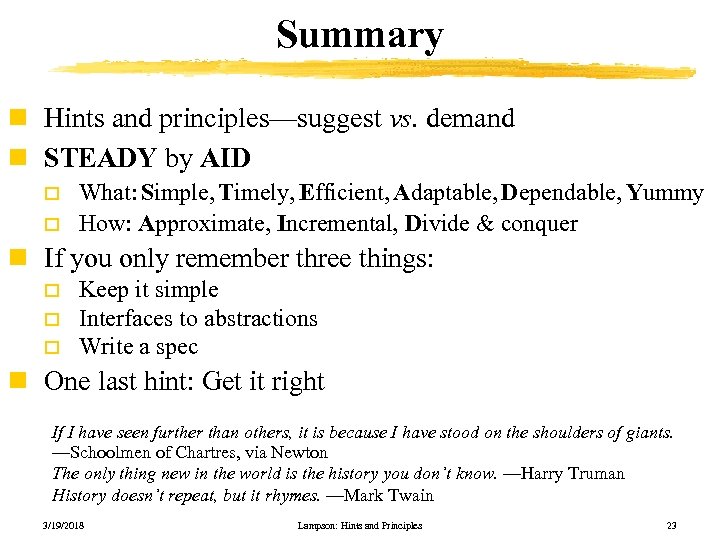
Summary n Hints and principles—suggest vs. demand n STEADY by AID o o What: Simple, Timely, Efficient, Adaptable, Dependable, Yummy How: Approximate, Incremental, Divide & conquer n If you only remember three things: o o o Keep it simple Interfaces to abstractions Write a spec n One last hint: Get it right If I have seen further than others, it is because I have stood on the shoulders of giants. —Schoolmen of Chartres, via Newton The only thing new in the world is the history you don’t know. —Harry Truman History doesn’t repeat, but it rhymes. —Mark Twain 3/19/2018 Lampson: Hints and Principles 23
Скачать презентацию Hints and Principles for Computer System Design Butler
69c05c925f33df8aac1f4d3b09a7c580.ppt