


 Скачать презентацию Highly-Cited Ideas in System Codesign and Synthesis Frank
cb825183fcfd94484be3724afe17df45.ppt
- Количество слайдов: 17
 Highly-Cited Ideas in System Codesign and Synthesis Frank Vahid Dept. of Computer Science and Engineering Univ. of California, Riverside, USA *Also with the Center for Embedded Computer Systems, UC Irvine Tony Givargis Center for Embedded Computer Systems Univ. of California, Irvine, USA http: //www. ics. ucr. edu/~givargis http: //www. cs. ucr. edu/~vahid This research was supported in part by the National Science Foundation (CNS-0614957). Frank Vahid, Univ. of California, Riverside 1
 CODES/ISSS in Atlanta #1 spectator sport in U. S. #2 sport on television in U. S. 2 nd to football American football, that is Frank Vahid, Univ. of California, Riverside 2
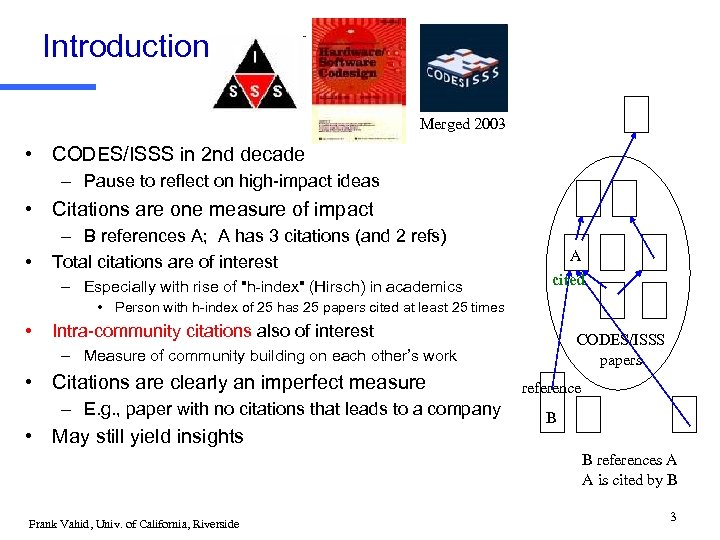 Introduction Merged 2003 • CODES/ISSS in 2 nd decade – Pause to reflect on high-impact ideas • Citations are one measure of impact • – B references A; A has 3 citations (and 2 refs) Total citations are of interest – Especially with rise of "h-index" (Hirsch) in academics A cited • Person with h-index of 25 has 25 papers cited at least 25 times • Intra-community citations also of interest CODES/ISSS papers – Measure of community building on each other’s work • Citations are clearly an imperfect measure – E. g. , paper with no citations that leads to a company • May still yield insights reference B B references A A is cited by B Frank Vahid, Univ. of California, Riverside 3
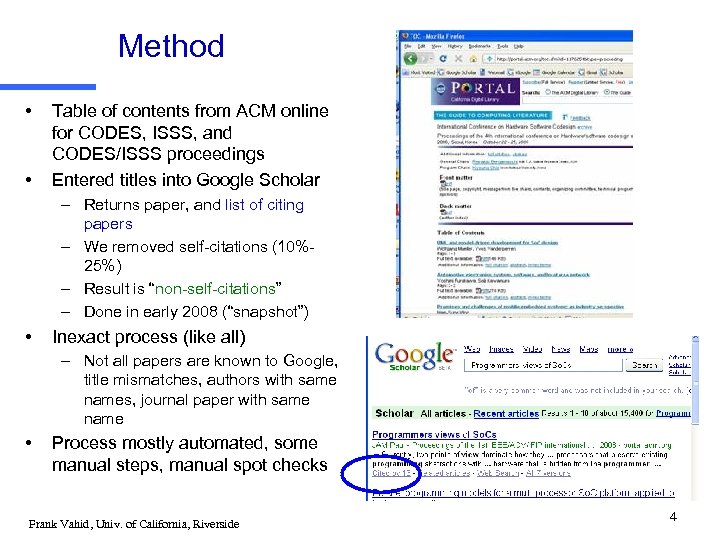 Method • • Table of contents from ACM online for CODES, ISSS, and CODES/ISSS proceedings Entered titles into Google Scholar – Returns paper, and list of citing papers – We removed self-citations (10%25%) – Result is “non-self-citations” – Done in early 2008 (“snapshot”) • Inexact process (like all) – Not all papers are known to Google, title mismatches, authors with same names, journal paper with same name • Process mostly automated, some manual steps, manual spot checks Frank Vahid, Univ. of California, Riverside 4
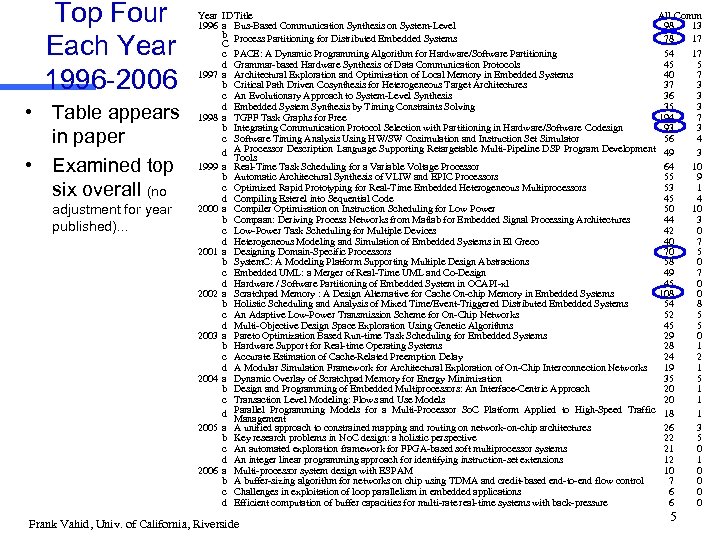 Top Four Each Year 1996 -2006 • Table appears in paper • Examined top six overall (no adjustment for year published). . . Year ID Title All Comm 1996 a Bus-Based Communication Synthesis on System-Level 98 13 b Process Partitioning for Distributed Embedded Systems 78 17 C c PACE: A Dynamic Programming Algorithm for Hardware/Software Partitioning 54 17 d Grammar-based Hardware Synthesis of Data Communication Protocols 45 5 1997 a Architectural Exploration and Optimization of Local Memory in Embedded Systems 40 7 b Critical Path Driven Cosynthesis for Heterogeneous Target Architectures 37 3 c An Evolutionary Approach to System-Level Synthesis 36 3 d Embedded System Synthesis by Timing Constraints Solving 35 3 1998 a TGFF Task Graphs for Free 194 7 b Integrating Communication Protocol Selection with Partitioning in Hardware/Software Codesign 93 3 c Software Timing Analysis Using HW/SW Cosimulation and Instruction Set Simulator 56 4 A Processor Description Language Supporting Retargetable Multi-Pipeline DSP Program Development 49 d Tools 3 1999 a Real-Time Task Scheduling for a Variable Voltage Processor 64 10 b Automatic Architectural Synthesis of VLIW and EPIC Processors 55 9 c Optimized Rapid Prototyping for Real-Time Embedded Heterogeneous Multiprocessors 53 1 d Compiling Esterel into Sequential Code 45 4 2000 a Compiler Optimization on Instruction Scheduling for Low Power 50 10 b Compaan: Deriving Process Networks from Matlab for Embedded Signal Processing Architectures 44 3 c Low-Power Task Scheduling for Multiple Devices 42 0 d Heterogeneous Modeling and Simulation of Embedded Systems in El Greco 40 7 2001 a Designing Domain-Specific Processors 70 5 b System. C: A Modeling Platform Supporting Multiple Design Abstractions 58 0 c Embedded UML: a Merger of Real-Time UML and Co-Design 49 7 d Hardware / Software Partitioning of Embedded System in OCAPI-xl 45 0 2002 a Scratchpad Memory : A Design Alternative for Cache On-chip Memory in Embedded Systems 108 0 b Holistic Scheduling and Analysis of Mixed Time/Event-Triggered Distributed Embedded Systems 54 8 c An Adaptive Low-Power Transmission Scheme for On-Chip Networks 52 5 d Multi-Objective Design Space Exploration Using Genetic Algorithms 45 5 2003 a Pareto Optimization Based Run-time Task Scheduling for Embedded Systems 29 0 b Hardware Support for Real-time Operating Systems 28 1 c Accurate Estimation of Cache-Related Preemption Delay 24 2 d A Modular Simulation Framework for Architectural Exploration of On-Chip Interconnection Networks 19 1 2004 a Dynamic Overlay of Scratchpad Memory for Energy Minimization 35 5 b Design and Programming of Embedded Multiprocessors: An Interface-Centric Approach 20 1 c Transaction Level Modeling: Flows and Use Models 20 1 Parallel Programming Models for a Multi-Processor So. C Platform Applied to High-Speed Traffic 18 d Management 1 2005 a A unified approach to constrained mapping and routing on network-on-chip architectures 26 3 b Key research problems in No. C design: a holistic perspective 22 5 c An automated exploration framework for FPGA-based soft multiprocessor systems 21 0 d An integer linear programming approach for identifying instruction-set extensions 12 1 2006 a Multi-processor system design with ESPAM 10 0 b A buffer-sizing algorithm for networks on chip using TDMA and credit-based end-to-end flow control 7 0 c Challenges in exploitation of loop parallelism in embedded applications 6 0 d Efficient computation of buffer capacities for multi-rate real-time systems with back-pressure 6 0 Frank Vahid, Univ. of California, Riverside 5
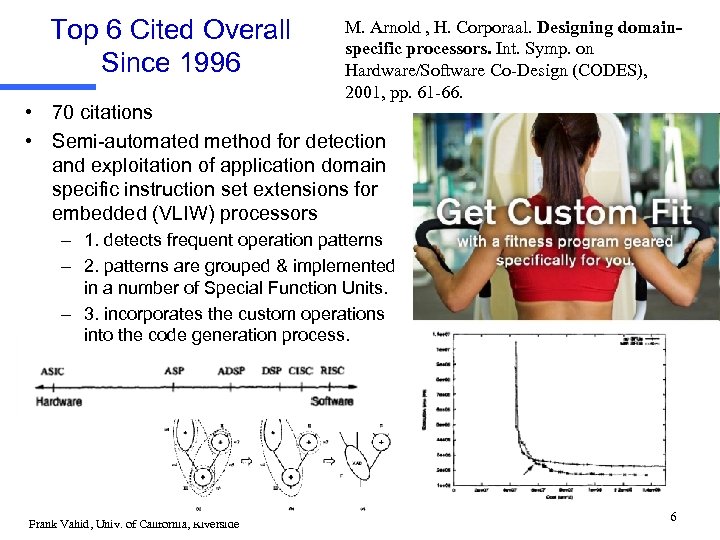 Top 6 Cited Overall Since 1996 M. Arnold , H. Corporaal. Designing domainspecific processors. Int. Symp. on Hardware/Software Co-Design (CODES), 2001, pp. 61 -66. • 70 citations • Semi-automated method for detection and exploitation of application domain specific instruction set extensions for embedded (VLIW) processors – 1. detects frequent operation patterns – 2. patterns are grouped & implemented in a number of Special Function Units. – 3. incorporates the custom operations into the code generation process. Frank Vahid, Univ. of California, Riverside 6
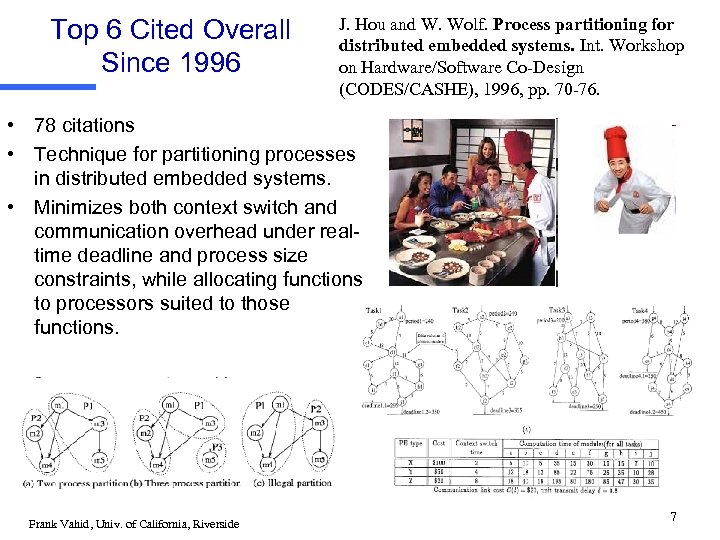 Top 6 Cited Overall Since 1996 J. Hou and W. Wolf. Process partitioning for distributed embedded systems. Int. Workshop on Hardware/Software Co-Design (CODES/CASHE), 1996, pp. 70 -76. • 78 citations • Technique for partitioning processes in distributed embedded systems. • Minimizes both context switch and communication overhead under realtime deadline and process size constraints, while allocating functions to processors suited to those functions. Frank Vahid, Univ. of California, Riverside 7
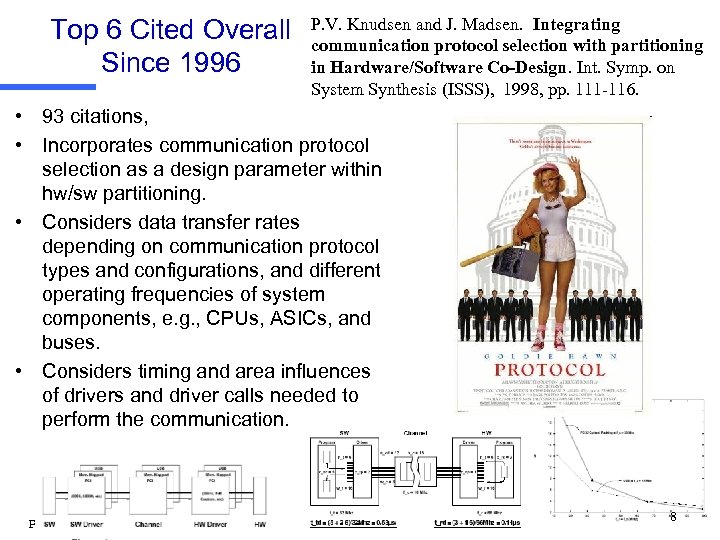 Top 6 Cited Overall Since 1996 P. V. Knudsen and J. Madsen. Integrating communication protocol selection with partitioning in Hardware/Software Co-Design. Int. Symp. on System Synthesis (ISSS), 1998, pp. 111 -116. • 93 citations, • Incorporates communication protocol selection as a design parameter within hw/sw partitioning. • Considers data transfer rates depending on communication protocol types and configurations, and different operating frequencies of system components, e. g. , CPUs, ASICs, and buses. • Considers timing and area influences of drivers and driver calls needed to perform the communication. Frank Vahid, Univ. of California, Riverside 8
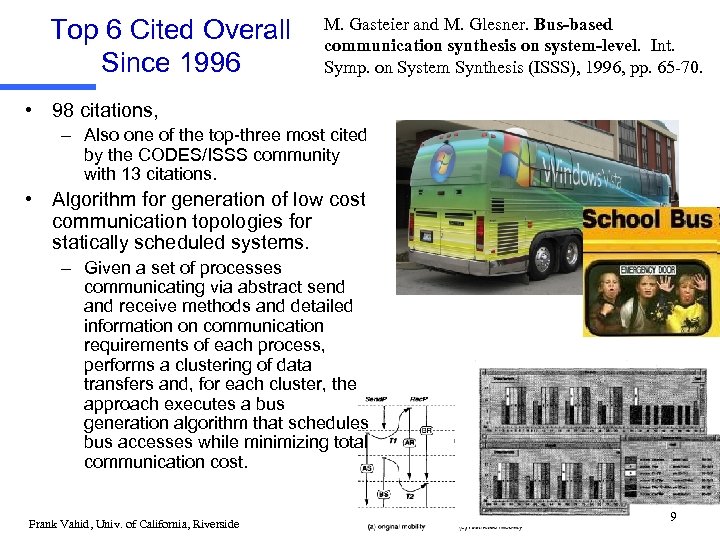 Top 6 Cited Overall Since 1996 M. Gasteier and M. Glesner. Bus-based communication synthesis on system-level. Int. Symp. on System Synthesis (ISSS), 1996, pp. 65 -70. • 98 citations, – Also one of the top-three most cited by the CODES/ISSS community with 13 citations. • Algorithm for generation of low cost communication topologies for statically scheduled systems. – Given a set of processes communicating via abstract send and receive methods and detailed information on communication requirements of each process, performs a clustering of data transfers and, for each cluster, the approach executes a bus generation algorithm that schedules bus accesses while minimizing total communication cost. Frank Vahid, Univ. of California, Riverside 9
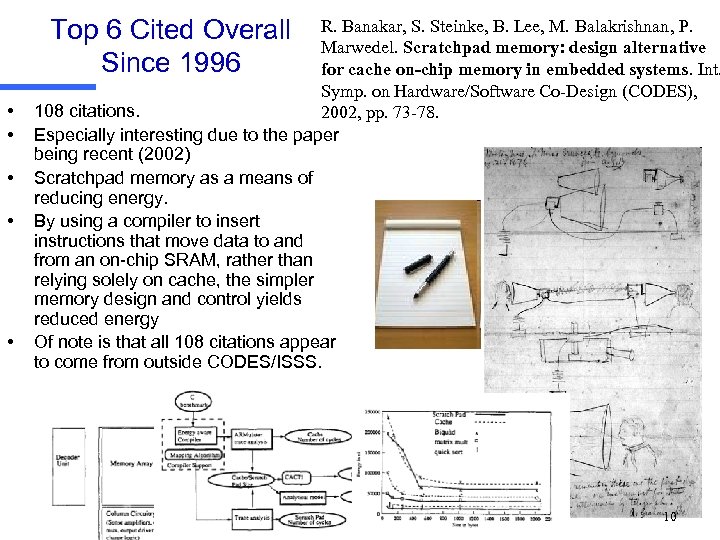 Top 6 Cited Overall Since 1996 • • • R. Banakar, S. Steinke, B. Lee, M. Balakrishnan, P. Marwedel. Scratchpad memory: design alternative for cache on-chip memory in embedded systems. Int. Symp. on Hardware/Software Co-Design (CODES), 108 citations. 2002, pp. 73 -78. Especially interesting due to the paper being recent (2002) Scratchpad memory as a means of reducing energy. By using a compiler to insert instructions that move data to and from an on-chip SRAM, rather than relying solely on cache, the simpler memory design and control yields reduced energy Of note is that all 108 citations appear to come from outside CODES/ISSS. Frank Vahid, Univ. of California, Riverside 10
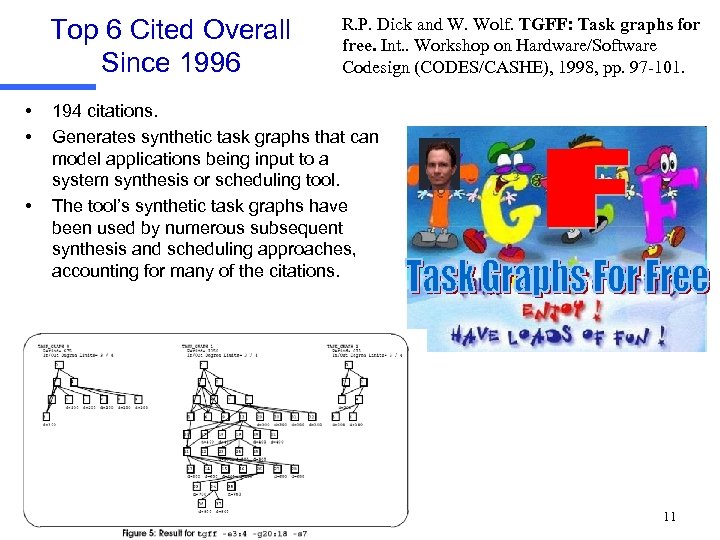 Top 6 Cited Overall Since 1996 • • • R. P. Dick and W. Wolf. TGFF: Task graphs for free. Int. . Workshop on Hardware/Software Codesign (CODES/CASHE), 1998, pp. 97 -101. 194 citations. Generates synthetic task graphs that can model applications being input to a system synthesis or scheduling tool. The tool’s synthetic task graphs have been used by numerous subsequent synthesis and scheduling approaches, accounting for many of the citations. Frank Vahid, Univ. of California, Riverside 11
 Top 6 Cited Overall Since 1996 • New general problems (bus/communication synthesis, multi-processor process partitioning) • New solutions (scratchpad mem, ASIP design/compilation) • Framework Compared top-3 per year with bottom-3 per year Top 3 tended to be big ideas, bottom 3 very specific solutions (still useful!) Predictable from the titles alone Frank Vahid, Univ. of California, Riverside 12
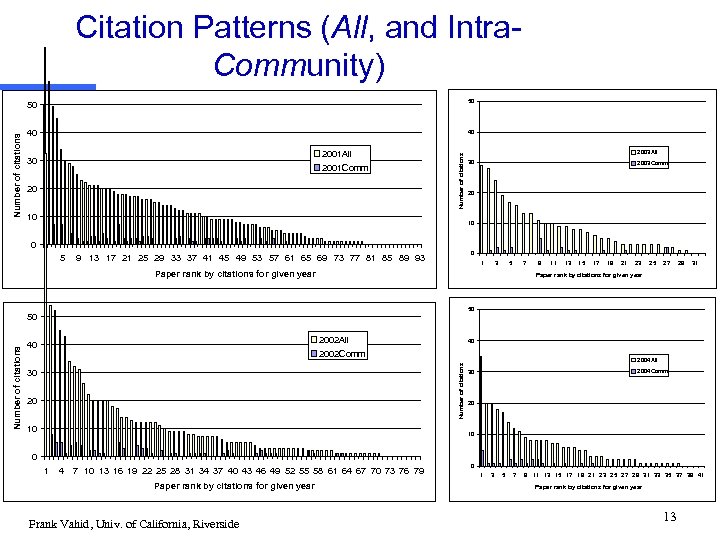 Citation Patterns (All, and Intra. Community) 50 40 40 2001 All 30 2001 Comm 20 Number of citations 50 10 2003 All 30 2003 Comm 20 10 0 1 5 0 9 13 17 21 25 29 33 37 41 45 49 53 57 61 65 69 73 77 81 85 89 93 1 3 5 7 Paper rank by citations for given year 11 13 15 17 19 21 23 25 27 29 31 50 50 2002 All 40 40 2002 Comm Number of citations 9 Paper rank by citations for given year 30 20 10 2004 All 2004 Comm 30 20 10 0 1 4 7 10 13 16 19 22 25 28 31 34 37 40 43 46 49 52 55 58 61 64 67 70 73 76 79 Paper rank by citations for given year Frank Vahid, Univ. of California, Riverside 0 1 3 5 7 9 11 13 15 17 19 21 23 25 27 29 31 33 35 37 39 41 Paper rank by citations for given year 13
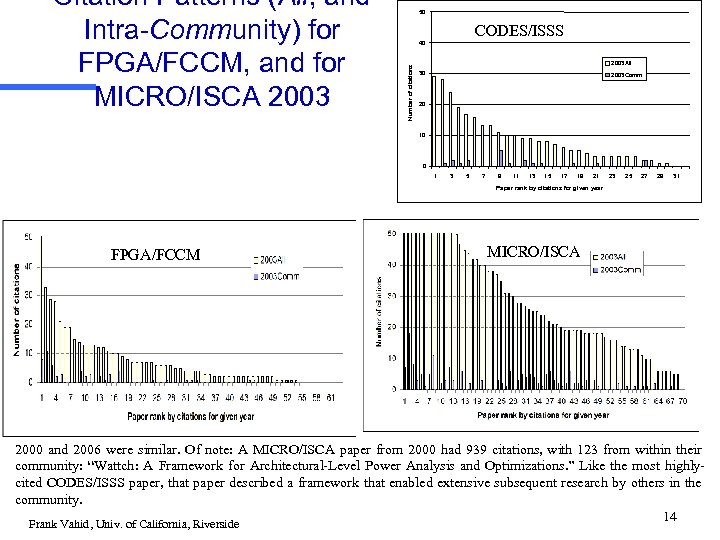 50 CODES/ISSS 40 Number of citations Citation Patterns (All, and Intra-Community) for FPGA/FCCM, and for MICRO/ISCA 2003 All 30 2003 Comm 20 10 0 1 3 5 7 9 11 13 15 17 19 21 23 25 27 29 31 Paper rank by citations for given year FPGA/FCCM MICRO/ISCA 2000 and 2006 were similar. Of note: A MICRO/ISCA paper from 2000 had 939 citations, with 123 from within their community: “Wattch: A Framework for Architectural-Level Power Analysis and Optimizations. ” Like the most highlycited CODES/ISSS paper, that paper described a framework that enabled extensive subsequent research by others in the community. 14 Frank Vahid, Univ. of California, Riverside
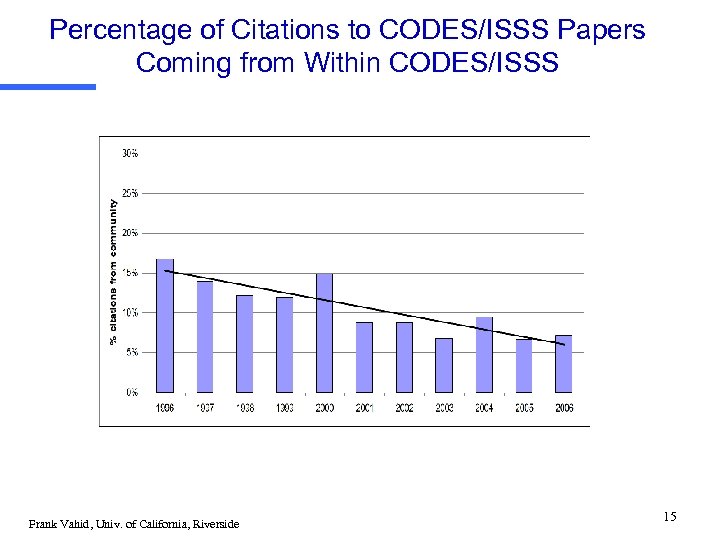 Percentage of Citations to CODES/ISSS Papers Coming from Within CODES/ISSS Frank Vahid, Univ. of California, Riverside 15
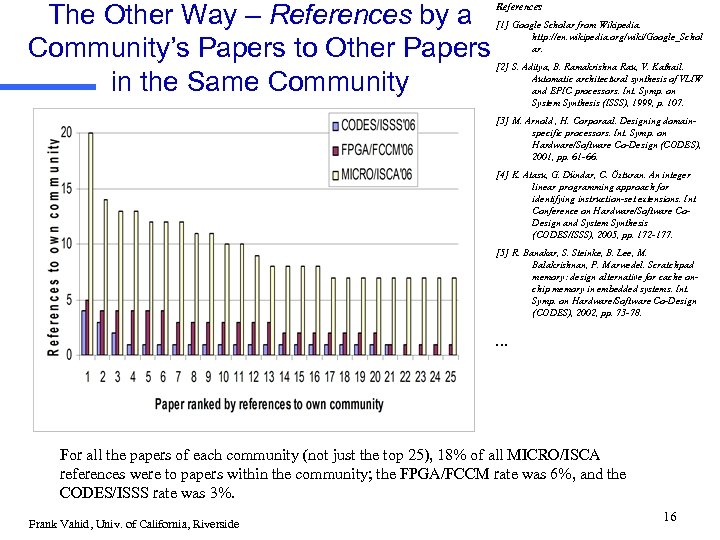 The Other Way – References by a Community’s Papers to Other Papers in the Same Community References [1] Google Scholar from Wikipedia. http: //en. wikipedia. org/wiki/Google_Schol ar. [2] S. Aditya, B. Ramakrishna Rau, V. Kathail. Automatic architectural synthesis of VLIW and EPIC processors. Int. Symp. on System Synthesis (ISSS), 1999, p. 107. [3] M. Arnold , H. Corporaal. Designing domainspecific processors. Int. Symp. on Hardware/Software Co-Design (CODES), 2001, pp. 61 -66. [4] K. Atasu, G. Dündar, C. Özturan. An integer linear programming approach for identifying instruction-set extensions. Int. Conference on Hardware/Software Co. Design and System Synthesis (CODES/ISSS), 2005, pp. 172 -177. [5] R. Banakar, S. Steinke, B. Lee, M. Balakrishnan, P. Marwedel. Scratchpad memory: design alternative for cache onchip memory in embedded systems. Int. Symp. on Hardware/Software Co-Design (CODES), 2002, pp. 73 -78. . For all the papers of each community (not just the top 25), 18% of all MICRO/ISCA references were to papers within the community; the FPGA/FCCM rate was 6%, and the CODES/ISSS rate was 3%. Frank Vahid, Univ. of California, Riverside 16
 Tough to catch up Conclusions • Highly-cited papers – Useful for study, graduate seminars, . . . – Features: New problems, new ideas, or useful framework – Beware of positive feedback "runaway" phenomena • Questions. . . – Would more citing (appropriate, of course) benefit the community? • h-index; also better tracing of research • Are page limits (typically 6; other confs 10 -12) a barrier? (No longer page costs) – Citations differences (vs other communities) due to more quality conferences in our area? Nature of relationship with industry? Multiple tracks? – Need for focus areas? • "Grand challenges" (akin to sequencing of human genome)? Focus on application areas? – Need for common benchmarks and frameworks? – Encourage (in CFP) reproduction/comparison of others’ work? – Encourage (in CFP) posting of complete data, examples, even tools? • – ? ? ? (This year, my students are posting data/tools to encourage improvement/comparison) Frank Vahid, Univ. of California, Riverside 17