 Скачать презентацию Highlights of Globus World 2004 Tameka Carter Brookhaven
6585dfbd546cc6ffd671c62d5c665f19.ppt
- Количество слайдов: 32



Highlights of Globus. World 2004 Tameka Carter Brookhaven National Laboratory Brookhaven Science Associates
Outline of Today’s Talk n n n OGSI -> WS-RF Grid/Globus Security Meta-scheduling - CSF Brookhaven Science Associates 2
OGSI -> WSRF Brookhaven Science Associates 3
OGSI -> WSRF Most of this section of the talk was taken from the paper, “From Open Grid Services Infrastructure to WS-Resource Framework: Refactoring and Evolution” 2/12/2004 by Karl Czajkowski (Globus Alliance/USC Information Sciences Institute), Don Ferguson (IBM), Ian Foster (Globus Alliance/Argonne National Laboratory), Jeff Frey (IBM), Steve Graham (IBM), Tom Maguire (IBM), David Snelling (Fujitsu Brookhaven Science Laboratories of Europe), Steve Tuecke 4 Associates (Globus Alliance, Argonne National
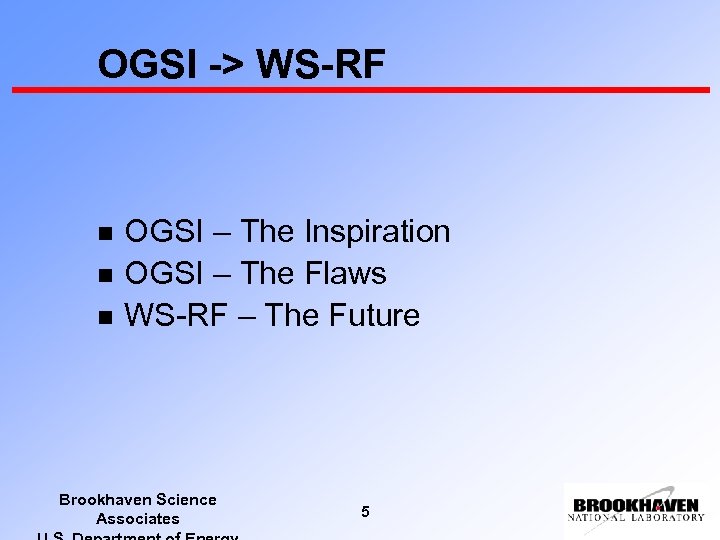
OGSI -> WS-RF n n n OGSI – The Inspiration OGSI – The Flaws WS-RF – The Future Brookhaven Science Associates 5
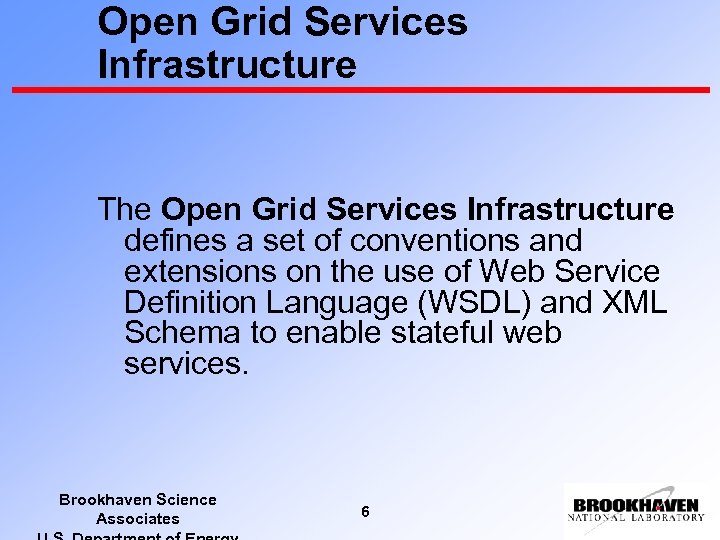
Open Grid Services Infrastructure The Open Grid Services Infrastructure defines a set of conventions and extensions on the use of Web Service Definition Language (WSDL) and XML Schema to enable stateful web services. Brookhaven Science Associates 6
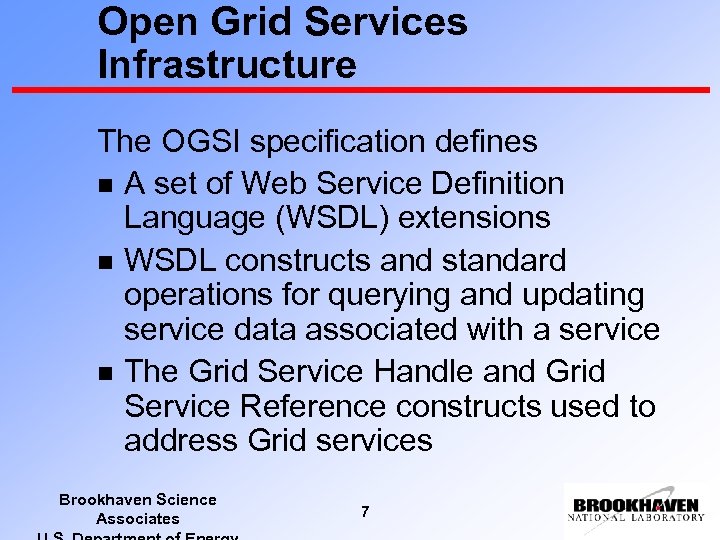
Open Grid Services Infrastructure The OGSI specification defines n A set of Web Service Definition Language (WSDL) extensions n WSDL constructs and standard operations for querying and updating service data associated with a service n The Grid Service Handle and Grid Service Reference constructs used to address Grid services Brookhaven Science Associates 7
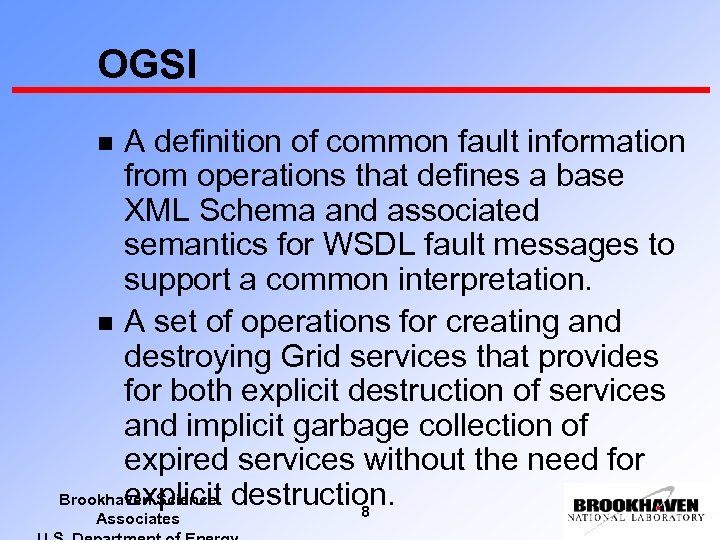
OGSI A definition of common fault information from operations that defines a base XML Schema and associated semantics for WSDL fault messages to support a common interpretation. n A set of operations for creating and destroying Grid services that provides for both explicit destruction of services and implicit garbage collection of expired services without the need for explicit Brookhaven Science destruction. 8 n Associates
OGSI n n A set of operations for creating and using hetrogeneous reference collections of Web services Mechanisms for requesting asynchronous notifications of changes in the value of service data elements. Brookhaven Science Associates 9
Critiques of OGSI n n Too much stuff in one specification Does not work well with existing Web Services and XML tooling Too object oriented WSDL 2. 0 would not fully support WSDL 1. 1 Brookhaven Science Associates 10
Web Services Resource Framework WSRF = OGSI + • The introduction of the WS-Resource Concept • Better separation of function and exploitation of other web services specifications • A broader view of notification, which is a general Web service requirement upon which state change notification can be built Brookhaven Science Associates 11
WS-Resource Framework The refactoring of OGSI yields five normative WSRF specifications plus WS-Notification n n n WS–Resource. Properties WS–Resource. Lifetime WS–Renewable. References WS–Service. Group WS-Base. Fault WS-Notification Brookhaven Science Associates 12
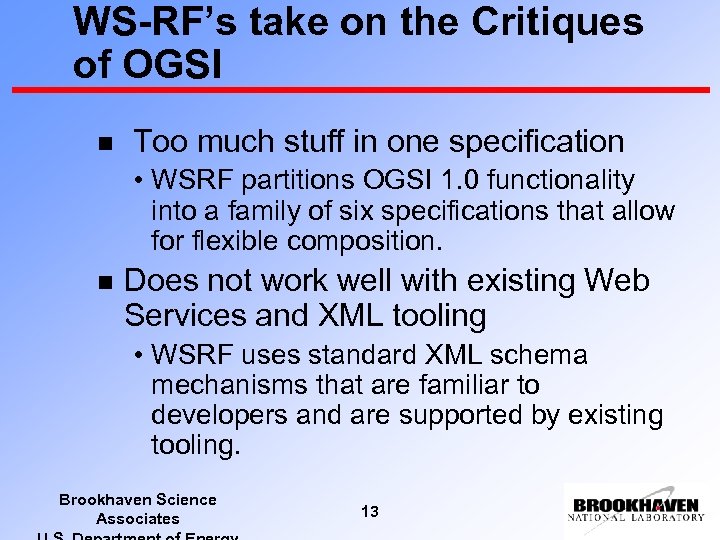
WS-RF’s take on the Critiques of OGSI n Too much stuff in one specification • WSRF partitions OGSI 1. 0 functionality into a family of six specifications that allow for flexible composition. n Does not work well with existing Web Services and XML tooling • WSRF uses standard XML schema mechanisms that are familiar to developers and are supported by existing tooling. Brookhaven Science Associates 13
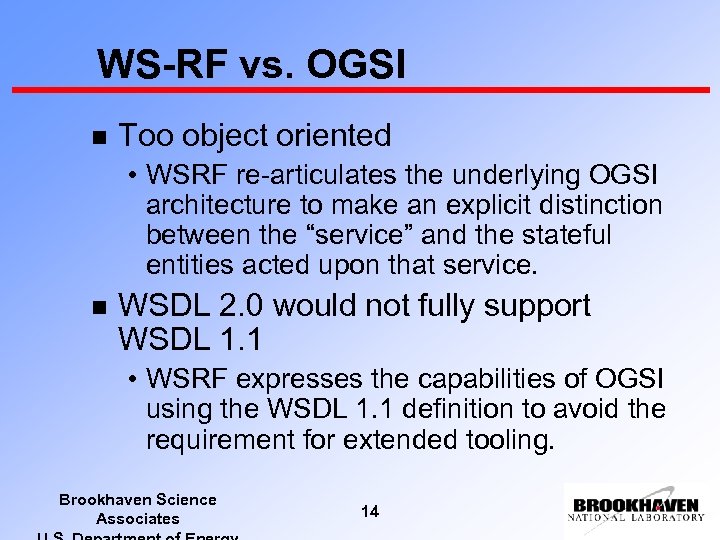
WS-RF vs. OGSI n Too object oriented • WSRF re-articulates the underlying OGSI architecture to make an explicit distinction between the “service” and the stateful entities acted upon that service. n WSDL 2. 0 would not fully support WSDL 1. 1 • WSRF expresses the capabilities of OGSI using the WSDL 1. 1 definition to avoid the requirement for extended tooling. Brookhaven Science Associates 14
Grid/Globus Security Brookhaven Science Associates 15
Grid/Globus Security: Firewalls Solution: Open Ports. Brookhaven Science Associates 16
Grid/Globus Security Most of this section of the talk was inspired by the a round table discussion on, “Firewalls in Grid Computing” Katarzyna (Kate) Keahey - Globus Alliance, Argonne National Laboratory; Participants: David Schissel - General Atomics; Lew Randerson - PPPL; James Rome - Oak Ridge National Laboratory; Stephen Chan - NERSC; Tom Goodale - Max Planck Institute for Gravitational Physics; Von Welch - NCSA, UIUC; Bill Allcock - Globus Alliance, Argonne National Brookhaven Science Laboratory; Scott Campbell - NERSC Associates 17
Grid/Globus Security n n Globus Solutions Site Solutions Brookhaven Science Associates 18
Globus Solutions n GRAM firewall requirements • Server Side: – In Globus Toolkit 3, it is sufficient to open a well-known static port 8080. • Client Side: – Open a range of ports to traffic: GLOBUS_TCP_PORT_RANGE (I’m just the messenger) Brookhaven Science Associates 19
Globus Solutions (cont. ) n Grid. FTP firewall requirements • Server Side: – In Globus Toolkit 3, it is sufficient to open a well-known static port 8080. – A range of ports for data channel • Client Side: – A range of port Brookhaven Science Associates 20
US Magnetic Fusion Energy Research Solution Current Firewall: Cisco IOS Firewall Feature Set n Rule Set • Default is to deny all • Opened on a case by case basis • Changes done only during off-peak times and on limited basis • Service/port availability tailored per user profile Brookhaven Science Associates 21
Fusion Energy Research (cont. ) n Specific firewall ports opened from specific host to specific host n Secure. IDs sometimes used to open firewall ports n Grant access for certain group members Brookhaven Science Associates 22
Princeton Plasma Physics Laboratory n n n Incoming under firewall control Outgoing allowed Tailored firewalls for specific services Incoming sites opened upon request Filtering based on target IP port and source IP address including Globus traffic Access allowed through opening ports for specific machines at known sites. Brookhaven Science Associates 23
Oak Ridge National Laboratory n Created what they call “enclaves” and “collaborative domains” with certain rights. n An enclave is specific to one site and is a collection of resources that are governed by a common site security policy. A collaborative domain is the fabric that instantiates the collection and connects Brookhaven Science the 24 Associatesenclaves. n
ORNL (cont) n Implemented one-time-password tokens. Brookhaven Science Associates 25
NERSC Grid Security Technologies n Centralized Authorization • LDAP Based solution n NERSC PKI Infrastructure • Integration with NIM database • Certificate management n Grid Firewall Work • Mitigation Policies and Recommendations • Bro Network Intrusion Detection • Real-time analysis of Grid traffic • Certificate identification Brookhaven Science Associates 26
Metascheduling - CSF Brookhaven Science Associates 27
Metascheduling/Community Scheduler Framework n n Lunch with Ian Lumb CSF and Globus Brookhaven Science Associates 28
Lunch with Ian Lumb n The big question: What is the difference between Condor and CSF? n The small answer: Not much. Condor is a scheduler; CSF is designed to be a meta-scheduler. CSF can work on top of other schedulers like Condor. Brookhaven Science Associates 29
Metascheduling/CSF Most of this section of the talk was inspired by the talk, “The Community Scheduler Framework: Comprehensive and Standards Based Metascheduling Services for the Grid” By Chris Smith Brookhaven Science Associates 30
CSF Grid Services n Job Service • Creates, monitors and controls compute jobs n Reservation Service • Guarantees resources are available for running a job Brookhaven Science Associates 31
CSF n Queueing Service • Provides a service where administrators can customize and define scheduling policies at the VO level and/or at the different resource manager level • Defines and APT for plug in schedulers n RM Adapter Service • Provides a Grid service interface that bridges the Grid service protocol and resource managers (LSF, PBS, SGE, Brookhaven Science 32 Condor and other RMs) Associates
Скачать презентацию Highlights of Globus World 2004 Tameka Carter Brookhaven
6585dfbd546cc6ffd671c62d5c665f19.ppt