


 Скачать презентацию HIGHLIGHTS FROM RUSALCA 2009 RUSSIAN-AMERICAN LONG-TERM CENSUS OF
3fe0625d99b7fe2095a25ed60d46711c.ppt
- Количество слайдов: 14
 HIGHLIGHTS FROM RUSALCA 2009 RUSSIAN-AMERICAN LONG-TERM CENSUS OF THE ARCTIC Kathleen Crane, Arctic Research Program, CPO NOAA, USA U. S. Oversight for RUSALCA Aleksey Ostrovskiy, Group Alliance, Russian Federation Oversight for RUSALCA
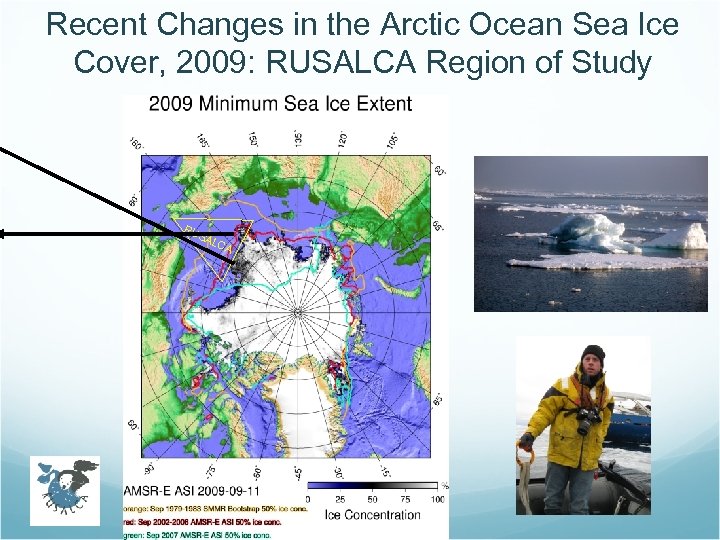 Recent Changes in the Arctic Ocean Sea Ice Cover, 2009: RUSALCA Region of Study RU SA LC A
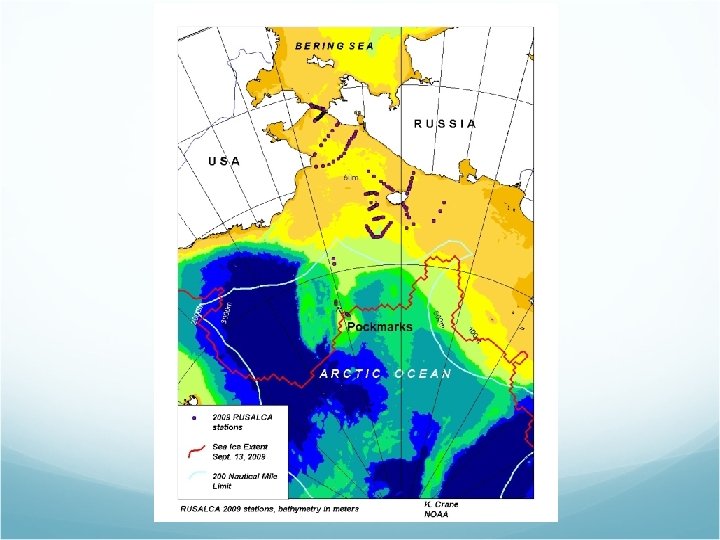
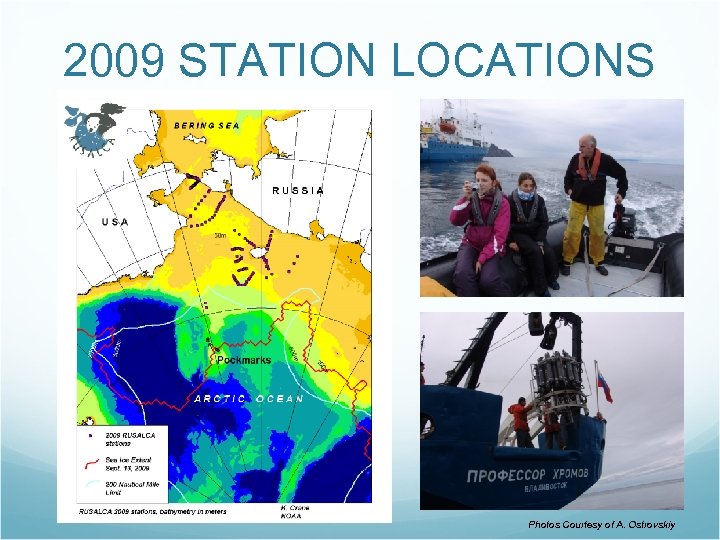 2009 STATION LOCATIONS Photos Courtesy of A. Ostrovskiy
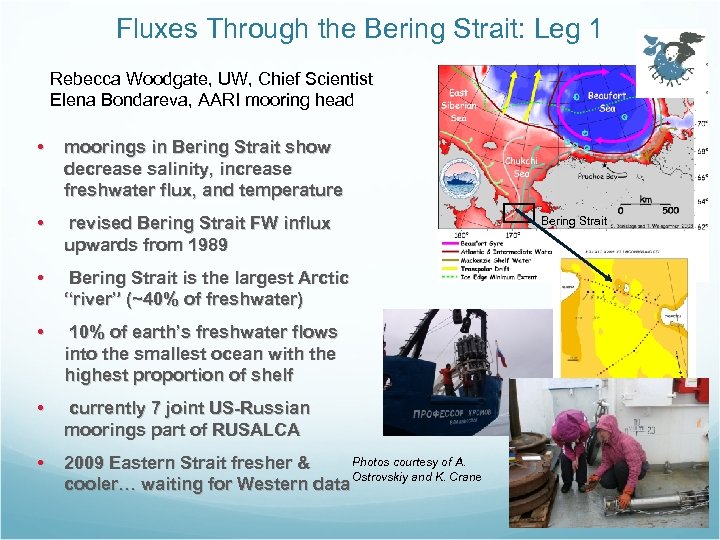 Fluxes Through the Bering Strait: Leg 1 Rebecca Woodgate, UW, Chief Scientist Elena Bondareva, AARI mooring head • moorings in Bering Strait show decrease salinity, increase freshwater flux, and temperature • revised Bering Strait FW influx upwards from 1989 • Bering Strait is the largest Arctic “river” (~40% of freshwater) • 10% of earth’s freshwater flows into the smallest ocean with the highest proportion of shelf • currently 7 joint US-Russian moorings part of RUSALCA • 2009 Eastern Strait fresher & cooler… waiting for Western data Bering Strait Photos courtesy of A. Ostrovskiy and K. Crane
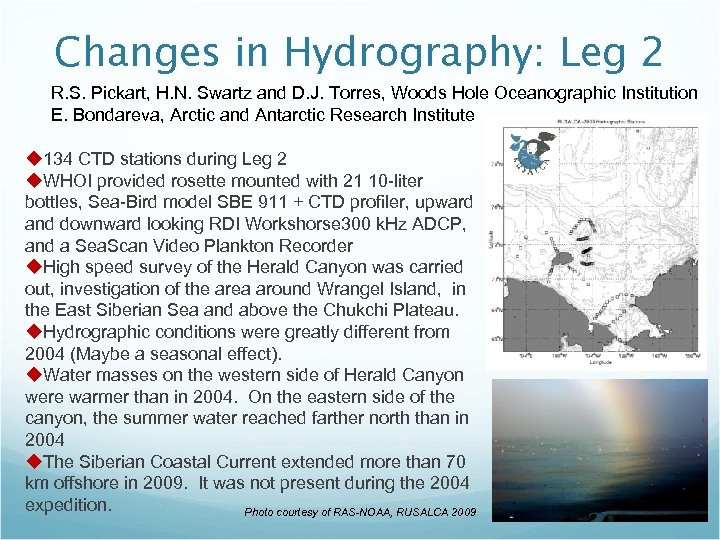 Changes in Hydrography: Leg 2 R. S. Pickart, H. N. Swartz and D. J. Torres, Woods Hole Oceanographic Institution E. Bondareva, Arctic and Antarctic Research Institute 134 CTD stations during Leg 2 WHOI provided rosette mounted with 21 10 -liter bottles, Sea-Bird model SBE 911 + CTD profiler, upward and downward looking RDI Workshorse 300 k. Hz ADCP, and a Sea. Scan Video Plankton Recorder High speed survey of the Herald Canyon was carried out, investigation of the area around Wrangel Island, in the East Siberian Sea and above the Chukchi Plateau. Hydrographic conditions were greatly different from 2004 (Maybe a seasonal effect). Water masses on the western side of Herald Canyon were warmer than in 2004. On the eastern side of the canyon, the summer water reached farther north than in 2004 The Siberian Coastal Current extended more than 70 km offshore in 2009. It was not present during the 2004 expedition. Photo courtesy of RAS-NOAA, RUSALCA 2009
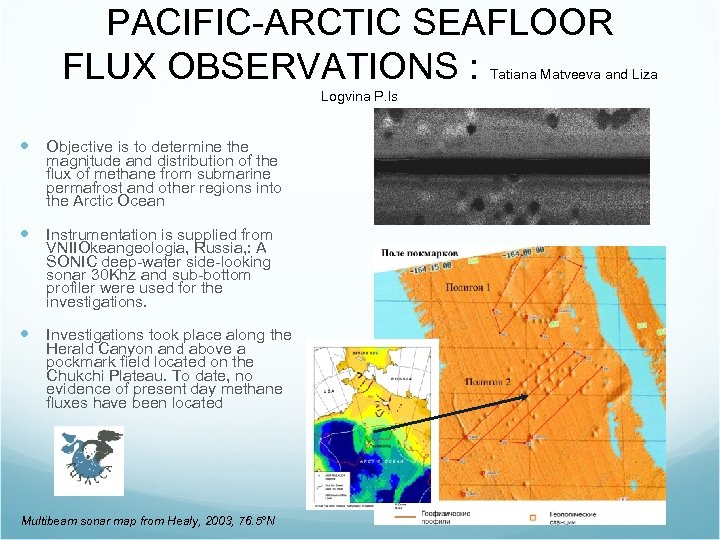 PACIFIC-ARCTIC SEAFLOOR FLUX OBSERVATIONS : Tatiana Matveeva and Liza Logvina P. Is Objective is to determine the magnitude and distribution of the flux of methane from submarine permafrost and other regions into the Arctic Ocean Instrumentation is supplied from VNIIOkeangeologia, Russia, : A SONIC deep-water side-looking sonar 30 Khz and sub-bottom profiler were used for the investigations. Investigations took place along the Herald Canyon and above a pockmark field located on the Chukchi Plateau. To date, no evidence of present day methane fluxes have been located Multibeam sonar map from Healy, 2003, 76. 5°N
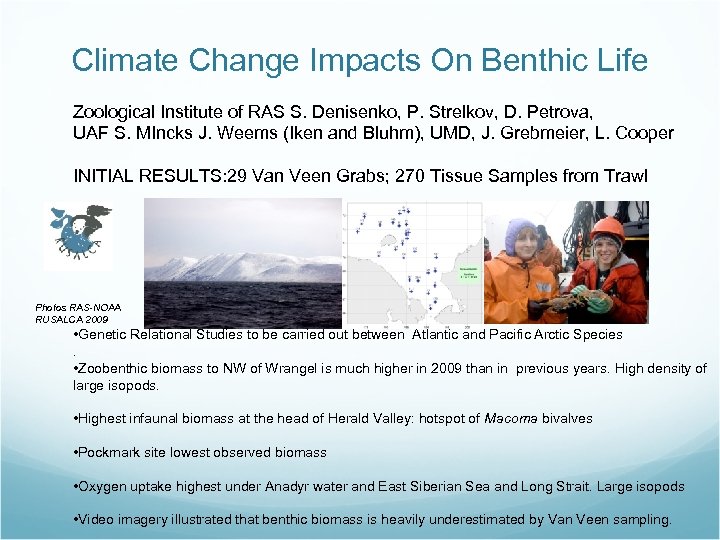 Climate Change Impacts On Benthic Life Zoological Institute of RAS S. Denisenko, P. Strelkov, D. Petrova, UAF S. MIncks J. Weems (Iken and Bluhm), UMD, J. Grebmeier, L. Cooper INITIAL RESULTS: 29 Van Veen Grabs; 270 Tissue Samples from Trawl Photos RAS-NOAA RUSALCA 2009 • Genetic Relational Studies to be carried out between Atlantic and Pacific Arctic Species. • Zoobenthic biomass to NW of Wrangel is much higher in 2009 than in previous years. High density of large isopods. • Highest infaunal biomass at the head of Herald Valley: hotspot of Macoma bivalves • Pockmark site lowest observed biomass • Oxygen uptake highest under Anadyr water and East Siberian Sea and Long Strait. Large isopods • Video imagery illustrated that benthic biomass is heavily underestimated by Van Veen sampling.
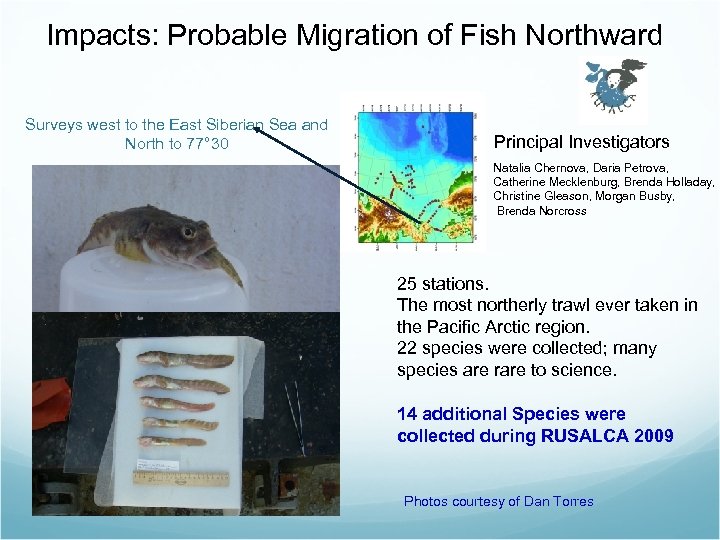 Impacts: Probable Migration of Fish Northward Surveys west to the East Siberian Sea and North to 77° 30 Principal Investigators Natalia Chernova, Daria Petrova, Catherine Mecklenburg, Brenda Holladay, Christine Gleason, Morgan Busby, Brenda Norcross 25 stations. The most northerly trawl ever taken in the Pacific Arctic region. 22 species were collected; many species are rare to science. 14 additional Species were collected during RUSALCA 2009 Photos courtesy of Dan Torres
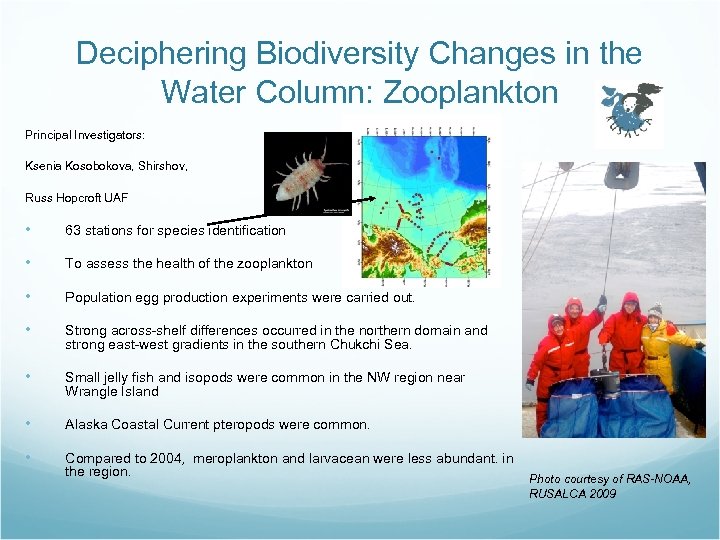 Deciphering Biodiversity Changes in the Water Column: Zooplankton Principal Investigators: Ksenia Kosobokova, Shirshov, Russ Hopcroft UAF • 63 stations for species identification • To assess the health of the zooplankton • Population egg production experiments were carried out. • Strong across-shelf differences occurred in the northern domain and strong east-west gradients in the southern Chukchi Sea. • Small jelly fish and isopods were common in the NW region near Wrangle Island • Alaska Coastal Current pteropods were common. • Compared to 2004, meroplankton and larvacean were less abundant. in the region. Photo courtesy of RAS-NOAA, RUSALCA 2009
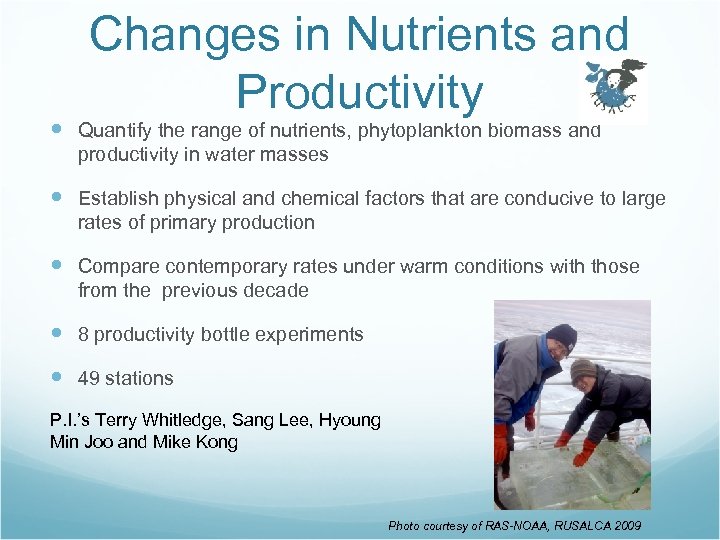 Changes in Nutrients and Productivity Quantify the range of nutrients, phytoplankton biomass and productivity in water masses Establish physical and chemical factors that are conducive to large rates of primary production Compare contemporary rates under warm conditions with those from the previous decade 8 productivity bottle experiments 49 stations P. I. ’s Terry Whitledge, Sang Lee, Hyoung Min Joo and Mike Kong Photo courtesy of RAS-NOAA, RUSALCA 2009
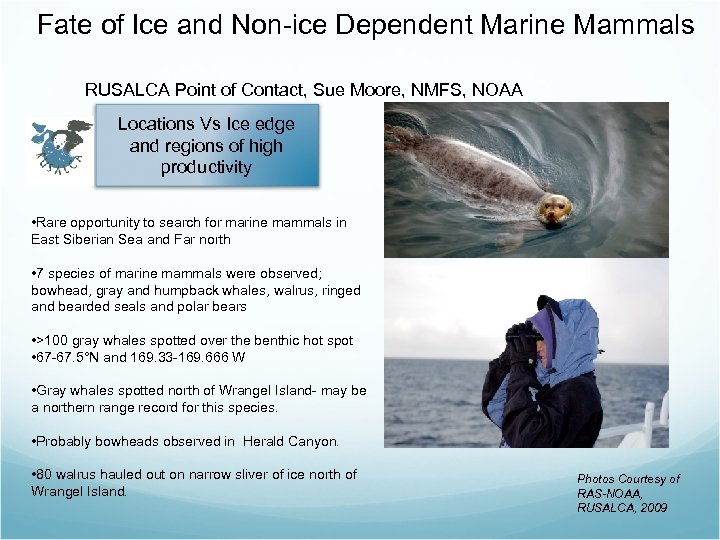 Fate of Ice and Non-ice Dependent Marine Mammals RUSALCA Point of Contact, Sue Moore, NMFS, NOAA Locations Vs Ice edge and regions of high productivity • Rare opportunity to search for marine mammals in East Siberian Sea and Far north • 7 species of marine mammals were observed; bowhead, gray and humpback whales, walrus, ringed and bearded seals and polar bears • >100 gray whales spotted over the benthic hot spot • 67 -67. 5°N and 169. 33 -169. 666 W • Gray whales spotted north of Wrangel Island- may be a northern range record for this species. • Probably bowheads observed in Herald Canyon. • 80 walrus hauled out on narrow sliver of ice north of Wrangel Island. Photos Courtesy of RAS-NOAA, RUSALCA, 2009
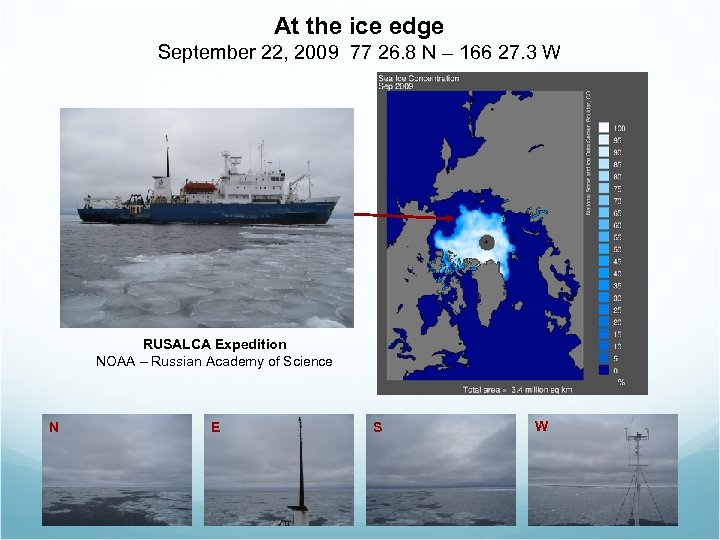 At the ice edge September 22, 2009 77 26. 8 N – 166 27. 3 W RUSALCA Expedition NOAA – Russian Academy of Science N E S W 04/15/10
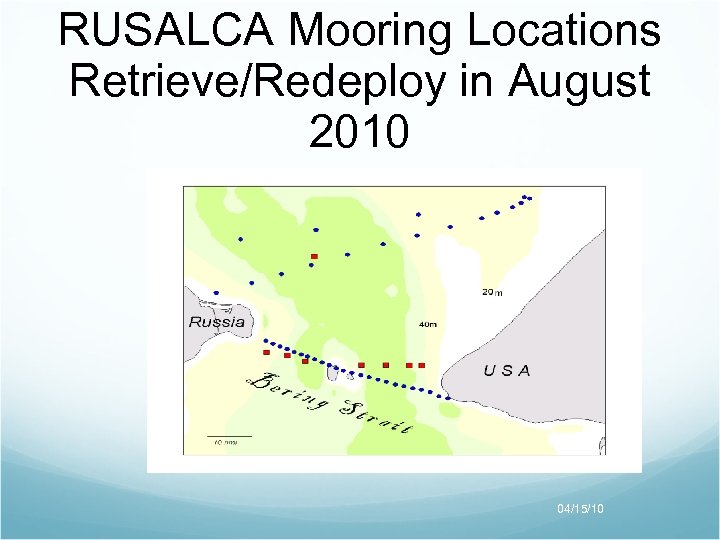 RUSALCA Mooring Locations Retrieve/Redeploy in August 2010 04/15/10