


 Скачать презентацию HIGHLIGHTS AND INSIGHTS FROM THE EDUCAUSE 2011 CORE
f5d8b1f234c62910c6aa0ba3285e2be5.ppt
- Количество слайдов: 77
 HIGHLIGHTS AND INSIGHTS FROM THE EDUCAUSE 2011 CORE DATA SURVEY Susan Grajek | October 19, 2011 © 2011 EDUCAUSE. CC by-nc-nd
 WELCOME, PHILADELPHIA AND ONLINE ATTENDEES! • Who are you? • • • Fill out CDS this year? Type of institution: Associate’s, BA, MA, DR, public, private, system From Canada? Other international? Role: CIO, support, infosec, infrastructure, enterprise, research, teaching and learning, faculty, vendor? CDS role: Primary representative, author, review, manager? What color is your institution? © 2011 EDUCAUSE. CC by-nc-nd 2
 TOPICS COVERED TODAY The IT organization • Leadership • Governance and service level agreements • Outsourcing • Staffing and Managing the workforce • IT budgets and funding • Support for faculty use of IT in teaching and learning • Support for students • • • Support of research IT in the institution IT support Student e-mail Enterprise systems Information security Data centers Sustainability There’s so much more in the Core Data Survey. . . © 2011 EDUCAUSE. CC by-nc-nd 3
 THE IT ORGANIZATION © 2011 EDUCAUSE. CC by-nc-nd 4
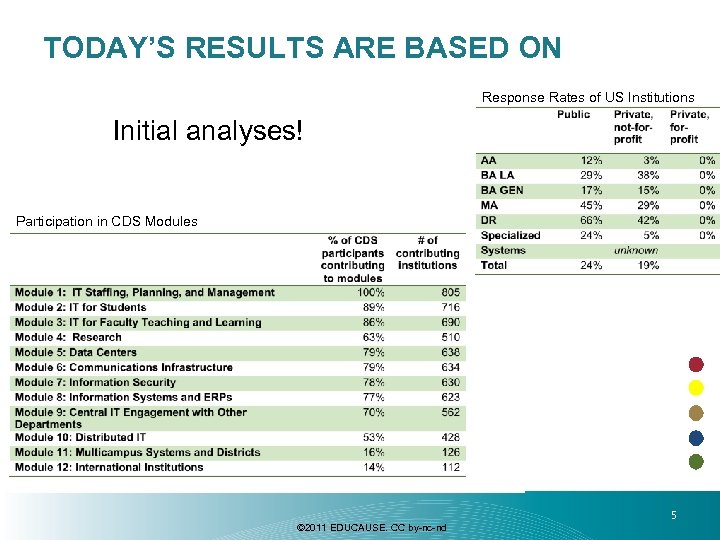 TODAY’S RESULTS ARE BASED ON Response Rates of US Institutions Initial analyses! Participation in CDS Modules © 2011 EDUCAUSE. CC by-nc-nd 5
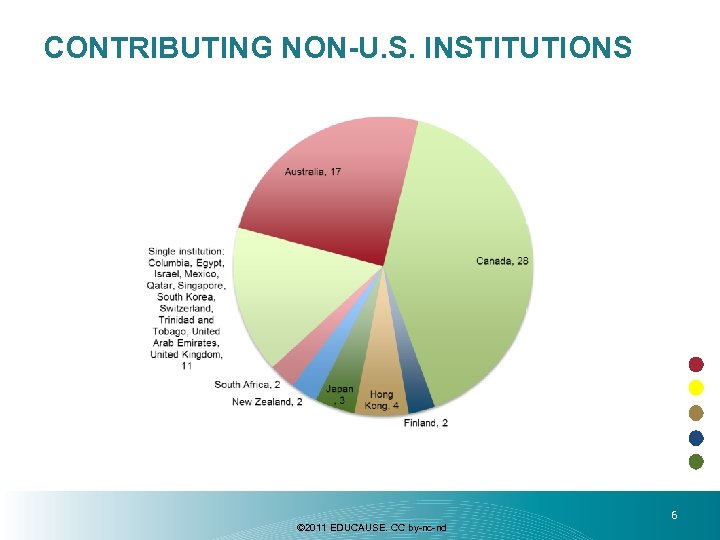 CONTRIBUTING NON-U. S. INSTITUTIONS © 2011 EDUCAUSE. CC by-nc-nd 6
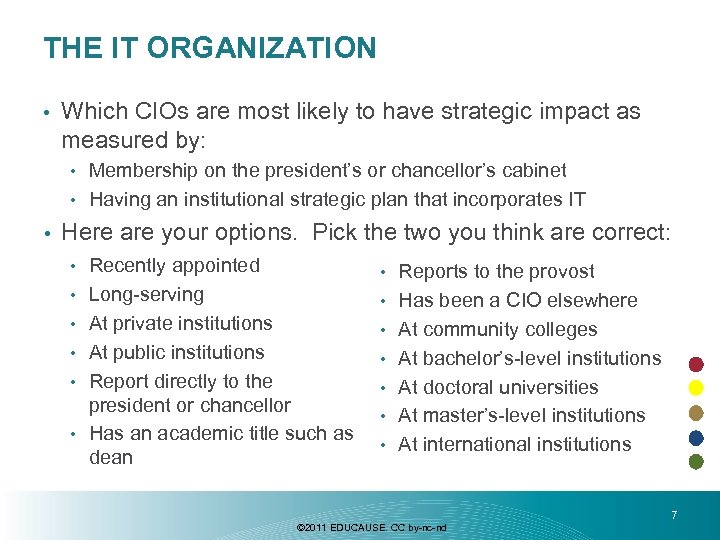 THE IT ORGANIZATION • Which CIOs are most likely to have strategic impact as measured by: Membership on the president’s or chancellor’s cabinet • Having an institutional strategic plan that incorporates IT • • Here are your options. Pick the two you think are correct: • • • Recently appointed Long-serving At private institutions At public institutions Report directly to the president or chancellor Has an academic title such as dean • • Reports to the provost Has been a CIO elsewhere At community colleges At bachelor’s-level institutions At doctoral universities At master’s-level institutions At international institutions © 2011 EDUCAUSE. CC by-nc-nd 7
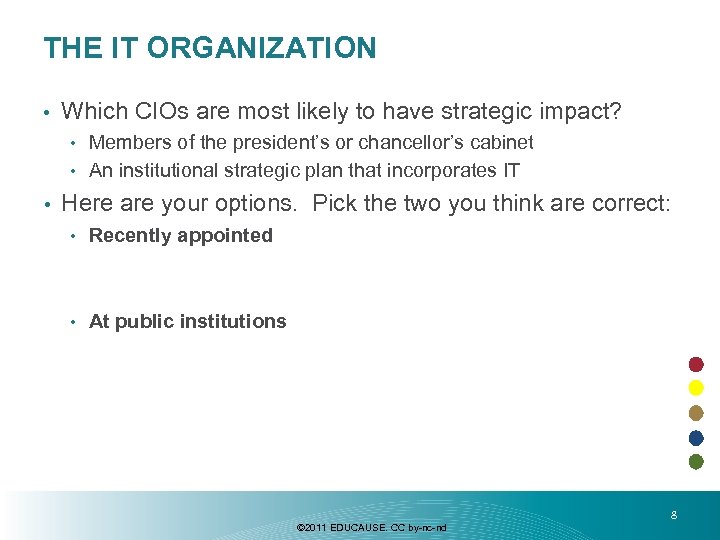 THE IT ORGANIZATION • Which CIOs are most likely to have strategic impact? Members of the president’s or chancellor’s cabinet • An institutional strategic plan that incorporates IT • • Here are your options. Pick the two you think are correct: • • • Recently appointed Long-serving At private institutions At public institutions Report directly to the President or Chancellor Has an academic title such as Dean • • Reports to the Provost Has been a CIO elsewhere At community colleges At Bachelors-level institutions At doctoral universities At Masters-level institutions At international institutions © 2011 EDUCAUSE. CC by-nc-nd 8
 ACADEMIC INVOLVEMENT IN IT GOVERNANCE • It is most common in doctoral and BA liberal arts institutions: Doctoral: 79% with a faculty and 57% with a student advisory committee • BA liberal arts: 70% with faculty, 48% with students • © 2011 EDUCAUSE. CC by-nc-nd 9
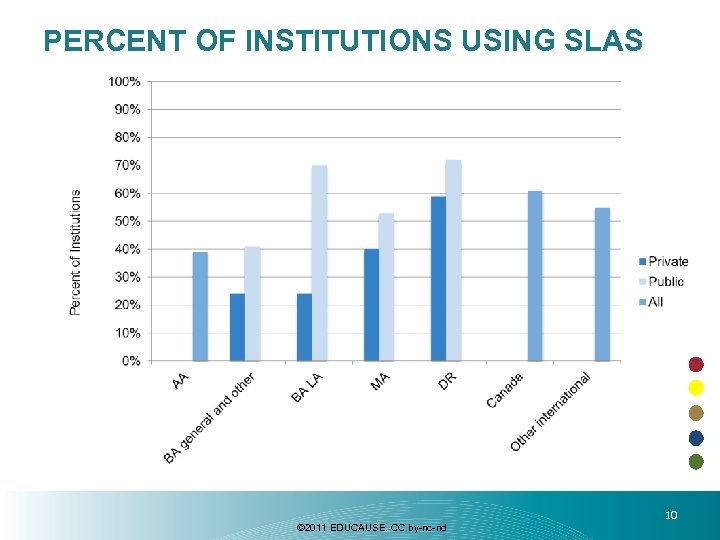 PERCENT OF INSTITUTIONS USING SLAS © 2011 EDUCAUSE. CC by-nc-nd 10
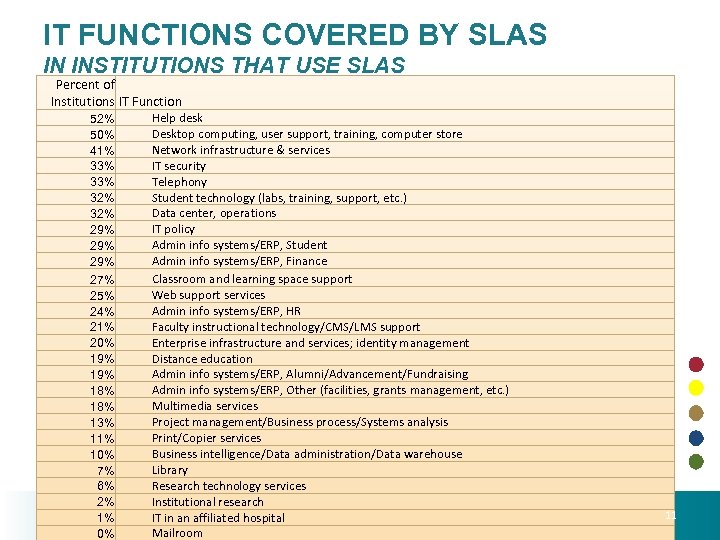 IT FUNCTIONS COVERED BY SLAS IN INSTITUTIONS THAT USE SLAS Percent of Institutions IT Function 52% 50% 41% 33% 32% 29% 29% 27% 25% 24% 21% 20% 19% 18% 13% 11% 10% 7% 6% 2% 1% 0% Help desk Desktop computing, user support, training, computer store Network infrastructure & services IT security Telephony Student technology (labs, training, support, etc. ) Data center, operations IT policy Admin info systems/ERP, Student Admin info systems/ERP, Finance Classroom and learning space support Web support services Admin info systems/ERP, HR Faculty instructional technology/CMS/LMS support Enterprise infrastructure and services; identity management Distance education Admin info systems/ERP, Alumni/Advancement/Fundraising Admin info systems/ERP, Other (facilities, grants management, etc. ) Multimedia services Project management/Business process/Systems analysis Print/Copier services Business intelligence/Data administration/Data warehouse Library Research technology services Institutional research IT in an affiliated hospital © 2011 EDUCAUSE. CC by-nc-nd Mailroom 11
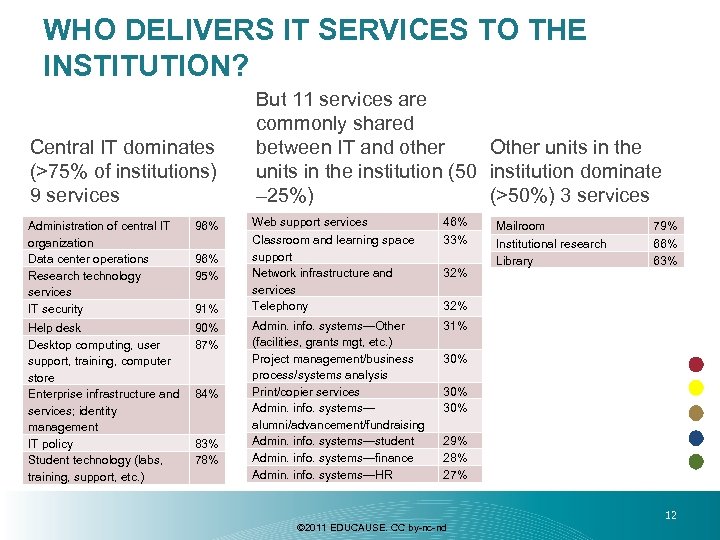 WHO DELIVERS IT SERVICES TO THE INSTITUTION? Central IT dominates (>75% of institutions) 9 services Administration of central IT organization Data center operations Research technology services IT security 96% Help desk Desktop computing, user support, training, computer store Enterprise infrastructure and services; identity management IT policy Student technology (labs, training, support, etc. ) 90% 87% 96% 95% 91% 84% 83% 78% But 11 services are commonly shared Other units in the between IT and other units in the institution (50 institution dominate (>50%) 3 services – 25%) Web support services Classroom and learning space support Network infrastructure and services Telephony 46% 33% Admin. info. systems—Other (facilities, grants mgt, etc. ) Project management/business process/systems analysis Print/copier services Admin. info. systems— alumni/advancement/fundraising Admin. info. systems—student Admin. info. systems—finance Admin. info. systems—HR 31% 32% Mailroom Institutional research Library 79% 66% 63% 32% 30% 30% 29% 28% 27% © 2011 EDUCAUSE. CC by-nc-nd 12
 OUTSOURCING: MORE TALK THAN ACTION Only 2. 5% of institutions’ IT staff are “all or nearly all” provided through an outsourcing arrangement. • Only 4% of institutions have outsourced “all or nearly all” central IT services. • © 2011 EDUCAUSE. CC by-nc-nd 13
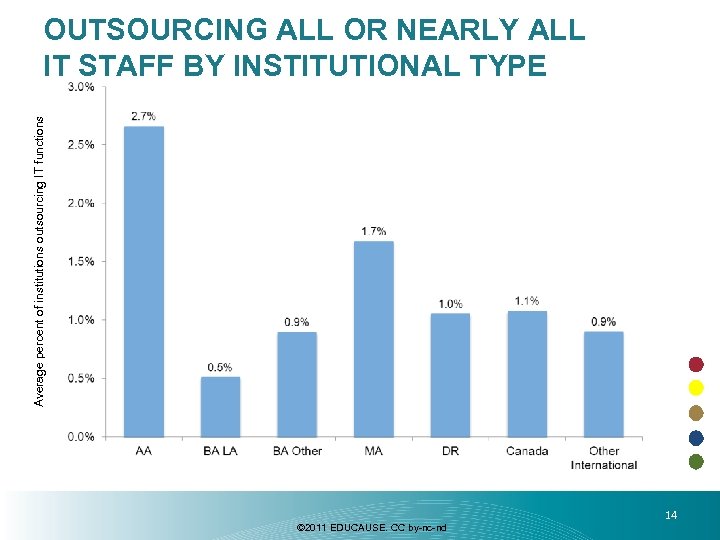 Average percent of institutions outsourcing IT functions OUTSOURCING ALL OR NEARLY ALL IT STAFF BY INSTITUTIONAL TYPE © 2011 EDUCAUSE. CC by-nc-nd 14
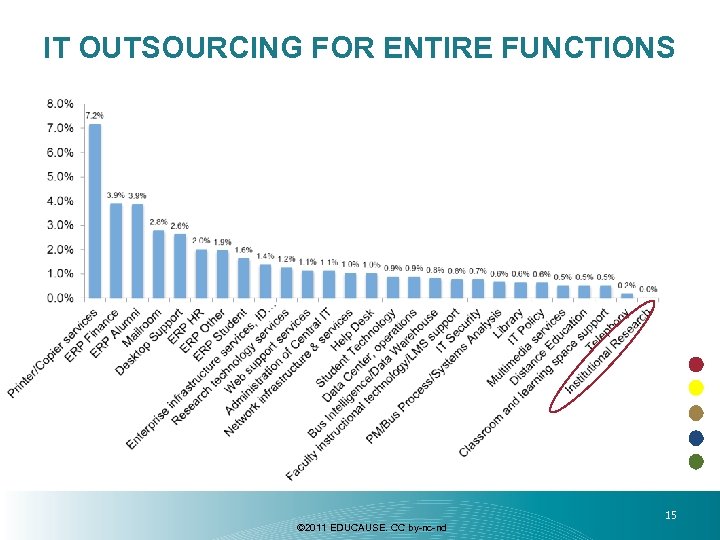 IT OUTSOURCING FOR ENTIRE FUNCTIONS © 2011 EDUCAUSE. CC by-nc-nd 15
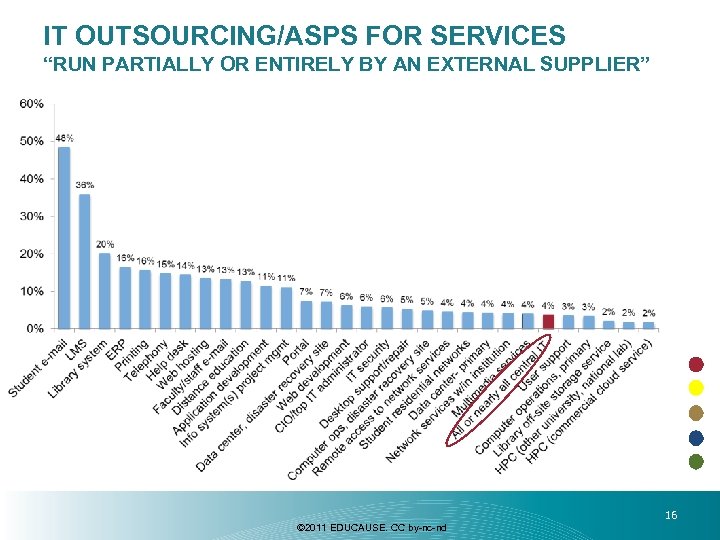 IT OUTSOURCING/ASPS FOR SERVICES “RUN PARTIALLY OR ENTIRELY BY AN EXTERNAL SUPPLIER” © 2011 EDUCAUSE. CC by-nc-nd 16
 MANAGING THE IT WORKFORCE • 32% of institutions have a salary scale for IT professionals that is different from that of other institutional staff. 97% of those have either a separate set of IT job titles or a broadband IT classification and compensations system, compared to… • 53% of the institutions without a separate salary scale for IT • © 2011 EDUCAUSE. CC by-nc-nd 17
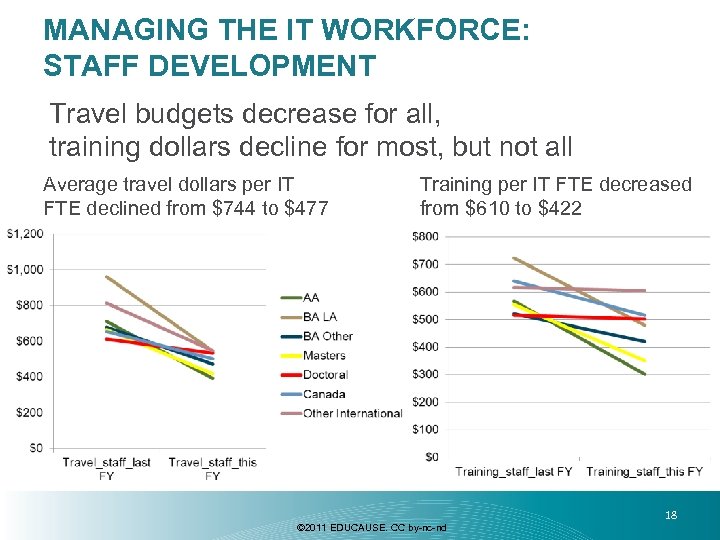 MANAGING THE IT WORKFORCE: STAFF DEVELOPMENT Travel budgets decrease for all, training dollars decline for most, but not all Average travel dollars per IT FTE declined from $744 to $477 Training per IT FTE decreased from $610 to $422 © 2011 EDUCAUSE. CC by-nc-nd 18
 IT BUDGETS AND FUNDING © 2011 EDUCAUSE. CC by-nc-nd 19
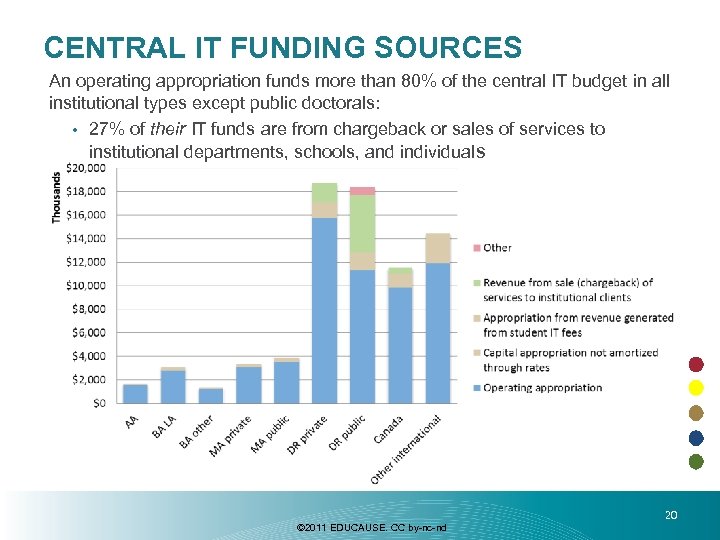 CENTRAL IT FUNDING SOURCES An operating appropriation funds more than 80% of the central IT budget in all institutional types except public doctorals: • 27% of their IT funds are from chargeback or sales of services to institutional departments, schools, and individuals © 2011 EDUCAUSE. CC by-nc-nd 20
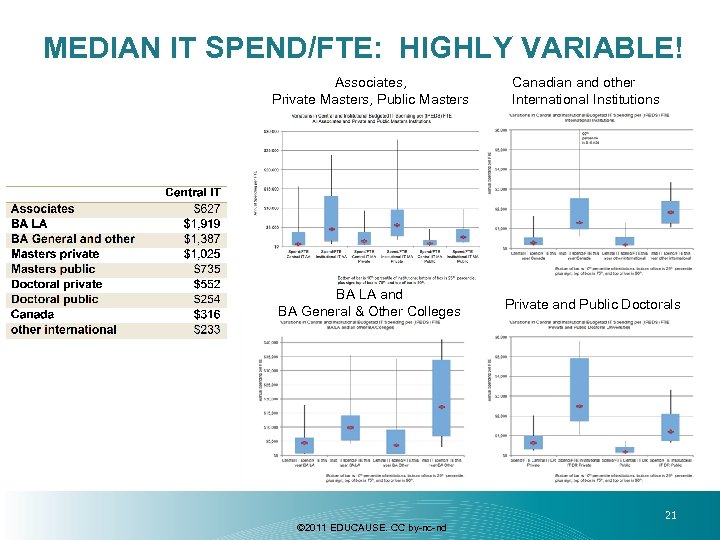 MEDIAN IT SPEND/FTE: HIGHLY VARIABLE! Associates, Private Masters, Public Masters BA LA and BA General & Other Colleges © 2011 EDUCAUSE. CC by-nc-nd Canadian and other International Institutions Private and Public Doctorals 21
 SUPPORT FOR FACULTY USE OF IT IN TEACHING AND LEARNING © 2011 EDUCAUSE. CC by-nc-nd 22
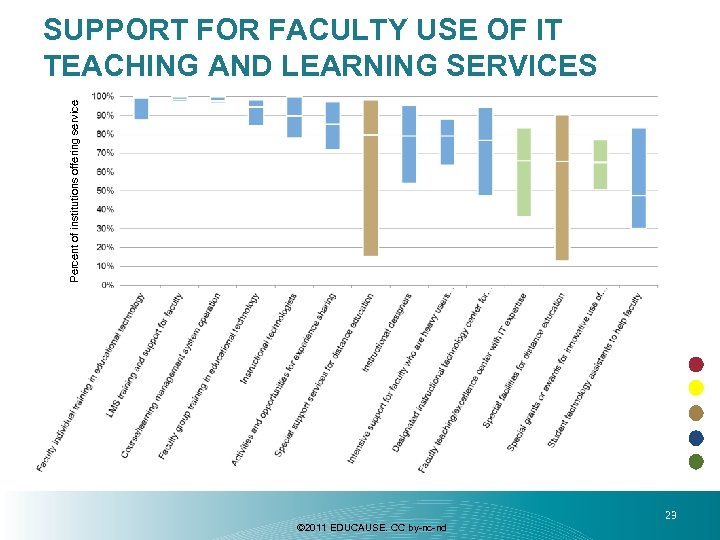 Percent of institutions offering service SUPPORT FOR FACULTY USE OF IT TEACHING AND LEARNING SERVICES © 2011 EDUCAUSE. CC by-nc-nd 23
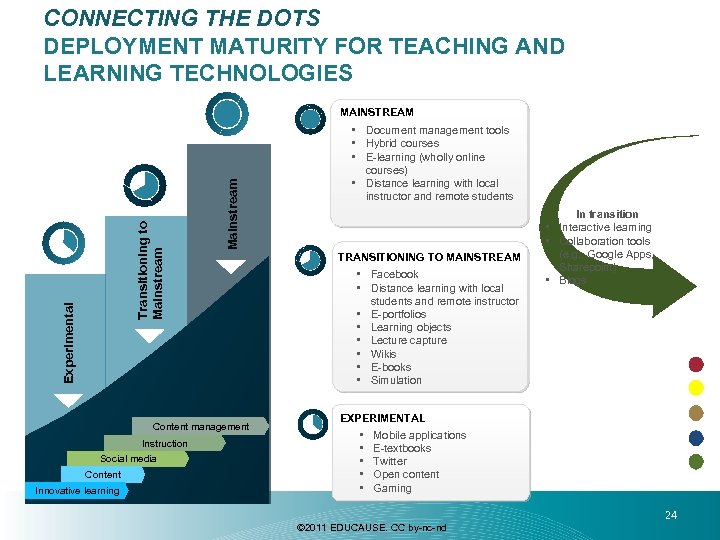 CONNECTING THE DOTS DEPLOYMENT MATURITY FOR TEACHING AND LEARNING TECHNOLOGIES Experimental Mainstream Transitioning to Mainstream MAINSTREAM Content management Instruction Social media Content Innovative learning • Document management tools • Hybrid courses • E-learning (wholly online courses) • Distance learning with local instructor and remote students TRANSITIONING TO MAINSTREAM • Facebook • Distance learning with local students and remote instructor • E-portfolios • Learning objects • Lecture capture • Wikis • E-books • Simulation In transition • Interactive learning • Collaboration tools (e. g. , Google Apps, Sharepoint) • Blogs EXPERIMENTAL • • • Mobile applications E-textbooks Twitter Open content Gaming © 2011 EDUCAUSE. CC by-nc-nd 24
 LEARNING MANAGEMENT SYSTEMS Use of commercial LMSs is more common in all types of institutions except BA Liberal Arts colleges • But faculty and students are most satisfied in institutions using a single open-source LMS • © 2011 EDUCAUSE. CC by-nc-nd 25
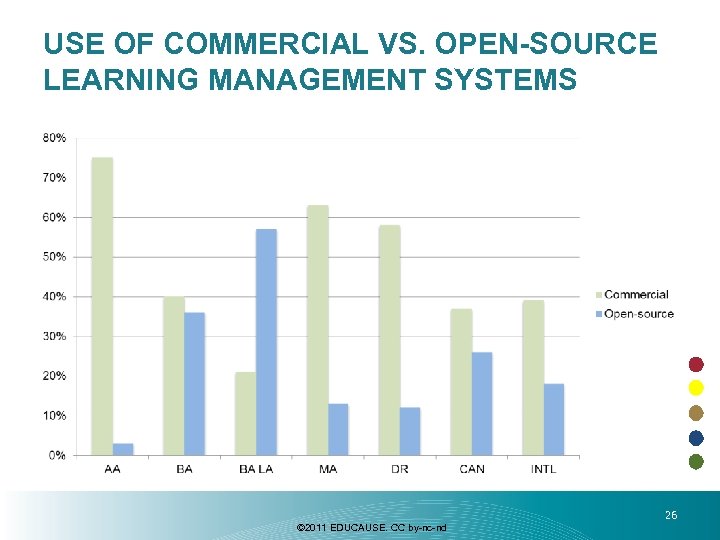 USE OF COMMERCIAL VS. OPEN-SOURCE LEARNING MANAGEMENT SYSTEMS © 2011 EDUCAUSE. CC by-nc-nd 26
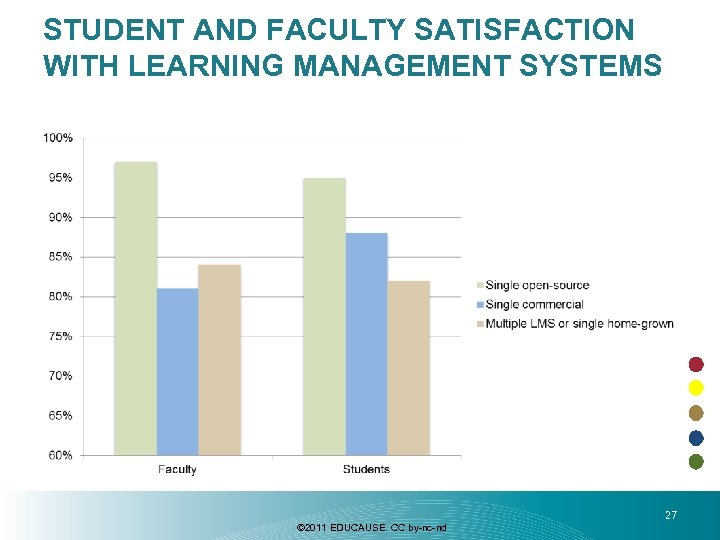 STUDENT AND FACULTY SATISFACTION WITH LEARNING MANAGEMENT SYSTEMS © 2011 EDUCAUSE. CC by-nc-nd 27
 IT SUPPORT FOR STUDENTS © 2011 EDUCAUSE. CC by-nc-nd 28
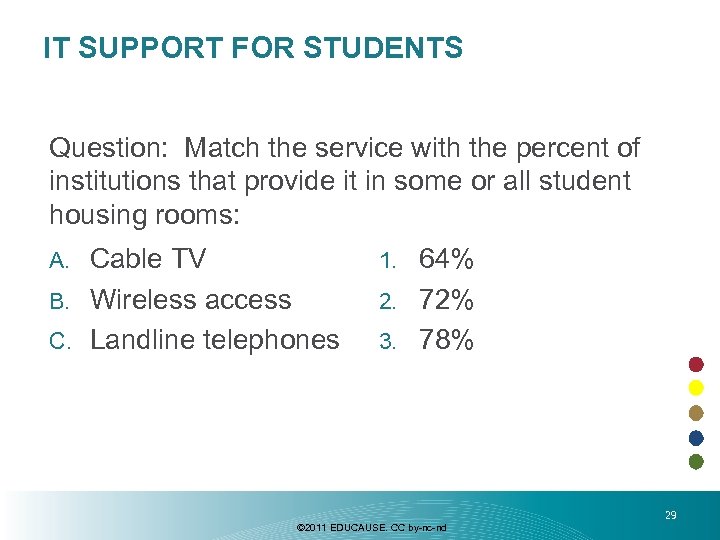 IT SUPPORT FOR STUDENTS Question: Match the service with the percent of institutions that provide it in some or all student housing rooms: Cable TV B. Wireless access C. Landline telephones A. 64% 2. 72% 3. 78% 1. © 2011 EDUCAUSE. CC by-nc-nd 29
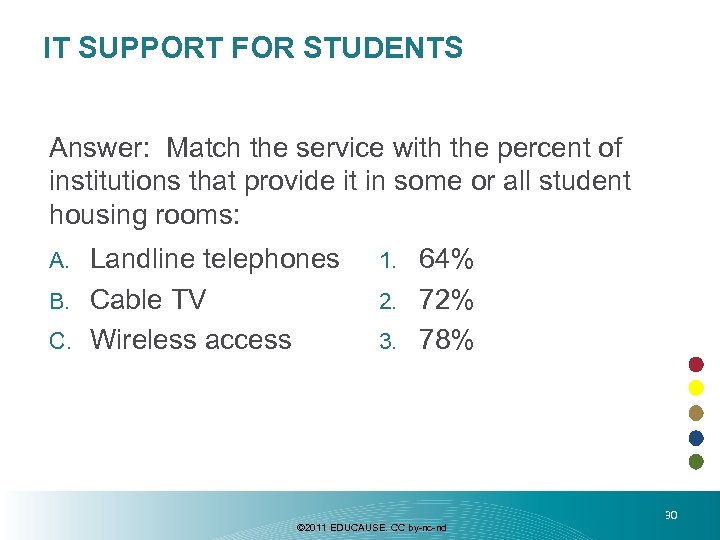 IT SUPPORT FOR STUDENTS Answer: Match the service with the percent of institutions that provide it in some or all student housing rooms: Landline telephones B. Cable TV C. Wireless access A. 64% 2. 72% 3. 78% 1. © 2011 EDUCAUSE. CC by-nc-nd 30
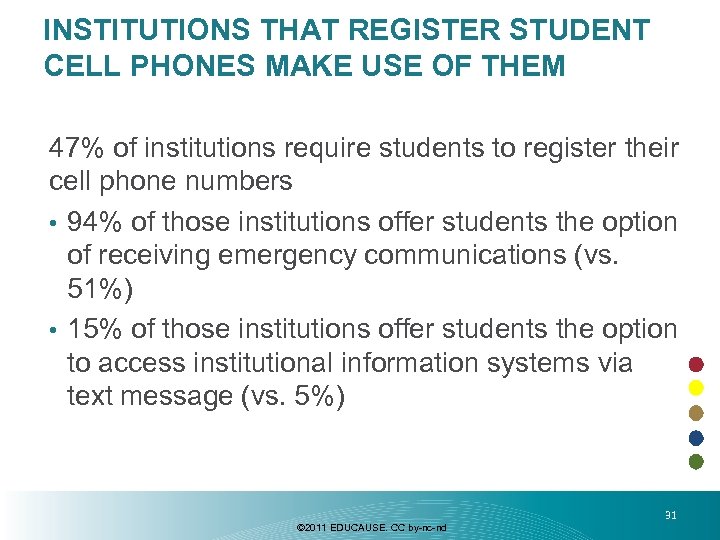 INSTITUTIONS THAT REGISTER STUDENT CELL PHONES MAKE USE OF THEM 47% of institutions require students to register their cell phone numbers • 94% of those institutions offer students the option of receiving emergency communications (vs. 51%) • 15% of those institutions offer students the option to access institutional information systems via text message (vs. 5%) © 2011 EDUCAUSE. CC by-nc-nd 31
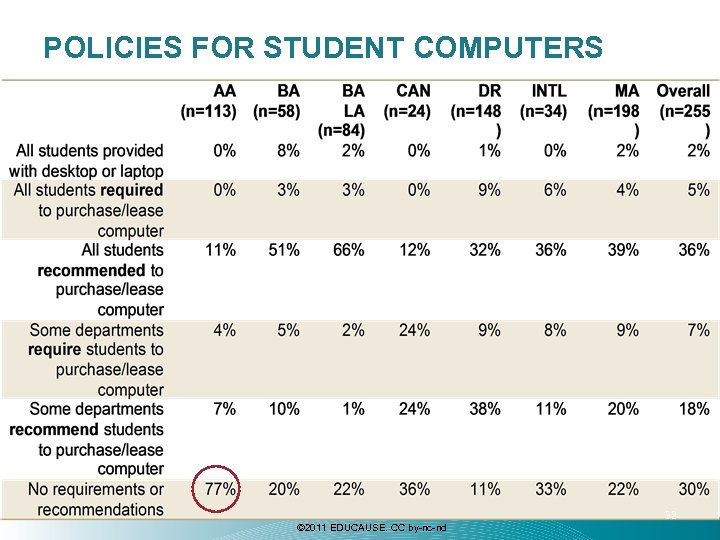 POLICIES FOR STUDENT COMPUTERS © 2011 EDUCAUSE. CC by-nc-nd 32
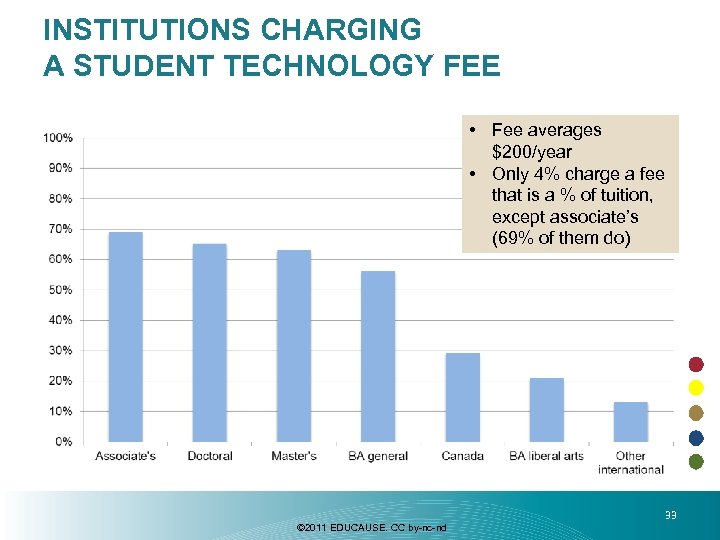 INSTITUTIONS CHARGING A STUDENT TECHNOLOGY FEE • Fee averages $200/year • Only 4% charge a fee that is a % of tuition, except associate’s (69% of them do) © 2011 EDUCAUSE. CC by-nc-nd 33
 SUPPORT FOR RESEARCH © 2011 EDUCAUSE. CC by-nc-nd 34
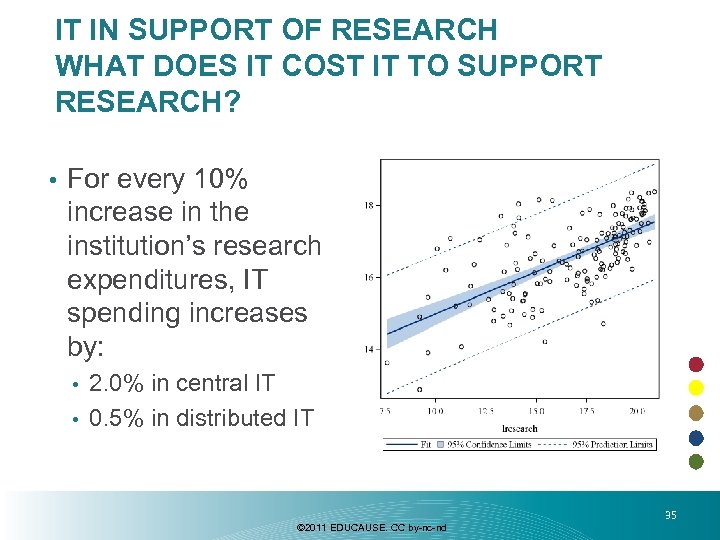 IT IN SUPPORT OF RESEARCH WHAT DOES IT COST IT TO SUPPORT RESEARCH? • For every 10% increase in the institution’s research expenditures, IT spending increases by: 2. 0% in central IT • 0. 5% in distributed IT • © 2011 EDUCAUSE. CC by-nc-nd 35
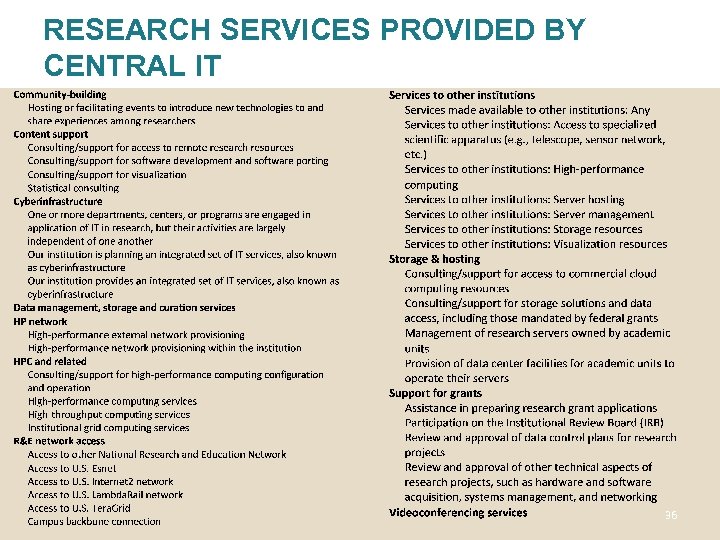 RESEARCH SERVICES PROVIDED BY CENTRAL IT © 2011 EDUCAUSE. CC by-nc-nd 36
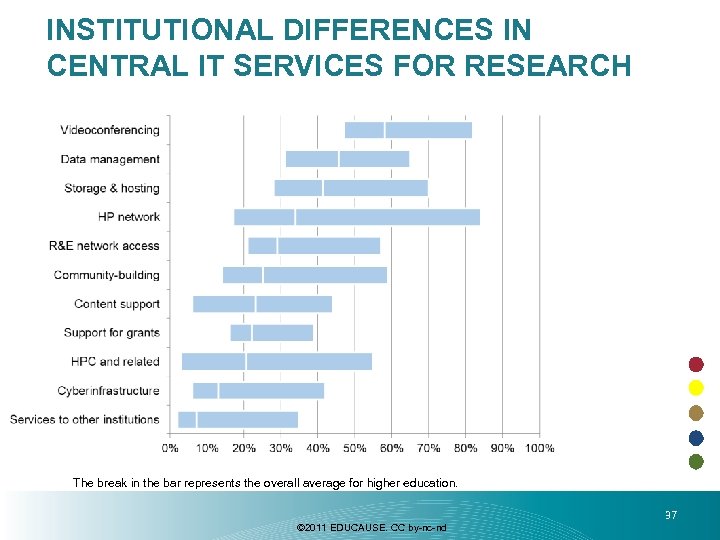 INSTITUTIONAL DIFFERENCES IN CENTRAL IT SERVICES FOR RESEARCH The break in the bar represents the overall average for higher education. © 2011 EDUCAUSE. CC by-nc-nd 37
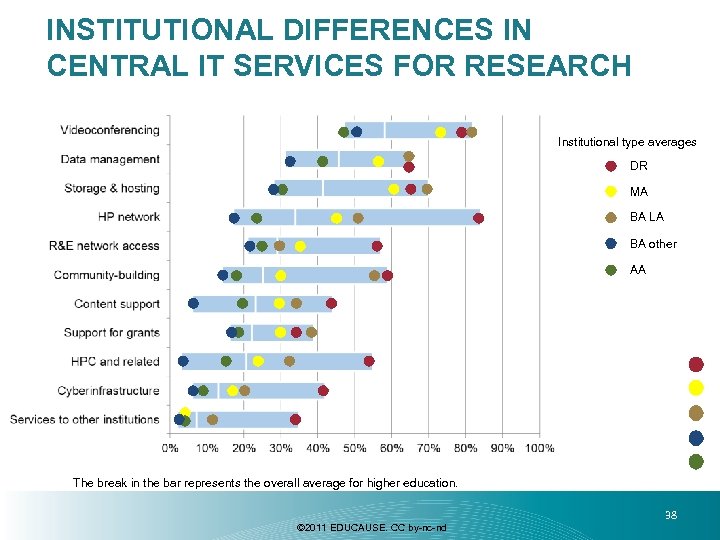 INSTITUTIONAL DIFFERENCES IN CENTRAL IT SERVICES FOR RESEARCH Institutional type averages DR MA BA LA BA other AA The break in the bar represents the overall average for higher education. © 2011 EDUCAUSE. CC by-nc-nd 38
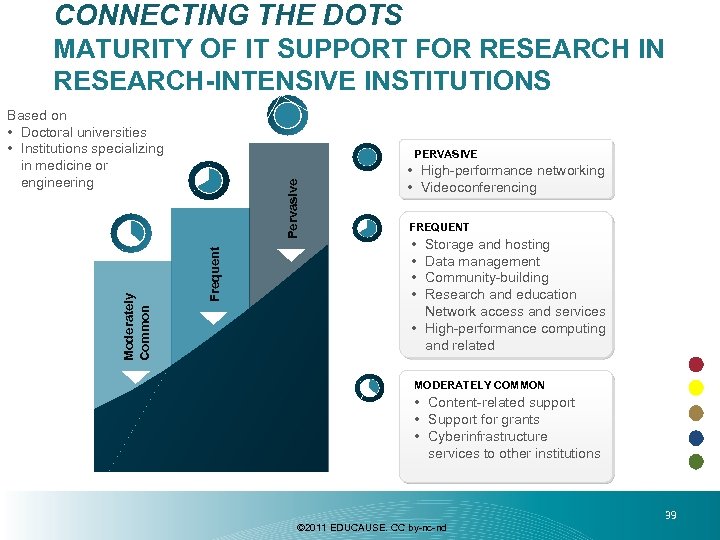 CONNECTING THE DOTS MATURITY OF IT SUPPORT FOR RESEARCH IN RESEARCH-INTENSIVE INSTITUTIONS Pervasive PERVASIVE Frequent Moderately Common Based on • Doctoral universities • Institutions specializing in medicine or engineering • High-performance networking • Videoconferencing FREQUENT • • Storage and hosting Data management Community-building Research and education Network access and services • High-performance computing and related MODERATELY COMMON • Content-related support • Support for grants • Cyberinfrastructure services to other institutions © 2011 EDUCAUSE. CC by-nc-nd 39
 IT IN THE INSTITUTION © 2011 EDUCAUSE. CC by-nc-nd 40
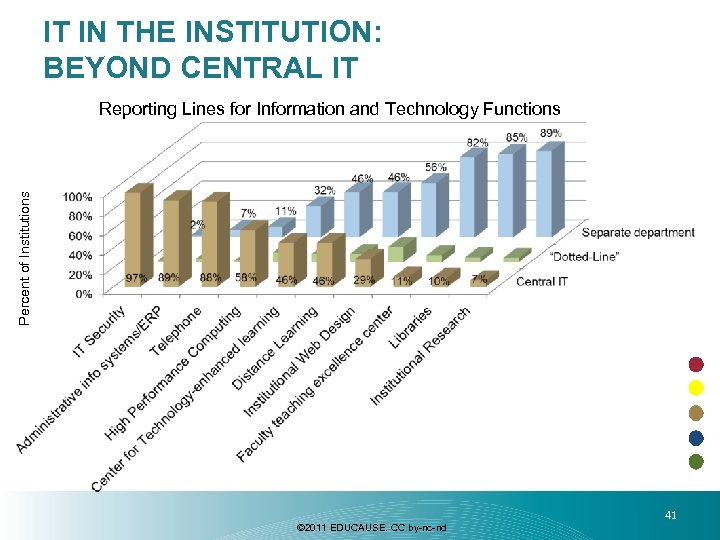 IT IN THE INSTITUTION: BEYOND CENTRAL IT Percent of Institutions Reporting Lines for Information and Technology Functions © 2011 EDUCAUSE. CC by-nc-nd 41
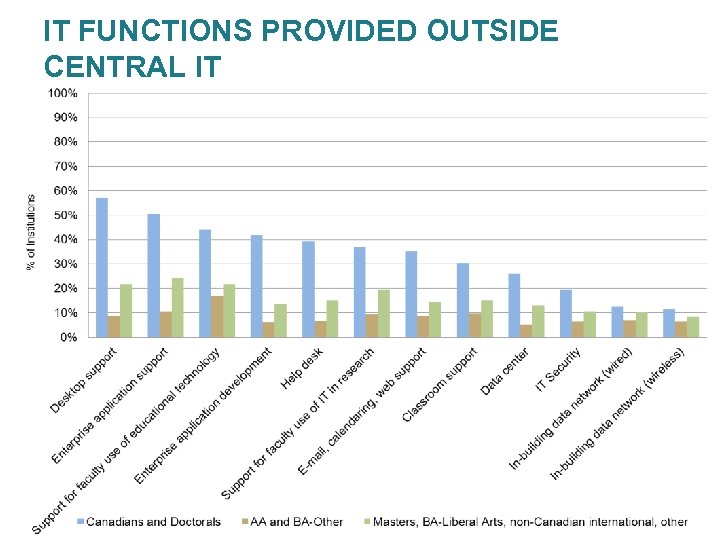 IT FUNCTIONS PROVIDED OUTSIDE CENTRAL IT © 2011 EDUCAUSE. CC by-nc-nd 42
 ACADEMIC DEPARTMENTS ARE MORE LIKELY THAN ADMINISTRATIVE TO DELIVER IT SERVICES © 2011 EDUCAUSE. CC by-nc-nd 43
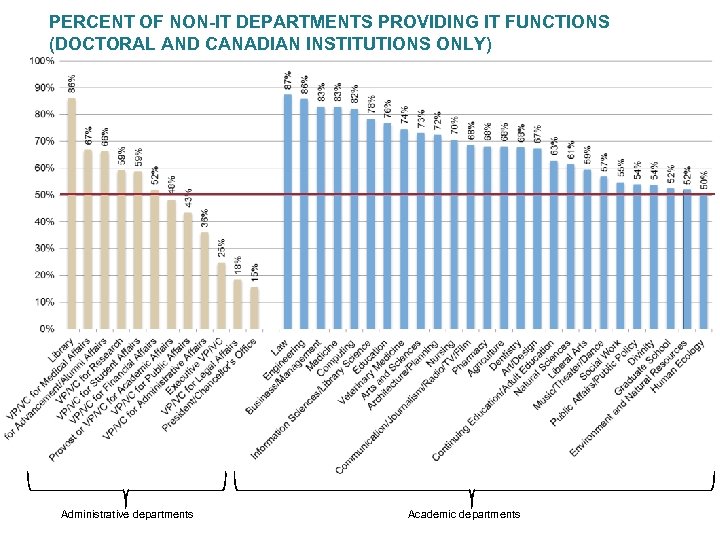 PERCENT OF NON-IT DEPARTMENTS PROVIDING IT FUNCTIONS (DOCTORAL AND CANADIAN INSTITUTIONS ONLY) Administrative departments Academic departments © 2011 EDUCAUSE. CC by-nc-nd 44
 IT SUPPORT © 2011 EDUCAUSE. CC by-nc-nd 45
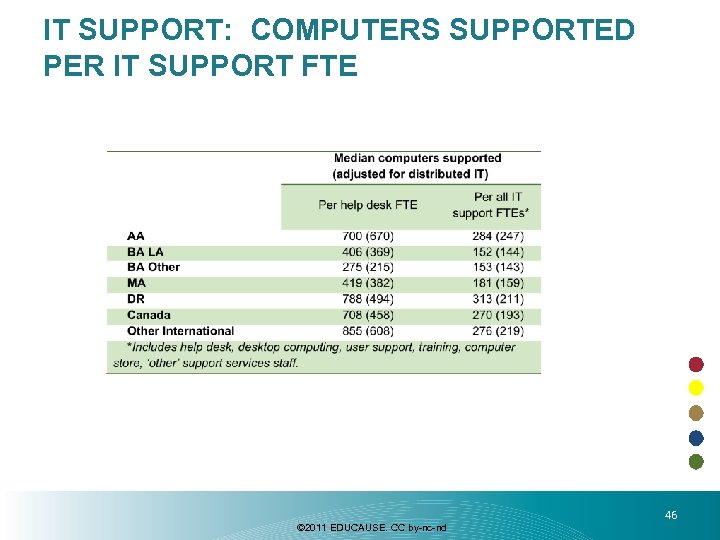 IT SUPPORT: COMPUTERS SUPPORTED PER IT SUPPORT FTE © 2011 EDUCAUSE. CC by-nc-nd 46
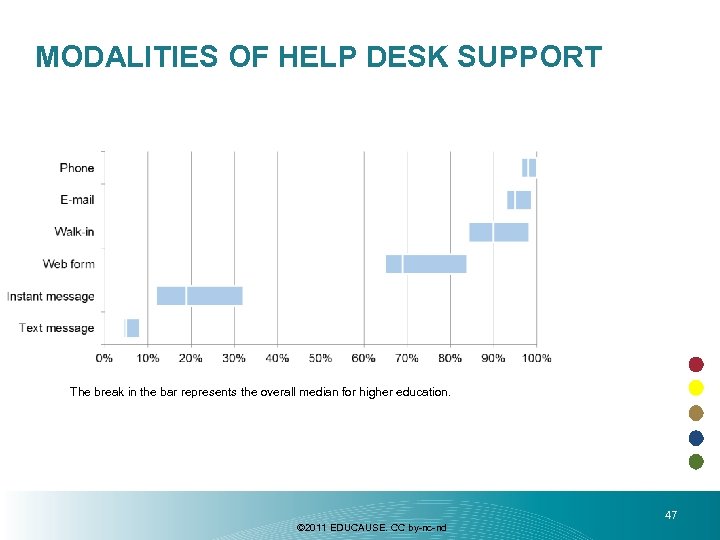 MODALITIES OF HELP DESK SUPPORT The break in the bar represents the overall median for higher education. © 2011 EDUCAUSE. CC by-nc-nd 47
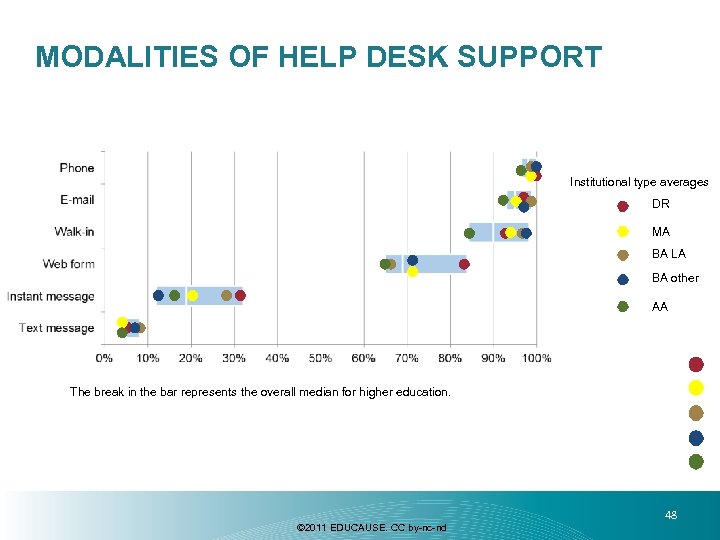 MODALITIES OF HELP DESK SUPPORT Institutional type averages DR MA BA LA BA other AA The break in the bar represents the overall median for higher education. © 2011 EDUCAUSE. CC by-nc-nd 48
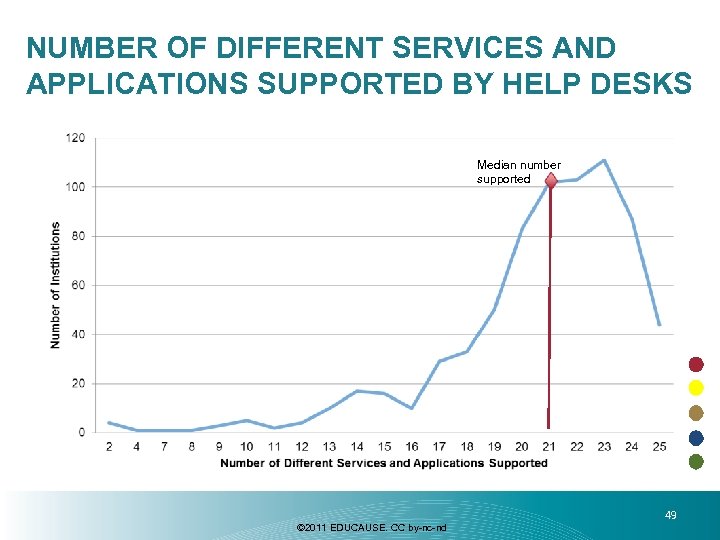 NUMBER OF DIFFERENT SERVICES AND APPLICATIONS SUPPORTED BY HELP DESKS Median number supported © 2011 EDUCAUSE. CC by-nc-nd 49
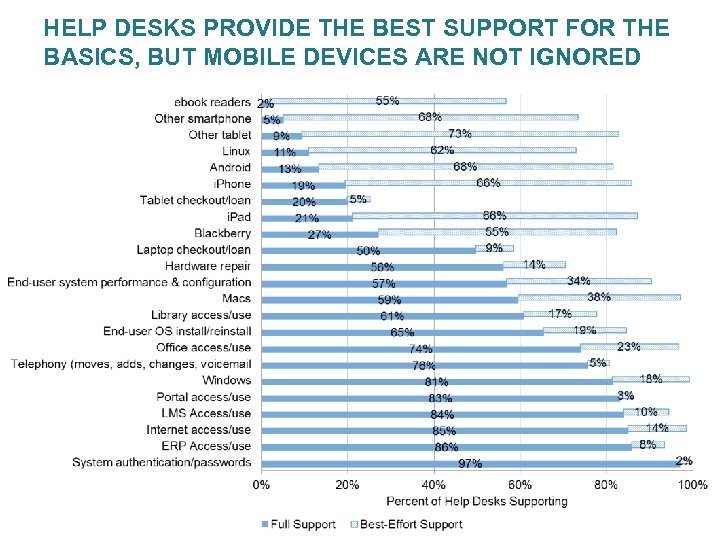 HELP DESKS PROVIDE THE BEST SUPPORT FOR THE BASICS, BUT MOBILE DEVICES ARE NOT IGNORED © 2011 EDUCAUSE. CC by-nc-nd 50
 STUDENT E-MAIL © 2011 EDUCAUSE. CC by-nc-nd 51
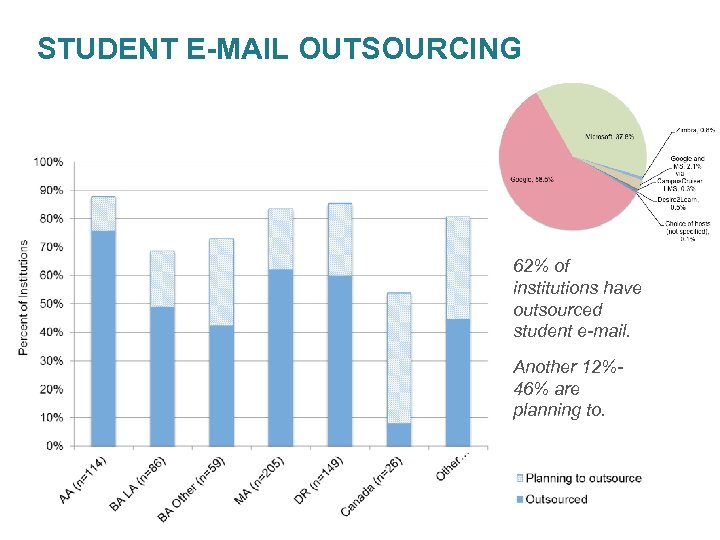 STUDENT E-MAIL OUTSOURCING 62% of institutions have outsourced student e-mail. Another 12%46% are planning to. © 2011 EDUCAUSE. CC by-nc-nd 52
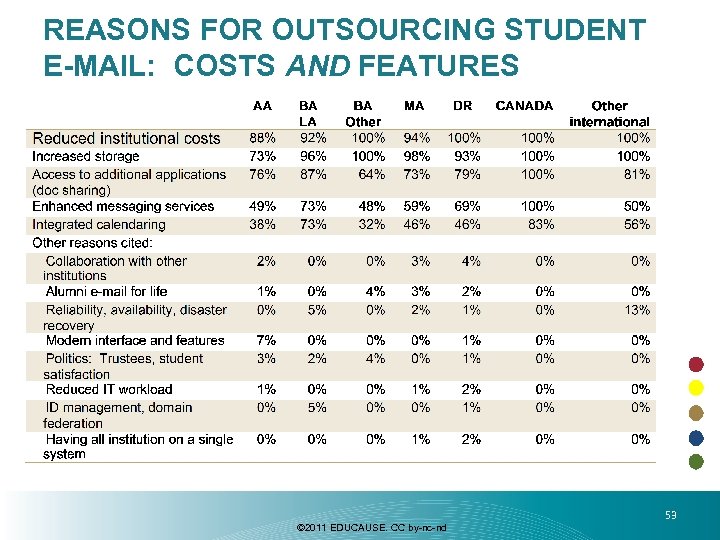 REASONS FOR OUTSOURCING STUDENT E-MAIL: COSTS AND FEATURES © 2011 EDUCAUSE. CC by-nc-nd 53
 ENTERPRISE SYSTEMS © 2011 EDUCAUSE. CC by-nc-nd 54
 ENTERPRISE SYSTEMS TODAY: VENDOR APPLICATIONS MANAGED IN-HOUSE • Application management 79% of enterprise applications are managed in-house • 8% by a system office (30% for community colleges) • 11% are outsourced (6% for doctorals, 5% for international institutions) • • Application origin Vendors (85% of applications) • Home-grown = 9%, open-source = 6% • Grants management has most homegrown (31%) • Content (21%) and learning (24%) management most open source • © 2011 EDUCAUSE. CC by-nc-nd 55
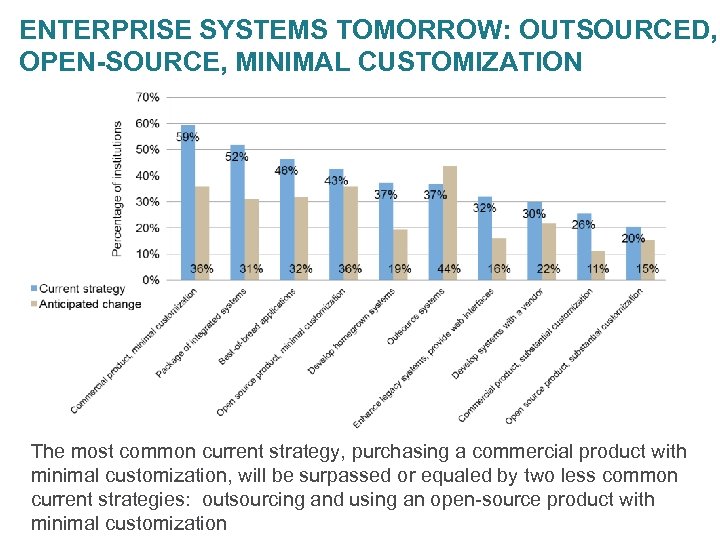 ENTERPRISE SYSTEMS TOMORROW: OUTSOURCED, OPEN-SOURCE, MINIMAL CUSTOMIZATION The most common current strategy, purchasing a commercial product with minimal customization, will be surpassed or equaled by two less common current strategies: outsourcing and using an open-source product with 56 minimal customization © 2011 EDUCAUSE. CC by-nc-nd
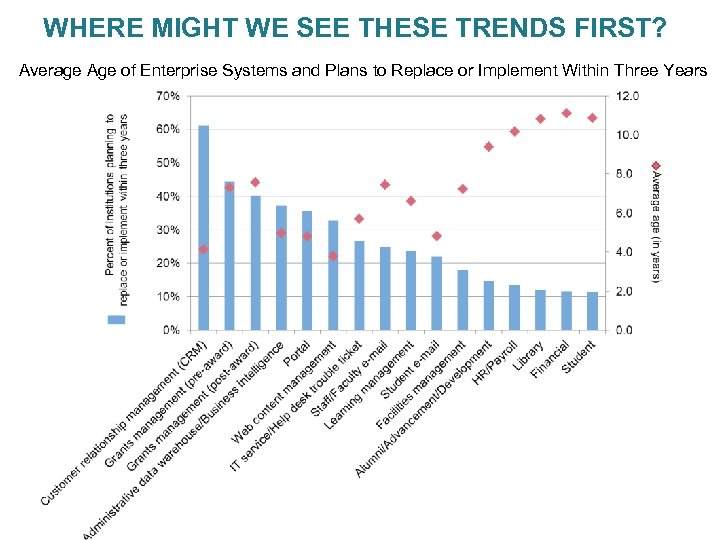 WHERE MIGHT WE SEE THESE TRENDS FIRST? Average Age of Enterprise Systems and Plans to Replace or Implement Within Three Years © 2011 EDUCAUSE. CC by-nc-nd 57
 USER SATISFACTION WITH ENTERPRISE SYSTEMS: IT DEPENDS Estimated user satisfaction with enterprise systems overall (no data on particular applications) High general satisfaction: 72% satisfied vs. 11% dissatisfied • Mixed user assessments of ease-of-use (39% vs. 29%) • Low satisfaction with data access and reporting capabilities (only 38% satisfied vs. 41% dissatisfied) • Institutions gave themselves high marks for systems implementations and upgrades: 68% satisfaction and only 10% dissatisfaction • © 2011 EDUCAUSE. CC by-nc-nd 58
 INFORMATION SECURITY © 2011 EDUCAUSE. CC by-nc-nd 59
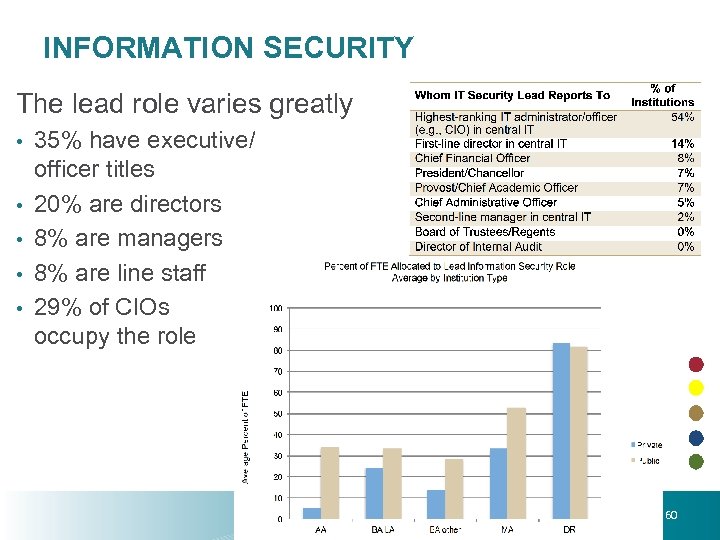 INFORMATION SECURITY The lead role varies greatly • • • 35% have executive/ officer titles 20% are directors 8% are managers 8% are line staff 29% of CIOs occupy the role © 2011 EDUCAUSE. CC by-nc-nd 60
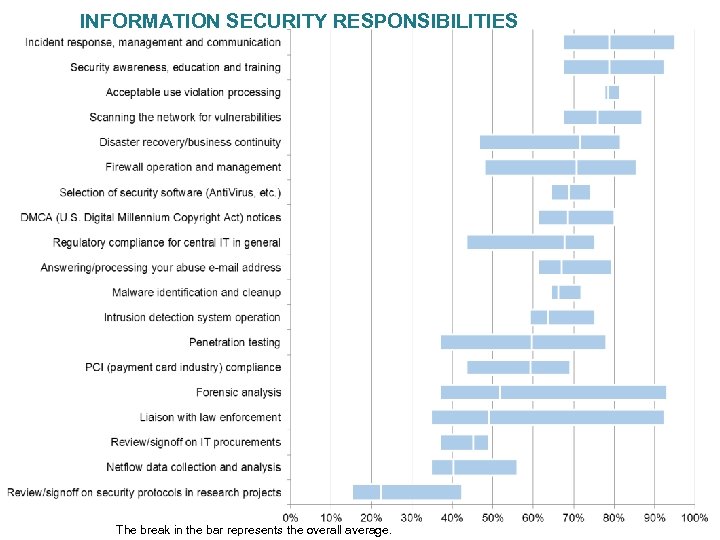 INFORMATION SECURITY RESPONSIBILITIES The break in the bar represents © 2011 EDUCAUSE. the overall average. CC by-nc-nd 61
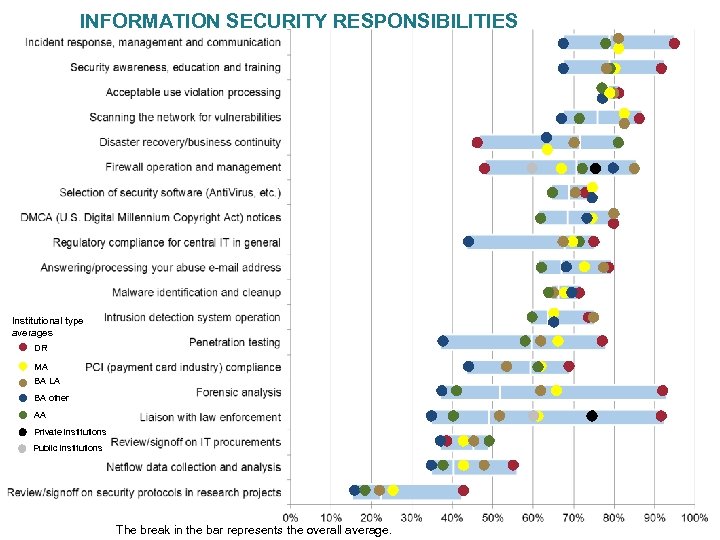 INFORMATION SECURITY RESPONSIBILITIES Institutional type averages DR MA BA LA BA other AA Private institutions Public institutions The break in the bar represents © 2011 EDUCAUSE. the overall average. CC by-nc-nd 62
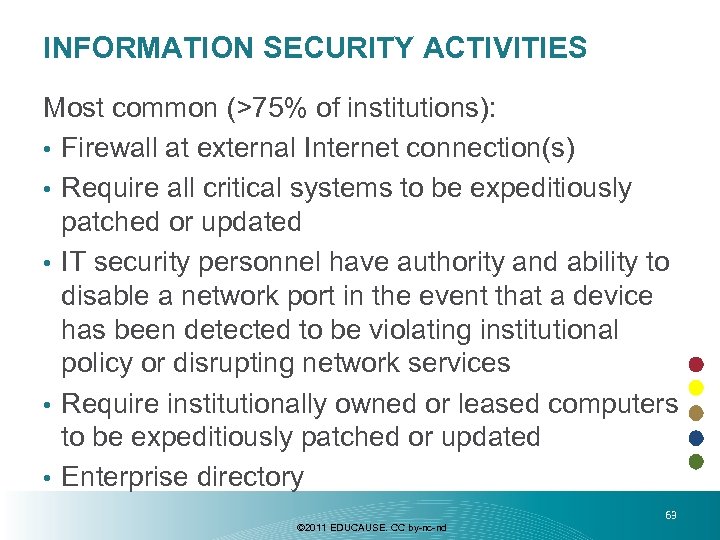 INFORMATION SECURITY ACTIVITIES Most common (>75% of institutions): • Firewall at external Internet connection(s) • Require all critical systems to be expeditiously patched or updated • IT security personnel have authority and ability to disable a network port in the event that a device has been detected to be violating institutional policy or disrupting network services • Require institutionally owned or leased computers to be expeditiously patched or updated • Enterprise directory © 2011 EDUCAUSE. CC by-nc-nd 63
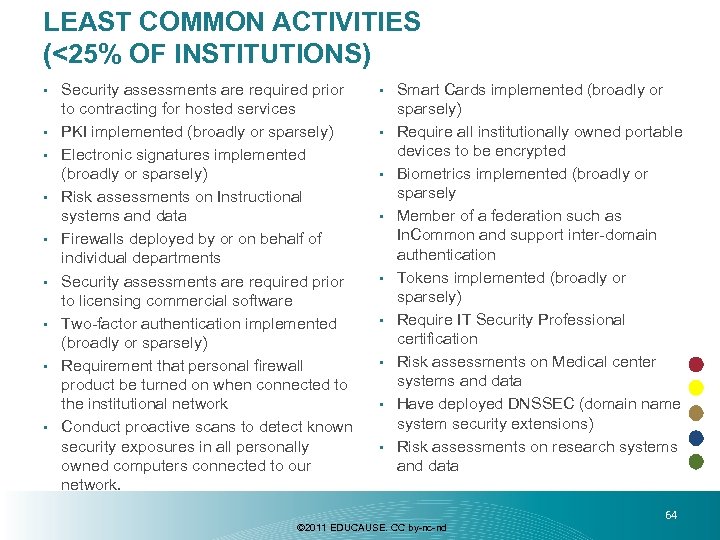 LEAST COMMON ACTIVITIES (<25% OF INSTITUTIONS) • • • Security assessments are required prior to contracting for hosted services PKI implemented (broadly or sparsely) Electronic signatures implemented (broadly or sparsely) Risk assessments on Instructional systems and data Firewalls deployed by or on behalf of individual departments Security assessments are required prior to licensing commercial software Two-factor authentication implemented (broadly or sparsely) Requirement that personal firewall product be turned on when connected to the institutional network Conduct proactive scans to detect known security exposures in all personally owned computers connected to our network. • • • Smart Cards implemented (broadly or sparsely) Require all institutionally owned portable devices to be encrypted Biometrics implemented (broadly or sparsely Member of a federation such as In. Common and support inter-domain authentication Tokens implemented (broadly or sparsely) Require IT Security Professional certification Risk assessments on Medical center systems and data Have deployed DNSSEC (domain name system security extensions) Risk assessments on research systems and data © 2011 EDUCAUSE. CC by-nc-nd 64
 INDICATORS OF INFORMATION SECURITY MATURITY: WHO HAS DONE THE MOST? Doctoral and public institutions are engaged in more activities • Information security departments with more responsibilities • Information security leads with full-time allocations to the role • Information security leads who report to the CIO • © 2011 EDUCAUSE. CC by-nc-nd 65
 DATA CENTERS © 2011 EDUCAUSE. CC by-nc-nd 66
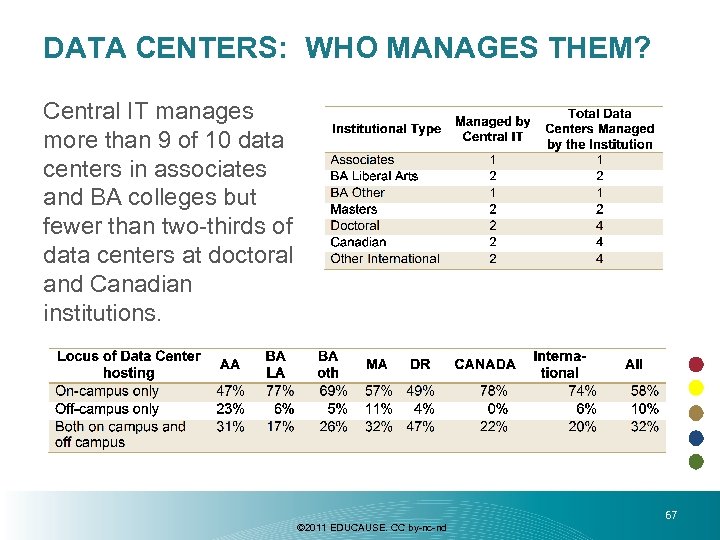 DATA CENTERS: WHO MANAGES THEM? Central IT manages more than 9 of 10 data centers in associates and BA colleges but fewer than two-thirds of data centers at doctoral and Canadian institutions. © 2011 EDUCAUSE. CC by-nc-nd 67
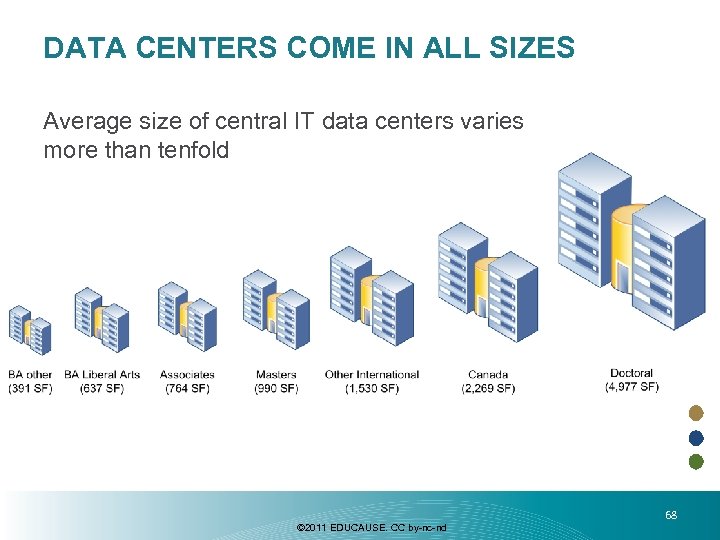 DATA CENTERS COME IN ALL SIZES Average size of central IT data centers varies more than tenfold © 2011 EDUCAUSE. CC by-nc-nd 68
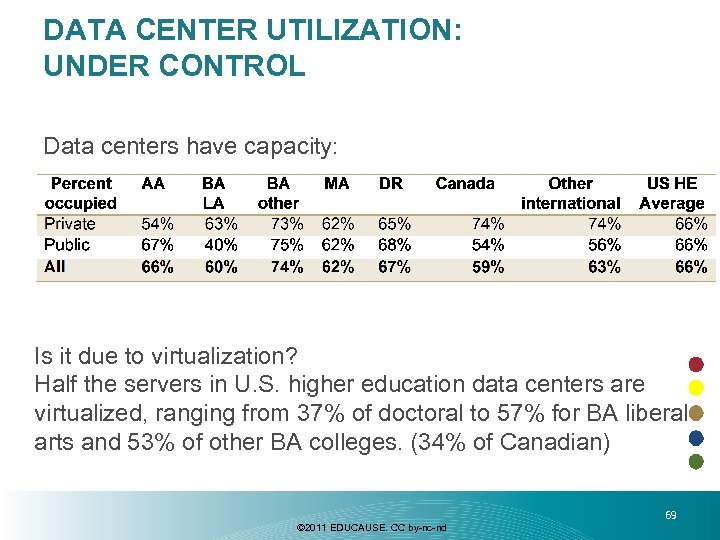 DATA CENTER UTILIZATION: UNDER CONTROL Data centers have capacity: Is it due to virtualization? Half the servers in U. S. higher education data centers are virtualized, ranging from 37% of doctoral to 57% for BA liberal arts and 53% of other BA colleges. (34% of Canadian) © 2011 EDUCAUSE. CC by-nc-nd 69
 WHEN DISASTER STRIKES 24% of data centers managed by central IT do not have a secondary power source • 77% lack a tertiary power source • 23% of institutions have no disaster recovery provisions in place for their data centers • 81% with a disaster recovery site have not tested it in the past year • © 2011 EDUCAUSE. CC by-nc-nd 70
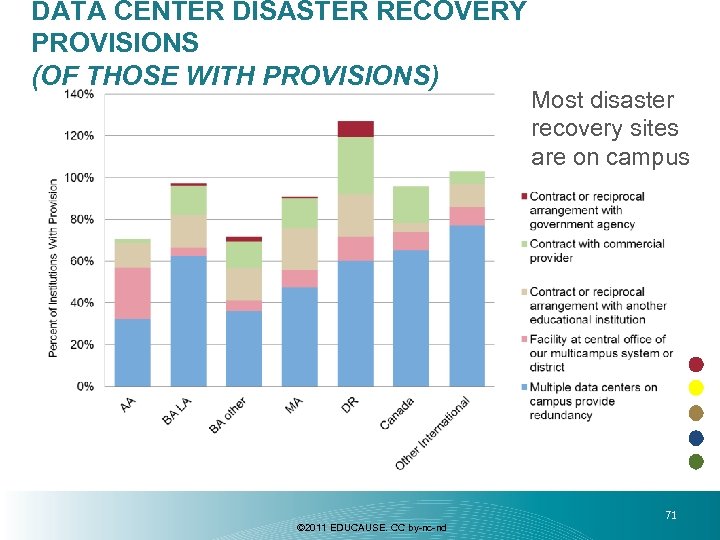 DATA CENTER DISASTER RECOVERY PROVISIONS (OF THOSE WITH PROVISIONS) © 2011 EDUCAUSE. CC by-nc-nd Most disaster recovery sites are on campus 71
 IT’S CONTRIBUTIONS TO SUSTAINABILITY © 2011 EDUCAUSE. CC by-nc-nd 72
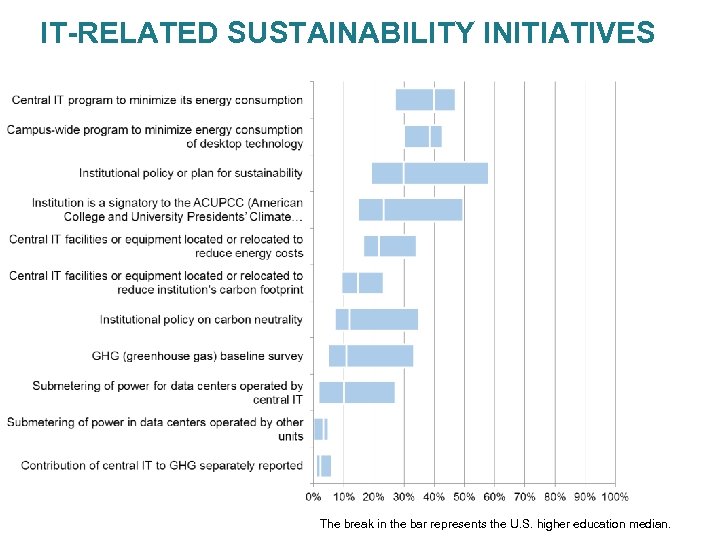 IT-RELATED SUSTAINABILITY INITIATIVES The break in CC bar represents © 2011 EDUCAUSE. the by-nc-nd 73 the U. S. higher education median.
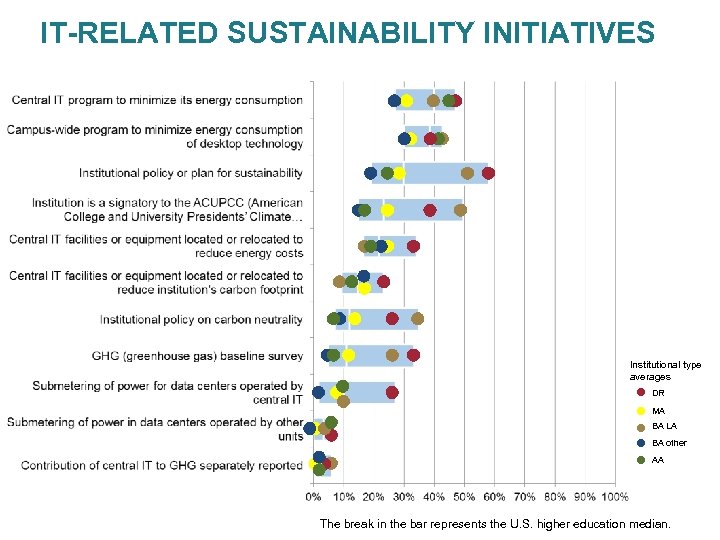 IT-RELATED SUSTAINABILITY INITIATIVES Institutional type averages DR MA BA LA BA other AA The break in CC bar represents © 2011 EDUCAUSE. the by-nc-nd 74 the U. S. higher education median.
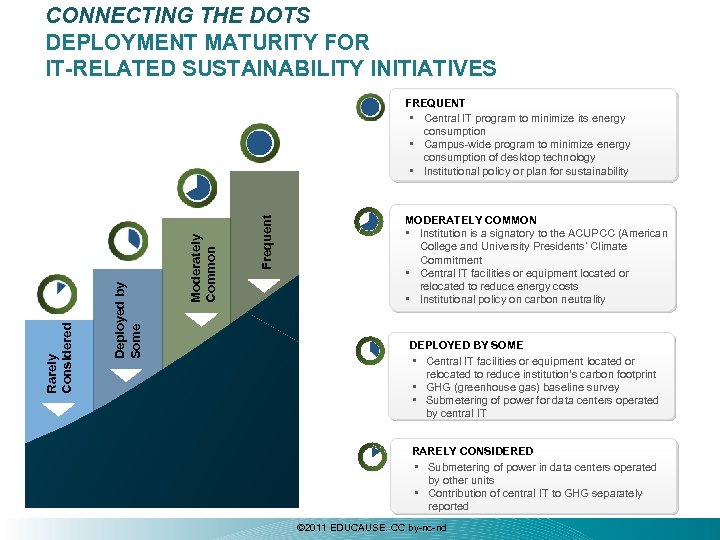 CONNECTING THE DOTS DEPLOYMENT MATURITY FOR IT-RELATED SUSTAINABILITY INITIATIVES Frequent Moderately Common Deployed by Some Rarely Considered FREQUENT • Central IT program to minimize its energy consumption • Campus-wide program to minimize energy consumption of desktop technology • Institutional policy or plan for sustainability MODERATELY COMMON • Institution is a signatory to the ACUPCC (American College and University Presidents’ Climate Commitment • Central IT facilities or equipment located or relocated to reduce energy costs • Institutional policy on carbon neutrality DEPLOYED BY SOME • Central IT facilities or equipment located or relocated to reduce institution's carbon footprint • GHG (greenhouse gas) baseline survey • Submetering of power for data centers operated by central IT RARELY CONSIDERED • Submetering of power in data centers operated by other units • Contribution of central IT to GHG separately reported © 2011 EDUCAUSE. CC by-nc-nd
 A WORD ABOUT THE CORE DATA SERVICE Big redesign this year • Some hits, some misses • We’re reviewing your evaluations to adapt the service for this year • We have plans to do more: Come learn more about our plans for data, benchmarking, and analytics tomorrow at 12: 30 in room 201 A • © 2011 EDUCAUSE. CC by-nc-nd 76
 THANK YOU sgrajek@educause. edu © 2011 EDUCAUSE. CC by-nc-nd