 Скачать презентацию Higher or Lower Density What Gives the Best
dcf2f11bc3febbf8c277b53c414f2150.ppt
- Количество слайдов: 35




Higher or Lower Density? What Gives the Best Bang for the Buck for Mitigating the Effects of Development? John Jacob, Ph. d. Ricardo López, M. S. Houston, TX May 8 -210, 2006 The AWRA 2006 Conference on GIS & Water Resources IV AWRA
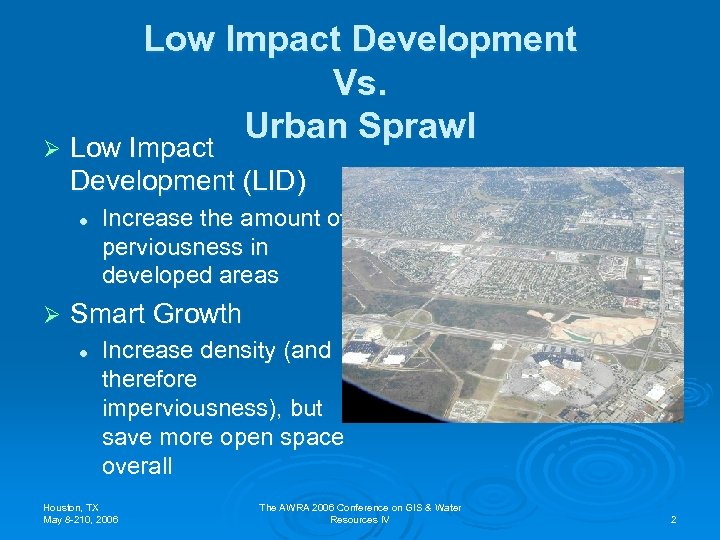
Low Impact Development Vs. Urban Sprawl Ø Low Impact Development (LID) l Ø Increase the amount of perviousness in developed areas Smart Growth l Increase density (and therefore imperviousness), but save more open space overall Houston, TX May 8 -210, 2006 The AWRA 2006 Conference on GIS & Water Resources IV 2
Goal Report the results of a modeling effort comparing the two approaches in a hypothetical watershed Houston, TX May 8 -210, 2006 The AWRA 2006 Conference on GIS & Water Resources IV 3
Impervious land cover Impervious surface features are those that prohibit water from naturally infiltrating the ground (concrete, pavement, etc) Ø Urban Landscapes: Ø l l Ø Concrete, pavement, rooftops Swimming Pools Impervious Land Cover: essentially the area that is not “green” Houston, TX May 8 -210, 2006 The AWRA 2006 Conference on GIS & Water Resources IV 4
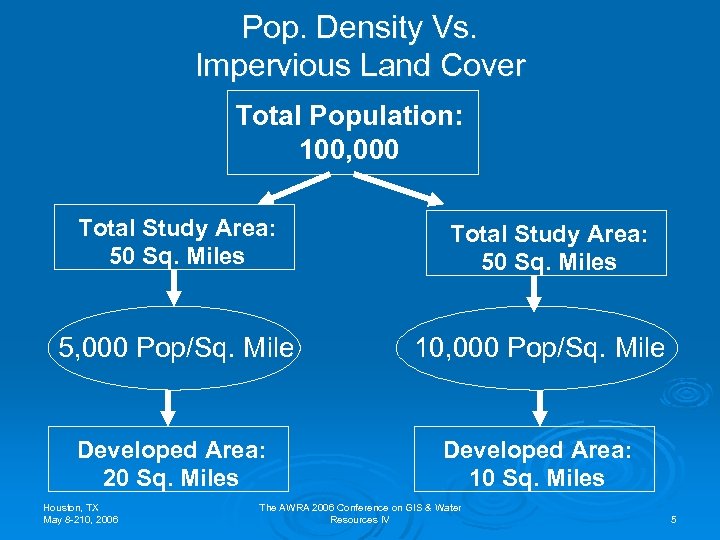
Pop. Density Vs. Impervious Land Cover Total Population: 100, 000 Total Study Area: 50 Sq. Miles 5, 000 Pop/Sq. Mile 10, 000 Pop/Sq. Mile Developed Area: 20 Sq. Miles Developed Area: 10 Sq. Miles Houston, TX May 8 -210, 2006 The AWRA 2006 Conference on GIS & Water Resources IV 5
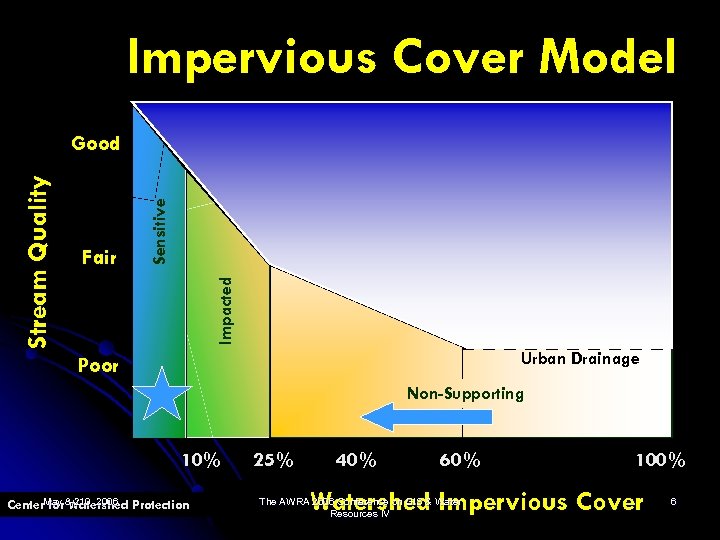
Impervious Cover Model Impacted Fair Sensitive Stream Quality Good Urban Drainage Poor Non-Supporting 10% Center. May 8 -210, 2006 Protection for Watershed 25% 40% 60% 100% Watershed Impervious Cover The AWRA 2006 Conference on GIS & Water Resources IV 6
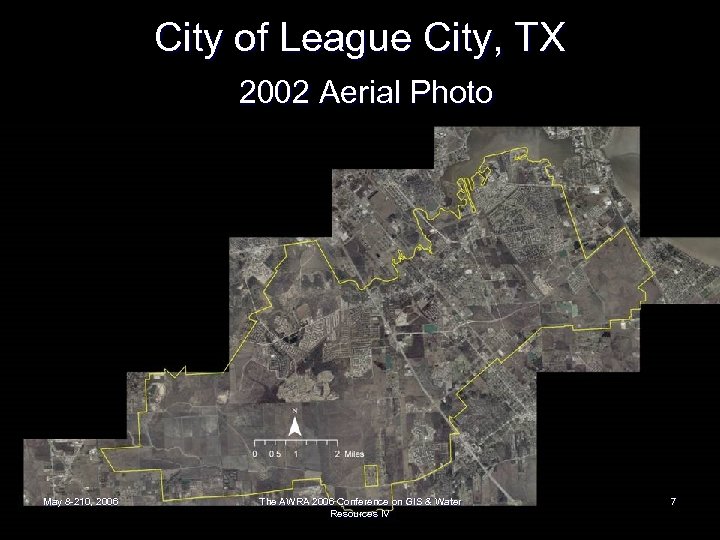
City of League City, TX 2002 Aerial Photo May 8 -210, 2006 The AWRA 2006 Conference on GIS & Water Resources IV 7
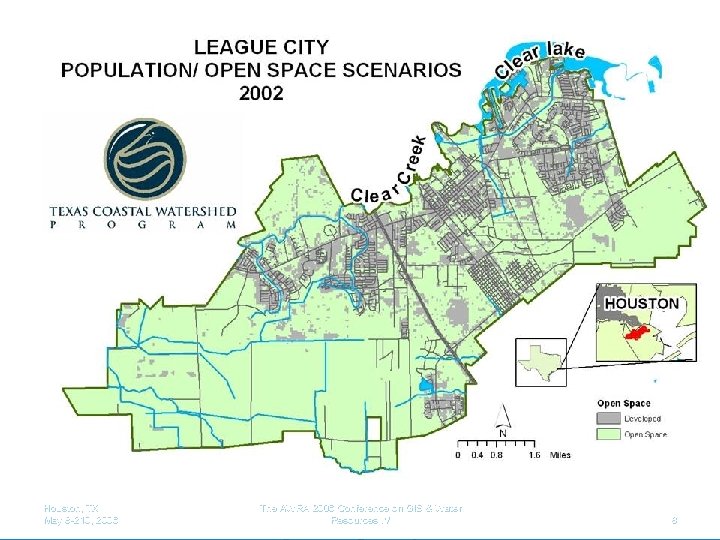
Houston, TX May 8 -210, 2006 The AWRA 2006 Conference on GIS & Water Resources IV 8
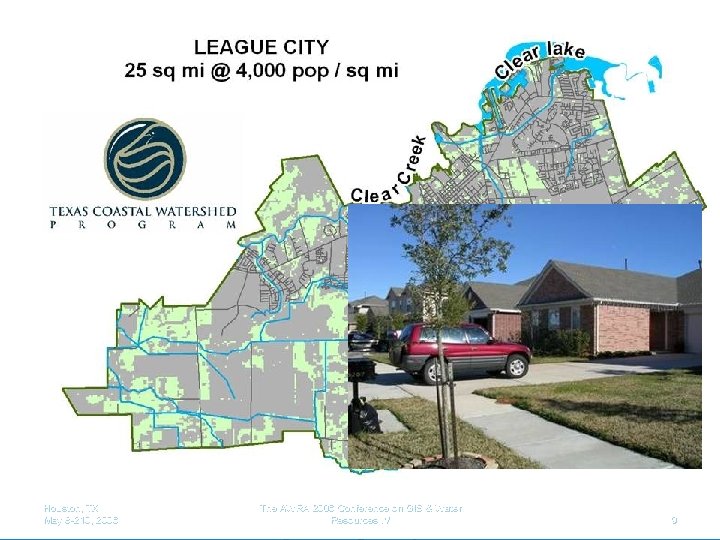
Houston, TX May 8 -210, 2006 100, 000 new residents The AWRA 2006 Conference on GIS & Water Resources IV 9
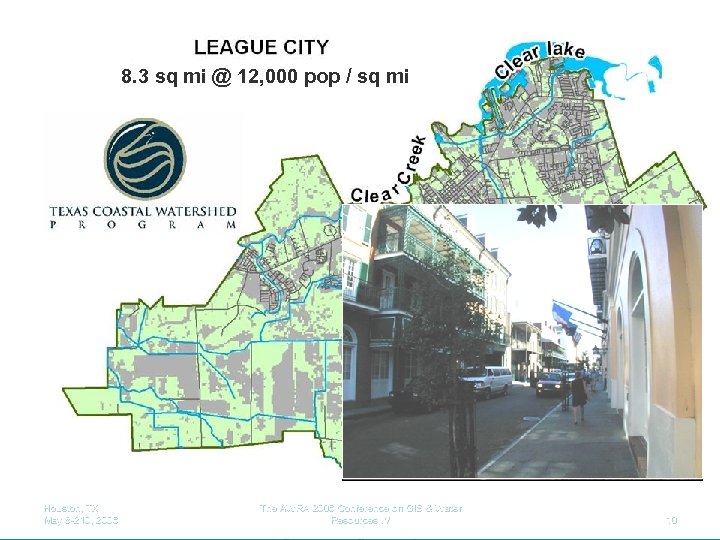
8. 3 sq mi @ 12, 000 pop / sq mi Houston, TX May 8 -210, 2006 100, 000 new residents The AWRA 2006 Conference on GIS & Water Resources IV 10
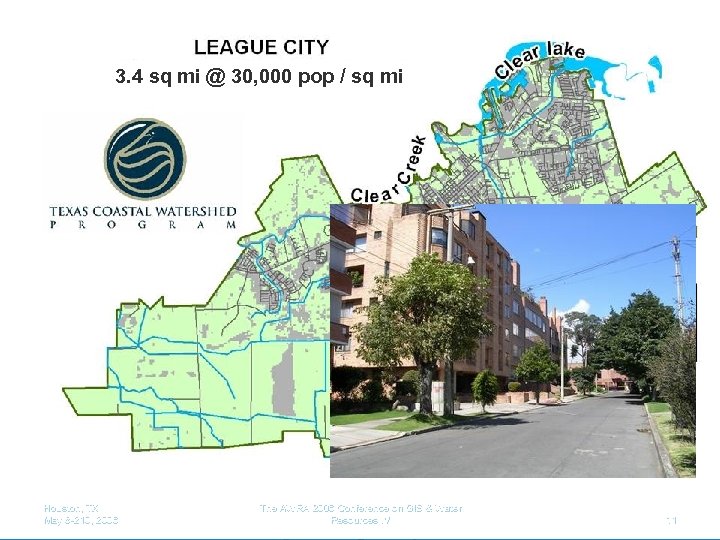
3. 4 sq mi @ 30, 000 pop / sq mi Houston, TX May 8 -210, 2006 100, 000 new residents The AWRA 2006 Conference on GIS & Water Resources IV 11
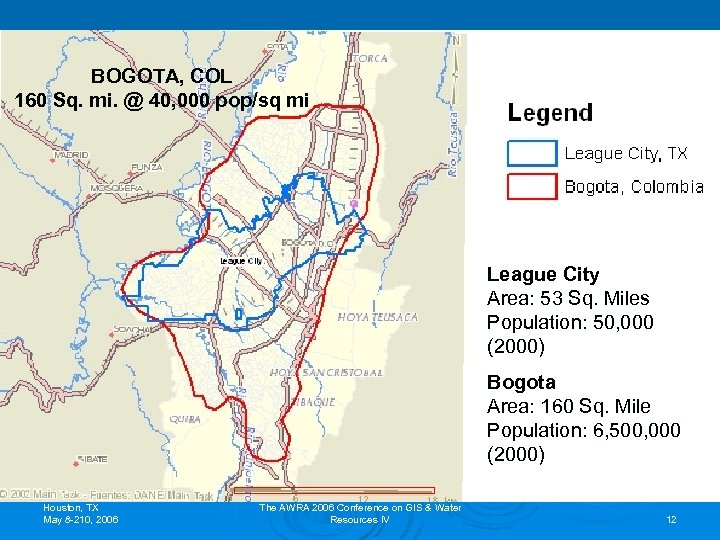
BOGOTA, COL 160 Sq. mi. @ 40, 000 pop/sq mi League City Area: 53 Sq. Miles Population: 50, 000 (2000) Bogota Area: 160 Sq. Mile Population: 6, 500, 000 (2000) Houston, TX May 8 -210, 2006 The AWRA 2006 Conference on GIS & Water Resources IV 12
Pollutant Load Calculations Houston, TX May 8 -210, 2006 The AWRA 2006 Conference on GIS & Water Resources IV AWRA
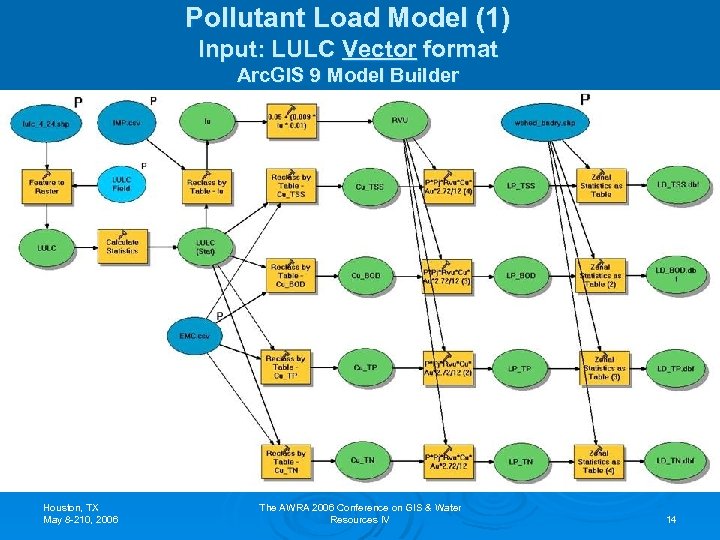
Pollutant Load Model (1) Input: LULC Vector format Arc. GIS 9 Model Builder Houston, TX May 8 -210, 2006 The AWRA 2006 Conference on GIS & Water Resources IV 14
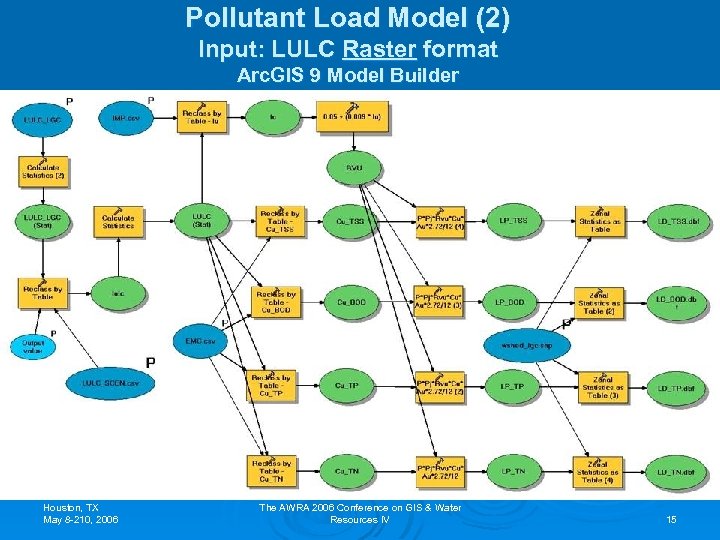
Pollutant Load Model (2) Input: LULC Raster format Arc. GIS 9 Model Builder Houston, TX May 8 -210, 2006 The AWRA 2006 Conference on GIS & Water Resources IV 15
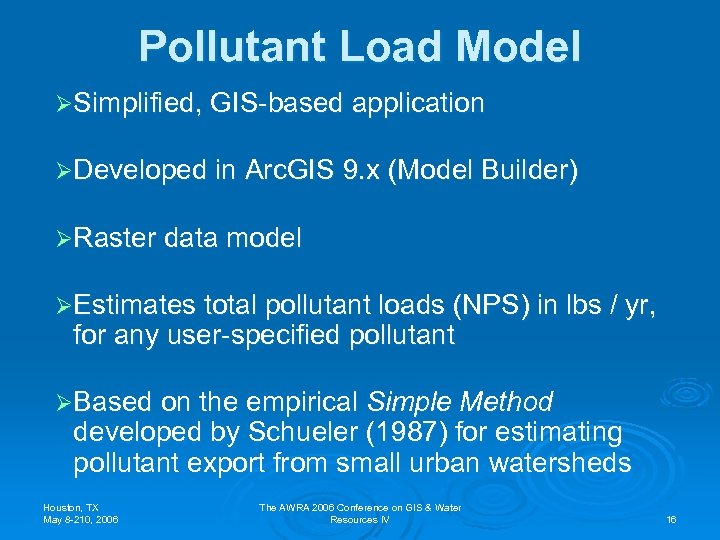
Pollutant Load Model ØSimplified, GIS-based application ØDeveloped in Arc. GIS 9. x (Model Builder) ØRaster data model ØEstimates total pollutant loads (NPS) in lbs / yr, for any user-specified pollutant ØBased on the empirical Simple Method developed by Schueler (1987) for estimating pollutant export from small urban watersheds Houston, TX May 8 -210, 2006 The AWRA 2006 Conference on GIS & Water Resources IV 16
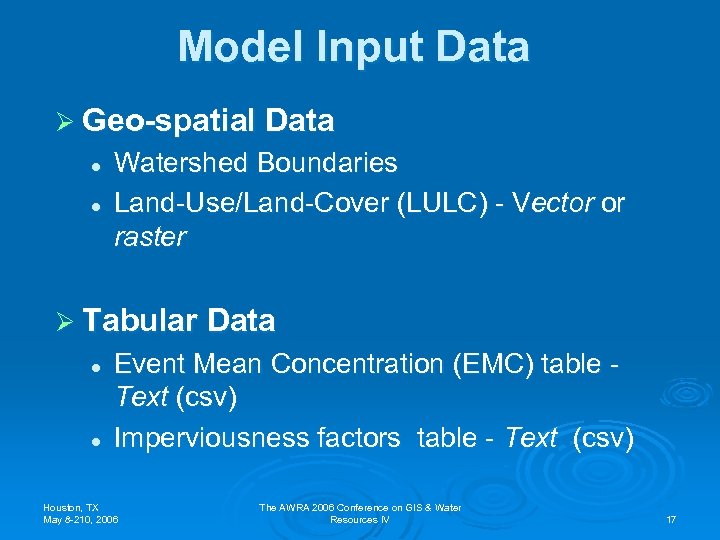
Model Input Data Ø Geo-spatial Data l l Watershed Boundaries Land-Use/Land-Cover (LULC) - Vector or raster Ø Tabular Data l l Event Mean Concentration (EMC) table Text (csv) Imperviousness factors table - Text (csv) Houston, TX May 8 -210, 2006 The AWRA 2006 Conference on GIS & Water Resources IV 17
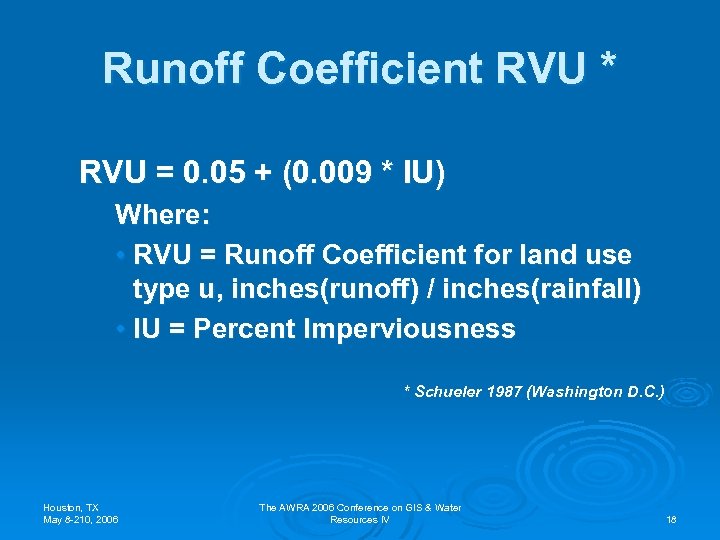
Runoff Coefficient RVU * RVU = 0. 05 + (0. 009 * IU) Where: • RVU = Runoff Coefficient for land use type u, inches(runoff) / inches(rainfall) • IU = Percent Imperviousness * Schueler 1987 (Washington D. C. ) Houston, TX May 8 -210, 2006 The AWRA 2006 Conference on GIS & Water Resources IV 18
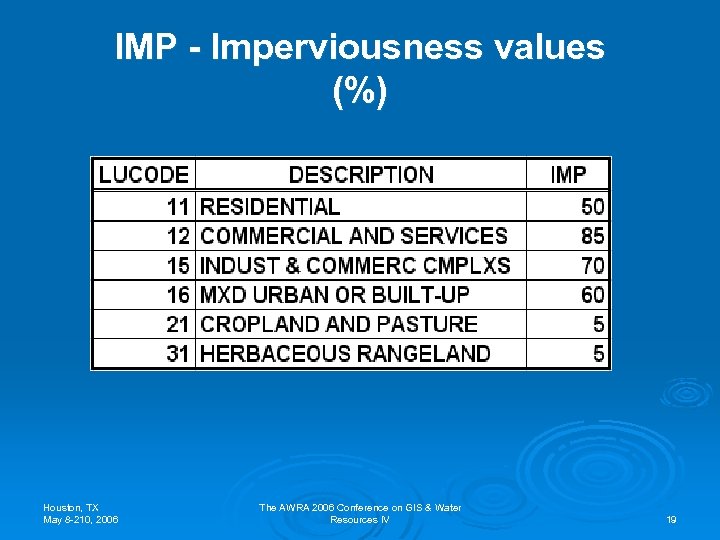
IMP - Imperviousness values (%) Houston, TX May 8 -210, 2006 The AWRA 2006 Conference on GIS & Water Resources IV 19
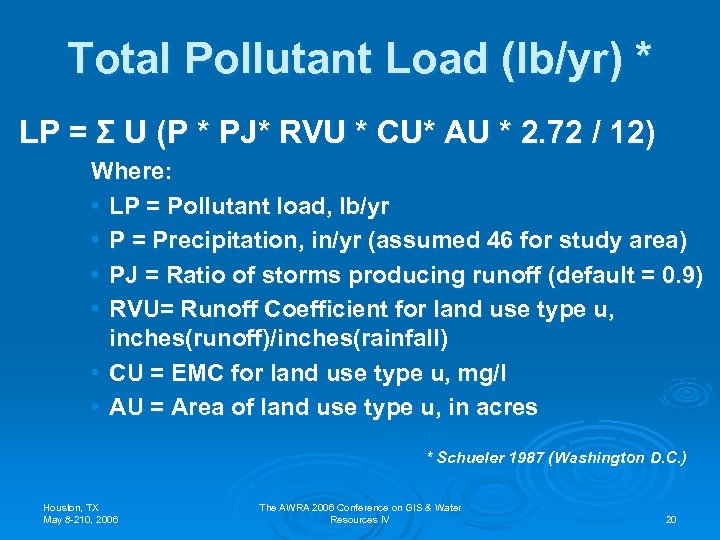
Total Pollutant Load (lb/yr) * LP = Σ U (P * PJ* RVU * CU* AU * 2. 72 / 12) Where: • LP = Pollutant load, lb/yr • P = Precipitation, in/yr (assumed 46 for study area) • PJ = Ratio of storms producing runoff (default = 0. 9) • RVU= Runoff Coefficient for land use type u, inches(runoff)/inches(rainfall) • CU = EMC for land use type u, mg/l • AU = Area of land use type u, in acres * Schueler 1987 (Washington D. C. ) Houston, TX May 8 -210, 2006 The AWRA 2006 Conference on GIS & Water Resources IV 20
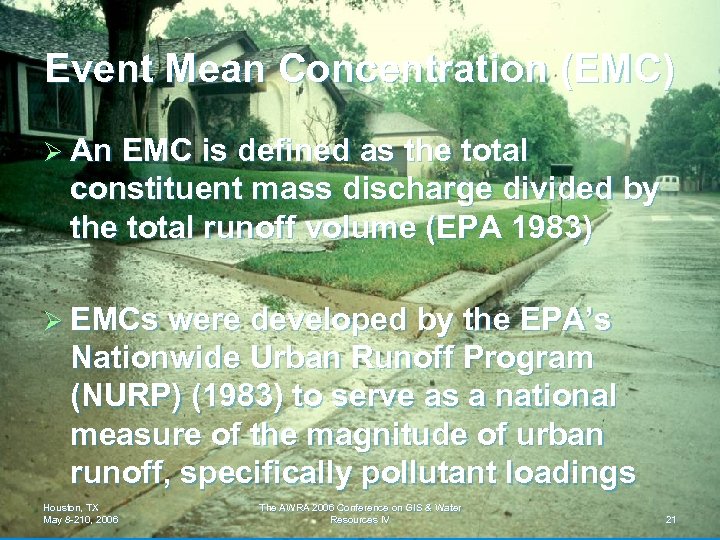
Event Mean Concentration (EMC) Ø An EMC is defined as the total constituent mass discharge divided by the total runoff volume (EPA 1983) Ø EMCs were developed by the EPA’s Nationwide Urban Runoff Program (NURP) (1983) to serve as a national measure of the magnitude of urban runoff, specifically pollutant loadings Houston, TX May 8 -210, 2006 The AWRA 2006 Conference on GIS & Water Resources IV 21
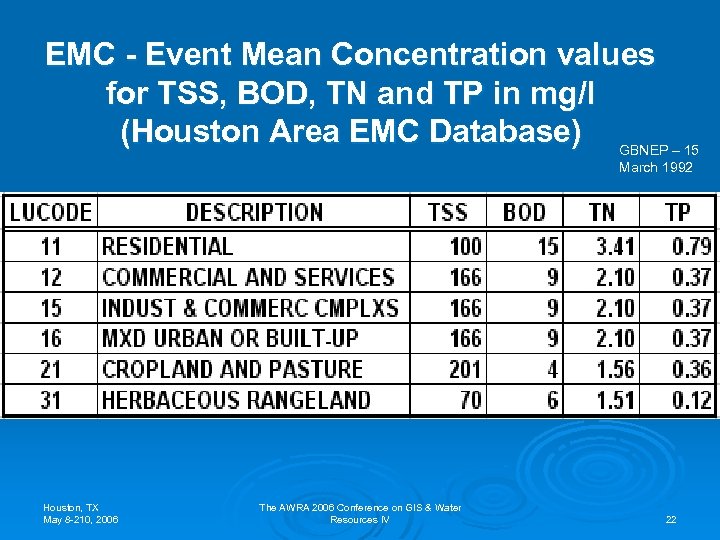
EMC - Event Mean Concentration values for TSS, BOD, TN and TP in mg/l (Houston Area EMC Database) GBNEP – 15 March 1992 Houston, TX May 8 -210, 2006 The AWRA 2006 Conference on GIS & Water Resources IV 22
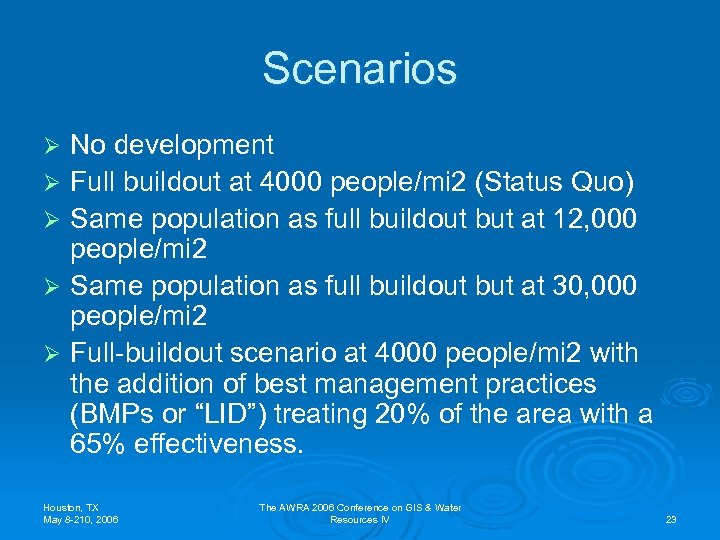
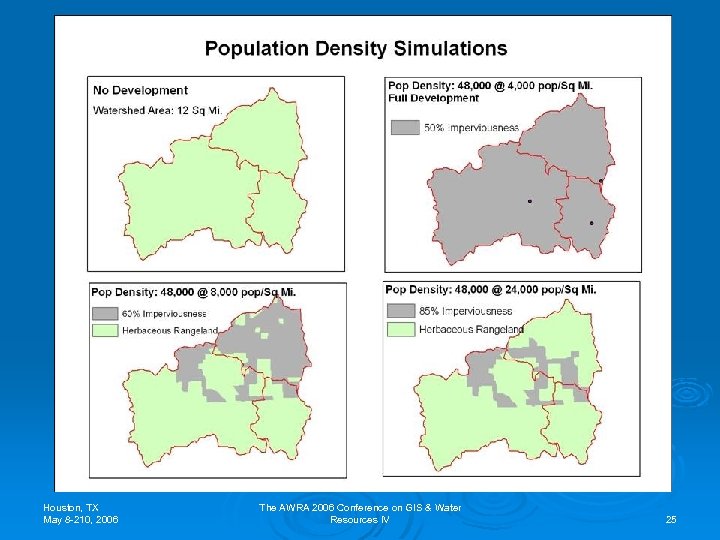
Scenarios Ø Ø Ø No development Full buildout at 4000 people/mi 2 (Status Quo) Same population as full buildout but at 12, 000 people/mi 2 Same population as full buildout but at 30, 000 people/mi 2 Full-buildout scenario at 4000 people/mi 2 with the addition of best management practices (BMPs or “LID”) treating 20% of the area with a 65% effectiveness. Houston, TX May 8 -210, 2006 The AWRA 2006 Conference on GIS & Water Resources IV 23

Results Houston, TX May 8 -210, 2006 The AWRA 2006 Conference on GIS & Water Resources IV AWRA
Houston, TX May 8 -210, 2006 The AWRA 2006 Conference on GIS & Water Resources IV 25
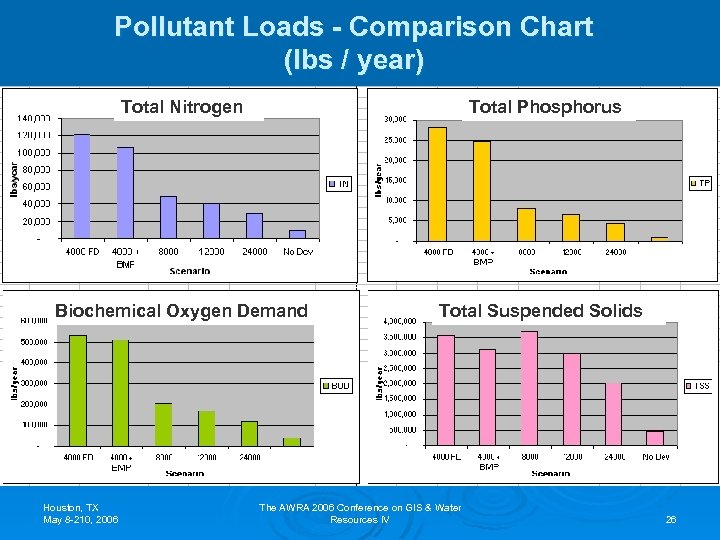
Pollutant Loads - Comparison Chart (lbs / year) Total Nitrogen Total Phosphorus Biochemical Oxygen Demand Total Suspended Solids Houston, TX May 8 -210, 2006 The AWRA 2006 Conference on GIS & Water Resources IV 26
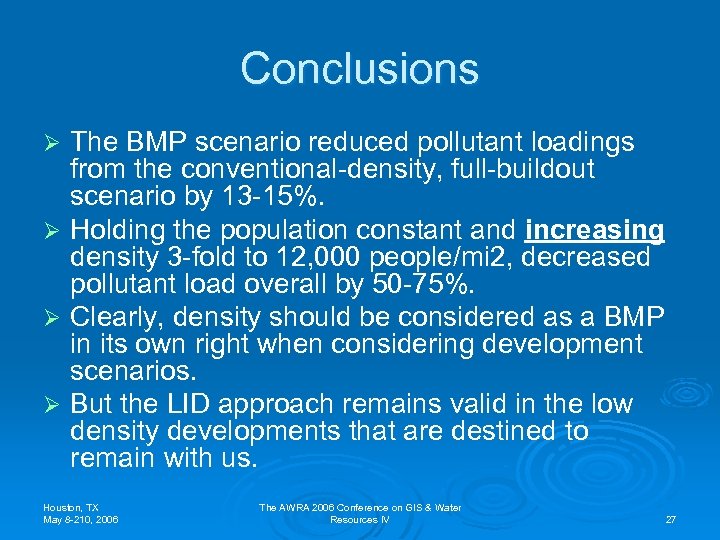
Conclusions The BMP scenario reduced pollutant loadings from the conventional-density, full-buildout scenario by 13 -15%. Ø Holding the population constant and increasing density 3 -fold to 12, 000 people/mi 2, decreased pollutant load overall by 50 -75%. Ø Clearly, density should be considered as a BMP in its own right when considering development scenarios. Ø But the LID approach remains valid in the low density developments that are destined to remain with us. Ø Houston, TX May 8 -210, 2006 The AWRA 2006 Conference on GIS & Water Resources IV 27

Texas Sea Grant / Tx. Coop. Extension Texas A&M University www. urban-nature. org Ricardo A Lopez M. S. 17000 El Camino Real, Suite 301 Houston, TX 77058 (281) 218 0570 E-mail: rilopez@tamu. edu Houston, TX May 8 -210, 2006 The AWRA 2006 Conference on GIS & Water Resources IV 28
Appendix Houston, TX May 8 -210, 2006 The AWRA 2006 Conference on GIS & Water Resources IV AWRA
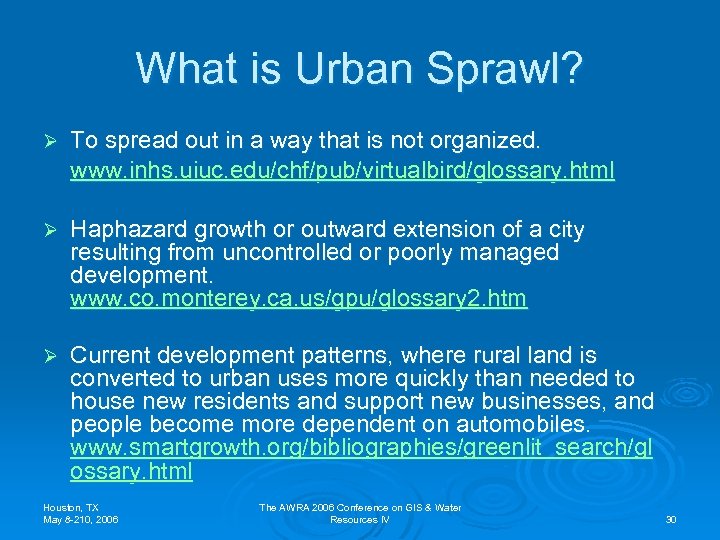
What is Urban Sprawl? Ø To spread out in a way that is not organized. www. inhs. uiuc. edu/chf/pub/virtualbird/glossary. html Ø Haphazard growth or outward extension of a city resulting from uncontrolled or poorly managed development. www. co. monterey. ca. us/gpu/glossary 2. htm Ø Current development patterns, where rural land is converted to urban uses more quickly than needed to house new residents and support new businesses, and people become more dependent on automobiles. www. smartgrowth. org/bibliographies/greenlit_search/gl ossary. html Houston, TX May 8 -210, 2006 The AWRA 2006 Conference on GIS & Water Resources IV 30
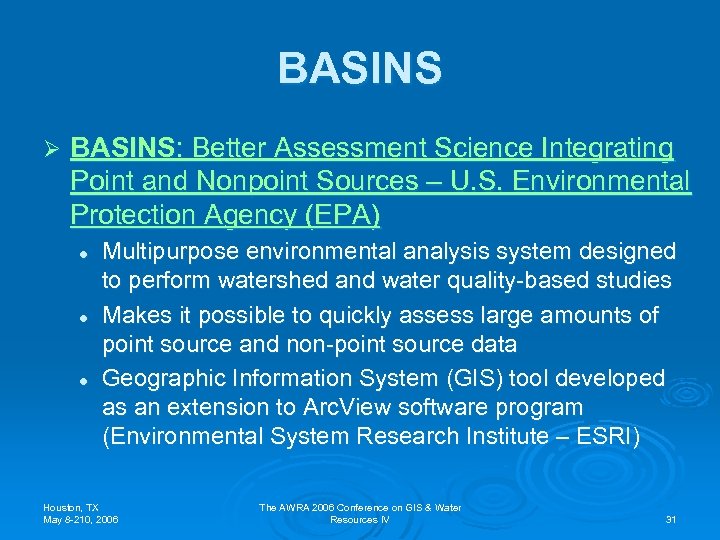
BASINS Ø BASINS: Better Assessment Science Integrating Point and Nonpoint Sources – U. S. Environmental Protection Agency (EPA) l l l Multipurpose environmental analysis system designed to perform watershed and water quality-based studies Makes it possible to quickly assess large amounts of point source and non-point source data Geographic Information System (GIS) tool developed as an extension to Arc. View software program (Environmental System Research Institute – ESRI) Houston, TX May 8 -210, 2006 The AWRA 2006 Conference on GIS & Water Resources IV 31
Watershed Boundary Watersheds define the areas for which the pollutant loads are calculated Ø Available from local government agencies in most moderate- to high-density urban areas Ø May be derived using standard GIS or BASINS tools and the United States Geological Survey (USGS) Digital Elevation Model (DEM) data files (See appendix) Ø Dataset must have a code field containing unique identifiers for each watershed Ø Vector format, projected CS, same projection and datum, stored in meters (map units) Ø Houston, TX May 8 -210, 2006 The AWRA 2006 Conference on GIS & Water Resources IV 32
LULC Dataset Defines Land-Use/Land-Cover types for the study area Ø Dataset must encompass the entire watershed Ø Essential for calculating the pollutant loads. Ø Available from local government agencies in most moderate- to high-density urban areas Ø If available in raster format (grid of cells), must be converted to vector format (polygon spatial features) Ø Houston, TX May 8 -210, 2006 The AWRA 2006 Conference on GIS & Water Resources IV 33
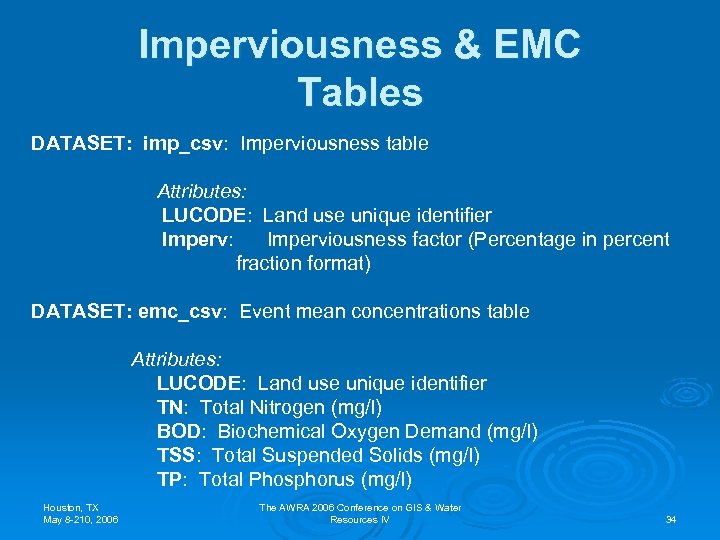
Imperviousness & EMC Tables DATASET: imp_csv: Imperviousness table Attributes: LUCODE: Land use unique identifier Imperv: Imperviousness factor (Percentage in percent fraction format) DATASET: emc_csv: Event mean concentrations table Attributes: LUCODE: Land use unique identifier TN: Total Nitrogen (mg/l) BOD: Biochemical Oxygen Demand (mg/l) TSS: Total Suspended Solids (mg/l) TP: Total Phosphorus (mg/l) Houston, TX May 8 -210, 2006 The AWRA 2006 Conference on GIS & Water Resources IV 34
Software References P-LOAD (Arc. View extension to BASINS (Better Assessment Science Integrating Point & Nonpoint Sources – U. S. Environmental Protection Agency EPA): BASINS 3. 1 Description: http: //www. epa. gov/waterscience/ftp/basins/system/B ASINS 3/areadb 3. htm Download BASINS 3. 1 program and data: http: //www. epa. gov/waterscience/basins/index. html Houston, TX May 8 -210, 2006 The AWRA 2006 Conference on GIS & Water Resources IV 35
Скачать презентацию Higher or Lower Density What Gives the Best
dcf2f11bc3febbf8c277b53c414f2150.ppt