


 Скачать презентацию Higher-Level Thinking Strategies in the Spanish Language and
29247a322e7dd2a61ee7f4a3e541c8e6.ppt
- Количество слайдов: 103
 Higher-Level Thinking Strategies in the Spanish Language and Culture class Bloom's Taxonomy & Gardner’s MIs Gustavo Fares, Ph. D. Lawrence University www. lawrence. edu/fast/faresg
 Goals • To gain a clear understanding of higher-level thinking strategies, following Bloom classifications, and the ways in which they can be related to Gardner’s theory of multiple intelligences. • To examine both theories and their implications for the development of classroom activities for the AP Spanish Language class, based on recent AP Spanish Language Exams tasks. • To see the AP Exam in light use of the two theories presented.
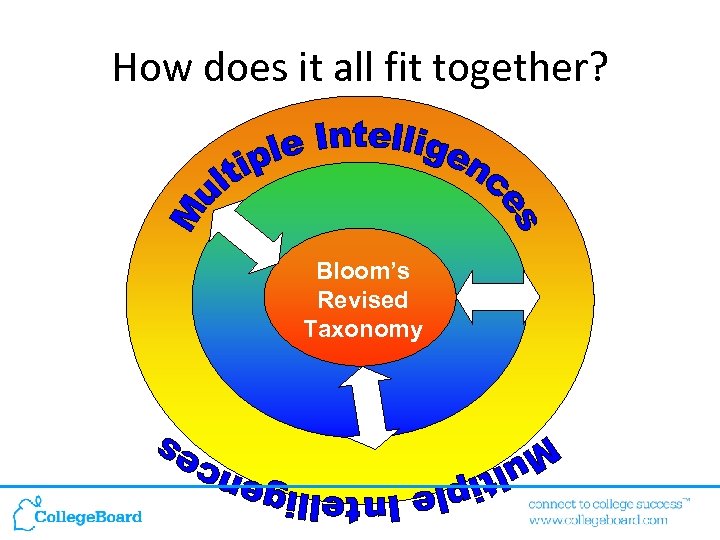
 Summary • Bloom's Taxonomy – Domains of educational activities: • Affective • Psychomotor • Cognitive • Bloom's Revised Taxonomy • Putting it all to work • Multiple Intelligences Today – Criteria of an Intelligence – The eight intelligtencies – Benefits of using the multiple intelligences approach? • How does it all fit together? – Activities – Bloom and Gardner in the AP Spanish Language Exam Tasks
 Bloom's Taxonomy • Classification of learning objectives within education • First presented in 1956 through The Taxonomy of Educational Objectives, The Classification of Educational Goals, Handbook I: Cognitive Domain, by Benjamin Bloom (editor), M. D. Englehart, E. J. Furst, W. H. Hill, and David Krathwohl. • It is considered a foundational element within education
 Bloom's Taxonomy • Following the 1948 Convention of the American Psychological Association, B. S. Bloom formulated a classification of "the goals of the educational process". • Bloom and his co-workers established a hierarchy of educational objectives, which is generally referred to as Bloom's Taxonomy • Three "domains" of educational activities were identified. • The Affective Domain – growth in feelings or emotional areas (Attitude) • The Psychomotor Domain – manual or physical skills (Skills) • The Cognitive Domain – knowledge and the development of intellectual attitudes and skills.
 Domains of educational activities: Affective Domain • The affective domain (Krathwohl, Bloom, Masia, 1973) includes the manner in which we deal with things emotionally, such as – feelings, values, appreciation, enthusiasms, motivations, and attitudes. • The five major categories are listed from the simplest behavior to the most complex:
 Affective Domain • • • Receiving – The lowest level; the student passively pays attention. Without this level no learning can occur. Responding – The person actively participates in the learning process, attends to a stimulus and reacts. Valuing – The person attaches a value to an object, or piece of information. Organizing – The person can put together different values, information, and ideas, comparing, relating and elaborating on what has been learned. Characterizing – The person holds a particular value or belief that exerts influence on his/her behavior so that it becomes a characteristic of that person.
 Psychomotor Domain • Skills in the psychomotor domain describe the ability to physically manipulate a tool or instrument. • Characterized by progressive levels of behaviors from observation to mastery of a physical skill. • Bloom and his colleagues never created subcategories for skills in the psychomotor domain, but since then other educators have created their own psychomotor taxonomies. – Simpson (1972), for instance, built a taxonomy based on the work of Bloom and others
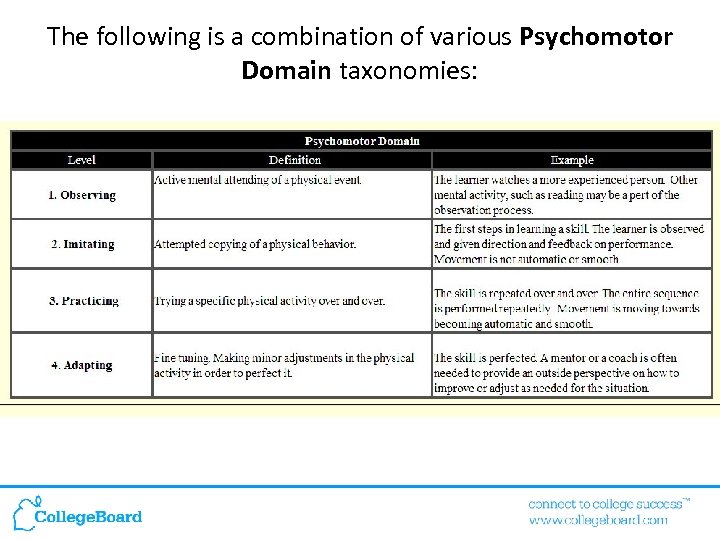 The following is a combination of various Psychomotor Domain taxonomies:
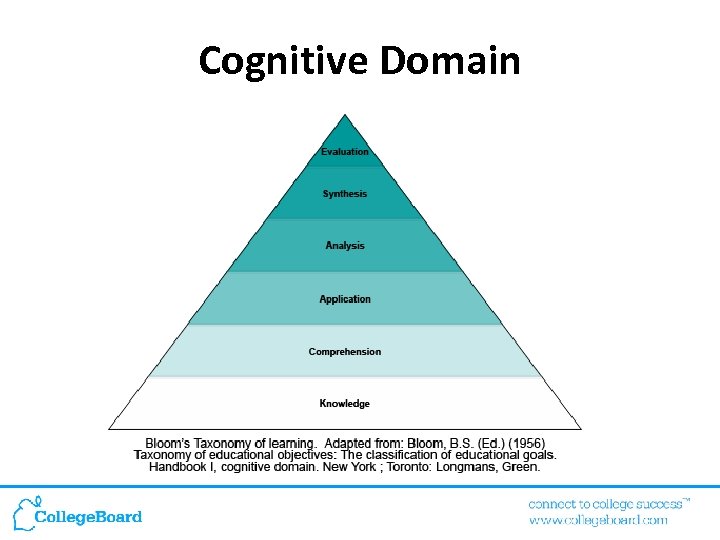
 Cognitive Domain • The cognitive domain involves knowledge and the development of intellectual skills. – Such as the recall or recognition of specific facts, patterns, and concepts • There are six major categories, which are listed in order, starting from the simplest behavior to the most complex. – The categories can be thought of as degrees of difficulties. – That is, the first one must be mastered before the next one can take place.
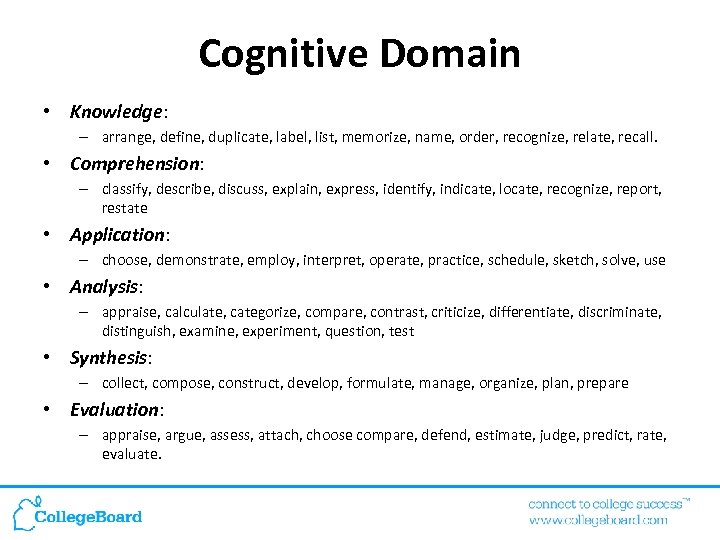 Cognitive Domain • Knowledge: – arrange, define, duplicate, label, list, memorize, name, order, recognize, relate, recall. • Comprehension: – classify, describe, discuss, explain, express, identify, indicate, locate, recognize, report, restate • Application: – choose, demonstrate, employ, interpret, operate, practice, schedule, sketch, solve, use • Analysis: – appraise, calculate, categorize, compare, contrast, criticize, differentiate, discriminate, distinguish, examine, experiment, question, test • Synthesis: – collect, compose, construct, develop, formulate, manage, organize, plan, prepare • Evaluation: – appraise, argue, assess, attach, choose compare, defend, estimate, judge, predict, rate, evaluate.
 Cognitive Domain
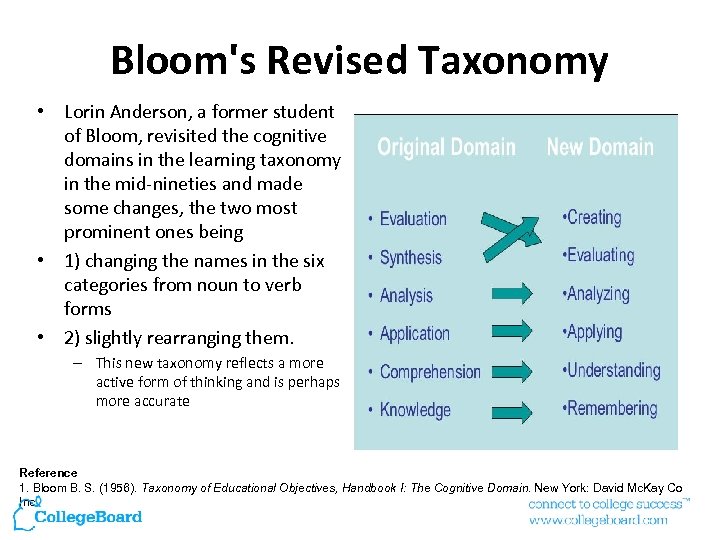 Bloom's Revised Taxonomy • Lorin Anderson, a former student of Bloom, revisited the cognitive domains in the learning taxonomy in the mid-nineties and made some changes, the two most prominent ones being • 1) changing the names in the six categories from noun to verb forms • 2) slightly rearranging them. – This new taxonomy reflects a more active form of thinking and is perhaps more accurate Reference 1. Bloom B. S. (1956). Taxonomy of Educational Objectives, Handbook I: The Cognitive Domain. New York: David Mc. Kay Co Inc.
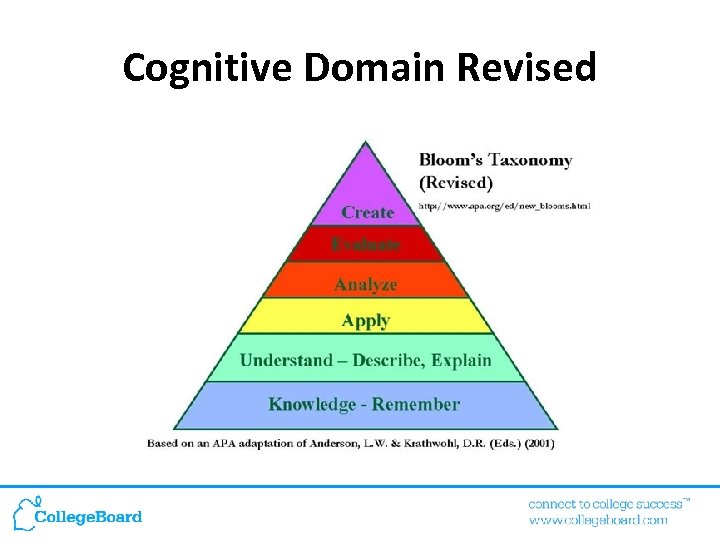 Cognitive Domain Revised
 Low levels in Bloom’s Cognitive Domain taxonomy Knowledge and Understanding • Remembering, Understanding • Typical keywords might include – “Define, describe, label, list, memorize, recall, identify, label, who, when, where. ” – …moving through to – “Summarize, interpret, contrast, predict, estimate, classify, describe, discuss, explain, indicate, give examples, paraphrase, locate. ”
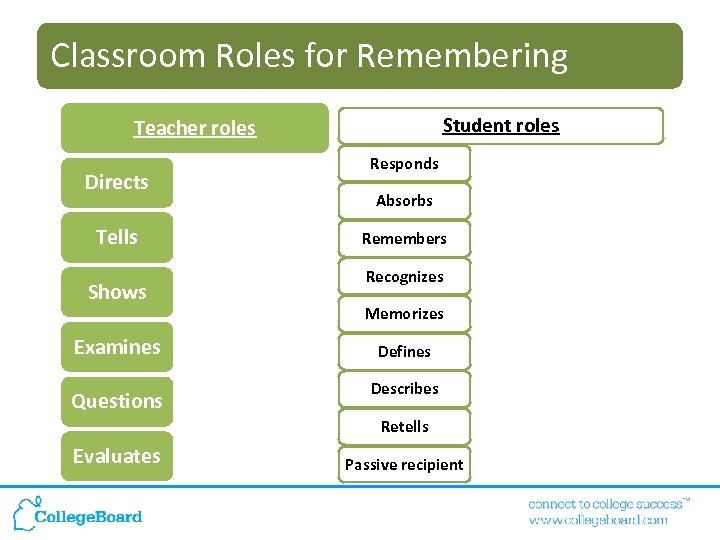 Classroom Roles for Remembering Student roles Teacher roles Directs Tells Shows Examines Questions Responds Absorbs Remembers Recognizes Memorizes Defines Describes Retells Evaluates Passive recipient
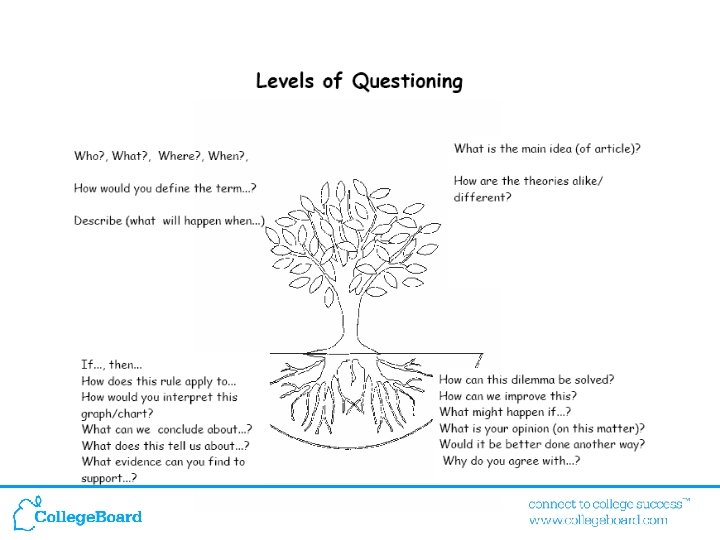
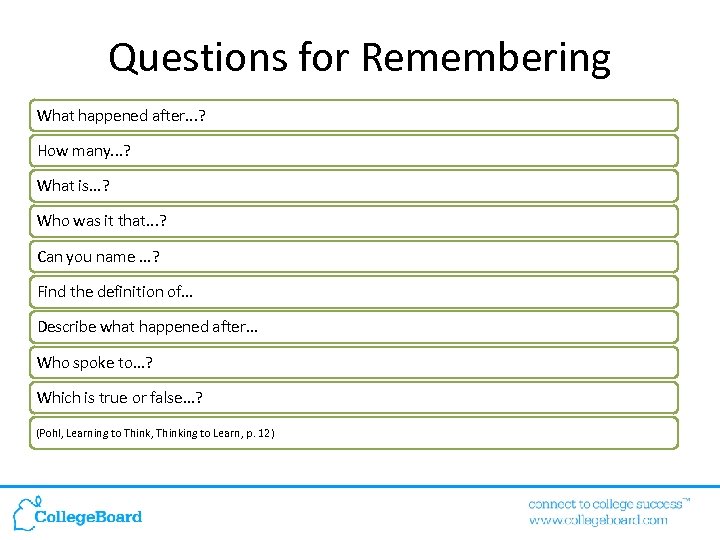 Questions for Remembering What happened after. . . ? How many. . . ? What is. . . ? Who was it that. . . ? Can you name. . . ? Find the definition of… Describe what happened after… Who spoke to. . . ? Which is true or false. . . ? (Pohl, Learning to Think, Thinking to Learn, p. 12)
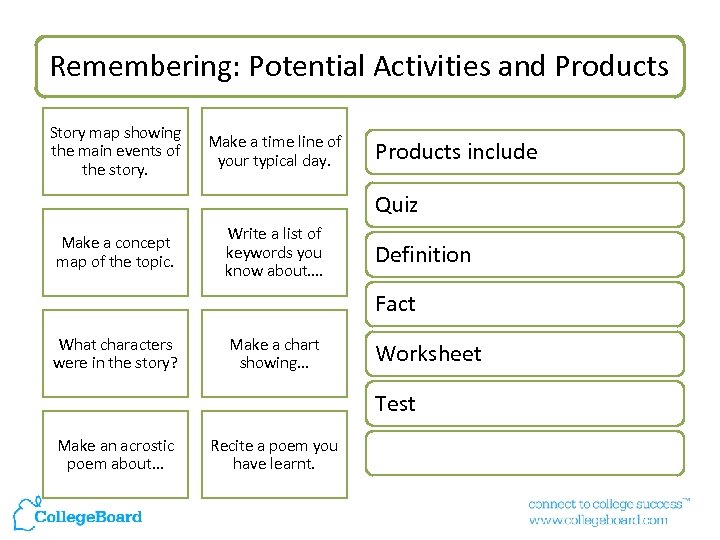 Remembering: Potential Activities and Products Story map showing the main events of the story. Make a time line of your typical day. Products include Quiz Make a concept map of the topic. Write a list of keywords you know about…. Definition Fact What characters were in the story? Make a chart showing… Worksheet Test Make an acrostic poem about… Recite a poem you have learnt.
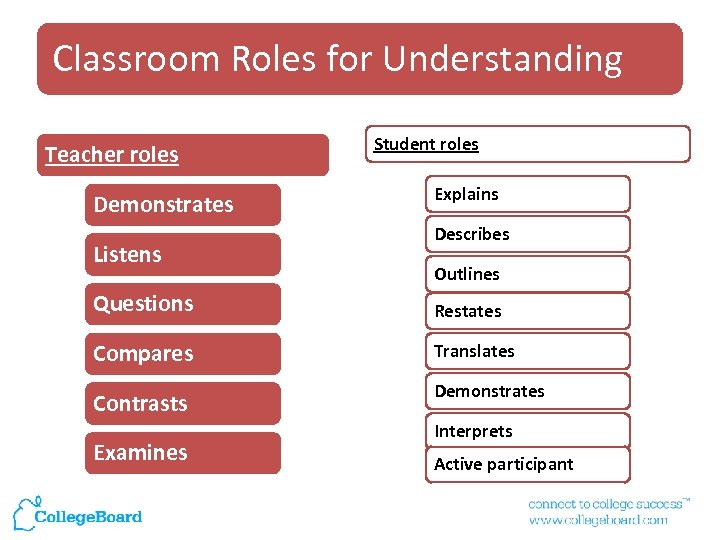 Classroom Roles for Understanding Teacher roles Demonstrates Listens Student roles Explains Describes Outlines Questions Restates Compares Translates Contrasts Demonstrates Examines Interprets Active participant
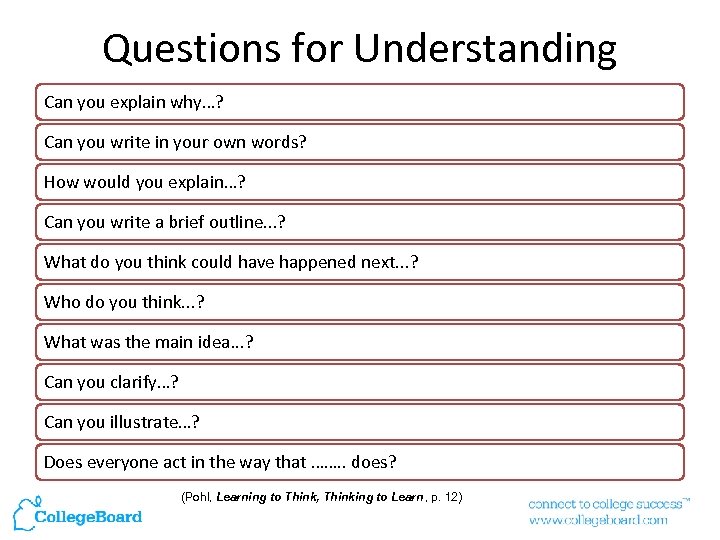 Questions for Understanding Can you explain why…? Can you write in your own words? How would you explain…? Can you write a brief outline. . . ? What do you think could have happened next. . . ? Who do you think. . . ? What was the main idea. . . ? Can you clarify…? Can you illustrate…? Does everyone act in the way that ……. . does? (Pohl, Learning to Think, Thinking to Learn, p. 12)
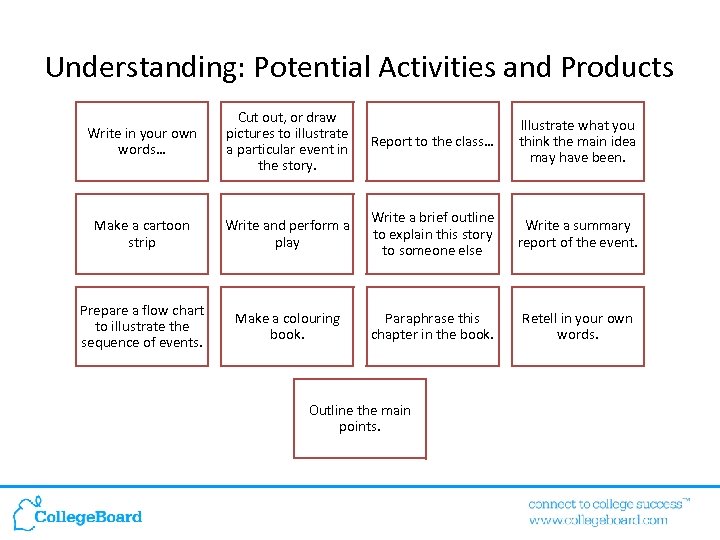 Understanding: Potential Activities and Products Write in your own words… Cut out, or draw pictures to illustrate a particular event in the story. Report to the class… Illustrate what you think the main idea may have been. Make a cartoon strip Write and perform a play Write a brief outline to explain this story to someone else Write a summary report of the event. Prepare a flow chart to illustrate the sequence of events. Make a colouring book. Paraphrase this chapter in the book. Retell in your own words. Outline the main points.
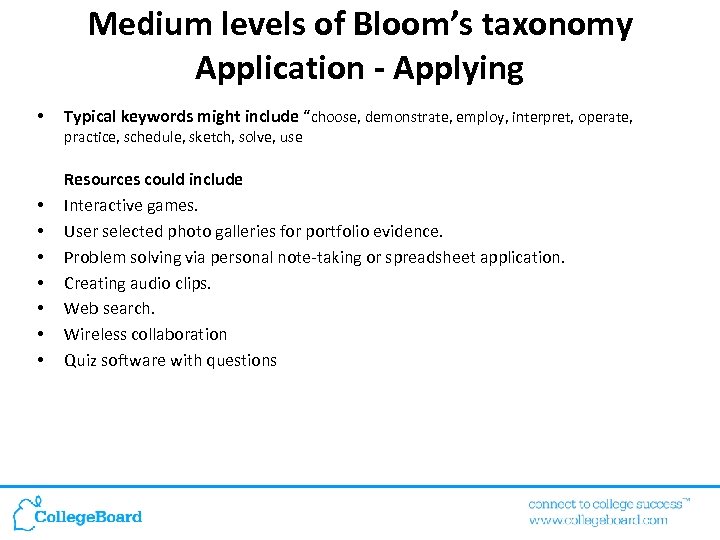 Medium levels of Bloom’s taxonomy Application - Applying • Typical keywords might include “choose, demonstrate, employ, interpret, operate, practice, schedule, sketch, solve, use • • Resources could include Interactive games. User selected photo galleries for portfolio evidence. Problem solving via personal note-taking or spreadsheet application. Creating audio clips. Web search. Wireless collaboration Quiz software with questions
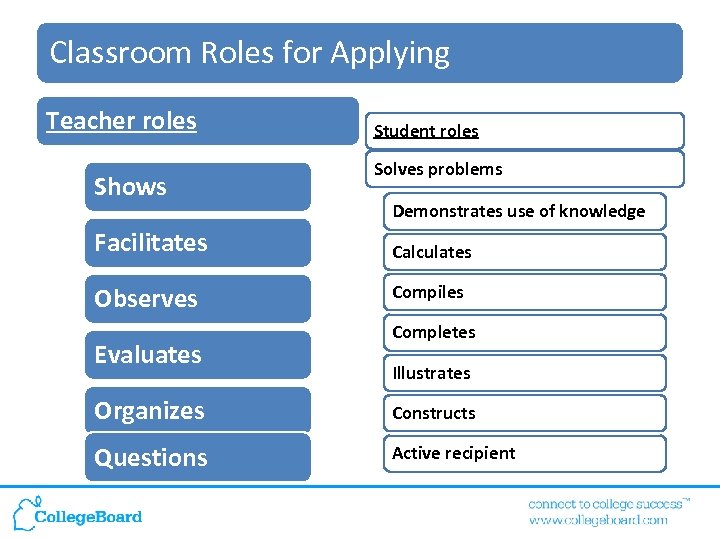 Classroom Roles for Applying Teacher roles Shows Student roles Solves problems Demonstrates use of knowledge Facilitates Calculates Observes Compiles Evaluates Completes Illustrates Organizes Constructs Questions Active recipient
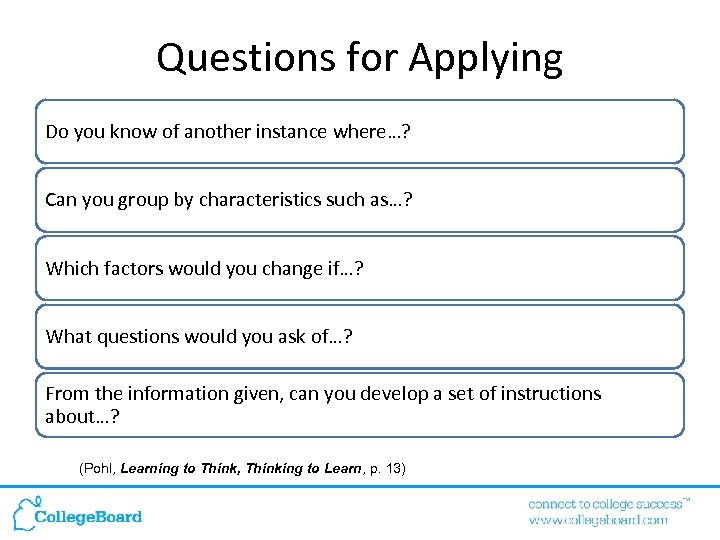 Questions for Applying Do you know of another instance where…? Can you group by characteristics such as…? Which factors would you change if…? What questions would you ask of…? From the information given, can you develop a set of instructions about…? (Pohl, Learning to Think, Thinking to Learn, p. 13)
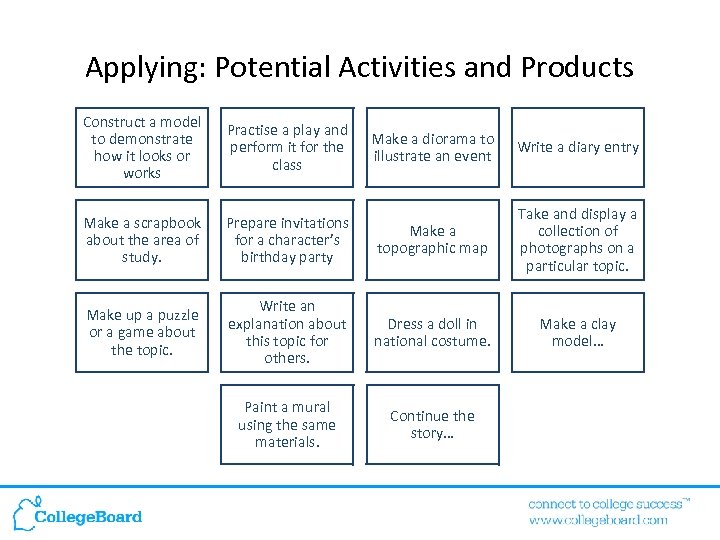 Applying: Potential Activities and Products Construct a model to demonstrate how it looks or works Practise a play and perform it for the class Make a scrapbook about the area of study. Make up a puzzle or a game about the topic. Make a diorama to illustrate an event Write a diary entry Prepare invitations for a character’s birthday party Make a topographic map Take and display a collection of photographs on a particular topic. Write an explanation about this topic for others. Dress a doll in national costume. Make a clay model… Paint a mural using the same materials. Continue the story…
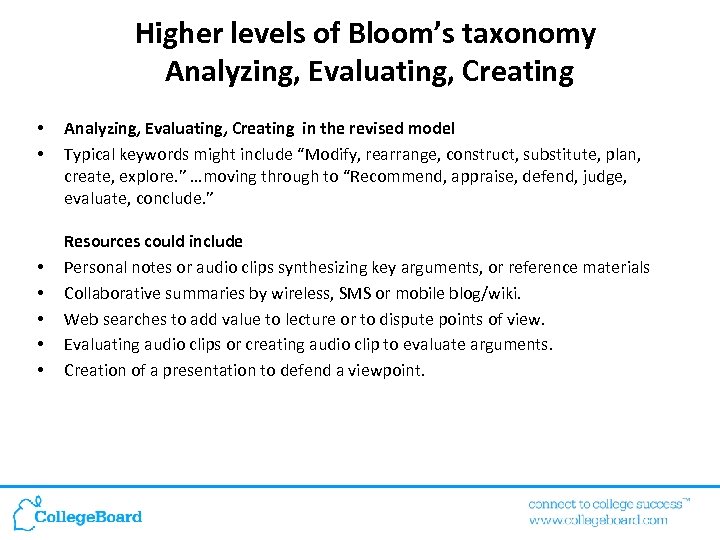 Higher levels of Bloom’s taxonomy Analyzing, Evaluating, Creating • • Analyzing, Evaluating, Creating in the revised model Typical keywords might include “Modify, rearrange, construct, substitute, plan, create, explore. ” …moving through to “Recommend, appraise, defend, judge, evaluate, conclude. ” Resources could include Personal notes or audio clips synthesizing key arguments, or reference materials Collaborative summaries by wireless, SMS or mobile blog/wiki. Web searches to add value to lecture or to dispute points of view. Evaluating audio clips or creating audio clip to evaluate arguments. Creation of a presentation to defend a viewpoint.
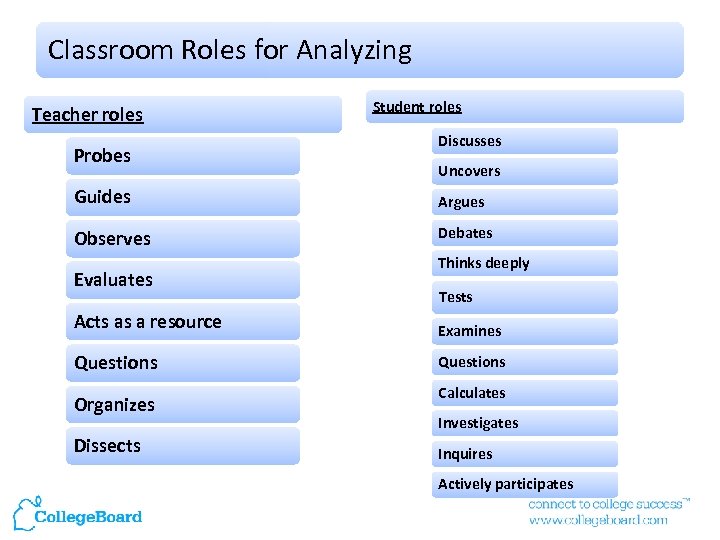 Classroom Roles for Analyzing Teacher roles Probes Student roles Discusses Uncovers Guides Argues Observes Debates Evaluates Thinks deeply Tests Acts as a resource Examines Questions Organizes Dissects Calculates Investigates Inquires Actively participates
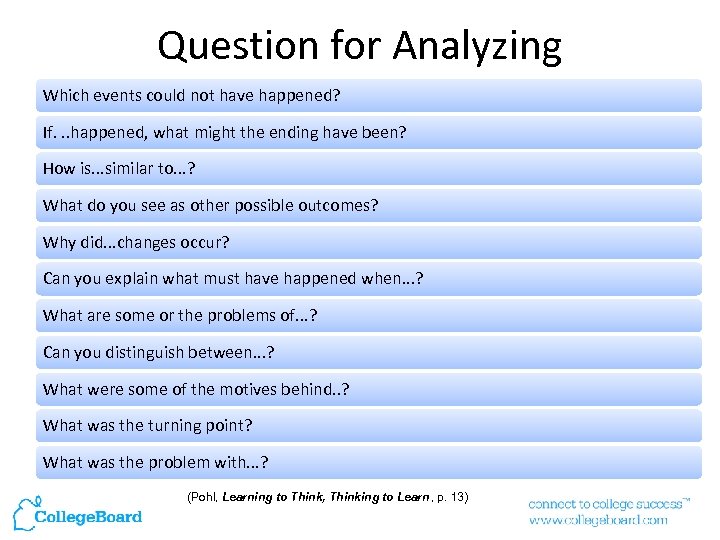 Question for Analyzing Which events could not have happened? If. . . happened, what might the ending have been? How is. . . similar to. . . ? What do you see as other possible outcomes? Why did. . . changes occur? Can you explain what must have happened when. . . ? What are some or the problems of. . . ? Can you distinguish between. . . ? What were some of the motives behind. . ? What was the turning point? What was the problem with. . . ? (Pohl, Learning to Think, Thinking to Learn, p. 13)
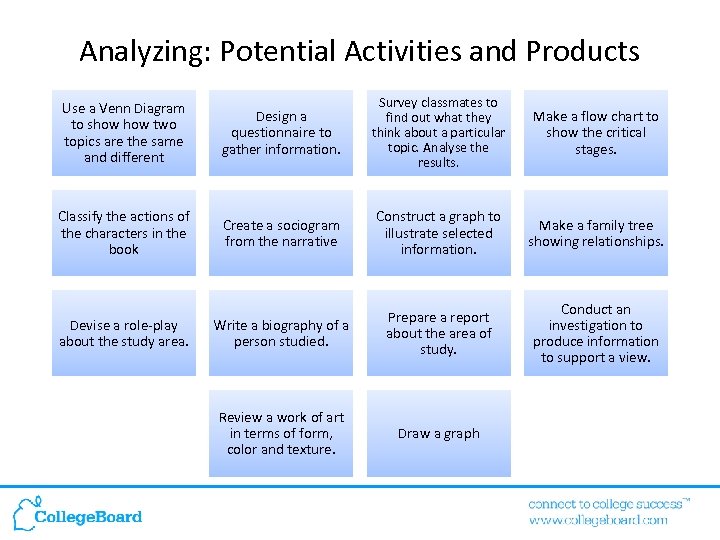 Analyzing: Potential Activities and Products Use a Venn Diagram to show two topics are the same and different Classify the actions of the characters in the book Devise a role-play about the study area. Design a questionnaire to gather information. Survey classmates to find out what they think about a particular topic. Analyse the results. Make a flow chart to show the critical stages. Create a sociogram from the narrative Construct a graph to illustrate selected information. Make a family tree showing relationships. Write a biography of a person studied. Prepare a report about the area of study. Conduct an investigation to produce information to support a view. Review a work of art in terms of form, color and texture. Draw a graph
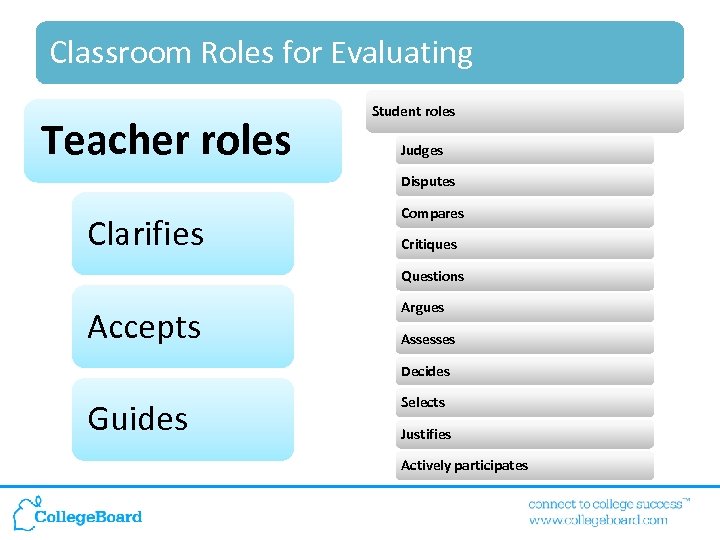 Classroom Roles for Evaluating Teacher roles Student roles Judges Disputes Clarifies Compares Critiques Questions Accepts Argues Assesses Decides Guides Selects Justifies Actively participates
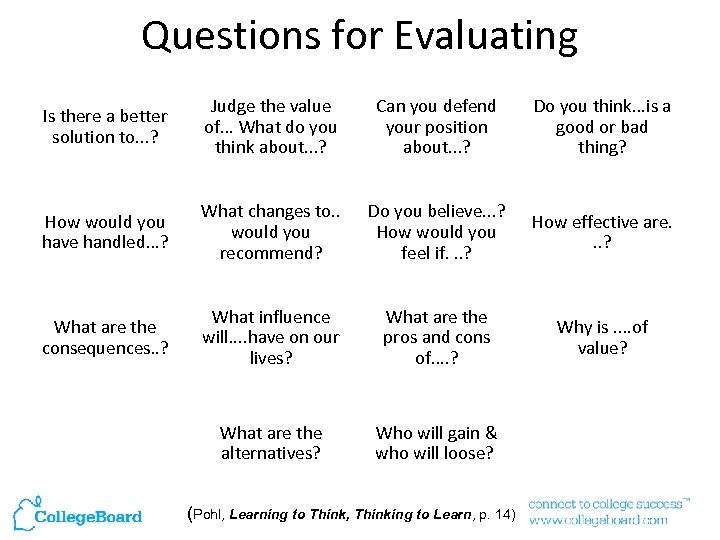 Questions for Evaluating Is there a better solution to. . . ? Judge the value of. . . What do you think about. . . ? Can you defend your position about. . . ? Do you think. . . is a good or bad thing? How would you have handled. . . ? What changes to. . would you recommend? Do you believe. . . ? How would you feel if. . . ? How effective are. . . ? What are the consequences. . ? What influence will. . have on our lives? What are the pros and cons of. . ? Why is. . of value? What are the alternatives? Who will gain & who will loose? (Pohl, Learning to Think, Thinking to Learn, p. 14)
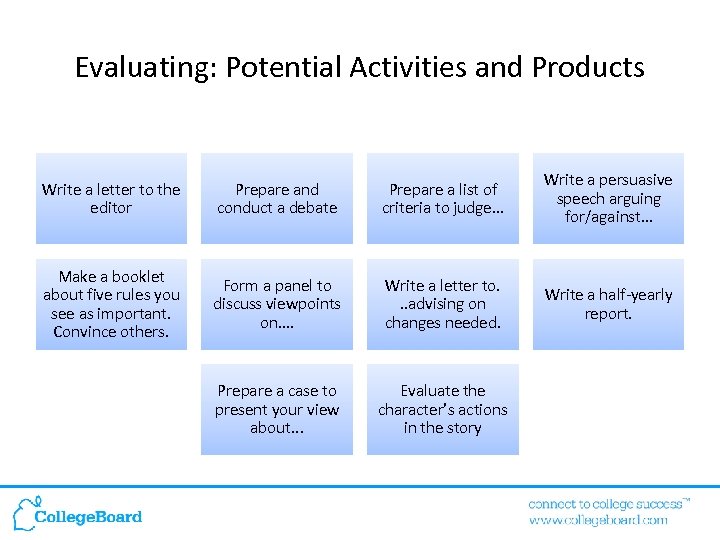 Evaluating: Potential Activities and Products Write a letter to the editor Prepare and conduct a debate Prepare a list of criteria to judge… Write a persuasive speech arguing for/against… Make a booklet about five rules you see as important. Convince others. Form a panel to discuss viewpoints on…. Write a letter to. . . advising on changes needed. Write a half-yearly report. Prepare a case to present your view about. . . Evaluate the character’s actions in the story
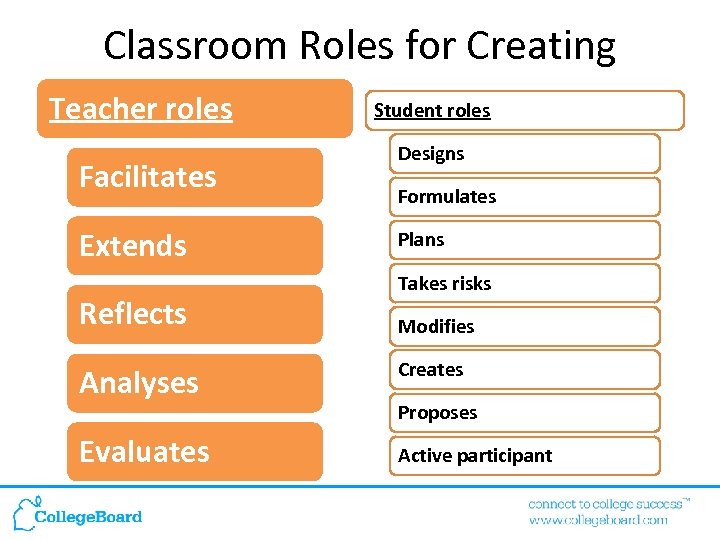 Classroom Roles for Creating Teacher roles Facilitates Extends Reflects Analyses Evaluates Student roles Designs Formulates Plans Takes risks Modifies Creates Proposes Active participant
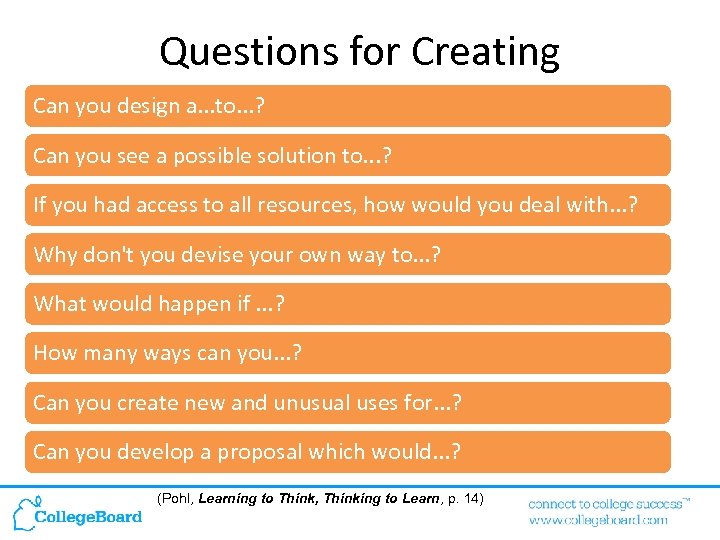 Questions for Creating Can you design a. . . to. . . ? Can you see a possible solution to. . . ? If you had access to all resources, how would you deal with. . . ? Why don't you devise your own way to. . . ? What would happen if. . . ? How many ways can you. . . ? Can you create new and unusual uses for. . . ? Can you develop a proposal which would. . . ? (Pohl, Learning to Think, Thinking to Learn, p. 14)
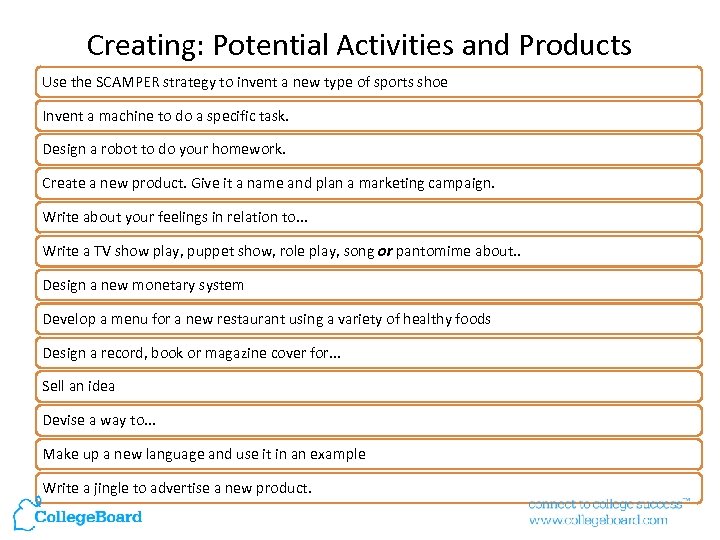 Creating: Potential Activities and Products Use the SCAMPER strategy to invent a new type of sports shoe Invent a machine to do a specific task. Design a robot to do your homework. Create a new product. Give it a name and plan a marketing campaign. Write about your feelings in relation to. . . Write a TV show play, puppet show, role play, song or pantomime about. . Design a new monetary system Develop a menu for a new restaurant using a variety of healthy foods Design a record, book or magazine cover for. . . Sell an idea Devise a way to. . . Make up a new language and use it in an example Write a jingle to advertise a new product.
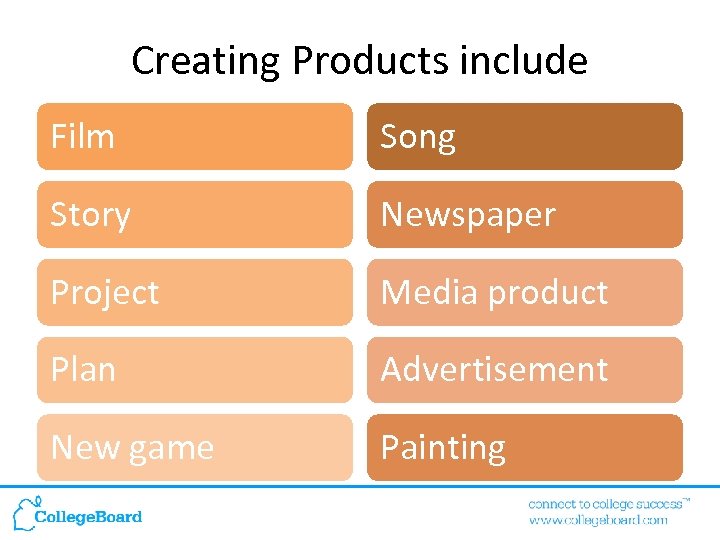 Creating Products include Film Song Story Newspaper Project Media product Plan Advertisement New game Painting
 Putting it all to work • Developing a Range of Thinking Skills • 3 Examples with multiple activities and engagement of Bloom’s Cognitive levels – Space – Travel – Using audio recordings to create alternative learning experiences
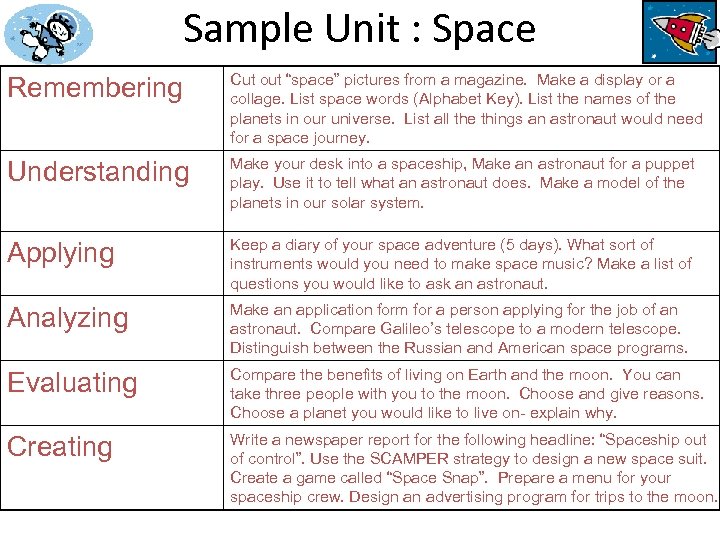 Sample Unit : Space Remembering Cut out “space” pictures from a magazine. Make a display or a collage. List space words (Alphabet Key). List the names of the planets in our universe. List all the things an astronaut would need for a space journey. Understanding Make your desk into a spaceship, Make an astronaut for a puppet play. Use it to tell what an astronaut does. Make a model of the planets in our solar system. Applying Keep a diary of your space adventure (5 days). What sort of instruments would you need to make space music? Make a list of questions you would like to ask an astronaut. Analyzing Make an application form for a person applying for the job of an astronaut. Compare Galileo’s telescope to a modern telescope. Distinguish between the Russian and American space programs. Evaluating Compare the benefits of living on Earth and the moon. You can take three people with you to the moon. Choose and give reasons. Choose a planet you would like to live on- explain why. Creating Write a newspaper report for the following headline: “Spaceship out of control”. Use the SCAMPER strategy to design a new space suit. Create a game called “Space Snap”. Prepare a menu for your spaceship crew. Design an advertising program for trips to the moon.
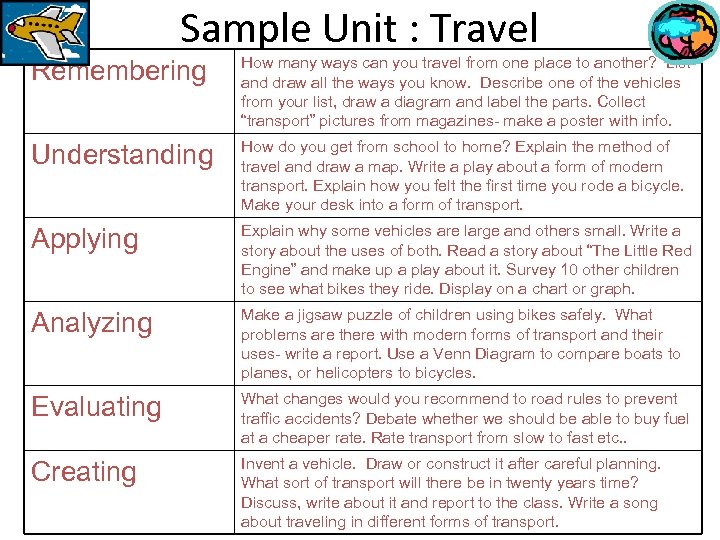 Sample Unit : Travel Remembering How many ways can you travel from one place to another? List and draw all the ways you know. Describe one of the vehicles from your list, draw a diagram and label the parts. Collect “transport” pictures from magazines- make a poster with info. Understanding How do you get from school to home? Explain the method of travel and draw a map. Write a play about a form of modern transport. Explain how you felt the first time you rode a bicycle. Make your desk into a form of transport. Applying Explain why some vehicles are large and others small. Write a story about the uses of both. Read a story about “The Little Red Engine” and make up a play about it. Survey 10 other children to see what bikes they ride. Display on a chart or graph. Analyzing Make a jigsaw puzzle of children using bikes safely. What problems are there with modern forms of transport and their uses- write a report. Use a Venn Diagram to compare boats to planes, or helicopters to bicycles. Evaluating What changes would you recommend to road rules to prevent traffic accidents? Debate whether we should be able to buy fuel at a cheaper rate. Rate transport from slow to fast etc. . Creating Invent a vehicle. Draw or construct it after careful planning. What sort of transport will there be in twenty years time? Discuss, write about it and report to the class. Write a song about traveling in different forms of transport.
 Example 3: Developing a Range of Thinking Skills • Using audio recordings to create alternative learning experiences • The examples below show a range of ways audio recording and playback can create very varied learning experiences at a range of different levels on Bloom's taxonomy. • The accessibility pros and cons vary with the pedagogical approach. • More creative and engaging uses may provide motivation.
 Using audio recordings • Lower levels in Bloom’s taxonomy: An audio recording can provide basic material that a learner needs • The learner may store basic notes in audio format – key vocabulary definitions, language phrases etc. • Text based information – e. g. handout notes - can be transformed to MP 3 format using text to speech software. • Audio clips loaded onto a device might include background information on different locations.
 Using audio recordings • Medium levels of Bloom’s taxonomy – A learner compares audio files in order to select and use the appropriate information – e. g. language based work or practical work. – A learner creates own audio clips explaining observations or summarizing group discussions.
 Higher levels of Bloom’s taxonomy • Learners listen to audio clips and assess them for bias or prejudice – e. g. in humanities or social sciences. • Learners create audio clips to replicate particular styles – – e. g. rhetorical, documentary, propagandist. • Learners create their own audio clips to summarize a series of arguments for or against a particular issue. • With each of these approaches, different factors come into play. • Group based work allows a division of labor that may bypass individual accessibility barriers. • Creating audio recordings may provide benefits for dyslexic or motor impaired learners – compared to note taking but may be inappropriate for speech impaired or deaf learners.
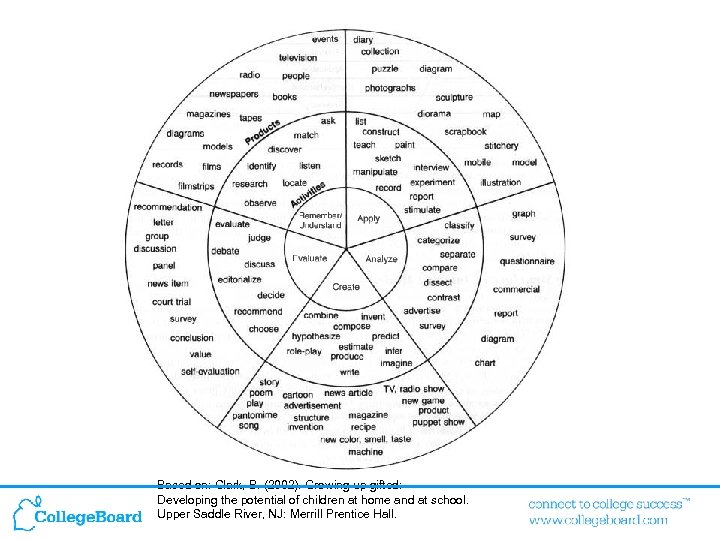 Based on: Clark, B. (2002). Growing up gifted: Developing the potential of children at home and at school. Upper Saddle River, NJ: Merrill Prentice Hall.
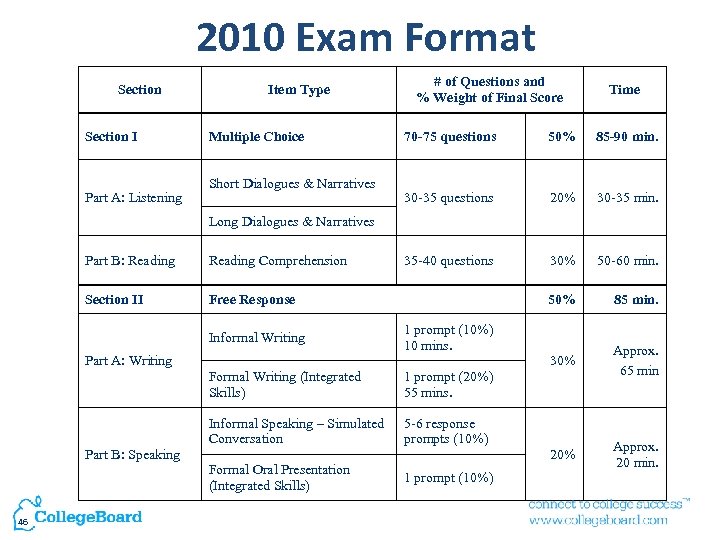 2010 Exam Format Section I Part A: Listening Item Type Multiple Choice Short Dialogues & Narratives # of Questions and % Weight of Final Score Time 70 -75 questions 50% 85 -90 min. 30 -35 questions 20% 30 -35 min. 35 -40 questions 30% 50 -60 min. 50% 85 min. 30% Approx. 65 min 20% Approx. 20 min. Long Dialogues & Narratives Part B: Reading Comprehension Section II Free Response Informal Writing Part A: Writing Part B: Speaking 46 1 prompt (10%) 10 mins. Formal Writing (Integrated Skills) 1 prompt (20%) 55 mins. Informal Speaking – Simulated Conversation 5 -6 response prompts (10%) Formal Oral Presentation (Integrated Skills) 1 prompt (10%)
 Qs ?
Qs ?
 Multiple Intelligences Today
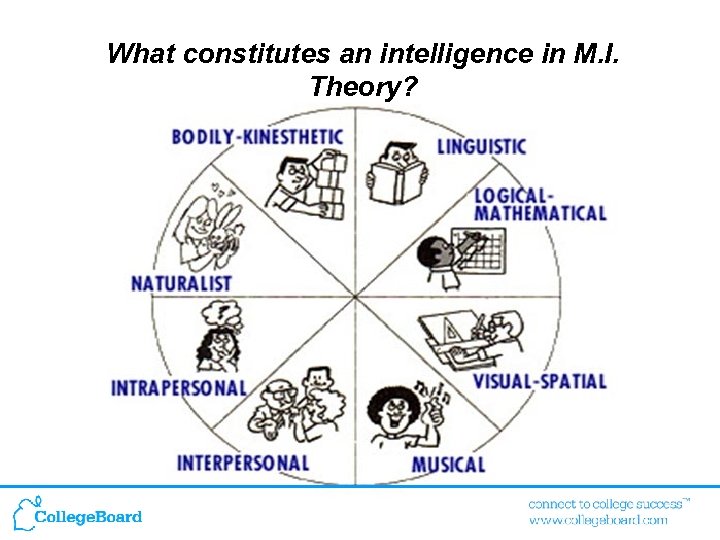 What constitutes an intelligence in M. I. Theory?
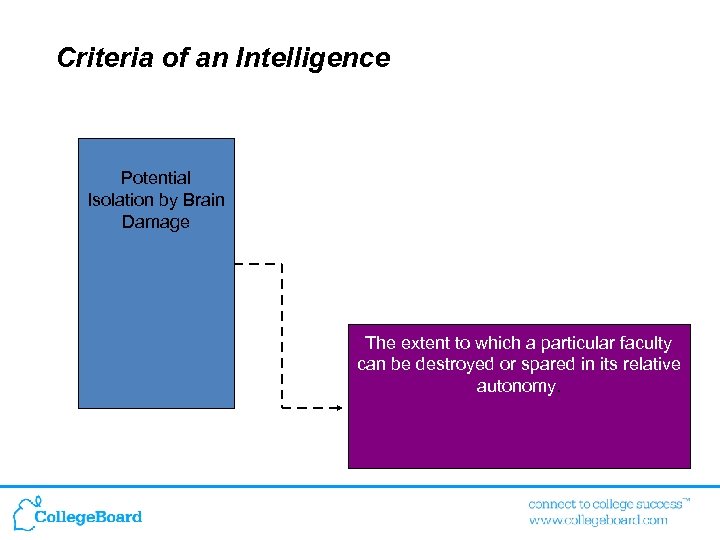 Criteria of an Intelligence Potential Isolation by Brain Damage The extent to which a particular faculty can be destroyed or spared in its relative autonomy.
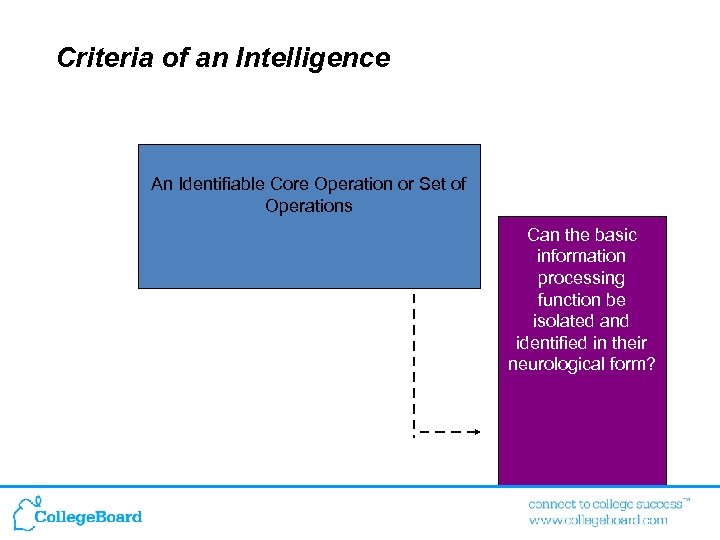 Criteria of an Intelligence An Identifiable Core Operation or Set of Operations Can the basic information processing function be isolated and identified in their neurological form?
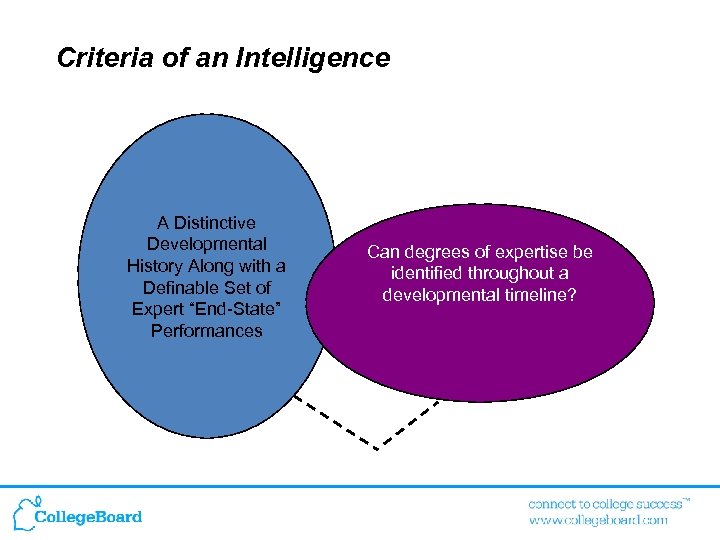 Criteria of an Intelligence A Distinctive Developmental History Along with a Definable Set of Expert “End-State” Performances Can degrees of expertise be identified throughout a developmental timeline?
 Criteria of an Intelligence An Evolutionary History and Evolutionary Plausibility An intelligence becomes more plausible if it can be traced to its evolutionary antecedents.
 Criteria of an Intelligence Support From Experimental Psychological Tasks The extent to a cognitive test can isolate the ability.
 Criteria of an Intelligence Support From Psychometric Findings The extent to which a specifically designed test can support a domain of intelligence.
 Criteria of an Intelligence Susceptibility to Encoding in a Symbol System Has a culture been able to harness the raw capacities to be exploited in a symbolic system?
 The Eight Intelligences • Each has met the majority of criteria: – – – Breakdown of cognitive skills with brain damage Existence of exceptional populations Identifiable core set of operations Developmental and Evolutionary History Psychometric and Psychological studies Susceptible to encoding in a symbol system • Possibility of additional intelligences • Technical and accessible terminology
 MIs Developing a Mindset: Intelligence is something you use, rather than something you have! The emphasis is on how you are smart, not how smart you are!
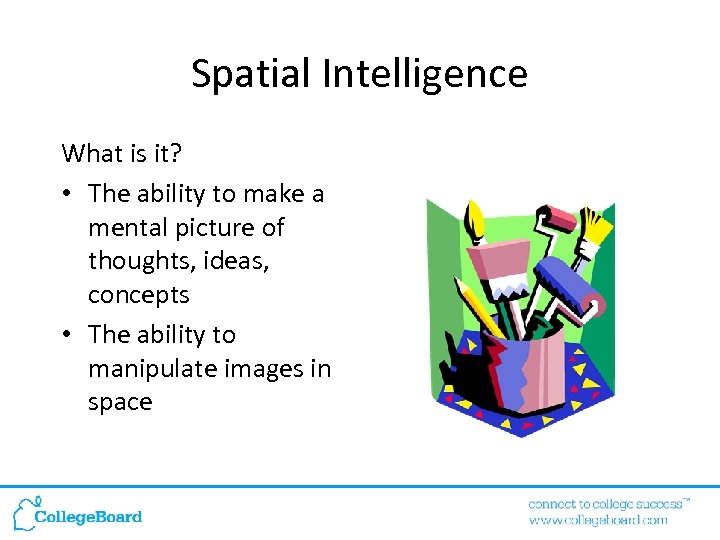 Spatial Intelligence What is it? • The ability to make a mental picture of thoughts, ideas, concepts • The ability to manipulate images in space
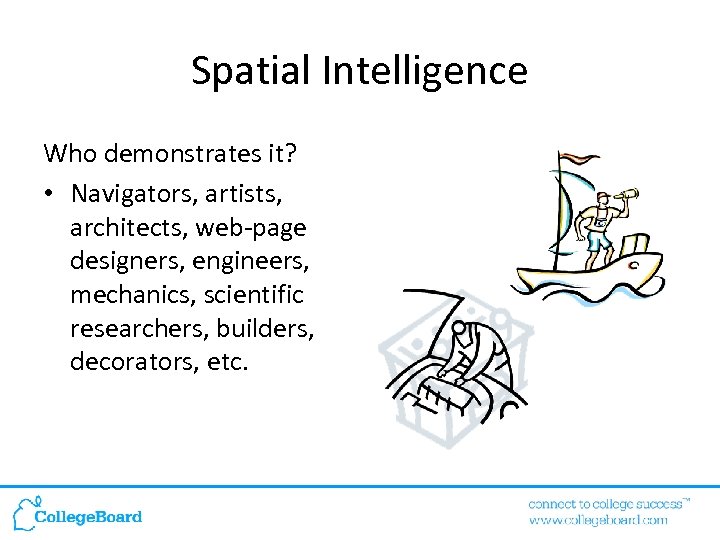 Spatial Intelligence Who demonstrates it? • Navigators, artists, architects, web-page designers, engineers, mechanics, scientific researchers, builders, decorators, etc.
 Naturalist Intelligence What is it? • The ability to recognize and classify the differences plants, animals, minerals, and man-made items
 Naturalist Intelligence Who demonstrates it? • Botanists, zoologists, landscapers, farmers, hunters, chefs • Anyone who organizes or catalogues items
 Interpersonal Intelligence What is it? • The ability to understand the thoughts and feelings of others
 Interpersonal Intelligence Who demonstrates it? • Teachers, lawyers, psychologists, preachers, salespeople, politicians, advertisers, entertainers • Anyone who lives, works, or interacts with others
 Intrapersonal Intelligence What is it? • An understanding of yourself, of who you are, what you can do, what you want to do, how you react to things, which things to avoid, and which things to gravitate toward
 Intrapersonal Intelligence Who demonstrates it? • Everybody and anybody, when we practice introspection • When we examine our thoughts and feelings
 Musical Intelligence What is it? • The ability to pick up and appreciate aural elements, such as those in music, and the capacity to work with rimes and rhythms.
 Musical Intelligence Who demonstrates it? • Musicians, music critics, advertisers, entertainers, teachers, aerobics instructors, dancers, poets • Anyone who appreciates music
 Linguistic Intelligence What is it? • The ability to use oral or written language to express what's on your mind and to understand other people.
 Linguistic Intelligence Who demonstrates it? • Writers, preachers, lawyers, teachers, entertainers, politicians, journalists, editors, students • Anyone who reads, writes, or speaks!
 Linguistic intelligence • People who are strong in the language intelligence enjoy saying, hearing, and seeing words. • They like telling stories. • They are motivated by books, records, dramas, opportunities for writing. • Here are ways to work with this intelligence in lessons:
 Linguistic intelligence • Look at different kinds of dictionaries. • Read plays and poetry out loud. • Write a story for a book or newsletter. • Keep a journal. • Read from books written by or for new readers. • Use a tape recorder to tape stories and write them down. • Trade tall tales, attend storytelling events and workshops. • Read together, i. e. , choral reading. • Read out loud to each other. • Read a section, then explain what you've read. • Read pieces with different emotional tones or viewpoints — one angry, one happy, etc. • Explore and develop the love of words.
 Logical-Mathematical Intelligence What is it? • A sensitivity towards and a capacity to see logical or numerical patterns • The ability to handle long chains of reasoning
 Logical-Mathematical Intelligence Who demonstrates it? • Scientists, engineers, mathematicians, doctors, accountants, contractors • Anybody who tries to solve challenging problems
 Bodily-Kinesthetic Intelligence What is it? • Ability to control one’s body movements with expertise and the capacity to handle objects skillfully
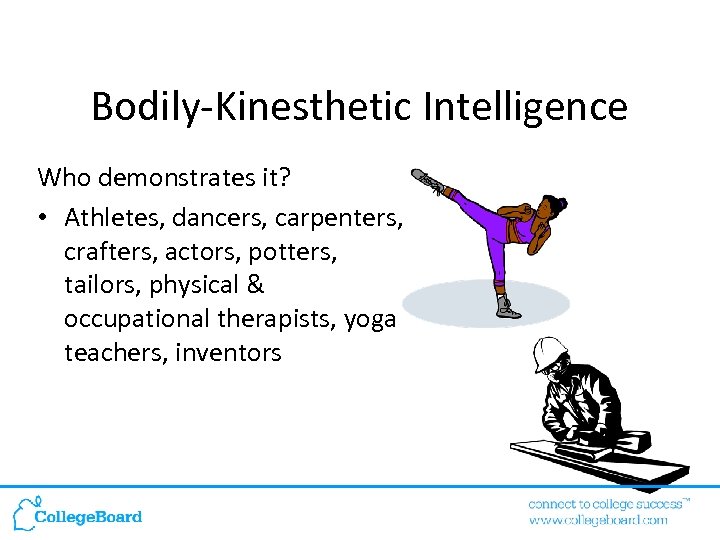 Bodily-Kinesthetic Intelligence Who demonstrates it? • Athletes, dancers, carpenters, crafters, actors, potters, tailors, physical & occupational therapists, yoga teachers, inventors
 The Eight Intelligences A ninth intelligence? • Gardner has allowed that there is an existential intelligence • He refers to this as, “The intelligence of big questions”
 The Eight Intelligences Intelligence Profiles: • Variable over time • Affected by: – Attention – Instruction – Practice – Development
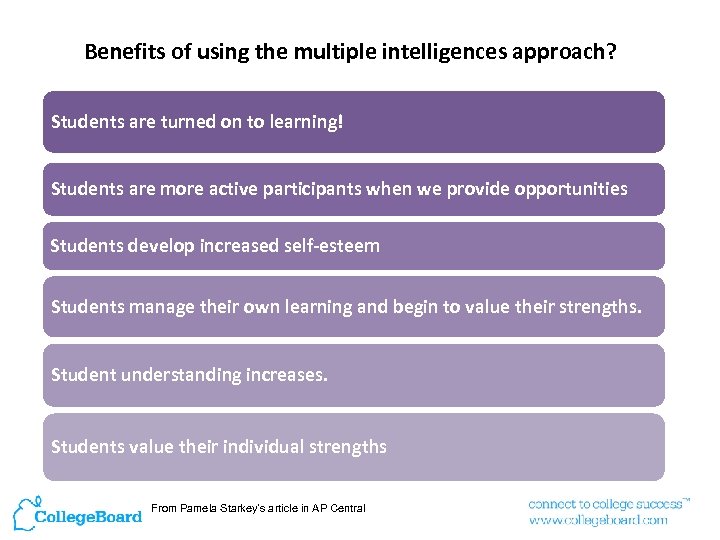
 So what are the benefits of using the MI approach? • Students are turned on to learning! – Students who may perform poorly on traditional tests are turned on to learning – when classroom experiences incorporate artistic, musical, or athletic activities. • • Students are more active participants when we provide opportunities for authentic learning based on each student’s needs, interests, and talents. Students develop increased self-esteem when they are able to demonstrate and share strengths and gain positive educational experiences. Students manage their own learning and begin to value their strengths. Student understanding increases. • When students understand their intelligences, they begin to manage their own learning and to value their individual strength From Pamela Starkey’s article in AP Central
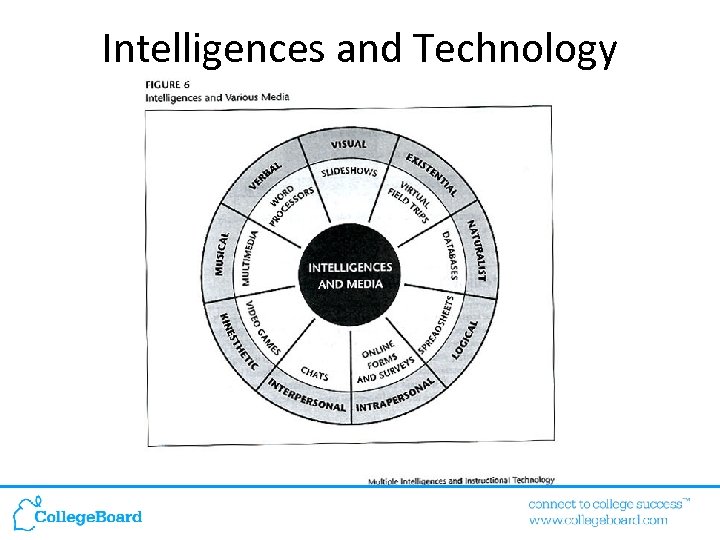 Intelligences and Technology
 Benefits of using the multiple intelligences approach? Students are turned on to learning! Students are more active participants when we provide opportunities Students develop increased self-esteem Students manage their own learning and begin to value their strengths. Student understanding increases. Students value their individual strengths From Pamela Starkey’s article in AP Central
 How does it all fit together? Bloom’s Revised Taxonomy
 Bloom-Gardner Matrix
 Activities
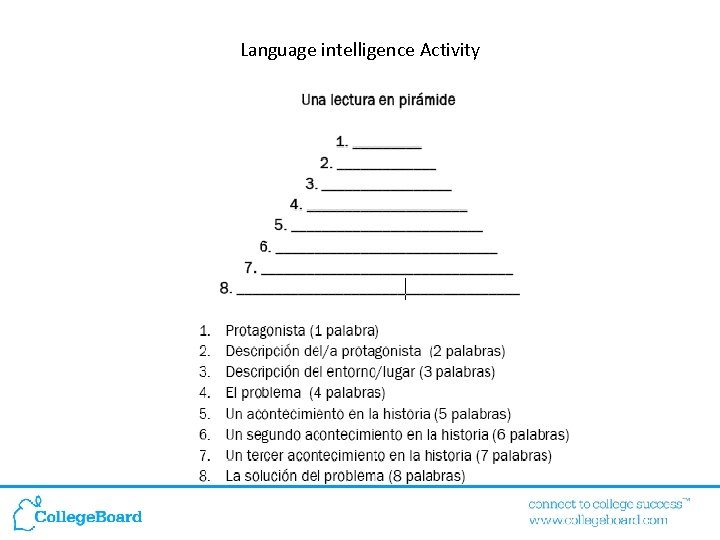 Language intelligence Activity
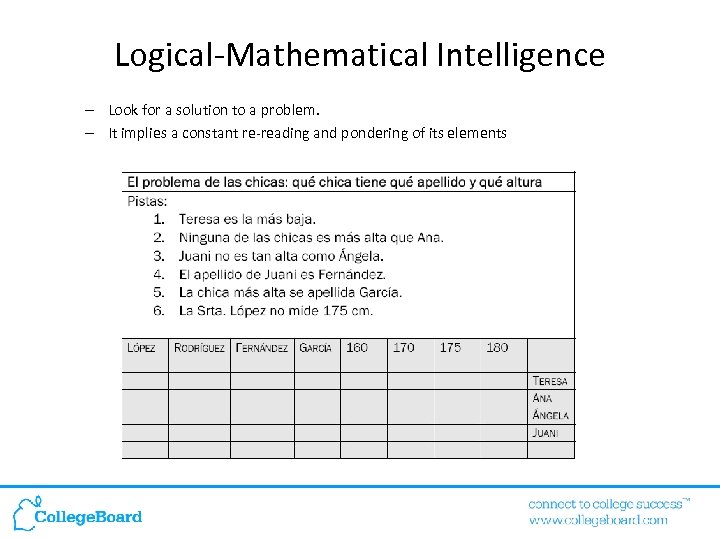 Logical-Mathematical Intelligence – Look for a solution to a problem. – It implies a constant re-reading and pondering of its elements
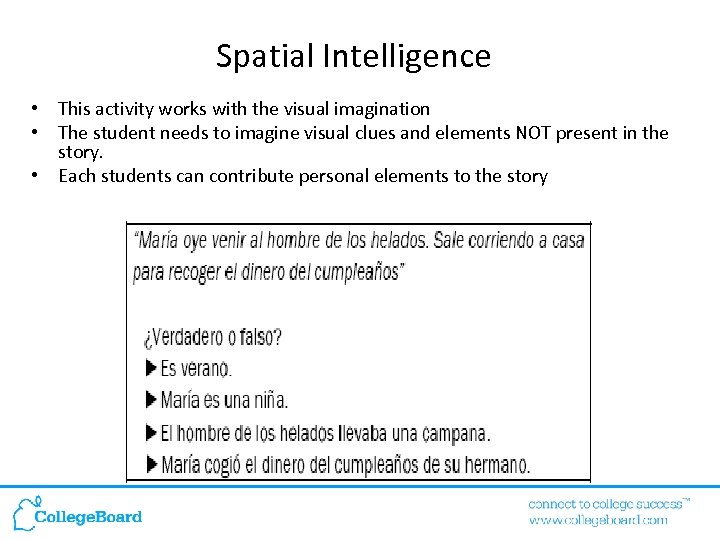 Spatial Intelligence • This activity works with the visual imagination • The student needs to imagine visual clues and elements NOT present in the story. • Each students can contribute personal elements to the story
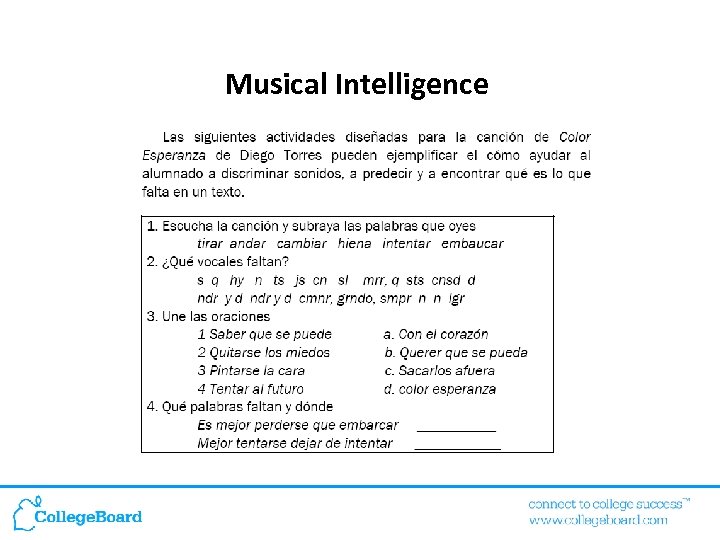 Musical Intelligence
 Bloom and Gardner in the AP Spanish Language Exam Tasks
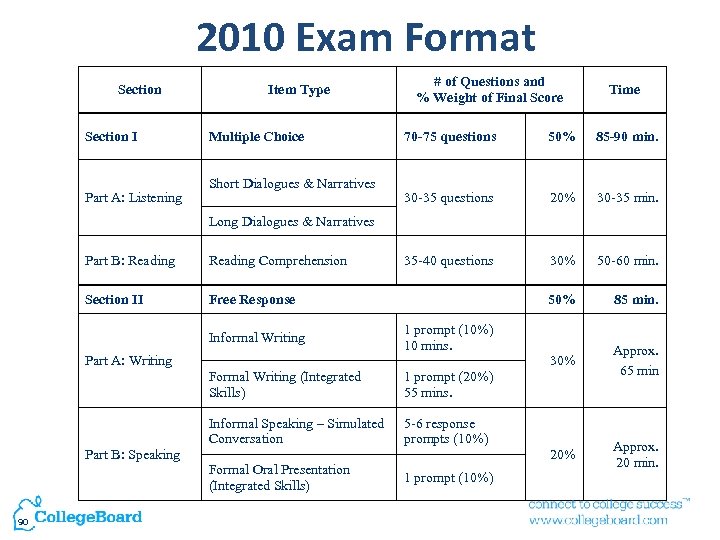 2010 Exam Format Section I Part A: Listening Item Type Multiple Choice Short Dialogues & Narratives # of Questions and % Weight of Final Score Time 70 -75 questions 50% 85 -90 min. 30 -35 questions 20% 30 -35 min. 35 -40 questions 30% 50 -60 min. 50% 85 min. 30% Approx. 65 min 20% Approx. 20 min. Long Dialogues & Narratives Part B: Reading Comprehension Section II Free Response Informal Writing Part A: Writing Part B: Speaking 90 1 prompt (10%) 10 mins. Formal Writing (Integrated Skills) 1 prompt (20%) 55 mins. Informal Speaking – Simulated Conversation 5 -6 response prompts (10%) Formal Oral Presentation (Integrated Skills) 1 prompt (10%)
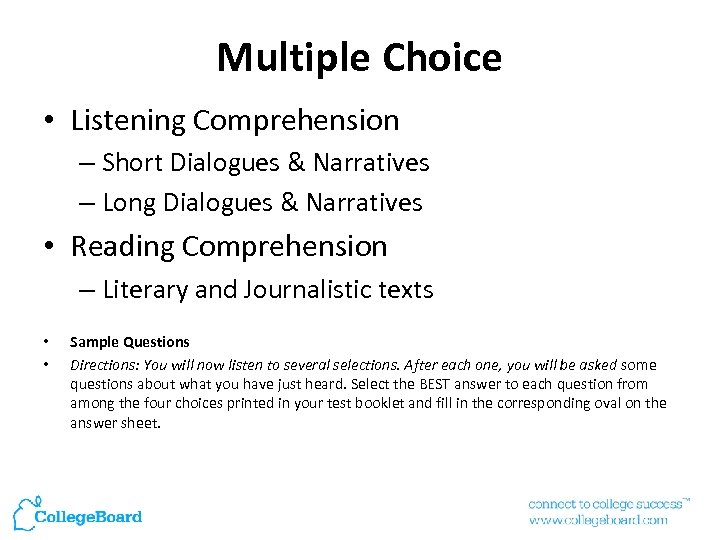 Multiple Choice • Listening Comprehension – Short Dialogues & Narratives – Long Dialogues & Narratives • Reading Comprehension – Literary and Journalistic texts • • Sample Questions Directions: You will now listen to several selections. After each one, you will be asked some questions about what you have just heard. Select the BEST answer to each question from among the four choices printed in your test booklet and fill in the corresponding oval on the answer sheet.
 Free Response Interpersonal Writing
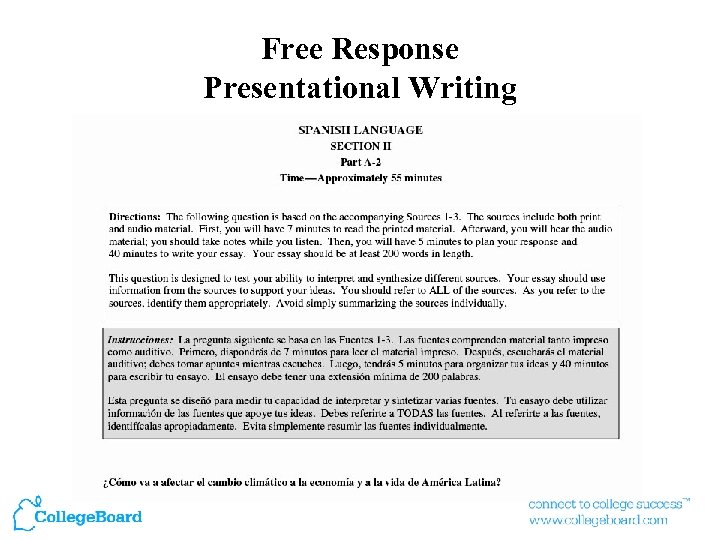 Free Response Presentational Writing
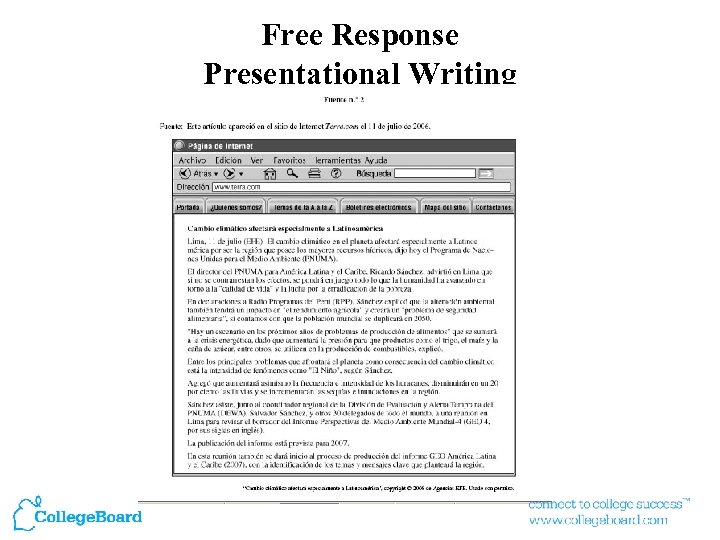 Free Response Presentational Writing
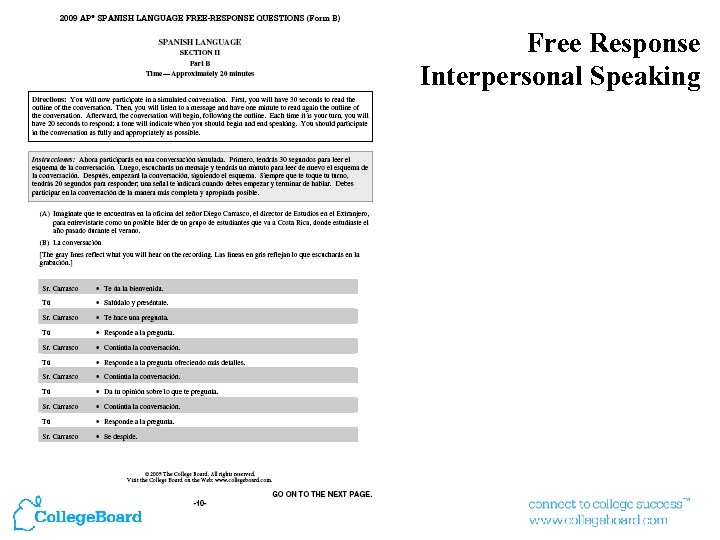 Free Response Interpersonal Speaking
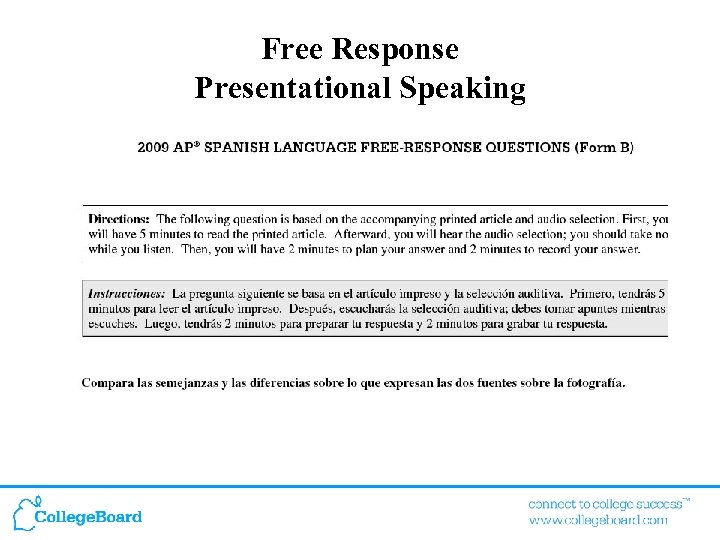 Free Response Presentational Speaking
 MI Tools • How Smart are you? Assessing MI • Practicing MI • Resources – Extending this module • Please read: Exploring "The Theory of Multiple Intelligences“ (http: //www. accelerated-learning. net/multiple. htm) • Please visit: • The Surfaquarium website (http: //surfaquarium. com/MI/)
 Q & A
Q & A
 Bloom – Gardner go High-tech • http: //www. youtube. com/watch? v=LOlt. DZg. IZ Vc&feature=related • National Educational Technology Standards • ISTE (International Society for Technology in Education)
 Bloom on the Internet • Bloom's(1956) Revised Taxonomy http: //rite. ed. qut. edu. au/oz-teachernet/training/bloom. html An excellent introduction and explanation of the revised Taxonomy by Michael Pole on the oz-Teacher. Net site written for the QSITE Higher order Thinking Skills Online Course 2000. Pohl explains the terms and provides a comprehensive overview of the sub-categories, along with some suggested question starters that aim to evoke thinking specific to each level of the taxonomy. Suggested potential activities and student products are also listed. • Bloom’s Revised Taxonomy http: //coe. sdsu. edu/eet/articles/bloomrev/index. htm Another useful site for teachers with useful explanations and examples of questions from the College of Education at San Diego State University. • Taxonomy of Technology Integration http: //education. ed. pacificu. edu/aacu/workshop/reconcept 2 B. html This site compiled by the Berglund Center for Internet Studies at Pacific University, makes a valiant effort towards linking ICT (information and communication technologies) to learning via Bloom's Revised Taxonomy of Educational Objectives (Anderson, et. al. , 2001). The taxonomy presented on this site is designed to represent the varying cognitive processes that can be facilitated by the integration of ICT into the teaching and learning process. • Critical and Creative Thinking - Bloom's Taxonomy http: //eduscapes. com/tap/topic 69. htm Part of Eduscape. com, this site includes a definitive overview of critical and creative thinking as well as how Bloom’s domains of learning can be reflected in technology-rich projects. Many other links to Internet resources to support Bloom’s Taxonomy, as well as research and papers on Thinking Skills. Well worth a look.
 Bloom on the Internet • • • • • http: //www. tedi. uq. edu. au/Assessment/bloomtax. html http: //www. acps. k 12. va. us/hammond/readstrat/Blooms. Taxonomy 2. html http: //www. teachers. ash. org. au/researchskills/dalton. htm http: //www. officeport. com/edu/blooms. htm http: //www. quia. com/fc/90134. html http: //www. utexas. edu/student/utlc/handouts/1414. html Model questions and keywords http: //schools. sd 68. bc. ca/webquests/blooms. htm http: //www. coun. uvic. ca/learn/program/hndouts/bloom. html http: //caribou. cc. trincoll. edu/depts_educ/Resources/Bloom. htm http: //www. kent. wednet. edu/KSD/MA/resources/blooms/teachers_blooms. html http: //www. hcc. hawaii. edu/intranet/committees/Fac. Dev. Com/guidebk/teachtip/questype. htm http: //www. nexus. edu. au/teachstud/gat/painter. htm Questioning Techniques that includes reference to Bloom’s Taxonomy. http: //scs. une. edu. au/Talent. Ed/Ed. Support/Snugglepot. htm http: //online. umwblogs. org/2008/08/27/bloom-gardner-gliffy-reflection/ http: //www. kurwongbss. eq. edu. au/thinking/Bloom/blooms. htm http: //www. teachers. ash. org. au/researchskills/matrix. htm http: //office. microsoft. com/en-us/templates/TC 300005771033. aspx? Ax. Installed=1&c=0
 Printed Resources • • • Bloom B. S. (1956). Taxonomy of Educational Objectives, Handbook I: The Cognitive Domain. New York: David Mc. Kay Co Inc. Clements, D. ; C. Gilliland P. Holko. (1992). Thinking in Themes: An Approach Through the Learning Centre. Melbourne: Oxford University Press. Crawford, Jean (ed. ) (1991). Achieveing Excellence: Units of Work for levels P-8. Carlton South, Vic. : Education Shop, Ministry of Education and Training, Victoria. Crosby, N. and E. Martin. (1981). Don’t Teach! Let Me Learn. Book 3. Cheltenham, Vic. : Hawker Brownlow. Dalton, Joan. (1986). Extending Children’s Special Abilities: Strategies for Primary Classrooms. Victoria: Department of School Education, Victoria. Dave, R. H. (1975). Developing and Writing Behavioural Objectives. (R J Armstrong, ed. ) Educational Innovators Press. Forte, Imogene and S. Schurr. (1997). The All-New Science Mind Stretchers: Interdisciplinary Units to Teach Science Concepts and Strengthen Thinking Skills. Cheltenham, Vic. : Hawker Brownlow. Fogarty, R. (1997). Problem-based learning and other curriculum models for the multiple intelligences classroom. Arlington Heights, IL: IRI/Skylight Training and Publishing, Inc. Frangenheim, E. (1998). Reflections on Classroom Thinking Strategies. Loganholme: Rodin Educational Consultancy.
 Printed Resources • • • Harrow, Anita (1972) A taxonomy of psychomotor domain: a guide for developing behavioral objectives. New York: David Mc. Kay. Knight, BA. , S. Bailey, W. Wearne and D. Brown. (1999). Blooms Multiple Intelligences Themes and Activities. Krathwohl, D. R. , Bloom, B. S. , & Masia, B. B. (1973). Taxonomy of Educational Objectives, the Classification of Educational Goals. Handbook II: Affective Domain. New York: David Mc. Kay Co. , Inc. Mc. Grath, H and T. Noble. (1995). Seven Ways at Once: Units of Work Based on the Seven Intelligences. Book 1. South Melbourne: Longman. Pohl, Michael. (2000). Learning to Think, Thinking to Learn: Models and Strategies to Develop a Classroom Culture of Thinking. Cheltenham, Vic. : Hawker Brownlow. Pohl, M. (2000). Teaching Complex Thinking: Critical, Creative, Caring. Cheltenham, Vic. : Hawker Brownlow. Pohl, Michael. (1997). Teaching Thinking Skills in the Primary Years: A Whole School Approach. Cheltenham, Vic. : Hawker Brownlow Education. Pohl, Michael. (2000). Learning to Think, Thinking to Learn: Models and Strategies to Develop a Classroom Culture of Thinking. Cheltenham, Vic. : Hawker Brownlow. Ryan, Maureen. (1996). The Gifted and Talented Children’s Course: Resolving Issues, Book 13 - 7 -8 Year Olds. Greenwood, WA: Ready-Ed Publications. Simpson E. J. (1972). The Classification of Educational Objectives in the Psychomotor Domain. Washington, DC: Gryphon House.