 Скачать презентацию Higher Human Biology Unit 1 Cell Function and
bec7376b2829be2becce4316c52f7e26.ppt
- Количество слайдов: 31



Higher Human Biology Unit 1: Cell Function and Inheritance Chapter 10 Meiosis 19/03/2018 Mrs Smith 1
Learning Intentions • • To revise chromosomes To revise mitosis To examine meiosis To look at effect of chromosomes crossing over during meiosis 19/03/2018 Mrs Smith 2
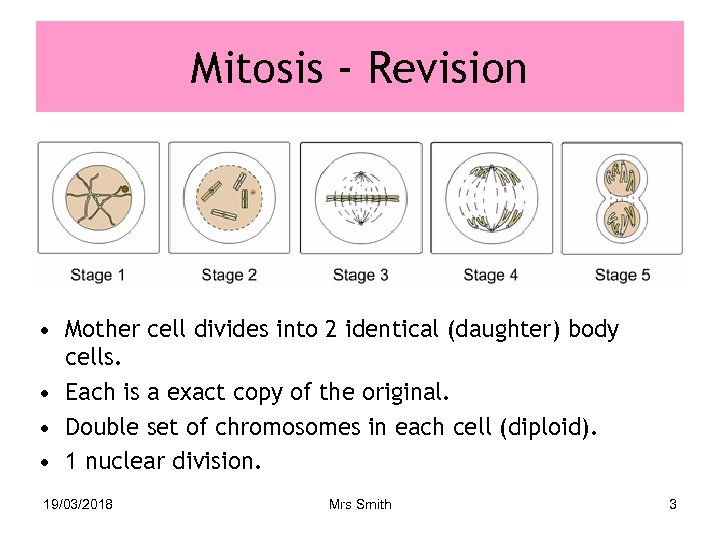
Mitosis - Revision • Mother cell divides into 2 identical (daughter) body cells. • Each is a exact copy of the original. • Double set of chromosomes in each cell (diploid). • 1 nuclear division. 19/03/2018 Mrs Smith 3
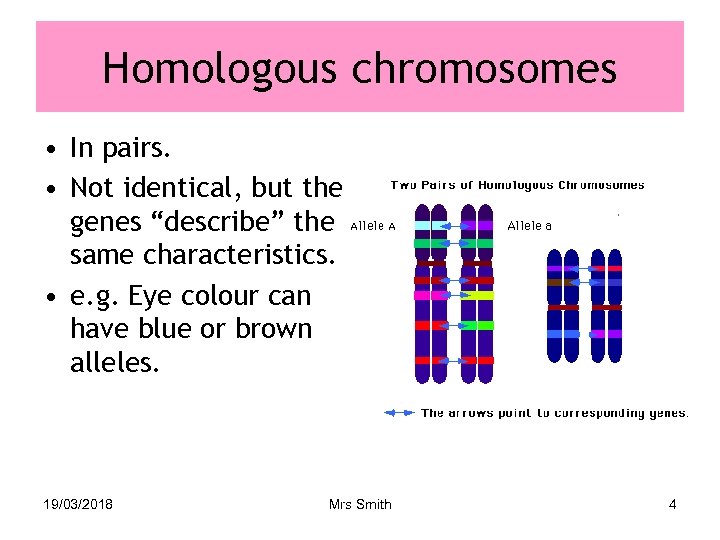
Homologous chromosomes • In pairs. • Not identical, but the genes “describe” the same characteristics. • e. g. Eye colour can have blue or brown alleles. 19/03/2018 Mrs Smith 4
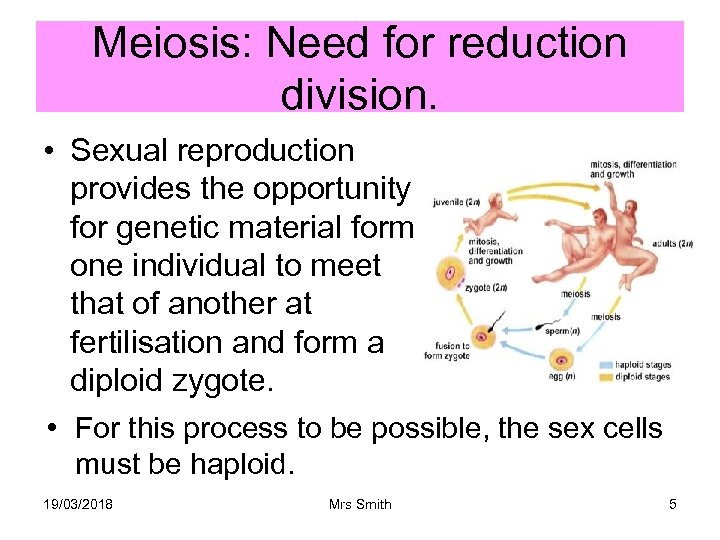
Meiosis: Need for reduction division. • Sexual reproduction provides the opportunity for genetic material form one individual to meet that of another at fertilisation and form a diploid zygote. • For this process to be possible, the sex cells must be haploid. 19/03/2018 Mrs Smith 5
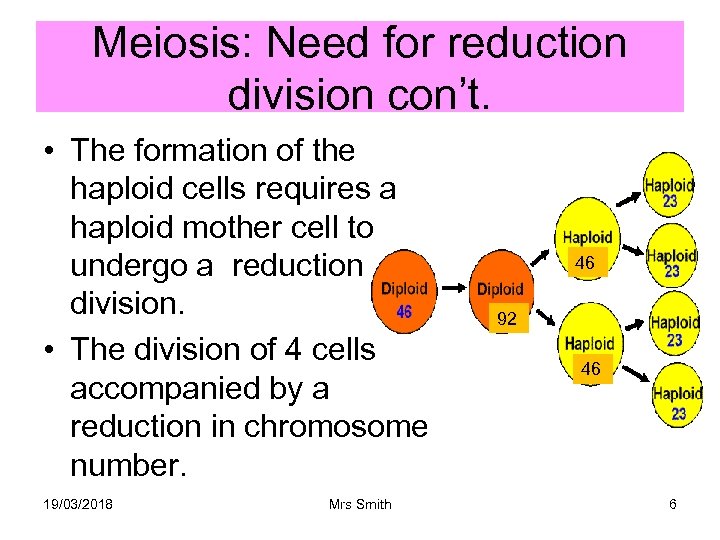
Meiosis: Need for reduction division con’t. • The formation of the haploid cells requires a haploid mother cell to undergo a reduction division. • The division of 4 cells accompanied by a reduction in chromosome number. 19/03/2018 Mrs Smith 46 92 46 6
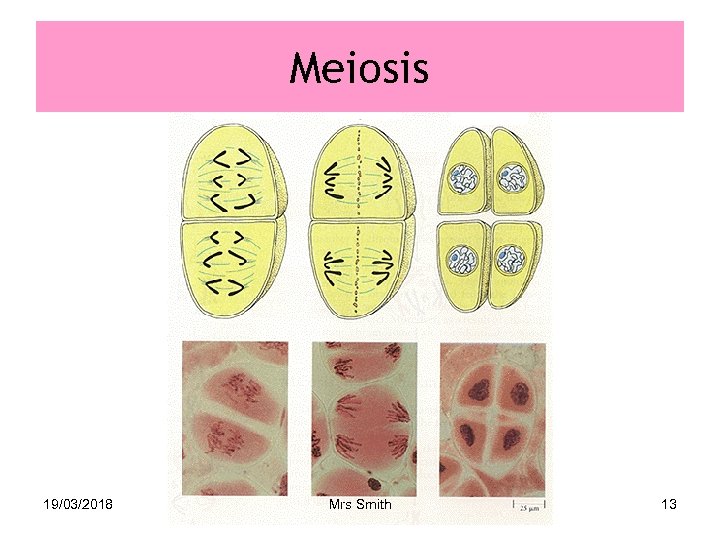
Meiosis: Summary • Mother cell divides to produce 4 gametes (sex cells). • Gametes contain half the genetic material of the parent cell (haploid). • 2 nuclear divisions. 19/03/2018 Mrs Smith 7
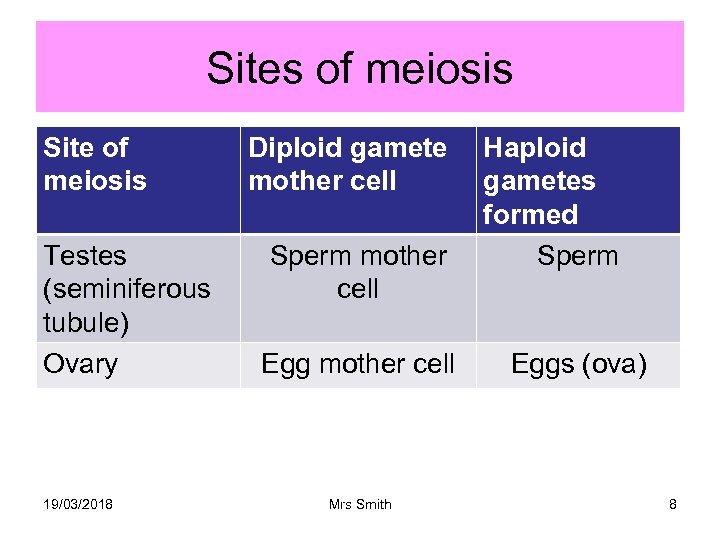
Sites of meiosis Site of meiosis Testes (seminiferous tubule) Ovary 19/03/2018 Diploid gamete mother cell Sperm mother cell Egg mother cell Mrs Smith Haploid gametes formed Sperm Eggs (ova) 8
Process of meiosis • Involves 2 consecutive nuclear divisions (followed by cell divisions) • The gamete mother cell (4 n) divides into two cells and these then divide again. 19/03/2018 Mrs Smith 9
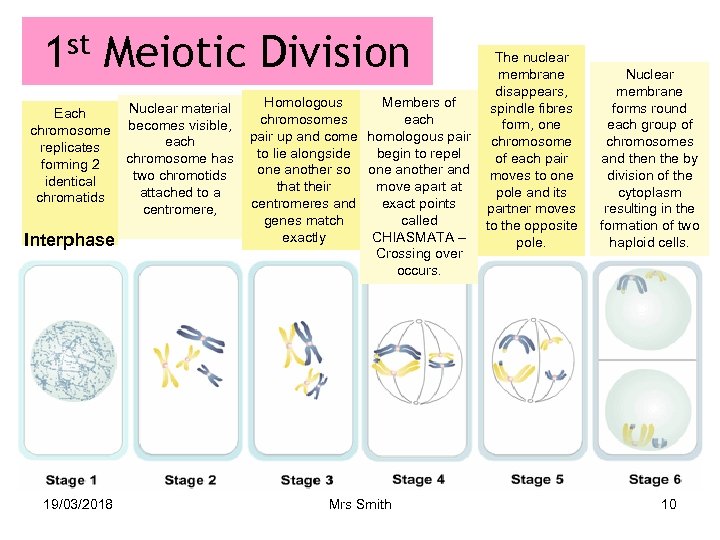
1 st Meiotic Division Each chromosome replicates forming 2 identical chromatids Interphase 19/03/2018 Nuclear material becomes visible, each chromosome has two chromotids attached to a centromere, Homologous Members of chromosomes each pair up and come homologous pair to lie alongside begin to repel one another so one another and that their move apart at centromeres and exact points genes match called exactly CHIASMATA – Crossing over occurs. Mrs Smith The nuclear membrane disappears, spindle fibres form, one chromosome of each pair moves to one pole and its partner moves to the opposite pole. Nuclear membrane forms round each group of chromosomes and then the by division of the cytoplasm resulting in the formation of two haploid cells. 10
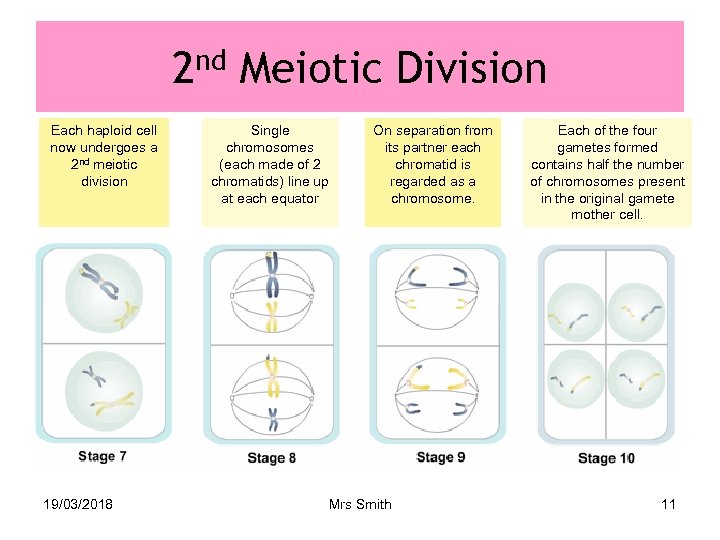
2 nd Meiotic Division Each haploid cell now undergoes a 2 nd meiotic division 19/03/2018 Single chromosomes (each made of 2 chromatids) line up at each equator On separation from its partner each chromatid is regarded as a chromosome. Mrs Smith Each of the four gametes formed contains half the number of chromosomes present in the original gamete mother cell. 11
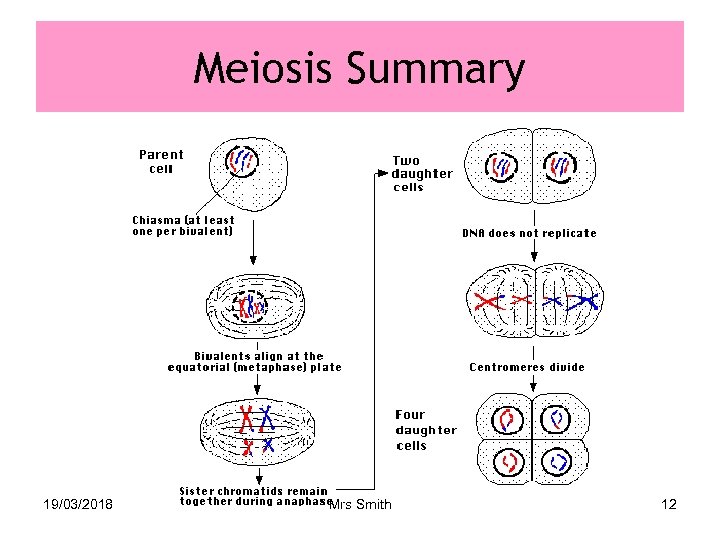
Meiosis Summary 19/03/2018 Mrs Smith 12
Meiosis 19/03/2018 Mrs Smith 13
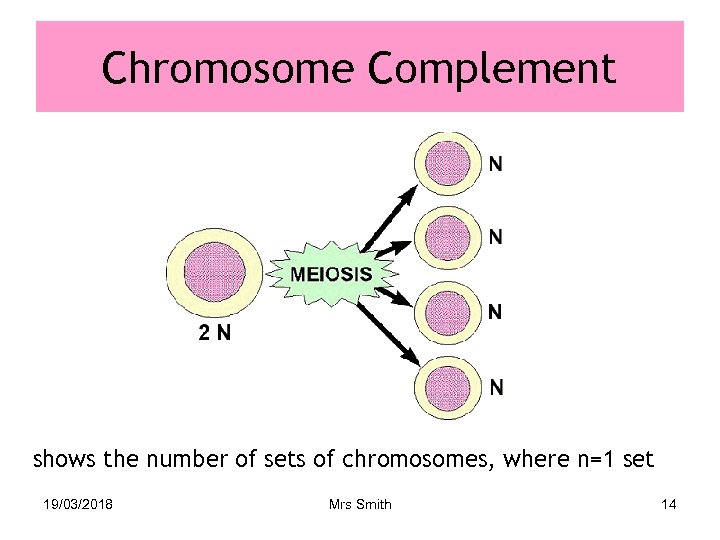
Chromosome Complement shows the number of sets of chromosomes, where n=1 set 19/03/2018 Mrs Smith 14
Task: TYK Qu’s Torrance pg 76 19/03/2018 Mrs Smith 15
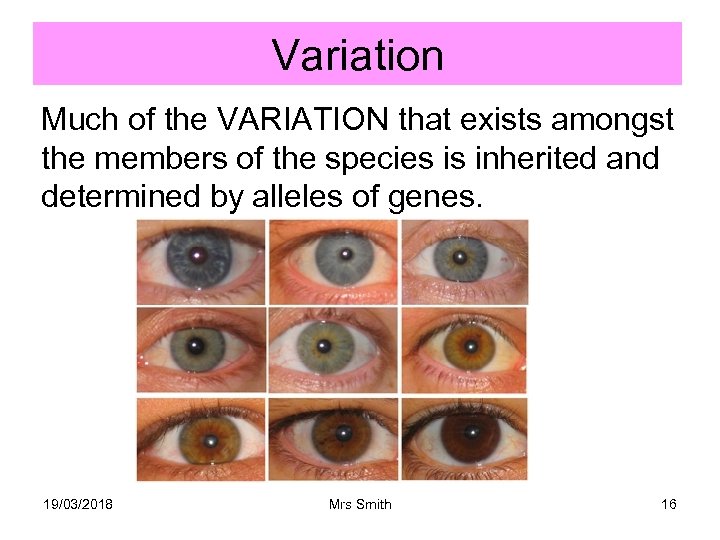
Variation Much of the VARIATION that exists amongst the members of the species is inherited and determined by alleles of genes. 19/03/2018 Mrs Smith 16
Variation Caused by: • Idependent assortment of chromosomes • Chiasmata (crossing over of genetic information) Results in variation between organisms of same species 19/03/2018 Mrs Smith 17
Independent assortment • When homologous pairs of chromosomes line up at the first meiotic division, the final position of any one pair is RANDOM relative to the other pair. 19/03/2018 Mrs Smith 18
The potential for infinite variation • In the next diagram this is shown, here it gives rise to 22 (i. e. 4) different combinations in the gametes. This may lead to the formations of new phenotypes. • The larger the number of chromosomes present the greater number of possible combinations. • A human egg mother cell with 23 chromosomes has the potential to produce 223 (i. e. 8388608) different combinations. 19/03/2018 Mrs Smith 19
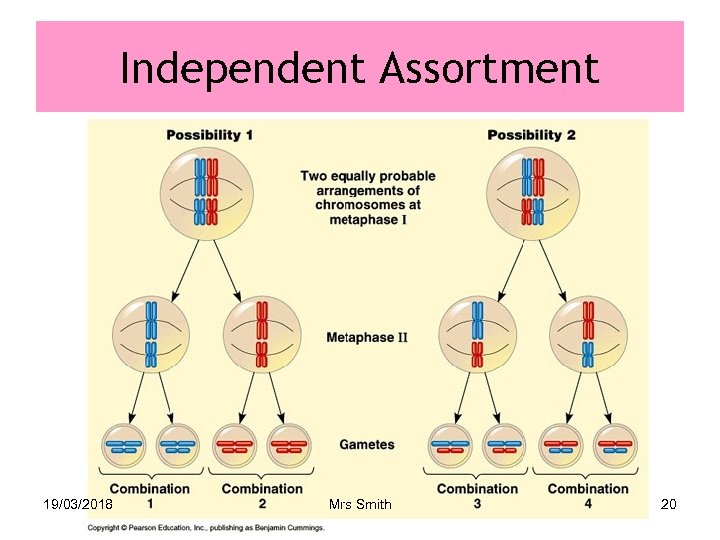
Independent Assortment 19/03/2018 Mrs Smith 20
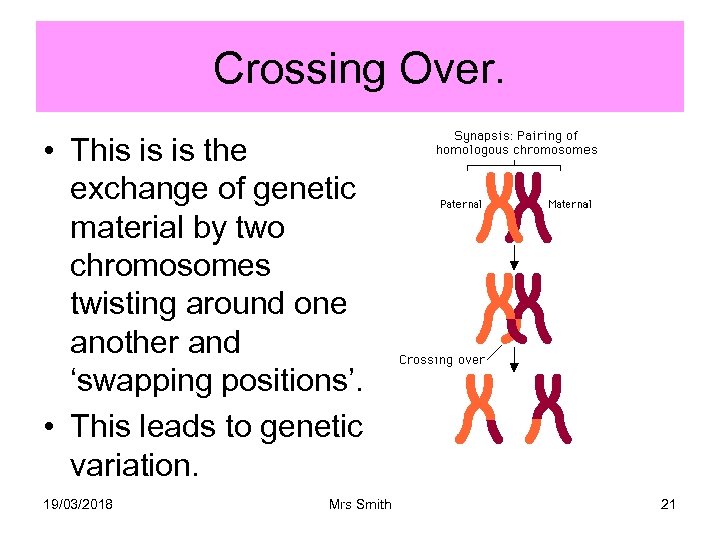
Crossing Over. • This is is the exchange of genetic material by two chromosomes twisting around one another and ‘swapping positions’. • This leads to genetic variation. 19/03/2018 Mrs Smith 21
Crossing over con’t • Two genes situated on the same chromosome are said to be LINKED • Involves chromatids being broken and the broken end of one joining with that of another. • This way alleles of linked genes can become sepaated and lead to new combinations of alleles. 19/03/2018 Mrs Smith 22
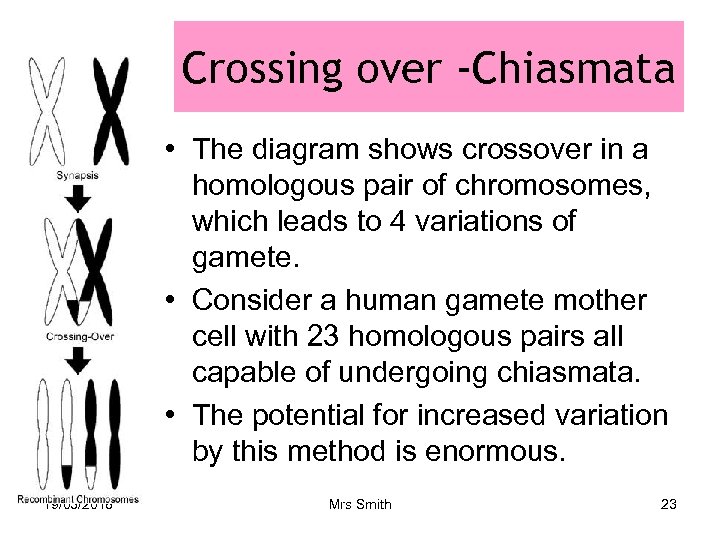
Crossing over -Chiasmata • The diagram shows crossover in a homologous pair of chromosomes, which leads to 4 variations of gamete. • Consider a human gamete mother cell with 23 homologous pairs all capable of undergoing chiasmata. • The potential for increased variation by this method is enormous. 19/03/2018 Mrs Smith 23
Sexual reproduction • During sexual reproduction, two haploid gametes (each carrying a unique version of the species’ genetic blueprint) meet at fertilisation. • This mixing of part of one parents genotype with that of another produces a new individual who is genetically different from both parents and from all other members of the species 19/03/2018 Mrs Smith 24
Importance of genetic variation • Such variation is of great importance because it helps the species adapt to a changing environment. • E. g. Adapting or becoming resistant to a new disease. Those of the species who can adapt will live to pass on these beneficial genes. 19/03/2018 Mrs Smith 25
Genetic fingerprinting • Some of the DNA in the human genome contains short, no-coding sequences of bases that are repeated many times. • These may vary in size and length form person to person. • DNA can be extracted and separated to show this pattern = GENETIC FINGERPRINT, it is unique to every person. 19/03/2018 Mrs Smith 26
DNA fingerprint uses. • A person inherits 50% of their DNA from each parent. • Every band in the genetic fingerprint must match one in theirs fathers print and one in their mothers. – Used to settle paternity disputes – Forensics DNA in cells, e. g. Blood, mucous, sperm, can be tested against the subject. 19/03/2018 Mrs Smith 27
Task: TYK Qu’s Torrance pg 78 19/03/2018 Mrs Smith 28
Task: Applying YK Qu’s Torrance pg 78 -79 19/03/2018 Mrs Smith 29
Essay Question 2004 (2 A) • Describe the events in meiosis which give rise to variation in gametes (10). 19/03/2018 Mrs Smith 30
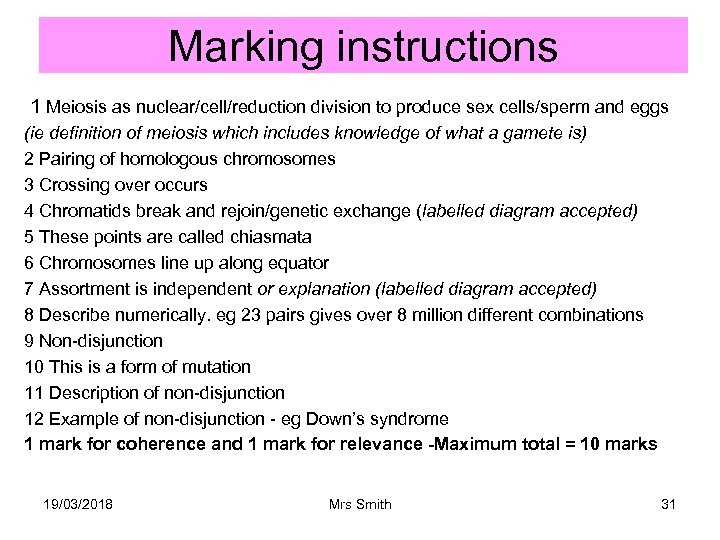
Marking instructions 1 Meiosis as nuclear/cell/reduction division to produce sex cells/sperm and eggs (ie definition of meiosis which includes knowledge of what a gamete is) 2 Pairing of homologous chromosomes 3 Crossing over occurs 4 Chromatids break and rejoin/genetic exchange (labelled diagram accepted) 5 These points are called chiasmata 6 Chromosomes line up along equator 7 Assortment is independent or explanation (labelled diagram accepted) 8 Describe numerically. eg 23 pairs gives over 8 million different combinations 9 Non-disjunction 10 This is a form of mutation 11 Description of non-disjunction 12 Example of non-disjunction - eg Down’s syndrome 1 mark for coherence and 1 mark for relevance -Maximum total = 10 marks 19/03/2018 Mrs Smith 31
Скачать презентацию Higher Human Biology Unit 1 Cell Function and
bec7376b2829be2becce4316c52f7e26.ppt