


 Скачать презентацию Higher Expectations and Fewer Resources What s a SHEEO
b29581a01e0ea03e00f010f51a09d05c.ppt
- Количество слайдов: 23
 Higher Expectations and Fewer Resources: What’s a SHEEO to Do? Dennis P. Jones SHEEO Annual Meeting Santa Fe, NM July 17, 2009 National Center for Higher Education Management Systems 3035 Center Green Drive, Suite 150 Boulder, Colorado 80301
 The Expectation “By 2020, America will once again have the highest proportion of college graduates in the world” President Barack Obama, February 24, 2009 slide 2
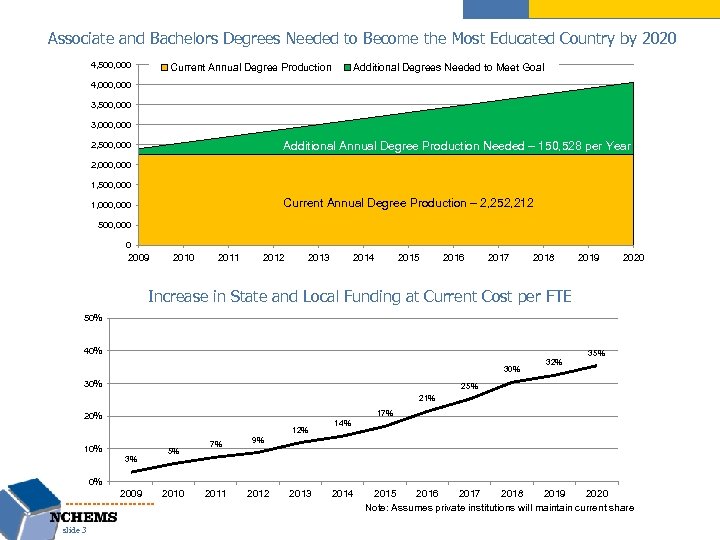 Associate and Bachelors Degrees Needed to Become the Most Educated Country by 2020 4, 500, 000 Current Annual Degree Production Additional Degrees Needed to Meet Goal 4, 000 3, 500, 000 3, 000 Additional Annual Degree Production Needed – 150, 528 per Year 2, 500, 000 2, 000 1, 500, 000 Current Annual Degree Production – 2, 252, 212 1, 000 500, 000 0 2009 2010 2011 2012 2013 2014 2015 2016 2017 2018 2019 2020 Increase in State and Local Funding at Current Cost per FTE 50% 40% 35% 30% 32% 25% 21% 17% 20% 12% 10% 3% 5% 7% 14% 9% 0% 2009 slide 3 2010 2011 2012 2013 2014 2015 2016 2017 2018 2019 2020 Note: Assumes private institutions will maintain current share
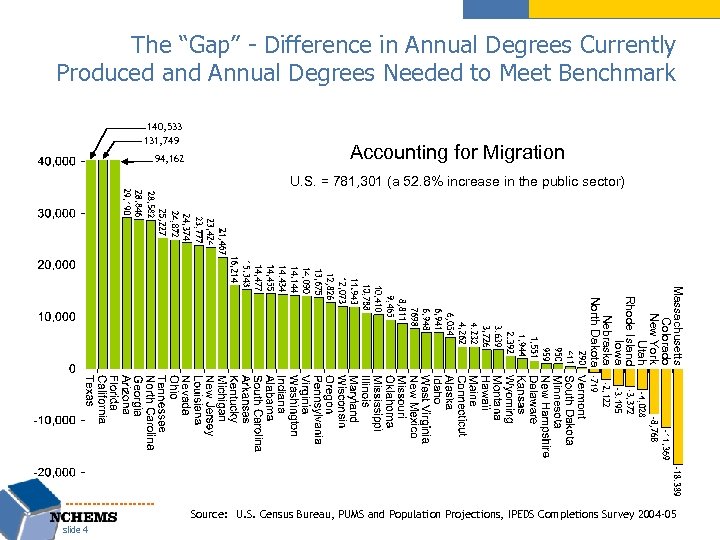 The “Gap” - Difference in Annual Degrees Currently Produced and Annual Degrees Needed to Meet Benchmark 140, 533 131, 749 94, 162 Accounting for Migration U. S. = 781, 301 (a 52. 8% increase in the public sector) Massachusetts Colorado New York Utah Rhode Island Iowa Nebraska North Dakota Source: U. S. Census Bureau, PUMS and Population Projections, IPEDS Completions Survey 2004 -05 slide 4
 THE FISCAL REALITIES slide 5
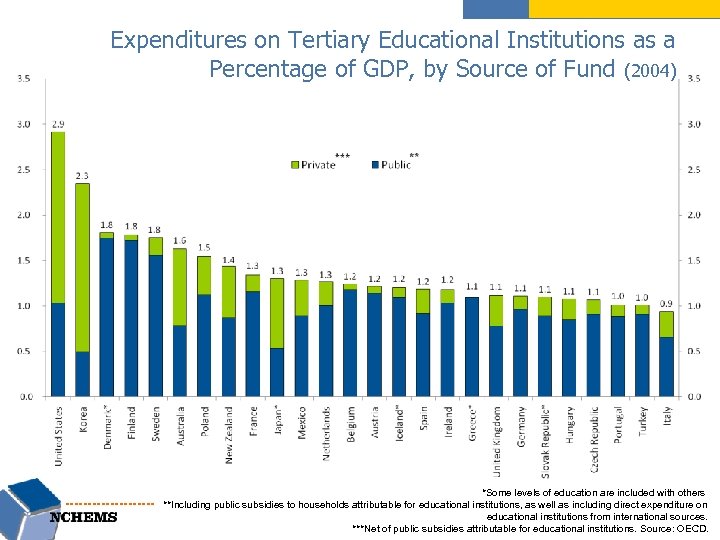 Expenditures on Tertiary Educational Institutions as a Percentage of GDP, by Source of Fund (2004) *Some levels of education are included with others **Including public subsidies to households attributable for educational institutions, as well as including direct expenditure on educational institutions from international sources. ***Net of public subsidies attributable for educational institutions. Source: OECD.
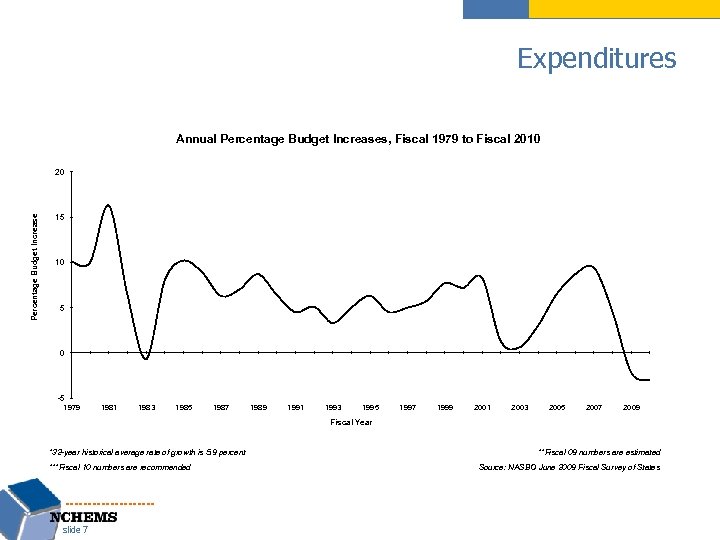 Expenditures Annual Percentage Budget Increases, Fiscal 1979 to Fiscal 2010 Annual % Budget Increase, Fiscal 1979 to Fiscal 2009 Percentage Budget Increase 20 15 10 5 0 -5 1979 1981 1983 1985 1987 1989 1991 1993 1995 1997 1999 2001 2003 2005 2007 2009 Fiscal Year *32 -year historical average rate of growth is 5. 9 percent ***Fiscal 10 numbers are recommended slide 7 **Fiscal 09 numbers are estimated Source: NASBO June 2009 Fiscal Survey of States
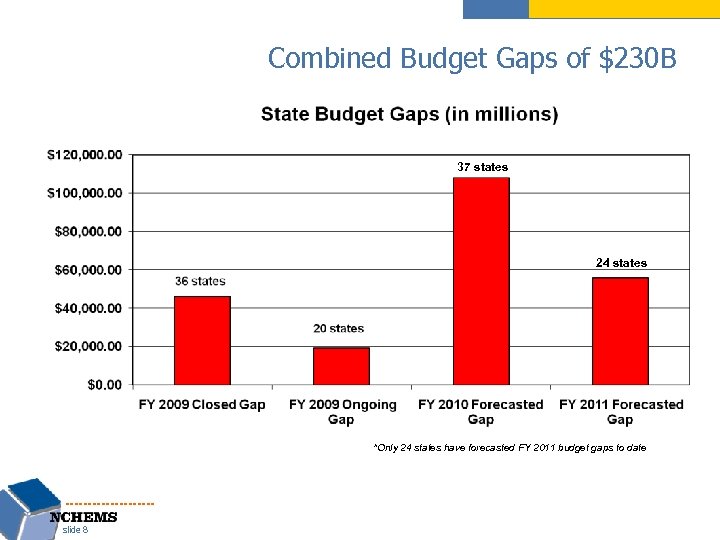 Combined Budget Gaps of $230 B 37 states 24 states *Only 24 states have forecasted FY 2011 budget gaps to date slide 8
 For most states – and for most public institutions – the stimulus package is not an answer. • But it could slow the impact • And it could buy enough time to adjust to substantially changed circumstances slide 9
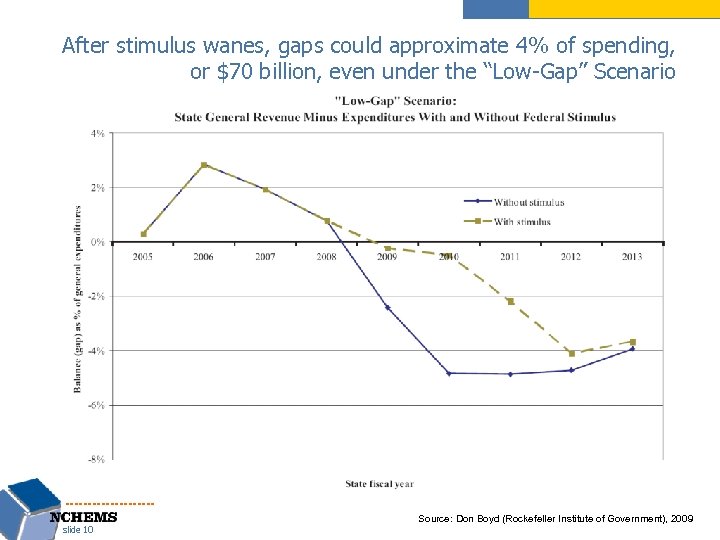 After stimulus wanes, gaps could approximate 4% of spending, or $70 billion, even under the “Low-Gap” Scenario Source: Don Boyd (Rockefeller Institute of Government), 2009 slide 10
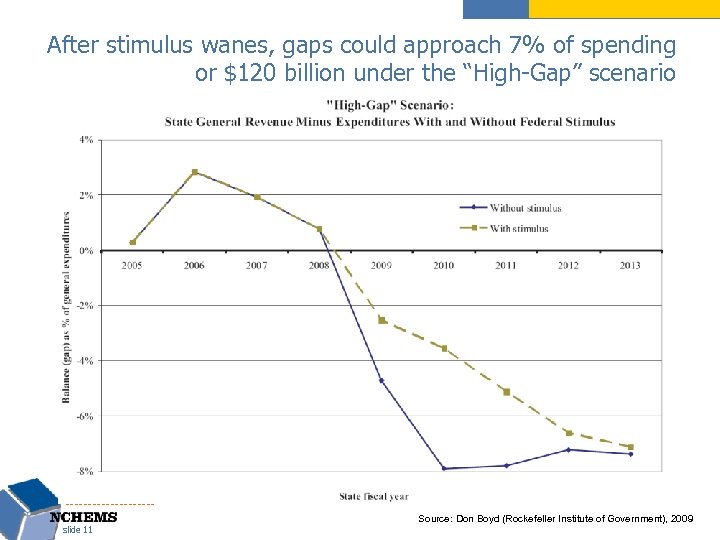 After stimulus wanes, gaps could approach 7% of spending or $120 billion under the “High-Gap” scenario Source: Don Boyd (Rockefeller Institute of Government), 2009 slide 11
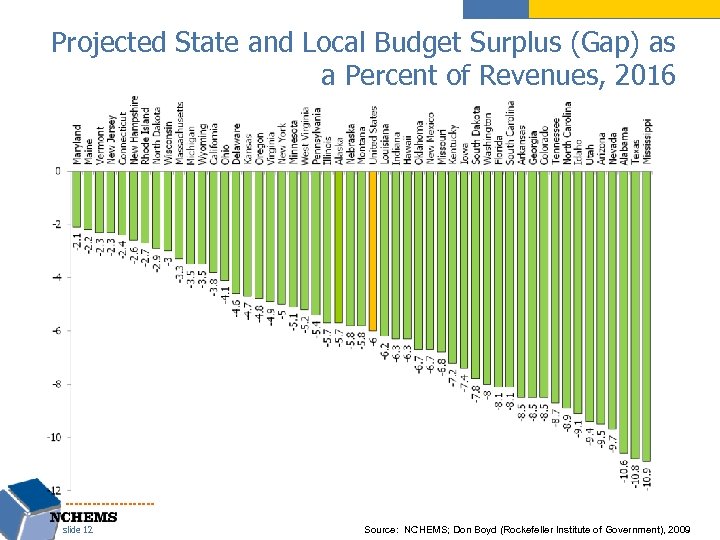 Projected State and Local Budget Surplus (Gap) as a Percent of Revenues, 2016 slide 12 Source: NCHEMS; Don Boyd (Rockefeller Institute of Government), 2009
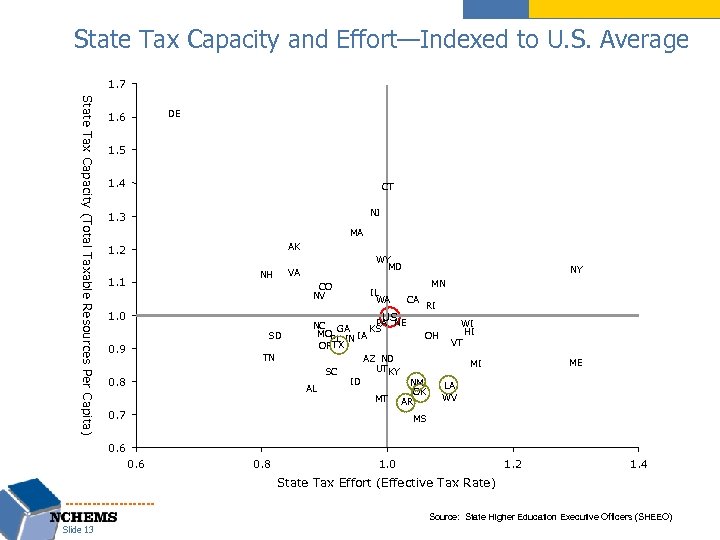 State Tax Capacity and Effort—Indexed to U. S. Average 1. 7 State Tax Capacity (Total Taxable Resources Per Capita) DE 1. 6 1. 5 1. 4 CT NJ 1. 3 MA AK 1. 2 VA NH 1. 1 WY MD CO NV 1. 0 IL WA CA US PA NE SD 0. 9 NC GA KS MO FL IN IA ORTX TN SC 0. 8 AL ID AZ ND UT KY MT 0. 7 NY MN RI OH WI HI VT ME MI NM OK AR LA WV MS 0. 6 0. 8 1. 0 1. 2 1. 4 State Tax Effort (Effective Tax Rate) Source: State Higher Education Executive Officers (SHEEO) Slide 13
 THE DEMOGRAPHIC REALITIES slide 14
 The big population growth will be in students of color. In the main these will be individuals of modest means. Therefore there are real limits as to how high tuition can go before price affects participation and completion. slide 15
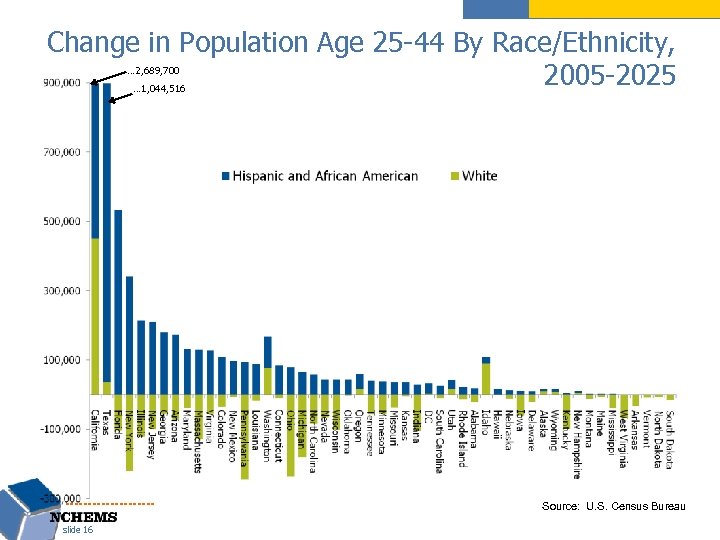 Change in Population Age 25 -44 By Race/Ethnicity, 2005 -2025 … 2, 689, 700 … 1, 044, 516 Source: U. S. Census Bureau slide 16
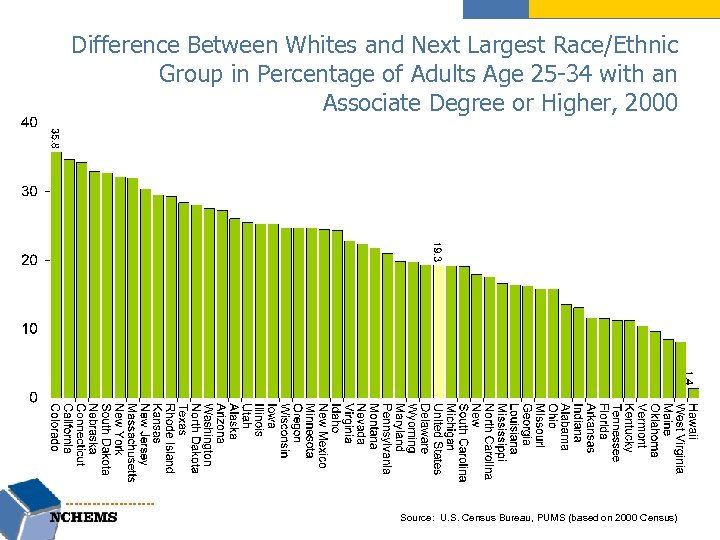 Difference Between Whites and Next Largest Race/Ethnic Group in Percentage of Adults Age 25 -34 with an Associate Degree or Higher, 2000 Source: U. S. Census Bureau, PUMS (based on 2000 Census)
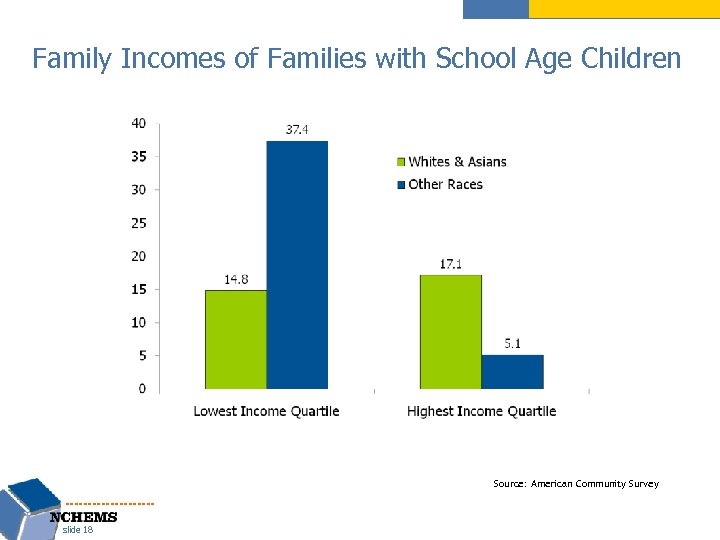 Family Incomes of Families with School Age Children Source: American Community Survey slide 18
 Expectations • Maintain access – serve an increasing number of students • Maintain affordability to both students and the state Invest stimulus funds in: • Developing more cost-effective ways of doing business • Paying for the transition slide 19
 Short-Term Actions • Reallocate faculty time to undergraduate courses and away from – Administrative and committee work and other activities for which release time is granted – Undersubscribed graduate programs that cannot be justified by regional labor market needs – Non-sponsored research • Collaborate with other institutions – share – Academic programs – Administrative services • Make sure that students are receiving all aid for which they’re eligible slide 20
 Longer Term Strategies – Mission Focus Refocus on the institutional mission – serving state and student needs rather than institutional aspirations – Eliminate small, non-core programs – close low-demand, highcost programs that aren’t distinguished and can’t be justified by labor market needs – Re-think institutional aid – focus on removing barriers to attendance rather than competing for students whose college participation is not in question slide 21
 Longer Term Strategies Make investments in more efficient administration and plant operations – Retrofit building for energy efficiency – Reengineer business processes – Renegotiate relationships with the state (invest in a Policy Audit with an eye toward restructuring state administrative and reporting requirements) slide 22
 Longer Term Strategies Invest in reengineering curricula and delivery methods – Restructure general education • Fewer options • More large enrollment courses • More courses that can be taught by faculty from multiple disciplines – Invest in course redesign – Tackle developmental education on a statewide basis • Common standards • Modularized • Technology enhanced slide 23