


 Скачать презентацию Higher Education Cost and Financial Aid Unraveling the
cd5a783597ed825a8692b787a0d50780.ppt
- Количество слайдов: 25
 Higher Education Cost and Financial Aid: Unraveling the Pieces Larry Warder Acting Chief Operating Officer Federal Student Aid
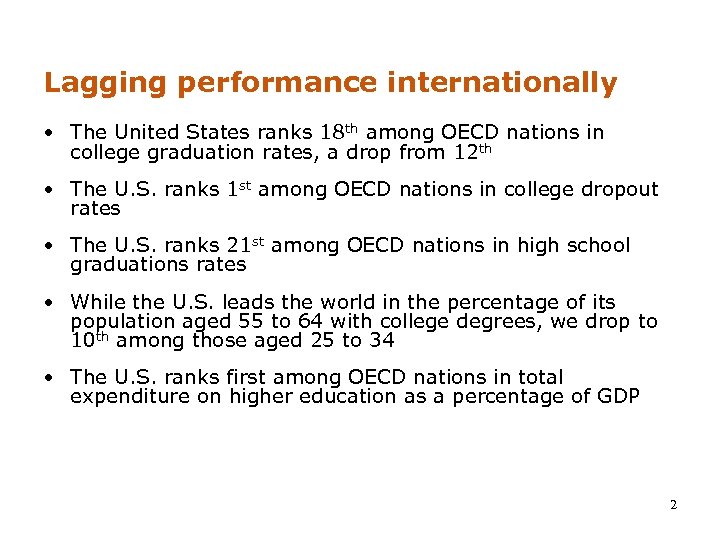 Lagging performance internationally • The United States ranks 18 th among OECD nations in college graduation rates, a drop from 12 th • The U. S. ranks 1 st among OECD nations in college dropout rates • The U. S. ranks 21 st among OECD nations in high school graduations rates • While the U. S. leads the world in the percentage of its population aged 55 to 64 with college degrees, we drop to 10 th among those aged 25 to 34 • The U. S. ranks first among OECD nations in total expenditure on higher education as a percentage of GDP 2
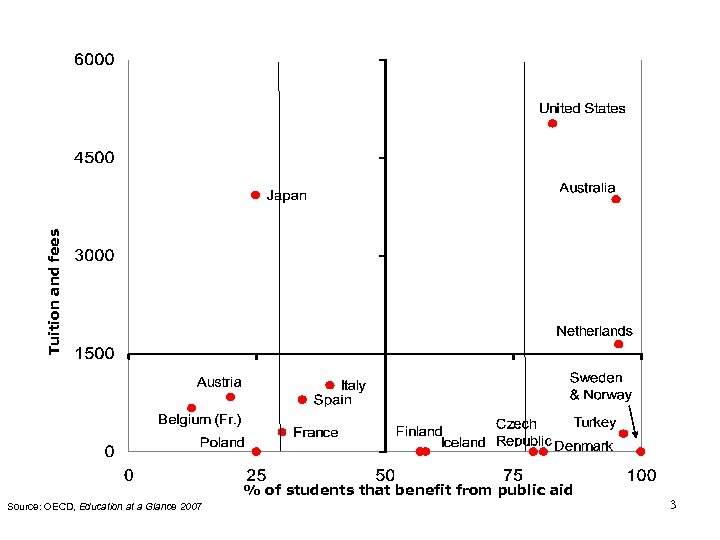 Tuition and fees % of students that benefit from public aid Source: OECD, Education at a Glance 2007 3
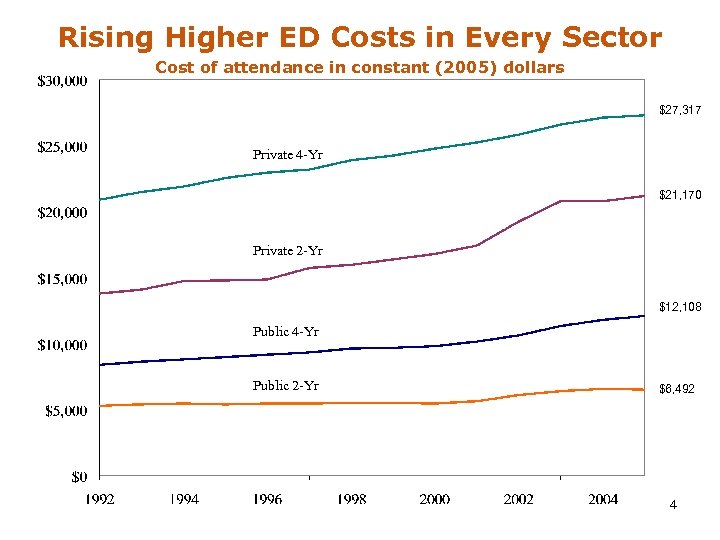 Rising Higher ED Costs in Every Sector Cost of attendance in constant (2005) dollars $27, 317 Private 4 -Yr $21, 170 Private 2 -Yr $12, 108 Public 4 -Yr Public 2 -Yr $6, 492 4
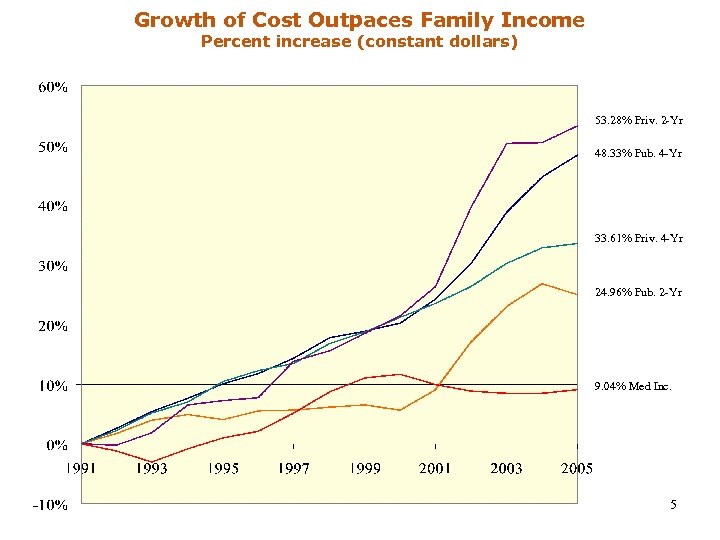 Growth of Cost Outpaces Family Income Percent increase (constant dollars) 53. 28% Priv. 2 -Yr 48. 33% Pub. 4 -Yr 33. 61% Priv. 4 -Yr 24. 96% Pub. 2 -Yr 9. 04% Med Inc. 5
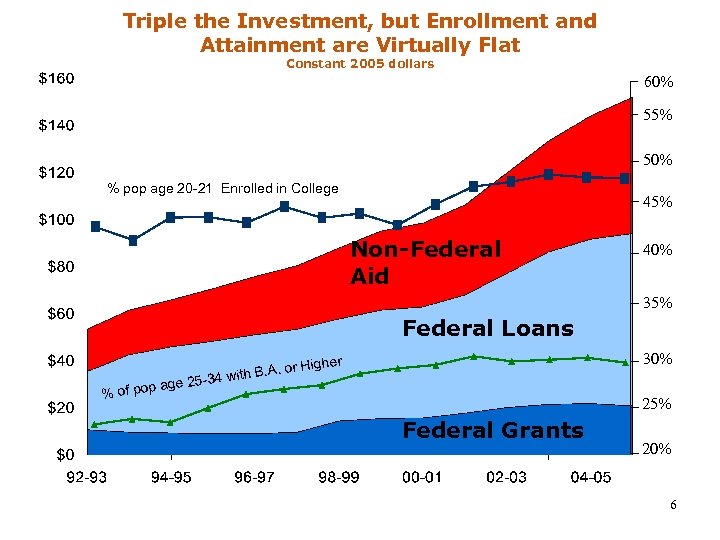 Triple the Investment, but Enrollment and Attainment are Virtually Flat Constant 2005 dollars 60% 55% 50% % pop age 20 -21 Enrolled in College 45% Non-Federal Aid 40% 35% Federal Loans 30% r Higher % of pop age h B. A. o 25 -34 wit 25% Federal Grants 20% 6
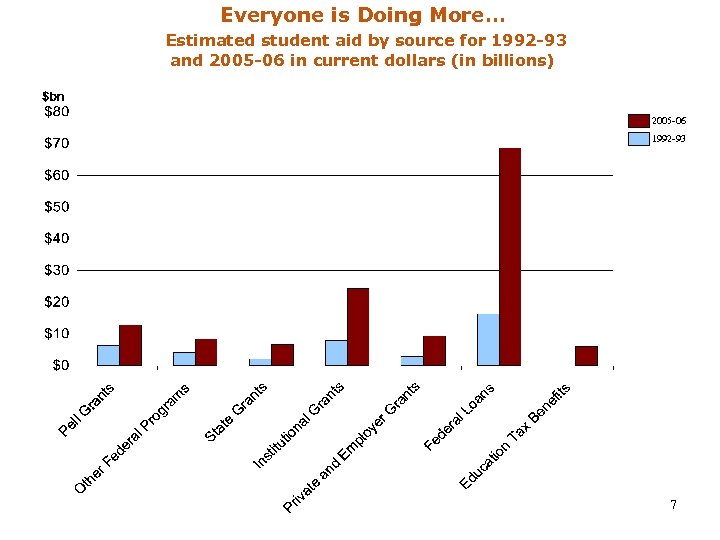 Everyone is Doing More… Estimated student aid by source for 1992 -93 and 2005 -06 in current dollars (in billions) 2005 -06 1992 -93 7
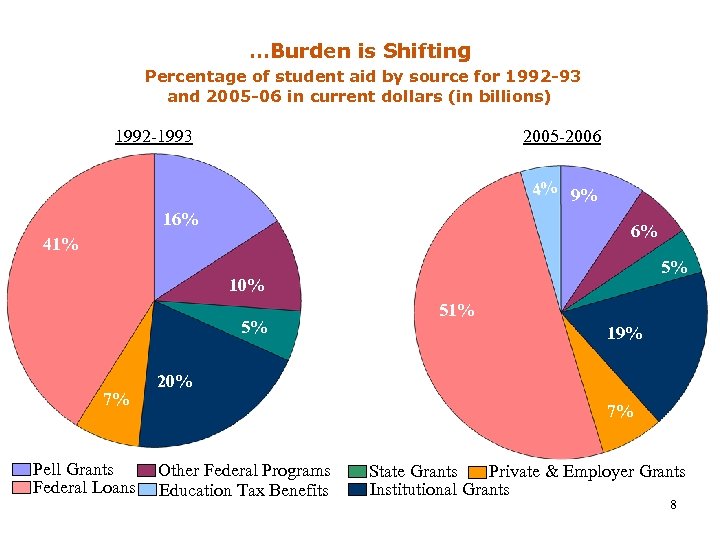 …Burden is Shifting Percentage of student aid by source for 1992 -93 and 2005 -06 in current dollars (in billions) 1992 -1993 2005 -2006 4% 9% 16% 6% 41% 5% 10% 5% 7% Pell Grants Federal Loans 51% 19% 20% 7% Other Federal Programs Education Tax Benefits State Grants Private & Employer Grants Institutional Grants 8
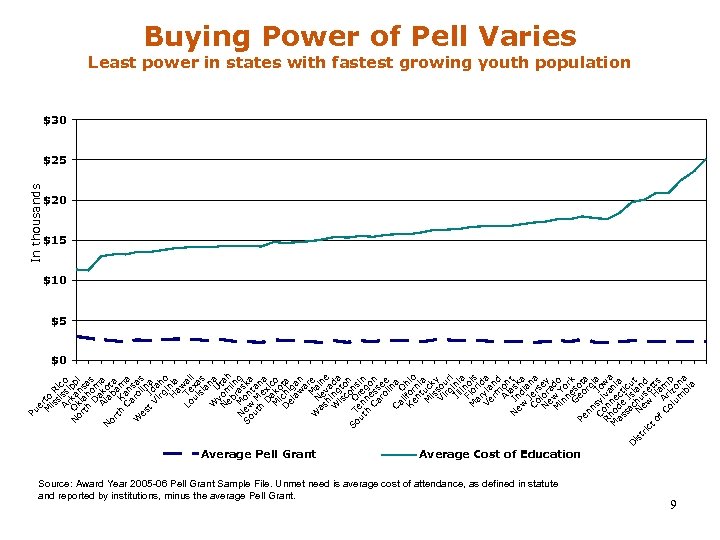 e M rto is R s i Ar iss co i N Ok ka pp or l ns i th ah a D om s Al ako a N ab ta or th K am Ca an a ro sa W li s es t Idna Vi a rg ho i H nia aw Lo Te ai ui xa i si s a W Una yo t N m ah eb i r n N Mo as g So ew n ka ut M ta h e na D xi M akoco D ich ta el ig aw an ar W N Ma e as e in h va e W ing da is to c n So T O ons en re in ut h ne go Ca ss n ro ee li Ca na l O Keifor hio nt nia M uc is ky Vi sou rg ri Ill ini in a M Flo ois ar rid Ve yla a rm nd Al on N In ask t ew d a ia Co. Jer na s N lor ey ew ad M in Yo o n r G eso k eo t Pe rg a nn i Co syl Io a Rh n va wa M o ne ni as de ct a sa I icu D c s t is N hu lan tr ew s d ic e t H tts of Ar am Co lu izo p m na bi a Pu In thousands Buying Power of Pell Varies Least power in states with fastest growing youth population $30 $25 $20 $15 $10 $5 $0 Average Pell Grant Average Cost of Education Source: Award Year 2005 -06 Pell Grant Sample File. Unmet need is average cost of attendance, as defined in statute and reported by institutions, minus the average Pell Grant. 9
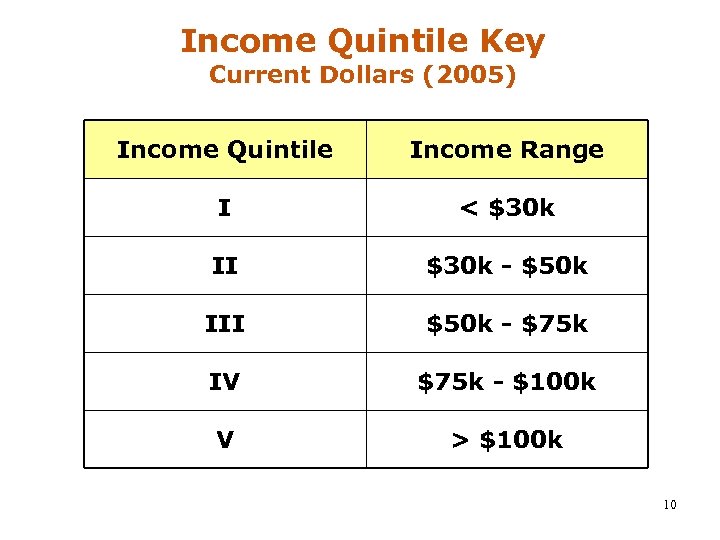 Income Quintile Key Current Dollars (2005) Income Quintile Income Range I < $30 k II $30 k - $50 k III $50 k - $75 k IV $75 k - $100 k V > $100 k 10
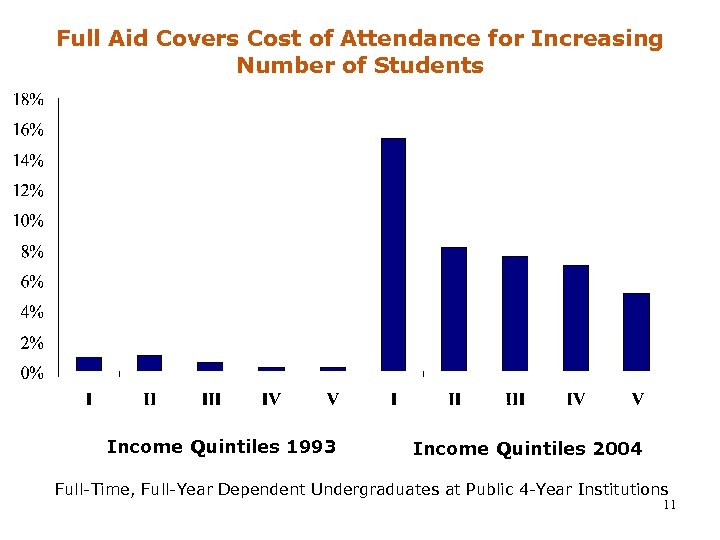 Full Aid Covers Cost of Attendance for Increasing Number of Students 1% Income Quintiles 1993 16. 3% Income Quintiles 2004 Full-Time, Full-Year Dependent Undergraduates at Public 4 -Year Institutions 11
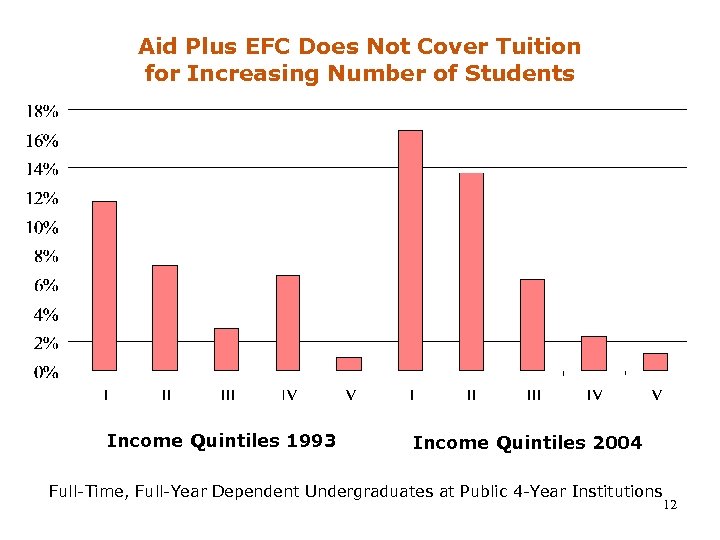 Aid Plus EFC Does Not Cover Tuition for Increasing Number of Students 1% Income Quintiles 1993 16. 3% Income Quintiles 2004 Full-Time, Full-Year Dependent Undergraduates at Public 4 -Year Institutions 12
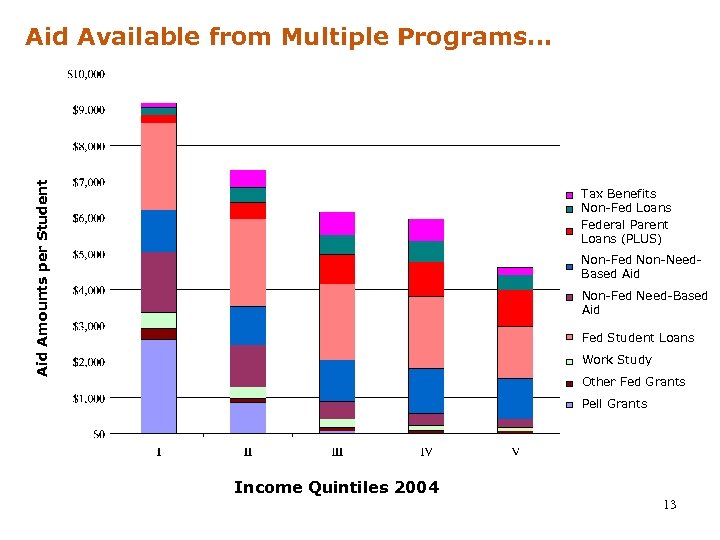 Aid Amounts per Student Aid Available from Multiple Programs… Tax Benefits Non-Fed Loans Federal Parent Loans (PLUS) Non-Fed Non-Need. Based Aid Non-Fed Need-Based Aid Fed Student Loans Work Study Other Fed Grants Pell Grants Income Quintiles 2004 13
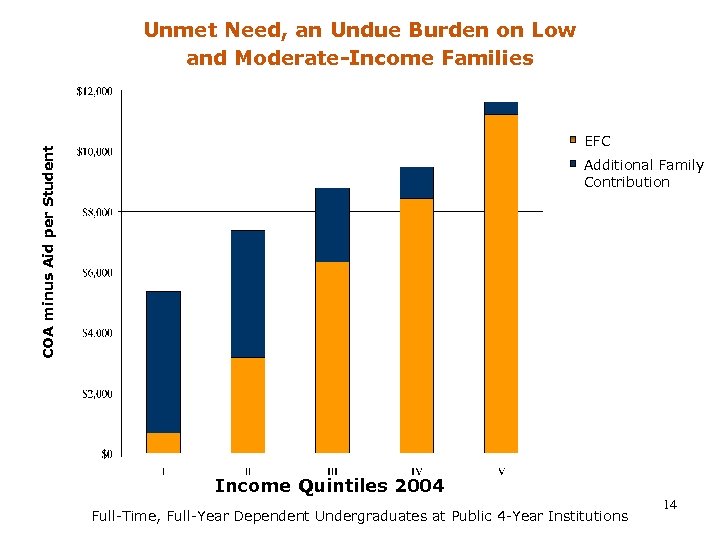 Unmet Need, an Undue Burden on Low and Moderate-Income Families COA minus Aid per Student EFC Additional Family Contribution Income Quintiles 2004 Full-Time, Full-Year Dependent Undergraduates at Public 4 -Year Institutions 14
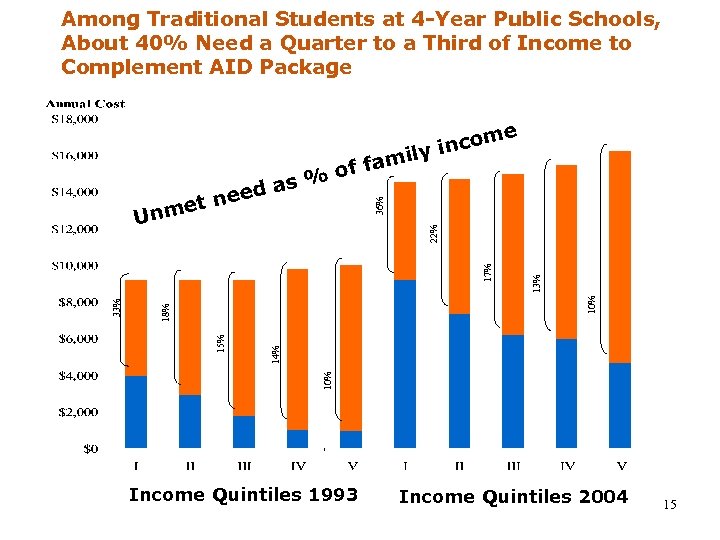 Among Traditional Students at 4 -Year Public Schools, About 40% Need a Quarter to a Third of Income to Complement AID Package e 10% 13% 10% 14% 15% 18% 33% 17% 22% 36% om y inc il f fam o s% a need t nme U Income Quintiles 1993 Income Quintiles 2004 15
 Under Secretary’s Listening Tours Real stories from students
 What is needed • Access to student financial aid needs to be simplified • Student financial aid needs fewer programs better targeting recipients • Student financial aid should facilitate attainment of a postsecondary credential 17
 The Department of Education’s Focus Areas: • Refocus the Federal investment toward simplified access and increased attainment • Enable more student access to a rigorous and aligned curriculum • Help more adults attain their first postsecondary credential • Engage families and students before high school to prepare for postsecondary education • Increase transparency and information available to students and families 18
 Enable more student access to a rigorous and aligned curriculum • Almost half of 17 -year-olds are not proficient enough in math for factory floor jobs • Two-thirds of college-bound high school graduates are not ready for college-level math and one-third for college-level English • Only 4% of low-income high school students complete a rigorous college preparatory curriculum 19
 Help more adults attain their first postsecondary credential • Greater numbers of adults are looking for ways to upgrade or expand their skills • Nearly 40% of today's postsecondary students are selfsupporting adults age 24 and up, almost half attend parttime, more than 1/3 work full-time and 27% have children • 44% of Americans don’t believe they have the education they need for the jobs they want • 32 states do not have enough young adults in the pipeline to replace college-educated, retiring Baby Boomers • There are 32 million adults who started, but did not complete, a college education 20
 Engage families and students before high school to prepare for and participate in postsecondary education • Research shows that most students have some posthigh school educational or job plans by the ninth grade • Nearly 2 million low and moderate-income students a year do not apply for federal financial aid • Financial obstacles will prevent over 400, 000 collegequalified students from attending a four-year college and nearly 170, 000 will attend no college at all • By age 24, 75% of students from the top-income bracket have earned a degree, while less than 9% of low-income students have earned one 21
 What has to happen outside the Federal government? • Aligning high school, college, and work expectations • Serving adults and other nontraditional students • Increasing need-based aid • Improving affordability, reducing costs, and increasing productivity • Supporting and emphasizing student learning outcomes 22
 TO DO: Institutional Leadership • Access – Redesign services to improve pathways to and within postsecondary education for all students • Affordability – Increase need-based aid – Develop strategies that reduce overall institutional cost 23
 TO DO: Institutional Leadership • Accountability – Create ownership at the institutional level for designing measures of student learning and achievement that are linked to mission and publicly communicate the results 24
 Conclusion • We've spent a year ensuring "buy-in" for the problem • We've identified the areas that can have the greatest impacts • We know what has to be done – by the Federal government and others • We're turning the spotlight towards solutions • And we're holding ourselves and the others who must accountable 25