


 Скачать презентацию High-voltage nanoimprint lithography of refractory metal films Dr
cdaeeb3dd527af2223a6a3e5132db104.ppt
- Количество слайдов: 8
 High-voltage nanoimprint lithography of refractory metal films Dr. John A. Dagata
 Benefits of nanoimprint lithography: Wafer-scale fabrication of micro/nanostructures Stamp – curable resist - thermal or laser energy source Advantages of incorporating an electric field: Induces a wide range of chemical reaction and mass transport mechanisms Beyond standard fab materials processing Functionalize organics localize nanoparticles oxidize metal films
![Technology • SPM oxidation of silicon [Appl. Phys. Lett. 56 2001 (1990)] • Electric](https://present5.com/presentation/cdaeeb3dd527af2223a6a3e5132db104/image-3.jpg "Technology • SPM oxidation of silicon [Appl. Phys. Lett. 56 2001 (1990)] • Electric") Technology • SPM oxidation of silicon [Appl. Phys. Lett. 56 2001 (1990)] • Electric field induces a water meniscus between the probe tip and substrate • Everything oxidizes above 108 V/m Major drawback is low throughput 500 nm 200 nm 100 nm
Technology • SPM oxidation of silicon [Appl. Phys. Lett. 56 2001 (1990)] • Electric field induces a water meniscus between the probe tip and substrate • Everything oxidizes above 108 V/m Major drawback is low throughput 500 nm 200 nm 100 nm
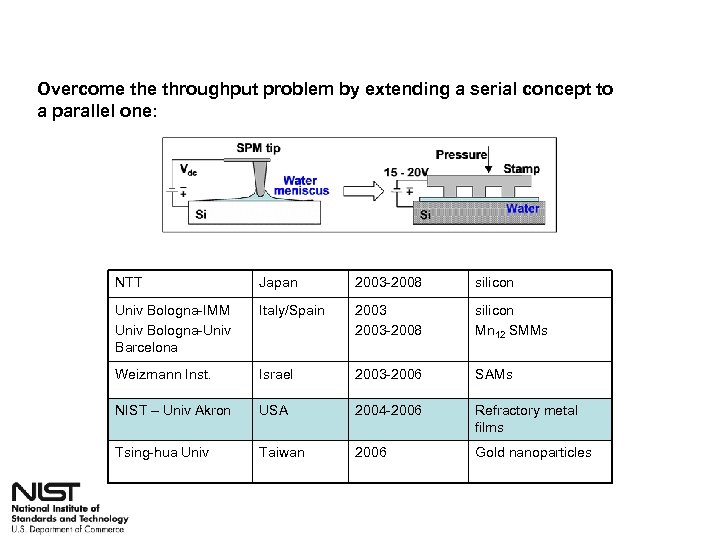 Overcome throughput problem by extending a serial concept to a parallel one: NTT Japan 2003 -2008 silicon Univ Bologna-IMM Univ Bologna-Univ Barcelona Italy/Spain 2003 -2008 silicon Mn 12 SMMs Weizmann Inst. Israel 2003 -2006 SAMs NIST – Univ Akron USA 2004 -2006 Refractory metal films Tsing-hua Univ Taiwan 2006 Gold nanoparticles
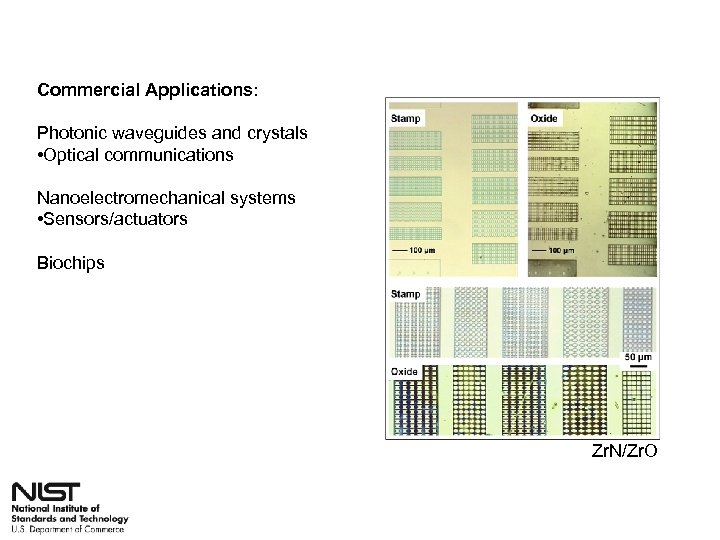 Commercial Applications: Photonic waveguides and crystals • Optical communications Nanoelectromechanical systems • Sensors/actuators Biochips Zr. N/Zr. O
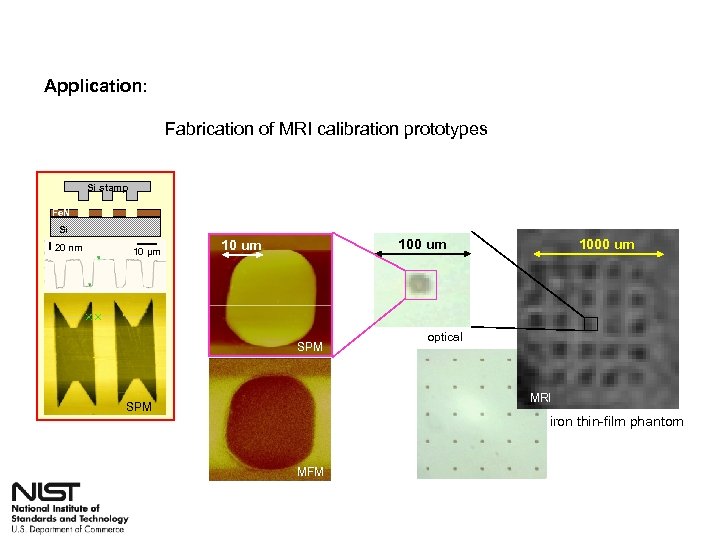 Application: Fabrication of MRI calibration prototypes Si stamp Fe. N Si 20 nm 10 µm 1000 um 10 um SPM optical MRI SPM iron thin-film phantom MFM
 Collaboration Opportunities: CRADA SBIR For technical details see the poster: High-voltage nanoimprint lithography of refractory metal films N. Farkas, et al.
 Contact Information: John A. Dagata Precision Engineering Division Manufacturing Engineering Laboratory National Institute of Standards & Technology 100 Bureau Drive MS 8212 Gaithersburg MD 20899 -8212 301 -975 -3597 tel. 301 -869 -0822 fax john. dagata@nist. gov