 Скачать презентацию High Skill Immigration Innovation Capturing The Best
dea95fc9ecb7651bd84c87da30cdcf47.ppt
- Количество слайдов: 19




High Skill Immigration & Innovation Capturing The Best & Brightest or Offshoring America’s Knowledge October 25, 2006 Technology, Innovation & America’s Primacy Council on Foreign Relations Ron Hira, Ph. D. , P. E. Assistant Professor of Public Policy Research Associate Rochester Institute of Technology Economic Policy Institute rhira@mail. rit. edu 757 -564 -0215 Ron Hira, RIT rhira@mail. rit. edu
Three Uses of High Skill Guest-worker Visas • Brain Capture 1. Skilled workers use non-immigrant guestworker programs as a bridge to immigration • Temporary Labor Mobility – Driven by Offshoring 2. Knowledge transfer programs shift tasks to offshore locations 3. Lower cost foreign labor for service delivery on-site to US clients 2 Ron Hira, RIT rhira@mail. rit. edu
H-1 B Visa • “Specialty” Occupations ØRequires Bachelors degree or equivalent experience ØVisa stay up to 6 years Ø~400, 000 H-1 B holders in US • Protections for US Workers ØAnnual quota for new petitions – o 65 k + 20 k (MS or Ph. D from US Univs) + exemptions ØWage parity – Largely ineffective 3 Ron Hira, RIT rhira@mail. rit. edu
H-1 B Visa • Misreporting by Press ØGetting an H-1 B “requires an employer to attest that it can't find a U. S. worker “ - A 1 story by June Kronholz, Wall Street Journal, June 27, 2006 • Bills in Congress to Increase Quotas ØMajor lobbying by tech industry o Bill Gates, Scott Mc. Nealy, etc. ØSupport from President Bush o Feb 06 speech to 3 M 4 Ron Hira, RIT rhira@mail. rit. edu
L-1 Visa • Intra-company Transfer Ø L-1 A - managers and executives 7 years Ø L-1 B - “specialized” skills - 5 years Ø 65, 000 L-1 s issued in FY 05 • 9 of Top 10 Petitioning Companies Specialize in Computer & IT Offshore Outsourcing from India Ø Tata Consultancy, Cognizant Technology Solutions, Wipro Technologies, Hewlett Packard, I-Flex Solutions, IBM Global Services, Information Systems Technology, Syntel Incorporated, and Satyam Computer Services 5 Ron Hira, RIT rhira@mail. rit. edu
L-1 Visa • Share of L-1 B Petitions for Workers from India Up Significantly Ø 2002: India 10% Ø 2005: India 48% • Since 2004 L-1 B > L-1 A • No Protections for US Workers ØRecent law limits use by “body shoppers” 6 Ron Hira, RIT rhira@mail. rit. edu
Brain Capture Scenario: Bridge to Immigration • Foreign Student Comes to US for Graduate Studies • Foreign Student Wants to Stay in US ØCompany applies for H-1 B work visa ØCompany applies for Green Card o 3 -5 year wait time traditionally o Quota inadequate so much longer backlog 7 Ron Hira, RIT rhira@mail. rit. edu
Knowledge Transfer Scenario • Company Wants to Transfer Specific Tasks from US to Overseas Operations ØBrings foreign workers into US (generally on L-1 visa) ØUS worker trains foreign worker ØForeign worker returns to country of origin and task migrates with him ØUS worker laid off or re-assigned 8 Ron Hira, RIT rhira@mail. rit. edu
On-site Offshore Outsourcing Scenario • Company Brings in Lower-Cost High-Skill Worker to Deliver Services On-Site in US ØH-1 B or L-1 visa used ØAdvantages o Lower labor cost o Better management of offshore team o Training ØBusiness model for most major IT offshore outsourcing firms o Cognizant, Infosys, Tata Consultancy, Wipro, etc. 9 Ron Hira, RIT rhira@mail. rit. edu
Visas Vital for On-site OO Firms • Firms Report in SEC Filings ØChanges in US visa laws are a significant risk ØVast majority of workers in US are on H-1 B or L-1 visas o Infosys, Cognizant, Wipro, Satyam • Visa Application Fees Large Enough to Affect P&L Reporting to Investors ØE. g. , Patni, Infosys 10 Ron Hira, RIT rhira@mail. rit. edu
On-site OO Business Model Tata has about 8, 000 employees in North America, primarily in the U. S. , and about 7, 200 of them are here on some kind of visa. Among its U. S. workers, about 65% have H-1 Bs, and the remainder hold L-1 visas, said spokesman Victor Chayet. He added that many of Tata's U. S. -based employees are graduates of universities in India and that only a handful ever seek permanent residency here. The company doesn't discourage workers from applying for green cards, but its service delivery model is based on the ability to move people from country to country as needed. "Keeping that fluid workforce is to our benefit, " Chayet said. - Patrick Thibodeau, “H-1 B backers want bigger increase in cap, ” Computer. World, November 29, 2004 Ron Hira, RIT rhira@mail. rit. edu 11
On-site OO Business Model “Our wage per employee is 20 -25% lesser than US wage for a similar employee. Typically, for a TCS employee with five years experience, the annual cost to the company is $60, 000 -70, 000, while a local American employee might cost $80, 000 -100, 000. This (labour arbitrage) is a fact of doing work onsite. It's a fact that Indian IT companies have an advantage here and there's nothing wrong in that. ” - Phiroz Vandrevala, Executive VP, Tata Consultancy Services, quoted in, Shelley Singh, “US Visas are not a TCS-specific issue, “ Business World, June 30, 2003. 12 Ron Hira, RIT rhira@mail. rit. edu
H-1 B Prevailing Wages Says Sanyogita Mukerjee (name changed on request), who works at a top-five Indian software company with a contract to develop complex software systems at International Monetary Fund in Washington, "I get an annual cost-tocompany salary of $46, 800 and a net salary of $36, 300, despite being in the software industry for more than five years. An American with a similar experience gets around $80, 000 a year. " Mukerjee is not alone. Her company has H 1 -B and L 1 employees in New York, Chicago, Atlanta, Boston and San Francisco working with some of the best brands in the world, and almost everyone has a similar grouse. She said her company told her she is being paid at prevailing wages. - Sachin Kalbag, “H-1 B visa holders get paid less than Americans: Report, ” DNA India, Sept. 8, 2006 13 Ron Hira, RIT rhira@mail. rit. edu
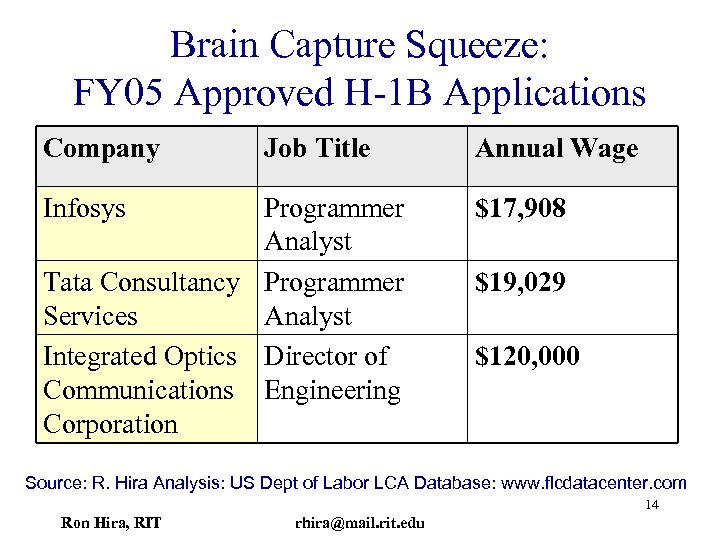
Brain Capture Squeeze: FY 05 Approved H-1 B Applications Company Job Title Infosys Programmer Analyst Tata Consultancy Programmer Services Analyst Integrated Optics Director of Communications Engineering Corporation Annual Wage $17, 908 $19, 029 $120, 000 Source: R. Hira Analysis: US Dept of Labor LCA Database: www. flcdatacenter. com 14 Ron Hira, RIT rhira@mail. rit. edu
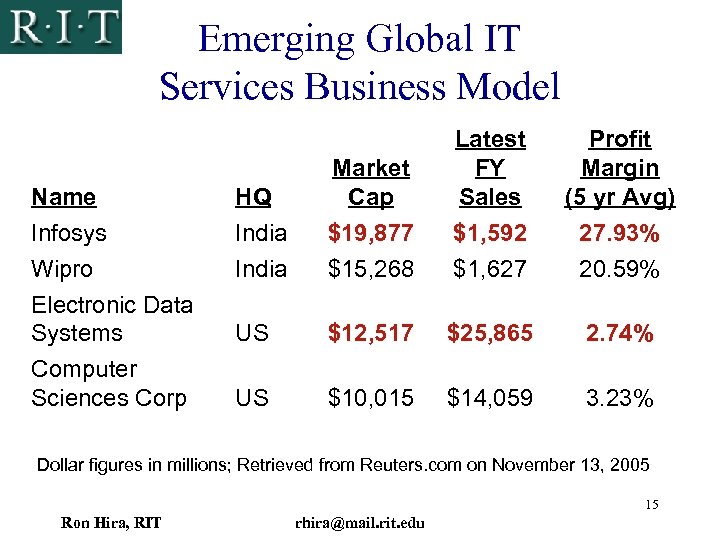
Emerging Global IT Services Business Model Latest FY Sales $1, 592 Profit Margin (5 yr Avg) 27. 93% Name Infosys HQ India Market Cap $19, 877 Wipro India $15, 268 $1, 627 20. 59% US $12, 517 $25, 865 2. 74% US $10, 015 $14, 059 3. 23% Electronic Data Systems Computer Sciences Corp Dollar figures in millions; Retrieved from Reuters. com on November 13, 2005 15 Ron Hira, RIT rhira@mail. rit. edu
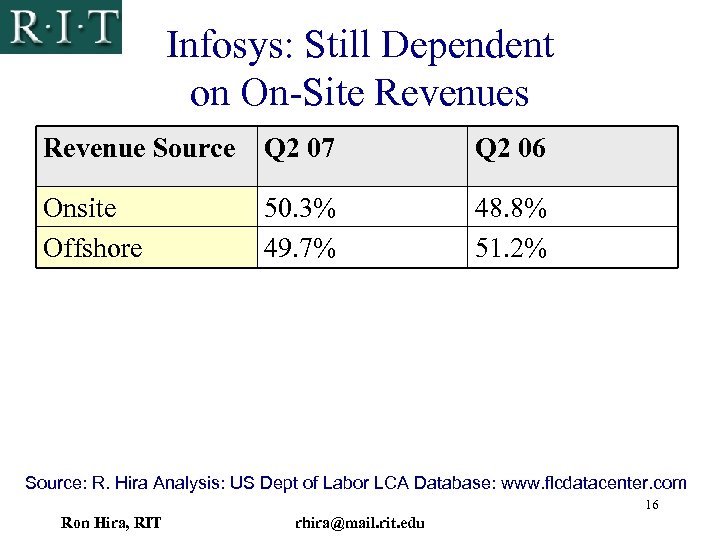
Infosys: Still Dependent on On-Site Revenues Revenue Source Q 2 07 Q 2 06 Onsite Offshore 50. 3% 49. 7% 48. 8% 51. 2% Source: R. Hira Analysis: US Dept of Labor LCA Database: www. flcdatacenter. com 16 Ron Hira, RIT rhira@mail. rit. edu
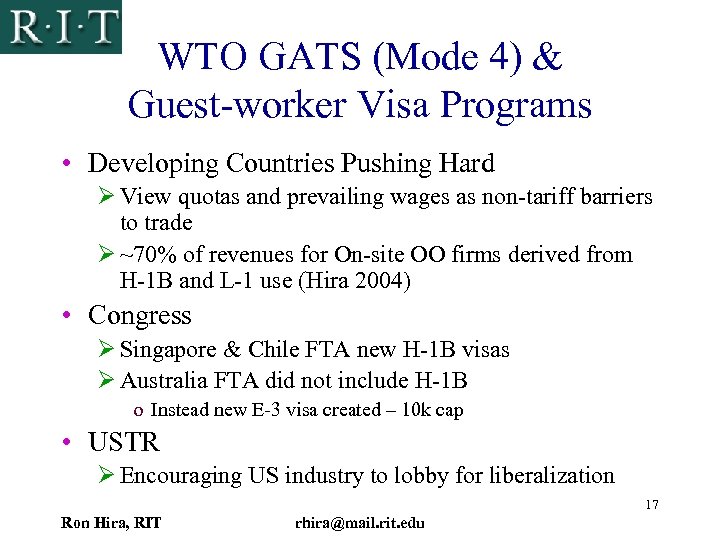
WTO GATS (Mode 4) & Guest-worker Visa Programs • Developing Countries Pushing Hard Ø View quotas and prevailing wages as non-tariff barriers to trade Ø ~70% of revenues for On-site OO firms derived from H-1 B and L-1 use (Hira 2004) • Congress Ø Singapore & Chile FTA new H-1 B visas Ø Australia FTA did not include H-1 B o Instead new E-3 visa created – 10 k cap • USTR Ø Encouraging US industry to lobby for liberalization 17 Ron Hira, RIT rhira@mail. rit. edu
Innovation Implications • Knowledge Transfer a Body Contact Sport ØLearning on most advanced equipment and most sophisticated customer market ØIndian H-1 Bs with US experience are sought after in Indian job market ØAccelerate offshore transfer speed • Brain Capture Squeezed Out ØIncreasing share of H-1 B cap being used by Onsite OO ØBetter job opportunities back home 18 Ron Hira, RIT rhira@mail. rit. edu
Innovation Implications • Impact on US Workers and Potential US Workers Ø Direct competition for jobs that must be done in US Ø Shift into non-H-1 B occupations • US National Innovation System Ø Accumulation of knowledge goes to foreign workers o National capacity to innovate Ø Loss of spillovers – o e. g. , next generation of entrepreneurs Ø Creating competitors 19 Ron Hira, RIT rhira@mail. rit. edu
Скачать презентацию High Skill Immigration Innovation Capturing The Best
dea95fc9ecb7651bd84c87da30cdcf47.ppt