


 Скачать презентацию High resolution mass spectrometry for nontargeted environmental exposomics
95a56e0d5b9498286c38f2774ef34259.ppt
- Количество слайдов: 28
 High resolution mass spectrometry for nontargeted environmental exposomics P. Lee Ferguson, Gordon J. Getzinger, Bernadette Vogler, and Heather M. Stapleton Nicholas School of the Environment, Duke University, Durham, NC lee. ferguson@duke. edu
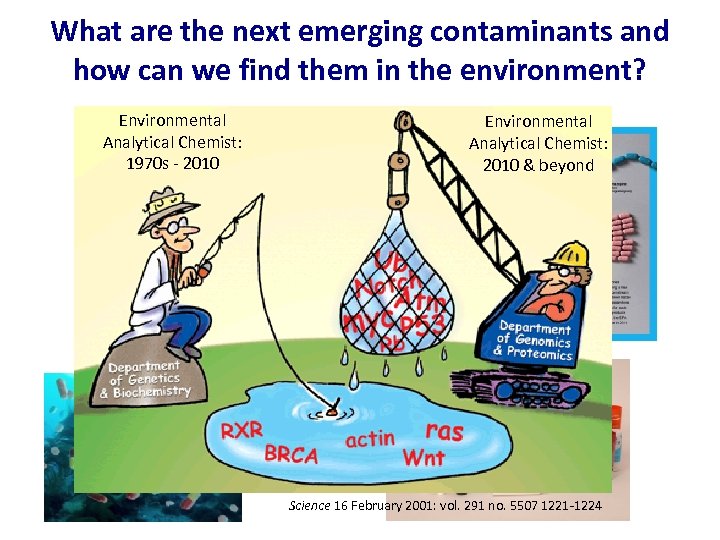 What are the next emerging contaminants and how can we find them in the environment? Environmental Analytical Chemist: 1970 s - 2010 Environmental Analytical Chemist: 2010 & beyond Science 16 February 2001: vol. 291 no. 5507 1221 -1224
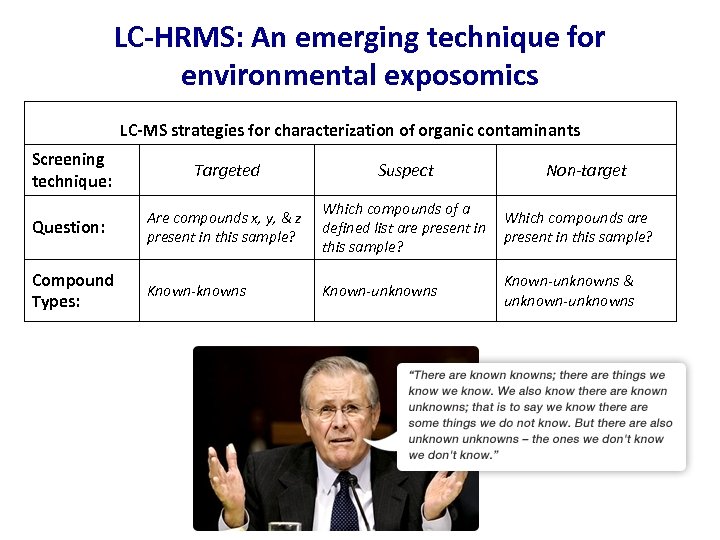 LC-HRMS: An emerging technique for environmental exposomics LC-MS strategies for characterization of organic contaminants Screening technique: Targeted Suspect Question: Are compounds x, y, & z present in this sample? Which compounds of a defined list are present in this sample? Which compounds are present in this sample? Compound Types: Known-knowns Known-unknowns & unknown-unknowns Non-target
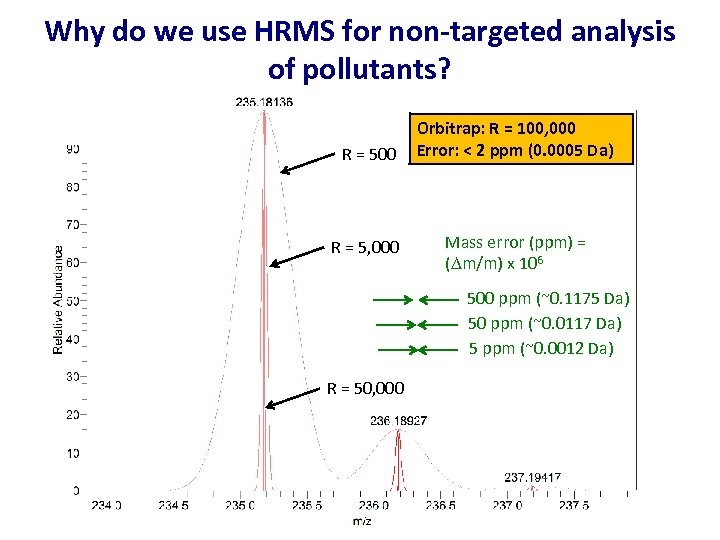 Why do we use HRMS for non-targeted analysis of pollutants? R = 500 R = 5, 000 Orbitrap: R = 100, 000 Error: < 2 ppm (0. 0005 Da) Mass error (ppm) = (Dm/m) x 106 500 ppm (~0. 1175 Da) 50 ppm (~0. 0117 Da) 5 ppm (~0. 0012 Da) R = 50, 000
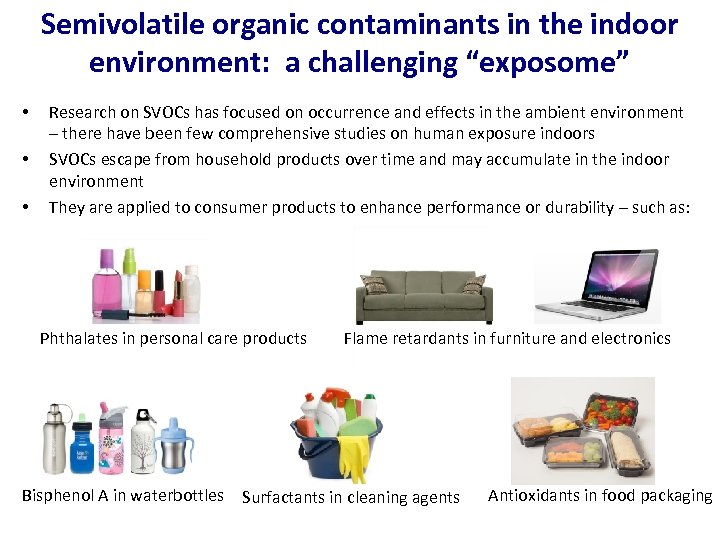 Semivolatile organic contaminants in the indoor environment: a challenging “exposome” • • • Research on SVOCs has focused on occurrence and effects in the ambient environment – there have been few comprehensive studies on human exposure indoors SVOCs escape from household products over time and may accumulate in the indoor environment They are applied to consumer products to enhance performance or durability – such as: Phthalates in personal care products Bisphenol A in waterbottles Flame retardants in furniture and electronics Surfactants in cleaning agents Antioxidants in food packaging
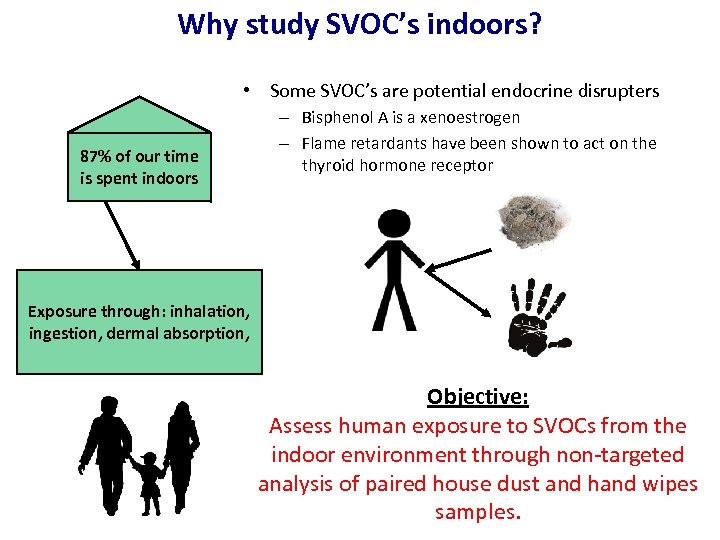 Why study SVOC’s indoors? • Some SVOC’s are potential endocrine disrupters 87% of our time is spent indoors – Bisphenol A is a xenoestrogen – Flame retardants have been shown to act on the thyroid hormone receptor Exposure through: inhalation, ingestion, dermal absorption, Objective: Assess human exposure to SVOCs from the indoor environment through non-targeted analysis of paired house dust and hand wipes samples.
 Analytical strategy for dust and handwipe samples • Most indoor exposure analysis has applied gas chromatography mass spectrometry (focus on nonpolar organic contaminants) • Liquid chromatography coupled with high resolution mass spectrometry can be used to characterize (semi)polar organic contaminants within indoor environments. • Non-targeted data analytics allows de novo identificatio, prioritized by compounds with highest exposure potential. • This approach complements more targeted, quantitative analysis of SVOCs by LC-MS/MS or GC-MS approaches.
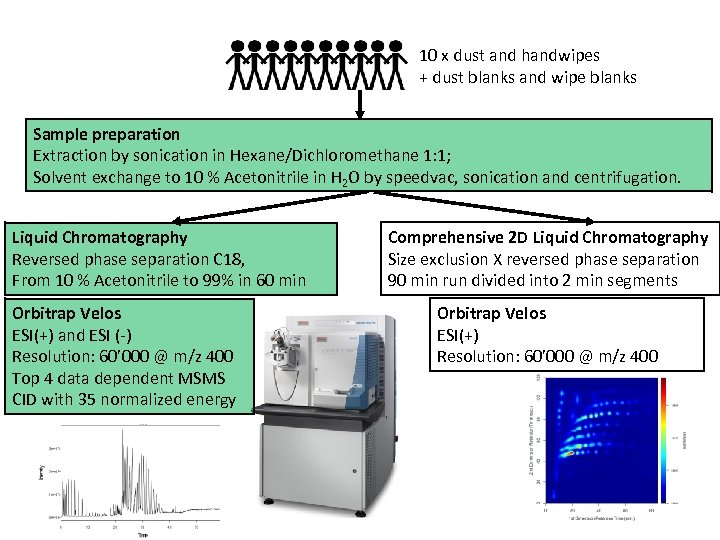 10 x dust and handwipes + dust blanks and wipe blanks Sample preparation Extraction by sonication in Hexane/Dichloromethane 1: 1; Solvent exchange to 10 % Acetonitrile in H 2 O by speedvac, sonication and centrifugation. Liquid Chromatography Reversed phase separation C 18, From 10 % Acetonitrile to 99% in 60 min Orbitrap Velos ESI(+) and ESI (-) Resolution: 60’ 000 @ m/z 400 Top 4 data dependent MSMS CID with 35 normalized energy Comprehensive 2 D Liquid Chromatography Size exclusion X reversed phase separation 90 min run divided into 2 min segments Orbitrap Velos ESI(+) Resolution: 60’ 000 @ m/z 400
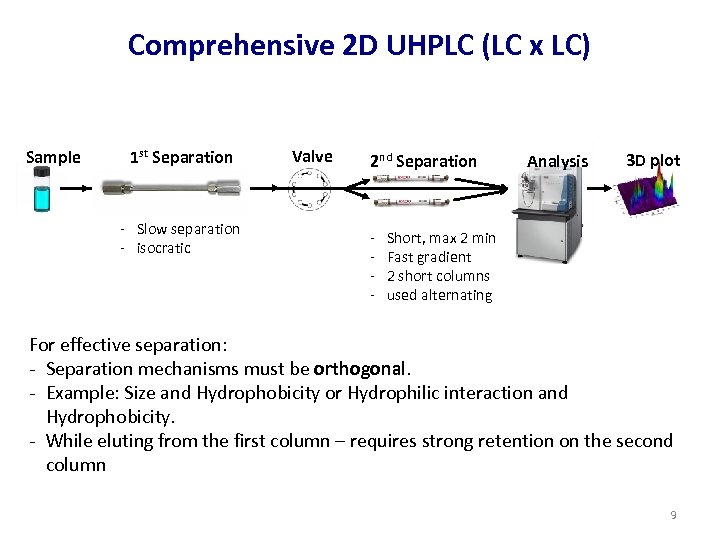 Comprehensive 2 D UHPLC (LC x LC) Sample 1 st Separation - Slow separation - isocratic Valve 2 nd Separation - Analysis 3 D plot Short, max 2 min Fast gradient 2 short columns used alternating For effective separation: - Separation mechanisms must be orthogonal. - Example: Size and Hydrophobicity or Hydrophilic interaction and Hydrophobicity. - While eluting from the first column – requires strong retention on the second column 9
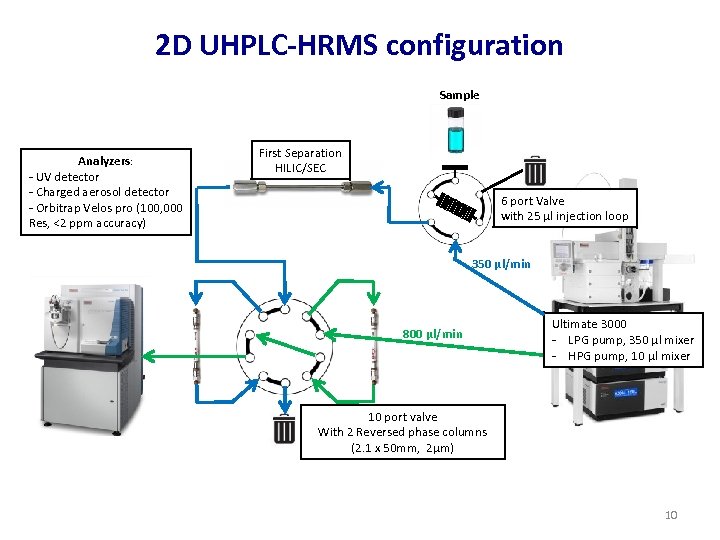 2 D UHPLC-HRMS configuration Sample Analyzers: - UV detector - Charged aerosol detector - Orbitrap Velos pro (100, 000 Res, <2 ppm accuracy) First Separation HILIC/SEC 6 port Valve with 25 µl injection loop 350 µl/min 800 µl/min Ultimate 3000 - LPG pump, 350 µl mixer - HPG pump, 10 µl mixer 10 port valve With 2 Reversed phase columns (2. 1 x 50 mm, 2µm) 10
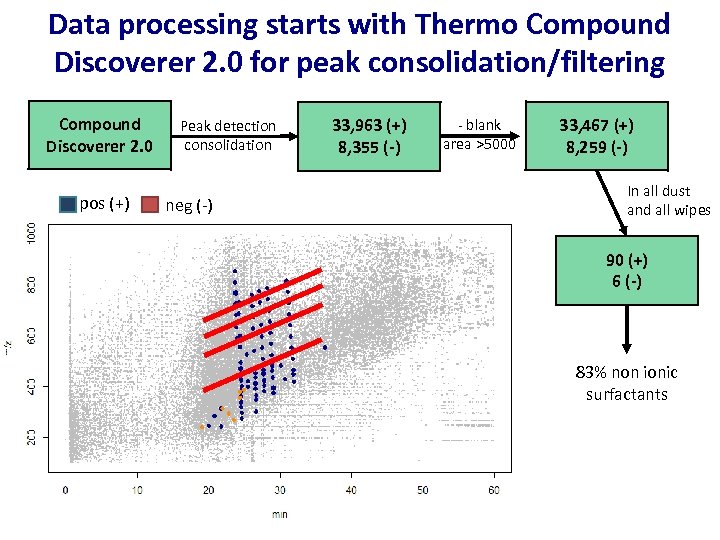 Data processing starts with Thermo Compound Discoverer 2. 0 for peak consolidation/filtering Compound Discoverer 2. 0 pos (+) Peak detection consolidation neg (-) 33, 963 (+) 8, 355 (-) - blank area >5000 33, 467 (+) 8, 259 (-) In all dust and all wipes 90 (+) 6 (-) 83% non ionic surfactants
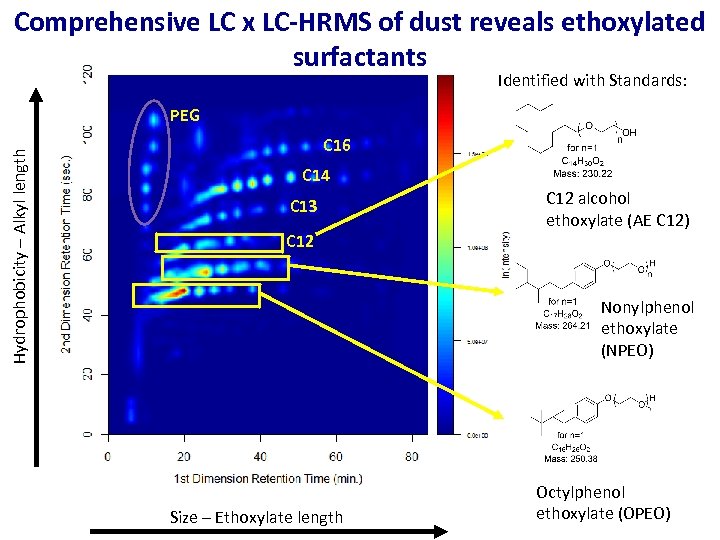 Comprehensive LC x LC-HRMS of dust reveals ethoxylated surfactants Identified with Standards: Hydrophobicity – Alkyl length PEG C 16 C 14 C 13 C 12 alcohol ethoxylate (AE C 12) Nonylphenol ethoxylate (NPEO) Size – Ethoxylate length Octylphenol ethoxylate (OPEO)
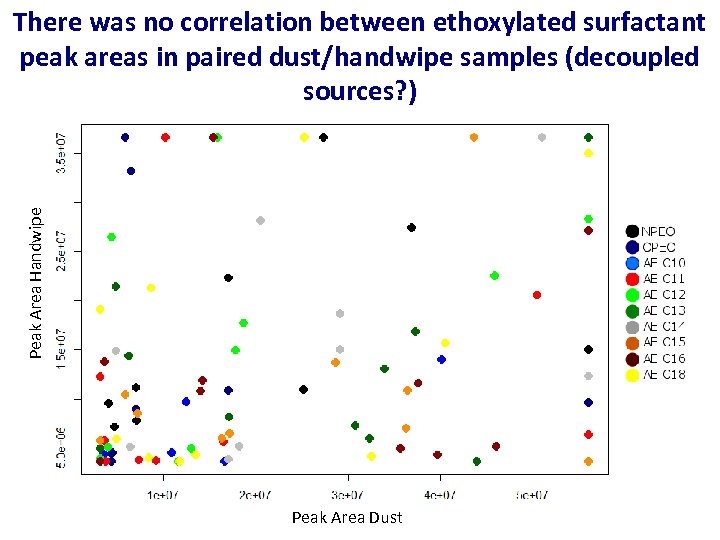 Peak Area Handwipe There was no correlation between ethoxylated surfactant peak areas in paired dust/handwipe samples (decoupled sources? ) Peak Area Dust
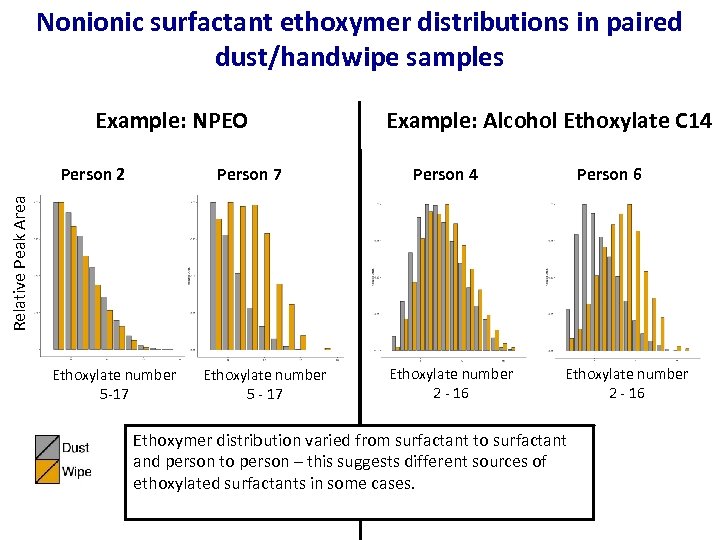 Nonionic surfactant ethoxymer distributions in paired dust/handwipe samples Example: NPEO Person 7 Person 4 Person 6 Relative Peak Area Person 2 Example: Alcohol Ethoxylate C 14 Ethoxylate number 5 -17 Ethoxylate number 5 - 17 Ethoxylate number 2 - 16 Ethoxymer distribution varied from surfactant to surfactant and person to person – this suggests different sources of ethoxylated surfactants in some cases.
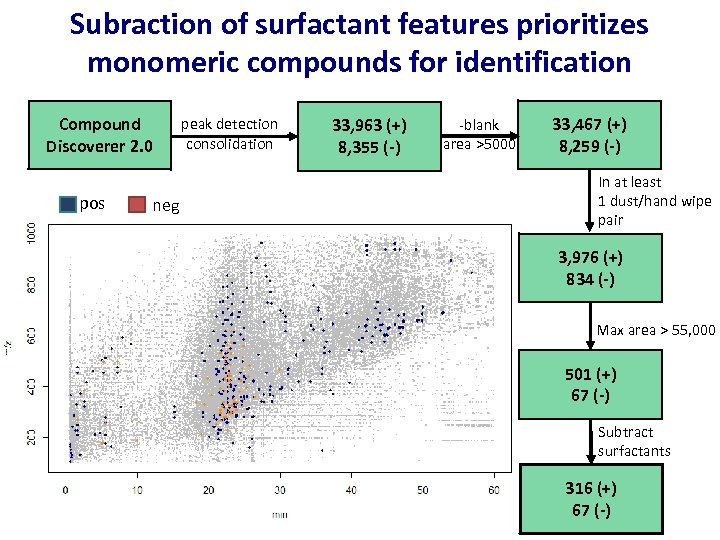 Subraction of surfactant features prioritizes monomeric compounds for identification Compound Discoverer 2. 0 pos neg peak detection consolidation 33, 963 (+) 8, 355 (-) -blank area >5000 33, 467 (+) 8, 259 (-) In at least 1 dust/hand wipe pair 3, 976 (+) 834 (-) Max area > 55, 000 501 (+) 67 (-) Subtract surfactants 316 (+) 67 (-)
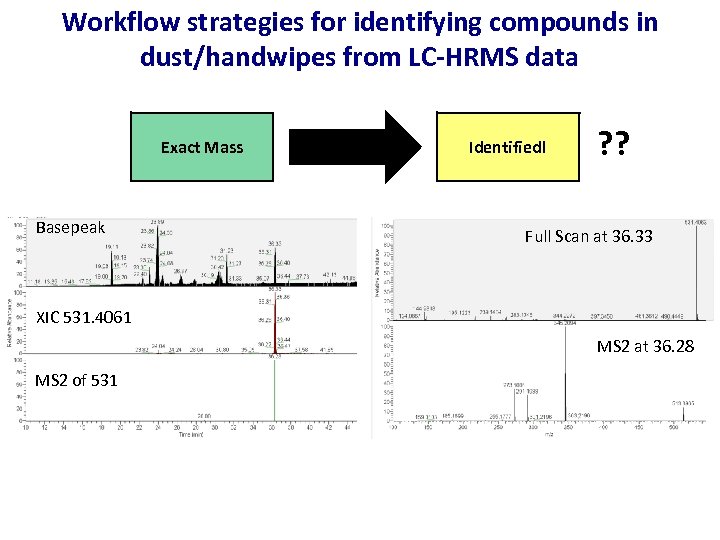 Workflow strategies for identifying compounds in dust/handwipes from LC-HRMS data Exact Mass Basepeak Identified! ? ? Full Scan at 36. 33 XIC 531. 4061 MS 2 at 36. 28 MS 2 of 531
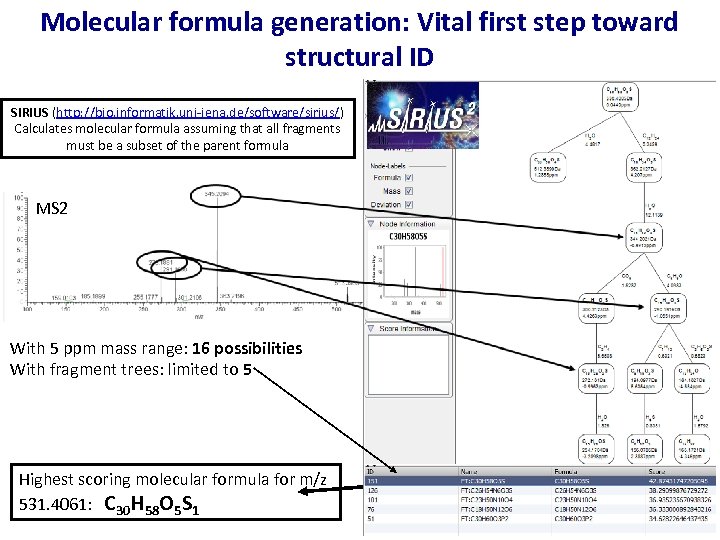 Molecular formula generation: Vital first step toward structural ID SIRIUS (http: //bio. informatik. uni-jena. de/software/sirius/) Calculates molecular formula assuming that all fragments must be a subset of the parent formula MS 2 With 5 ppm mass range: 16 possibilities With fragment trees: limited to 5 Highest scoring molecular formula for m/z 531. 4061: C 30 H 58 O 5 S 1
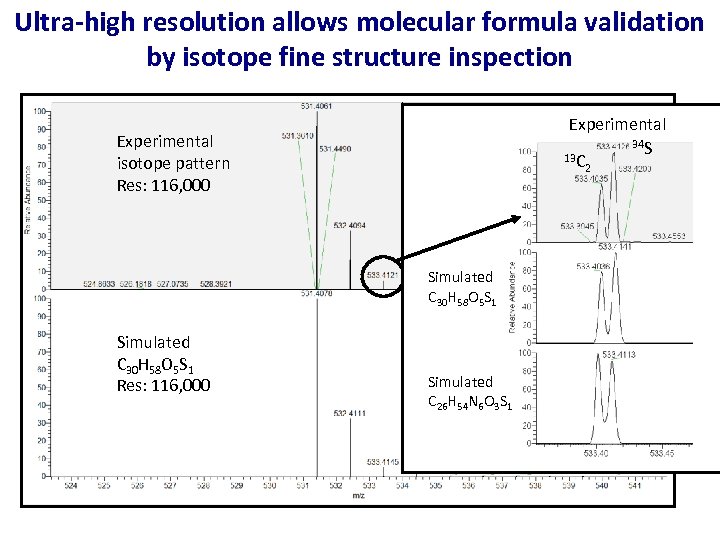 Ultra-high resolution allows molecular formula validation by isotope fine structure inspection Experimental 34 S 13 C 2 Experimental isotope pattern Res: 116, 000 Simulated C 30 H 58 O 5 S 1 Res: 116, 000 Simulated C 26 H 54 N 6 O 3 S 1
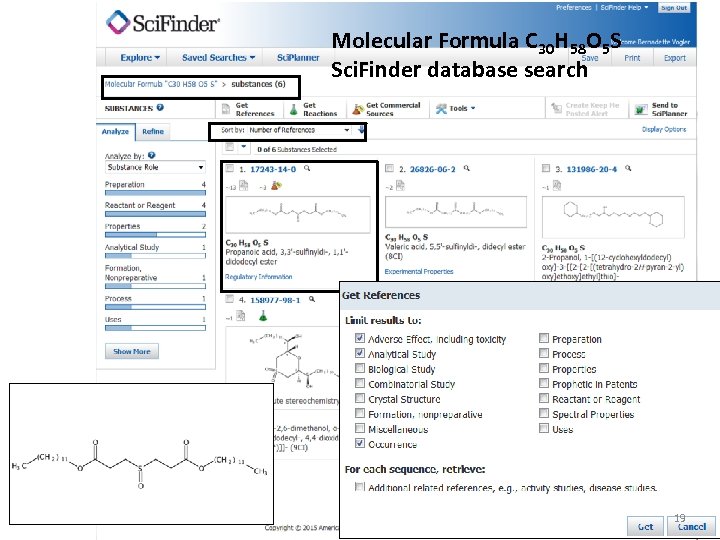 Molecular Formula C 30 H 58 O 5 S Sci. Finder database search 19
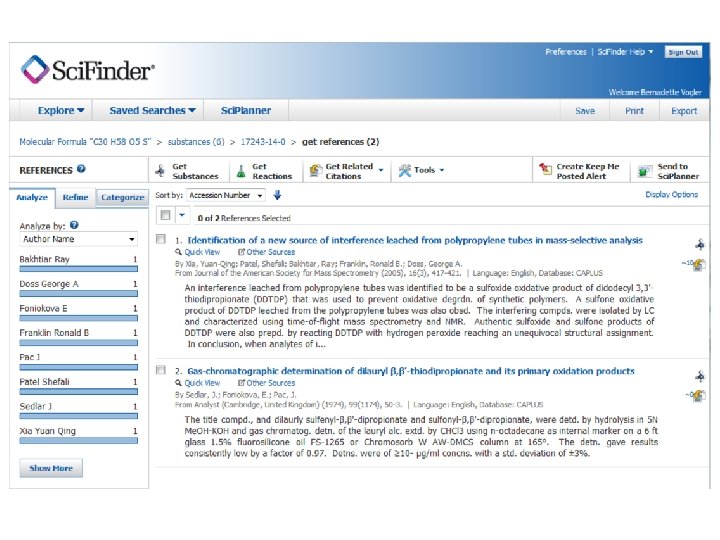
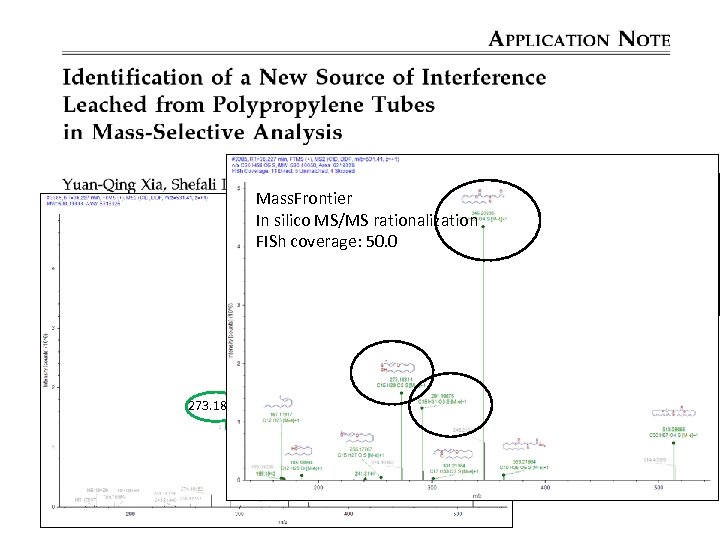 Mass. Frontier In silico MS/MS rationalization 345. 2093 FISh coverage: 50. 0 273. 1890 291. 1995
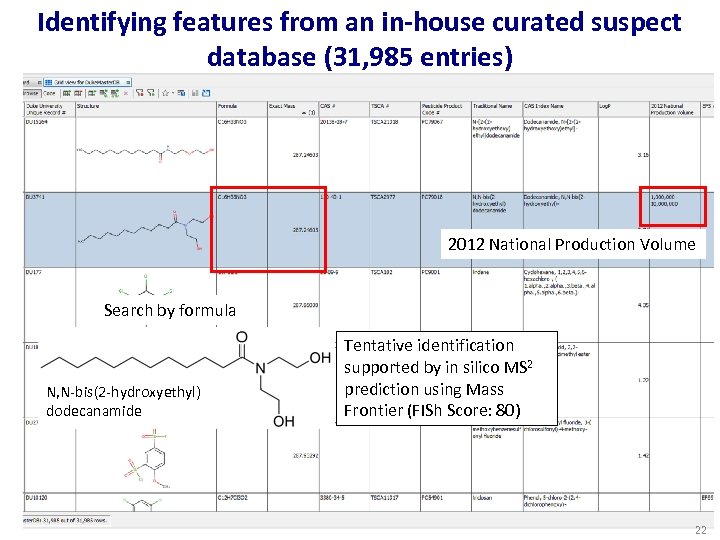 Identifying features from an in-house curated suspect database (31, 985 entries) 2012 National Production Volume Search by formula N, N-bis(2 -hydroxyethyl) dodecanamide Tentative identification supported by in silico MS 2 prediction using Mass Frontier (FISh Score: 80) 22
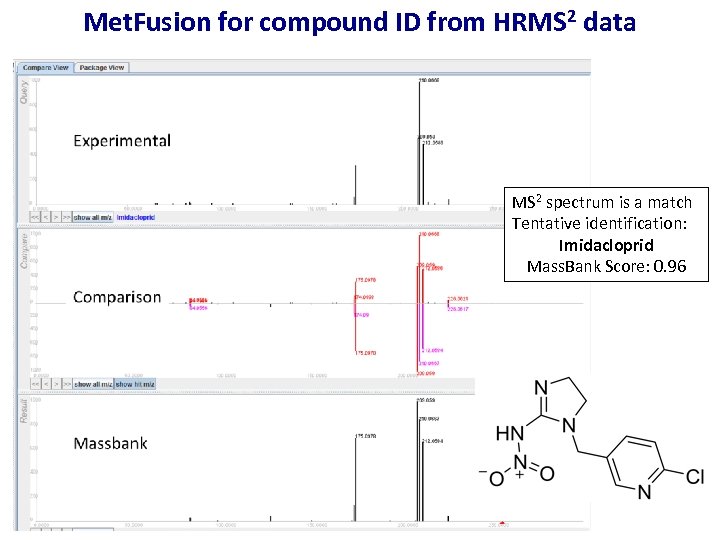 Met. Fusion for compound ID from HRMS 2 data + Online tool: http: //msbi. ipbhalle. de/Met. Fusion/ Input: - Molecular formula - MS 2 spectra MS 2 spectrum is a match Tentative identification: Imidacloprid Mass. Bank Score: 0. 96
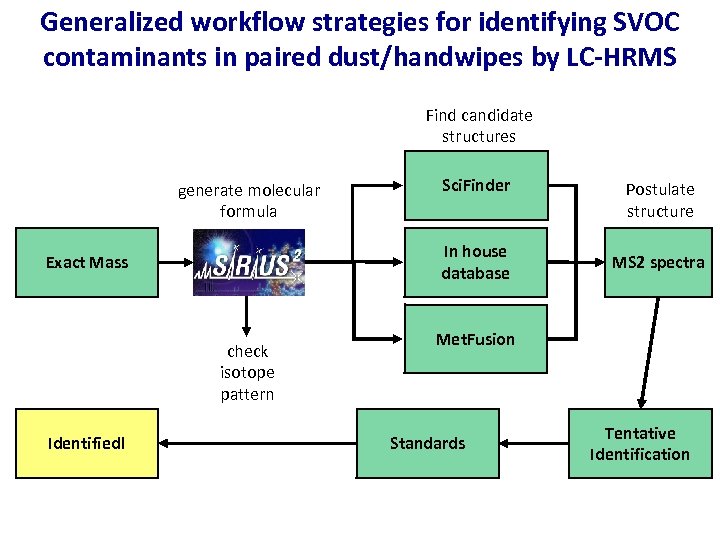 Generalized workflow strategies for identifying SVOC contaminants in paired dust/handwipes by LC-HRMS Find candidate structures generate molecular formula In house database Exact Mass check isotope pattern Identified! Sci. Finder Postulate structure MS 2 spectra Met. Fusion Standards Tentative Identification
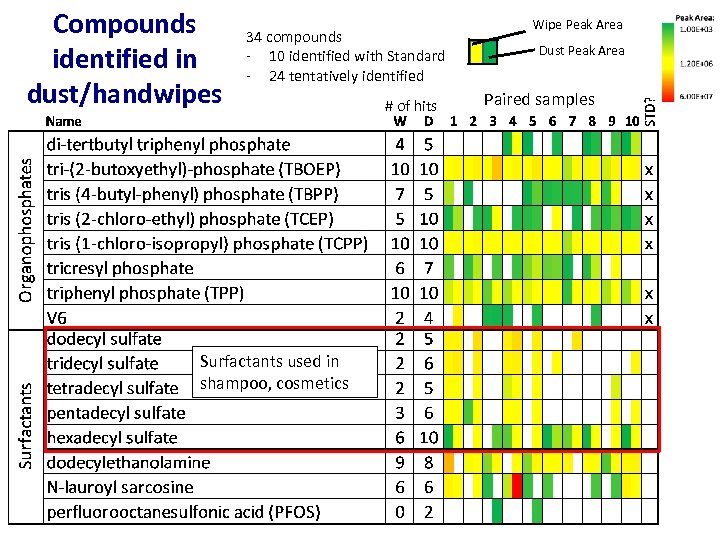 Compounds identified in dust/handwipes 34 compounds - 10 identified with Standard - 24 tentatively identified Surfactants used in shampoo, cosmetics # of hits Wipe Peak Area Dust Peak Area Paired samples
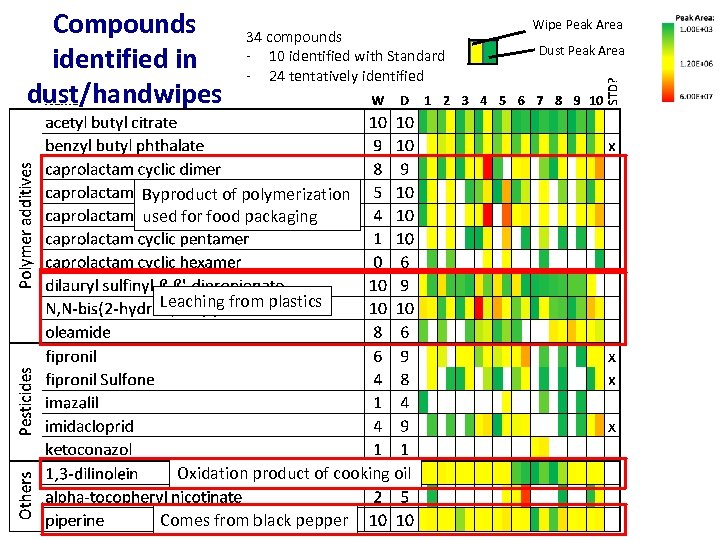 Compounds identified in dust/handwipes 34 compounds - 10 identified with Standard - 24 tentatively identified Byproduct of polymerization used for food packaging Leaching from plastics Oxidation product of cooking oil Comes from black pepper Wipe Peak Area Dust Peak Area
 Conclusions: Exploring the indoor environment exposome using non-targeted analysis strategies • (2 D)LC-HRAM mass spectrometry is a powerful tool for analysis of SVOC compounds in dust and hand wipe samples. • Non-targeted workflows allow a more holistic view of contaminant exposure in indoor environments relative to targeted analysis. • 213 tentative and confirmed identifications were made from 567 filtered components in dust/wipes (37. 5% of filtered features). • The most dominant compounds in dust and handwipes were non ionic surfactants such as nonylphenol ethoxylates or alcohol ethoxylates.
 Acknowledgement Ferguson Lab Group Stapleton Lab Group Richard Jack and Dipankar Ghosh