 Скачать презентацию High Performance Cluster Computing Architectures and Systems Book
b90071d0199a378b7c74171205e4bfa5.ppt
- Количество слайдов: 33



High Performance Cluster Computing Architectures and Systems Book Editor: Rajkumar Buyya Slides Prepared by: Hai Jin Internet and Cluster Computing Center
Job and Resource Management Systems n n n 2 By: Fritz Ferstl Motivation and Historical Systems Components and Architecture of Job- and Resource Management The State-of-the-Art in RMS Challenges for the Present and the Future Summary http: //www. buyya. com/cluster/
Motivation and Historical Evolution n A Need for Job Management n n n Operating system offers job and resource management service for a single computer The batch job control on multi-user mainframes was performed outside the operating system Main advantages are: n n 3 Allow for a structured resource utilization planning and control by the administration Offer the resources of a compute center to a user in an abstract, transparent, easy-to-understand easy-to-use fashion Provide a vendor independent user interface The first RMS of this type was NQS (Network Queuing System)
Job Management Systems on Workstation Clusters n n Using workstation clusters imposes specific requirements on job management systems A typical job management system usually offers n n n n n Primary application field n 4 Heterogeneous Support Batch Support Parallel Support Interactive Support Check-pointing and Process Migration Load Balancing Job Run-Time Limits GUI n Checkpointing and migrating jobs Parallel programs or I/O intensive jobs
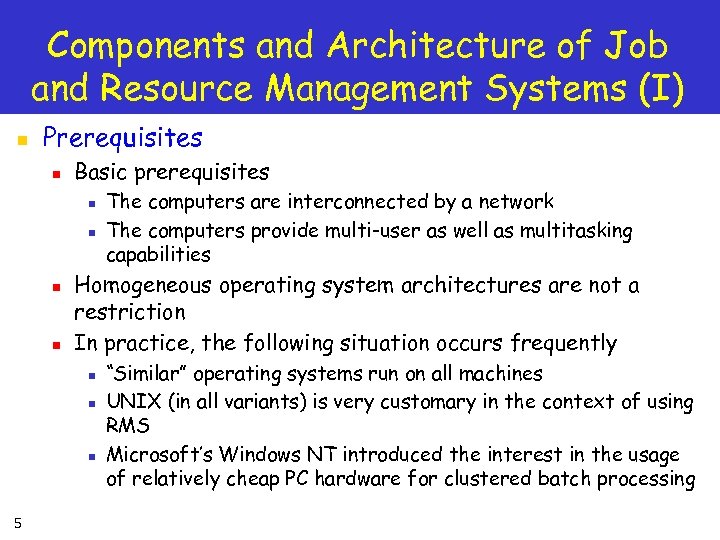
Components and Architecture of Job and Resource Management Systems (I) n Prerequisites n Basic prerequisites n n Homogeneous operating system architectures are not a restriction In practice, the following situation occurs frequently n n n 5 The computers are interconnected by a network The computers provide multi-user as well as multitasking capabilities “Similar” operating systems run on all machines UNIX (in all variants) is very customary in the context of using RMS Microsoft’s Windows NT introduced the interest in the usage of relatively cheap PC hardware for clustered batch processing
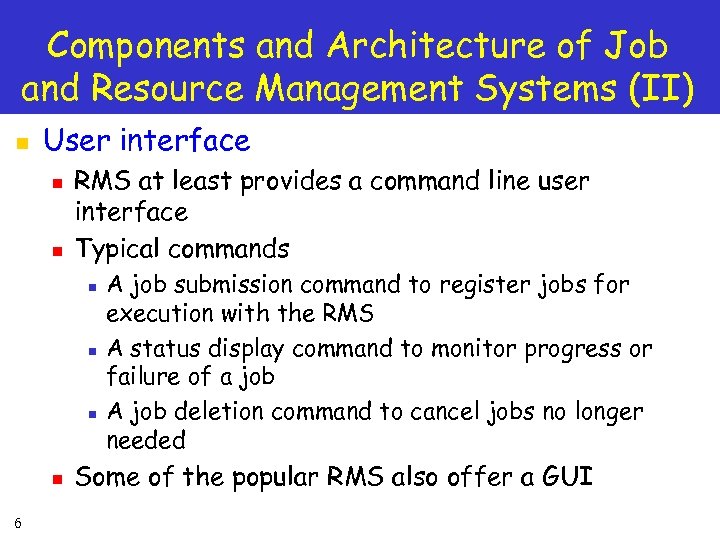
Components and Architecture of Job and Resource Management Systems (II) n User interface n n RMS at least provides a command line user interface Typical commands n n 6 A job submission command to register jobs for execution with the RMS A status display command to monitor progress or failure of a job A job deletion command to cancel jobs no longer needed Some of the popular RMS also offer a GUI
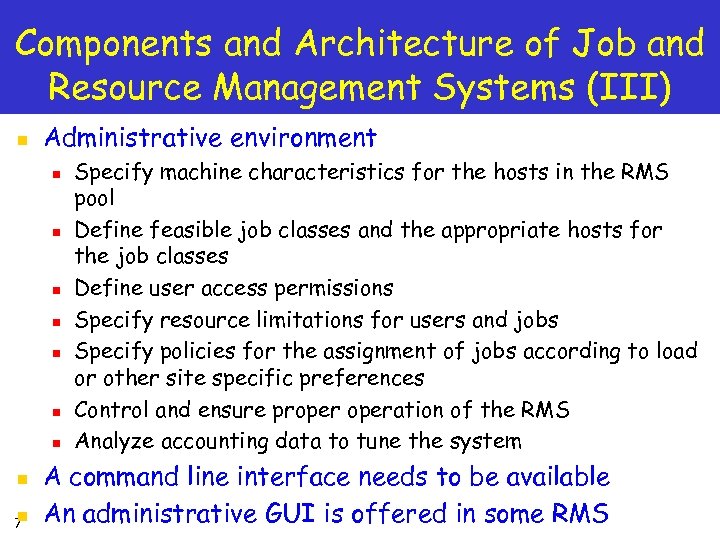
Components and Architecture of Job and Resource Management Systems (III) n Administrative environment n n n n n 7 Specify machine characteristics for the hosts in the RMS pool Define feasible job classes and the appropriate hosts for the job classes Define user access permissions Specify resource limitations for users and jobs Specify policies for the assignment of jobs according to load or other site specific preferences Control and ensure properation of the RMS Analyze accounting data to tune the system A command line interface needs to be available An administrative GUI is offered in some RMS
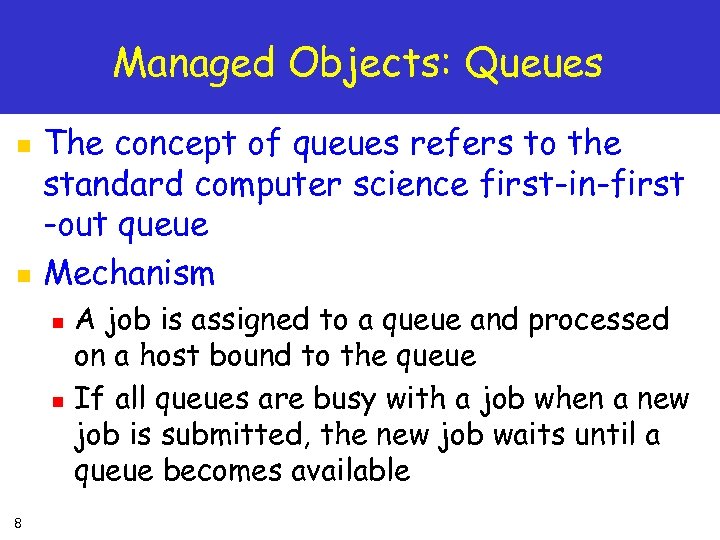
Managed Objects: Queues n n The concept of queues refers to the standard computer science first-in-first -out queue Mechanism n n 8 A job is assigned to a queue and processed on a host bound to the queue If all queues are busy with a job when a new job is submitted, the new job waits until a queue becomes available
Managed Objects: Hosts n Server nodes n n n Submit/control hosts n 9 Compute services: consists of executing jobs RMS management services: covers all types of tasks to guarantee the operability of the RMS (network communication, scheduling, RMS configuration, etc. ) To pass jobs to the RMS for execution and to control jobs respectively
Managed Objects: Jobs n n A job in the context of a RMS is any agglomeration of computational tasks usually solving a complex problem A job n n n There are four types of jobs in the context of RMS n n 10 May consist of a single program, of several interacting programs May also utilize operating system commands Batch Jobs: require no manual interaction as soon as started Interactive Jobs: require input during runtime Parallel Jobs: subtasks spread across several hosts in a cluster Check-pointing Jobs: periodically save status to the file system and can be aborted anytime
Managed Objects: Resources n The term resources n n A job is accompanied by its resource requirements An RMS should ensure that resources are not oversubscribed by running jobs n 11 Often called attributes Refers to the available memory, CPU time, and peripheral devices This can be performed by comparing resource utilization information with the thresholds defined by the cluster administration
Managed Objects: Policies n n n To manage the computational resources of a cluster, categorizing classes of jobs in terms of queues is used A RMS may offer more abstract and advanced mechanisms to automate control of utilization of a compute server environment Two types of policies n n 12 Resource Utilization Policies Scheduling Policies
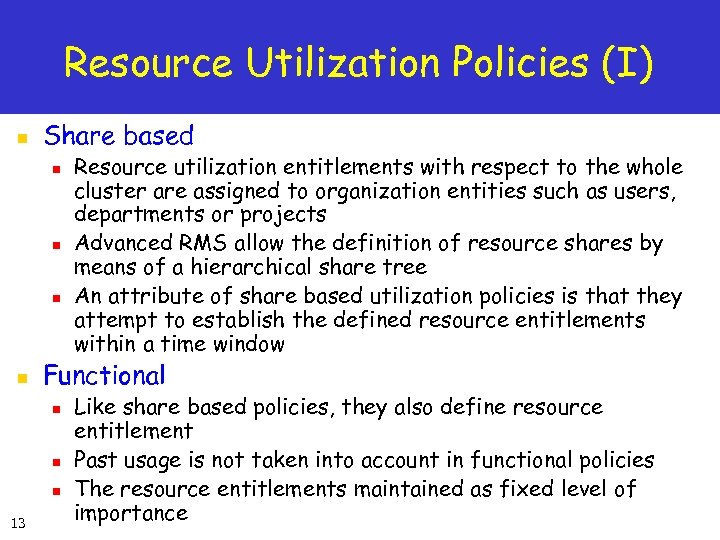
Resource Utilization Policies (I) n Share based n n Functional n n n 13 Resource utilization entitlements with respect to the whole cluster are assigned to organization entities such as users, departments or projects Advanced RMS allow the definition of resource shares by means of a hierarchical share tree An attribute of share based utilization policies is that they attempt to establish the defined resource entitlements within a time window Like share based policies, they also define resource entitlement Past usage is not taken into account in functional policies The resource entitlements maintained as fixed level of importance
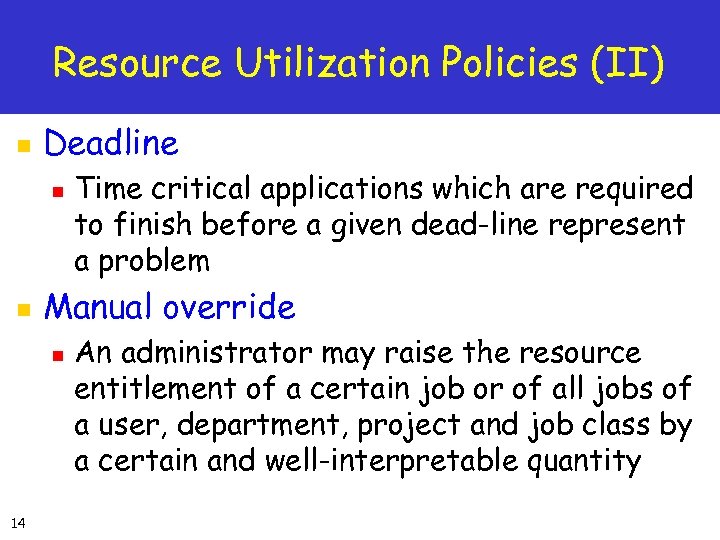
Resource Utilization Policies (II) n Deadline n n Manual override n 14 Time critical applications which are required to finish before a given dead-line represent a problem An administrator may raise the resource entitlement of a certain job or of all jobs of a user, department, project and job class by a certain and well-interpretable quantity
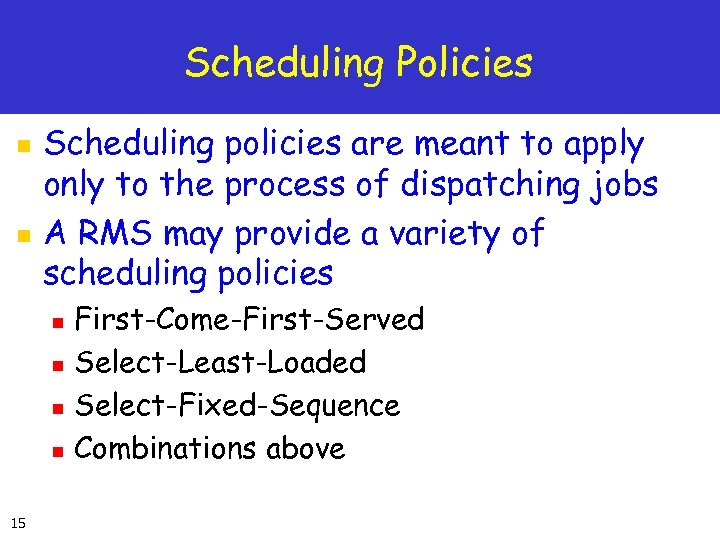
Scheduling Policies n n Scheduling policies are meant to apply only to the process of dispatching jobs A RMS may provide a variety of scheduling policies n n 15 First-Come-First-Served Select-Least-Loaded Select-Fixed-Sequence Combinations above
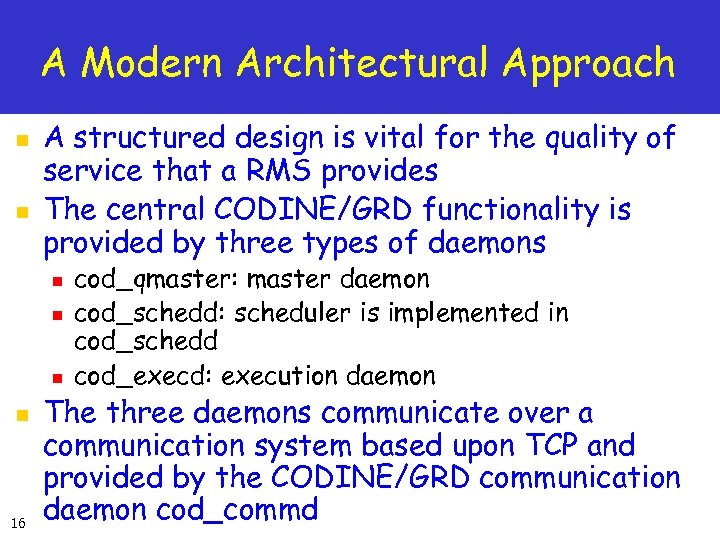
A Modern Architectural Approach n n A structured design is vital for the quality of service that a RMS provides The central CODINE/GRD functionality is provided by three types of daemons n n 16 cod_qmaster: master daemon cod_schedd: scheduler is implemented in cod_schedd cod_execd: execution daemon The three daemons communicate over a communication system based upon TCP and provided by the CODINE/GRD communication daemon cod_commd
Automated Policy Based Resource Management (I) n Requirements and Goals n Goal n n n Weaknesses in mediating the sharing of resources n n n Applications will rarely perform at the optimum performance because imbalanced load is the common situation in multiprocessing environments Important/urgent work may be deferred or starved for resources while other work is initiated and processed Unauthorized users may inadvertently dominate shared resources by simply submitting the largest amount of work A user may grossly exceed her/his desired resource utilization level over time Requirement n 17 Maximally achieve the performance goals of the enterprise This is accomplished through resource management polices Dynamic reallocation of resources is a prerequisite to optimal workload management
Automated Policy Based Resource Management (II) n Quantifying Availability and Usage of Resources n GRD performs resource tasking based upon the utilization and collective capabilities of an entire system of resources n n n 18 In order to avoid improper dispatching of jobs GRD continuously maintains alignment of resource utilization with policies, using a dynamic workload regulation scheme GRD monitors and adjusts resource usage correlated to all processes of a job
Automated Policy Based Resource Management (III) n Policy Models n Shared based n n Functional n n Automatically escalates a job’s resource entitlement over time as it approaches its deadline Override n 19 Supports relative weighting among users, projects, departments, and job classes during execution Initiation deadline n n Supports hierarchical allocation of resources Adjusts resource entitlements at the job, job class, user, project, or department levels
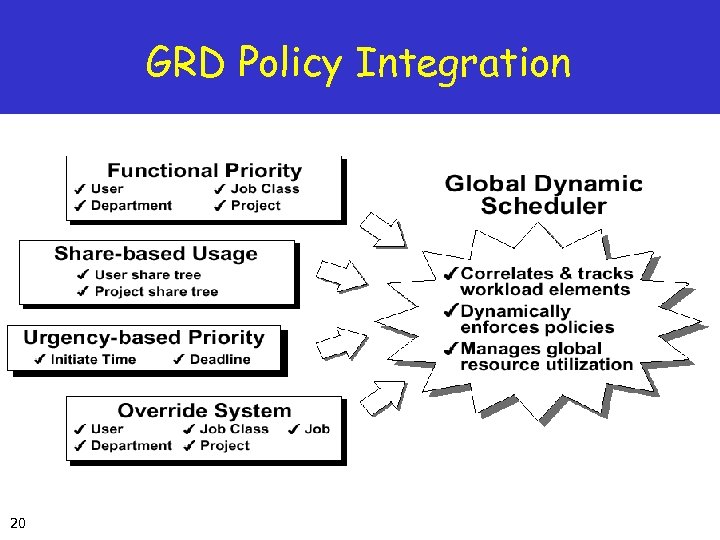
GRD Policy Integration 20
Automated Policy Based Resource Management (IV) n Policy Enforcement GRD is implemented by a dynamic scheduling facility n Multiple feed-back loops to adjust CPU shares of concurrently executing jobs toward dynamically changing requirements n 21
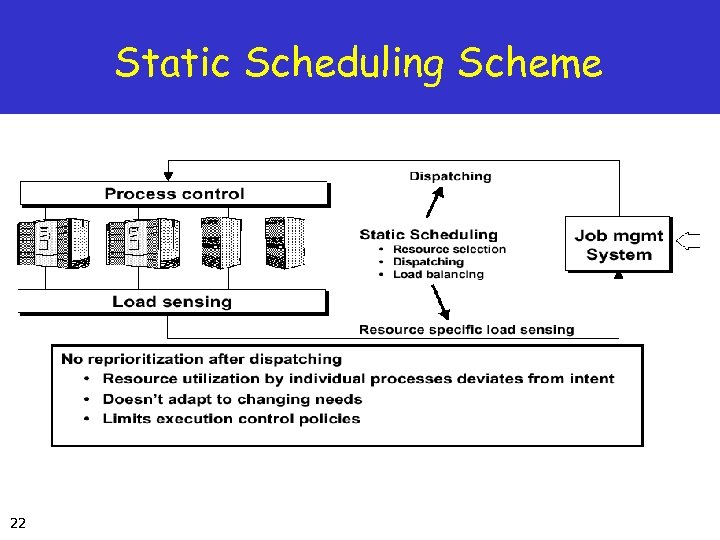
Static Scheduling Scheme 22
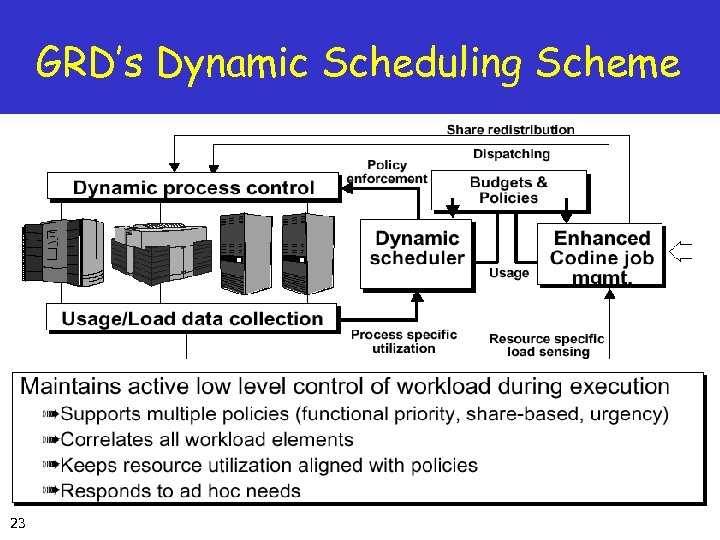
GRD’s Dynamic Scheduling Scheme 23
The State-of-the-Art of Job Support (I) n Serial Batch Jobs n n n Interactive Support n n 24 All RMS allow to submit batch jobs The ability to suspend and resume execution of batch jobs and to restart batch jobs after system crashes is a standard today Interactive job need to maintain a terminal connection When the interactive user suffers from background RMS jobs, “watchdog” program withdraw such machines from the RMS pool subsequently
The State-of-the-Art of Job Support (II) n Parallel Support n n n Support of Arbitrary or Particular PPEs n n 25 Not all RMS provide parallel support The kind of support provided differs considerably Fixed integrated parallel support (e. g. . Condor) providing an interfaces to PVM only CODINE/GRD offers freely configurable start-and-stop procedures for each PPE to be supported
The State-of-the-Art of Job Support (III) n Level of Control for Parallel Processes n n A simple way to provide an interface between a RMS and PPEs consists of submitting a start-up procedure/script for the run-time environment of PPEs to the RMS instead of a simple job script A approach proposed by the psched initiative n 26 APIs linking a RMS and PPEs to exchange information
The State-of-the-Art of Job Support (IV) n Mechanisms for dealing with the checkpointing of a job are provided n n 27 LSF and CODINE/GRD provide interfaces for so-called kernel level, application level and library based checkpointing Load. Leveler and Condor provide checkpointing only for applications linked with operating specific libraries enabling the facility
Challenges for the Present and the Future (I) n Open Interfaces n Advanced APIs are needed n n Developers might want to use a RMS’s load balancing and load distribution capabilities to distribute computational subtasks across a network of compute hosts For various reasons it is necessary to retrieve the following kind of information from inside RMS related applications n n n n 28 The overall load situation The status of jobs The status of queues A software developer might want to pass information to a RMS system to support the scheduler Especially for the purpose of low-level integration of RMS with other software systems An RMS’s graphical user’s and administrator’s interface should use API to configure RMS objects or to submit and monitor batch requests RMS administrators might wish to write special-purpose RMS commands in case the site’s users expect a very special behavior
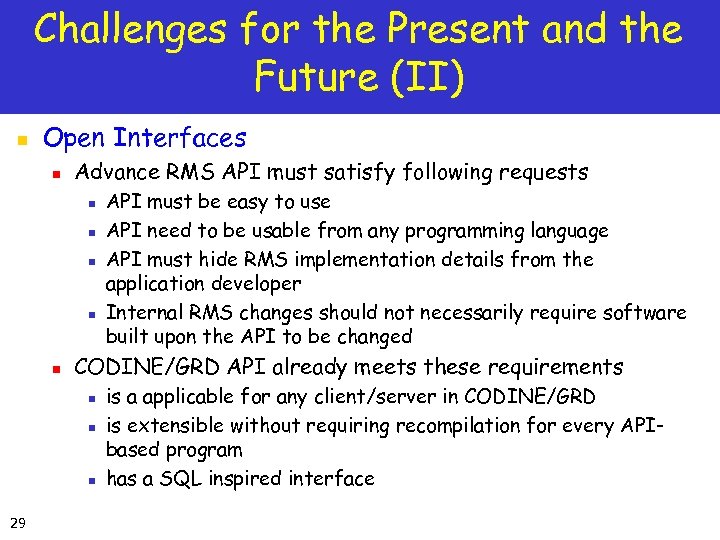
Challenges for the Present and the Future (II) n Open Interfaces n Advance RMS API must satisfy following requests n n n CODINE/GRD API already meets these requirements n n n 29 API must be easy to use API need to be usable from any programming language API must hide RMS implementation details from the application developer Internal RMS changes should not necessarily require software built upon the API to be changed is a applicable for any client/server in CODINE/GRD is extensible without requiring recompilation for every APIbased program has a SQL inspired interface
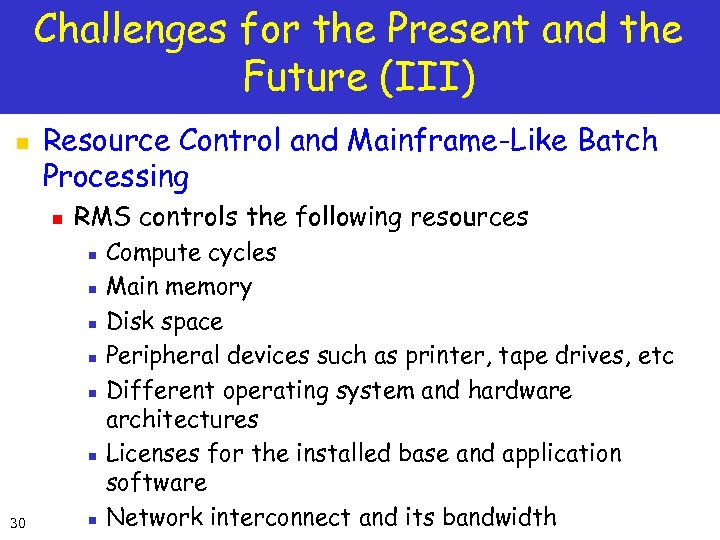
Challenges for the Present and the Future (III) n Resource Control and Mainframe-Like Batch Processing n RMS controls the following resources n n n 30 n Compute cycles Main memory Disk space Peripheral devices such as printer, tape drives, etc Different operating system and hardware architectures Licenses for the installed base and application software Network interconnect and its bandwidth
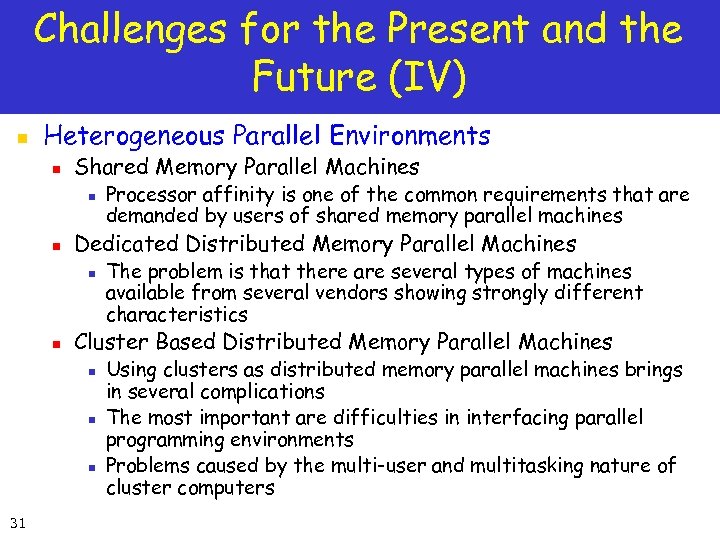
Challenges for the Present and the Future (IV) n Heterogeneous Parallel Environments n Shared Memory Parallel Machines n n Dedicated Distributed Memory Parallel Machines n n The problem is that there are several types of machines available from several vendors showing strongly different characteristics Cluster Based Distributed Memory Parallel Machines n n n 31 Processor affinity is one of the common requirements that are demanded by users of shared memory parallel machines Using clusters as distributed memory parallel machines brings in several complications The most important are difficulties in interfacing parallel programming environments Problems caused by the multi-user and multitasking nature of cluster computers
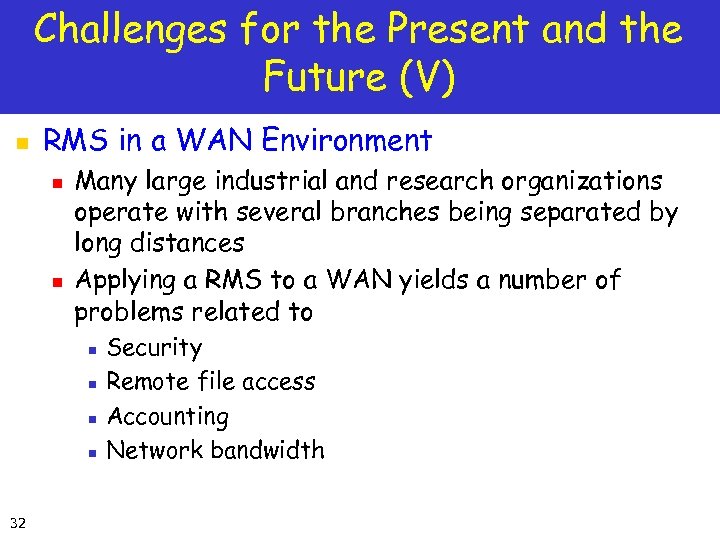
Challenges for the Present and the Future (V) n RMS in a WAN Environment n n Many large industrial and research organizations operate with several branches being separated by long distances Applying a RMS to a WAN yields a number of problems related to n n 32 Security Remote file access Accounting Network bandwidth
Summary n n 33 Today’s RMS offer good utilization of compute resources for a wide variety of applications They have proven their usefulness in production environments and still extend their application area Need to evolve and integrate with other client/server software CODINE/GRD is well recognized as one of the leading RMS for clusters today and is wellequipped for the challenges of the future
Скачать презентацию High Performance Cluster Computing Architectures and Systems Book
b90071d0199a378b7c74171205e4bfa5.ppt