


 Скачать презентацию High Performance Active End-toend Network Monitoring Les Cottrell
a3ffa5fcb8b0d15299201fe9e841d820.ppt
- Количество слайдов: 36
 High Performance Active End-toend Network Monitoring Les Cottrell, Connie Logg, Warren Matthews, Jiri Navratil, Ajay Tirumala – SLAC Prepared for the Protocols for Long Distance Networks Workshop, CERN, February 2003 Partially funded by DOE/MICS Field Work Proposal on Internet End-to-end Performance Monitoring (IEPM), by the Sci. DAC base program, and also supported by IUPAP 1
 Outline • High performance testbed – Challenges for measurements at high speeds • Simple infrastructure for regular high-performance measurements – Results 2
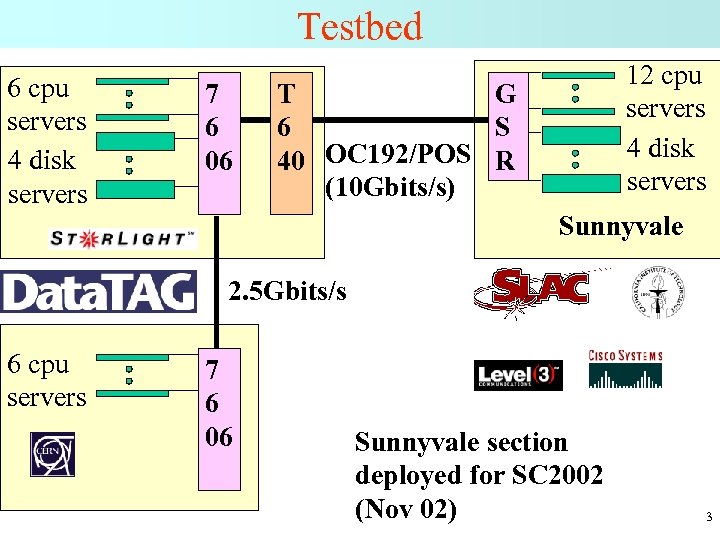 Testbed 6 cpu servers 4 disk servers 7 6 06 12 cpu servers 4 disk servers T G 6 S 40 OC 192/POS R (10 Gbits/s) Sunnyvale 2. 5 Gbits/s 6 cpu servers 7 6 06 Sunnyvale section deployed for SC 2002 (Nov 02) 3
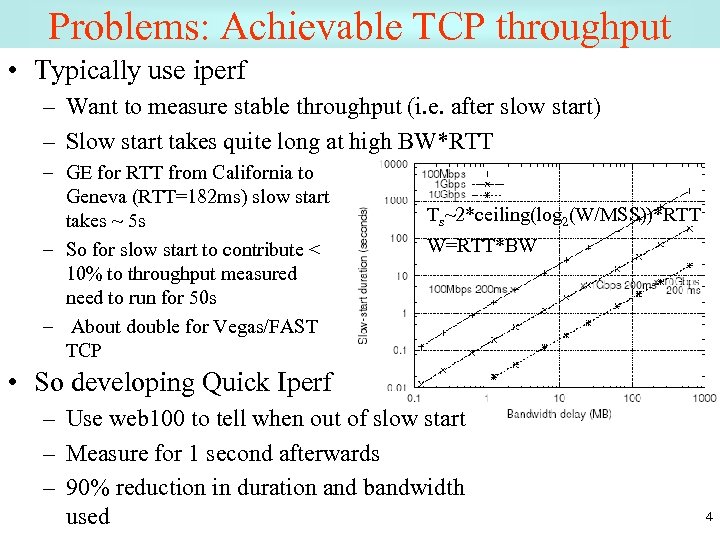 Problems: Achievable TCP throughput • Typically use iperf – Want to measure stable throughput (i. e. after slow start) – Slow start takes quite long at high BW*RTT – GE for RTT from California to Geneva (RTT=182 ms) slow start takes ~ 5 s – So for slow start to contribute < 10% to throughput measured need to run for 50 s – About double for Vegas/FAST TCP Ts~2*ceiling(log 2(W/MSS))*RTT W=RTT*BW • So developing Quick Iperf – Use web 100 to tell when out of slow start – Measure for 1 second afterwards – 90% reduction in duration and bandwidth used 4
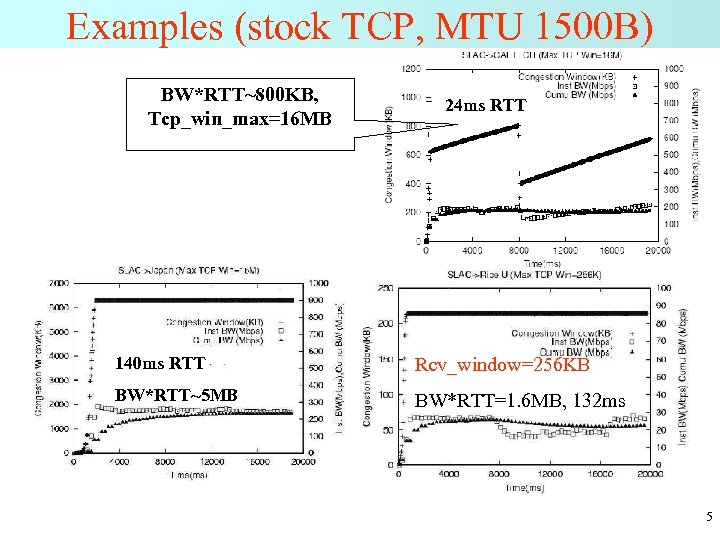 Examples (stock TCP, MTU 1500 B) BW*RTT~800 KB, Tcp_win_max=16 MB 24 ms RTT 140 ms RTT Rcv_window=256 KB BW*RTT~5 MB BW*RTT=1. 6 MB, 132 ms 5
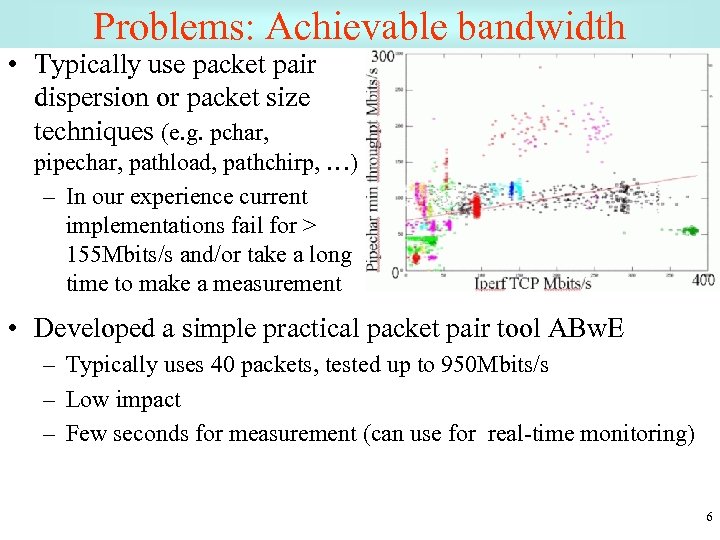 Problems: Achievable bandwidth • Typically use packet pair dispersion or packet size techniques (e. g. pchar, pipechar, pathload, pathchirp, …) – In our experience current implementations fail for > 155 Mbits/s and/or take a long time to make a measurement • Developed a simple practical packet pair tool ABw. E – Typically uses 40 packets, tested up to 950 Mbits/s – Low impact – Few seconds for measurement (can use for real-time monitoring) 6
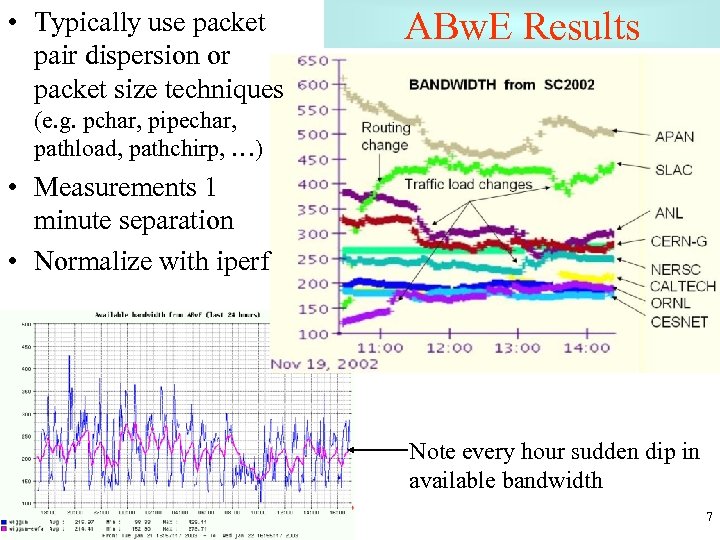 • Typically use packet pair dispersion or packet size techniques ABw. E Results (e. g. pchar, pipechar, pathload, pathchirp, …) • Measurements 1 minute separation • Normalize with iperf Note every hour sudden dip in available bandwidth 7
 Problem: File copy applications • Some tools (e. g. bbcp will not allow a large enough window – currently limited to 2 MBytes) • Same slow start problem as iperf • Need big file to assure not cached – E. g. 2 GBytes, at 200 Mbits/s takes 80 s to transfer, even longer at lower speeds – Looking at whether can get same effect as a big file but with a small (64 MByte) file, by playing with commit • Many more factors involved, e. g. adds file system, disks speeds, RAID etc. • Maybe best bet is to let the user measure it for us. 8
 Passive (Netflow) Measurements • Use Netflow measurements from border router – – Netflow records time, duration, bytes, packets etc. /flow Calculate throughput from Bytes/duration Validate vs. iperf, bbcp etc. No extra load on network, provides other SLAC & remote hosts & applications, ~ 10 -20 K flows/day, 100 -300 unique pairs/day – Tricky to aggregate all flows for single application call • Look for flows with fixed triplet (sce & dst addr, and port) • Starting at the same time +- 2. 5 secs, ending at roughly same time - needs tuning missing some delayed flows • Check works for known active flows • To ID application need a fixed server port (bbcp peer-to-peer but have modified to support) • Investigating differences with tcpdump – Aggregate throughputs, note number of flows/streams 9
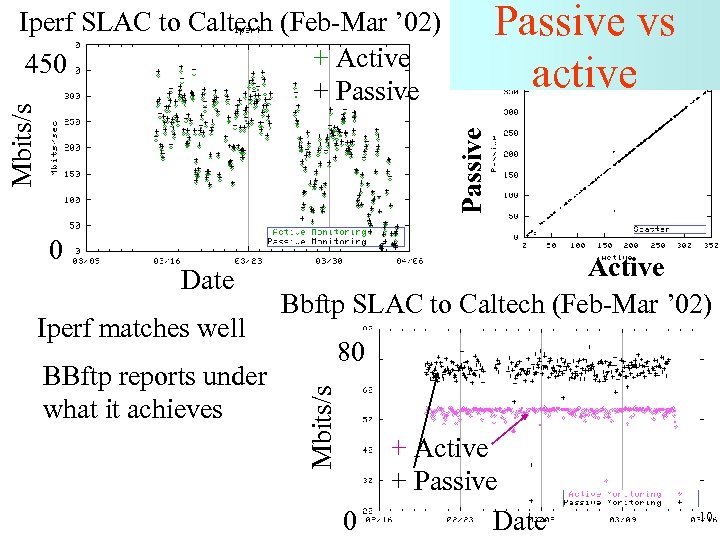 Passive vs active Passive Mbits/s Iperf SLAC to Caltech (Feb-Mar ’ 02) + Active 450 + Passive Date Iperf matches well BBftp reports under what it achieves Active Bbftp SLAC to Caltech (Feb-Mar ’ 02) 80 Mbits/s 0 0 + Active + Passive Date 10
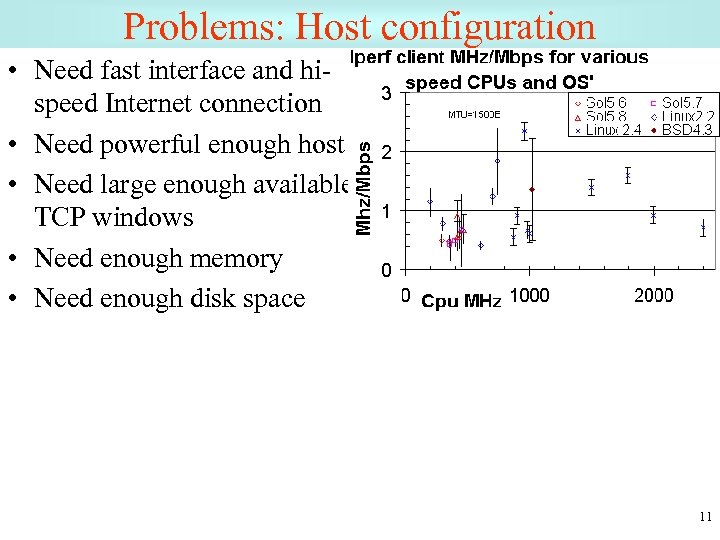 Problems: Host configuration • Need fast interface and hispeed Internet connection • Need powerful enough host • Need large enough available TCP windows • Need enough memory • Need enough disk space 11
 Windows and Streams • Well accepted that multiple streams and/or big windows are important to achieve optimal throughput • Can be unfriendly to others • Optimum windows & streams changes with changes in path, hard to optimize • For 3 Gbits/s and 200 ms RTT need a 75 MByte window 12
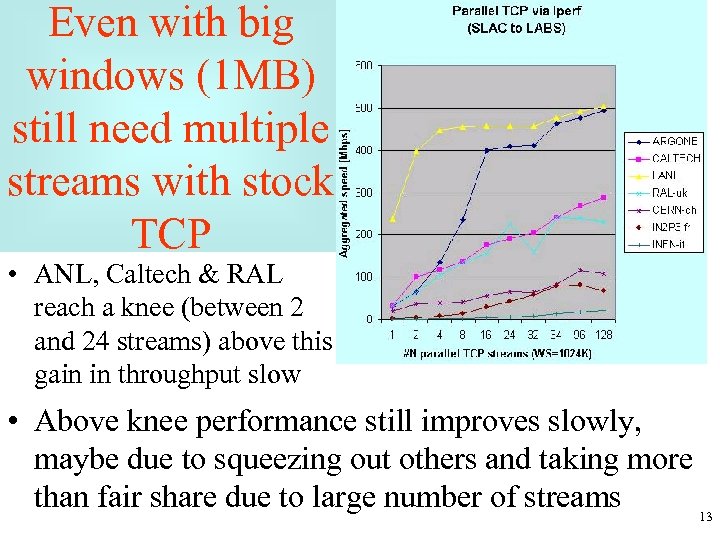 Even with big windows (1 MB) still need multiple streams with stock TCP • ANL, Caltech & RAL reach a knee (between 2 and 24 streams) above this gain in throughput slow • Above knee performance still improves slowly, maybe due to squeezing out others and taking more than fair share due to large number of streams 13
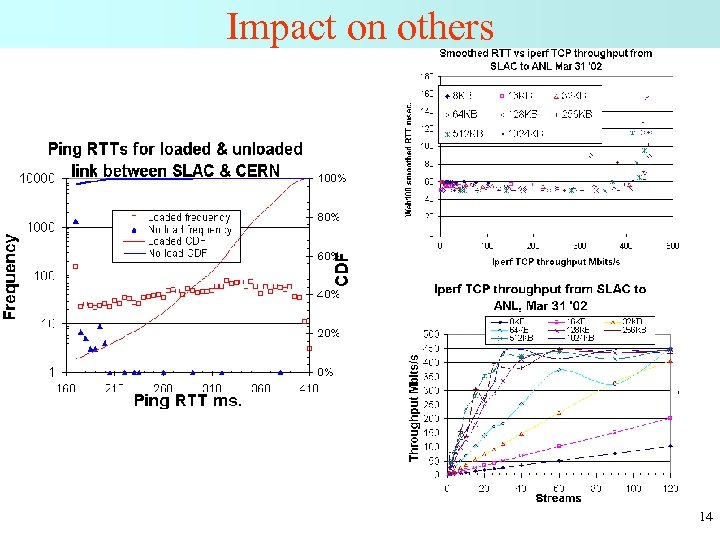 Impact on others 14
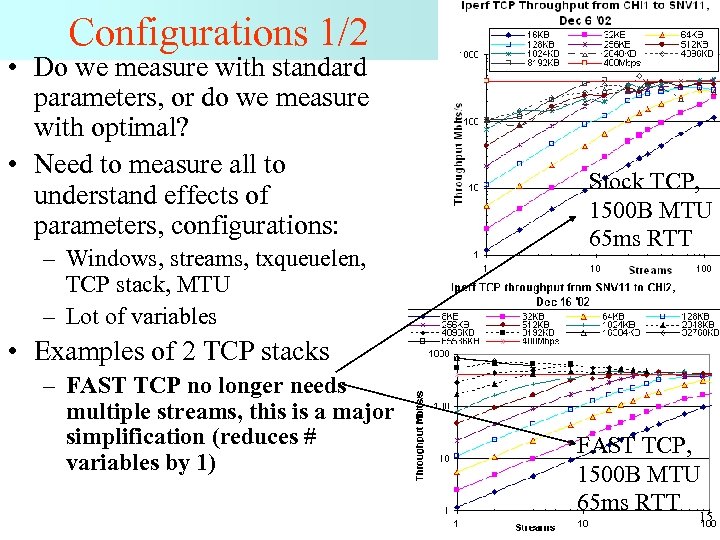 Configurations 1/2 • Do we measure with standard parameters, or do we measure with optimal? • Need to measure all to understand effects of parameters, configurations: – Windows, streams, txqueuelen, TCP stack, MTU – Lot of variables Stock TCP, 1500 B MTU 65 ms RTT • Examples of 2 TCP stacks – FAST TCP no longer needs multiple streams, this is a major simplification (reduces # variables by 1) FAST TCP, 1500 B MTU FAST TCP, 65 ms RTT 1500 B MTU 65 ms RTT 15
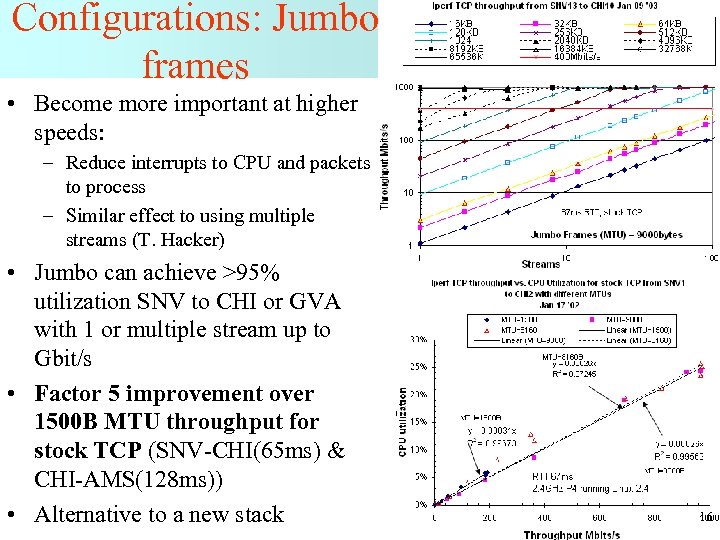 Configurations: Jumbo frames • Become more important at higher speeds: – Reduce interrupts to CPU and packets to process – Similar effect to using multiple streams (T. Hacker) • Jumbo can achieve >95% utilization SNV to CHI or GVA with 1 or multiple stream up to Gbit/s • Factor 5 improvement over 1500 B MTU throughput for stock TCP (SNV-CHI(65 ms) & CHI-AMS(128 ms)) • Alternative to a new stack 16
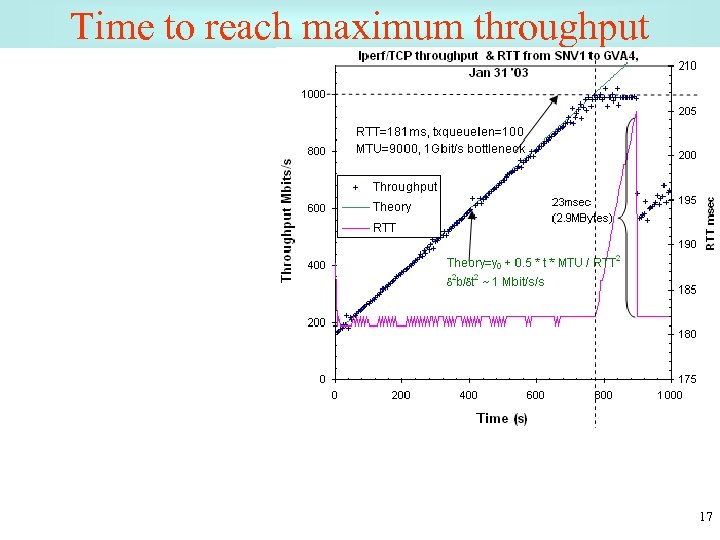 Time to reach maximum throughput 17
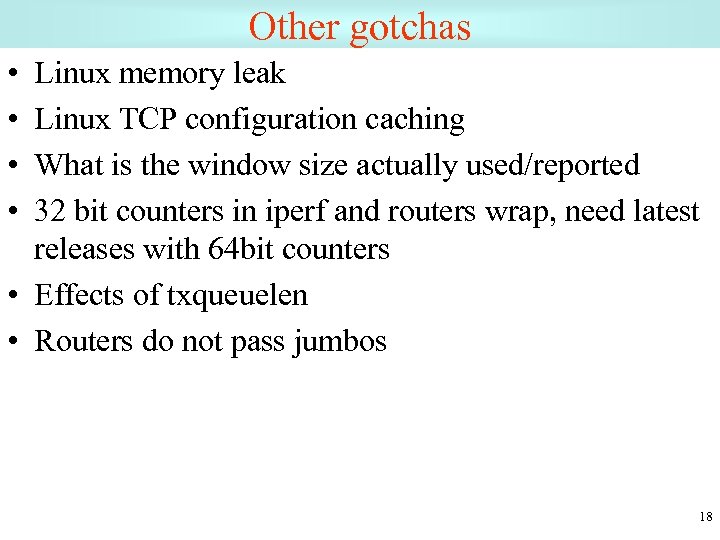 Other gotchas • • Linux memory leak Linux TCP configuration caching What is the window size actually used/reported 32 bit counters in iperf and routers wrap, need latest releases with 64 bit counters • Effects of txqueuelen • Routers do not pass jumbos 18
 Repetitive long term measurements 19
 IEPM-BW = Ping. ER NG • Driven by data replication needs of HENP, PPDG, Data. Grid – No longer ship plane/truck loads of data • Latency is poor • Now ship all data by network (TB/day today, double each year) – Complements Ping. ER, but for high performance nets • Need an infrastructure to make E 2 E network (e. g. iperf, packet pair dispersion) & application (FTP) measurements for high-performance A&R networking • Started SC 2001 20
 Tasks • Develop/deploy a simple, robust ssh based E 2 E app & net measurement and management infrastructure for making regular measurements – Major step is setting up collaborations, getting trust, accounts/passwords – Can use dedicated or shared hosts, located at borders or with real applications – COTS hardware & OS (Linux or Solaris) simplifies application integration • Integrate base set of measurement tools (ping, iperf, bbcp …), provide simple (cron) scheduling • Develop data extraction, reduction, analysis, reporting, simple forecasting & archiving 21
 Purposes • Compare & validate tools – With one another (pipechar vs pathload vs iperf or bbcp vs bbftp vs Grid. FTP vs Tsunami) – With passive measurements, – With web 100 • Evaluate TCP stacks (FAST, Sylvain Ravot, HS TCP, Tom Kelley, Net 100 …) – Trouble shooting – Set expectations, planning – Understand • requirements for high performance, jumbos • performance issues, in network, OS, cpu, disk/file system etc. – Provide public access to results for people & applications 22
 Measurement Sites • Production, i. e. choose own remote hosts, run monitor themselves: – SLAC (40) San Francisco, FNAL (2) Chicago, INFN (4) Milan, NIKHEF (32) Amsterdam, APAN Japan (4) • Evaluating toolkit: – Internet 2 (Michigan), Manchester University, UCL, Univ. Michigan, GA Tech (5) • Also demonstrated at: – i. Grid 2002, SC 2002 • Using on Caltech / SLAC / Data. Tag / Teragrid / Star. Light / SURFnet testbed • If all goes well 30 -60 minutes to install monitoring host, often problems with keys, disk space, ports blocked, not registered in DNS, need for web access, disk space • SLAC monitoring over 40 sites in 9 countries 23
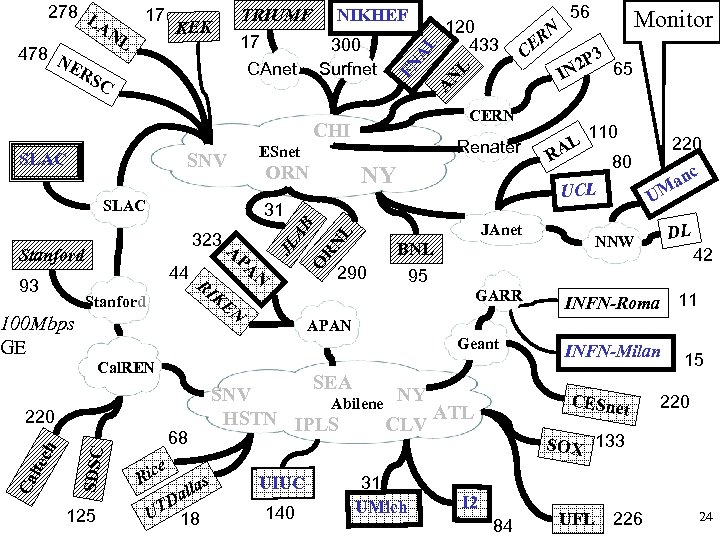 SLAC ORN SLAC N PA RI KE Stanford O A 44 N SDSC 68 e Ric s a all D UT 18 110 290 GARR 220 80 c U an M DL NNW BNL 95 42 INFN-Roma 11 APAN SEA SNV NY Abilene ATL HSTN IPLS CLV 220 AL UCL Geant Cal. REN R Monitor 3 2 P 65 IN JAnet RN L JL AB 323 100 Mbps GE ech NY 31 Stanford Ca lt Renater ESnet SNV 125 CE 56 CERN CHI 93 RN A CAnet 300 Surfnet 120 433 L KEK NIKHEF N L TRIUMF 17 AL 478 N ER SC 17 FN 278 L AN UIUC 140 31 UMich INFN-Milan CESne t 15 220 SOX 133 I 2 84 UFL 226 24
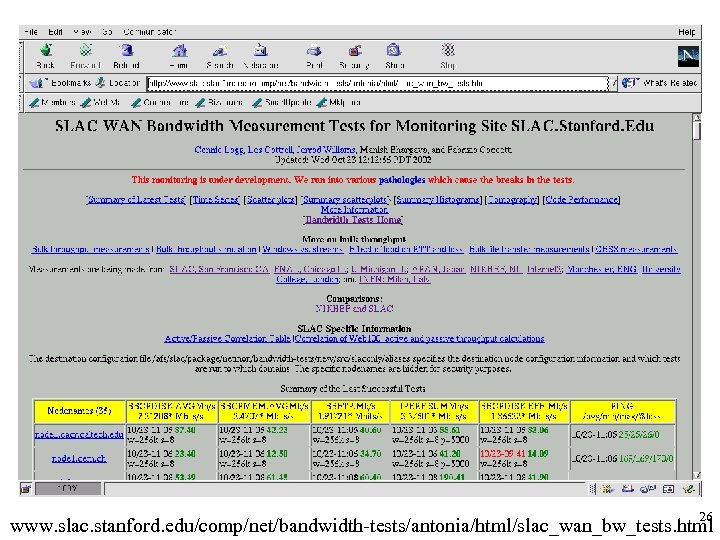
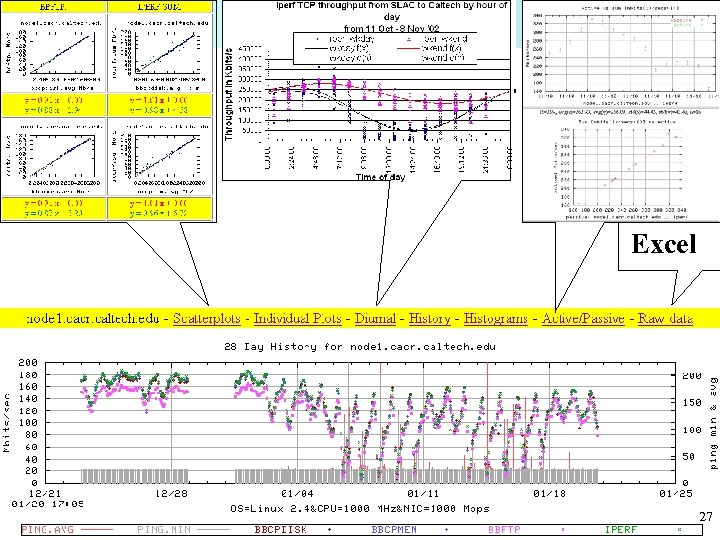
 Results • Time series data, scatter plots, histograms • CPU utilization required (MHz/Mbits/s) jumbo and standard, new stacks • Forecasting • Diurnal behavior characterization • Disk throughput as function of OS, file system, caching • Correlations with passive, web 100 25
 26 www. slac. stanford. edu/comp/net/bandwidth-tests/antonia/html/slac_wan_bw_tests. html
 Excel 27
 Problem Detection • Must be lots of people working on this ? • Our approach is: – Rolling averages if have recent data – Diurnal changes 28
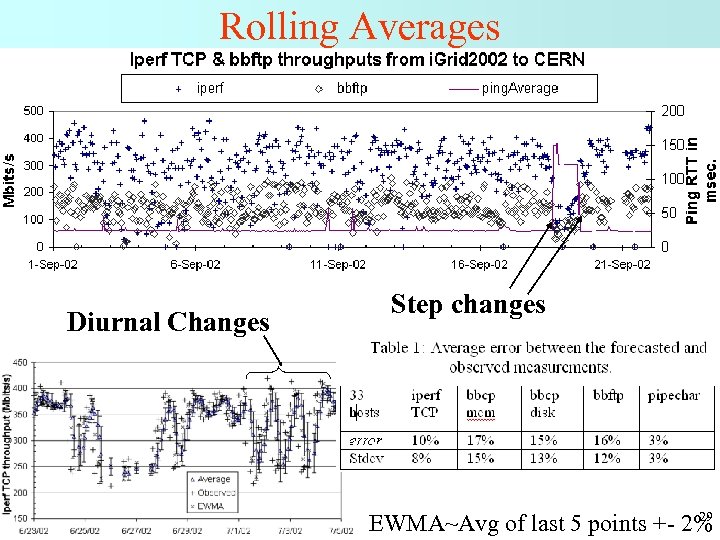 Rolling Averages Diurnal Changes Step changes 29 EWMA~Avg of last 5 points +- 2%
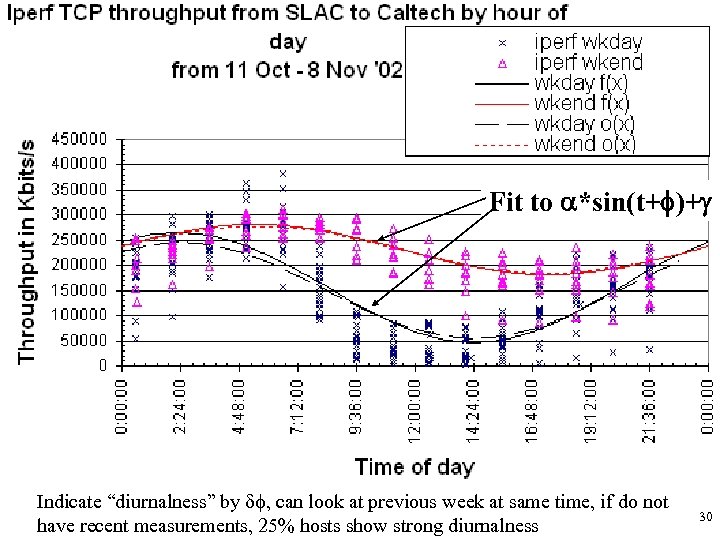 Fit to a*sin(t+f)+g Indicate “diurnalness” by df, can look at previous week at same time, if do not have recent measurements, 25% hosts show strong diurnalness 30
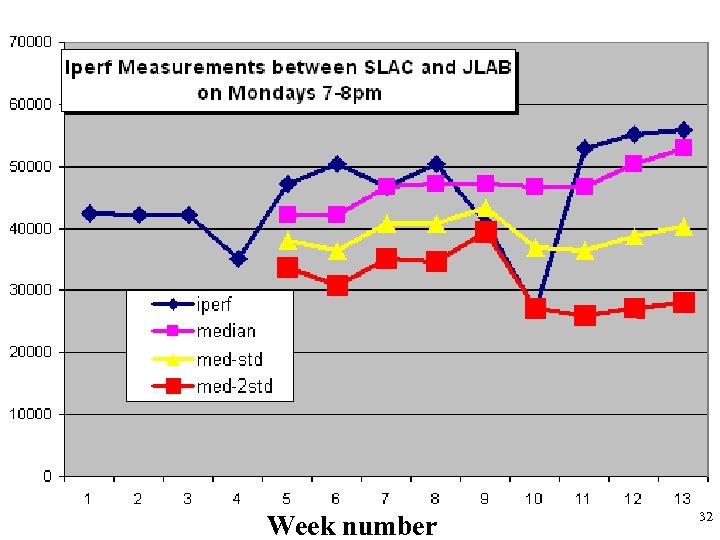
 Alarms • • Too much to keep track of Rather not wait for complaints Automated Alarms Rolling average à la RIPE-TTM 31
 Week number 32
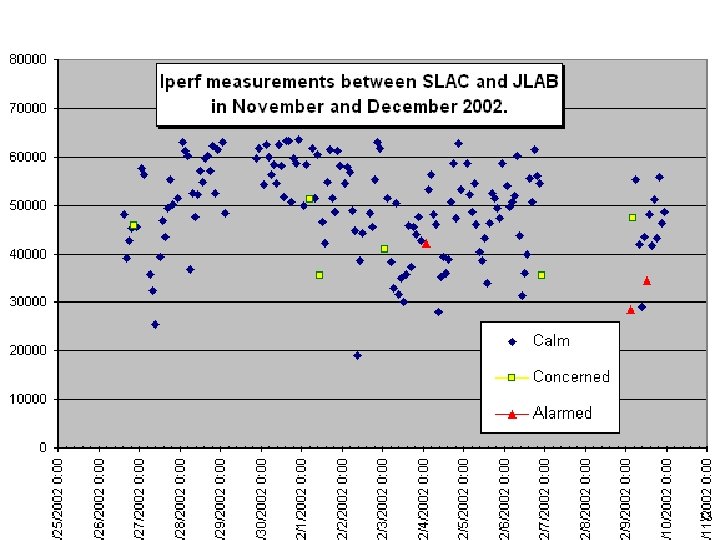 33
33
 Action • However concern is generated – Look for changes in traceroute – Compare tools – Compare common routes – Cross reference other alarms 34
 Next steps • Rewrite (again) based on experiences – Improved ability to add new tools to measurement engine and integrate into extraction, analysis • Grid. FTP, tsunami, UDPMon, pathload … – Improved robustness, error diagnosis, management • Need improved scheduling • Want to look at other security mechanisms 35
 More Information • IEPM/Ping. ER home site: – www-iepm. slac. stanford. edu/ • IEPM-BW site – www-iepm. slac. stanford. edu/bw • Quick Iperf – http: //www-iepm. slac. stanford. edu/bw/iperf_res. html • ABw. E – Submitted to PAM 2003 36