


 Скачать презентацию High p T po and Direct g Production
d21fc30eebcd01c63d27c36a26f418a0.ppt
- Количество слайдов: 36
 High p. T po and Direct g Production T. C. Awes, ORNL International Workshop on RHIC and LHC Detectors Delphi, Greece, June 9, 2003
 Theme: “The virtue of p 0’s and g’s” To determine if we have produced deconfined QGP we must separately distinguish initial state effects from final state effects. Once produced, g’s do not interact -> sensitive to: ( yield goes • initial parton distributions: Intrinsic k. T, k. T Broadening, Shadowing, Saturation • final state parton/hadron rescatterings: Thermal, Jet/Parton Radiation ) p 0’s will suffer additional final state effects: Rescattering (low p. T), Absorption, k. T Broadening, Jet/Parton Energy Loss Experimental virtues (calorimeter measurement): • Measure g and p 0 in same detector (get 2 for the price of 1!) • Identified particles to very high p. T • p 0’s abundantly produced Highlighted • p 0 mass provides calibration check here
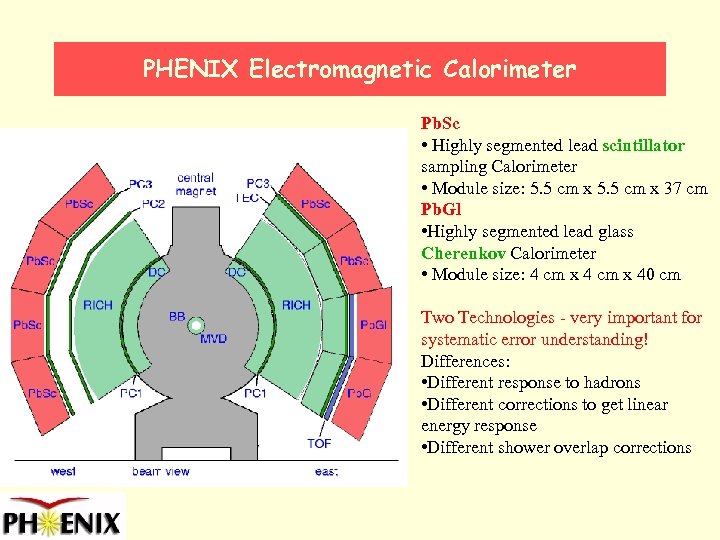 PHENIX Electromagnetic Calorimeter Pb. Sc • Highly segmented lead scintillator sampling Calorimeter • Module size: 5. 5 cm x 37 cm Pb. Gl • Highly segmented lead glass Cherenkov Calorimeter • Module size: 4 cm x 40 cm Two Technologies - very important for systematic error understanding! Differences: • Different response to hadrons • Different corrections to get linear energy response • Different shower overlap corrections
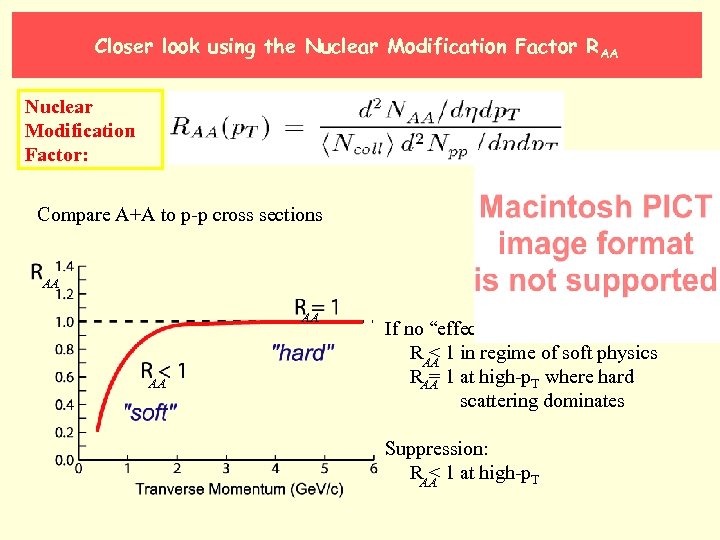 Closer look using the Nuclear Modification Factor RAA Nuclear Modification Factor: Compare A+A to p-p cross sections AA AA AA If no “effects”: RAA 1 in regime of soft physics < RAA 1 at high-p. T where hard = scattering dominates Suppression: RAA 1 at high-p. T <
 RHIC Year-1 High-PT Hadrons hadron spectra out to p. T~4 Ge. V/c Nominally expect production through hard scattering, scale spectra from N+N by number of binary collisions Peripheral reasonably well reproduced; but central significantly below binary scaling
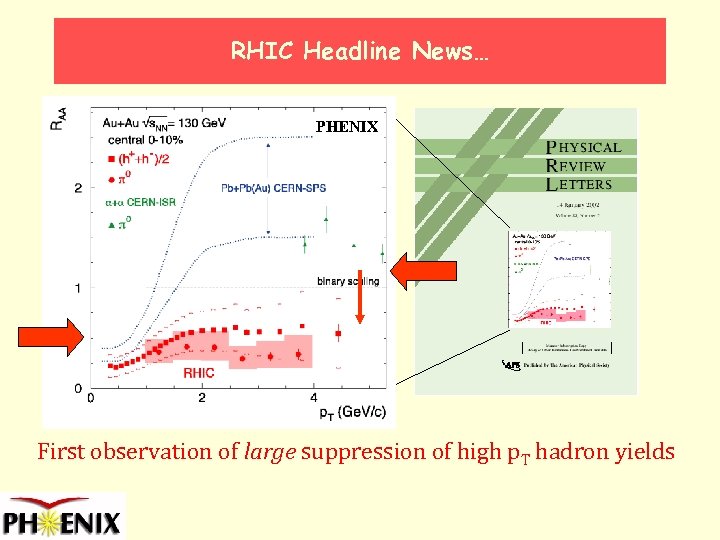 RHIC Headline News… PHENIX First observation of large suppression of high p. T hadron yields
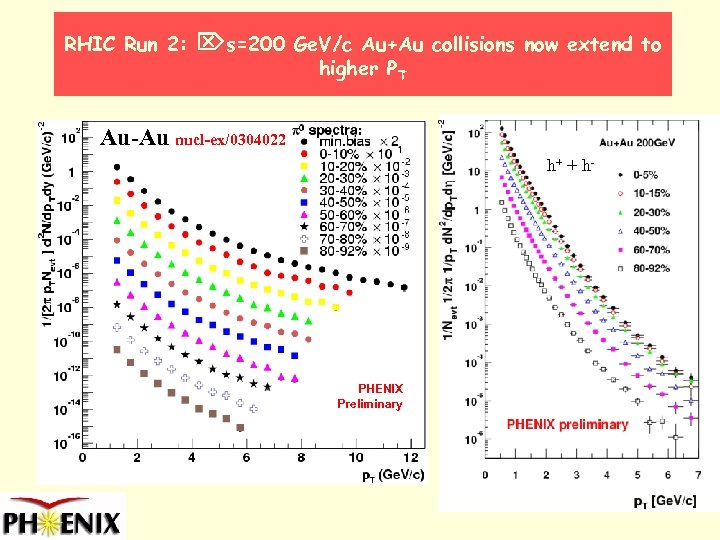 RHIC Run 2: s=200 Ge. V/c Au+Au collisions now extend to higher PT Au-Au nucl-ex/0304022 h+ + h- PHENIX Preliminary
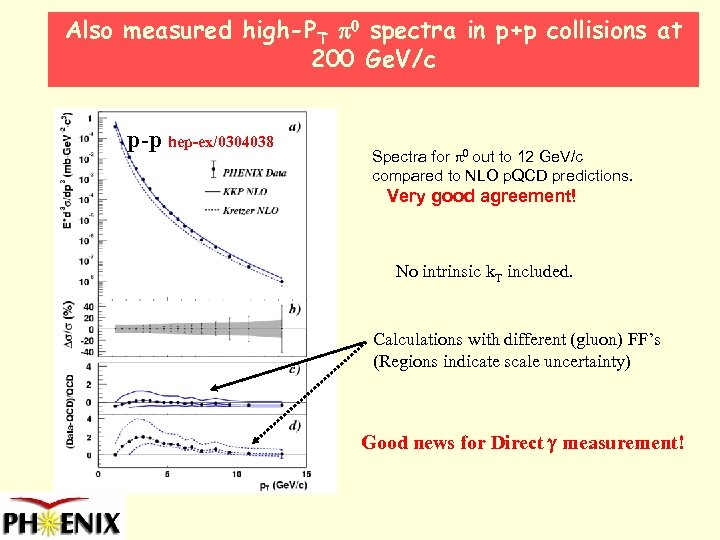 Also measured high-PT p 0 spectra in p+p collisions at 200 Ge. V/c p-p hep-ex/0304038 Spectra for p 0 out to 12 Ge. V/c compared to NLO p. QCD predictions. Very good agreement! No intrinsic k. T included. Calculations with different (gluon) FF’s (Regions indicate scale uncertainty) Good news for Direct g measurement!
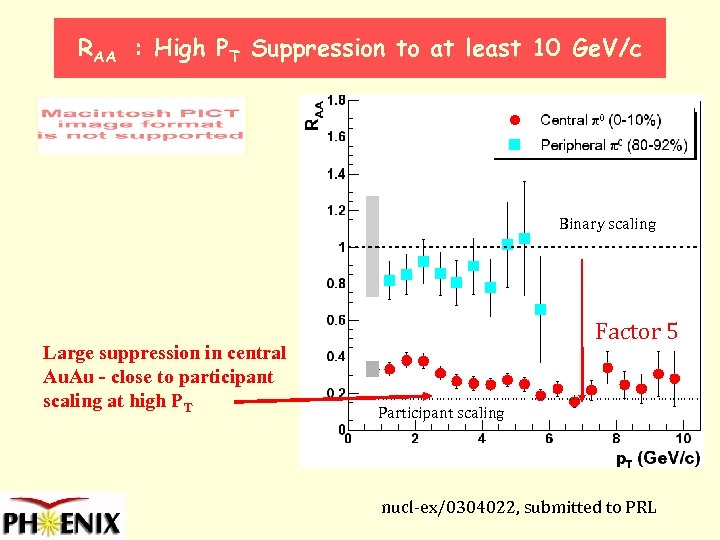 RAA : High PT Suppression to at least 10 Ge. V/c Binary scaling Large suppression in central Au. Au - close to participant scaling at high PT Factor 5 Participant scaling nucl-ex/0304022, submitted to PRL
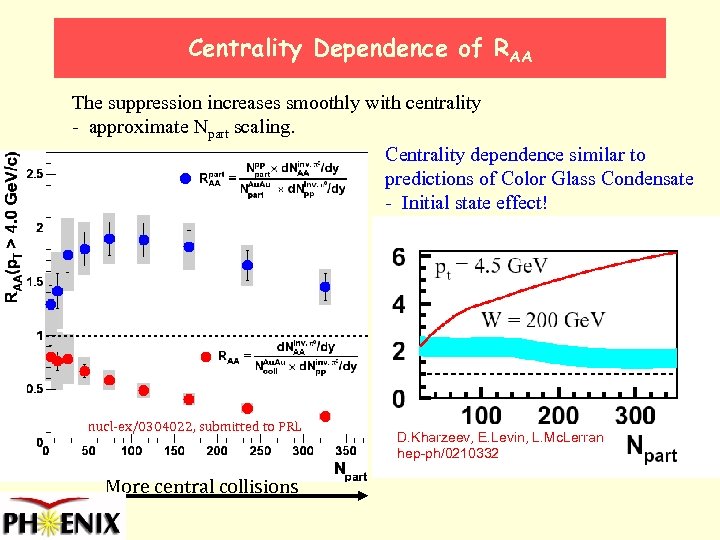 Centrality Dependence of RAA The suppression increases smoothly with centrality - approximate Npart scaling. Centrality dependence similar to predictions of Color Glass Condensate - Initial state effect! nucl-ex/0304022, submitted to PRL More central collisions D. Kharzeev, E. Levin, L. Mc. Lerran hep-ph/0210332
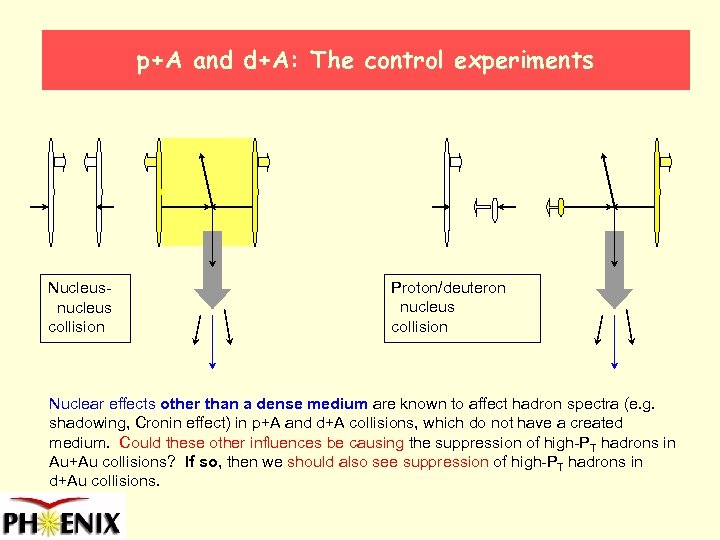 p+A and d+A: The control experiments Nucleusnucleus collision Proton/deuteron nucleus collision Nuclear effects other than a dense medium are known to affect hadron spectra (e. g. shadowing, Cronin effect) in p+A and d+A collisions, which do not have a created medium. Could these other influences be causing the suppression of high-PT hadrons in Au+Au collisions? If so, then we should also see suppression of high-PT hadrons in d+Au collisions.
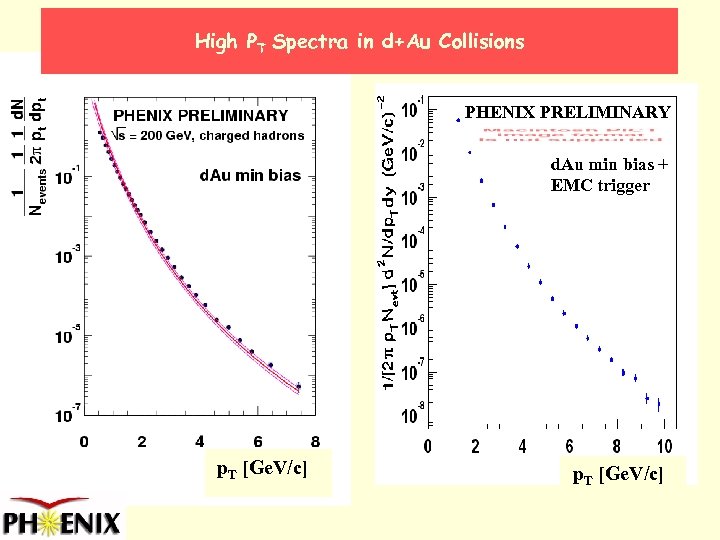 High PT Spectra in d+Au Collisions PHENIX PRELIMINARY d. Au min bias + EMC trigger p. T [Ge. V/c]
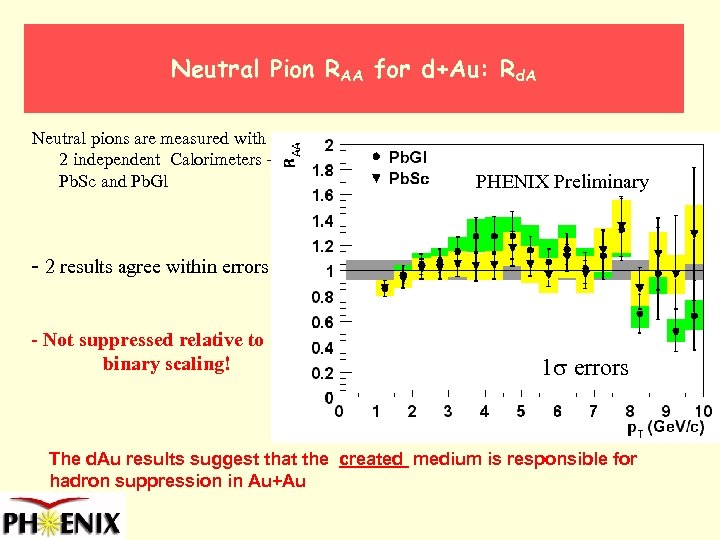 Neutral Pion RAA for d+Au: Rd. A Neutral pions are measured with 2 independent Calorimeters – Pb. Sc and Pb. Gl PHENIX Preliminary - 2 results agree within errors - Not suppressed relative to binary scaling! 1 s errors The d. Au results suggest that the created medium is responsible for hadron suppression in Au+Au
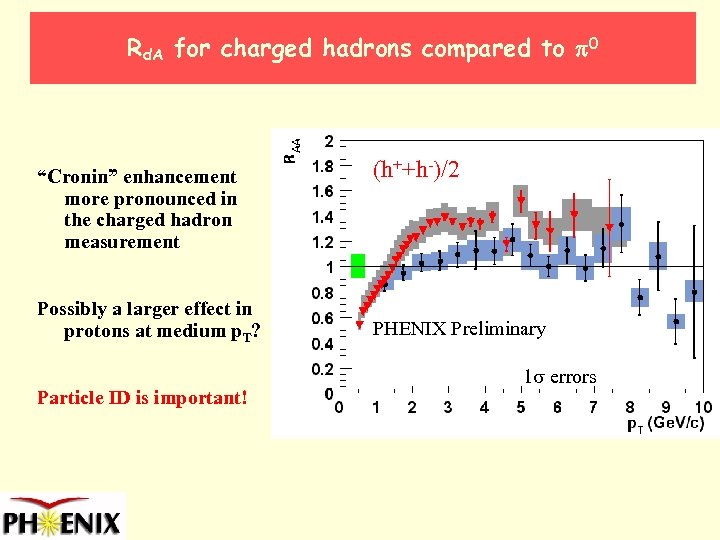 Rd. A for charged hadrons compared to p 0 “Cronin” enhancement more pronounced in the charged hadron measurement Possibly a larger effect in protons at medium p. T? Particle ID is important! (h++h-)/2 PHENIX Preliminary 1 s errors
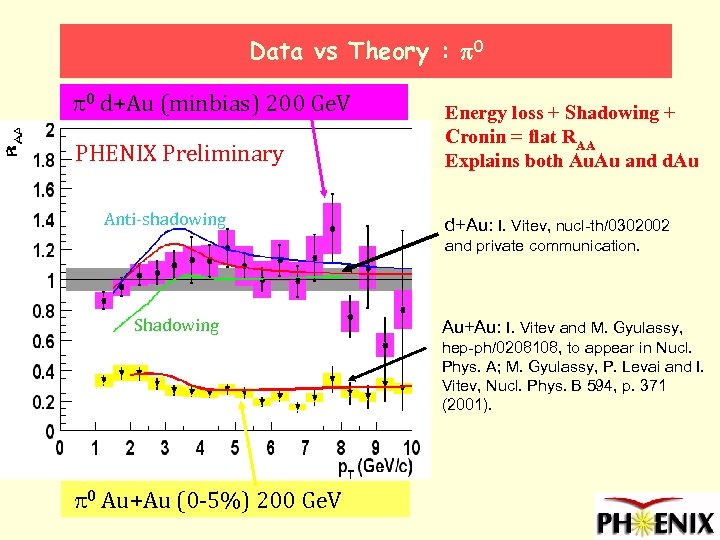 Data vs Theory : p 0 d+Au (minbias) 200 Ge. V PHENIX Preliminary Anti-shadowing Energy loss + Shadowing + Cronin = flat RAA Explains both Au. Au and d. Au d+Au: I. Vitev, nucl-th/0302002 and private communication. Shadowing Au+Au: I. Vitev and M. Gyulassy, hep-ph/0208108, to appear in Nucl. Phys. A; M. Gyulassy, P. Levai and I. Vitev, Nucl. Phys. B 594, p. 371 (2001). p 0 Au+Au (0 -5%) 200 Ge. V
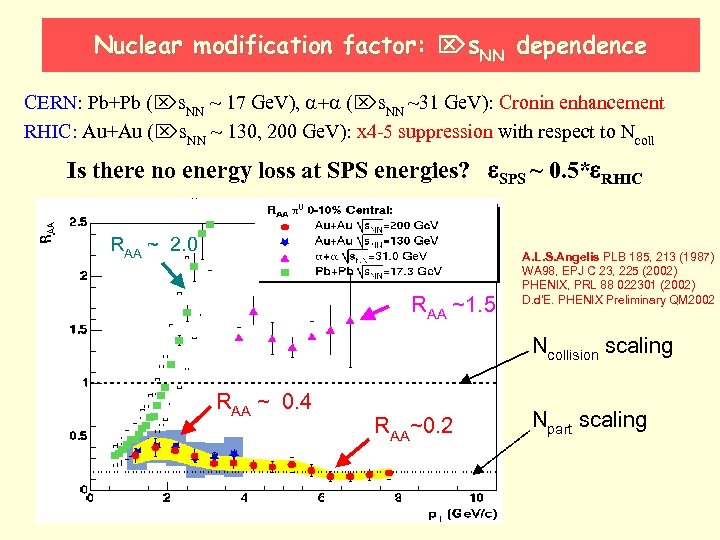 Nuclear modification factor: s. NN dependence CERN: Pb+Pb ( s. NN ~ 17 Ge. V), a+a ( s. NN ~31 Ge. V): Cronin enhancement RHIC: Au+Au ( s. NN ~ 130, 200 Ge. V): x 4 -5 suppression with respect to Ncoll Is there no energy loss at SPS energies? e. SPS ~ 0. 5*e. RHIC RAA ~ 2. 0 RAA ~1. 5 A. L. S. Angelis PLB 185, 213 (1987) WA 98, EPJ C 23, 225 (2002) PHENIX, PRL 88 022301 (2002) D. d'E. PHENIX Preliminary QM 2002 Ncollision scaling RAA ~ 0. 4 RAA~0. 2 Npart scaling
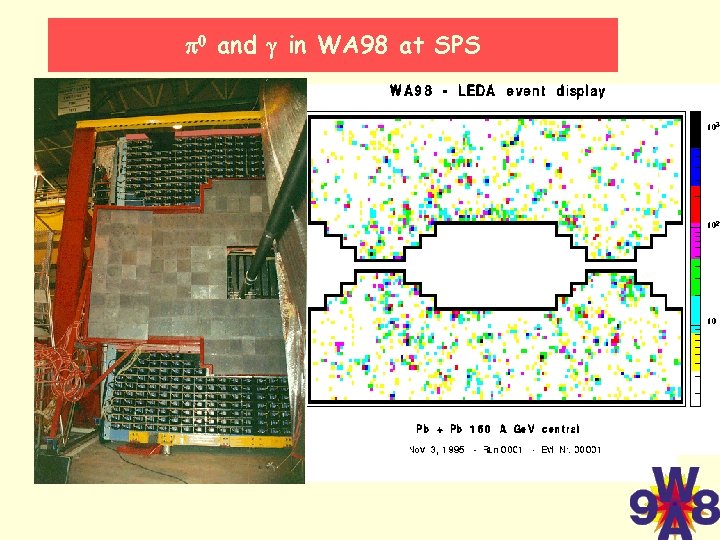 p 0 and g in WA 98 at SPS
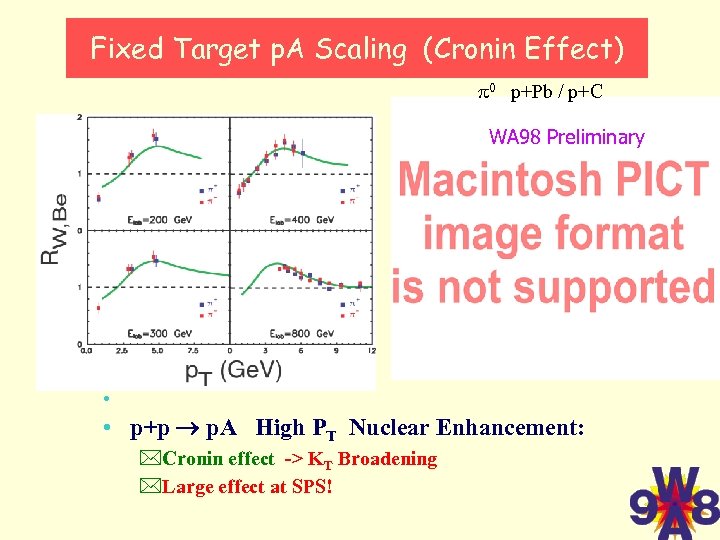 Fixed Target p. A Scaling (Cronin Effect) p 0 p+Pb / p+C WA 98 Preliminary • • p+p p. A High PT Nuclear Enhancement: *Cronin effect -> KT Broadening *Large effect at SPS!
 p 0 Scaling with NColl 158 A Ge. V Pb+Pb (Pb+Pb)central suppressed relative to (Pb+Pb)peripheral *Scales weaker than NColl *Not Cronin-like ! *Decreases with p. T ? WA 98 PRL 81 (1998) 4087 EPJ C 23 (2002) 225. Central suppressed relative to semi-peripheral Similar to RHIC result!
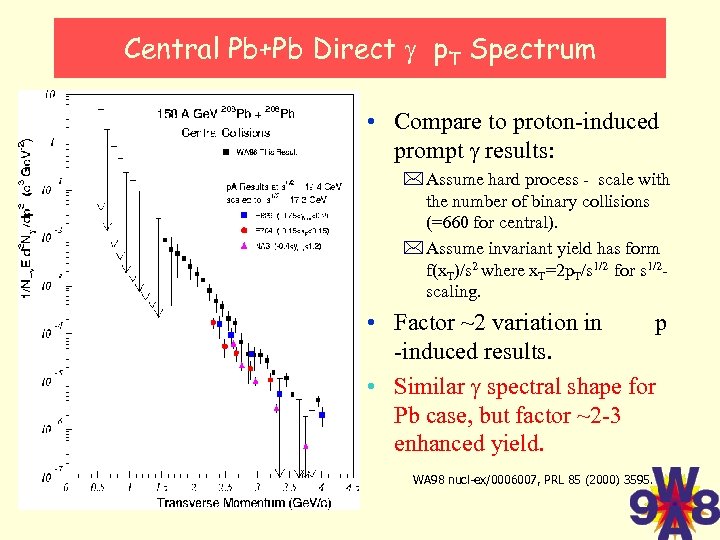 Central Pb+Pb Direct g p. T Spectrum • Compare to proton-induced prompt g results: * Assume hard process - scale with the number of binary collisions (=660 for central). * Assume invariant yield has form f(x. T)/s 2 where x. T=2 p. T/s 1/2 for s 1/2 scaling. • Factor ~2 variation in p -induced results. • Similar g spectral shape for Pb case, but factor ~2 -3 enhanced yield. WA 98 nucl-ex/0006007, PRL 85 (2000) 3595.
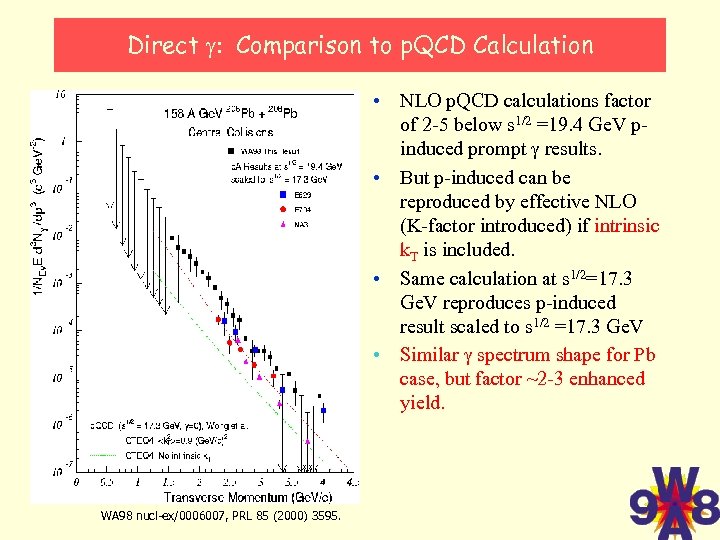 Direct g: Comparison to p. QCD Calculation • NLO p. QCD calculations factor of 2 -5 below s 1/2 =19. 4 Ge. V pinduced prompt g results. • But p-induced can be reproduced by effective NLO (K-factor introduced) if intrinsic k. T is included. • Same calculation at s 1/2=17. 3 Ge. V reproduces p-induced result scaled to s 1/2 =17. 3 Ge. V • Similar g spectrum shape for Pb case, but factor ~2 -3 enhanced yield. WA 98 nucl-ex/0006007, PRL 85 (2000) 3595.
 Photons - k. T Broadening • p. QCD-calculations • Fit intrinsic k. T in pp (E 704) (Q 2 = (2 p. T)2) < k. T 2 > ~ 1. 3 -1. 5 Ge. V 2 • k. T - broadening in Pb+Pb Dk. T 2 ~ 1 Ge. V 2 • Magnitude “consistent“ with expectations from p. A • Hard processes cannot explain excess at low p. T Dumitru et al. , hep-ph/0103203.
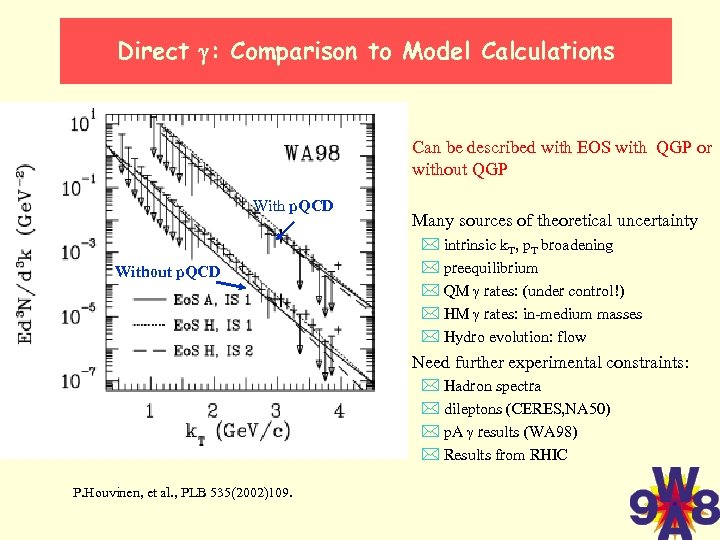 Direct g: Comparison to Model Calculations • With p. QCD Can be described with EOS with QGP or without QGP • Many sources of theoretical uncertainty * intrinsic k. T, p. T broadening * preequilibrium * QM g rates: (under control!) * HM g rates: in-medium masses * Hydro evolution: flow Without p. QCD • Need further experimental constraints: * Hadron spectra * dileptons (CERES, NA 50) * p. A g results (WA 98) * Results from RHIC P. Houvinen, et al. , PLB 535(2002)109.
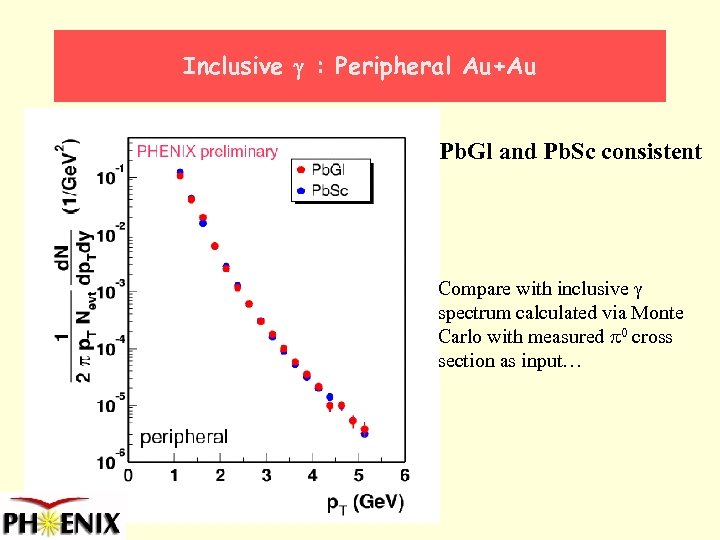 Inclusive g : Peripheral Au+Au Pb. Gl and Pb. Sc consistent Compare with inclusive g spectrum calculated via Monte Carlo with measured p 0 cross section as input…
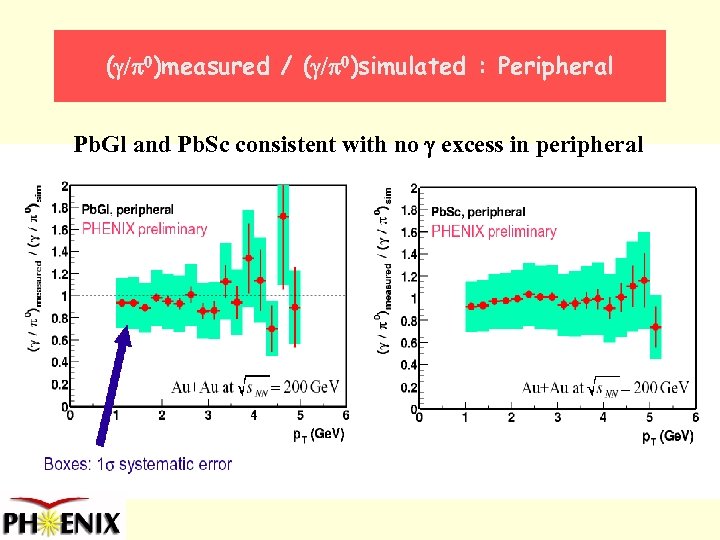 (g/p 0)measured / (g/p 0)simulated : Peripheral Pb. Gl and Pb. Sc consistent with no g excess in peripheral
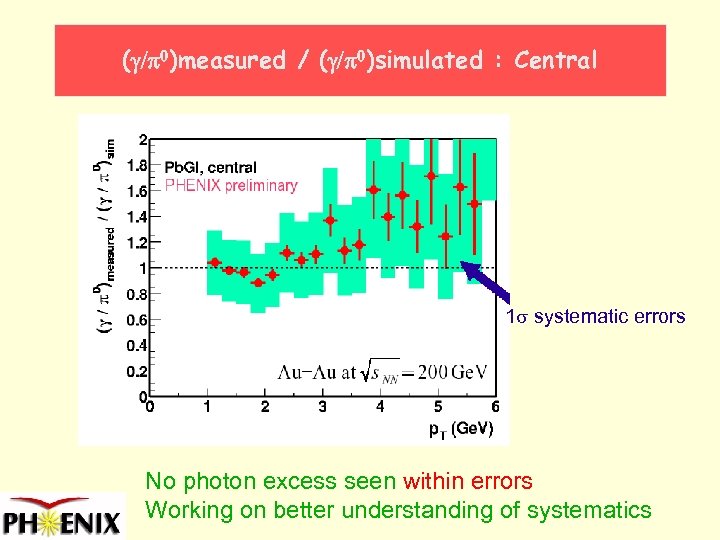 (g/p 0)measured / (g/p 0)simulated : Central 1 s systematic errors No photon excess seen within errors Working on better understanding of systematics
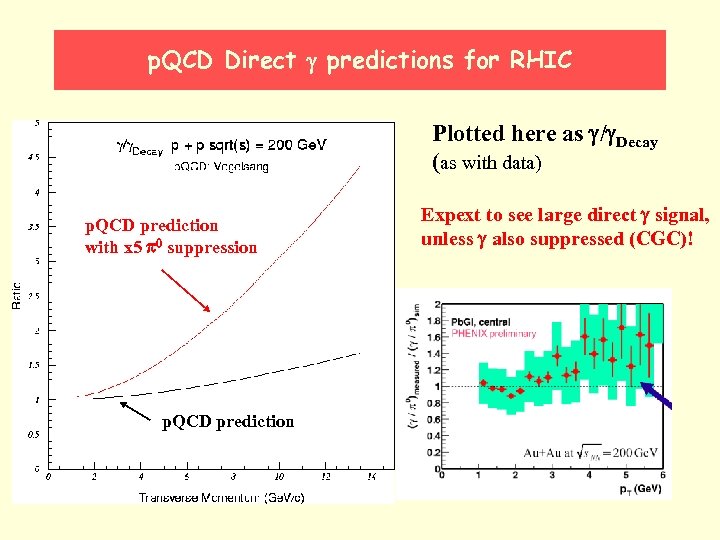 p. QCD Direct g predictions for RHIC Plotted here as g/g. Decay (as with data) p. QCD prediction with x 5 p 0 suppression p. QCD prediction Expext to see large direct g signal, unless g also suppressed (CGC)!
 Direct g: Expectations for RHIC & LHC • At RHIC & LHC the QM contribution dominates for p. T>2 -3 Ge. V/c • p 0 “suppression” = decay g suppression * Increases Direct/Decay • For PHENIX: s 1/2 =200 Ge. V: * Two times WA 98 central sample in PHENIX Min. Bias * High p. T trigger events another x 2 increase Steffan & Thoma PLB 510 (2001) 98.
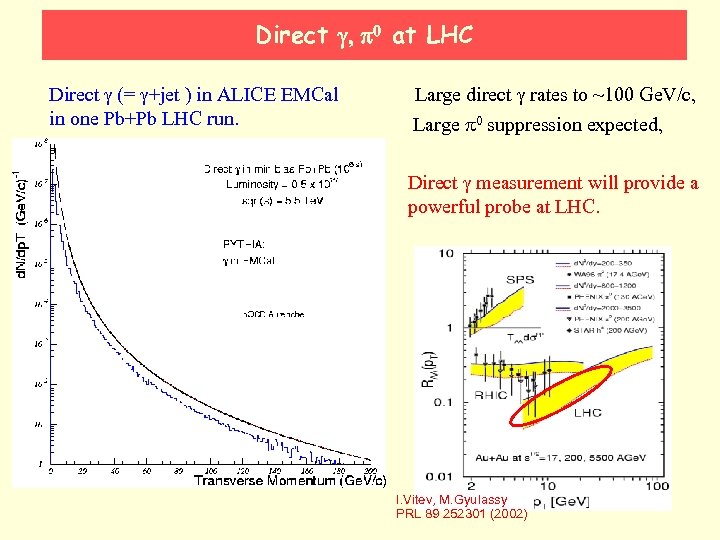 Direct g, p 0 at LHC Direct g (= g+jet ) in ALICE EMCal in one Pb+Pb LHC run. Large direct g rates to ~100 Ge. V/c, Large p 0 suppression expected, Direct g measurement will provide a powerful probe at LHC. I. Vitev, M. Gyulassy PRL 89 252301 (2002)
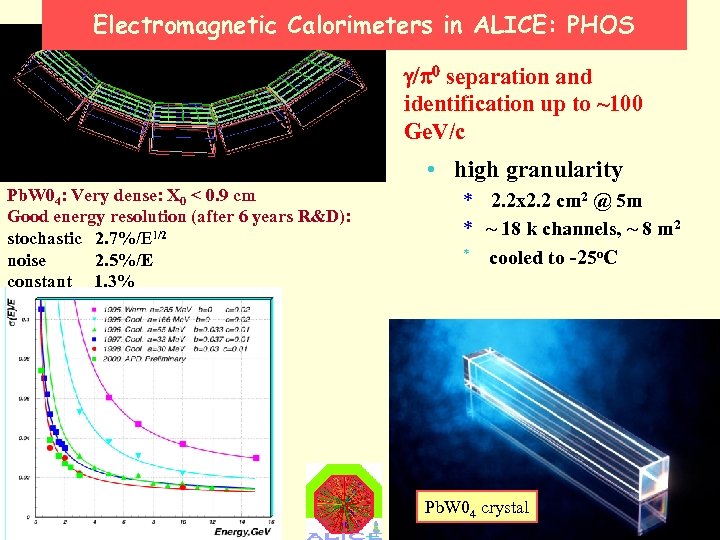 Electromagnetic Calorimeters Photon Spectrometer in ALICE: PHOS g/p 0 separation and identification up to ~100 Ge. V/c • high granularity Pb. W 04: Very dense: X 0 < 0. 9 cm Good energy resolution (after 6 years R&D): stochastic 2. 7%/E 1/2 noise 2. 5%/E constant 1. 3% * 2. 2 x 2. 2 cm 2 @ 5 m * ~ 18 k channels, ~ 8 m 2 * cooled to -25 o. C Pb. W 04 crystal
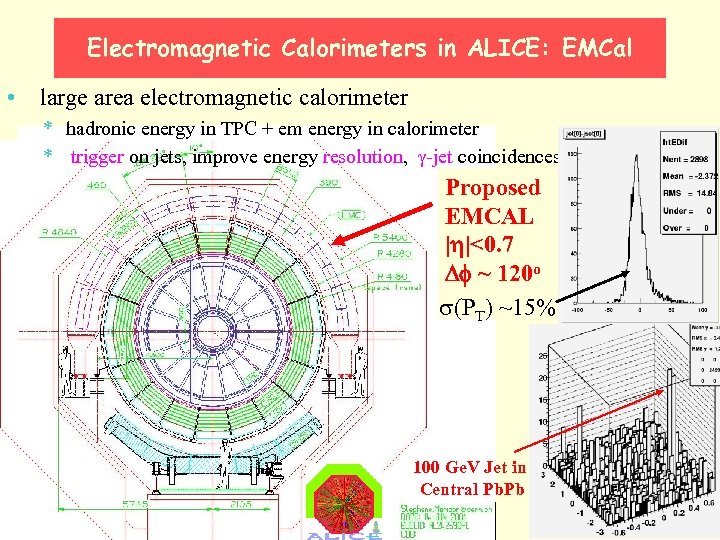 Electromagnetic Calorimeters in ALICE: EMCal • large area electromagnetic calorimeter * hadronic energy in TPC + em energy in calorimeter * trigger on jets, improve energy resolution, g-jet coincidences Proposed EMCAL |h|<0. 7 Df ~ 120 o s(PT) ~15% 100 Ge. V Jet in Central Pb. Pb
 Summary and Conclusions • A strong suppression of hadron production is observed in central Au+Au collisions at RHIC (but protons not suppressed? ); possibly due to parton energy loss in medium (not conclusive). • The hadron production in d+Au collisions shows no strong suppression of high-PT hadrons. Strongly indicative that suppression effect in Au+Au is due to created QCD medium. • Suppression also occurs at SPS energies, but much weaker and obscured by large Cronin effect. • Direct g signal observed at SPS in Pb+Pb collisions possibly explained by EOS with QGP, but also consistent with HG. Many ambiguities - poor p. QCD description, intrinsic k. T effects, etc. Situation will be clearer at RHIC. • Due to p 0 suppression, direct g signal at RHIC and LHC should stand out like a beacon!
 In fond remembrance of Aris…
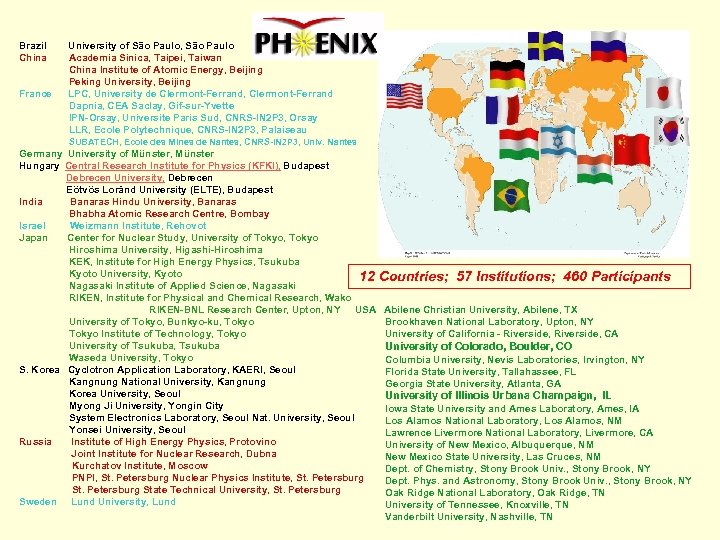 Brazil China France University of São Paulo, São Paulo Academia Sinica, Taipei, Taiwan China Institute of Atomic Energy, Beijing Peking University, Beijing LPC, University de Clermont-Ferrand, Clermont-Ferrand Dapnia, CEA Saclay, Gif-sur-Yvette IPN-Orsay, Universite Paris Sud, CNRS-IN 2 P 3, Orsay LLR, Ecole Polytechnique, CNRS-IN 2 P 3, Palaiseau SUBATECH, Ecole des Mines de Nantes, CNRS-IN 2 P 3, Univ. Nantes Germany University of Münster, Münster Hungary Central Research Institute for Physics (KFKI), Budapest Debrecen University, Debrecen Eötvös Loránd University (ELTE), Budapest India Banaras Hindu University, Banaras Bhabha Atomic Research Centre, Bombay Israel Weizmann Institute, Rehovot Japan Center for Nuclear Study, University of Tokyo, Tokyo Hiroshima University, Higashi-Hiroshima KEK, Institute for High Energy Physics, Tsukuba Kyoto University, Kyoto 12 Countries; 57 Institutions; 460 Participants Nagasaki Institute of Applied Science, Nagasaki RIKEN, Institute for Physical and Chemical Research, Wako RIKEN-BNL Research Center, Upton, NY USA Abilene Christian University, Abilene, TX Brookhaven National Laboratory, Upton, NY University of Tokyo, Bunkyo-ku, Tokyo University of California - Riverside, CA Tokyo Institute of Technology, Tokyo University of Tsukuba, Tsukuba University of Colorado, Boulder, CO Waseda University, Tokyo Columbia University, Nevis Laboratories, Irvington, NY S. Korea Cyclotron Application Laboratory, KAERI, Seoul Florida State University, Tallahassee, FL Kangnung National University, Kangnung Georgia State University, Atlanta, GA Korea University, Seoul University of Illinois Urbana Champaign, IL Myong Ji University, Yongin City Iowa State University and Ames Laboratory, Ames, IA System Electronics Laboratory, Seoul Nat. University, Seoul Los Alamos National Laboratory, Los Alamos, NM Yonsei University, Seoul Lawrence Livermore National Laboratory, Livermore, CA Russia Institute of High Energy Physics, Protovino University of New Mexico, Albuquerque, NM Joint Institute for Nuclear Research, Dubna New Mexico State University, Las Cruces, NM Kurchatov Institute, Moscow Dept. of Chemistry, Stony Brook Univ. , Stony Brook, NY PNPI, St. Petersburg Nuclear Physics Institute, St. Petersburg Dept. Phys. and Astronomy, Stony Brook Univ. , Stony Brook, NY St. Petersburg State Technical University, St. Petersburg Oak Ridge National Laboratory, Oak Ridge, TN Sweden Lund University, Lund University of Tennessee, Knoxville, TN Vanderbilt University, Nashville, TN
 BACKUP SLIDES
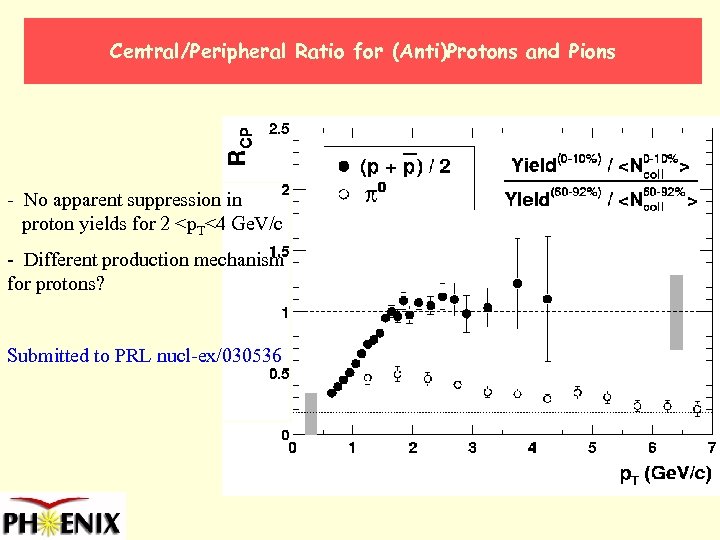 Central/Peripheral Ratio for (Anti)Protons and Pions - No apparent suppression in proton yields for 2