 Скачать презентацию High-Level Synthesis Université de Bretagne-Sud Lab-STICC Philippe COUSSY
e4dc40a34fcf502d3cb08fbbee5464ac.ppt
- Количество слайдов: 62




High-Level Synthesis Université de Bretagne-Sud Lab-STICC Philippe COUSSY philippe. coussy@univ-ubs. fr Workshop - November 2011 - Toulouse
Outline Context High-Level Synthesis GAUT Conclusion
A bit of History Design methodologies Synthesis and verification automation has always been key factors in the evolution of the design process allow to explore the design space efficiently and rapidly deliver correct by construction design High-level language Platform independent Provide flexibility and portability by hiding details of the computer architecture Follow the rules of human language with a grammar, a syntax and a semantic 3
Software domain Machine code (binary sequence) 50’s: concept of assembly language (and assembler) based on mnemonics Maurice V. Wilkes, Cambridge University Later: High-level languages and compilers 1951: First compiler (A-0 system) par Grace Hopper 1954 -1957 Fortran: First high-level language FORmula TRANslator 1959 Cobol, 1964 Basic, 1972 C, 1983 C++…
Hardware domain 60’s: IC were done by hand designed, optimized and laid out 70’s: Gate-level simulation End of 70’s: Cycle-based simulation 80’s: Wide automation Place & route, schematic circuit capture, formal verification and static timing analysis Mid 80’s: Hardware description language 1986 Verilog, 1987 VHDL
Hardware domain 90’s: logic synthesis VHDL and Verilog synthesizable subsets Mid 90’s: High-level synthesis (First gen), Co-design, IP-core reuse… 2000 : Electronic System Level ESL System level language System. C, System. Verilog … Virtual prototyping, Transaction Level Modelling TLM. . .
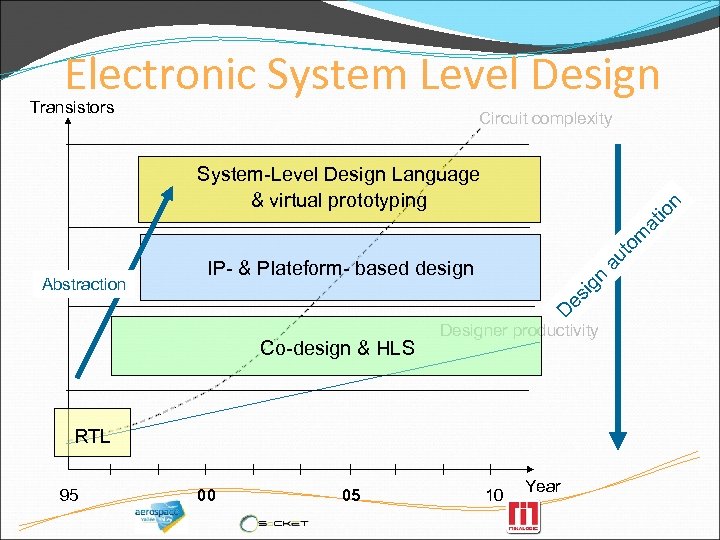
Electronic System Level Design Transistors Circuit complexity es ig n IP- & Plateform- based design D Abstraction au to m at io n System-Level Design Language & virtual prototyping Co-design & HLS Designer productivity RTL 95 00 05 10 Year
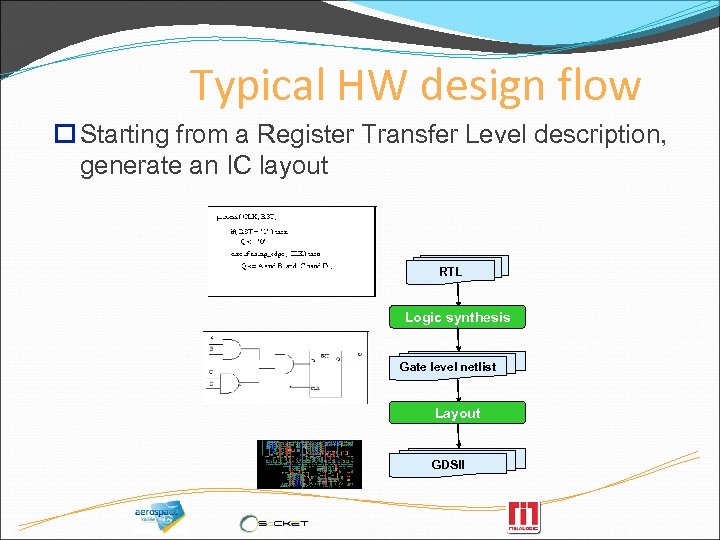
Typical HW design flow o Starting from a Register Transfer Level description, generate an IC layout RTL Logic synthesis Gate level netlist Layout GDSII
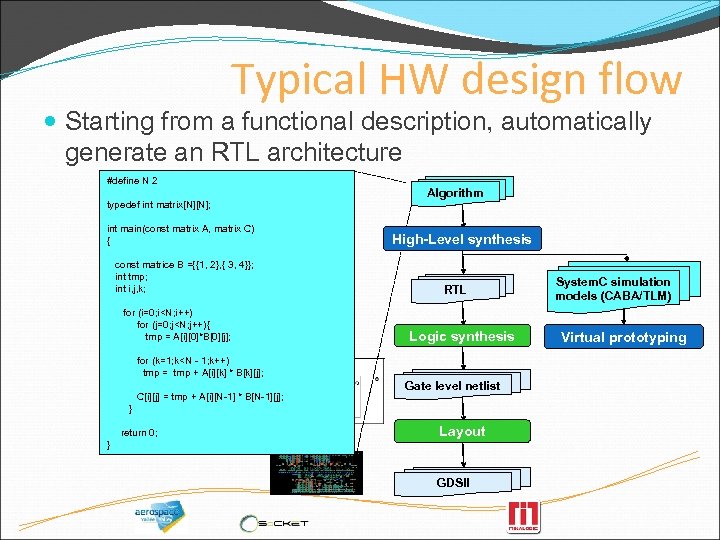
Typical HW design flow Starting from a functional description, automatically generate an RTL architecture #define N 2 typedef int matrix[N][N]; int main(const matrix A, matrix C) { const matrice B ={{1, 2}, { 3, 4}}; int tmp; int i, j, k; for (i=0; i<N; i++) for (j=0; j<N; j++){ tmp = A[i][0]*B[0][j]; Algorithm High-Level synthesis RTL Logic synthesis for (k=1; k<N - 1; k++) tmp = tmp + A[i][k] * B[k][j]; C[i][j] = tmp + A[i][N-1] * B[N-1][j]; Gate level netlist } return 0; } Layout GDSII System. C simulation models (CABA/TLM) Virtual prototyping
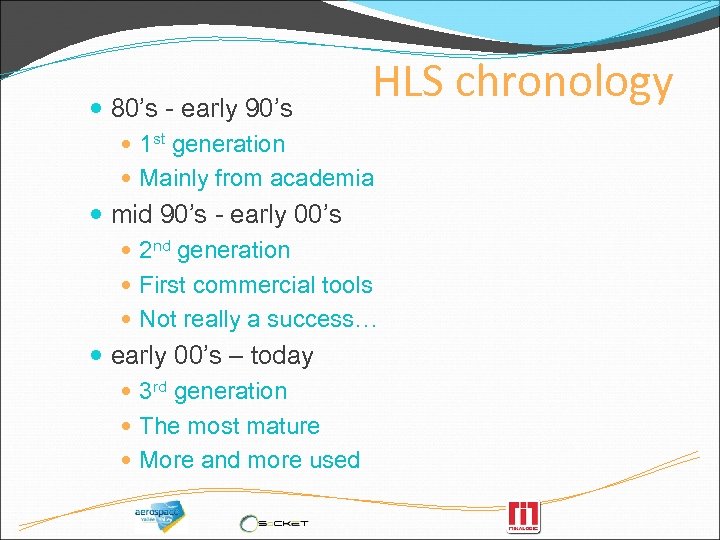
HLS chronology 80’s - early 90’s 1 st generation Mainly from academia mid 90’s - early 00’s 2 nd generation First commercial tools Not really a success… early 00’s – today 3 rd generation The most mature More and more used
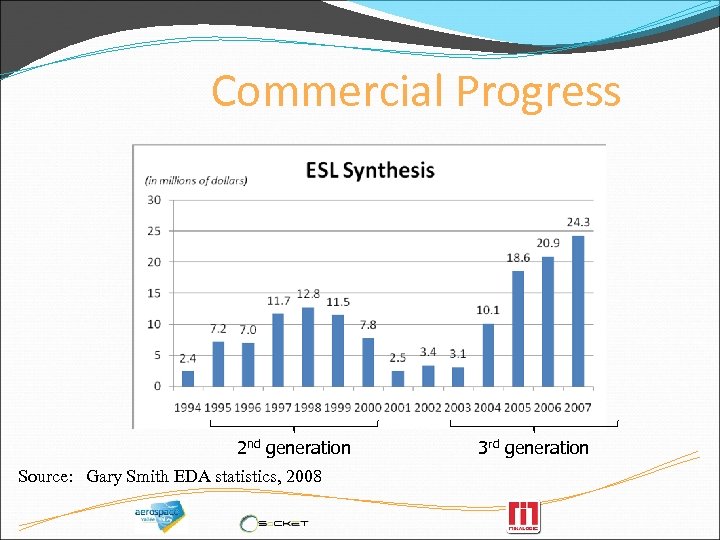
Commercial Progress 2 nd generation Source: Gary Smith EDA statistics, 2008 3 rd generation
Outline Context High-Level Synthesis GAUT Conclusion
High-level synthesis Starting from a functional description, automatically generate an RTL architecture Algorithmic description No timing notion in the source code Mainly oriented toward data dominated application Highly processing algorithm like filters… Initial description can be “RTL oriented” “Function oriented”
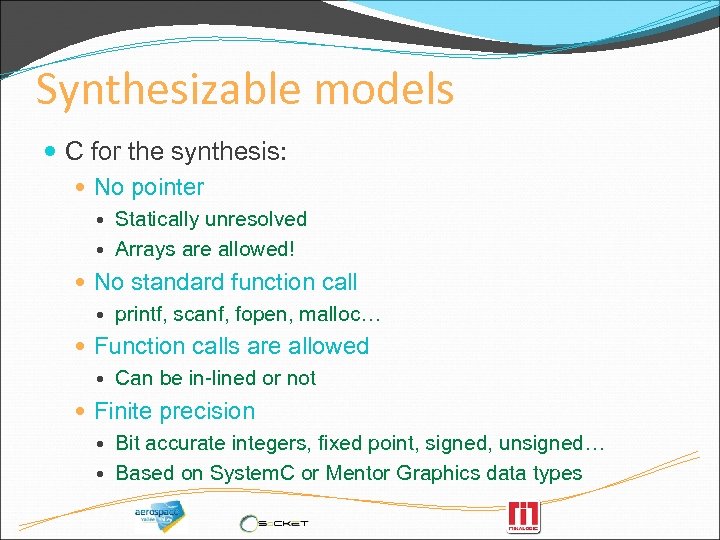
Synthesizable models C for the synthesis: No pointer Statically unresolved Arrays are allowed! No standard function call printf, scanf, fopen, malloc… Function calls are allowed Can be in-lined or not Finite precision Bit accurate integers, fixed point, signed, unsigned… Based on System. C or Mentor Graphics data types
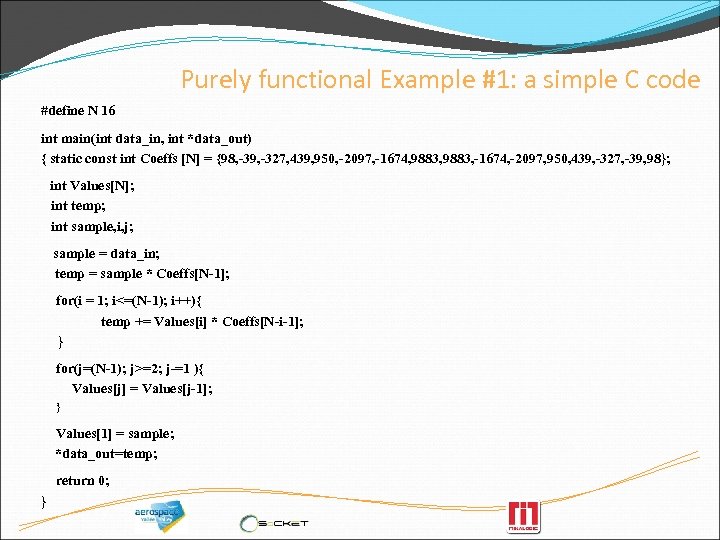
Purely functional Example #1: a simple C code #define N 16 int main(int data_in, int *data_out) { static const int Coeffs [N] = {98, -39, -327, 439, 950, -2097, -1674, 9883, -1674, -2097, 950, 439, -327, -39, 98}; int Values[N]; int temp; int sample, i, j; sample = data_in; temp = sample * Coeffs[N-1]; for(i = 1; i<=(N-1); i++){ temp += Values[i] * Coeffs[N-i-1]; } for(j=(N-1); j>=2; j-=1 ){ Values[j] = Values[j-1]; } Values[1] = sample; *data_out=temp; return 0; }
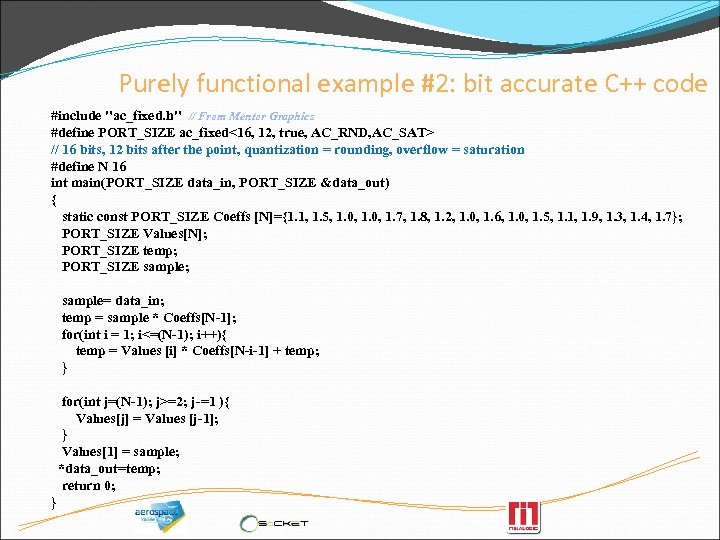
Purely functional example #2: bit accurate C++ code #include "ac_fixed. h" // From Mentor Graphics #define PORT_SIZE ac_fixed<16, 12, true, AC_RND, AC_SAT> // 16 bits, 12 bits after the point, quantization = rounding, overflow = saturation #define N 16 int main(PORT_SIZE data_in, PORT_SIZE &data_out) { static const PORT_SIZE Coeffs [N]={1. 1, 1. 5, 1. 0, 1. 7, 1. 8, 1. 2, 1. 0, 1. 6, 1. 0, 1. 5, 1. 1, 1. 9, 1. 3, 1. 4, 1. 7}; PORT_SIZE Values[N]; PORT_SIZE temp; PORT_SIZE sample; sample= data_in; temp = sample * Coeffs[N-1]; for(int i = 1; i<=(N-1); i++){ temp = Values [i] * Coeffs[N-i-1] + temp; } for(int j=(N-1); j>=2; j-=1 ){ Values[j] = Values [j-1]; } Values[1] = sample; *data_out=temp; return 0; }
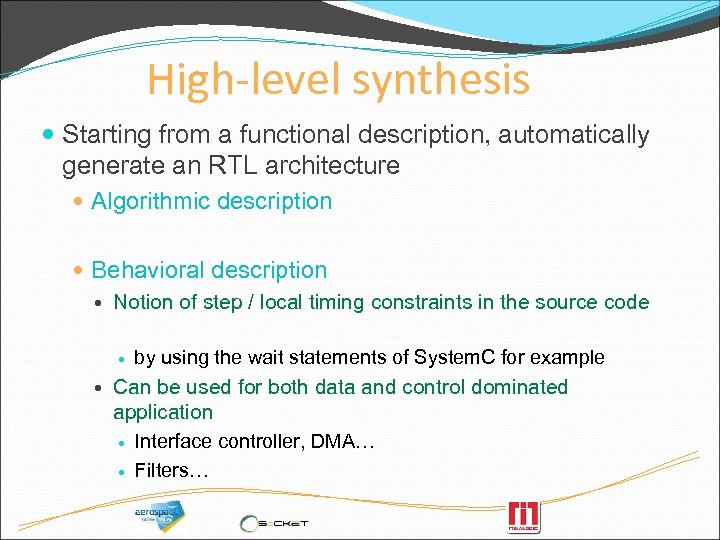
High-level synthesis Starting from a functional description, automatically generate an RTL architecture Algorithmic description Behavioral description Notion of step / local timing constraints in the source code by using the wait statements of System. C for example Can be used for both data and control dominated application Interface controller, DMA… Filters…
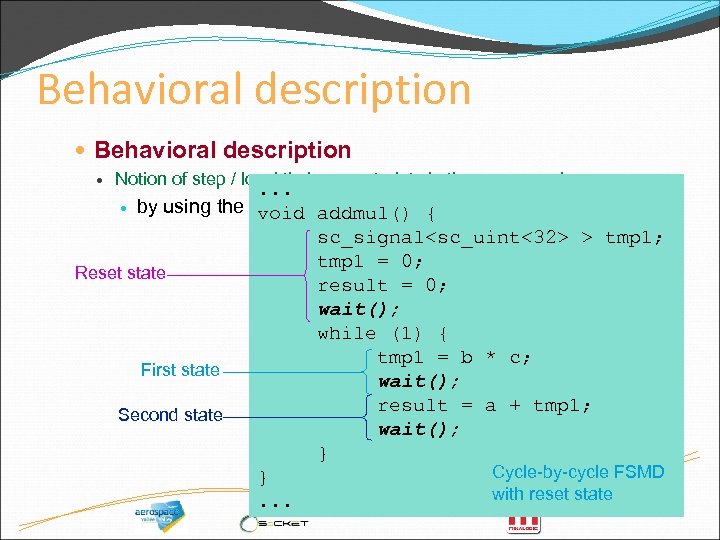
Behavioral description Notion of step / local timing constraints in the source code . . . by using the wait statements of System. C for example void addmul() { sc_signal<sc_uint<32> > tmp 1; tmp 1 = 0; Reset state result = 0; wait(); while (1) { tmp 1 = b * c; First state wait(); result = a + tmp 1; Second state wait(); } Cycle-by-cycle FSMD } with reset state. . .
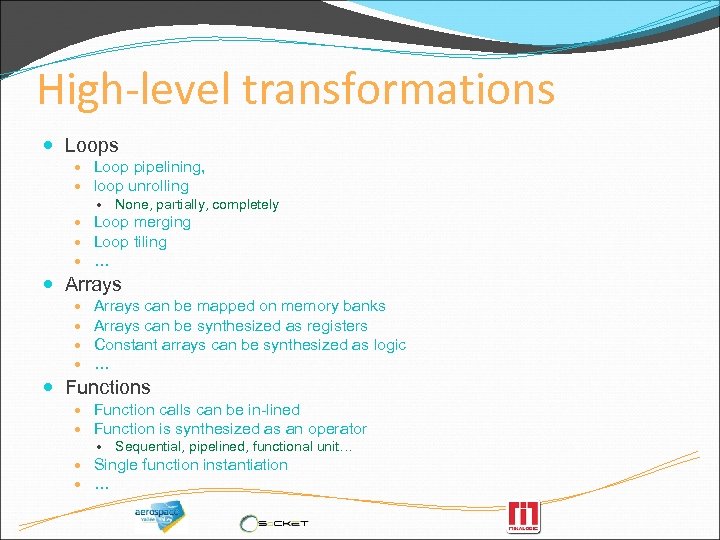
High-level transformations Loop pipelining, loop unrolling None, partially, completely Loop merging Loop tiling … Arrays can be mapped on memory banks Arrays can be synthesized as registers Constant arrays can be synthesized as logic … Functions Function calls can be in-lined Function is synthesized as an operator Sequential, pipelined, functional unit… Single function instantiation …
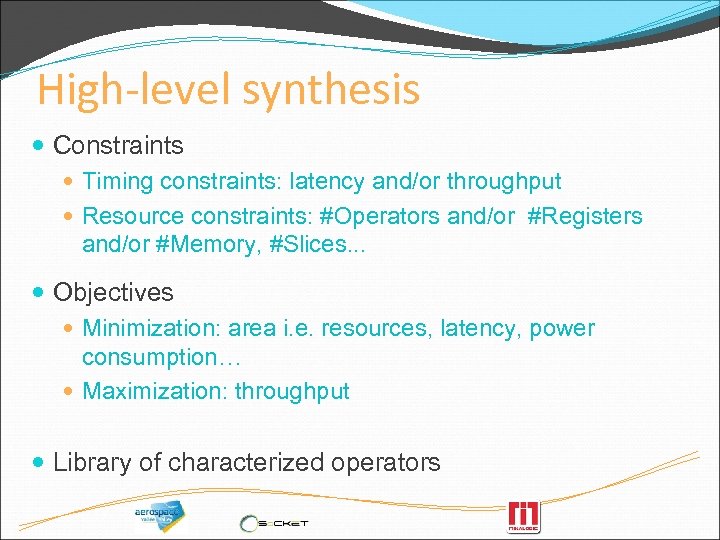
High-level synthesis Constraints Timing constraints: latency and/or throughput Resource constraints: #Operators and/or #Registers and/or #Memory, #Slices. . . Objectives Minimization: area i. e. resources, latency, power consumption… Maximization: throughput Library of characterized operators
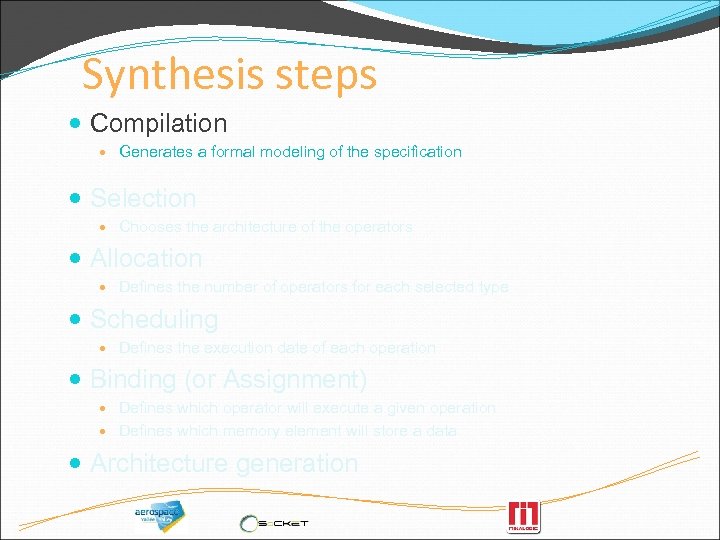
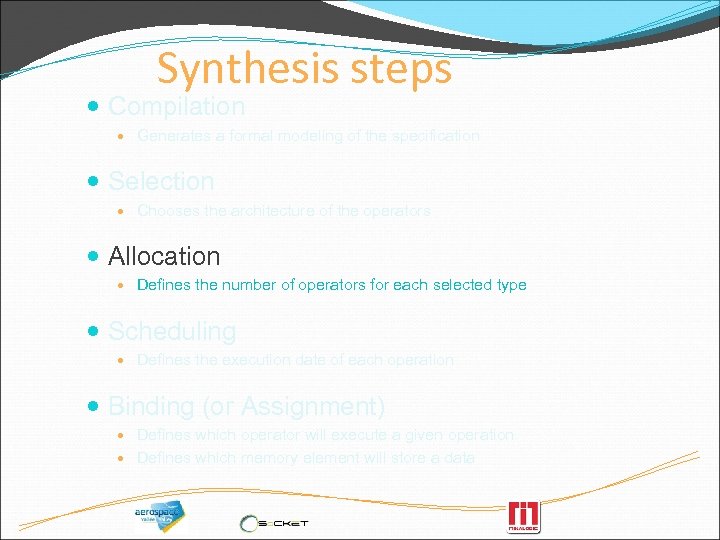
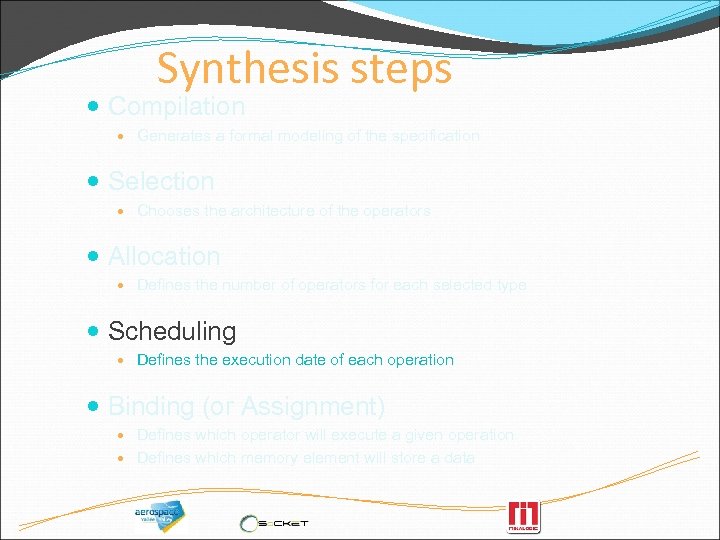
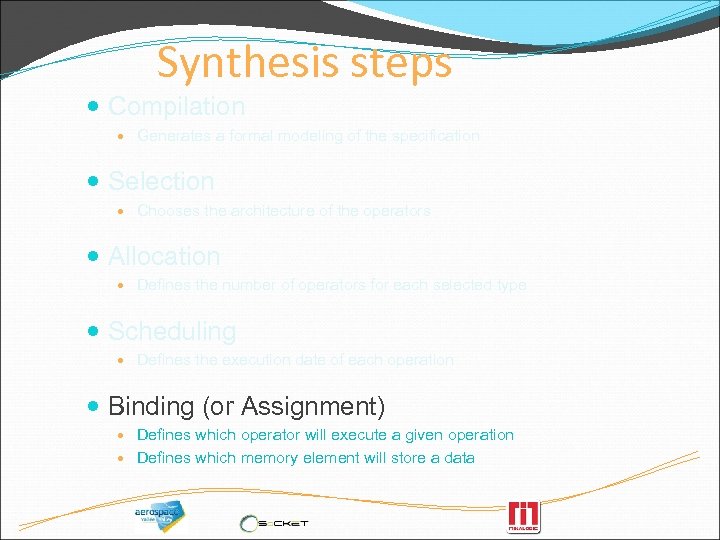
Synthesis steps Compilation Generates a formal modeling of the specification Selection Chooses the architecture of the operators Allocation Defines the number of operators for each selected type Scheduling Defines the execution date of each operation Binding (or Assignment) Defines which operator will execute a given operation Defines which memory element will store a data Architecture generation
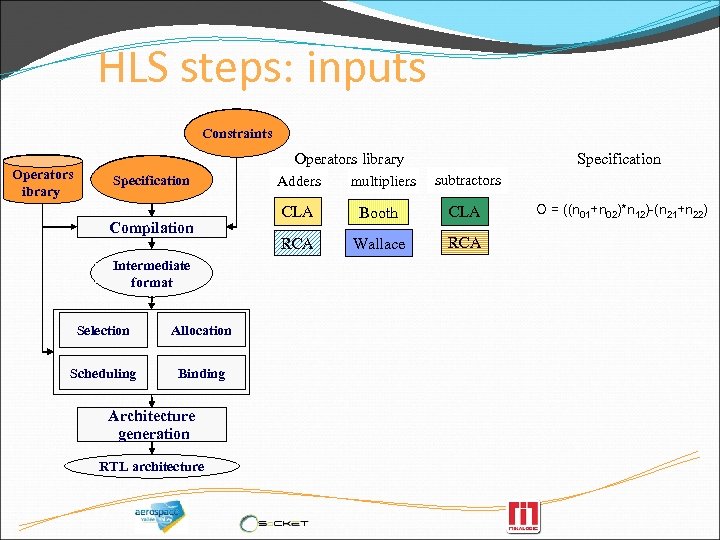
HLS steps: inputs Constraints Operators Library Operators library Specification Compilation Intermediate format Selection Allocation Scheduling Binding Architecture generation RTL architecture Adders multipliers Specification subtractors CLA Booth CLA RCA Wallace RCA O = ((n 01+n 02)*n 12)-(n 21+n 22)
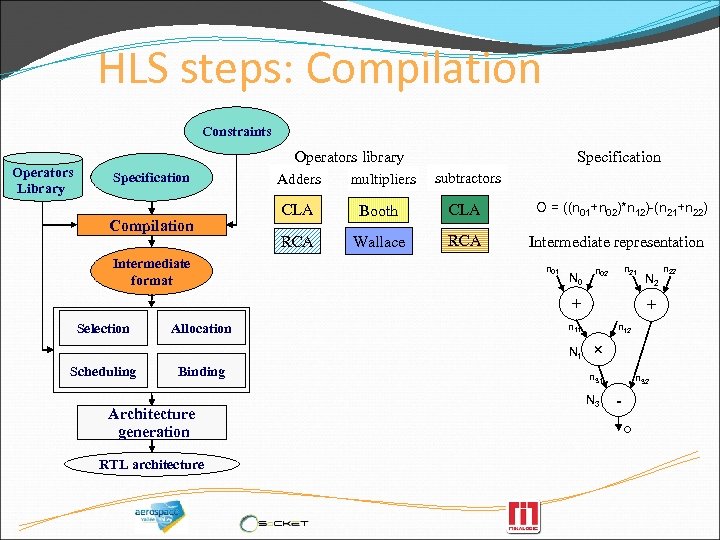
HLS steps: Compilation Constraints Operators Library Operators library Specification Compilation Intermediate format Adders multipliers Specification subtractors CLA Booth CLA O = ((n 01+n 02)*n 12)-(n 21+n 22) RCA Wallace RCA Intermediate representation n 01 N 0 n 21 n 02 + Selection Allocation Scheduling Binding Architecture generation RTL architecture + n 11 N 2 n 12 × n 31 N 3 n 32 O n 22
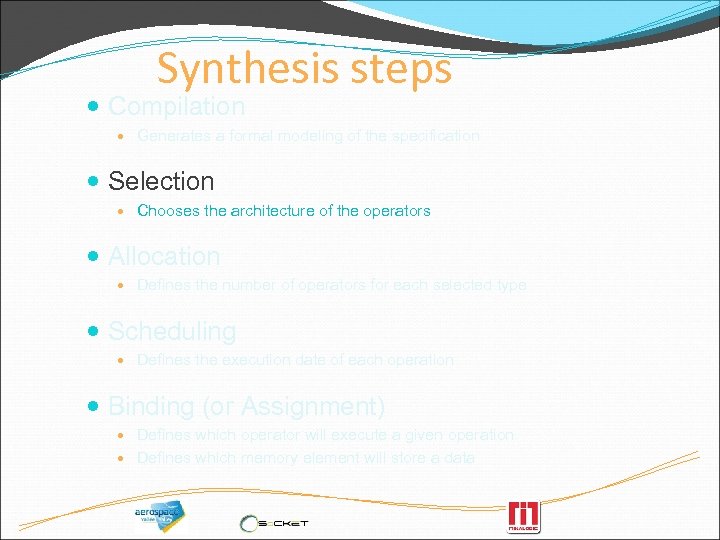
Synthesis steps Compilation Generates a formal modeling of the specification Selection Chooses the architecture of the operators Allocation Defines the number of operators for each selected type Scheduling Defines the execution date of each operation Binding (or Assignment) Defines which operator will execute a given operation Defines which memory element will store a data
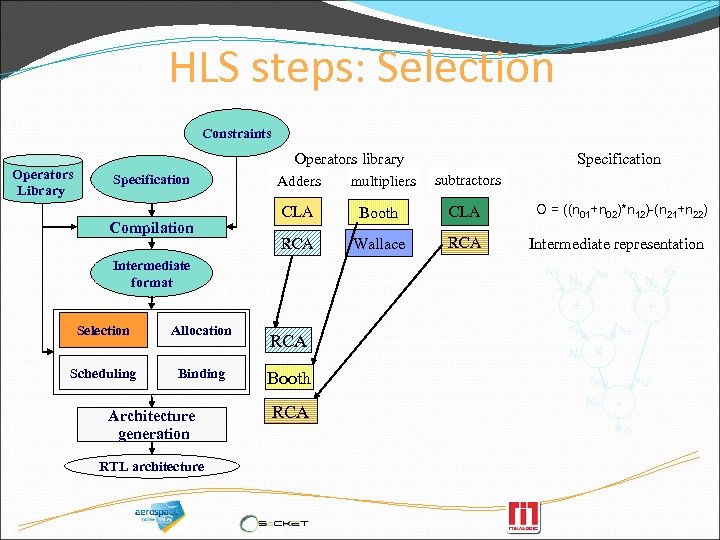
HLS steps: Selection Constraints Operators Library Operators library Specification Compilation Adders multipliers Specification subtractors CLA Booth CLA O = ((n 01+n 02)*n 12)-(n 21+n 22) RCA Wallace RCA Intermediate representation Intermediate format n 01 N 0 n 21 n 02 + Selection Scheduling Allocation Binding Architecture generation RTL architecture RCA Booth RCA + n 11 N 2 n 12 × n 31 N 3 n 32 O n 22
Synthesis steps Compilation Generates a formal modeling of the specification Selection Chooses the architecture of the operators Allocation Defines the number of operators for each selected type Scheduling Defines the execution date of each operation Binding (or Assignment) Defines which operator will execute a given operation Defines which memory element will store a data
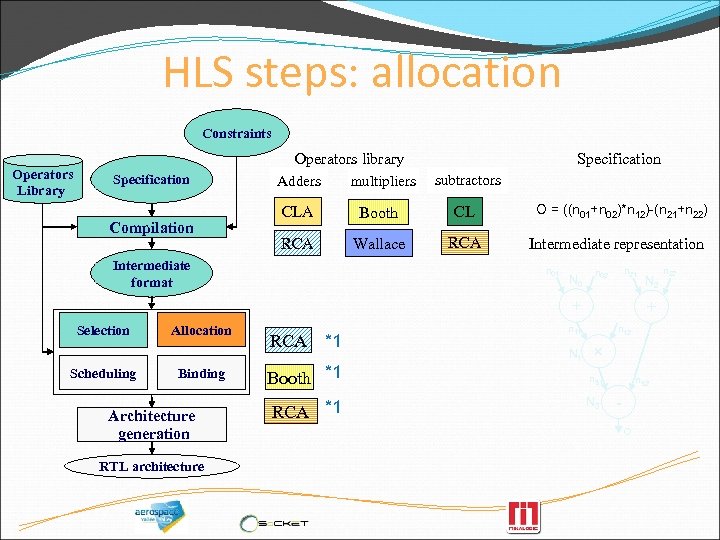
HLS steps: allocation Constraints Operators Library Operators library Specification Compilation Adders multipliers Specification subtractors CLA Booth CL RCA Wallace RCA Intermediate format O = ((n 01+n 02)*n 12)-(n 21+n 22) Intermediate representation n 01 N 0 n 21 n 02 + Selection Scheduling Allocation Binding Architecture generation RTL architecture RCA *1 Booth *1 RCA *1 + n 11 N 2 n 12 × n 31 N 3 n 32 O n 22
Synthesis steps Compilation Generates a formal modeling of the specification Selection Chooses the architecture of the operators Allocation Defines the number of operators for each selected type Scheduling Defines the execution date of each operation Binding (or Assignment) Defines which operator will execute a given operation Defines which memory element will store a data
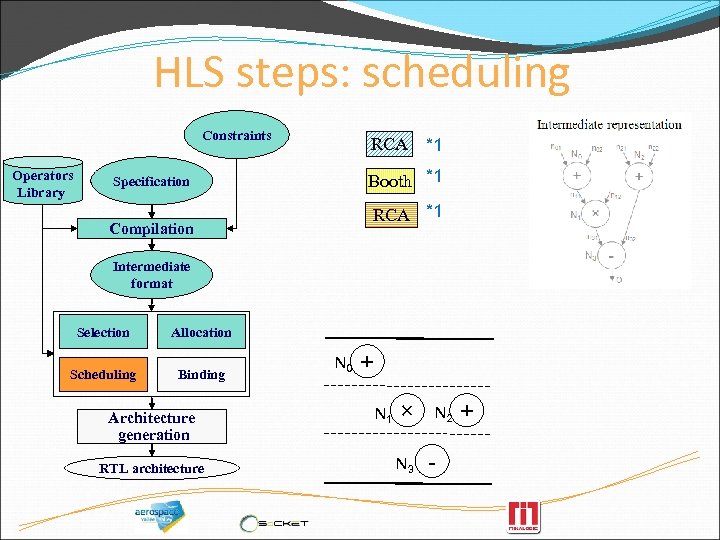
HLS steps: scheduling Constraints Operators Library RCA *1 Booth *1 Specification RCA *1 Compilation Intermediate format Selection Allocation Scheduling Binding Architecture generation RTL architecture N 0 + N 1 × N 3 N 2 - +
Synthesis steps Compilation Generates a formal modeling of the specification Selection Chooses the architecture of the operators Allocation Defines the number of operators for each selected type Scheduling Defines the execution date of each operation Binding (or Assignment) Defines which operator will execute a given operation Defines which memory element will store a data
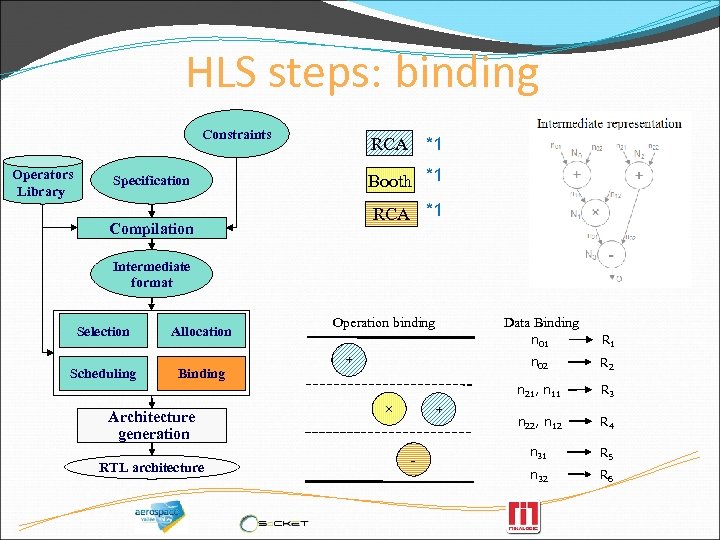
HLS steps: binding Constraints Operators Library RCA *1 Booth *1 Specification RCA *1 Compilation Intermediate format Selection Allocation Scheduling Binding Architecture generation RTL architecture Operation binding Data Binding n 01 n 02 × + - R 2 n 21, n 11 + R 1 R 3 n 22, n 12 R 4 n 31 R 5 n 32 R 6
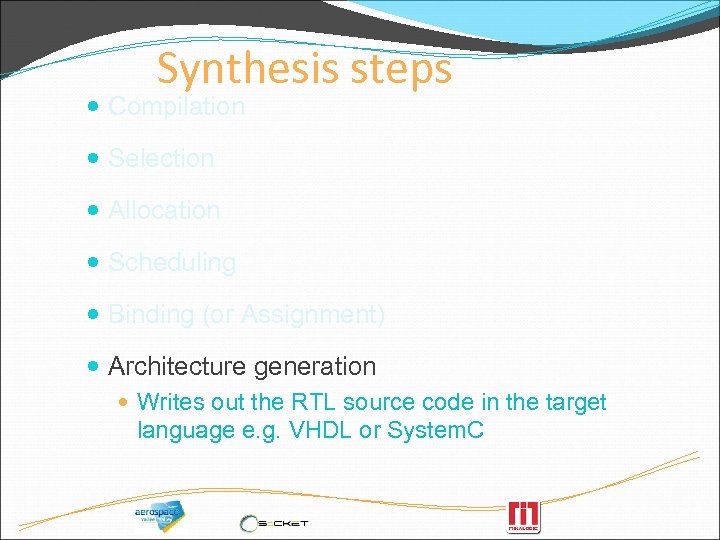
Synthesis steps Compilation Selection Allocation Scheduling Binding (or Assignment) Architecture generation Writes out the RTL source code in the target language e. g. VHDL or System. C
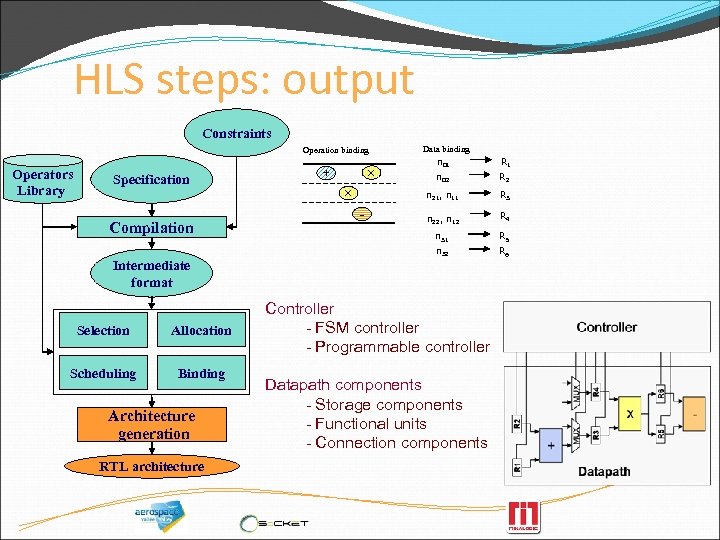
HLS steps: output Constraints Operation binding Operators Library Specification Compilation Intermediate format Selection Allocation Scheduling Binding Architecture generation RTL architecture × + Data binding n 01 R 3 n 22, n 12 R 4 n 31 R 5 n 32 - R 2 n 21, n 11 × n 02 R 6 Controller - FSM controller - Programmable controller Datapath components - Storage components - Functional units - Connection components
And a lot of additional problems to solve. . . Connection merging Bus sharing Register merging Register file. . . Chaining Several sequential operations in a cycle Multi-cycling One operation takes more than one clock cycle to execute Pipelining Pipelined Datapath, pipelined operator, pipelined controller . . .
Academic tools Streamroller (Univ. Mich. ) MMALPHA (IRISA+CITI+…) SPARK (UCSD) UGH (TIMA+LIP 6) x. Pilot (UCLA) ROCCC (UC Riverside) GAUT (UBS / Lab-STICC) …
Commercial tools q Catapult. C (Mentor Graphics => Calypto) q Cynthecizer (Forte design) q Cyber (NEC) q Auto. Pilot (Auto. ESL => Xilinx) q C to Silicon (Candence) q PICO (Spin-off HP => Synfora => Synopsys) q Synphony (Synopsys) q…
Outline Context High-Level Synthesis GAUT Conclusion
GAUT An academic, free and open source HLS tool Dedicated to DSP applications Data-dominated algorithm 1 D, 2 D Filters Transforms (Fourrier, Hadamar, DCT…) Channel Coding, source coding algorithms Input: bit-accurate C/C++ algorithm bit-accurate integer and fixed-point from Mentor Graphics
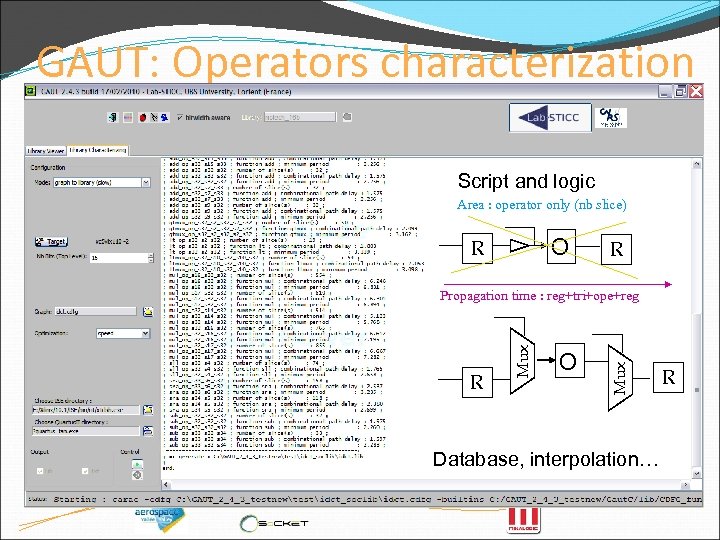
GAUT Output: RTL Architecture VHDL System. C CABA: Cycle accurate and Bit accurate TLM: Transaction level model Compatible with both Soc. Lib and MPARM virtual prototyping platforms Automated Test-bench generation Automated operators characterization
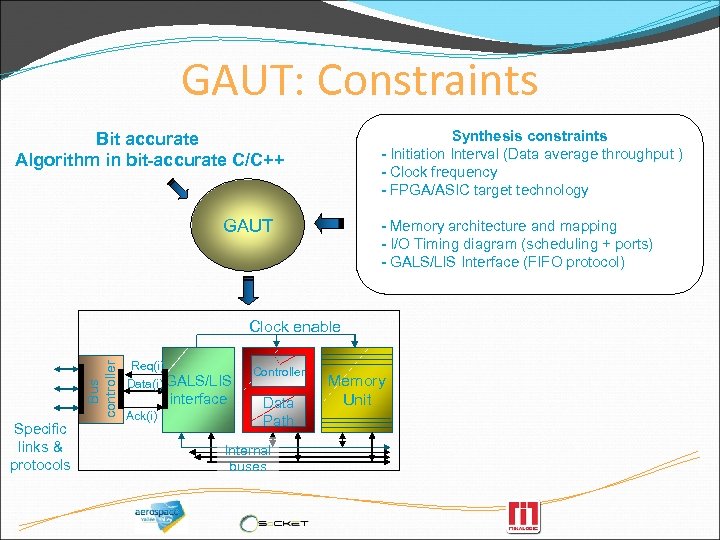
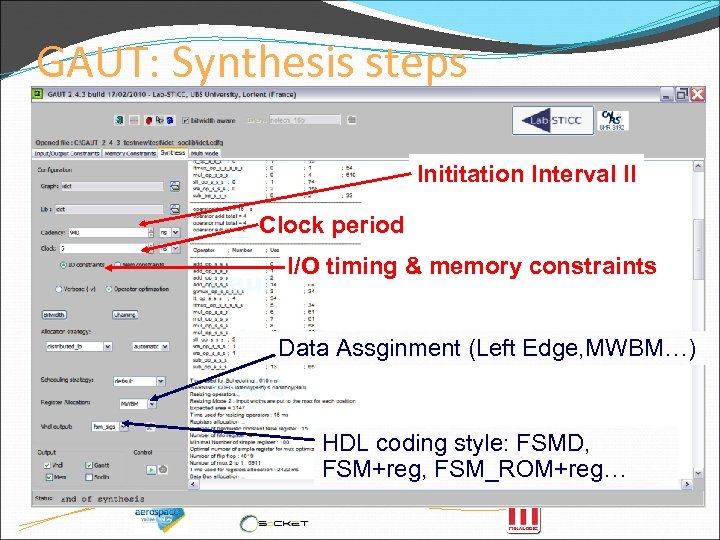
GAUT: Constraints Synthesis constraints - Initiation Interval (Data average throughput ) - Clock frequency - FPGA/ASIC target technology Bit accurate Algorithm in bit-accurate C/C++ GAUT - Memory architecture and mapping - I/O Timing diagram (scheduling + ports) - GALS/LIS Interface (FIFO protocol) Bus controller Clock enable Specific links & protocols Req(i) Data(i) GALS/LIS interface Ack(i) Controller Data Path Internal buses Memory Unit
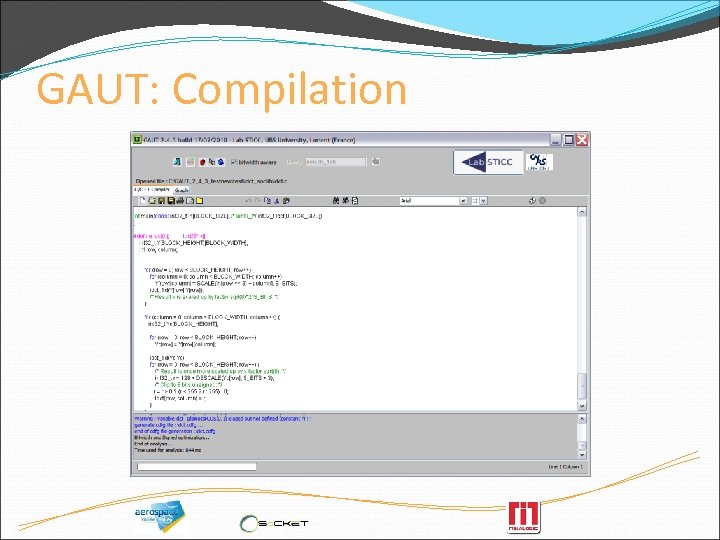
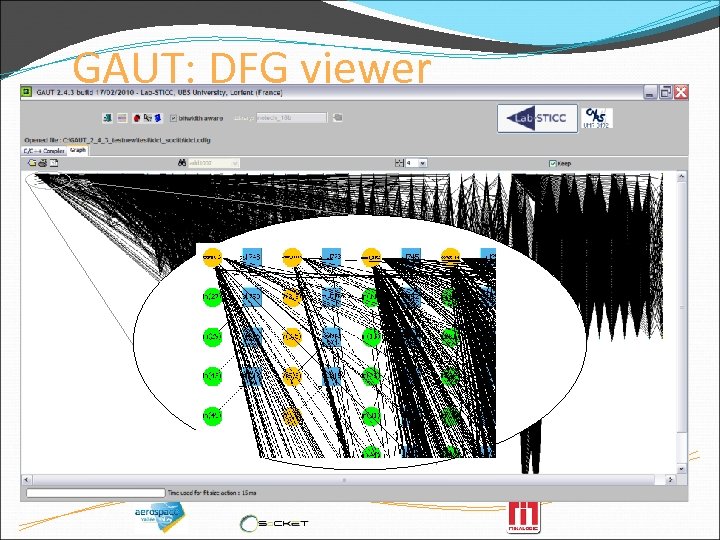
GAUT: Compilation
GAUT: DFG viewer
GAUT: Operators characterization Script and logic Area : operator only (nb slice) O R R O Mux R Mux Propagation time : reg+tri+ope+reg Database, interpolation… R
GAUT: Synthesis steps Inititation Interval II Clock period I/O timing & memory constraints Data Assginment (Left Edge, MWBM…) HDL coding style: FSMD, FSM+reg, FSM_ROM+reg…
GAUT: Gantt viewer
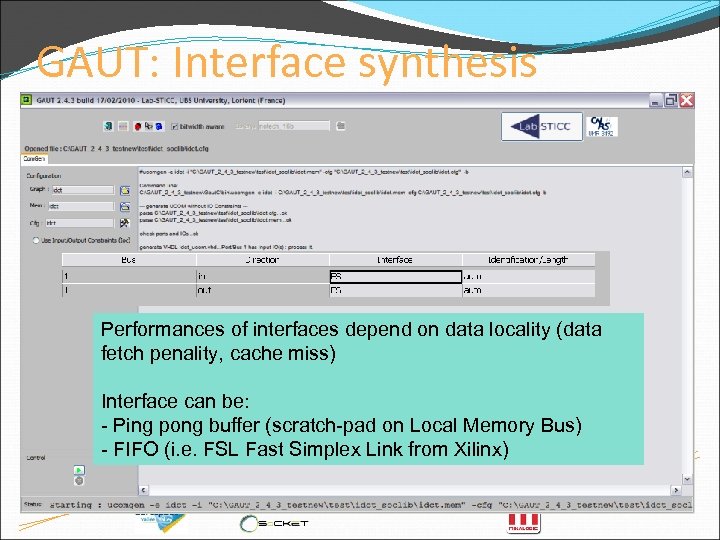
GAUT: Interface synthesis Performances of interfaces depend on data locality (data fetch penality, cache miss) Interface can be: - Ping pong buffer (scratch-pad on Local Memory Bus) - FIFO (i. e. FSL Fast Simplex Link from Xilinx)
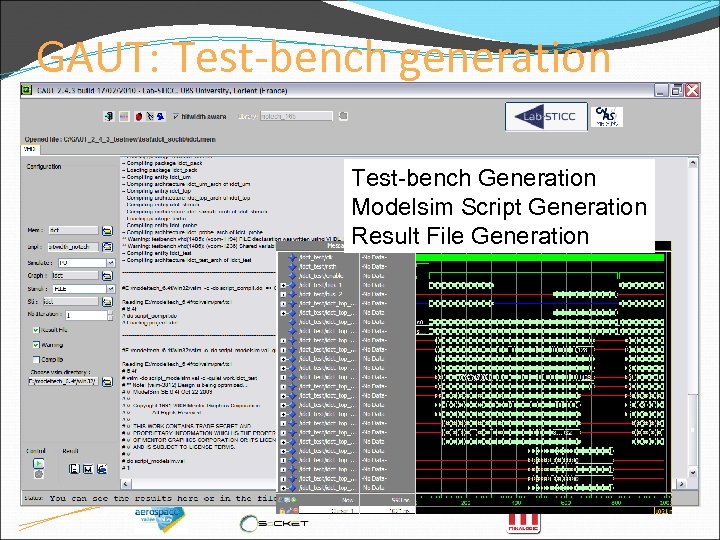
GAUT: Test-bench generation Test-bench Generation Modelsim Script Generation Result File Generation
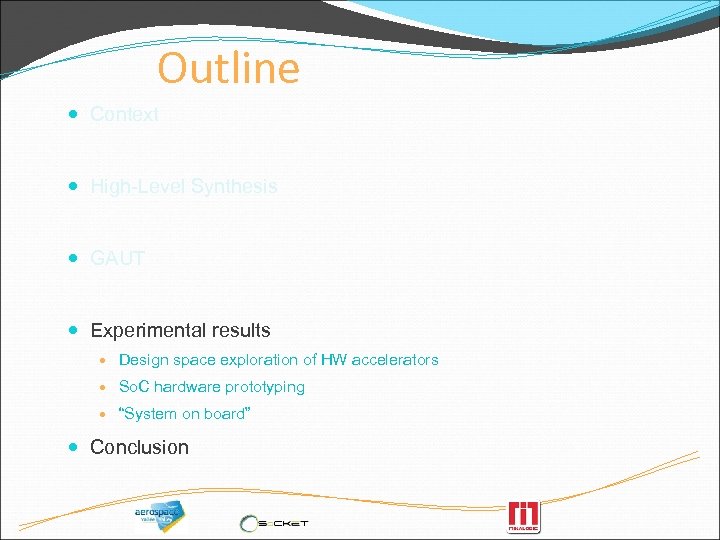
Outline Context High-Level Synthesis GAUT Experimental results Design space exploration of HW accelerators So. C hardware prototyping “System on board” Conclusion
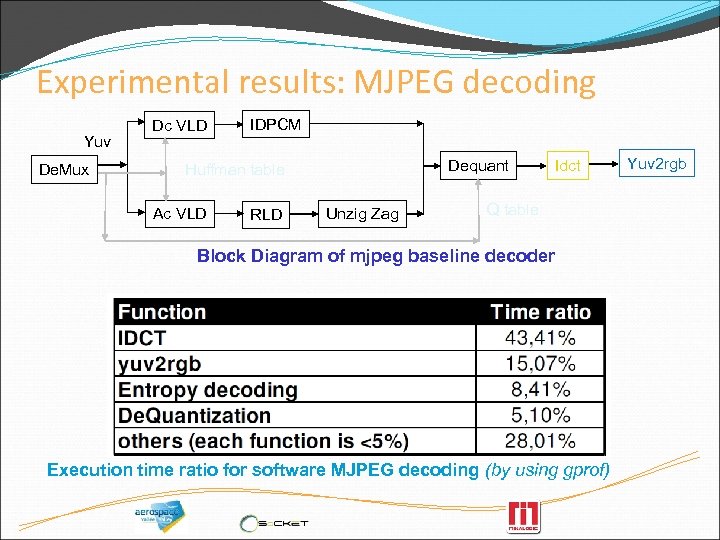
Experimental results: MJPEG decoding Yuv De. Mux Dc VLD IDPCM Dequant Huffman table Ac VLD RLD Unzig Zag Idct Q table Block Diagram of mjpeg baseline decoder Execution time ratio for software MJPEG decoding (by using gprof) Yuv 2 rgb
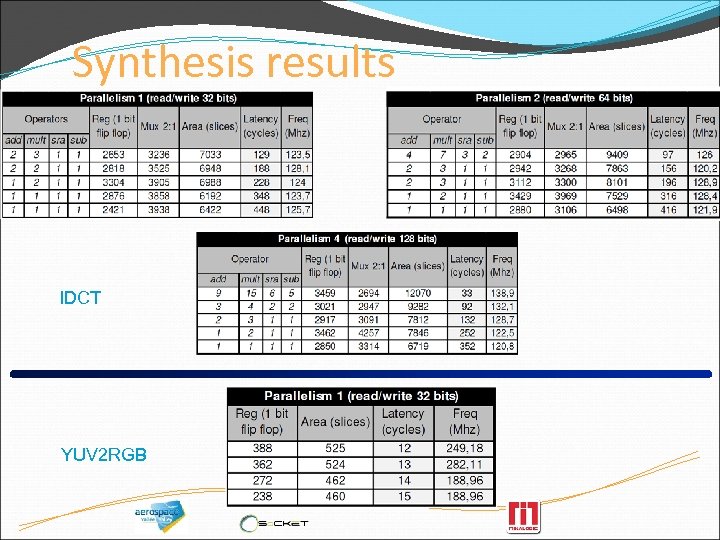
Synthesis results IDCT YUV 2 RGB
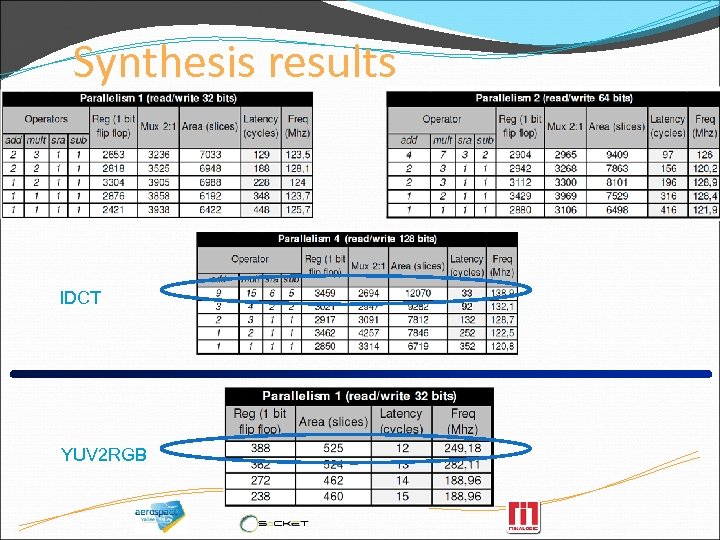
Synthesis results IDCT YUV 2 RGB
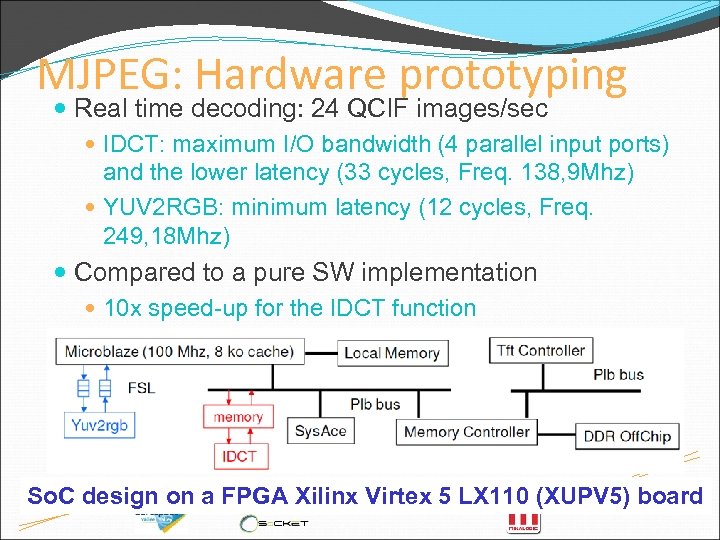
MJPEG: Hardware prototyping Real time decoding: 24 QCIF images/sec IDCT: maximum I/O bandwidth (4 parallel input ports) and the lower latency (33 cycles, Freq. 138, 9 Mhz) YUV 2 RGB: minimum latency (12 cycles, Freq. 249, 18 Mhz) Compared to a pure SW implementation 10 x speed-up for the IDCT function 5 x speed-up for the yuv 2 rgb function So. C design on a FPGA Xilinx Virtex 5 LX 110 (XUPV 5) board
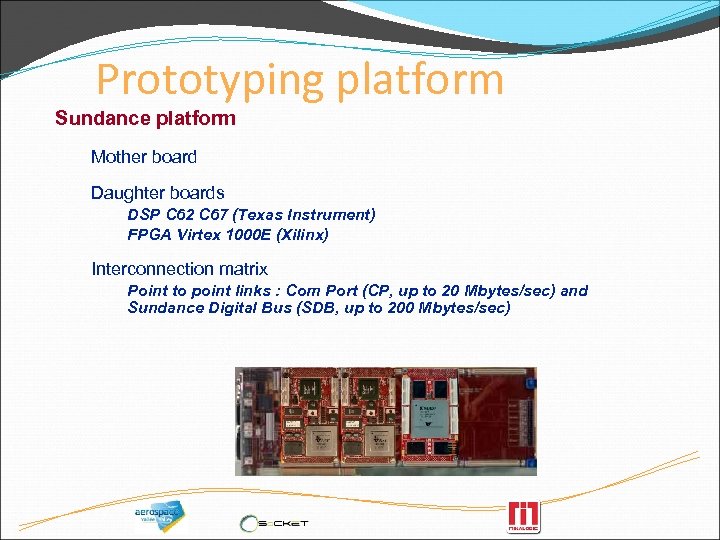
Prototyping platform Sundance platform Mother board Daughter boards DSP C 62 C 67 (Texas Instrument) FPGA Virtex 1000 E (Xilinx) Interconnection matrix Point to point links : Com Port (CP, up to 20 Mbytes/sec) and Sundance Digital Bus (SDB, up to 200 Mbytes/sec)
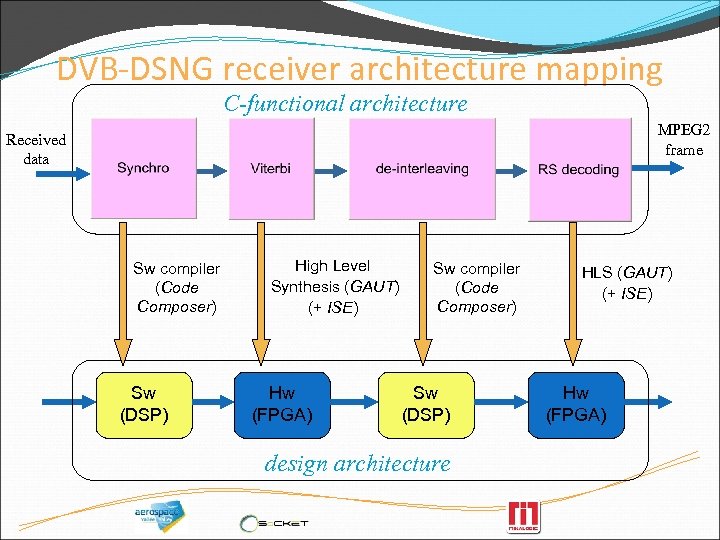
DVB-DSNG receiver architecture mapping C-functional architecture MPEG 2 frame Received data Sw compiler (Code Composer) Sw (DSP) High Level Synthesis (GAUT) (+ ISE) Hw (FPGA) Sw compiler (Code Composer) Sw (DSP) design architecture HLS (GAUT) (+ ISE) Hw (FPGA)
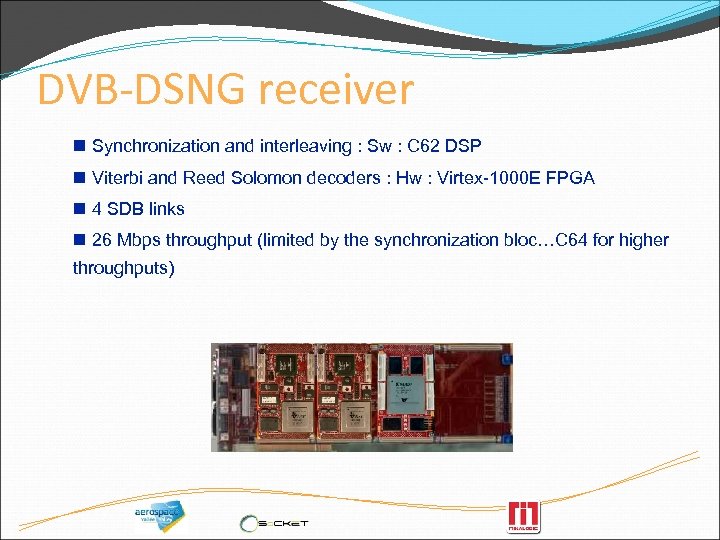
DVB-DSNG receiver n Synchronization and interleaving : Sw : C 62 DSP n Viterbi and Reed Solomon decoders : Hw : Virtex-1000 E FPGA n 4 SDB links n 26 Mbps throughput (limited by the synchronization bloc…C 64 for higher throughputs)
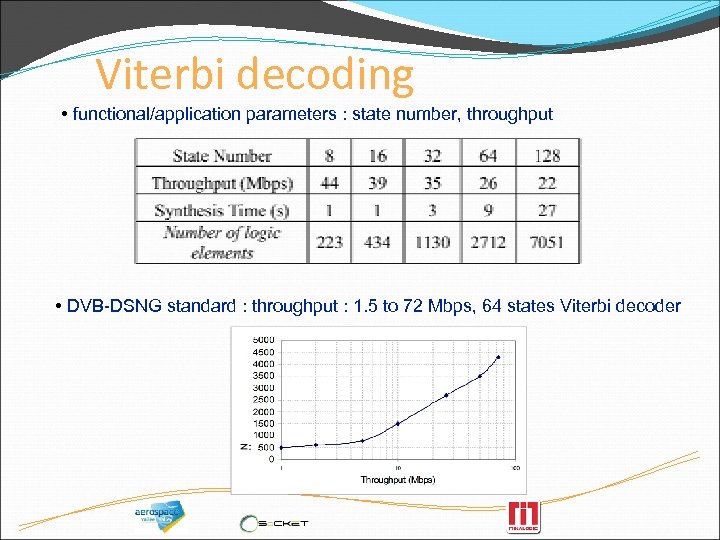
Viterbi decoding • functional/application parameters : state number, throughput • DVB-DSNG standard : throughput : 1. 5 to 72 Mbps, 64 states Viterbi decoder
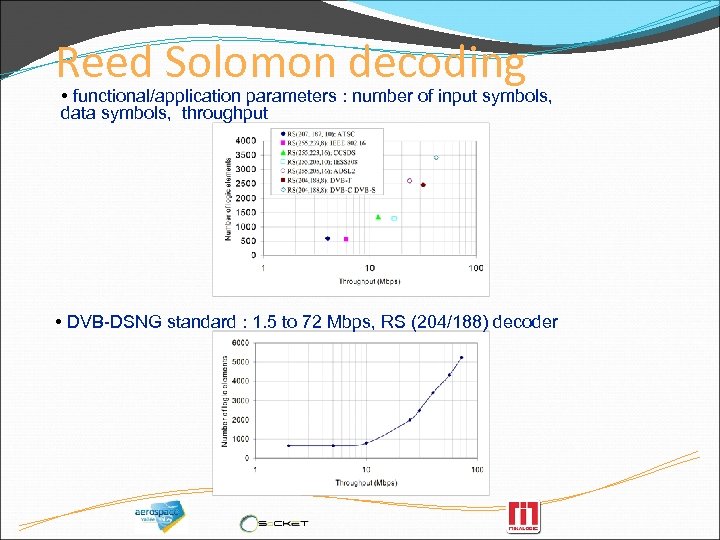
Reed Solomon decoding • functional/application parameters : number of input symbols, data symbols, throughput • DVB-DSNG standard : 1. 5 to 72 Mbps, RS (204/188) decoder
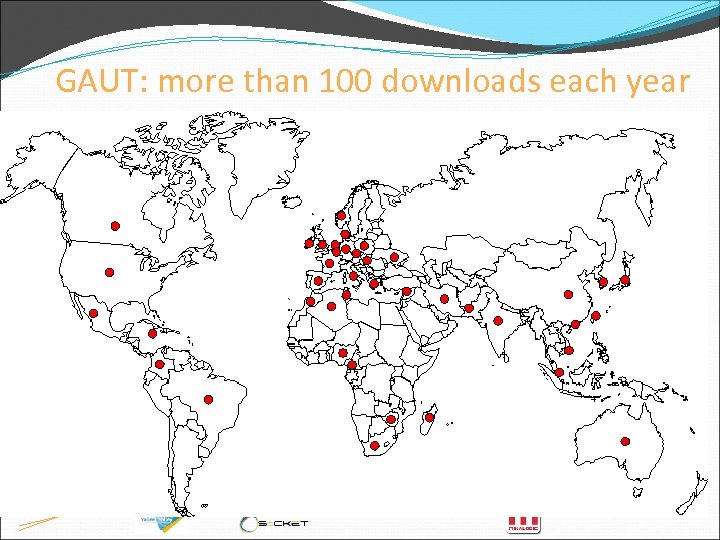
GAUT: more than 100 downloads each year
References
References
Conclusion HLS allows to automatically generate several RTL architectures From an algorithmic/behavioral description and a set of constraints HLS allows to generate VHDL models for synthesis purpose System. C simulation models for virtual prototyping HLS allows to explore the design space of Hardware accelerators MPSo. C architectures including HW accelerators GAUT is free downloadable at http: //lab-sticc. fr/www-gaut

High-Level Synthesis Université de Bretagne-Sud Lab-STICC Philippe COUSSY philippe. coussy@univ-ubs. fr Workshop - November 2011 - Toulouse
Скачать презентацию High-Level Synthesis Université de Bretagne-Sud Lab-STICC Philippe COUSSY
e4dc40a34fcf502d3cb08fbbee5464ac.ppt