


 Скачать презентацию High Energy Physics Lecture 1 Overview of the
cf26ac761c31bb304acfe0143383d754.ppt
- Количество слайдов: 16
 High Energy Physics Lecture 1: Overview of the current state of HEP
 Science is built up of facts, as a house is built of stones; but an accumulation of facts is no more a science than a heap of stones is a house. Henri Poincaré (1854 – 1912) in “Science and Hypothesis” (1905)
 Two Names for our Subject: “High Energy Physics”: emphasis on methods • Accelerators • Detectors “Elementary Particle Physics”: emphasis on the objects of study Fundamental Particles: Leptons and Quarks Composite Particles: Hadrons composed of quarks
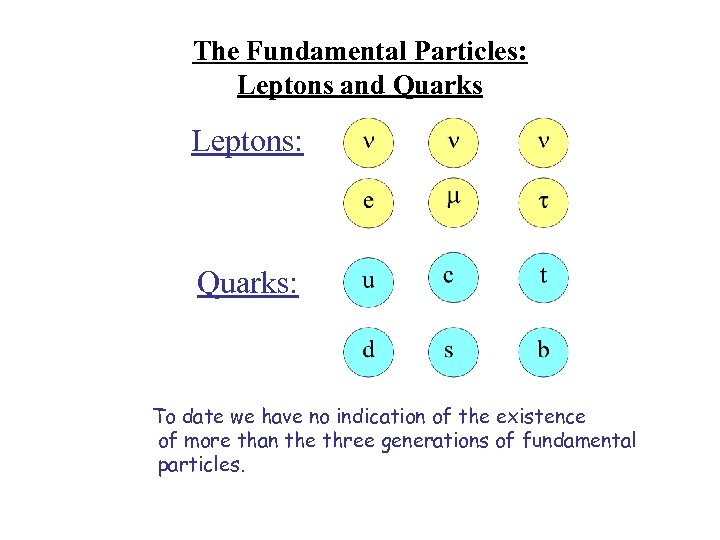 The Fundamental Particles: Leptons and Quarks Leptons: Quarks: To date we have no indication of the existence of more than the three generations of fundamental particles.
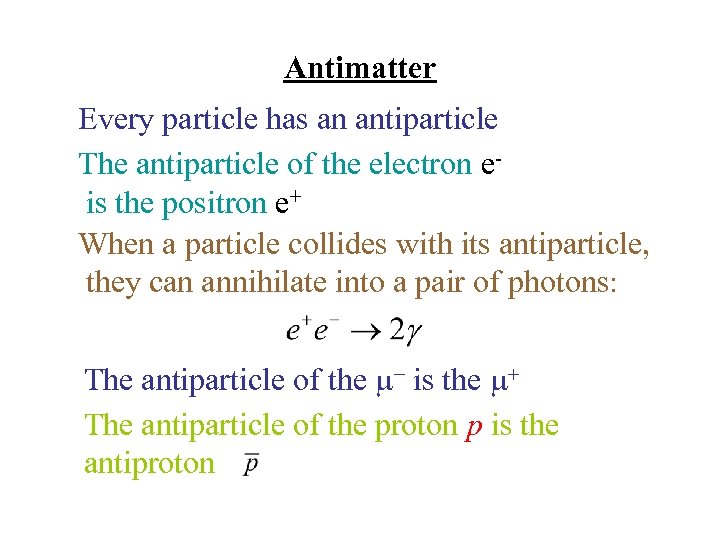 Antimatter Every particle has an antiparticle The antiparticle of the electron eis the positron e+ When a particle collides with its antiparticle, they can annihilate into a pair of photons: The antiparticle of the m- is the m+ The antiparticle of the proton p is the antiproton
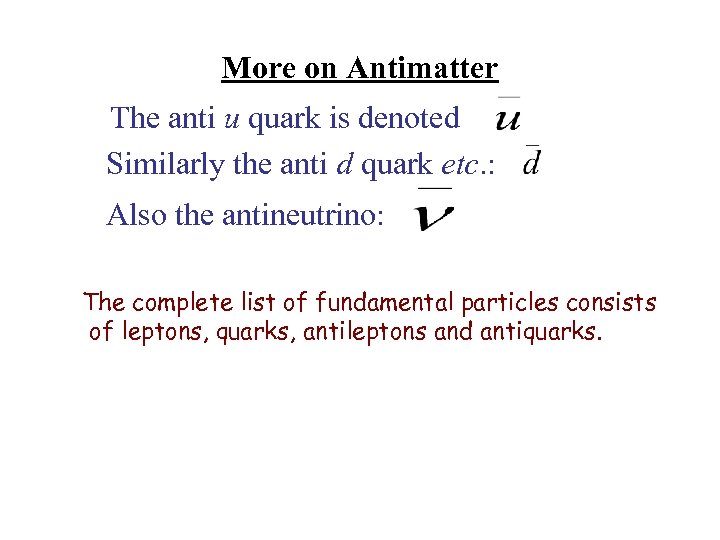 More on Antimatter The anti u quark is denoted Similarly the anti d quark etc. : Also the antineutrino: The complete list of fundamental particles consists of leptons, quarks, antileptons and antiquarks.
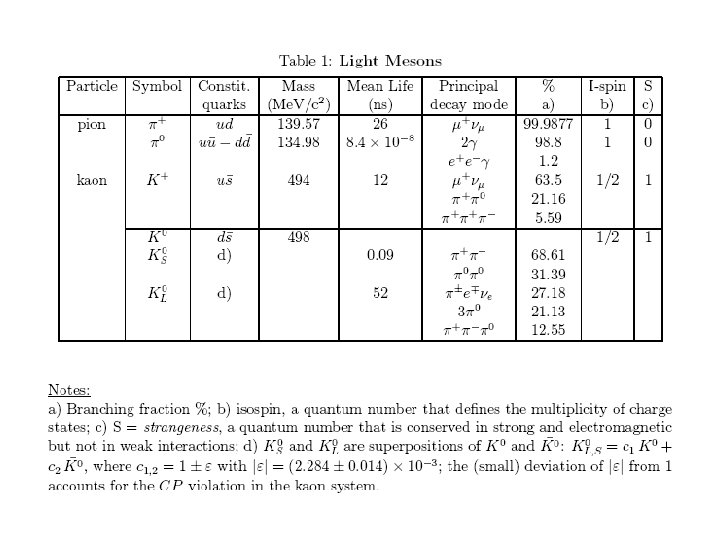
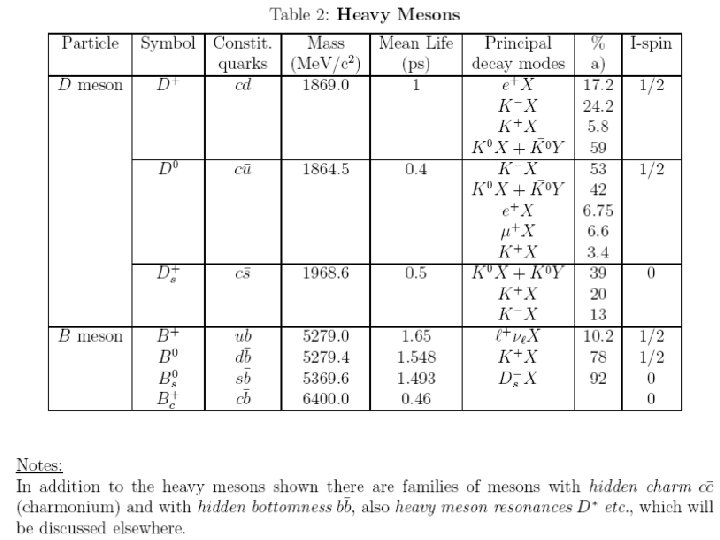
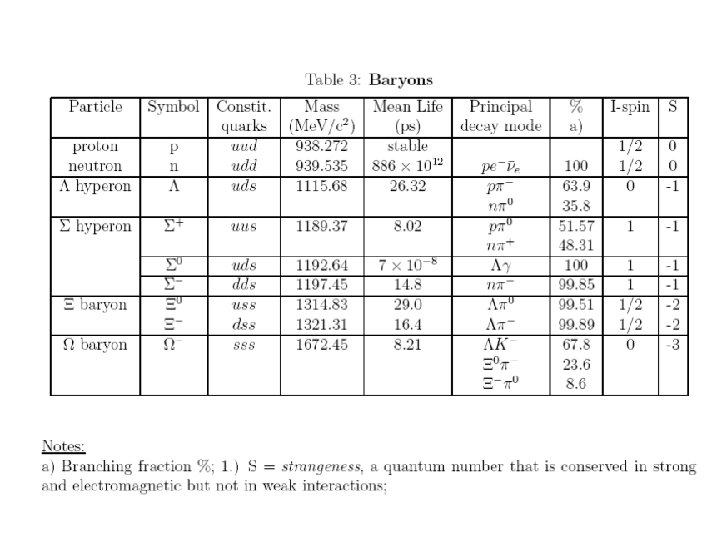
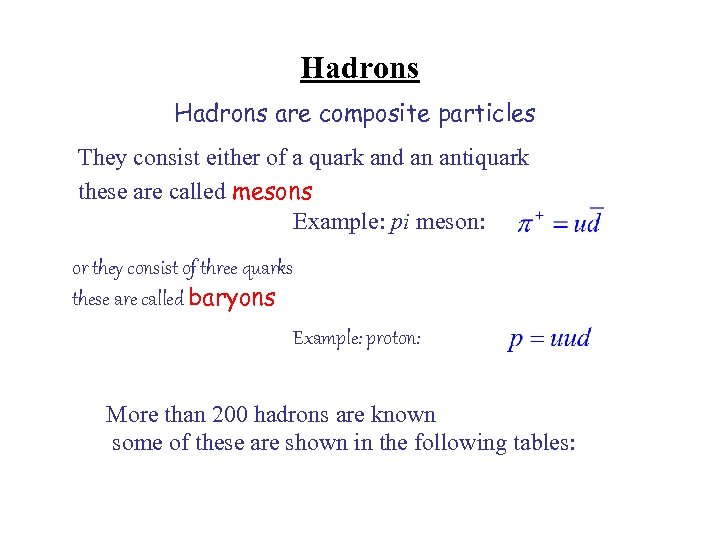 Hadrons are composite particles They consist either of a quark and an antiquark these are called mesons Example: pi meson: or they consist of three quarks these are called baryons Example: proton: More than 200 hadrons are known some of these are shown in the following tables:
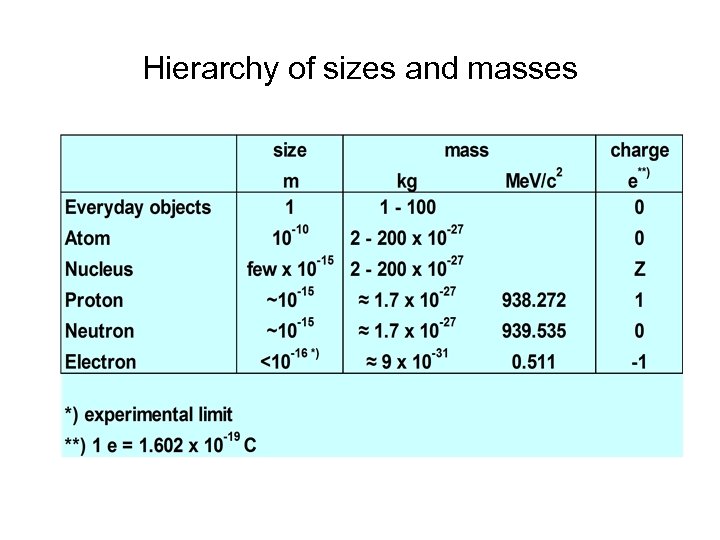 Hierarchy of sizes and masses
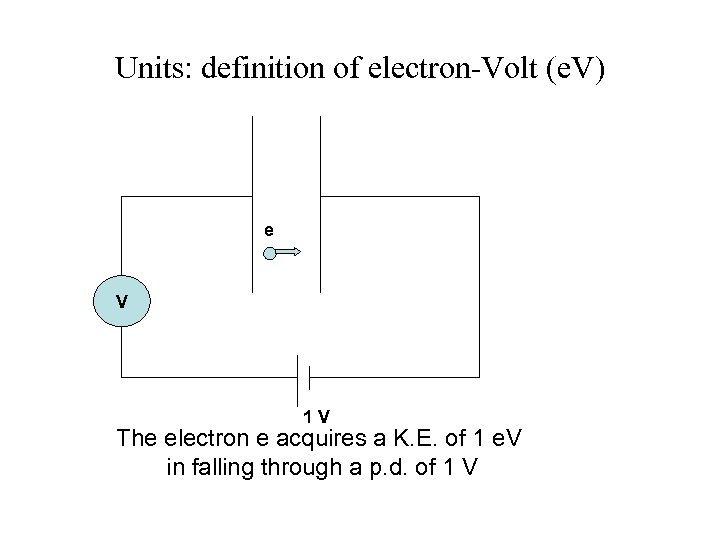 Units: definition of electron-Volt (e. V) e V 1 V The electron e acquires a K. E. of 1 e. V in falling through a p. d. of 1 V
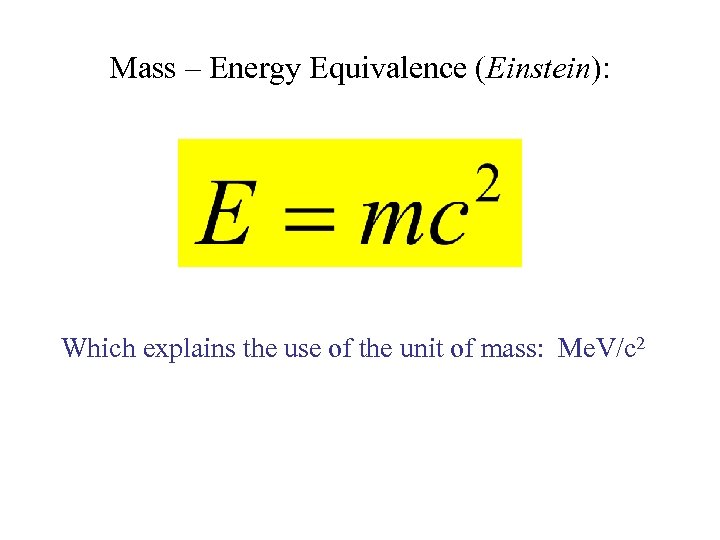 Mass – Energy Equivalence (Einstein): Which explains the use of the unit of mass: Me. V/c 2
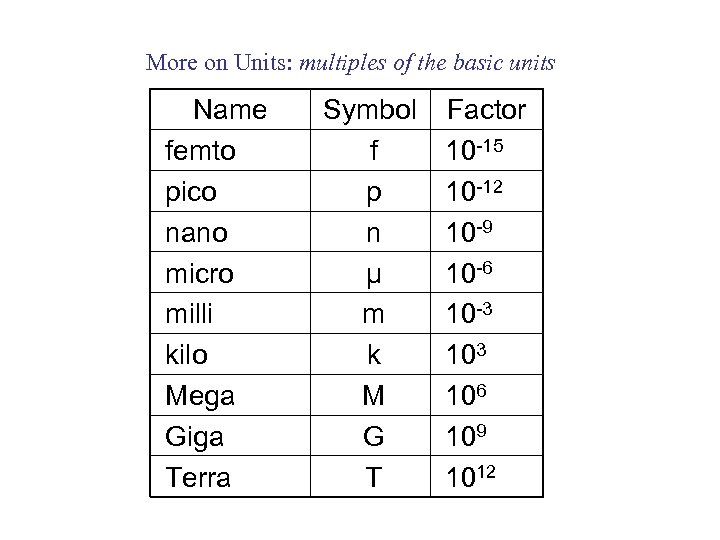 More on Units: multiples of the basic units Name femto pico nano micro milli kilo Mega Giga Terra Symbol f p n μ m k M G T Factor 10 -15 10 -12 10 -9 10 -6 10 -3 106 109 1012
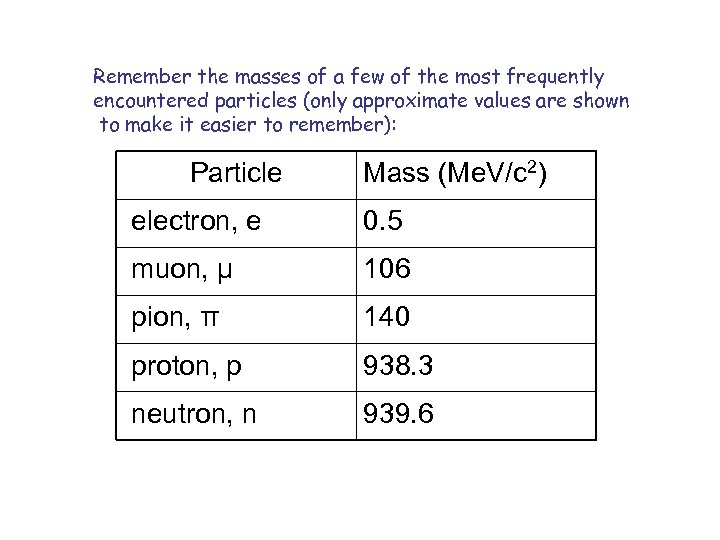 Remember the masses of a few of the most frequently encountered particles (only approximate values are shown to make it easier to remember): Particle Mass (Me. V/c 2) electron, e 0. 5 muon, μ 106 pion, π 140 proton, p 938. 3 neutron, n 939. 6
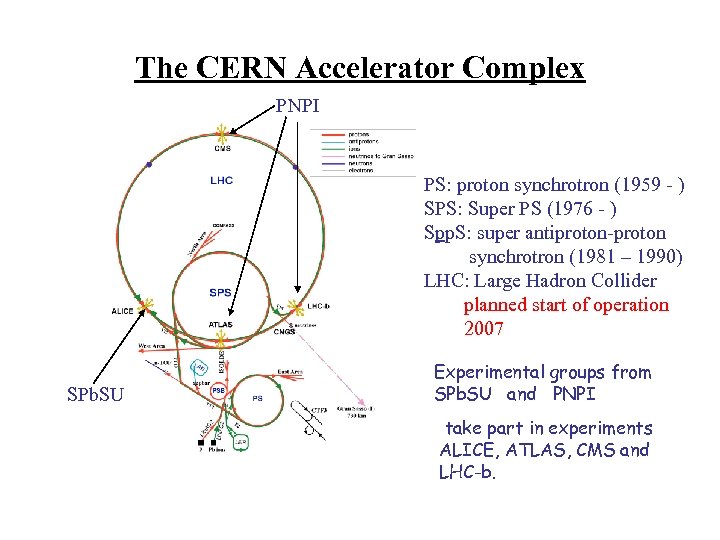 The CERN Accelerator Complex PNPI PS: proton synchrotron (1959 - ) SPS: Super PS (1976 - ) Spp. S: super antiproton-proton synchrotron (1981 – 1990) LHC: Large Hadron Collider planned start of operation 2007 SPb. SU Experimental groups from SPb. SU and PNPI take part in experiments ALICE, ATLAS, CMS and LHC-b.