 Скачать презентацию HIGH ENERGY NEUTRINOS FROM PULSAR WIND NEBULAE Dafne
4145c33067dd7d28b08853263a64e6dd.ppt
- Количество слайдов: 29



HIGH ENERGY NEUTRINOS FROM PULSAR WIND NEBULAE Dafne Guetta INAF-Osservatorio Astrofisico di Roma BRAUDE-Israel Collaborators: Irene Di Palma, Elena Amato
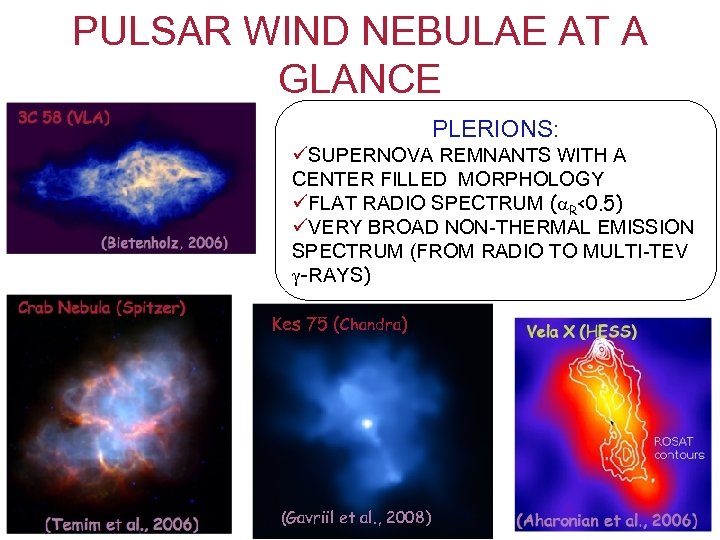
PULSAR WIND NEBULAE AT A GLANCE PLERIONS: üSUPERNOVA REMNANTS WITH A CENTER FILLED MORPHOLOGY üFLAT RADIO SPECTRUM ( R<0. 5) üVERY BROAD NON-THERMAL EMISSION SPECTRUM (FROM RADIO TO MULTI-TEV -RAYS) Kes 75 (Chandra) (Gavriil et al. , 2008)
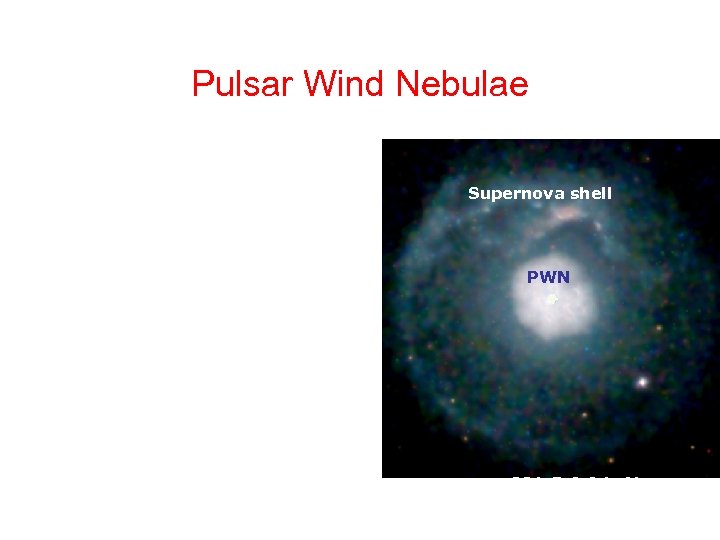
Pulsar Wind Nebulae Supernova shell PWN G 21. 5 -0. 9 in X-rays Chandra / H. Matheson & S. Safi-Harb
WHY PWNe ARE INTERESTING ØPULSAR PHYSICS: THEY ENCLOSE MOST OF THE PULSAR SPIN-DOWN ENERGY ØCLOSE AND BRIGHT: BEST-SUITED LABORATORIES FOR THE PHYSICS OF RELATIVISTIC ASTROPHYSICAL PLASMAS ØPARTICLE ACCELERATION AT THE HIGHEST SPEED SHOCKS IN NATURE (104< <107) ØCOSMIC RAYS: ONLY SOURCES SHOWING DIRECT EVIDENCE FOR PEV PARTICLES
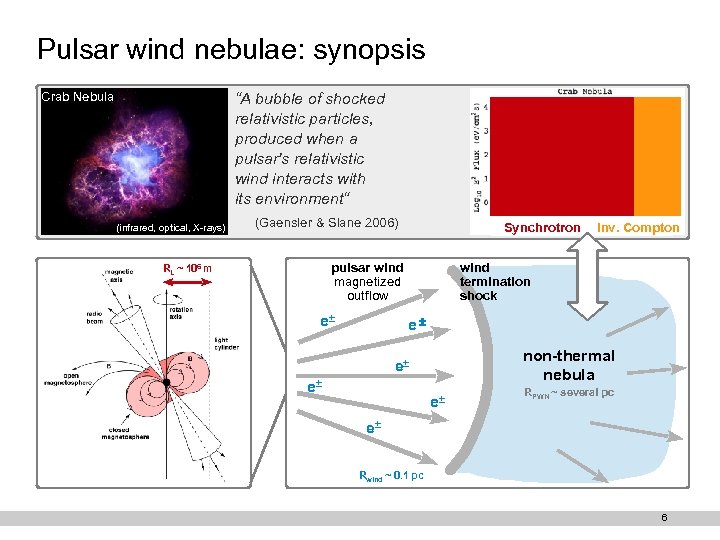
Pulsar wind nebulae: synopsis Crab Nebula “A bubble of shocked relativistic particles, produced when a pulsar's relativistic wind interacts with its environment“ (infrared, optical, X-rays) (Gaensler & Slane 2006) Synchrotron wind termination shock pulsar wind magnetized outflow RL ~ 106 m e± Inv. Compton e± non-thermal nebula e± e± e± RPWN ~ several pc e± Rwind ~ 0. 1 pc 6
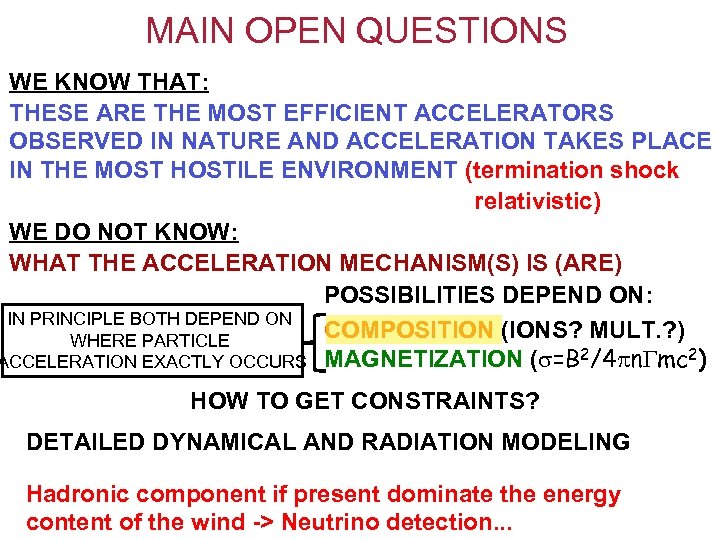
MAIN OPEN QUESTIONS WE KNOW THAT: THESE ARE THE MOST EFFICIENT ACCELERATORS OBSERVED IN NATURE AND ACCELERATION TAKES PLACE IN THE MOST HOSTILE ENVIRONMENT (termination shock relativistic) WE DO NOT KNOW: WHAT THE ACCELERATION MECHANISM(S) IS (ARE) POSSIBILITIES DEPEND ON: IN PRINCIPLE BOTH DEPEND ON COMPOSITION (IONS? MULT. ? ) WHERE PARTICLE ACCELERATION EXACTLY OCCURS MAGNETIZATION ( =B 2/4 n mc 2) HOW TO GET CONSTRAINTS? DETAILED DYNAMICAL AND RADIATION MODELING Hadronic component if present dominate the energy content of the wind -> Neutrino detection. . .
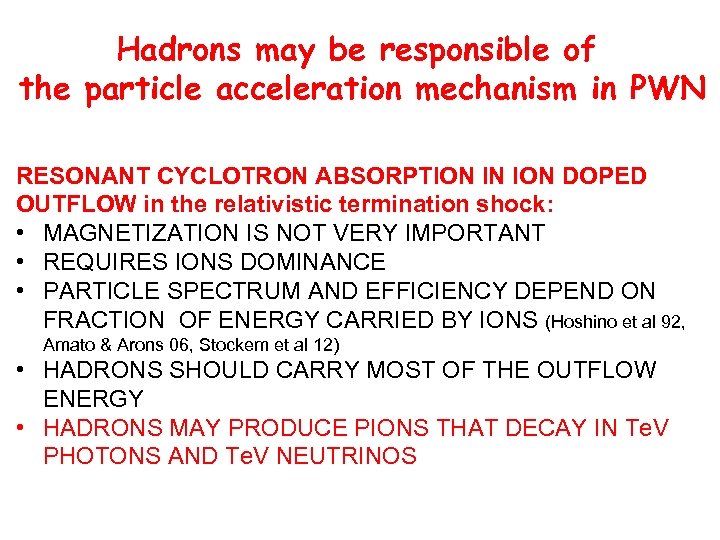
Hadrons may be responsible of the particle acceleration mechanism in PWN RESONANT CYCLOTRON ABSORPTION IN ION DOPED OUTFLOW in the relativistic termination shock: • MAGNETIZATION IS NOT VERY IMPORTANT • REQUIRES IONS DOMINANCE • PARTICLE SPECTRUM AND EFFICIENCY DEPEND ON FRACTION OF ENERGY CARRIED BY IONS (Hoshino et al 92, Amato & Arons 06, Stockem et al 12) • HADRONS SHOULD CARRY MOST OF THE OUTFLOW ENERGY • HADRONS MAY PRODUCE PIONS THAT DECAY IN Te. V PHOTONS AND Te. V NEUTRINOS
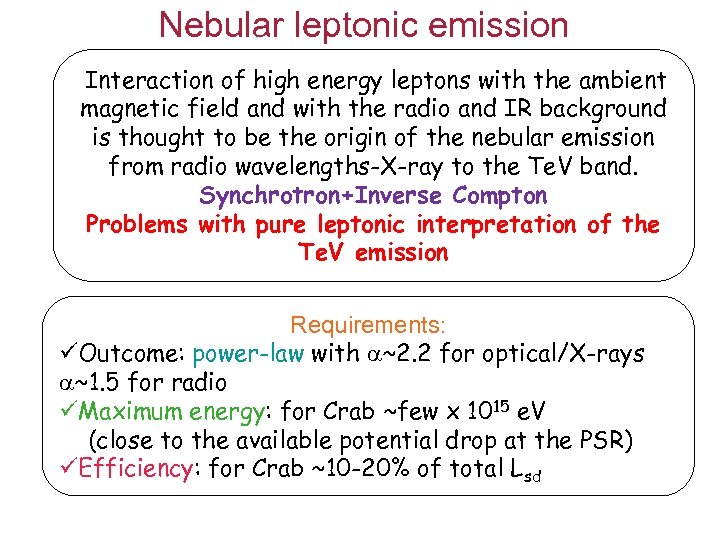
Nebular leptonic emission Interaction of high energy leptons with the ambient magnetic field and with the radio and IR background is thought to be the origin of the nebular emission from radio wavelengths-X-ray to the Te. V band. Synchrotron+Inverse Compton Problems with pure leptonic interpretation of the Te. V emission Requirements: üOutcome: power-law with ~2. 2 for optical/X-rays ~1. 5 for radio üMaximum energy: for Crab ~few x 1015 e. V (close to the available potential drop at the PSR) üEfficiency: for Crab ~10 -20% of total Lsd
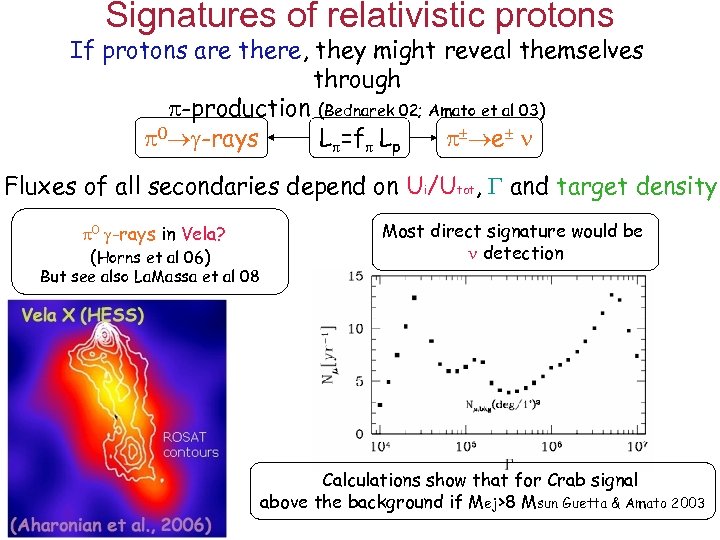
Signatures of relativistic protons If protons are there, they might reveal themselves through -production (Bednarek 02; Amato et al 03) L =f Lp e 0 -rays Fluxes of all secondaries depend on Ui/Utot, and target density 0 -rays in Vela? (Horns et al 06) Most direct signature would be detection But see also La. Massa et al 08 Calculations show that for Crab signal above the background if Mej>8 Msun Guetta & Amato 2003
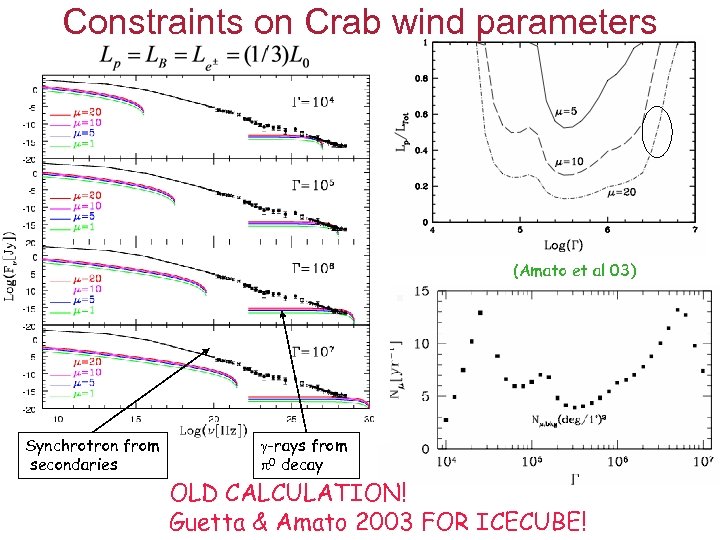
Constraints on Crab wind parameters (Amato et al 03) Synchrotron from secondaries -rays from 0 decay OLD CALCULATION! Guetta & Amato 2003 FOR ICECUBE!
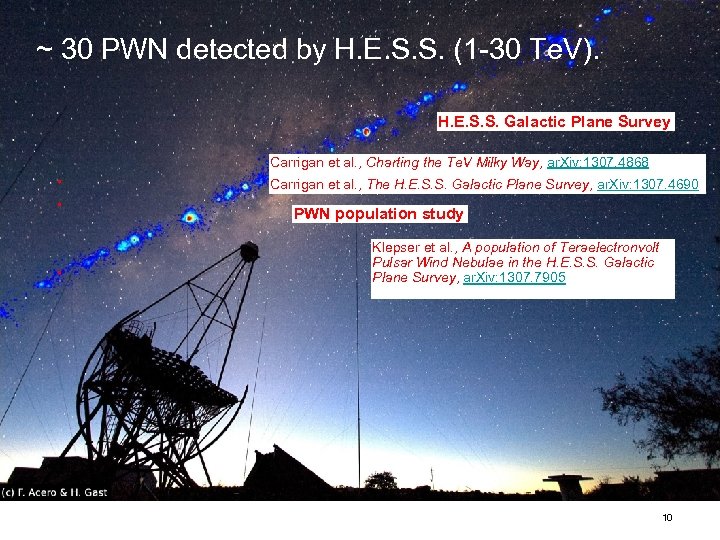
~ 30 PWN detected by H. E. S. S. (1 -30 Te. V). H. E. S. S. Galactic Plane Survey Carrigan et al. , Charting the Te. V Milky Way, ar. Xiv: 1307. 4868 ● ● ● Carrigan et al. , The H. E. S. S. Galactic Plane Survey, ar. Xiv: 1307. 4690 PWN population study Klepser et al. , A population of Teraelectronvolt Pulsar Wind Nebulae in the H. E. S. S. Galactic Plane Survey, ar. Xiv: 1307. 7905 10
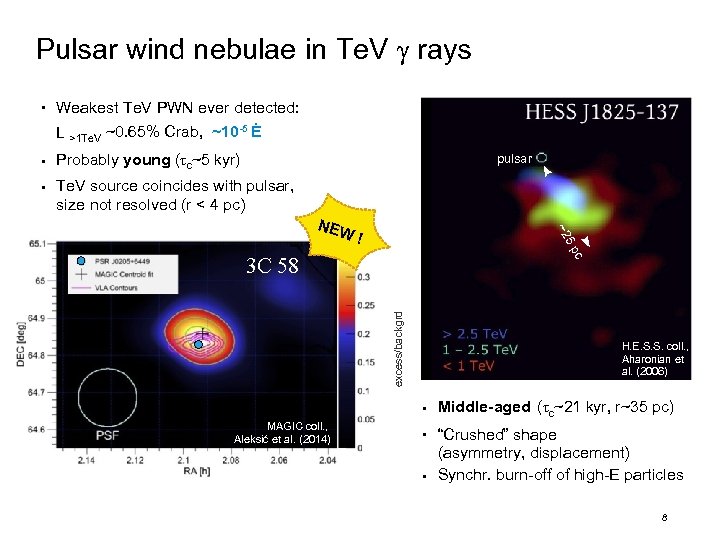
Pulsar wind nebulae in Te. V γ rays ● Weakest Te. V PWN ever detected: L >1 Te. V ~0. 65% Crab, ~10 -5 Ė ● Probably young (τc~5 kyr) pulsar Te. V source coincides with pulsar, size not resolved (r < 4 pc) ~2 ! 5 p NEW c 3 C 58 excess/backgrd ● H. E. S. S. coll. , Aharonian et al. (2006) Funk et al. (2008) ● MAGIC coll. , Aleksić et al. (2014) ● ● Middle-aged (τc~21 kyr, r~35 pc) “Crushed” shape (asymmetry, displacement) Synchr. burn-off of high-E particles 8
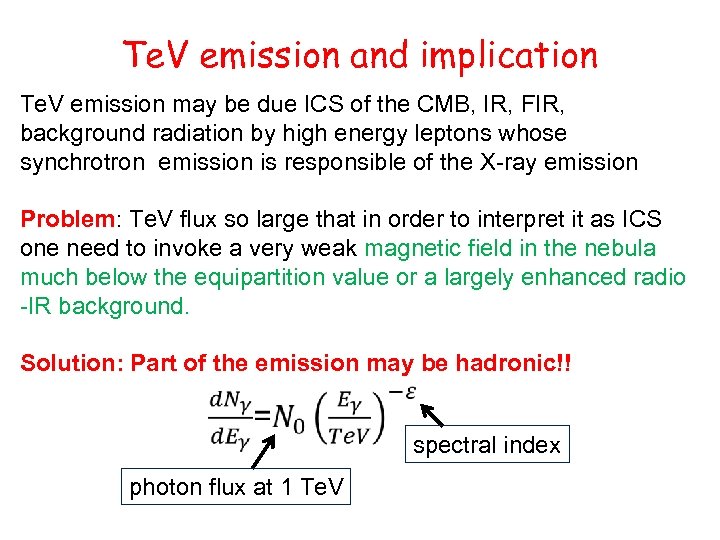
Te. V emission and implication Te. V emission may be due ICS of the CMB, IR, FIR, background radiation by high energy leptons whose synchrotron emission is responsible of the X-ray emission Problem: Te. V flux so large that in order to interpret it as ICS one need to invoke a very weak magnetic field in the nebula much below the equipartition value or a largely enhanced radio -IR background. Solution: Part of the emission may be hadronic!! spectral index photon flux at 1 Te. V
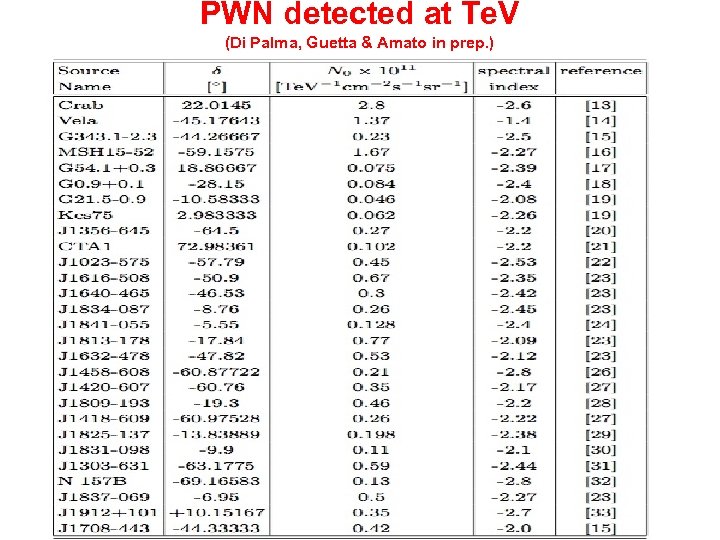
PWN detected at Te. V (Di Palma, Guetta & Amato in prep. )
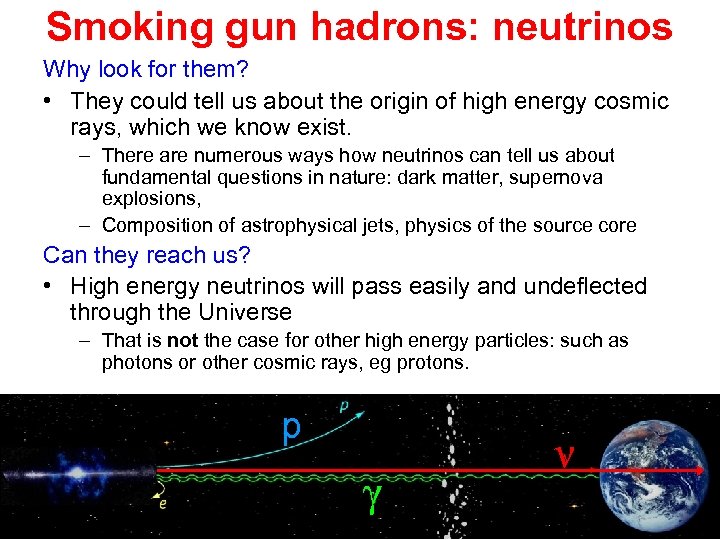
Smoking gun hadrons: neutrinos Why look for them? • They could tell us about the origin of high energy cosmic rays, which we know exist. – There are numerous ways how neutrinos can tell us about fundamental questions in nature: dark matter, supernova explosions, – Composition of astrophysical jets, physics of the source core Can they reach us? • High energy neutrinos will pass easily and undeflected through the Universe – That is not the case for other high energy particles: such as photons or other cosmic rays, eg protons. p γ ν
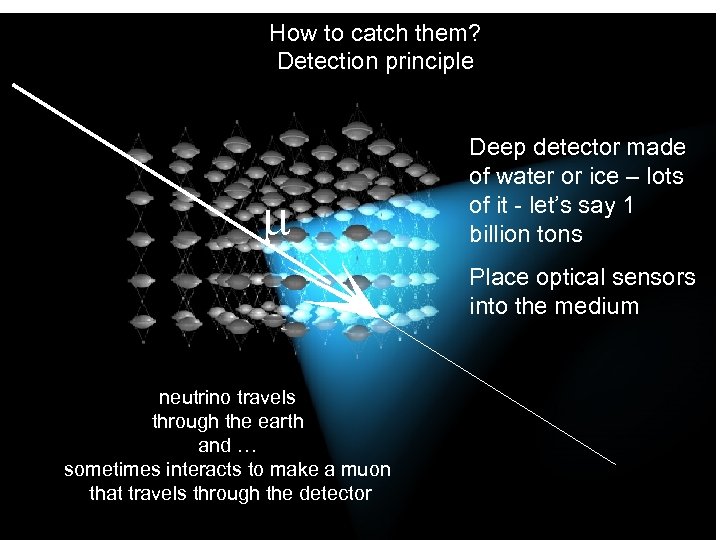
How to catch them? Detection principle μ Deep detector made of water or ice – lots of it - let’s say 1 billion tons Place optical sensors into the medium neutrino travels through the earth and … sometimes interacts to make a muon that travels through the detector 16
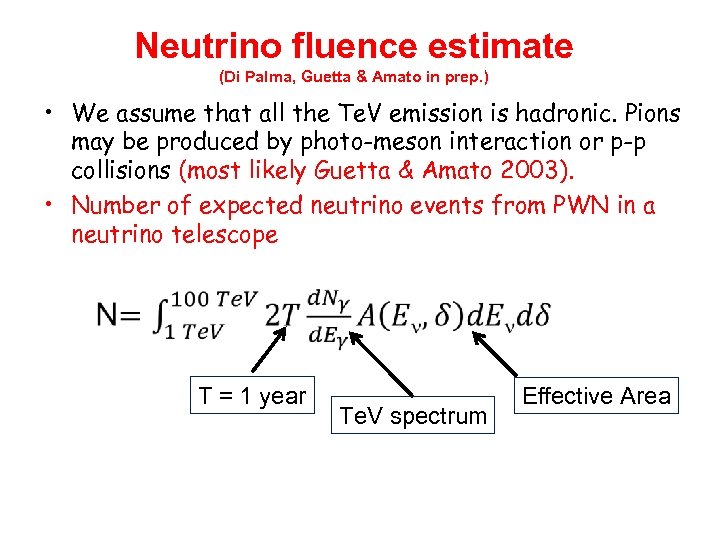
Neutrino fluence estimate (Di Palma, Guetta & Amato in prep. ) • We assume that all the Te. V emission is hadronic. Pions may be produced by photo-meson interaction or p-p collisions (most likely Guetta & Amato 2003). • Number of expected neutrino events from PWN in a neutrino telescope T = 1 year Te. V spectrum Effective Area
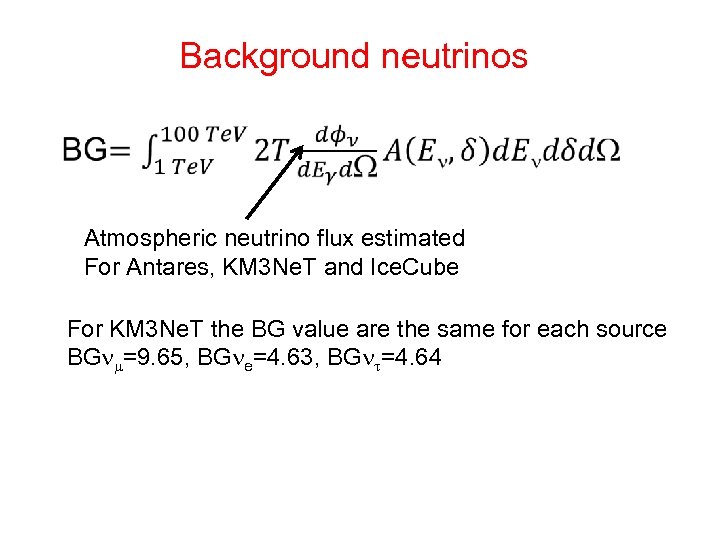
Background neutrinos Atmospheric neutrino flux estimated For Antares, KM 3 Ne. T and Ice. Cube For KM 3 Ne. T the BG value are the same for each source BG =9. 65, BG e=4. 63, BG =4. 64
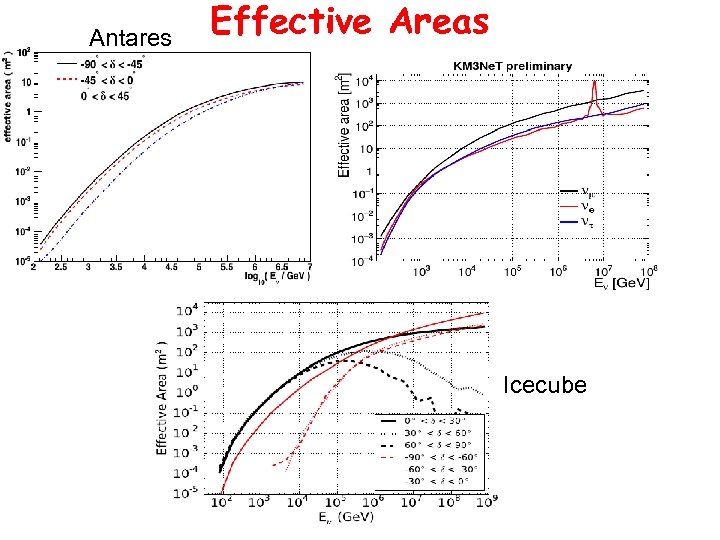
Antares Effective Areas Icecube
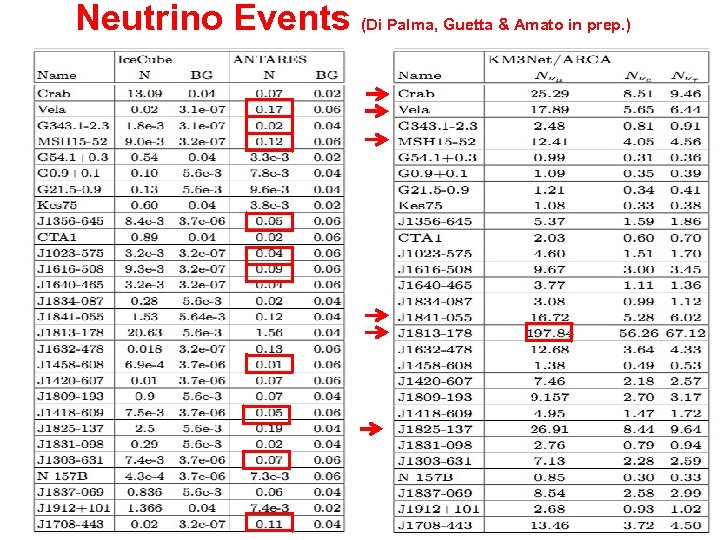
Neutrino Events (Di Palma, Guetta & Amato in prep. )
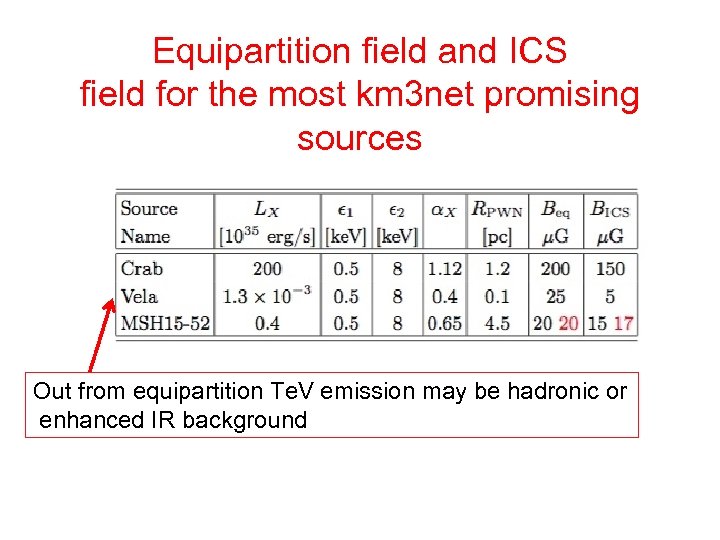
Equipartition field and ICS field for the most km 3 net promising sources Out from equipartition Te. V emission may be hadronic or enhanced IR background
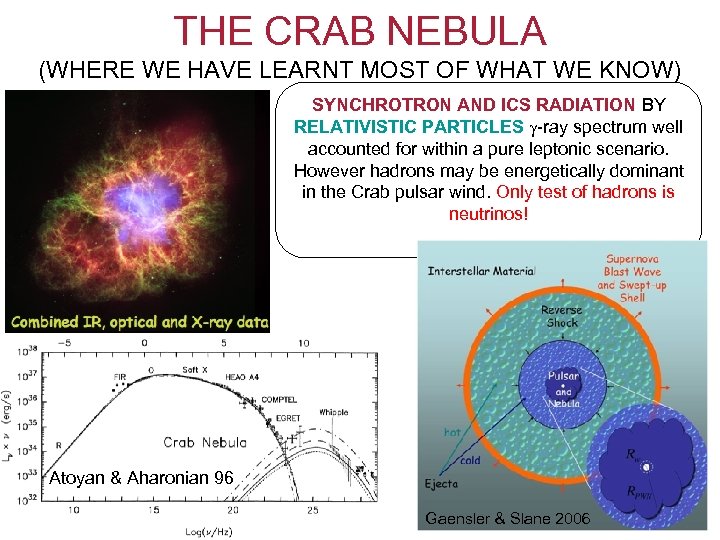
THE CRAB NEBULA (WHERE WE HAVE LEARNT MOST OF WHAT WE KNOW) SYNCHROTRON AND ICS RADIATION BY RELATIVISTIC PARTICLES -ray spectrum well accounted for within a pure leptonic scenario. However hadrons may be energetically dominant in the Crab pulsar wind. Only test of hadrons is neutrinos! SOURCE OF B FIELD AND PARTICLES: NS SUGGESTED BEFORE PSR DISCOVERY (Pacini 67) Atoyan & Aharonian 96 Gaensler & Slane 2006
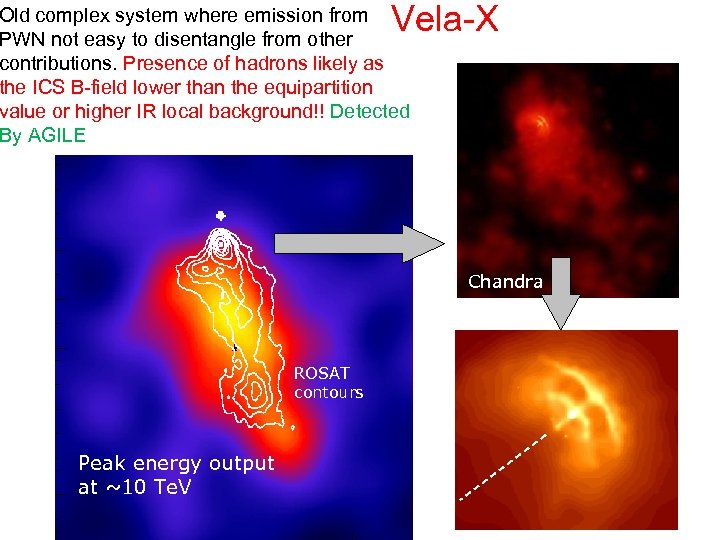
Vela-X Old complex system where emission from PWN not easy to disentangle from other contributions. Presence of hadrons likely as the ICS B-field lower than the equipartition value or higher IR local background!! Detected By AGILE Chandra ROSAT contours Peak energy output at ~10 Te. V
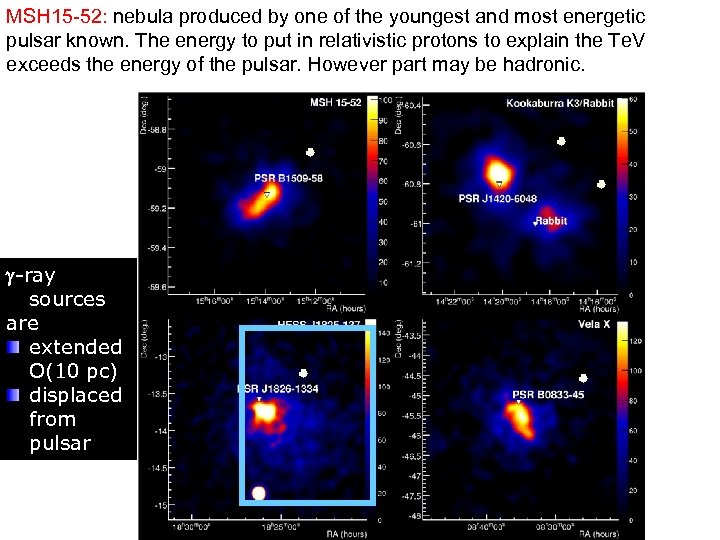
MSH 15 -52: nebula produced by one of the youngest and most energetic pulsar known. The energy to put in relativistic protons to explain the Te. V exceeds the energy of the pulsar. However part may be hadronic. g-ray sources are extended O(10 pc) displaced from pulsar
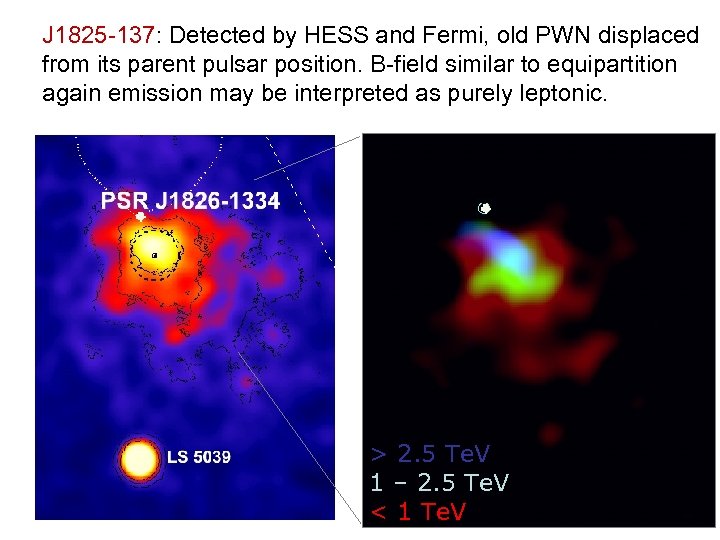
J 1825 -137: Detected by HESS and Fermi, old PWN displaced from its parent pulsar position. B-field similar to equipartition again emission may be interpreted as purely leptonic. > 2. 5 Te. V 1 – 1. 5 Te. V 2. 5 < 1 Te. V
Other promising sources for KM 3 Ne. T • J 1841 -055: Te. V source discovered in the HESS galactic plane survey. Detected by Fermi Very extended source, not clear from where the Te. V emission come: need multiwavelenght survey • J 1813 -178: Current spectra modeling explain the Te. V emission as due to ICS with the target photon field contributed by CMB, IR and FIR background. The resulting magnetic field ~equipartition so emission may be purely leptonic. Ice. Cube should have detected this source
SUMMARY AND CONCLUSIONS Acceleration process • PWNe ARE THE MOST EFFICIENT ACCELERATORS SEEN IN NATURE BUT PARTICLE ACCELERATION IN A VERY HOSTILE SETTING • UNDERSTANDING THE ACCELERATION PHYSICS REQUIRES PINNING DOWN THE PLASMA PROPERTIES • DETAILED DYNAMICS AND RADIATION MODELING ALLOWS TO SET LOWER LIMIT ON WIND MAGNETIZATION PRESENCE OF HADRONS SEEMS NECESSARY TO EXPLAIN THE ACCELERATION AT RELATIVISTIC TERMINATION SHOCK Emission mechanism • ~30 PWN were detected at Te. V, CTA several hundreds. Most of the emission from radio-X-ray to Te. V may be interpreted as purely sync+ICS however presence of hadrons NOT EXCLUDED and necessary for some PWN (Vela)
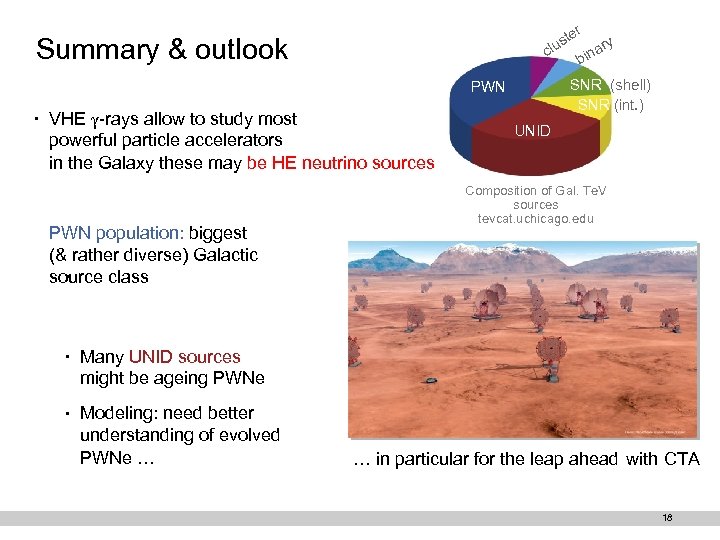
r ste ry clu na bi Summary & outlook SNR (shell) SNR (int. ) PWN ● VHE γ-rays allow to study most powerful particle accelerators in the Galaxy these may be HE neutrino sources PWN population: biggest (& rather diverse) Galactic ● source class ● ● UNID Composition of Gal. Te. V sources tevcat. uchicago. edu Many UNID sources might be ageing PWNe Modeling: need better understanding of evolved PWNe … … in particular for the leap ahead with CTA 18
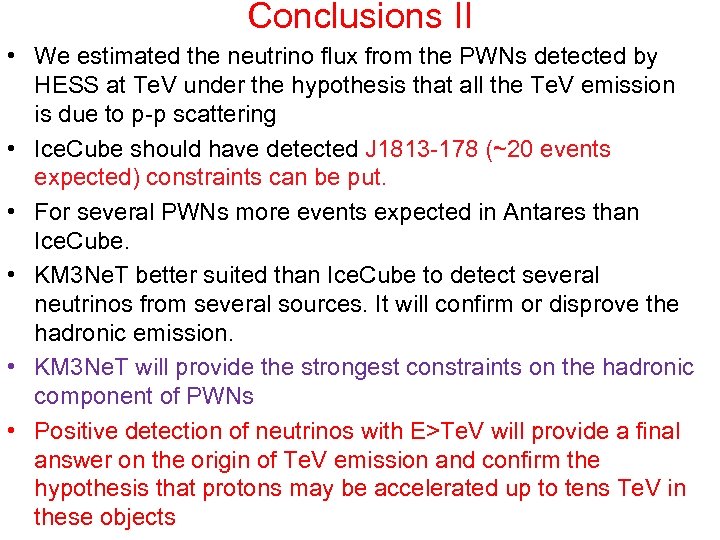
Conclusions II • We estimated the neutrino flux from the PWNs detected by HESS at Te. V under the hypothesis that all the Te. V emission is due to p-p scattering • Ice. Cube should have detected J 1813 -178 (~20 events expected) constraints can be put. • For several PWNs more events expected in Antares than Ice. Cube. • KM 3 Ne. T better suited than Ice. Cube to detect several neutrinos from several sources. It will confirm or disprove the hadronic emission. • KM 3 Ne. T will provide the strongest constraints on the hadronic component of PWNs • Positive detection of neutrinos with E>Te. V will provide a final answer on the origin of Te. V emission and confirm the hypothesis that protons may be accelerated up to tens Te. V in these objects
Скачать презентацию HIGH ENERGY NEUTRINOS FROM PULSAR WIND NEBULAE Dafne
4145c33067dd7d28b08853263a64e6dd.ppt