 Скачать презентацию High Energy Neutrino Detectors Deborah Harris Fermilab Nufact
332e9065336061078b446f2fdc1dcb9f.ppt
- Количество слайдов: 30



High Energy Neutrino Detectors Deborah Harris Fermilab Nufact’ 05 Summer Institute June 14 -15, 2005 14 -15 June 2005 Deborah Harris High Energy Neutrino Detectors
Outline of this Lecture • Introduction – What are the goals? – Particle Interactions in Matter • Detectors – Fully Active • Liquid Argon Time Projection • Cerenkov (covered in later talk) – Sampling Detectors • • 14 -15 June 2005 Overview: Absorber and Readout Steel/Lead Emulsion Scintillator/Absorber Steel-Scintillator Deborah Harris High Energy Neutrino Detectors 2
For Each Detector • Underlying principle • Example from real life • What do events look like? – Quasi-elastic Charged Current – Inelastic Charged Current – Neutral Currents • Backgrounds • Neutrino Energy Reconstruction • What else do we want to know? All detector questions are far from answered! 14 -15 June 2005 Deborah Harris High Energy Neutrino Detectors 3
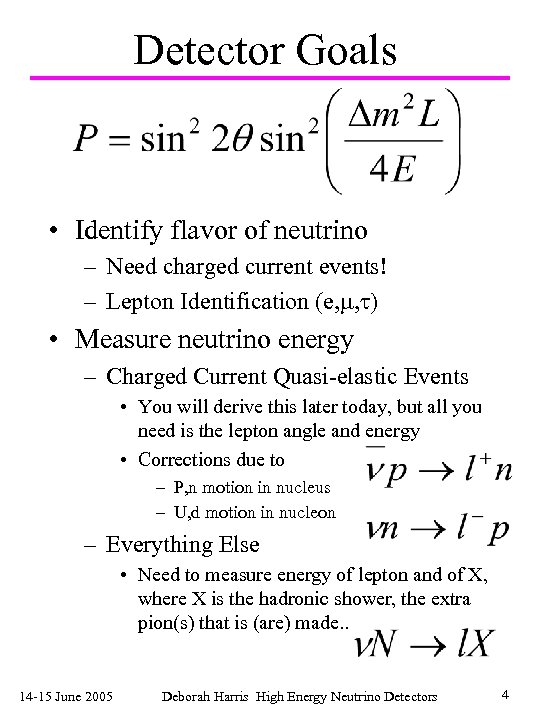
Detector Goals • Identify flavor of neutrino – Need charged current events! – Lepton Identification (e, m, ) • Measure neutrino energy – Charged Current Quasi-elastic Events • You will derive this later today, but all you need is the lepton angle and energy • Corrections due to – P, n motion in nucleus – U, d motion in nucleon – Everything Else • Need to measure energy of lepton and of X, where X is the hadronic shower, the extra pion(s) that is (are) made. . 14 -15 June 2005 Deborah Harris High Energy Neutrino Detectors 4
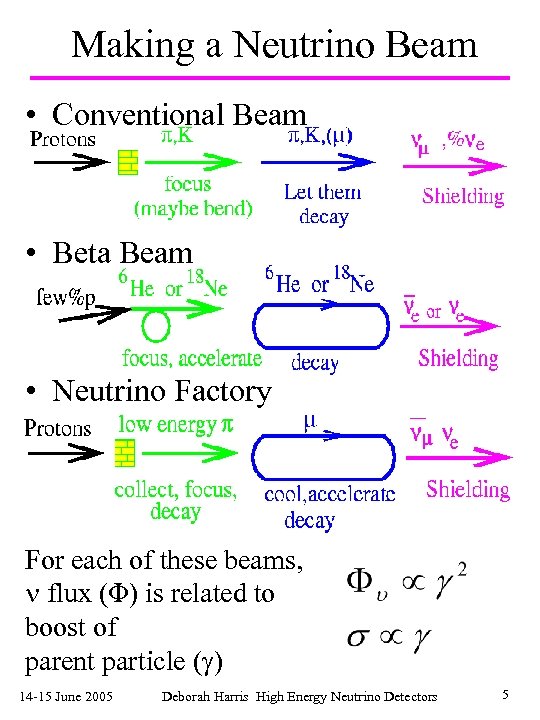
Making a Neutrino Beam • Conventional Beam • Beta Beam • Neutrino Factory For each of these beams, flux (Φ) is related to boost of parent particle ( ) 14 -15 June 2005 Deborah Harris High Energy Neutrino Detectors 5
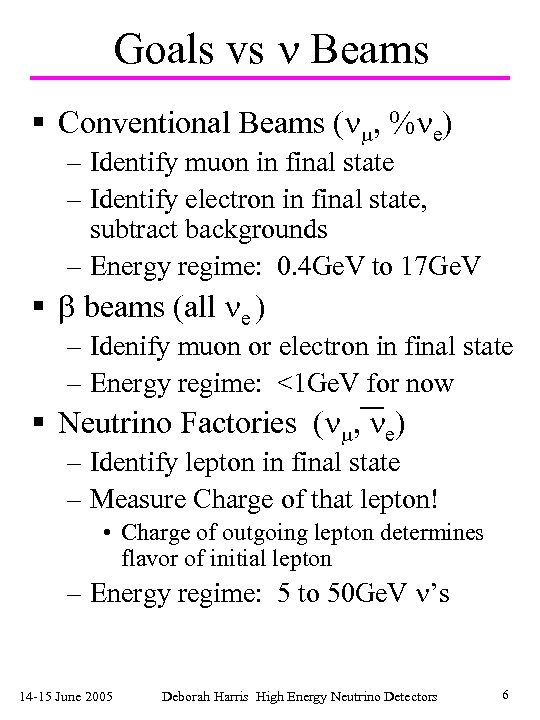
Goals vs Beams § Conventional Beams ( m, % e) – Identify muon in final state – Identify electron in final state, subtract backgrounds – Energy regime: 0. 4 Ge. V to 17 Ge. V § b beams (all e ) – Idenify muon or electron in final state – Energy regime: <1 Ge. V for now § Neutrino Factories ( m, e) – Identify lepton in final state – Measure Charge of that lepton! • Charge of outgoing lepton determines flavor of initial lepton – Energy regime: 5 to 50 Ge. V ’s 14 -15 June 2005 Deborah Harris High Energy Neutrino Detectors 6
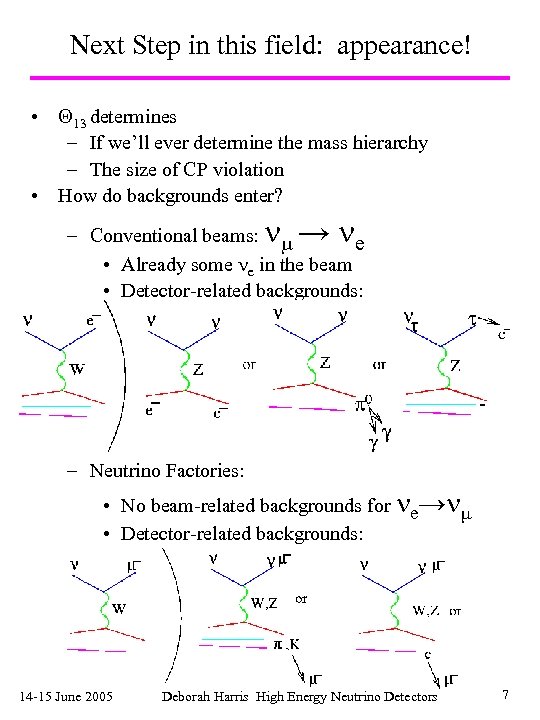
Next Step in this field: appearance! • Q 13 determines – If we’ll ever determine the mass hierarchy – The size of CP violation • How do backgrounds enter? – Conventional beams: m → e • Already some e in the beam • Detector-related backgrounds: – Neutrino Factories: • No beam-related backgrounds for e→ m • Detector-related backgrounds: 14 -15 June 2005 Deborah Harris High Energy Neutrino Detectors 7
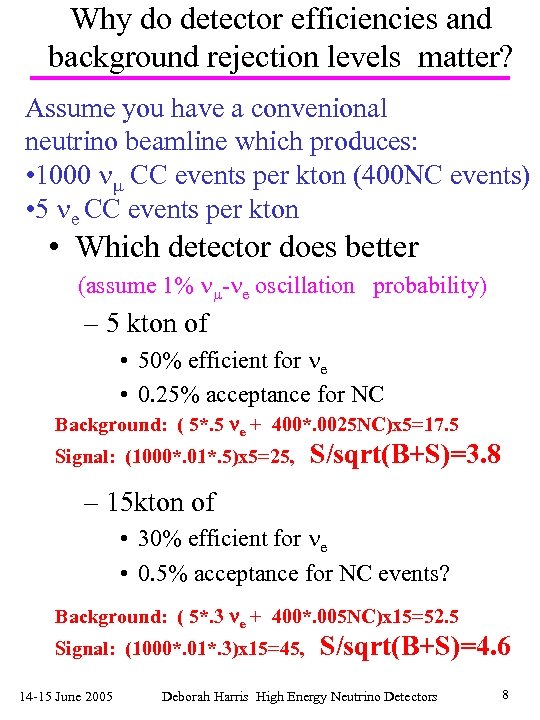
Why do detector efficiencies and background rejection levels matter? Assume you have a convenional neutrino beamline which produces: • 1000 m CC events per kton (400 NC events) • 5 e CC events per kton • Which detector does better (assume 1% m- e oscillation probability) – 5 kton of • 50% efficient for e • 0. 25% acceptance for NC Background: ( 5*. 5 e + 400*. 0025 NC)x 5=17. 5 Signal: (1000*. 01*. 5)x 5=25, S/sqrt(B+S)=3. 8 – 15 kton of • 30% efficient for e • 0. 5% acceptance for NC events? Background: ( 5*. 3 e + 400*. 005 NC)x 15=52. 5 Signal: (1000*. 01*. 3)x 15=45, 14 -15 June 2005 S/sqrt(B+S)=4. 6 Deborah Harris High Energy Neutrino Detectors 8
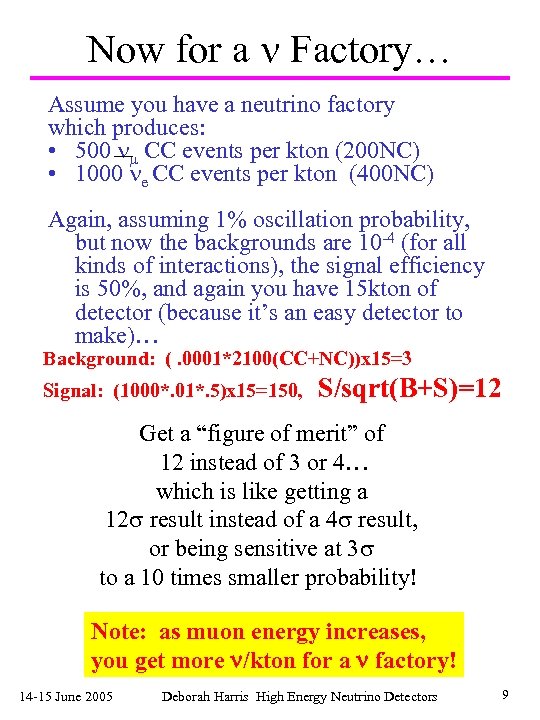
Now for a Factory… Assume you have a neutrino factory which produces: • 500 m CC events per kton (200 NC) • 1000 e CC events per kton (400 NC) Again, assuming 1% oscillation probability, but now the backgrounds are 10 -4 (for all kinds of interactions), the signal efficiency is 50%, and again you have 15 kton of detector (because it’s an easy detector to make)… Background: (. 0001*2100(CC+NC))x 15=3 Signal: (1000*. 01*. 5)x 15=150, S/sqrt(B+S)=12 Get a “figure of merit” of 12 instead of 3 or 4… which is like getting a 12 s result instead of a 4 s result, or being sensitive at 3 s to a 10 times smaller probability! Note: as muon energy increases, you get more /kton for a factory! 14 -15 June 2005 Deborah Harris High Energy Neutrino Detectors 9
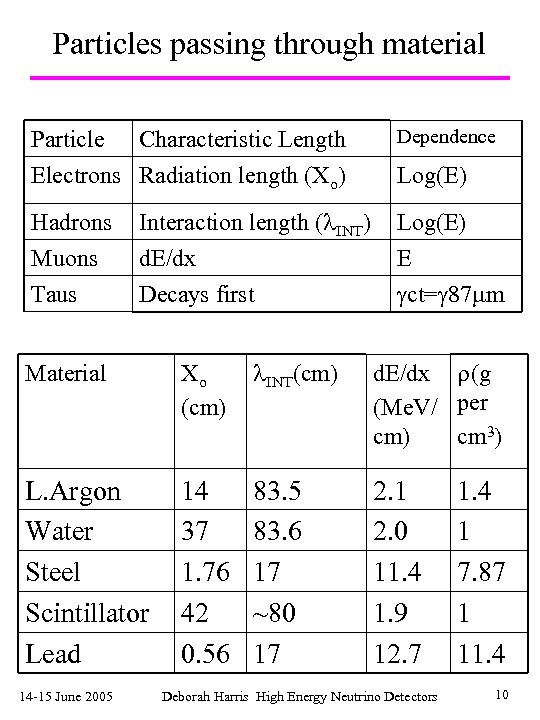
Particles passing through material Particle Characteristic Length Electrons Radiation length (Xo) Dependence Hadrons Muons Interaction length (l. INT) d. E/dx Log(E) E Taus Decays first ct= 87 mm Log(E) Material Xo (cm) l. INT(cm) d. E/dx r(g (Me. V/ per cm) cm 3) L. Argon Water Steel Scintillator Lead 14 37 1. 76 42 0. 56 83. 5 83. 6 17 ~80 17 2. 1 2. 0 11. 4 1. 9 12. 7 14 -15 June 2005 Deborah Harris High Energy Neutrino Detectors 1. 4 1 7. 87 1 11. 4 10
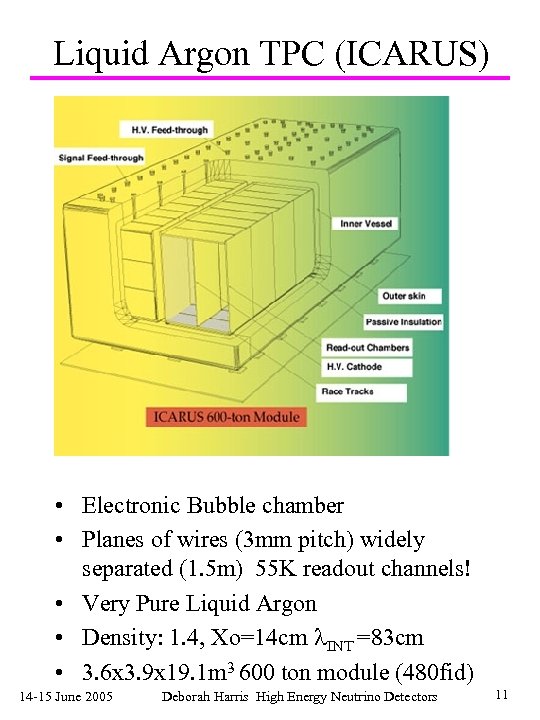
Liquid Argon TPC (ICARUS) • Electronic Bubble chamber • Planes of wires (3 mm pitch) widely separated (1. 5 m) 55 K readout channels! • Very Pure Liquid Argon • Density: 1. 4, Xo=14 cm l. INT =83 cm • 3. 6 x 3. 9 x 19. 1 m 3 600 ton module (480 fid) 14 -15 June 2005 Deborah Harris High Energy Neutrino Detectors 11
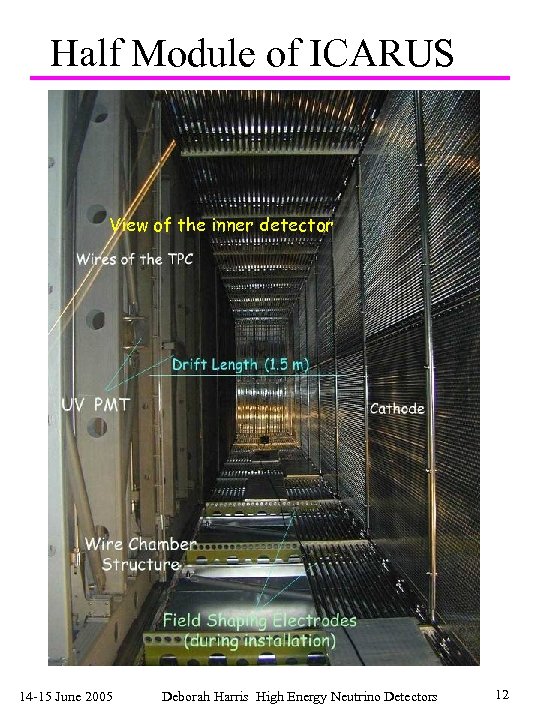
Half Module of ICARUS View of the inner detector 14 -15 June 2005 Deborah Harris High Energy Neutrino Detectors 12
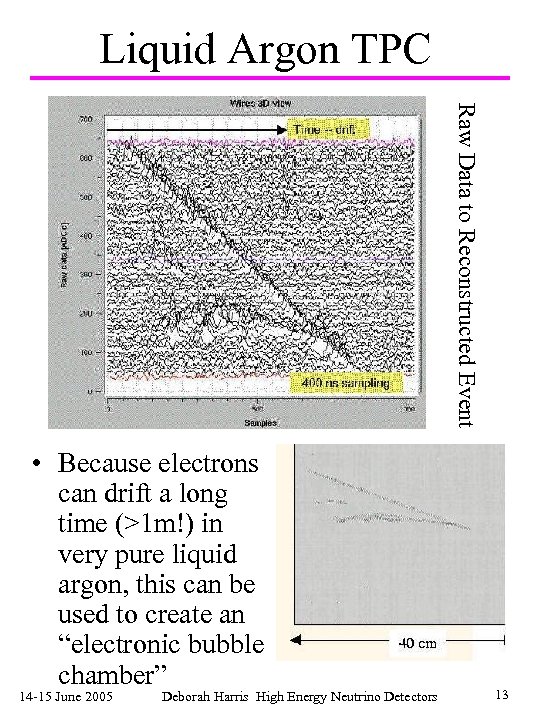
Liquid Argon TPC Raw Data to Reconstructed Event • Because electrons can drift a long time (>1 m!) in very pure liquid argon, this can be used to create an “electronic bubble chamber” 14 -15 June 2005 Deborah Harris High Energy Neutrino Detectors 13
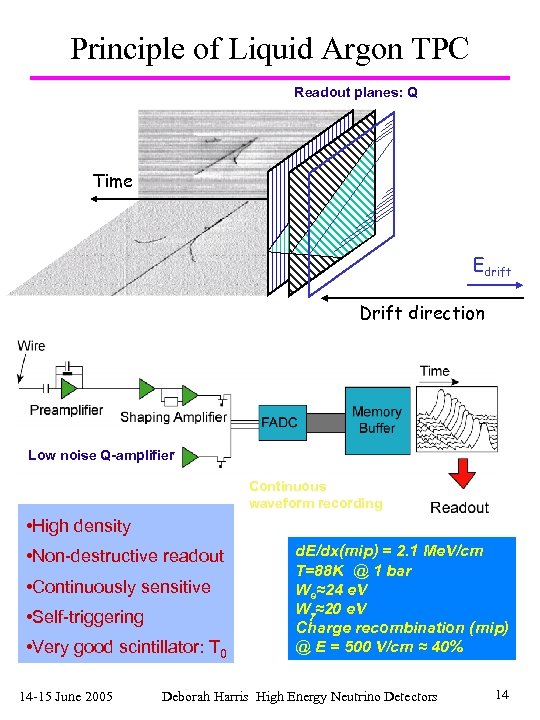
Principle of Liquid Argon TPC Readout planes: Q Time Edrift Drift direction Low noise Q-amplifier Continuous waveform recording • High density • Non-destructive readout • Continuously sensitive • Self-triggering • Very good scintillator: T 0 14 -15 June 2005 d. E/dx(mip) = 2. 1 Me. V/cm T=88 K @ 1 bar We≈24 e. V Wg≈20 e. V Charge recombination (mip) @ E = 500 V/cm ≈ 40% Deborah Harris High Energy Neutrino Detectors 14
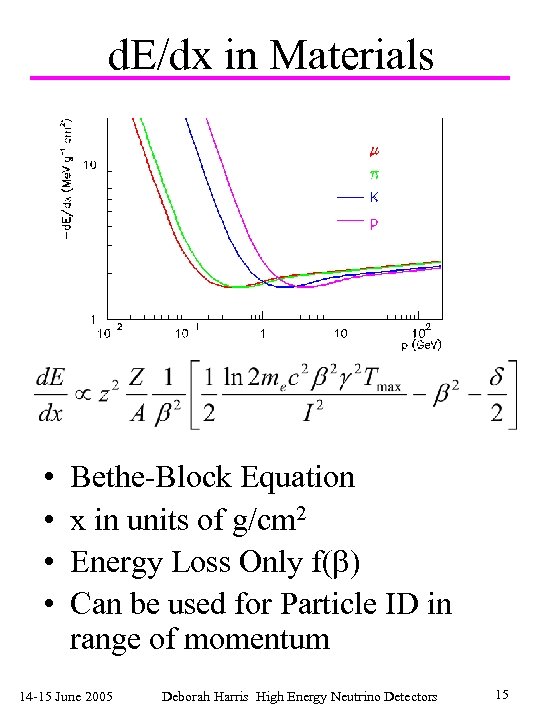
d. E/dx in Materials • • Bethe-Block Equation x in units of g/cm 2 Energy Loss Only f(b) Can be used for Particle ID in range of momentum 14 -15 June 2005 Deborah Harris High Energy Neutrino Detectors 15
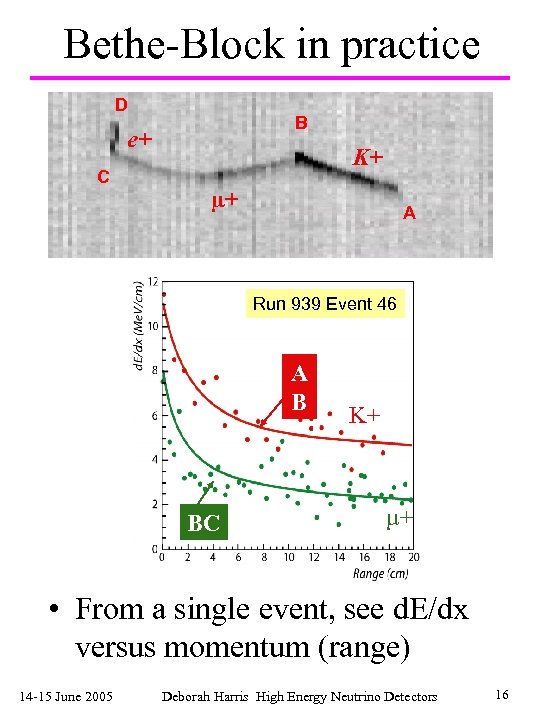
Bethe-Block in practice D B e+ C K+ µ+ A Run 939 Event 46 A B BC K+ µ+ • From a single event, see d. E/dx versus momentum (range) 14 -15 June 2005 Deborah Harris High Energy Neutrino Detectors 16
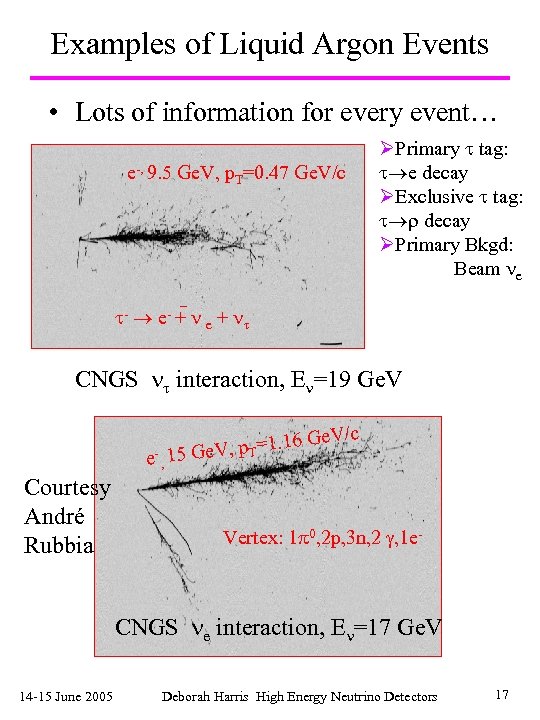
Examples of Liquid Argon Events • Lots of information for every event… e-, 9. 5 Ge. V, p. T=0. 47 Ge. V/c - _ -+ e ØPrimary tag: e decay ØExclusive tag: r decay ØPrimary Bkgd: Beam e e + CNGS interaction, E =19 Ge. V , p T=1. 16 G 5 Ge. V e- , 1 Courtesy André Rubbia /c Vertex: 1 0, 2 p, 3 n, 2 , 1 e- CNGS e interaction, E =17 Ge. V 14 -15 June 2005 Deborah Harris High Energy Neutrino Detectors 17
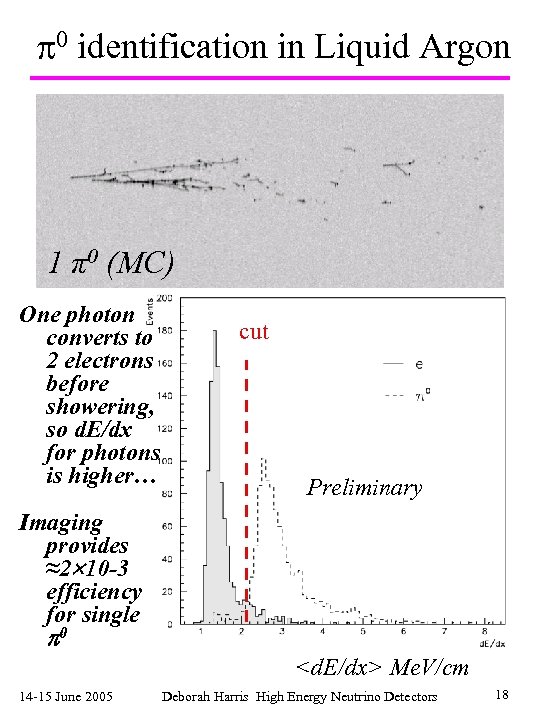
0 identification in Liquid Argon 1 π0 (MC) One photon converts to 2 electrons before showering, so d. E/dx for photons is higher… cut Preliminary Imaging provides ≈2 10 -3 efficiency for single p 0 <d. E/dx> Me. V/cm 14 -15 June 2005 Deborah Harris High Energy Neutrino Detectors 18
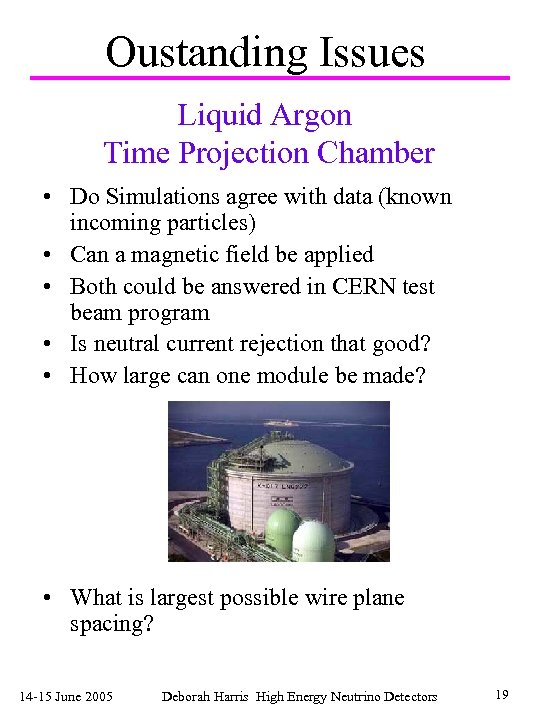
Oustanding Issues Liquid Argon Time Projection Chamber • Do Simulations agree with data (known incoming particles) • Can a magnetic field be applied • Both could be answered in CERN test beam program • Is neutral current rejection that good? • How large can one module be made? • What is largest possible wire plane spacing? 14 -15 June 2005 Deborah Harris High Energy Neutrino Detectors 19
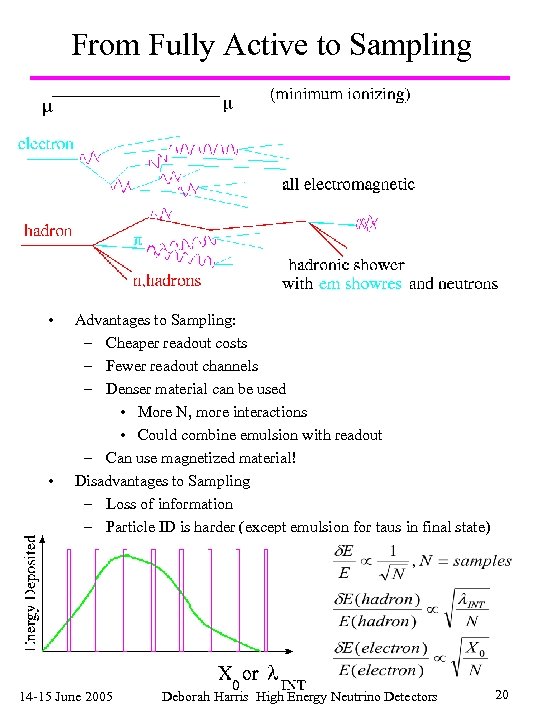
From Fully Active to Sampling • • Advantages to Sampling: – Cheaper readout costs – Fewer readout channels – Denser material can be used • More N, more interactions • Could combine emulsion with readout – Can use magnetized material! Disadvantages to Sampling – Loss of information – Particle ID is harder (except emulsion for taus in final state) 14 -15 June 2005 Deborah Harris High Energy Neutrino Detectors 20
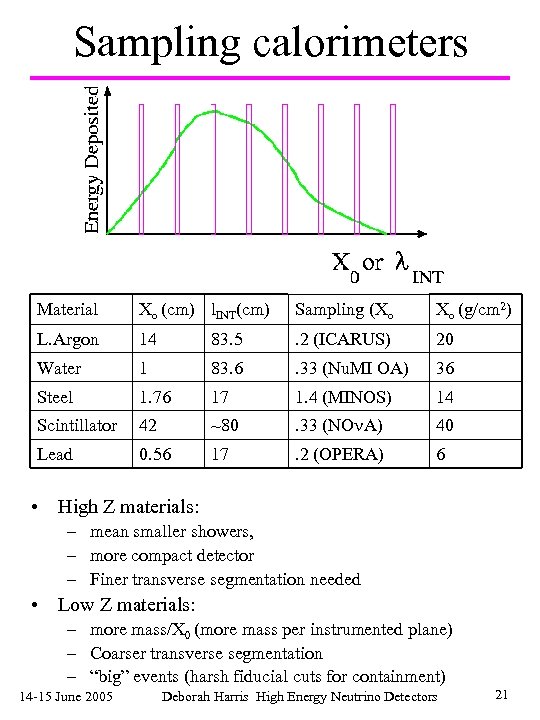
Sampling calorimeters Material Xo (cm) l. INT(cm) Sampling (Xo Xo (g/cm 2) L. Argon 14 83. 5 . 2 (ICARUS) 20 Water 1 83. 6 . 33 (Nu. MI OA) 36 Steel 1. 76 17 1. 4 (MINOS) 14 Scintillator 42 ~80 . 33 (NO A) 40 Lead 0. 56 17 . 2 (OPERA) 6 • High Z materials: – mean smaller showers, – more compact detector – Finer transverse segmentation needed • Low Z materials: – more mass/X 0 (more mass per instrumented plane) – Coarser transverse segmentation – “big” events (harsh fiducial cuts for containment) 14 -15 June 2005 Deborah Harris High Energy Neutrino Detectors 21
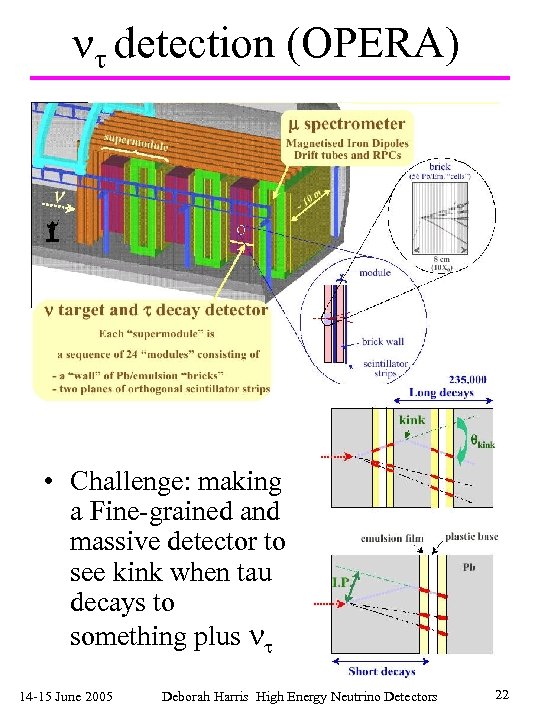
detection (OPERA) • Challenge: making a Fine-grained and massive detector to see kink when tau decays to something plus 14 -15 June 2005 Deborah Harris High Energy Neutrino Detectors 22
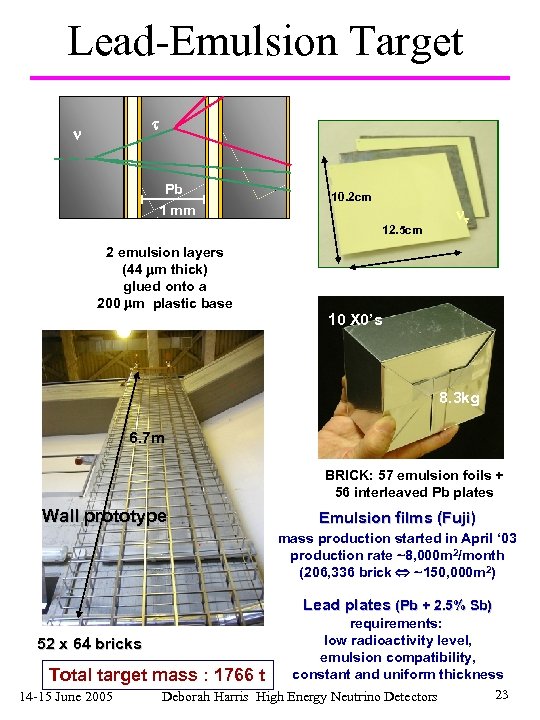
Lead-Emulsion Target Pb 1 mm 10. 2 cm 12. 5 cm 2 emulsion layers (44 m thick) glued onto a 200 m plastic base 10 X 0’s 8. 3 kg 6. 7 m BRICK: 57 emulsion foils + 56 interleaved Pb plates Wall prototype Emulsion films (Fuji) mass production started in April ‘ 03 production rate ~8, 000 m 2/month (206, 336 brick ~150, 000 m 2) Lead plates (Pb + 2. 5% Sb) requirements: low radioactivity level, 52 x 64 bricks emulsion compatibility, constant and uniform thickness Total target mass : 1766 t 23 14 -15 June 2005 Deborah Harris High Energy Neutrino Detectors
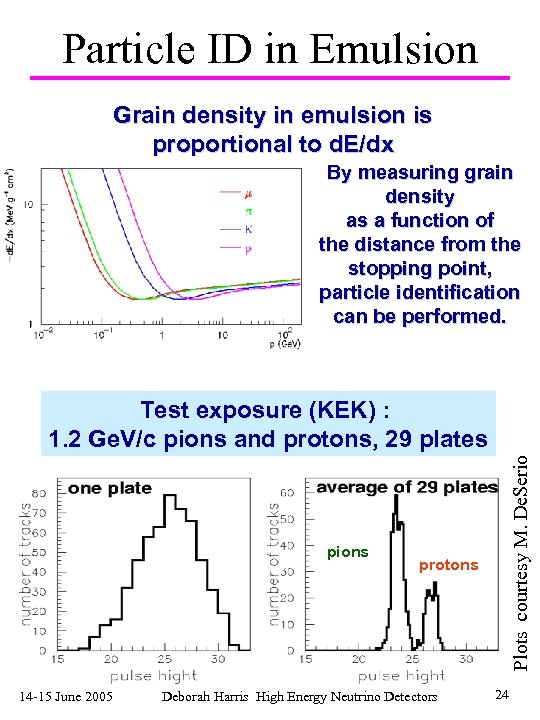
Particle ID in Emulsion Grain density in emulsion is proportional to d. E/dx By measuring grain density as a function of the distance from the stopping point, particle identification can be performed. pions 14 -15 June 2005 Plots courtesy M. De. Serio Test exposure (KEK) : 1. 2 Ge. V/c pions and protons, 29 plates protons Deborah Harris High Energy Neutrino Detectors 24
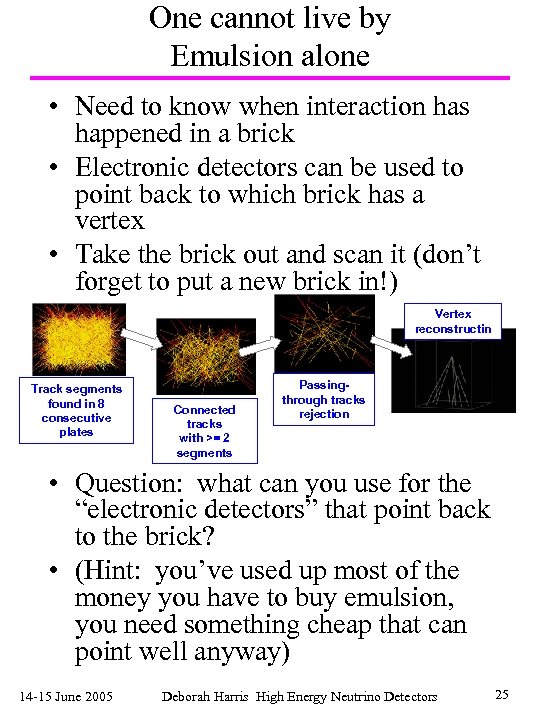
One cannot live by Emulsion alone • Need to know when interaction has happened in a brick • Electronic detectors can be used to point back to which brick has a vertex • Take the brick out and scan it (don’t forget to put a new brick in!) Vertex reconstructin Track segments found in 8 consecutive plates Connected tracks with >= 2 segments Passingthrough tracks rejection • Question: what can you use for the “electronic detectors” that point back to the brick? • (Hint: you’ve used up most of the money you have to buy emulsion, you need something cheap that can point well anyway) 14 -15 June 2005 Deborah Harris High Energy Neutrino Detectors 25
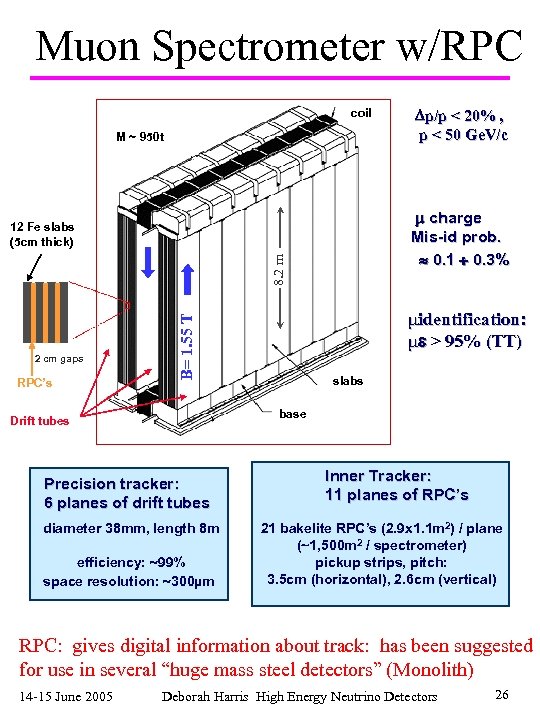
Muon Spectrometer w/RPC coil M ~ 950 t charge Mis-id prob. 0. 1 0. 3% 8. 2 m 12 Fe slabs (5 cm thick) RPC’s midentification: m > 95% (TT) B= 1. 55 T 2 cm gaps p/p < 20% , p < 50 Ge. V/c slabs base Drift tubes Precision tracker: 6 planes of drift tubes diameter 38 mm, length 8 m efficiency: 99% space resolution: 300µm Inner Tracker: 11 planes of RPC’s 21 bakelite RPC’s (2. 9 x 1. 1 m 2) / plane (~1, 500 m 2 / spectrometer) pickup strips, pitch: 3. 5 cm (horizontal), 2. 6 cm (vertical) RPC: gives digital information about track: has been suggested for use in several “huge mass steel detectors” (Monolith) 14 -15 June 2005 Deborah Harris High Energy Neutrino Detectors 26
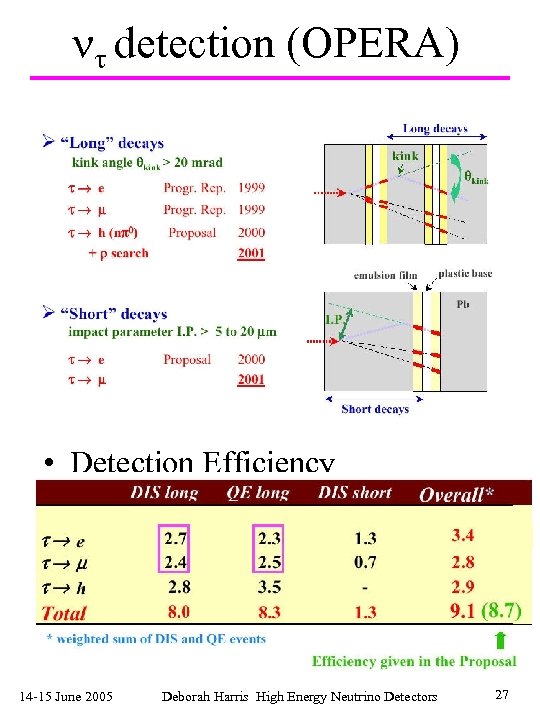
detection (OPERA) • Detection Efficiency 14 -15 June 2005 Deborah Harris High Energy Neutrino Detectors 27
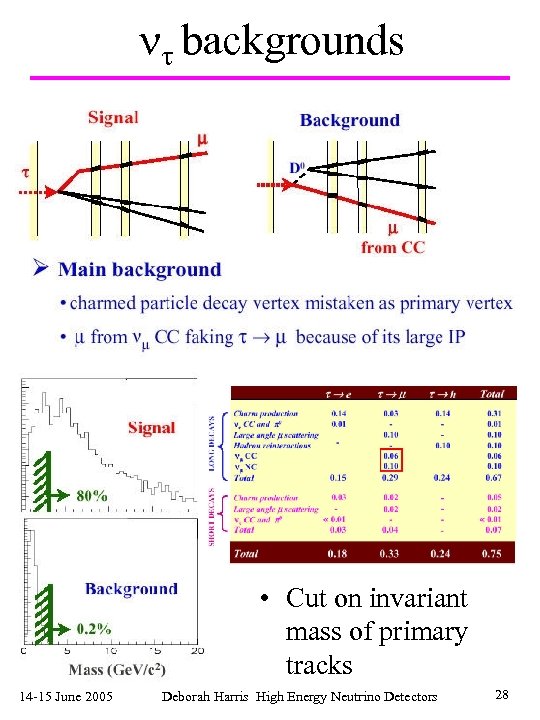
backgrounds • Cut on invariant mass of primary tracks 14 -15 June 2005 Deborah Harris High Energy Neutrino Detectors 28
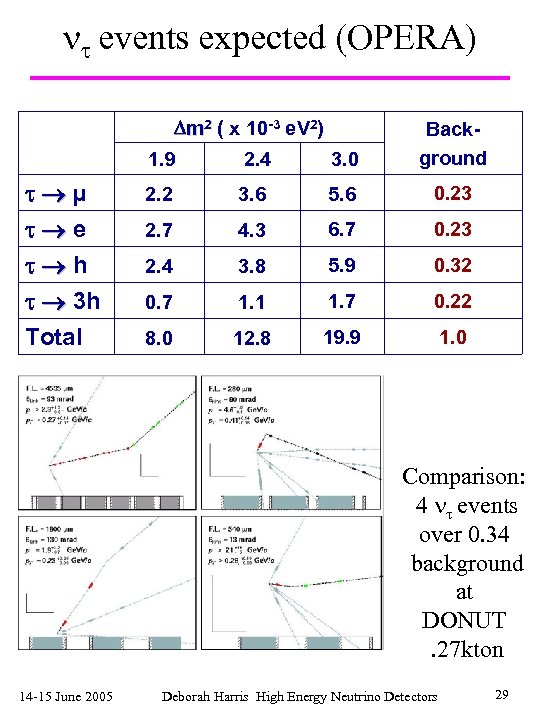
events expected (OPERA) m 2 ( x 10 -3 e. V 2) 1. 9 µ e h 3 h Total 2. 4 3. 0 Background 2. 2 3. 6 5. 6 0. 23 2. 7 4. 3 6. 7 0. 23 2. 4 3. 8 5. 9 0. 32 0. 7 1. 1 1. 7 0. 22 8. 0 12. 8 19. 9 1. 0 Comparison: 4 events over 0. 34 background at DONUT. 27 kton 14 -15 June 2005 Deborah Harris High Energy Neutrino Detectors 29
Outstanding Issues Emulsion Sampling • If LSND signature is oscillations, appearance will be much more important in the future • For future neutrino factory experiments, could study e → • For either of these topics, need to understand if/how magnetic field can be made… • Any way to make this detector more massive? 14 -15 June 2005 Deborah Harris High Energy Neutrino Detectors 30
Скачать презентацию High Energy Neutrino Detectors Deborah Harris Fermilab Nufact
332e9065336061078b446f2fdc1dcb9f.ppt