


 Скачать презентацию High Energy Gamma Physics with GLAST Gamma-ray Large
ee0093db36fc24ddc7f730a91ef95e47.ppt
- Количество слайдов: 14
 High Energy Gamma Physics with GLAST Gamma-ray Large Area Space Telescope Monica Pepe INFN Perugia on behalf of the GLAST-LAT Collaboration 32 nd International Conference on High Energy Physics August 16 -22, 2004, Beijing, China ICHEP 04 - August 16 -22, 2004, Beijing 1 Monica Pepe – INFN Perugia
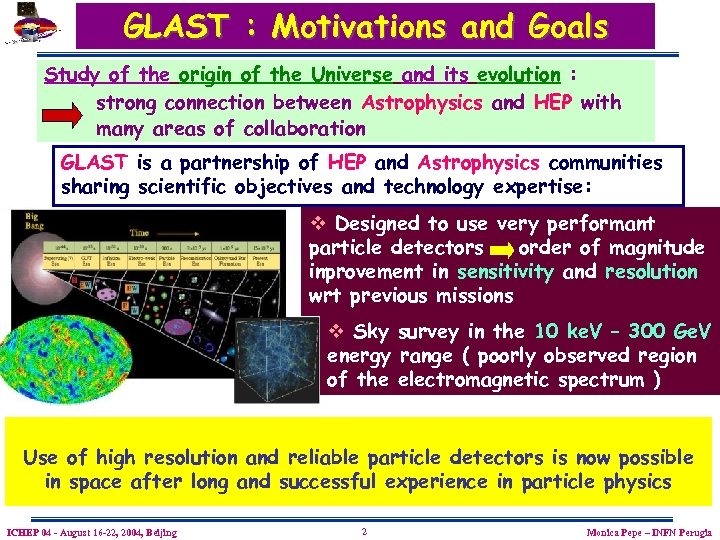 GLAST : Motivations and Goals Study of the origin of the Universe and its evolution : strong connection between Astrophysics and HEP with many areas of collaboration GLAST is a partnership of HEP and Astrophysics communities sharing scientific objectives and technology expertise: v Designed to use very performant particle detectors order of magnitude inprovement in sensitivity and resolution wrt previous missions v Sky survey in the 10 ke. V – 300 Ge. V energy range ( poorly observed region of the electromagnetic spectrum ) Use of high resolution and reliable particle detectors is now possible in space after long and successful experience in particle physics ICHEP 04 - August 16 -22, 2004, Beijing 2 Monica Pepe – INFN Perugia
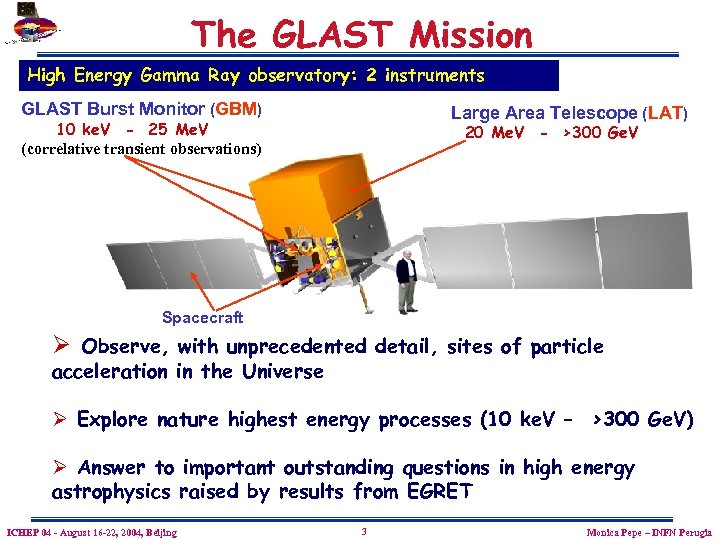 The GLAST Mission High Energy Gamma Ray observatory: 2 instruments GLAST Burst Monitor (GBM) Large Area Telescope (LAT) 10 ke. V - 25 Me. V (correlative transient observations) 20 Me. V - >300 Ge. V Spacecraft Ø Observe, with unprecedented detail, sites of particle acceleration in the Universe Ø Explore nature highest energy processes (10 ke. V – >300 Ge. V) Ø Answer to important outstanding questions in high energy astrophysics raised by results from EGRET ICHEP 04 - August 16 -22, 2004, Beijing 3 Monica Pepe – INFN Perugia
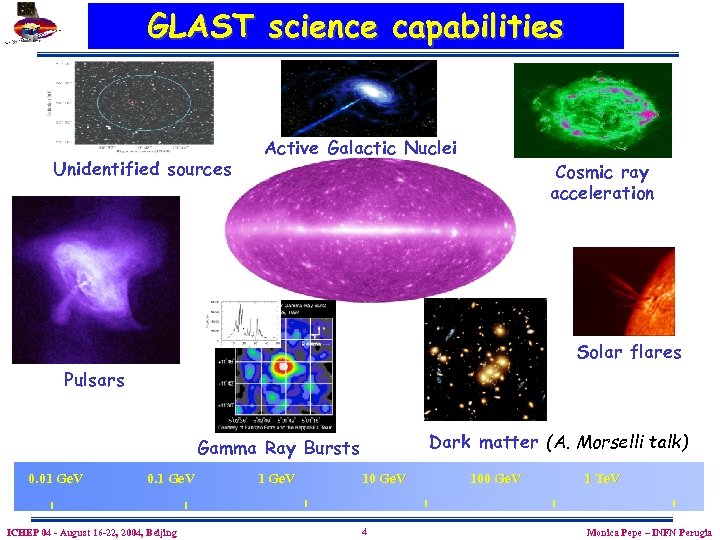 GLAST science capabilities Unidentified sources Active Galactic Nuclei Cosmic ray acceleration Solar flares Pulsars Dark matter (A. Morselli talk) Gamma Ray Bursts 0. 01 Ge. V 0. 1 Ge. V ICHEP 04 - August 16 -22, 2004, Beijing 1 Ge. V 10 Ge. V 4 100 Ge. V 1 Te. V Monica Pepe – INFN Perugia
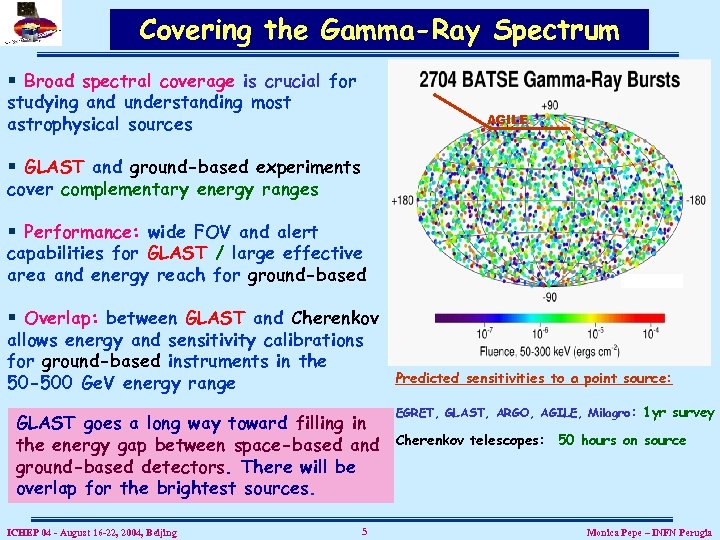 Covering the Gamma-Ray Spectrum § Broad spectral coverage is crucial for studying and understanding most astrophysical sources AGILE § GLAST and ground-based experiments cover complementary energy ranges § Performance: wide FOV and alert capabilities for GLAST / large effective area and energy reach for ground-based § Overlap: between GLAST and Cherenkov allows energy and sensitivity calibrations for ground-based instruments in the 50 -500 Ge. V energy range GLAST goes a long way toward filling in the energy gap between space-based and ground-based detectors. There will be overlap for the brightest sources. ICHEP 04 - August 16 -22, 2004, Beijing 5 Predicted sensitivities to a point source: EGRET, GLAST, ARGO, AGILE, Milagro: 1 yr survey Cherenkov telescopes: 50 hours on source Monica Pepe – INFN Perugia
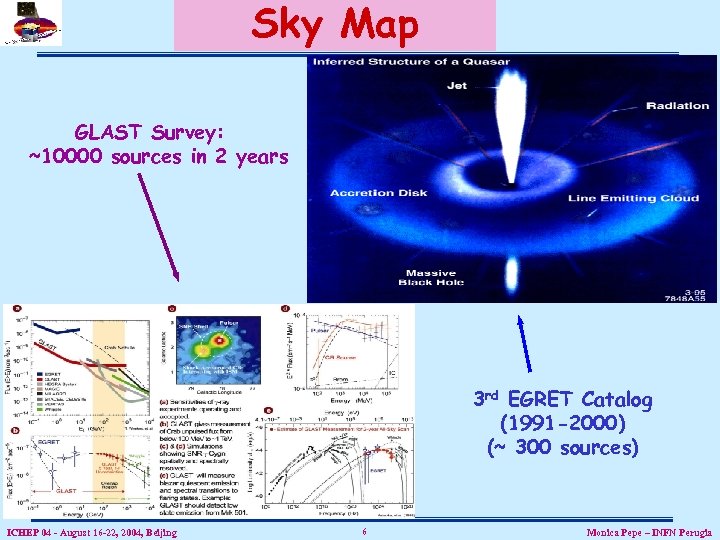 Sky Map GLAST Survey: ~10000 sources in 2 years 3 rd EGRET Catalog (1991 -2000) (~ 300 sources) ICHEP 04 - August 16 -22, 2004, Beijing 6 Monica Pepe – INFN Perugia
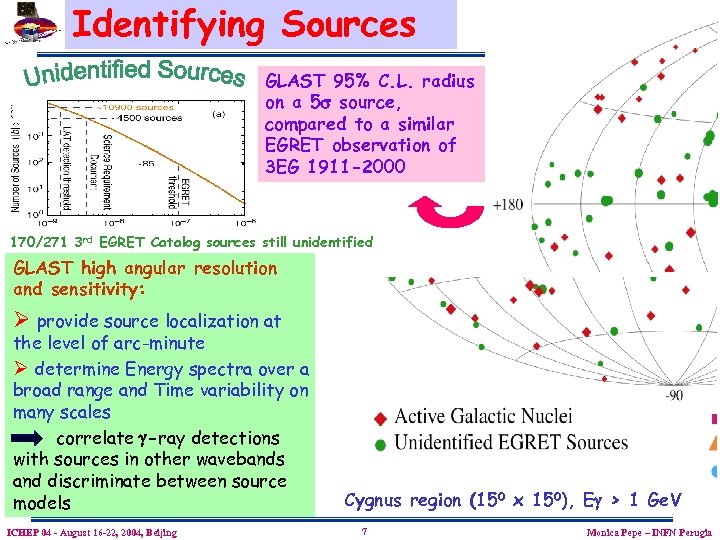 Identifying Sources GLAST 95% C. L. radius on a 5 source, compared to a similar EGRET observation of 3 EG 1911 -2000 170/271 3 rd EGRET Catalog sources still unidentified GLAST high angular resolution and sensitivity: Counting stats not included. Ø provide source localization at the level of arc-minute Ø determine Energy spectra over a broad range and Time variability on many scales correlate -ray detections with sources in other wavebands and discriminate between source models ICHEP 04 - August 16 -22, 2004, Beijing Cygnus region (150 x 150), E > 1 Ge. V 7 Monica Pepe – INFN Perugia
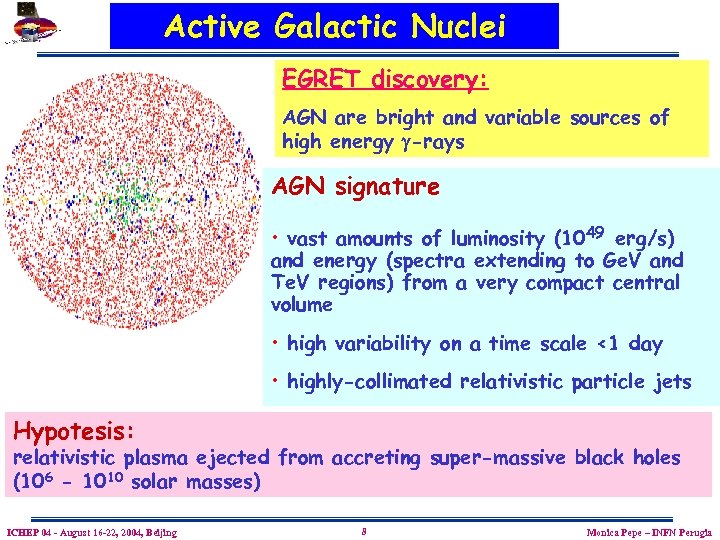 Active Galactic Nuclei EGRET discovery: AGN are bright and variable sources of high energy -rays AGN signature • vast amounts of luminosity (1049 erg/s) and energy (spectra extending to Ge. V and Te. V regions) from a very compact central volume • high variability on a time scale <1 day • highly-collimated relativistic particle jets Hypotesis: relativistic plasma ejected from accreting super-massive black holes (106 - 1010 solar masses) ICHEP 04 - August 16 -22, 2004, Beijing 8 Monica Pepe – INFN Perugia
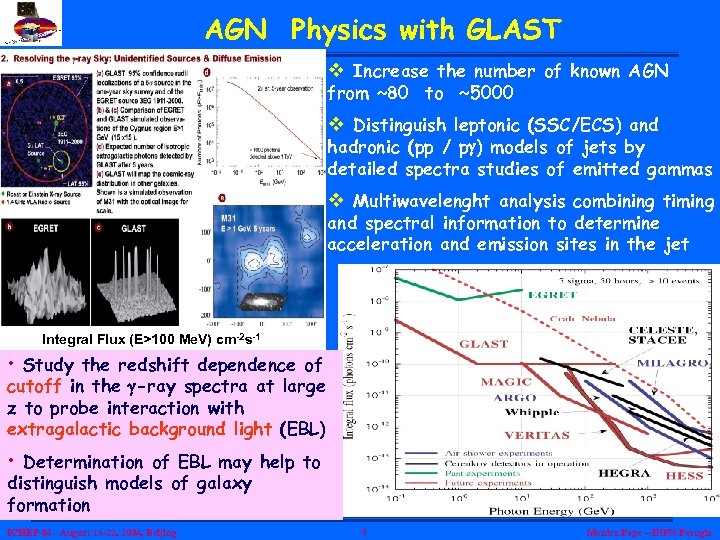 AGN Physics with GLAST v Increase the number of known AGN from ~80 to ~5000 v Distinguish leptonic (SSC/ECS) and hadronic (pp / p ) models of jets by detailed spectra studies of emitted gammas v Multiwavelenght analysis combining timing and spectral information to determine acceleration and emission sites in the jet Integral Flux (E>100 Me. V) cm-2 s-1 • Study the redshift dependence of cutoff in the -ray spectra at large z to probe interaction with extragalactic background light (EBL) • Determination of EBL may help to distinguish models of galaxy formation ICHEP 04 - August 16 -22, 2004, Beijing 9 Monica Pepe – INFN Perugia
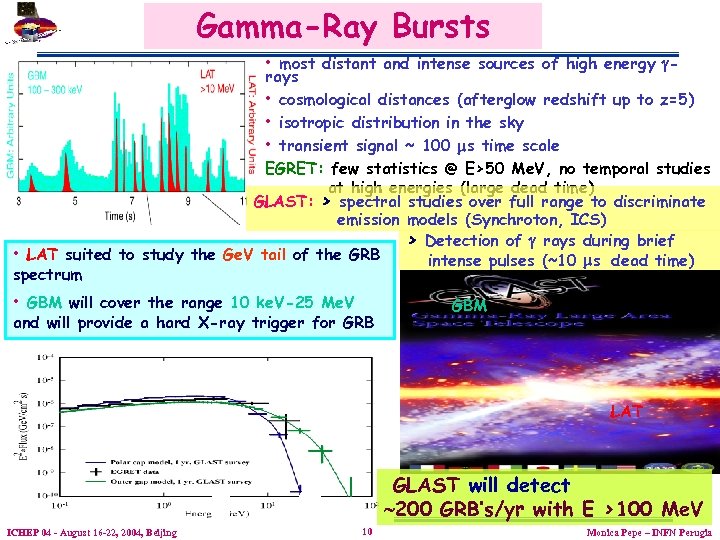 Gamma-Ray Bursts • most distant and intense sources of high energy - rays • cosmological distances (afterglow redshift up to z=5) • isotropic distribution in the sky • transient signal ~ 100 s time scale EGRET: few statistics @ E>50 Me. V, no temporal studies at high energies (large dead time) GLAST: > spectral studies over full range to discriminate emission models (Synchroton, ICS) > Detection of rays during brief • LAT suited to study the Ge. V tail of the GRB intense pulses (~10 s dead time) spectrum • GBM will cover the range 10 ke. V-25 Me. V and will provide a hard X-ray trigger for GRB GBM LAT GLAST will detect 200 GRB’s/yr with E >100 Me. V ICHEP 04 - August 16 -22, 2004, Beijing 10 Monica Pepe – INFN Perugia
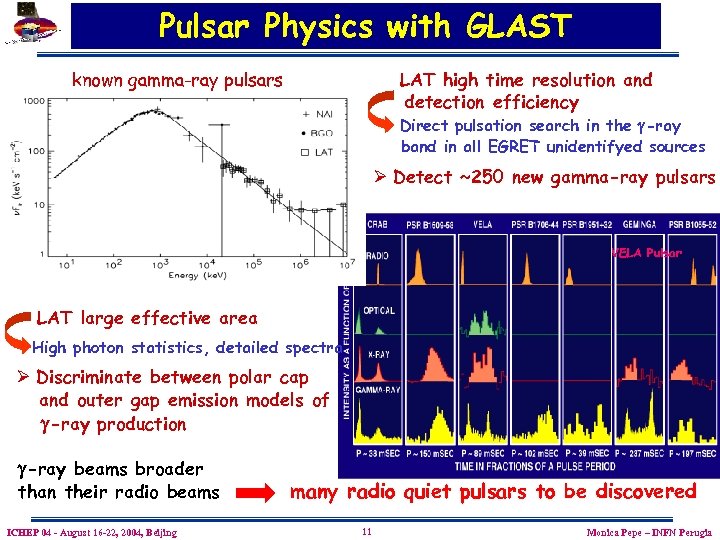 Pulsar Physics with GLAST known gamma-ray pulsars LAT high time resolution and detection efficiency Direct pulsation search in the -ray band in all EGRET unidentifyed sources Ø Detect ~250 new gamma-ray pulsars VELA Pulsar LAT large effective area High photon statistics, detailed spectra Ø Discriminate between polar cap and outer gap emission models of -ray production -ray beams broader than their radio beams ICHEP 04 - August 16 -22, 2004, Beijing many radio quiet pulsars to be discovered 11 Monica Pepe – INFN Perugia
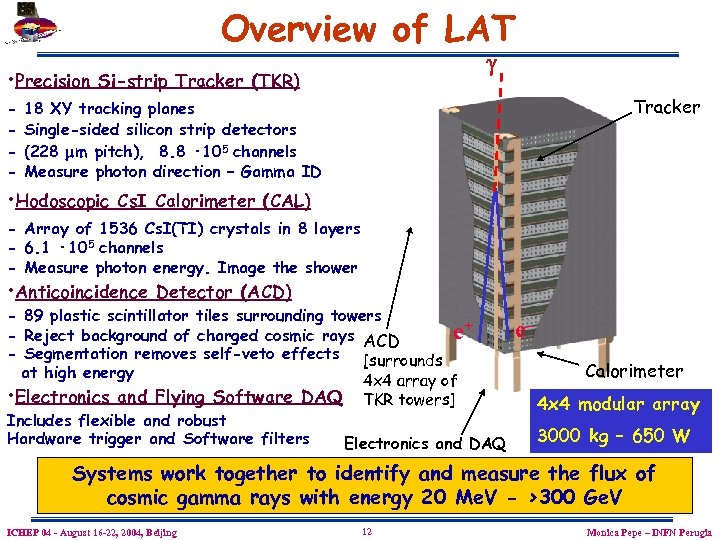 Overview of LAT • Precision Si-strip Tracker (TKR) - Tracker 18 XY tracking planes Single-sided silicon strip detectors (228 m pitch), 8. 8 · 105 channels Measure photon direction – Gamma ID • Hodoscopic Cs. I Calorimeter (CAL) - Array of 1536 Cs. I(TI) crystals in 8 layers - 6. 1 · 105 channels - Measure photon energy. Image the shower • Anticoincidence Detector (ACD) - 89 plastic scintillator tiles surrounding towers e+ - Reject background of charged cosmic rays ACD - Segmentation removes self-veto effects [surrounds at high energy 4 x 4 array of • Electronics and Flying Software DAQ Includes flexible and robust Hardware trigger and Software filters TKR towers] Electronics and DAQ e– Calorimeter 4 x 4 modular array 3000 kg – 650 W Systems work together to identify and measure the flux of cosmic gamma rays with energy 20 Me. V - >300 Ge. V ICHEP 04 - August 16 -22, 2004, Beijing 12 Monica Pepe – INFN Perugia
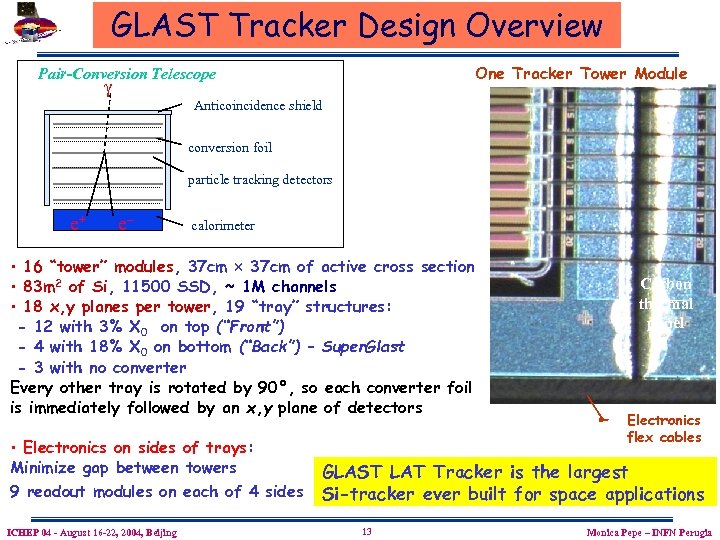 GLAST Tracker Design Overview One Tracker Tower Module Pair-Conversion Telescope Anticoincidence shield conversion foil particle tracking detectors e+ e– calorimeter • 16 “tower” modules, 37 cm of active cross section • 83 m 2 of Si, 11500 SSD, ~ 1 M channels • 18 x, y planes per tower, 19 “tray” structures: - 12 with 3% X 0 on top (“Front”) - 4 with 18% X 0 on bottom (“Back”) – Super. Glast - 3 with no converter Every other tray is rotated by 90°, so each converter foil is immediately followed by an x, y plane of detectors • Electronics on sides of trays: Minimize gap between towers 9 readout modules on each of 4 sides ICHEP 04 - August 16 -22, 2004, Beijing Carbon thermal panel Electronics flex cables GLAST LAT Tracker is the largest Si-tracker ever built for space applications 13 Monica Pepe – INFN Perugia
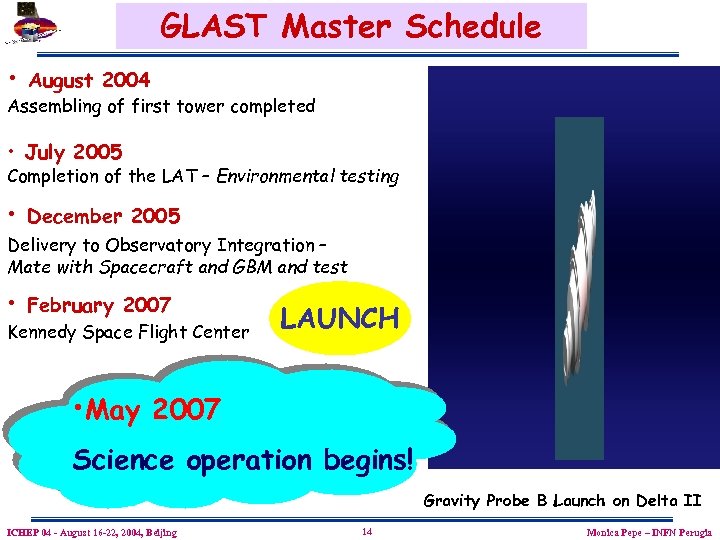 GLAST Master Schedule • August 2004 Assembling of first tower completed • July 2005 Completion of the LAT – Environmental testing • December 2005 Delivery to Observatory Integration – Mate with Spacecraft and GBM and test • February 2007 Kennedy Space Flight Center LAUNCH • May 2007 Science operation begins! Gravity Probe B Launch on Delta II ICHEP 04 - August 16 -22, 2004, Beijing 14 Monica Pepe – INFN Perugia