 Скачать презентацию High-Energy Emission from GRBs expectations first results
87b4bcd5d89dbc3447d49718c64c16ce.ppt
- Количество слайдов: 29



High-Energy Emission from GRBs: expectations & first results from the Fermi Gamma-ray Space Telescope Jonathan Granot University of Hertfordshire (Royal Society Wolfson Research Merit Award Holder) on behalf of the Fermi LAT & GMB Collaborations Nordita, Stockholm, Sweden, May 25, 2009
Outline of the Talk: New Space missions help drive progress in GRBs n GRB: some basic properties, theoretical framework n High-energy emission processes & pre-Fermi obs. n Some expectations & hopes from Fermi n Fermi: initial results n GRB 081024 B: 1 st clearly short GRB above 1 Ge. V u GRB 080916 C: very bright – a lot of interesting data u Lower limit on the Bulk Lorentz factor u Limit on Lorentz invariance violation u Possible causes of HE delayed onset & longer duration u n Conclusions
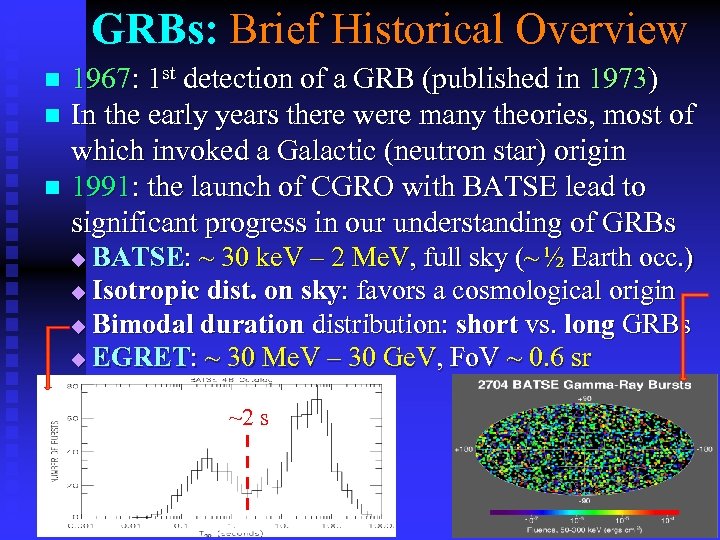
GRBs: Brief Historical Overview 1967: 1 st detection of a GRB (published in 1973) n In the early years there were many theories, most of which invoked a Galactic (neutron star) origin n 1991: the launch of CGRO with BATSE lead to significant progress in our understanding of GRBs n BATSE: ~ 30 ke. V – 2 Me. V, full sky (~ ½ Earth occ. ) u Isotropic dist. on sky: favors a cosmological origin u Bimodal duration distribution: short vs. long GRBs u EGRET: ~ 30 Me. V – 30 Ge. V, Fo. V ~ 0. 6 sr u ~2 s
n Beppo. SAX (1996 - 2002): lead to discovery of afterglow (1997) in X-rays, optical, radio (for long GRBs) u This led to redshift measurements: clear cut determination of the distance/energy (long GRBs) Eγ, iso ~ 1052 -1054 erg u Afterglow observations provided information on beaming (narrow jets: Eγ ~ 1051 erg), event rate, external density, supernova connection ( long GRB progenitors) n Swift (2004 - ? ): autonomously localizes GRBs slews in ~1 -2 min) and observed in X-ray + optical/UV u Discovered unexpected behavior of early afterglow u Led to the discovery of afterglow from short GRBs host galaxies, redshifts, energy, rate, clues for progenitors n Fermi (2008 - ? ): may also lead to significant progress in GRB research, like previous major space missions
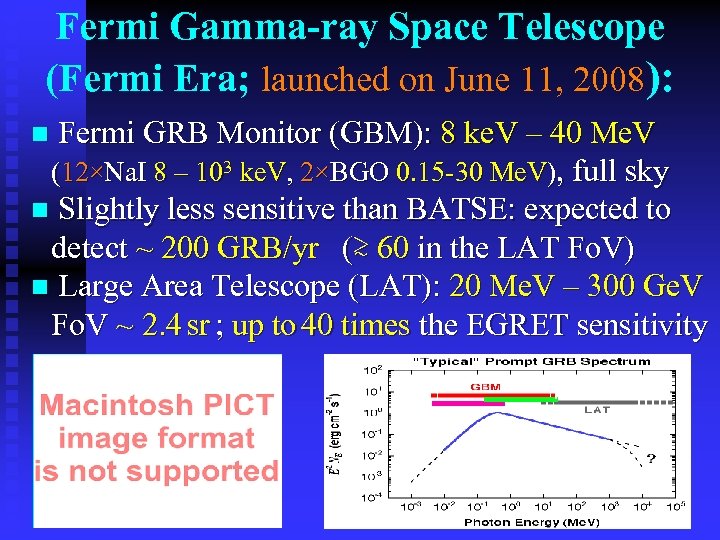
Fermi Gamma-ray Space Telescope (Fermi Era; launched on June 11, 2008): Fermi GRB Monitor (GBM): 8 ke. V – 40 Me. V (12×Na. I 8 – 103 ke. V, 2×BGO 0. 15 -30 Me. V), full sky n Slightly less sensitive than BATSE: expected to detect ~ 200 GRB/yr (≳ 60 in the LAT Fo. V) n Large Area Telescope (LAT): 20 Me. V – 300 Ge. V Fo. V ~ 2. 4 sr ; up to 40 times the EGRET sensitivity n
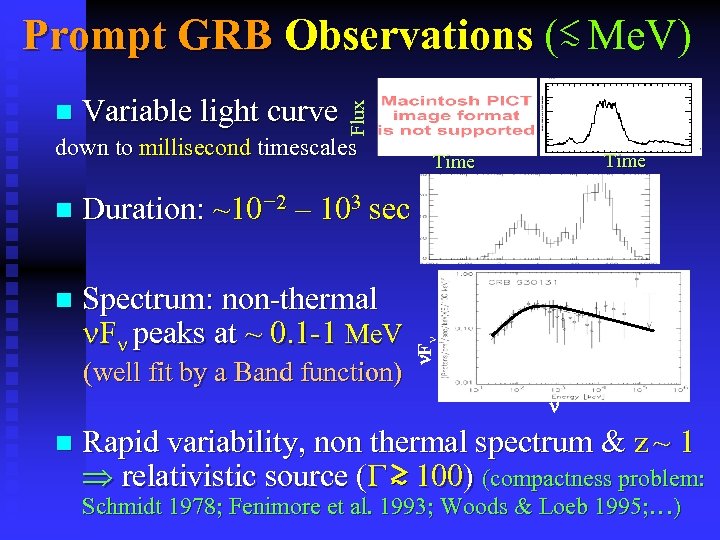
Prompt GRB Observations (≲ Me. V) Flux n Variable light curve down to millisecond timescales Time Duration: ~10 − 2 – 103 sec n Spectrum: non-thermal F peaks at ~ 0. 1 -1 Me. V (well fit by a Band function) F n n Rapid variability, non thermal spectrum & z ~ 1 relativistic source ( ≳ 100) (compactness problem: Schmidt 1978; Fenimore et al. 1993; Woods & Loeb 1995; …)
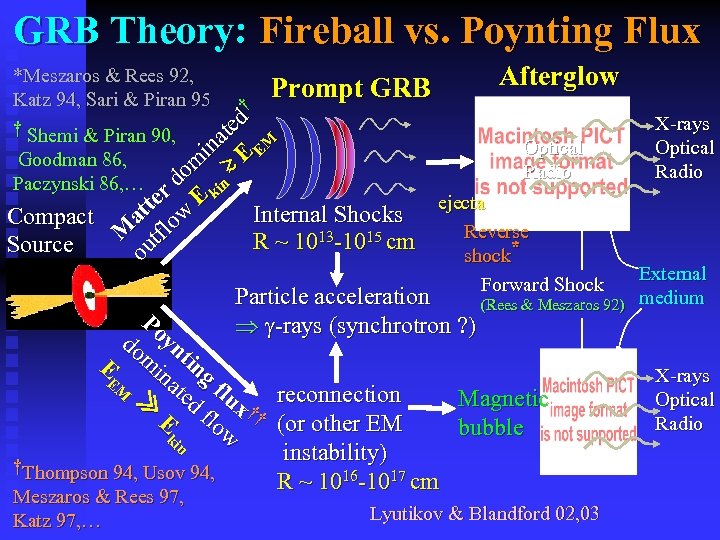
GRB Theory: Fireball vs. Poynting Flux *Meszaros & Rees 92, Katz 94, Sari & Piran 95 † Prompt GRB Afterglow ted M a Optical in E E Goodman 86, Radio om n≳ Paczynski 86, … r d ki ejecta tte w E Internal Shocks Compact a lo Reverse M tf R ~ 1013 -1015 cm Source ou shock* † Shemi & Piran 90, Forward Shock Particle acceleration (Rees & Meszaros 92) -rays (synchrotron ? ) Po do yn E min ting EM ate fl ≫ d ux † reconnection Magnetic flo † (or other EM E bubble w ki n instability) †Thompson 94, Usov 94, R ~ 1016 -1017 cm Meszaros & Rees 97, Katz 97, … Lyutikov & Blandford 02, 03 X-rays Optical Radio External medium X-rays Optical Radio
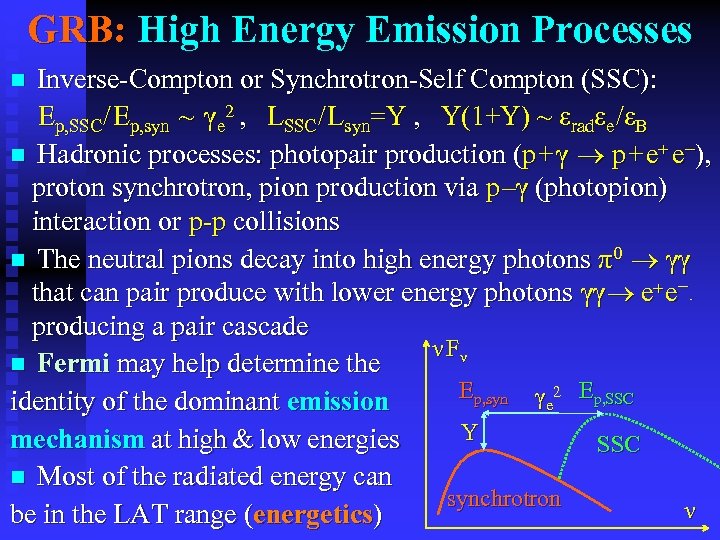
GRB: High Energy Emission Processes Inverse-Compton or Synchrotron-Self Compton (SSC): Ep, SSC / Ep, syn ~ γe 2 , LSSC / Lsyn=Y , Y(1+Y) ~ εradεe /εB n Hadronic processes: photopair production (p + γ p + e e ), proton synchrotron, pion production via p –γ (photopion) interaction or p-p collisions n The neutral pions decay into high energy photons π0 γγ that can pair produce with lower energy photons γγ e e− producing a pair cascade ν Fν n Fermi may help determine the Ep, syn γe 2 Ep, SSC identity of the dominant emission Y mechanism at high & low energies SSC n Most of the radiated energy can synchrotron ν be in the LAT range (energetics) n -
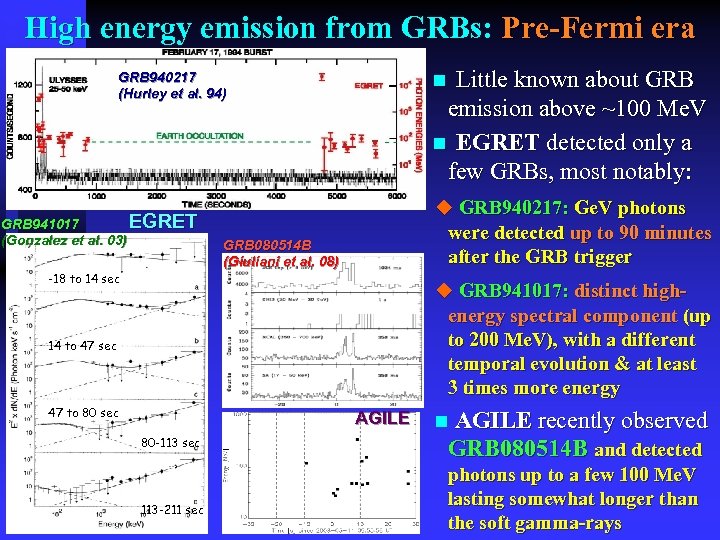
High energy emission from GRBs: Pre-Fermi era Little known about GRB emission above ~100 Me. V n EGRET detected only a few GRBs, most notably: GRB 940217 (Hurley et al. 94) EGRET GRB 941017 (Gonzalez et al. 03) n u GRB 940217: Ge. V photons were detected up to 90 minutes after the GRB trigger GRB 080514 B (Giuliani et al. 08) -18 to 14 sec u GRB 941017: distinct high- energy spectral component (up to 200 Me. V), with a different temporal evolution & at least 3 times more energy 14 to 47 sec 47 to 80 sec AGILE 80 -113 sec BATSE - LAD EGRET - TASC 113 -211 sec n AGILE recently observed GRB 080514 B and detected photons up to a few 100 Me. V lasting somewhat longer than the soft gamma-rays
High-Energy emission from GRBs: Expectations & Hopes for Fermi n Prompt GRB emission: Detecting a distinct high-energy spectral component teach us about emission mechanism & energetics u Detecting opacity signatures (internal / external-EBL) u Constraining Lorentz Invariance Violation (LIV) u n First several hours after the GRB: HE afterglow emission (SSC from the forward shock) u IC from the forward-reverse shock system near ~ tdec − u Pair echo: Te. V (GRB) + CIB γγ e e EC on CMB u IC involving the external shock & late source activity u Hadronic induced cascades in the early afterglow u
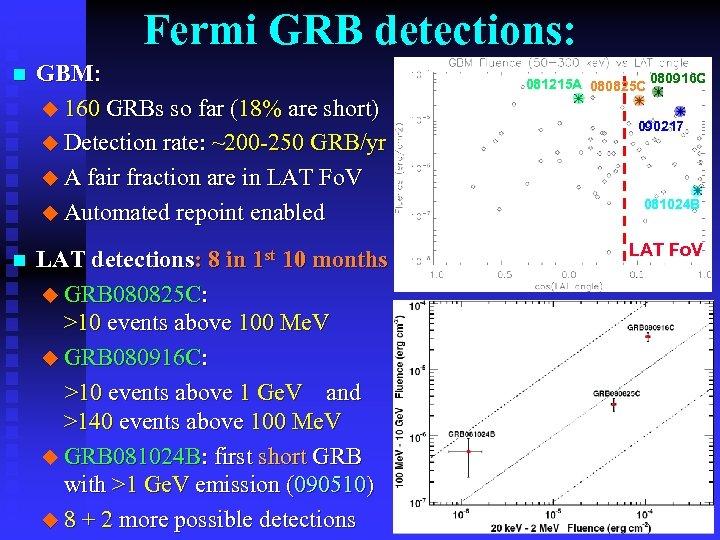
Fermi GRB detections: n n GBM: u 160 GRBs so far (18% are short) u Detection rate: ~200 -250 GRB/yr u A fair fraction are in LAT Fo. V u Automated repoint enabled LAT detections: 8 in 1 st 10 months u GRB 080825 C: >10 events above 100 Me. V u GRB 080916 C: >10 events above 1 Ge. V and >140 events above 100 Me. V u GRB 081024 B: first short GRB with >1 Ge. V emission (090510) u 8 + 2 more possible detections 081215 A 080825 C 080916 C 090217 081024 B LAT Fo. V cosθ
Breaking News: GRB 090510 Short-hard GRB (T 90 ~ 0. 5 s, Epeak ~ 4 -5 Me. V) n Detected by Swift, Fermi, Suzaku, AGILE, K-W n AGILE: >5 σ detection of >100 Me. V γ-rays, during the prompt phase & a “delayed” phase (GCN 9343) n Fermi LAT: >50 γ’s above 100 Me. V (>10 γ’s above 1 Ge. V) in 1 st sec. ; >150 γ’s above 100 Me. V (>20 above 1 Ge. V) in 1 st min. (GCN 9350) n X-ray (Swift XRT) & optical afterglow n Spectroscopic redshift: z = 0. 903 Eγ, iso ~ 4× 1052 erg (GCN 9350) n Very interesting GRB: I can’t say much more now n
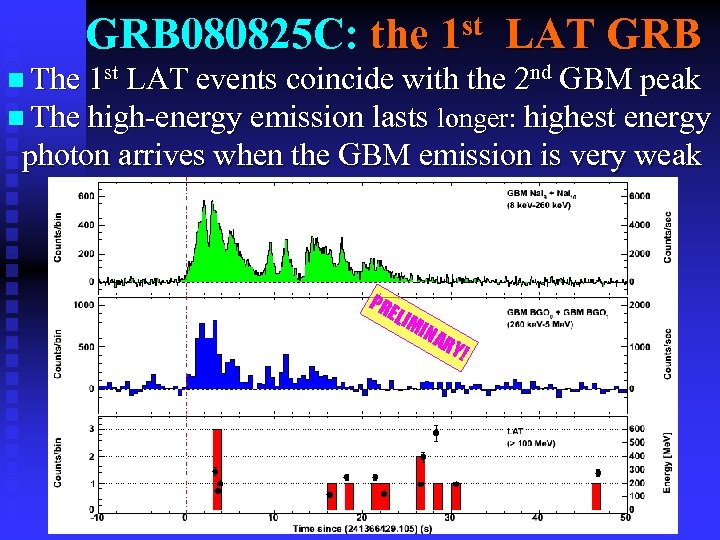
GRB 080825 C: the st 1 LAT GRB n The 1 st LAT events coincide with the 2 nd GBM peak n The high-energy emission lasts longer: highest energy photon arrives when the GBM emission is very weak PR EL IM INA RY !
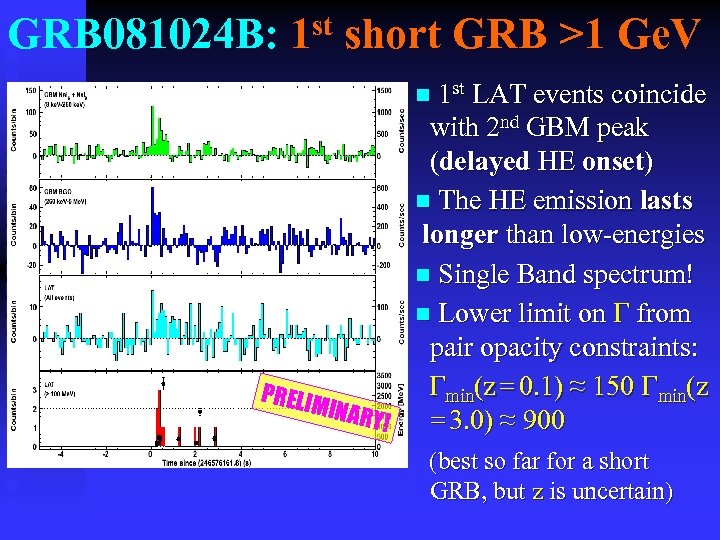
GRB 081024 B: st 1 short GRB >1 Ge. V n 1 st LAT events coincide with 2 nd GBM peak (delayed HE onset) n The HE emission lasts longer than low-energies n Single Band spectrum! n Lower limit on Γ from pair opacity constraints: Γmin(z = 0. 1) ≈ 150 Γmin(z PRELI MINAR Y! = 3. 0) ≈ 900 (best so far for a short GRB, but z is uncertain)
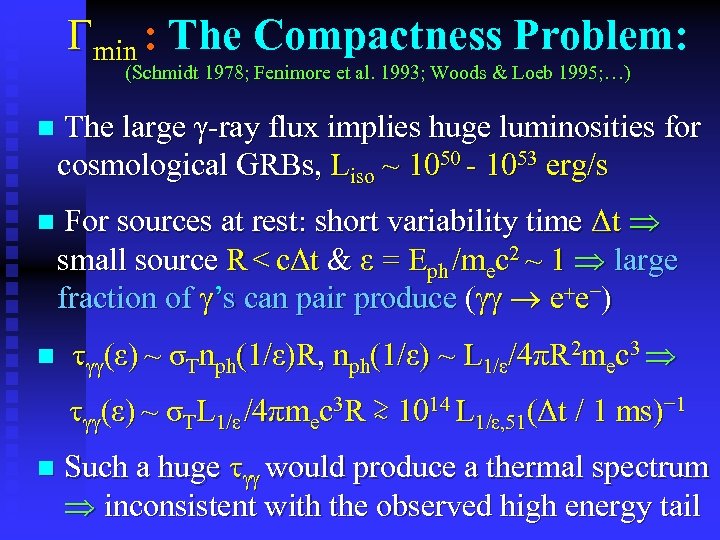
Γmin : The Compactness Problem: (Schmidt 1978; Fenimore et al. 1993; Woods & Loeb 1995; …) n The large γ-ray flux implies huge luminosities for cosmological GRBs, Liso ~ 1050 - 1053 erg/s n For sources at rest: short variability time Δt small source R < cΔt & ε = Eph /mec 2 ~ 1 large fraction of ’s can pair produce ( e e−) n (ε) ~ σTnph(1/ε)R, nph(1/ε) ~ L 1/ε/4πR 2 mec 3 (ε) ~ σTL 1/ε /4πmec 3 R ≳ 1014 L 1/ε, 51(Δt / 1 ms)− 1 n Such a huge would produce a thermal spectrum inconsistent with the observed high energy tail
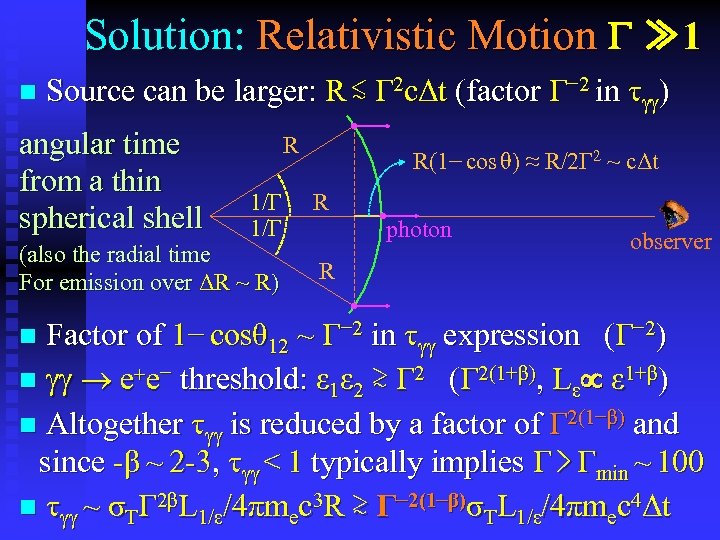
Solution: Relativistic Motion ≫ 1 n Source can be larger: R ≲ Γ 2 cΔt (factor Γ− 2 in ) angular time from a thin spherical shell R 1/Γ (also the radial time For emission over ΔR ~ R) R(1− cos θ) ≈ R/2Γ 2 ~ cΔt R photon observer R Factor of 1− cosθ 12 ~ Γ− 2 in expression (Γ− 2) n e e− threshold: ε 1ε 2 ≳ Γ 2 (Γ 2(1+β), Lε ε 1+β) n Altogether is reduced by a factor of Γ 2(1−β) and since -β ~ 2 -3, < 1 typically implies Γ > Γmin ~ 100 n ~ σTΓ 2βL 1/ε/4πmec 3 R ≳ Γ− 2(1−β)σTL 1/ε/4πmec 4Δt n
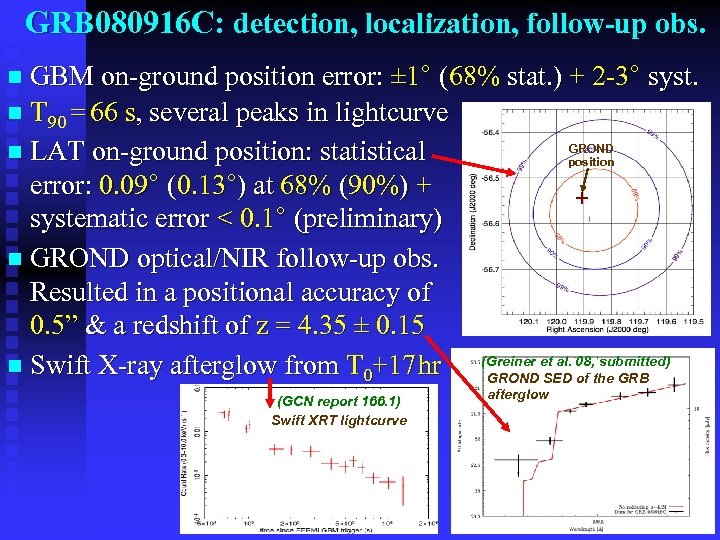
GRB 080916 C: detection, localization, follow-up obs. n GBM on-ground position error: ± 1° (68% stat. ) + 2 -3° syst. n T 90 = 66 s, several peaks in lightcurve GROND n LAT on-ground position: statistical position error: 0. 09° (0. 13°) at 68% (90%) + systematic error < 0. 1° (preliminary) n GROND optical/NIR follow-up obs. Resulted in a positional accuracy of 0. 5” & a redshift of z = 4. 35 ± 0. 15 (Greiner et al. 08, submitted) n Swift X-ray afterglow from T 0+17 hr GROND SED of the GRB (GCN report 166. 1) Swift XRT lightcurve afterglow
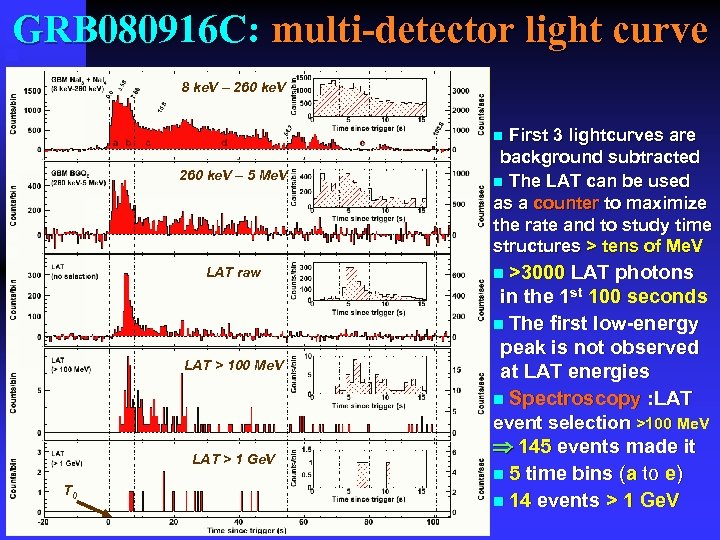
GRB 080916 C: multi-detector light curve 8 ke. V – 260 ke. V First 3 lightcurves are background subtracted n The LAT can be used as a counter to maximize the rate and to study time structures > tens of Me. V n 260 ke. V – 5 Me. V LAT raw LAT > 100 Me. V n >3000 LAT photons in the 1 st 100 seconds n The first low-energy peak is not observed at LAT energies n Spectroscopy : LAT event selection >100 Me. V LAT > 1 Ge. V T 0 145 events made it n 5 time bins (a to e) n 14 events > 1 Ge. V
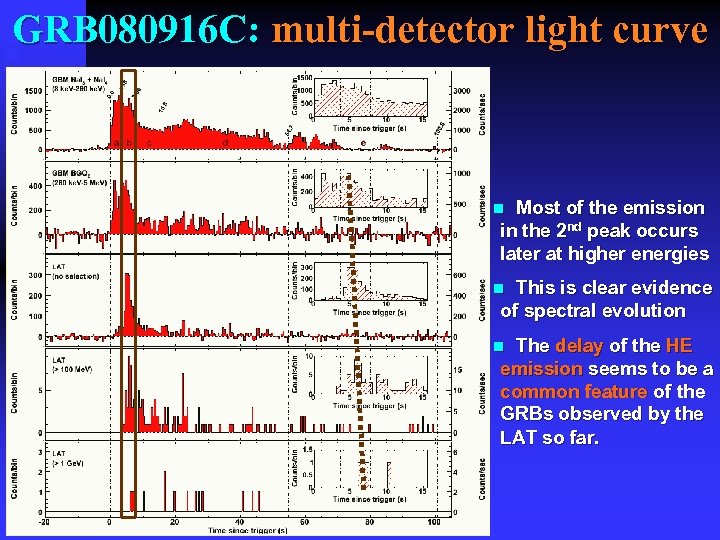
GRB 080916 C: multi-detector light curve Most of the emission in the 2 nd peak occurs later at higher energies n This is clear evidence of spectral evolution n The delay of the HE emission seems to be a common feature of the GRBs observed by the LAT so far. n
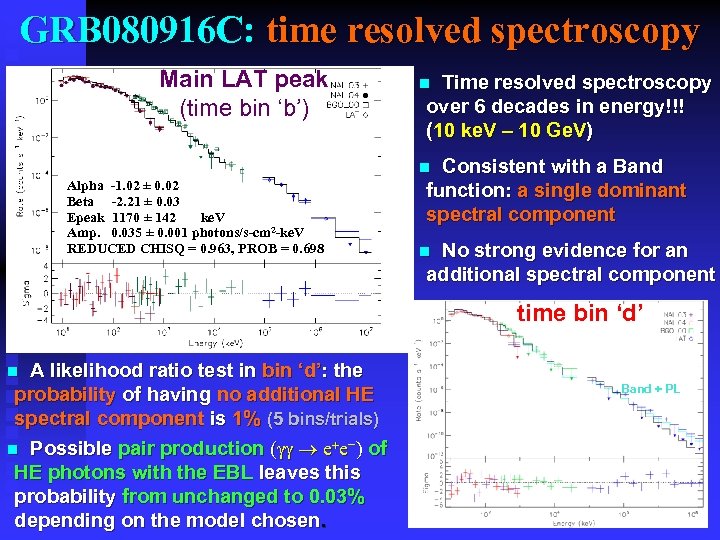
GRB 080916 C: time resolved spectroscopy Main LAT peak (time bin ‘b’) Time resolved spectroscopy over 6 decades in energy!!! (10 ke. V – 10 Ge. V) n Consistent with a Band function: a single dominant spectral component n Alpha -1. 02 ± 0. 02 Beta -2. 21 ± 0. 03 Epeak 1170 ± 142 ke. V Amp. 0. 035 ± 0. 001 photons/s-cm 2 -ke. V REDUCED CHISQ = 0. 963, PROB = 0. 698 No strong evidence for an additional spectral component n time bin ‘d’ A likelihood ratio test in bin ‘d’: the probability of having no additional HE spectral component is 1% (5 bins/trials) n Possible pair production ( e e−) of HE photons with the EBL leaves this probability from unchanged to 0. 03% depending on the model chosen. n Band + PL
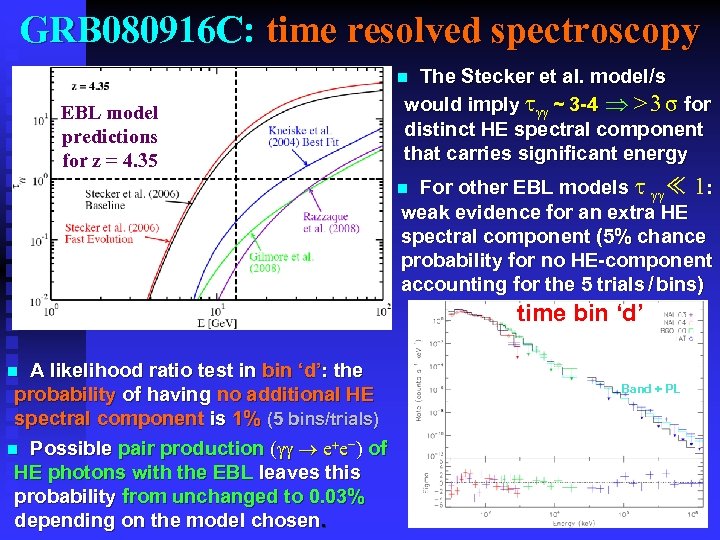
GRB 080916 C: time resolved spectroscopy The Stecker et al. model/s would imply ~ 3 -4 > 3 σ for distinct HE spectral component that carries significant energy n EBL model predictions for z = 4. 35 For other EBL models ≪ 1: weak evidence for an extra HE spectral component (5% chance probability for no HE-component accounting for the 5 trials / bins) n time bin ‘d’ A likelihood ratio test in bin ‘d’: the probability of having no additional HE spectral component is 1% (5 bins/trials) n Possible pair production ( e e−) of HE photons with the EBL leaves this probability from unchanged to 0. 03% depending on the model chosen. n Band + PL
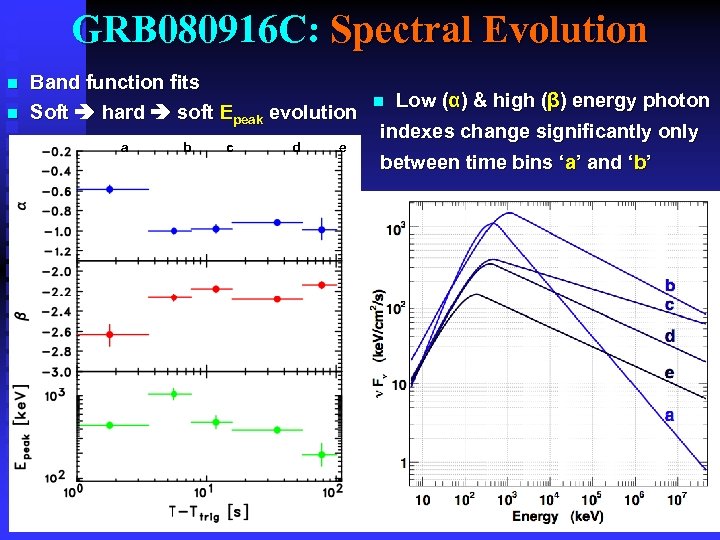
GRB 080916 C: Spectral Evolution n n Band function fits Soft hard soft Epeak evolution a b c d e n Low (α) & high (β) energy photon indexes change significantly only between time bins ‘a’ and ‘b’
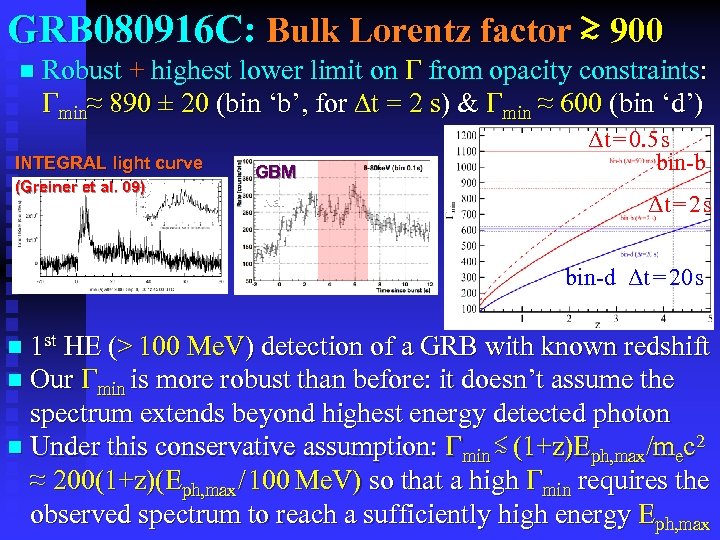
GRB 080916 C: Bulk Lorentz factor ≳ 900 n Robust + highest lower limit on Γ from opacity constraints: Γmin≈ 890 ± 20 (bin ‘b’, for t = 2 s) & Γmin ≈ 600 (bin ‘d’) INTEGRAL light curve (Greiner et al. 09)) GBM Na. I Δt = 0. 5 s bin-b Δt = 2 s bin-d Δt = 20 s n 1 st HE (> 100 Me. V) detection of a GRB with known redshift n Our Γmin is more robust than before: it doesn’t assume the spectrum extends beyond highest energy detected photon n Under this conservative assumption: Γmin ≲ (1+z)Eph, max/mec 2 ≈ 200(1+z)(Eph, max / 100 Me. V) so that a high Γmin requires the observed spectrum to reach a sufficiently high energy Eph, max
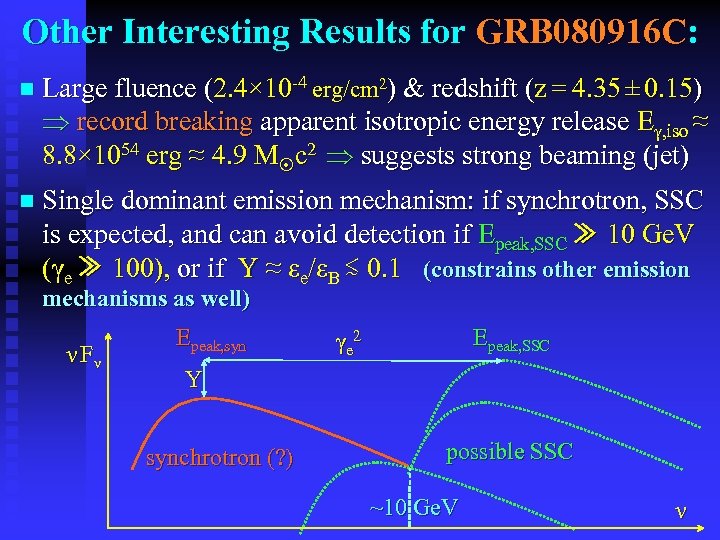
Other Interesting Results for GRB 080916 C: n Large fluence (2. 4× 10 -4 erg/cm 2) & redshift (z = 4. 35 ± 0. 15) record breaking apparent isotropic energy release Eγ, iso ≈ 8. 8× 1054 erg ≈ 4. 9 M c 2 suggests strong beaming (jet) n Single dominant emission mechanism: if synchrotron, SSC is expected, and can avoid detection if Epeak, SSC ≫ 10 Ge. V (γe ≫ 100), or if Y ≈ εe/εB ≲ 0. 1 (constrains other emission mechanisms as well) ν Fν Epeak, syn Epeak, SSC γ e 2 Y synchrotron (? ) possible SSC ~10 Ge. V ν
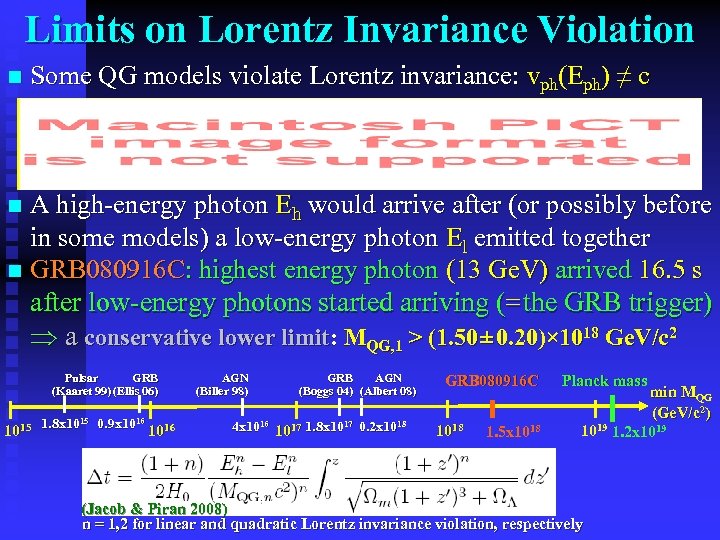
Limits on Lorentz Invariance Violation n Some QG models violate Lorentz invariance: vph(Eph) ≠ c A high-energy photon Eh would arrive after (or possibly before in some models) a low-energy photon El emitted together n GRB 080916 C: highest energy photon (13 Ge. V) arrived 16. 5 s after low-energy photons started arriving (= the GRB trigger) a conservative lower limit: MQG, 1 > (1. 50 ± 0. 20)× 1018 Ge. V/c 2 n Pulsar GRB (Kaaret 99) (Ellis 06) 15 16 1015 1. 8 x 10 0. 9 x 10 1016 AGN (Biller 98) GRB AGN (Boggs 04) (Albert 08) 4 x 10¹⁶ 1017 1. 8 x 10¹⁷ 0. 2 x 10¹⁸ GRB 080916 C 1018 1. 5 x 10¹⁸ Planck mass min MQG (Ge. V/c 2) 1019 1. 2 x 10¹⁹ (Jacob & Piran 2008) n = 1, 2 for linear and quadratic Lorentz invariance violation, respectively
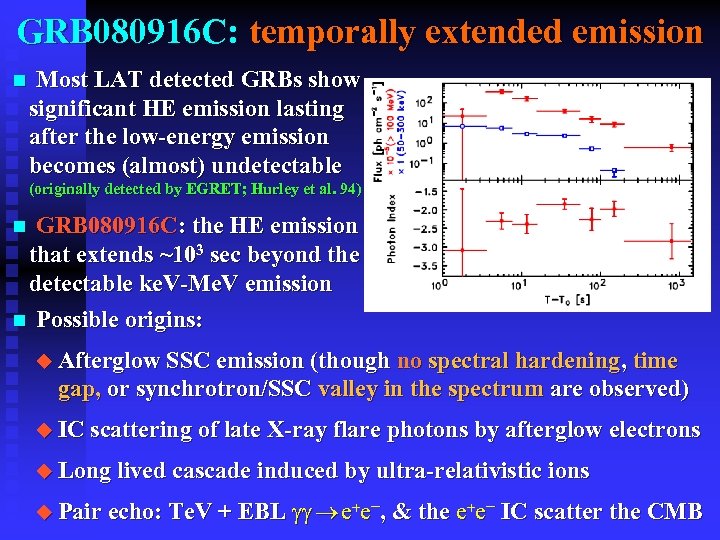
GRB 080916 C: temporally extended emission n Most LAT detected GRBs show significant HE emission lasting after the low-energy emission becomes (almost) undetectable (originally detected by EGRET; Hurley et al. 94) GRB 080916 C: the HE emission that extends ~103 sec beyond the detectable ke. V-Me. V emission n Possible origins: n u Afterglow SSC emission (though no spectral hardening, time gap, or synchrotron/SSC valley in the spectrum are observed) u IC scattering of late X-ray flare photons by afterglow electrons u Long lived cascade induced by ultra-relativistic ions u Pair echo: Te. V + EBL e e−, & the e e− IC scatter the CMB
Delayed onset of HE emission: Possible Causes n 1. The 1 st and 2 nd peaks are emitted from distinct physical regions (e. g. different colliding shell in the internal shocks model) u Unclear why a similar behaviour occurs in all 3 LAT GRBs (if it is random then some GRBs should have a reverse order) n 2. opacity effects don’t work well as there is no cutoff or steepening of the spectrum at high-energies n 3. Hadronic origin: time to accelerate protons & develop pair cascade, if the high-energy emission is of hadronic origin u Two distinct spectral components (leptonic at low-energies & hadronic at high-energies) & hard to soft evolution are expected (but not seen); hard to explain sharpness of 1 st LAT peak + coincidence with 2 nd GBM peak
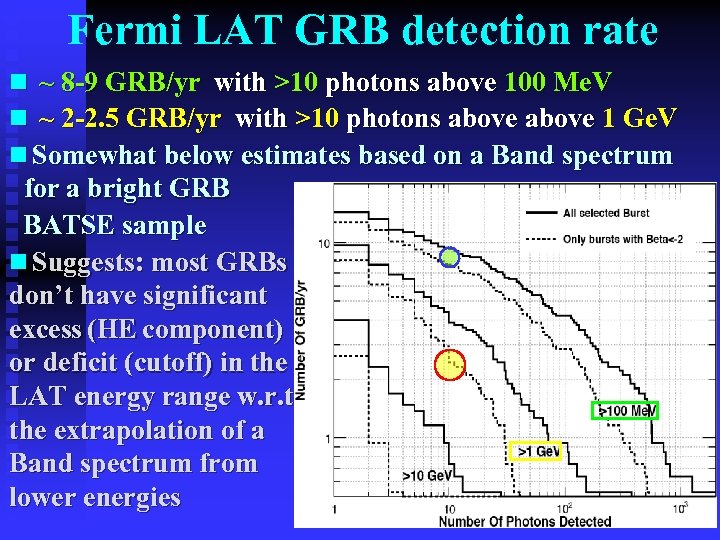
Fermi LAT GRB detection rate n ~ 8 -9 GRB/yr with >10 photons above 100 Me. V n ~ 2 -2. 5 GRB/yr with >10 photons above 1 Ge. V n Somewhat below estimates based on a Band spectrum for a bright GRB BATSE sample n Suggests: most GRBs don’t have significant excess (HE component) or deficit (cutoff) in the LAT energy range w. r. t the extrapolation of a Band spectrum from lower energies
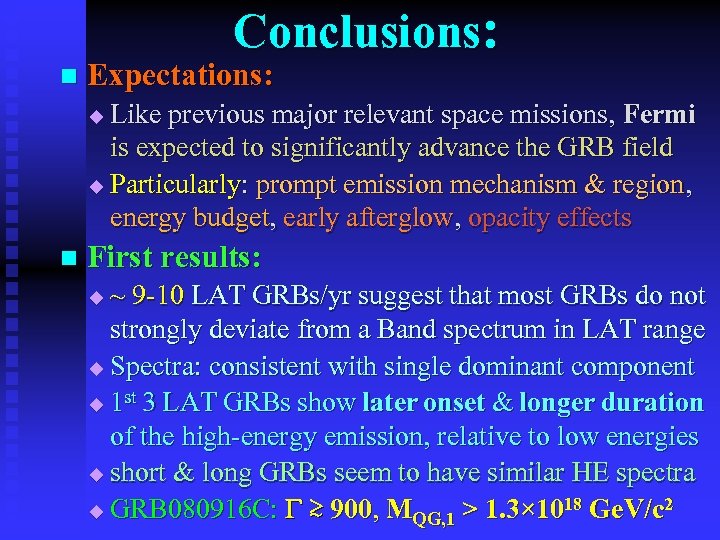
Conclusions: n Expectations: Like previous major relevant space missions, Fermi is expected to significantly advance the GRB field u Particularly: prompt emission mechanism & region, energy budget, early afterglow, opacity effects u n First results: ~ 9 -10 LAT GRBs/yr suggest that most GRBs do not strongly deviate from a Band spectrum in LAT range u Spectra: consistent with single dominant component u 1 st 3 LAT GRBs show later onset & longer duration of the high-energy emission, relative to low energies u short & long GRBs seem to have similar HE spectra u GRB 080916 C: ≳ 900, MQG, 1 > 1. 3× 10¹⁸ Ge. V/c 2 u
Скачать презентацию High-Energy Emission from GRBs expectations first results
87b4bcd5d89dbc3447d49718c64c16ce.ppt