


 Скачать презентацию High-End Computing Systems Group Department of Computer Science
22d41afd40443d9cb3f858467bad0473.ppt
- Количество слайдов: 26
 (High-End) Computing Systems Group Department of Computer Science and Engineering The Ohio State University
 High-End Computing and Its Benefits • Computation spread over hundreds and thousands of processors • Provides far-reaching benefits to society: – – new drugs, safer and fuel-efficient vehicles, environmental modeling – weather and climate prediction scientific discoveries in a broad range of disciplines • Essential to commercial domains as well – Web servers, large databases, search engines
 Our Vision • Cover the entire range, from the Applications level, through the Systems Software level, to the Networking and Communications level, in developing high-end systems and enabling their use in application areas: – – – Data-Intensive Computing Data-mining and Database Systems High-Performance Scientific Computing Middleware and Compilers Network-Based Computing • Carry out research in an integrated manner (systems, networking, and applications)
 The Research Challenges • The cost/performance ratio of computing, networking, and storage components has improved dramatically, making the aggregate available “raw” computing power very high • However, the fraction of the potential power that is actually utilized is getting smaller every year • Two broad challenges: – Make the large aggregate power of distributed computing resources available in a transparent manner to high-end applications – Create high-level approaches to ease the development of high-end applications
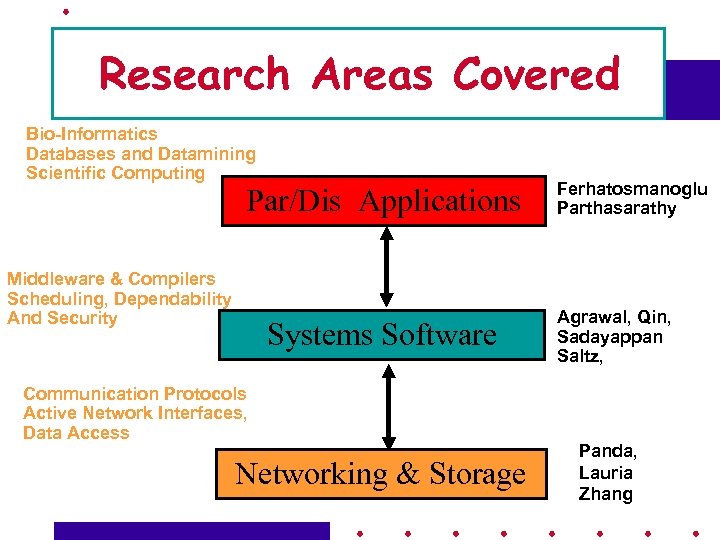 Research Areas Covered Bio-Informatics Databases and Datamining Scientific Computing Par/Dis Applications Middleware & Compilers Scheduling, Dependability And Security Systems Software Communication Protocols Active Network Interfaces, Data Access Networking & Storage Ferhatosmanoglu Parthasarathy Agrawal, Qin, Sadayappan Saltz, Panda, Lauria Zhang
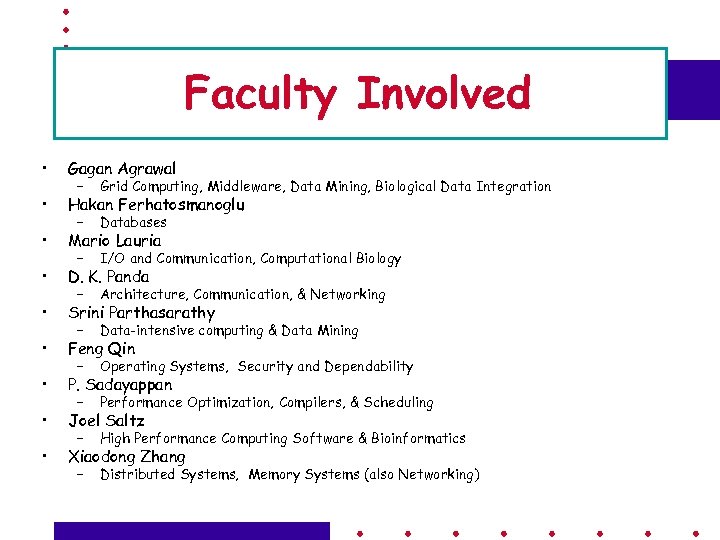 Faculty Involved • Gagan Agrawal • Hakan Ferhatosmanoglu • Mario Lauria • D. K. Panda • Srini Parthasarathy • Feng Qin • P. Sadayappan • Joel Saltz • Xiaodong Zhang – Grid Computing, Middleware, Data Mining, Biological Data Integration – Databases – I/O and Communication, Computational Biology – Architecture, Communication, & Networking – Data-intensive computing & Data Mining – Operating Systems, Security and Dependability – Performance Optimization, Compilers, & Scheduling – High Performance Computing Software & Bioinformatics – Distributed Systems, Memory Systems (also Networking)
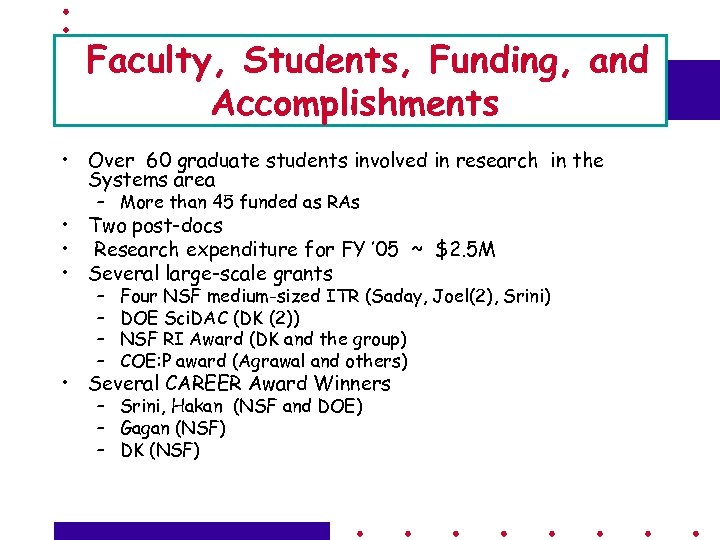 Faculty, Students, Funding, and Accomplishments • Over 60 graduate students involved in research in the Systems area – More than 45 funded as RAs • Two post-docs • Research expenditure for FY ’ 05 ~ $2. 5 M • Several large-scale grants – – Four NSF medium-sized ITR (Saday, Joel(2), Srini) DOE Sci. DAC (DK (2)) NSF RI Award (DK and the group) COE: P award (Agrawal and others) • Several CAREER Award Winners – Srini, Hakan (NSF and DOE) – Gagan (NSF) – DK (NSF)
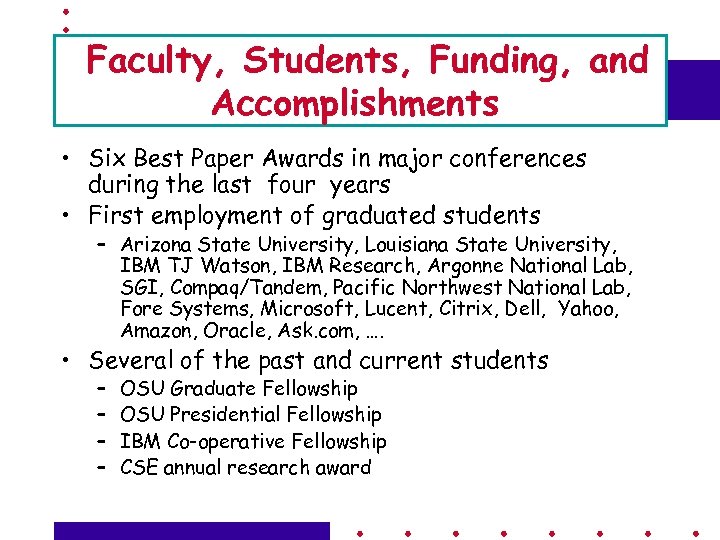 Faculty, Students, Funding, and Accomplishments • Six Best Paper Awards in major conferences during the last four years • First employment of graduated students – Arizona State University, Louisiana State University, IBM TJ Watson, IBM Research, Argonne National Lab, SGI, Compaq/Tandem, Pacific Northwest National Lab, Fore Systems, Microsoft, Lucent, Citrix, Dell, Yahoo, Amazon, Oracle, Ask. com, …. • Several of the past and current students – – OSU Graduate Fellowship OSU Presidential Fellowship IBM Co-operative Fellowship CSE annual research award
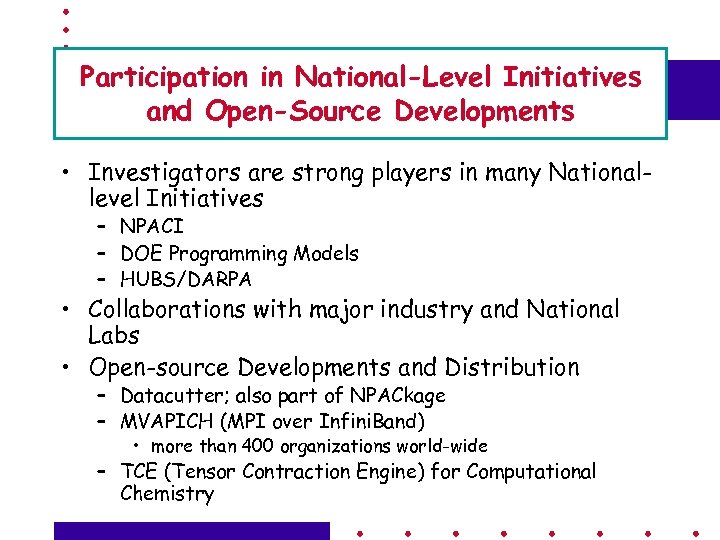 Participation in National-Level Initiatives and Open-Source Developments • Investigators are strong players in many Nationallevel Initiatives – NPACI – DOE Programming Models – HUBS/DARPA • Collaborations with major industry and National Labs • Open-source Developments and Distribution – Datacutter; also part of NPACkage – MVAPICH (MPI over Infini. Band) • more than 400 organizations world-wide – TCE (Tensor Contraction Engine) for Computational Chemistry
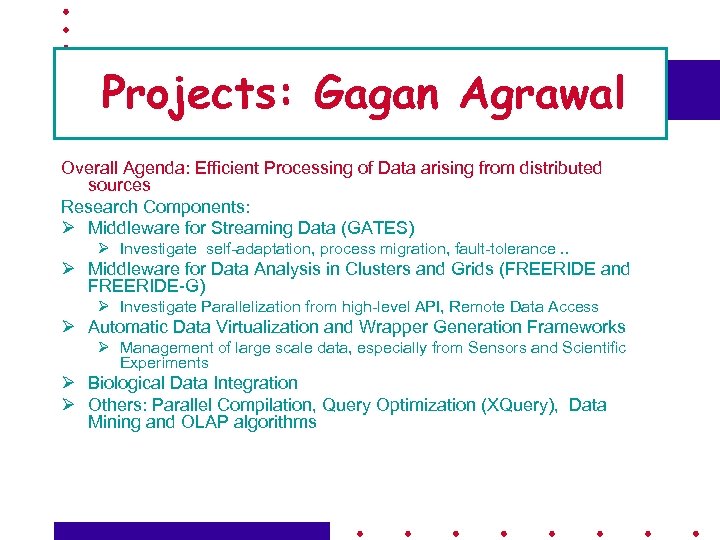 Projects: Gagan Agrawal Overall Agenda: Efficient Processing of Data arising from distributed sources Research Components: Ø Middleware for Streaming Data (GATES) Ø Investigate self-adaptation, process migration, fault-tolerance. . Ø Middleware for Data Analysis in Clusters and Grids (FREERIDE and FREERIDE-G) Ø Investigate Parallelization from high-level API, Remote Data Access Ø Automatic Data Virtualization and Wrapper Generation Frameworks Ø Management of large scale data, especially from Sensors and Scientific Experiments Ø Biological Data Integration Ø Others: Parallel Compilation, Query Optimization (XQuery), Data Mining and OLAP algorithms
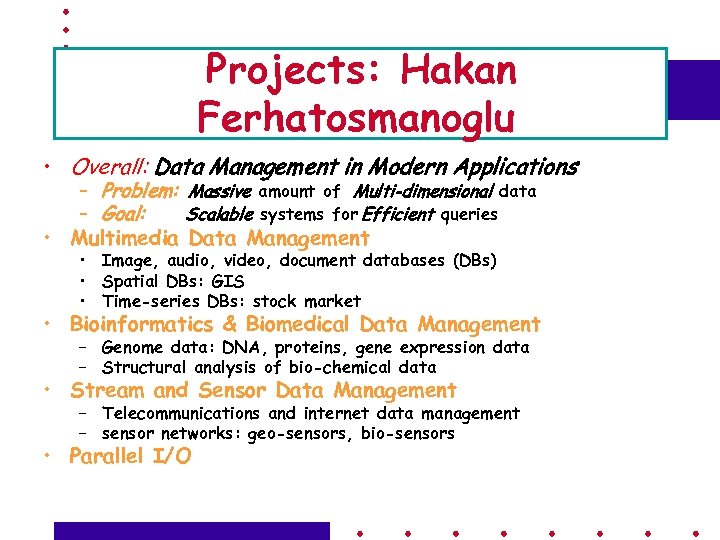 Projects: Hakan Ferhatosmanoglu • Overall: Data Management in Modern Applications – Problem: Massive amount of Multi-dimensional data – Goal: Scalable systems for Efficient queries • Multimedia Data Management • Image, audio, video, document databases (DBs) • Spatial DBs: GIS • Time-series DBs: stock market • Bioinformatics & Biomedical Data Management – Genome data: DNA, proteins, gene expression data – Structural analysis of bio-chemical data • Stream and Sensor Data Management – Telecommunications and internet data management – sensor networks: geo-sensors, bio-sensors • Parallel I/O
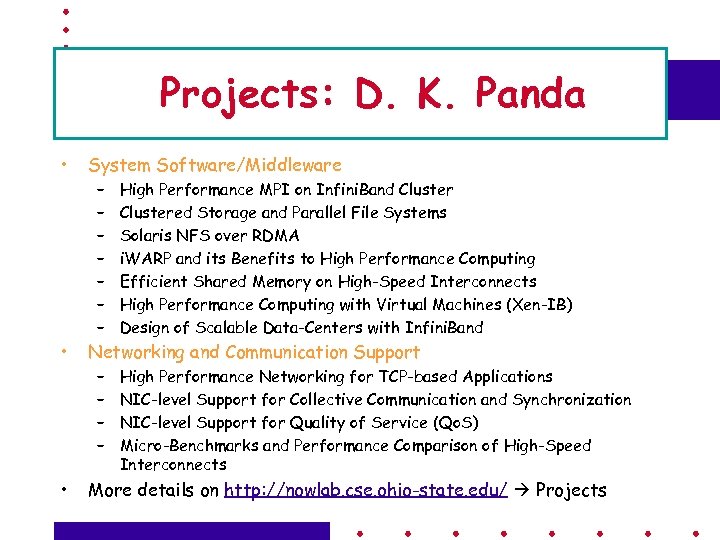 Projects: D. K. Panda • • • System Software/Middleware – – – – High Performance MPI on Infini. Band Clustered Storage and Parallel File Systems Solaris NFS over RDMA i. WARP and its Benefits to High Performance Computing Efficient Shared Memory on High-Speed Interconnects High Performance Computing with Virtual Machines (Xen-IB) Design of Scalable Data-Centers with Infini. Band Networking and Communication Support – – High Performance Networking for TCP-based Applications NIC-level Support for Collective Communication and Synchronization NIC-level Support for Quality of Service (Qo. S) Micro-Benchmarks and Performance Comparison of High-Speed Interconnects More details on http: //nowlab. cse. ohio-state. edu/ Projects
 Projects: Feng Qin • Agenda: Dependability and Security of Computer Systems • Online Techniques for System Dependability and Security – Failure recovery for high-end parallel and distributed systems – Online bug diagnosis, i. e. , identifying root causes of software bugs – Dynamic system security enhancement based on runtime information • Software Debugging – Bug detection (esp. concurrency bugs) in multi-core, parallel and distributed systems – Automated software bugs localization/isolation (e. g.
 Projects: P. (Saday) Sadayappan • Systems Support for High-Level Parallel Programming: Goal is to enable higher level programming than message passing (MPI), without sacrificing performance – Automatic synthesis of high-performance parallel programs for a class of quantum chemistry computations – Compiler optimizations for locality enhancement and communication minimization. – Parallel Global-Address-Space programming with MATLAB – Scheduling and load balancing – Performance Optimization for multi-core architectures – CIS 888. 11 K (every quarter)
 Projects: Srinivasan Parthasarathy • Agenda: Data Mining and Parallel/Distributed Systems. • Systems Support for Data Mining Applications – Resource and Location Aware Data Management and Mining for Dynamic (potentially streaming) & Distributed Datasets. – Distributed Shared State for Interactive Applications • Fundamental Algorithms and Techniques – Incremental Techniques for Mining Streaming Datasets – Parallel and Distributed Data Mining Algorithms • Applications Research – Intrusion Detection – Scientific & Biomedical Data Mining – Web/Text Mining
 Projects: Joel Saltz (Bioinformatics and CSE) • • Dynamic Data Driven Applications Systems – Data-intensive and Grid Computing tools and frameworks targeting data/compute intensive applications – Runtime and compiler support – Component frameworks for combined task and data parallelism in heterogeneous environments – Service-oriented Architectures for Grid-enabled data-intensive computing • • Scheduling Services in the Grid Generalized Reduction Active Semantic Data Caching Data Cluster/Decluster/Range Query Services Application Areas include – Earth Systems Sciences: Instrumented oil field simulations, seismic data analysis. – Medical Imaging: Texture analysis, segmentation, registration of ensembles of multi-modal, multi-resolution, time-dependent imagery. – Pathology Informatics: Visualization and exploration of digitized pathology slides – Bioinformatics: Querying and analysis of large databases of gene and protein sequence data. – Medical Informatics: Ad-hoc, federated data warehouses.
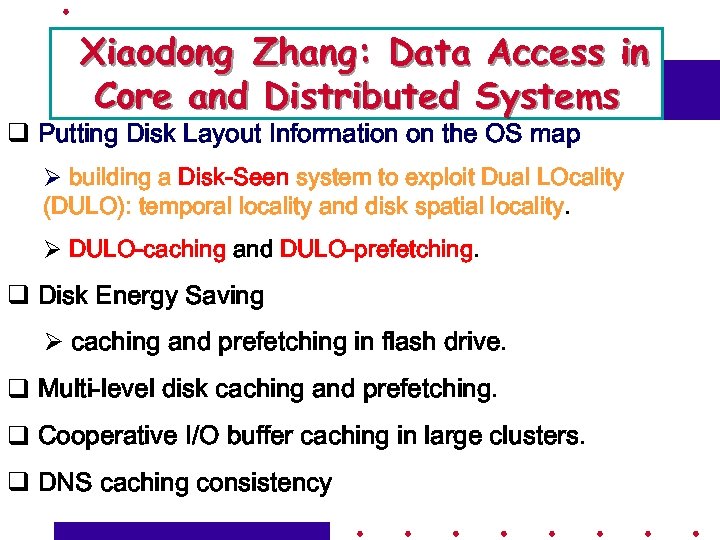 Xiaodong Zhang: Data Access in Core and Distributed Systems q Putting Disk Layout Information on the OS map Ø building a Disk-Seen system to exploit Dual LOcality (DULO): temporal locality and disk spatial locality. Ø DULO-caching and DULO-prefetching. q Disk Energy Saving Ø caching and prefetching in flash drive. q Multi-level disk caching and prefetching. q Cooperative I/O buffer caching in large clusters. q DNS caching consistency
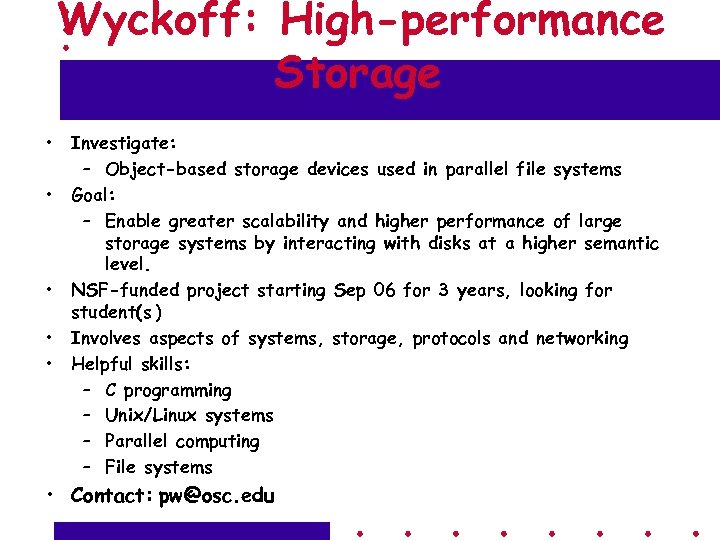 Wyckoff: High-performance Storage • Investigate: – Object-based storage devices used in parallel file systems • Goal: – Enable greater scalability and higher performance of large storage systems by interacting with disks at a higher semantic level. • NSF-funded project starting Sep 06 for 3 years, looking for student(s ) • Involves aspects of systems, storage, protocols and networking • Helpful skills: – C programming – Unix/Linux systems – Parallel computing – File systems • Contact: pw@osc. edu
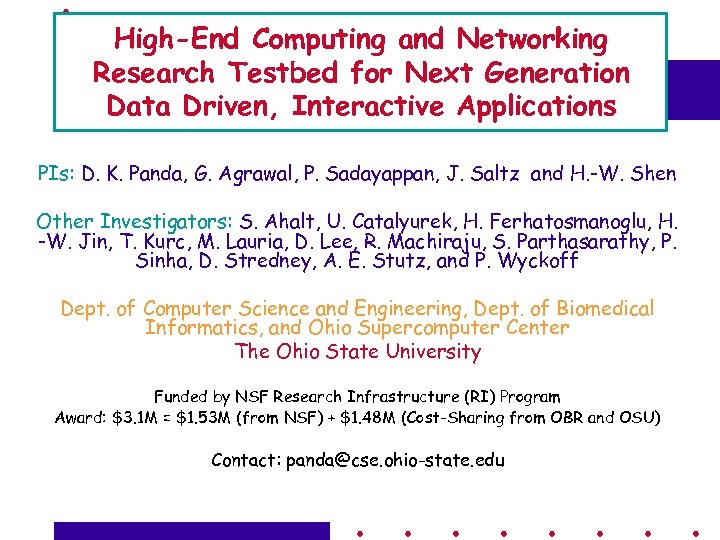 High-End Computing and Networking Research Testbed for Next Generation Data Driven, Interactive Applications PIs: D. K. Panda, G. Agrawal, P. Sadayappan, J. Saltz and H. -W. Shen Other Investigators: S. Ahalt, U. Catalyurek, H. Ferhatosmanoglu, H. -W. Jin, T. Kurc, M. Lauria, D. Lee, R. Machiraju, S. Parthasarathy, P. Sinha, D. Stredney, A. E. Stutz, and P. Wyckoff Dept. of Computer Science and Engineering, Dept. of Biomedical Informatics, and Ohio Supercomputer Center The Ohio State University Funded by NSF Research Infrastructure (RI) Program Award: $3. 1 M = $1. 53 M (from NSF) + $1. 48 M (Cost-Sharing from OBR and OSU) Contact: panda@cse. ohio-state. edu
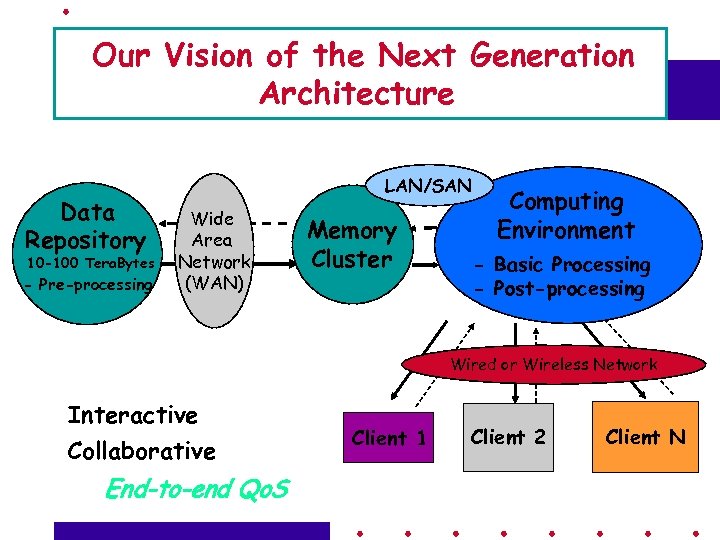 Our Vision of the Next Generation Architecture Data Repository 10 -100 Tera. Bytes - Pre-processing LAN/SAN Wide Area Network (WAN) Memory Cluster Computing Environment - Basic Processing - Post-processing Wired or Wireless Network Interactive Collaborative End-to-end Qo. S Client 1 Client 2 Client N
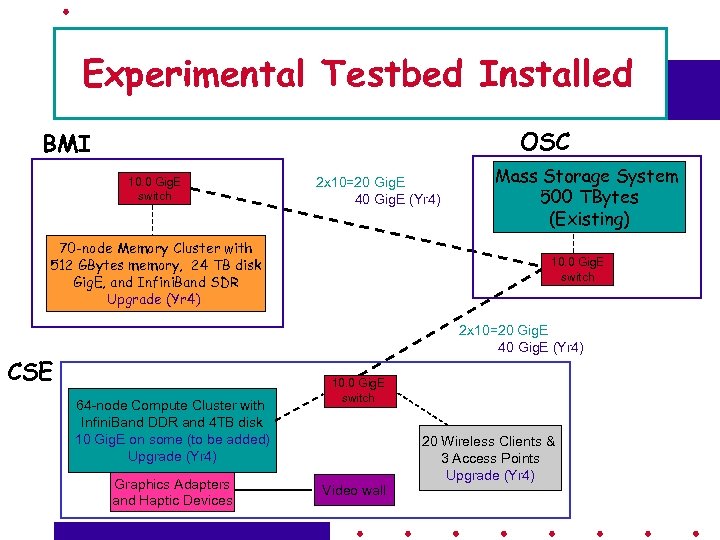 Experimental Testbed Installed OSC BMI 10. 0 Gig. E switch 2 x 10=20 Gig. E 40 Gig. E (Yr 4) 70 -node Memory Cluster with 512 GBytes memory, 24 TB disk Gig. E, and Infini. Band SDR Upgrade (Yr 4) Mass Storage System 500 TBytes (Existing) 10. 0 Gig. E switch 2 x 10=20 Gig. E 40 Gig. E (Yr 4) CSE 64 -node Compute Cluster with Infini. Band DDR and 4 TB disk 10 Gig. E on some (to be added) Upgrade (Yr 4) Graphics Adapters and Haptic Devices 10. 0 Gig. E switch Video wall 20 Wireless Clients & 3 Access Points Upgrade (Yr 4)
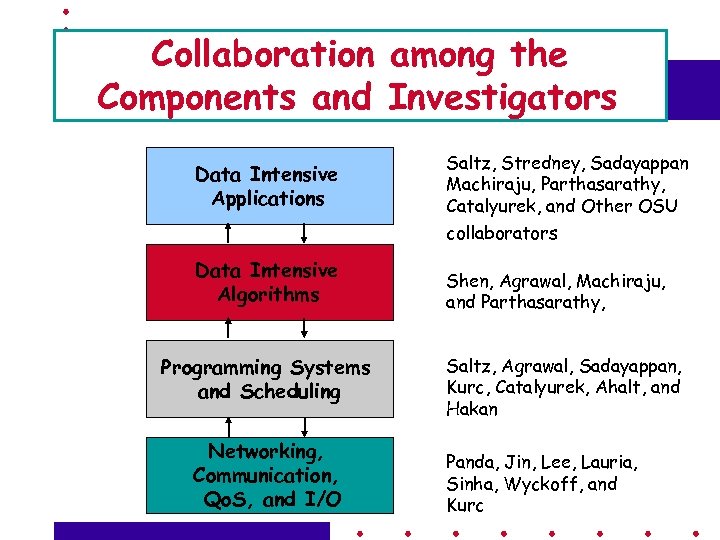 Collaboration among the Components and Investigators Data Intensive Applications Saltz, Stredney, Sadayappan Machiraju, Parthasarathy, Catalyurek, and Other OSU collaborators Data Intensive Algorithms Programming Systems and Scheduling Networking, Communication, Qo. S, and I/O Shen, Agrawal, Machiraju, and Parthasarathy, Saltz, Agrawal, Sadayappan, Kurc, Catalyurek, Ahalt, and Hakan Panda, Jin, Lee, Lauria, Sinha, Wyckoff, and Kurc
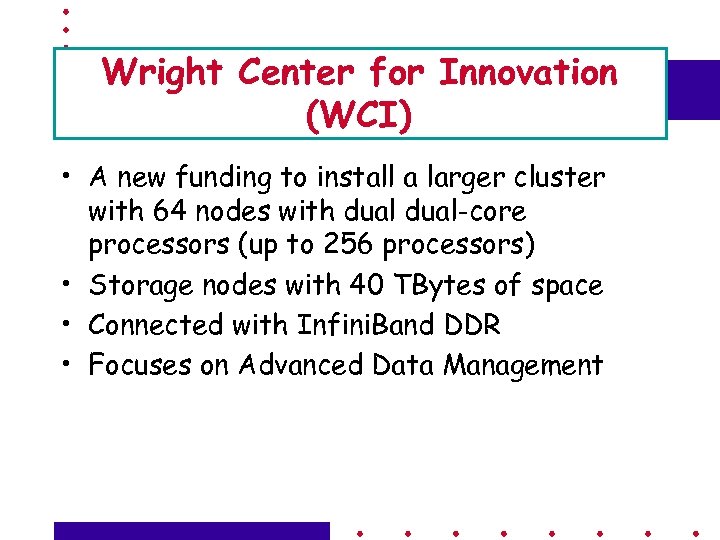 Wright Center for Innovation (WCI) • A new funding to install a larger cluster with 64 nodes with dual-core processors (up to 256 processors) • Storage nodes with 40 TBytes of space • Connected with Infini. Band DDR • Focuses on Advanced Data Management
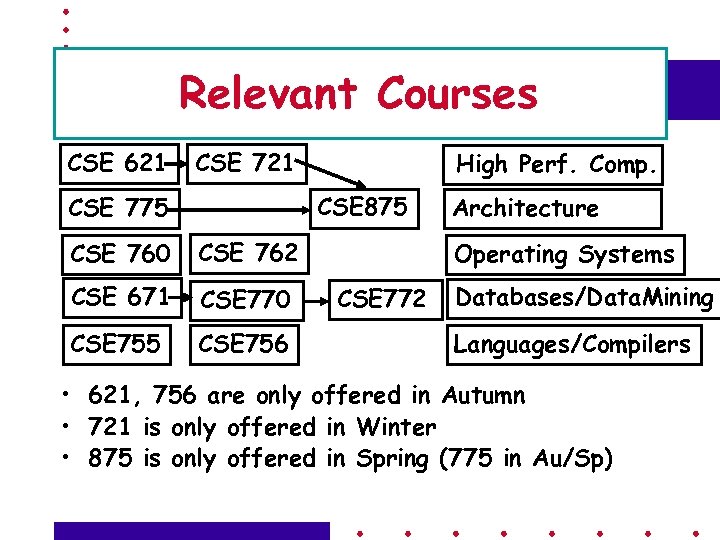 Relevant Courses CSE 621 CSE 721 High Perf. Comp. CSE 875 CSE 760 CSE 762 CSE 671 CSE 770 CSE 755 CSE 756 Architecture Operating Systems CSE 772 Databases/Data. Mining Languages/Compilers • 621, 756 are only offered in Autumn • 721 is only offered in Winter • 875 is only offered in Spring (775 in Au/Sp)
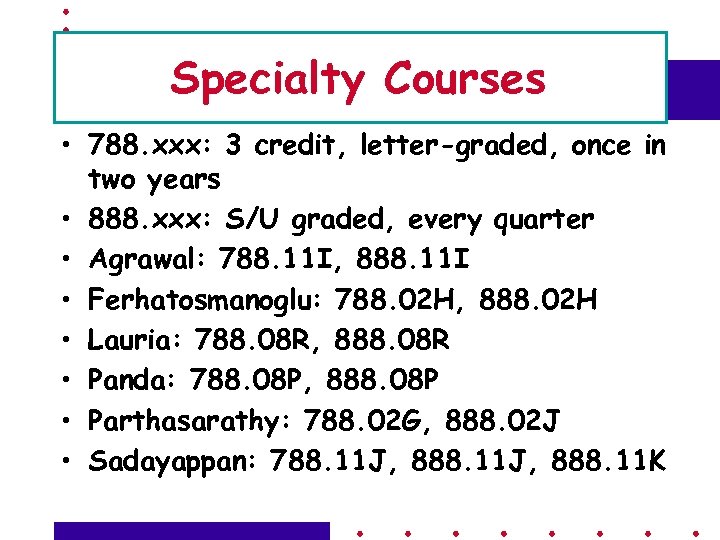 Specialty Courses • 788. xxx: 3 credit, letter-graded, once in two years • 888. xxx: S/U graded, every quarter • Agrawal: 788. 11 I, 888. 11 I • Ferhatosmanoglu: 788. 02 H, 888. 02 H • Lauria: 788. 08 R, 888. 08 R • Panda: 788. 08 P, 888. 08 P • Parthasarathy: 788. 02 G, 888. 02 J • Sadayappan: 788. 11 J, 888. 11 K
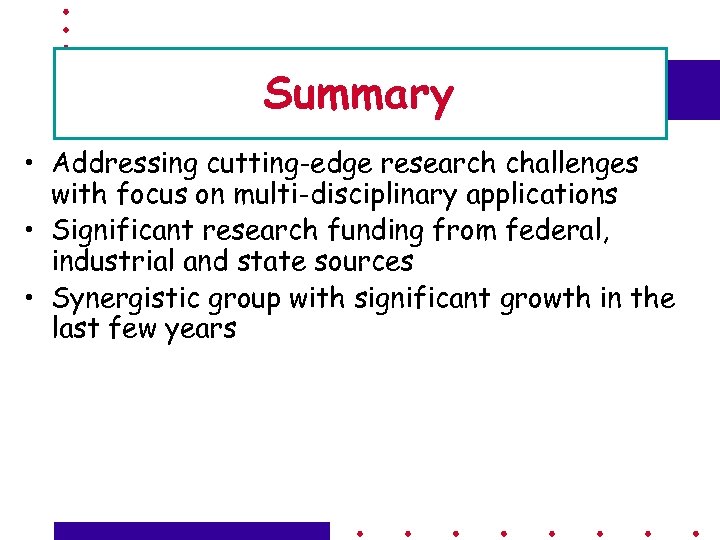 Summary • Addressing cutting-edge research challenges with focus on multi-disciplinary applications • Significant research funding from federal, industrial and state sources • Synergistic group with significant growth in the last few years