


 Скачать презентацию Higgi 2003 Guide To Emergency Medicine Dr Ian
a10595dd0251d6a41e935128419b596c.ppt
- Количество слайдов: 39
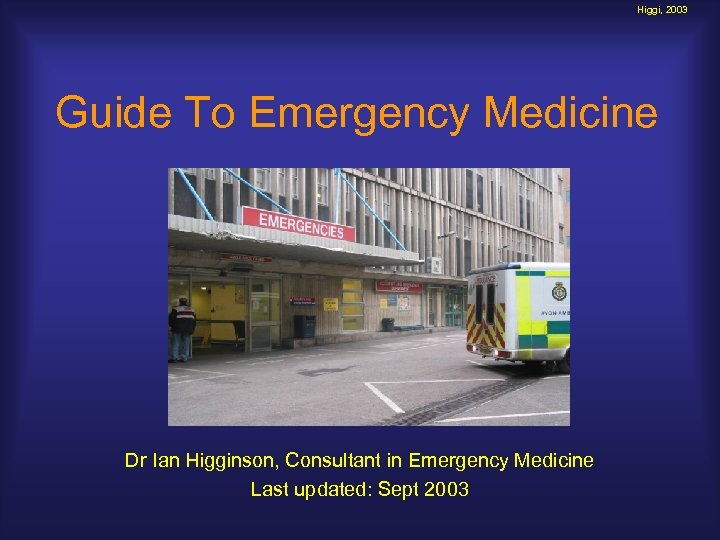 Higgi, 2003 Guide To Emergency Medicine Dr Ian Higginson, Consultant in Emergency Medicine Last updated: Sept 2003
 Higgi, 2003 Overview • What is Emergency Medicine? • What goes on in an Emergency Department? • Trends and changes in Emergency Medicine
 Higgi, 2003 What Is Emergency Medicine?
 Higgi, 2003 What Is Emergency Medicine? Emergency medicine is a field of practice based on the knowledge, skills and attitudes required for the prevention, diagnosis and management of acute and urgent aspects of illness and injury affecting patients of all age groups with a full spectrum of undifferentiated physical and behavioural disorders. It further encompasses an understanding of the development of pre-hospital and in-hospital emergency medical systems, and the skills necessary for this development Source: Australasian College of Emergency Medicine
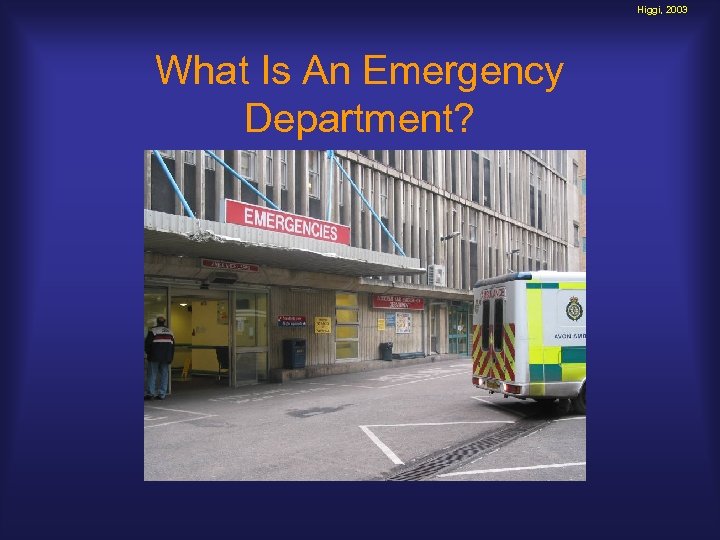 Higgi, 2003 What Is An Emergency Department?
 Higgi, 2003 What Is An Emergency Department? The Emergency Department (ED) is the dedicated area in a hospital that is organised and administered to provide a high standard of emergency care to those in the community who perceive the need for, or are in need of, acute or urgent care, including hospital admission Source: Australasian College of Emergency Medicine
 Higgi, 2003 What Services Should An Emergency Department Provide?
 Higgi, 2003 What Services Should An Emergency Department Provide? • 24/7 consultant led service • Resuscitation, assessment and treatment of acute illness and injury in patients of all ages by appropriately trained staff, according to national and local standards. • Onward referral as appropriate • Review work as appropriate • Observation medicine / decision medicine • Major incident planning Source: “The Way Ahead”, British Association For A&E Medicine, 1998
 Higgi, 2003 Components Of An Emergency Department
 Higgi, 2003 Components Of An Emergency Department • Physical space: – Registration / triage / initial assessment – Detailed assessment and management: ambulant, nonambulant, resuscitation – Observation units / clinical decision units – Waiting / play – Quiet rooms – Administrative – Staff rest / changing – Education
 Higgi, 2003 Components Of An Emergency Department • • Administrative structure Medical, nursing, and ancillary staff Access to diagnostic and support services Access to specialist consultation Access to extended care facilities Links with local and regional patient care networks Clinical and management information systems Clinical governance ( patient and public involvement, achieving standards, risk management, M&M structures, education, audit, research)
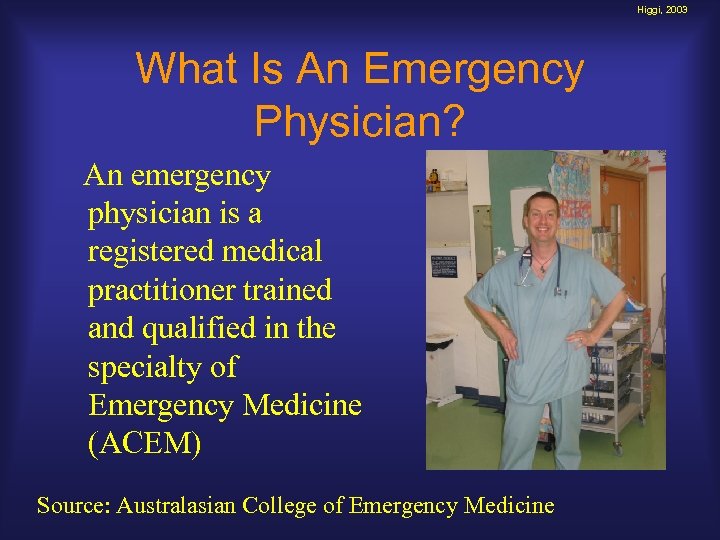 Higgi, 2003 What Is An Emergency Physician? An emergency physician is a registered medical practitioner trained and qualified in the specialty of Emergency Medicine (ACEM) Source: Australasian College of Emergency Medicine
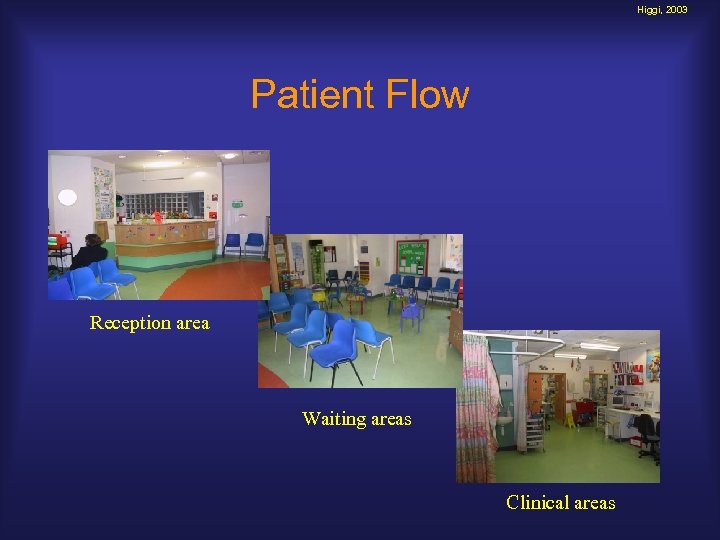 Higgi, 2003 Patient Flow Reception area Waiting areas Clinical areas
 Higgi, 2003 Mode Of Arrival • Referred • Self presenting • Brought in by others (e. g. police) • Walking / own transport • Ambulance • From somewhere else in the hospital • Pre-ED care?
 Higgi, 2003 Primary Care • • Home and lay networks GP / practice nurse NHS direct Walk-in-centres Nursing colleagues (e. g. district nurse) Allied health professionals (e. g. physiotherapist) “Alternative” health practitioners Dental practitioners
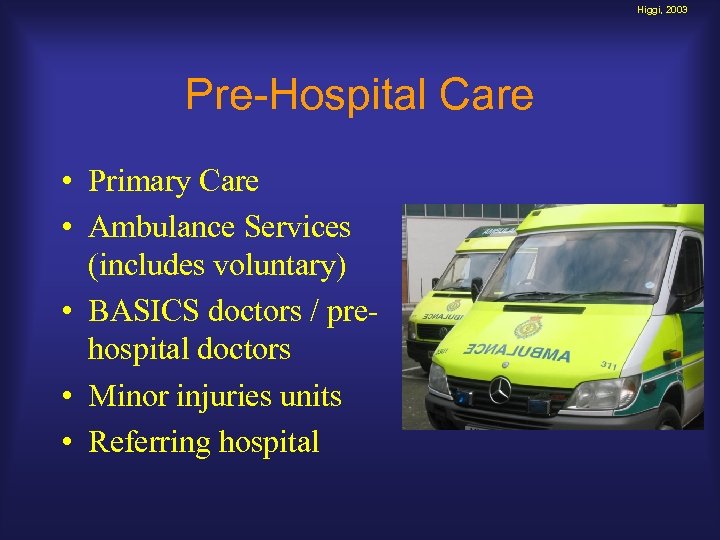 Higgi, 2003 Pre-Hospital Care • Primary Care • Ambulance Services (includes voluntary) • BASICS doctors / prehospital doctors • Minor injuries units • Referring hospital
 Higgi, 2003 Emergency Care • Triage and Registration • Assessment – History – Physical Examination – Investigations • Management – Treatment – Disposition
 Higgi, 2003 Triage • Triage categories 1 to 5 • Determines how soon the patient needs to be seen, not how serious their condition is • Up to 20% of triage category 5 patients may need admitting • “Traditional” triage may disappear from EDs in the UK
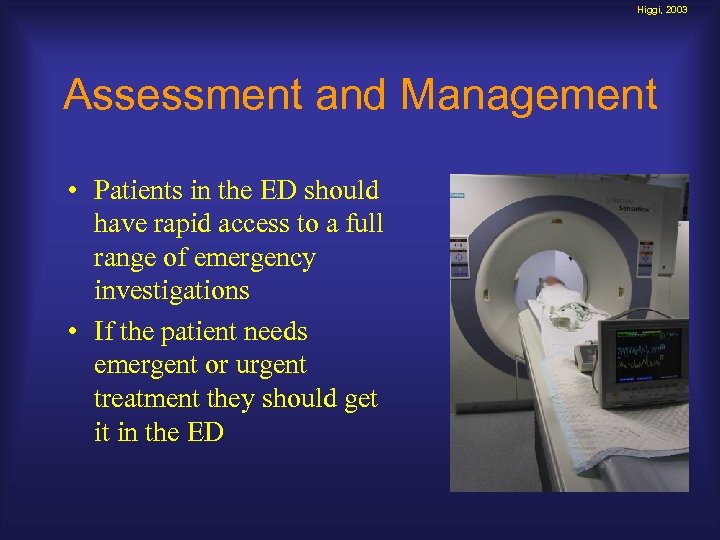 Higgi, 2003 Assessment and Management • Patients in the ED should have rapid access to a full range of emergency investigations • If the patient needs emergent or urgent treatment they should get it in the ED
 Higgi, 2003 Disposition • • Home Other community facility Referred to outpatient care Admitted to own hospital – Direct to regular ward – ICU / HDU – Theatres +/- radiology • Admitted to another hospital • Mortuary
 Higgi, 2003 Emergency Care Elsewhere In The Hospital • Assessment units • Urgent access outpatients • Direct access arrangements and alternative emergency care pathways
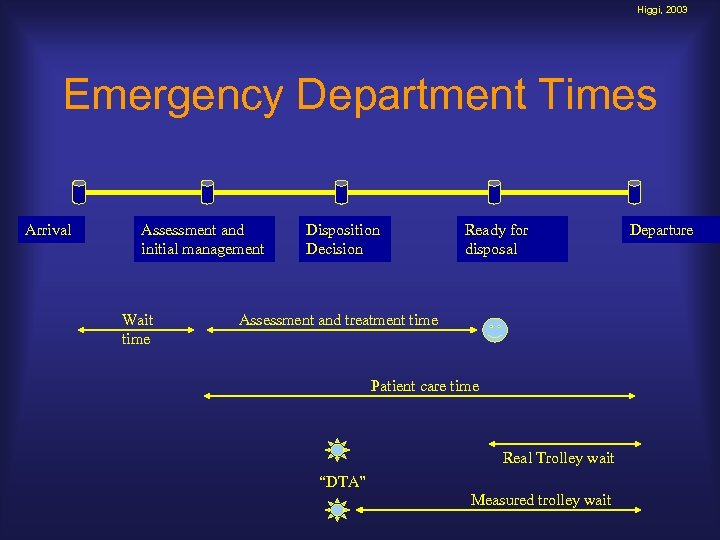 Higgi, 2003 Emergency Department Times Arrival Assessment and initial management Wait time Disposition Decision Ready for disposal Assessment and treatment time Patient care time Real Trolley wait “DTA” Measured trolley wait Departure
 Higgi, 2003 Access Block • Patients in the ED requiring inpatient care unable to gain access to appropriate hospital beds within a reasonable timeframe • Also known as exit block (from the ED) • Principal cause = inadequate system-wide bed capacity
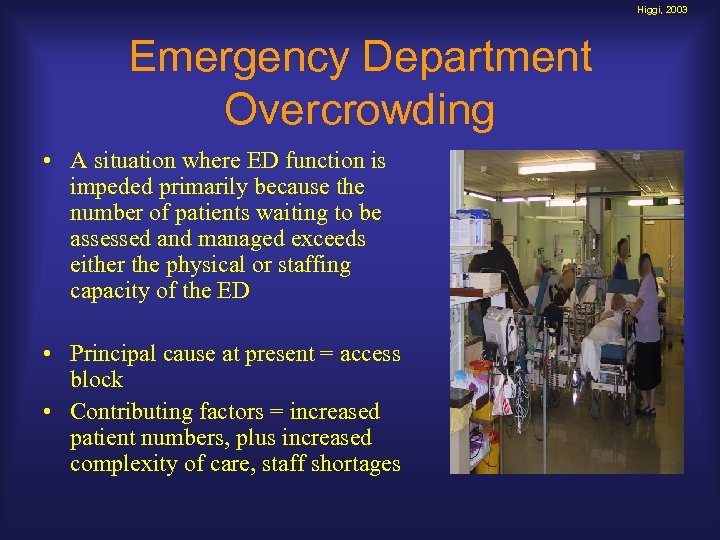 Higgi, 2003 Emergency Department Overcrowding • A situation where ED function is impeded primarily because the number of patients waiting to be assessed and managed exceeds either the physical or staffing capacity of the ED • Principal cause at present = access block • Contributing factors = increased patient numbers, plus increased complexity of care, staff shortages
 Higgi, 2003 Emergency Department Saturation Patient need (defined as timely assessment and management) cannot be met for existing and/or additional patients due to fully committed ED resources
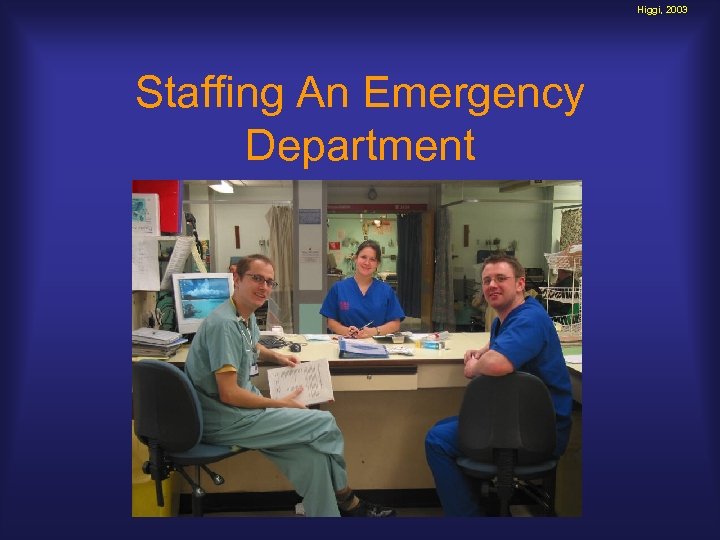 Higgi, 2003 Staffing An Emergency Department
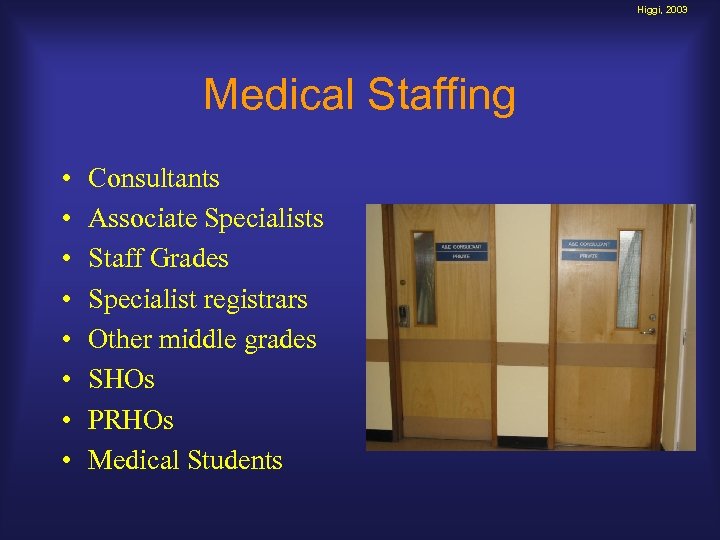 Higgi, 2003 Medical Staffing • • Consultants Associate Specialists Staff Grades Specialist registrars Other middle grades SHOs PRHOs Medical Students
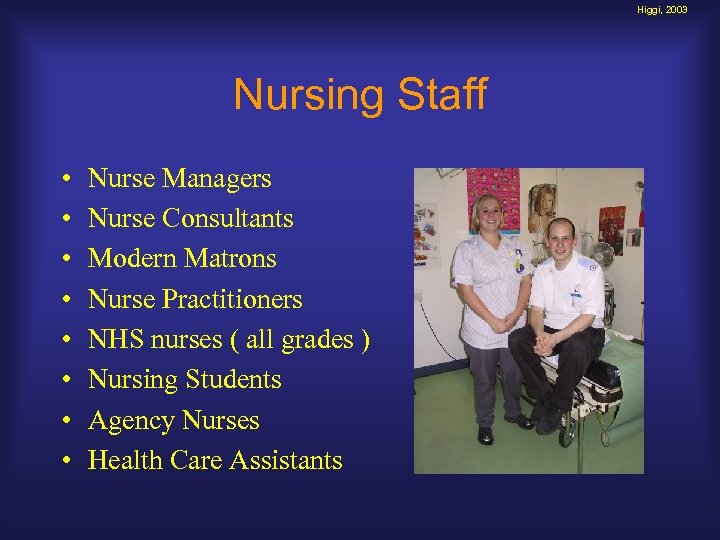 Higgi, 2003 Nursing Staff • • Nurse Managers Nurse Consultants Modern Matrons Nurse Practitioners NHS nurses ( all grades ) Nursing Students Agency Nurses Health Care Assistants
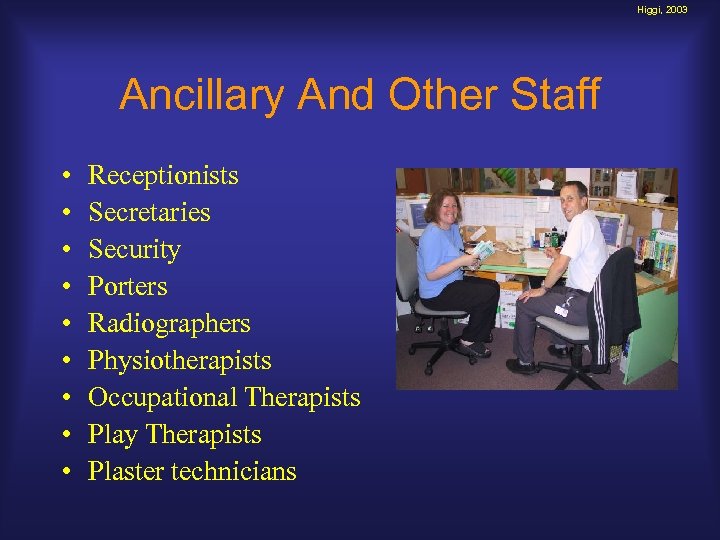 Higgi, 2003 Ancillary And Other Staff • • • Receptionists Secretaries Security Porters Radiographers Physiotherapists Occupational Therapists Play Therapists Plaster technicians
 Higgi, 2003 Standards, Guidelines And Policies
 Higgi, 2003 Standards • • Regular clinical governance Association and Faculty standards National standards International standards
 Higgi, 2003 Guidelines • • Departmental Trust Association (BAEM) and Faculty (FAEM) Other colleges and learned bodies (e. g. SIGN) • National • International
 Higgi, 2003 Policies • Local – Departmental – Trust • National – Clinical – Non-clinical: e. g. European Working Time Directive
 Higgi, 2003 Trends And Change
 Higgi, 2003 Trends Within The Specialty • Recognition of Emergency Medicine as a specialty, and higher profile for Emergency Departments • Development of Paediatric Emergency Medicine • Improved training in Emergency Medicine • Improved research and evidence-based practice • Willingness to undertake full assessment and management (not just triage for other specialties) • Increased access to special investigations • Increased use of observation / clinical decision units • Recognition that the service should not be SHO-based
 Higgi, 2003 External Drivers Of Change • Recent and current government initiatives: – The NHS Plan / Reforming Emergency Care • NHS Direct / Walk-in-Centres / Minor Injuries Units established. Increased role for nurses in delivery of care, in alternative environments • Concerns over trolley waits • Total ED time targets – Streaming – See and Treat – Emergency Services Collaboratives • Thrombolysis targets – NICE guidelines
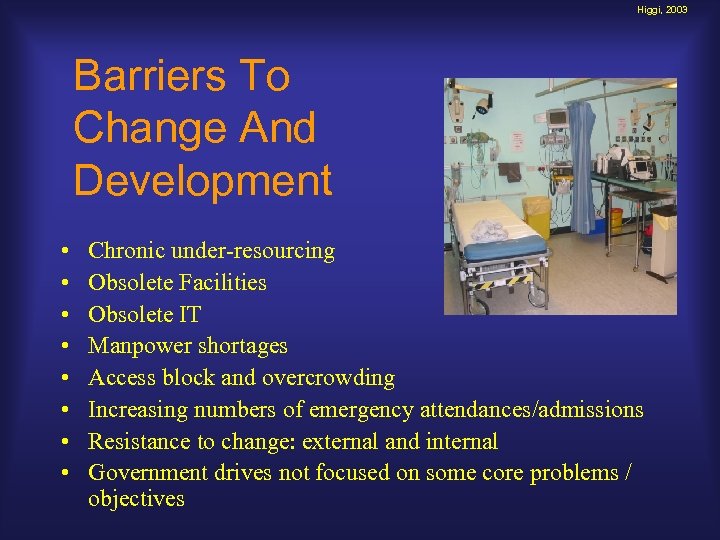 Higgi, 2003 Barriers To Change And Development • • Chronic under-resourcing Obsolete Facilities Obsolete IT Manpower shortages Access block and overcrowding Increasing numbers of emergency attendances/admissions Resistance to change: external and internal Government drives not focused on some core problems / objectives
 Higgi, 2003 Threats To Change And Development • Physicians with an interest in acute medicine? • Emergency Department bypass protocols (e. g. chest pain to coronary care)? • Outdated attitudes towards Emergency Medicine? • Poor understanding of the role and potential of a modern Emergency Department
 Higgi, 2003 Summary • Emergency Medicine is a rapidly evolving and developing speciality • Emergency Departments are complex facilities • Emergency care in the UK is under considerable stress, but has substantial future potential