 Скачать презентацию Hierarchical Task Network HTN Planning José Luis Ambite
10718aae512802991479b6eca641ec76.ppt
- Количество слайдов: 35




Hierarchical Task Network (HTN) Planning José Luis Ambite* [* Based in part on presentations by Dana Nau and Rao Kambhampati] 1
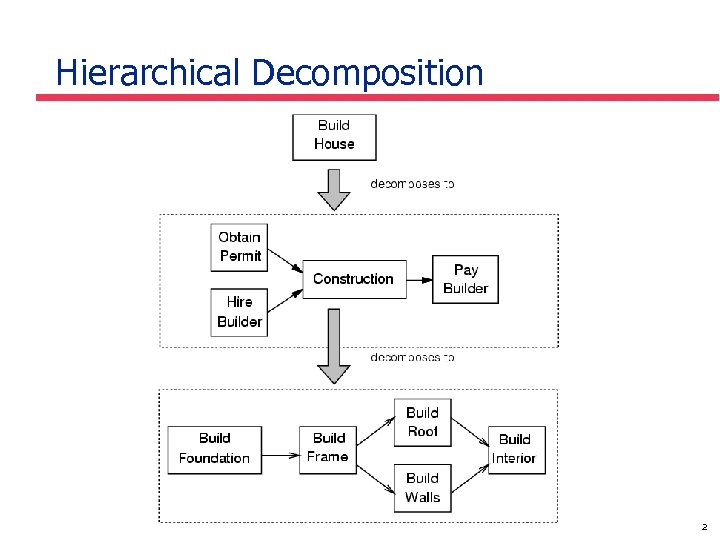
Hierarchical Decomposition 2
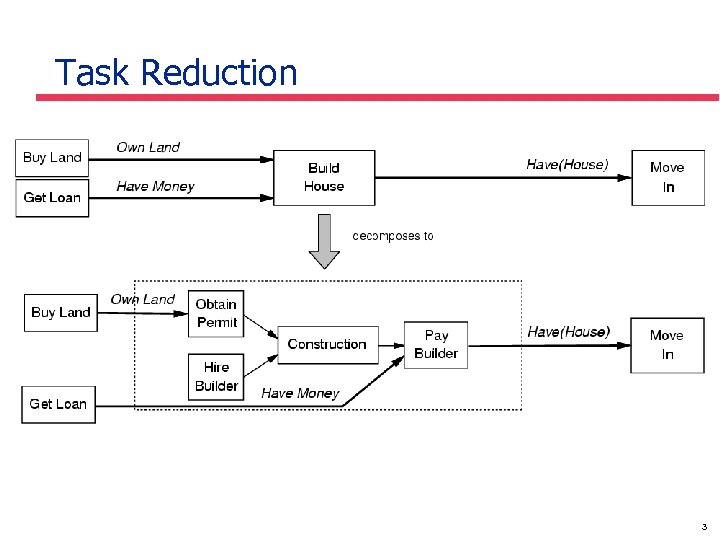
Task Reduction 3
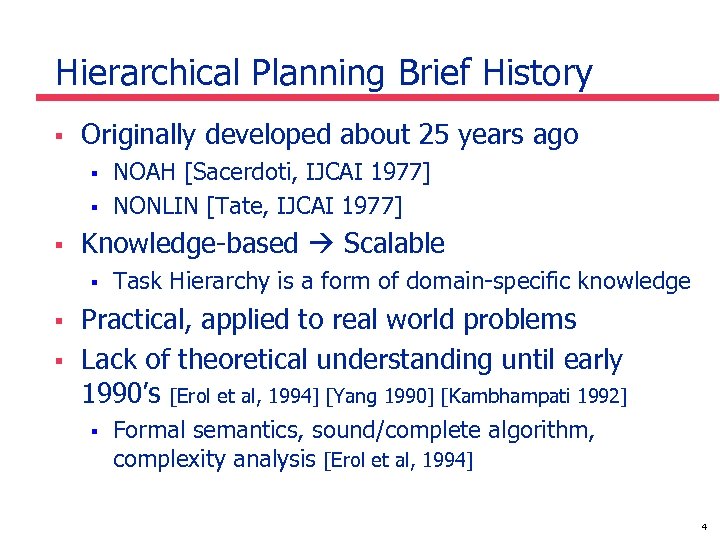
Hierarchical Planning Brief History § Originally developed about 25 years ago § § § Knowledge-based Scalable § § § NOAH [Sacerdoti, IJCAI 1977] NONLIN [Tate, IJCAI 1977] Task Hierarchy is a form of domain-specific knowledge Practical, applied to real world problems Lack of theoretical understanding until early 1990’s [Erol et al, 1994] [Yang 1990] [Kambhampati 1992] § Formal semantics, sound/complete algorithm, complexity analysis [Erol et al, 1994] 4
![Deployed, Practical Planners § SIPE, SIPE-2 [Wilkins, 85 -] § § NONLIN/O-Plan/I-X [Tate et.](https://present5.com/presentation/10718aae512802991479b6eca641ec76/image-5.jpg "Deployed, Practical Planners § SIPE, SIPE-2 [Wilkins, 85 -] § § NONLIN/O-Plan/I-X [Tate et.")
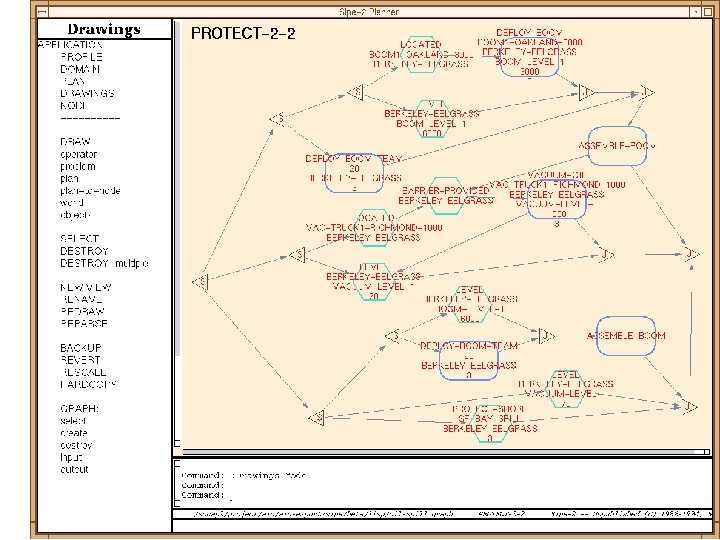
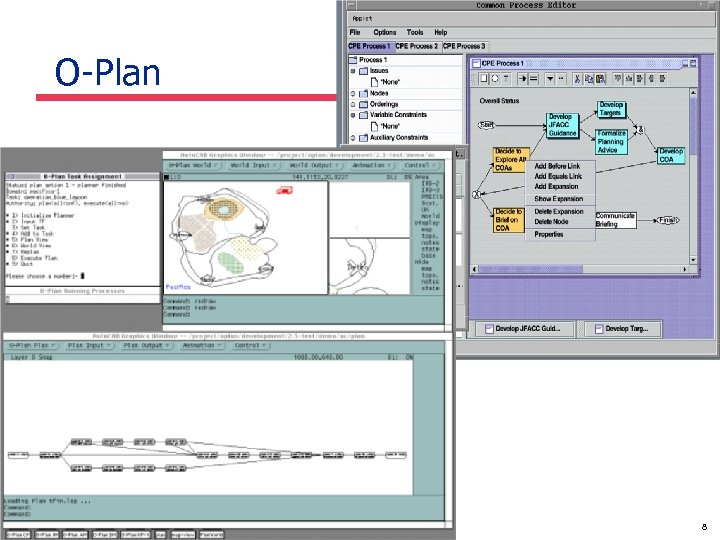
Deployed, Practical Planners § SIPE, SIPE-2 [Wilkins, 85 -] § § NONLIN/O-Plan/I-X [Tate et. al. , 77 -] § § § http: //www. ai. sri. com/~sipe/ http: //www. aiai. ed. ac. uk/~oplan/ http: //www. aiai. ed. ac. uk/project/ix/ Applications: § Logistics § Military operations planning: Air campaign planning, Non. Combatant Evacuation Operations § Crisis Response: Oil Spill Response § § Production line scheduling Construction planning: Space platform building, house construction Space applications: mission sequencing, satellite control Software Development: Unix administrator's script writing 5
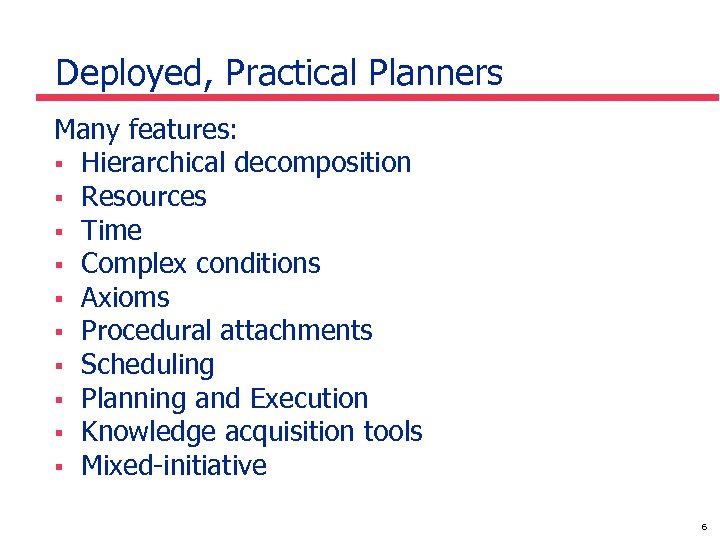
Deployed, Practical Planners Many features: § Hierarchical decomposition § Resources § Time § Complex conditions § Axioms § Procedural attachments § Scheduling § Planning and Execution § Knowledge acquisition tools § Mixed-initiative 6
7
O-Plan 8
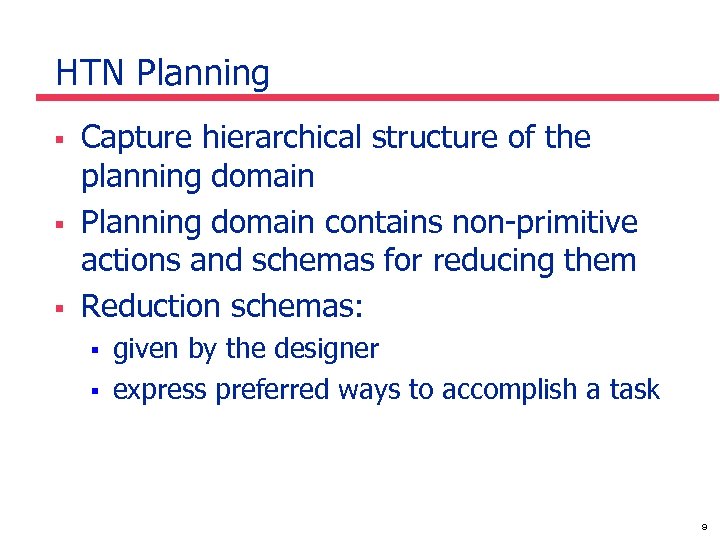
HTN Planning § § § Capture hierarchical structure of the planning domain Planning domain contains non-primitive actions and schemas for reducing them Reduction schemas: § § given by the designer express preferred ways to accomplish a task 9
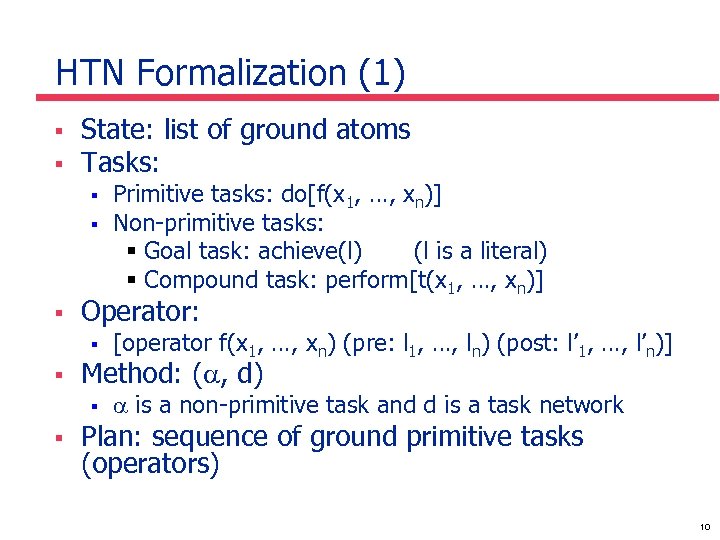
HTN Formalization (1) § § State: list of ground atoms Tasks: § § § Operator: § § [operator f(x 1, …, xn) (pre: l 1, …, ln) (post: l’ 1, …, l’n)] Method: ( , d) § § Primitive tasks: do[f(x 1, …, xn)] Non-primitive tasks: § Goal task: achieve(l) (l is a literal) § Compound task: perform[t(x 1, …, xn)] is a non-primitive task and d is a task network Plan: sequence of ground primitive tasks (operators) 10
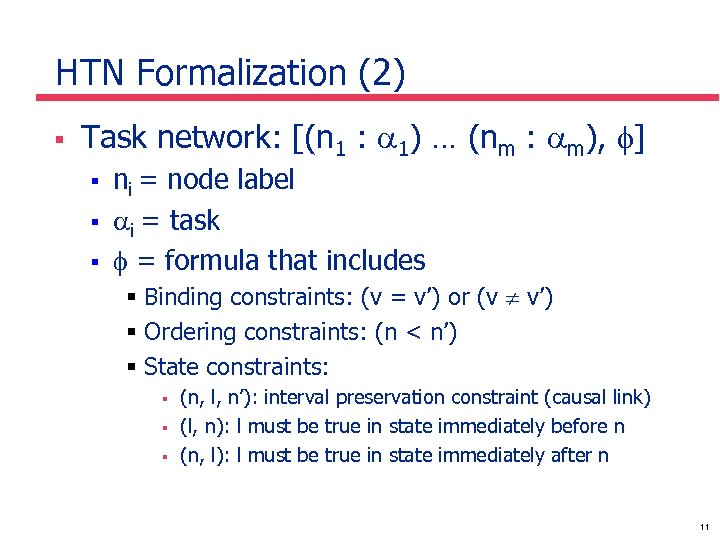
HTN Formalization (2) § Task network: [(n 1 : 1) … (nm : m), ] § § § ni = node label i = task = formula that includes § Binding constraints: (v = v’) or (v v’) § Ordering constraints: (n < n’) § State constraints: § § § (n, l, n’): interval preservation constraint (causal link) (l, n): l must be true in state immediately before n (n, l): l must be true in state immediately after n 11
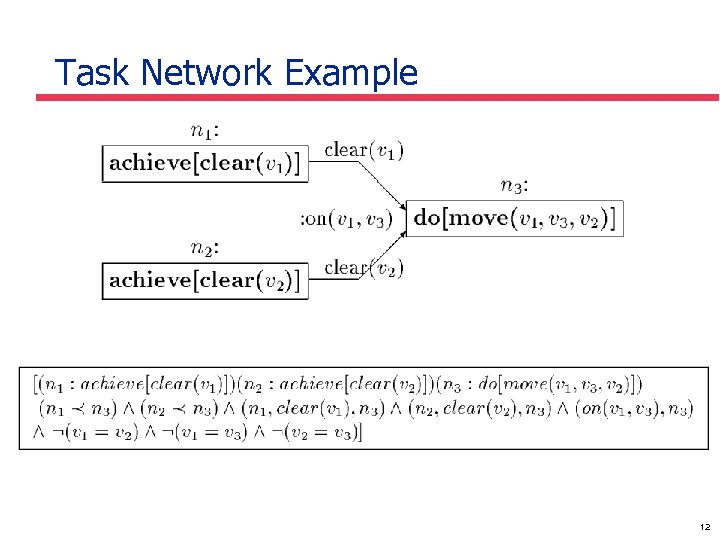
Task Network Example 12
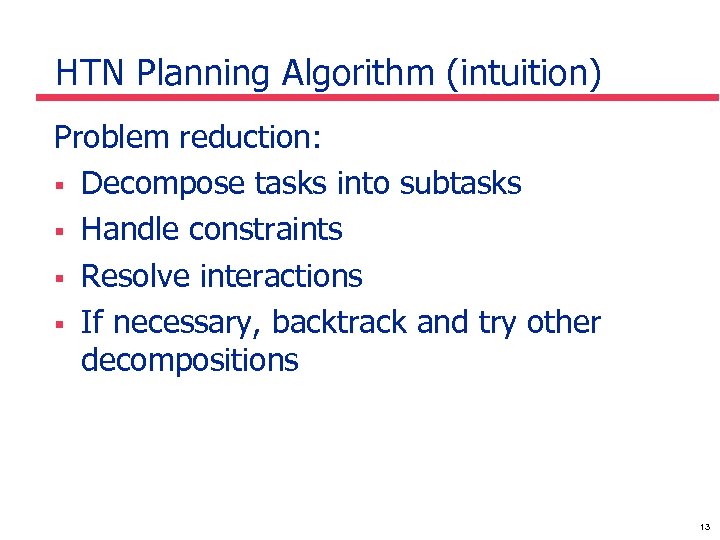
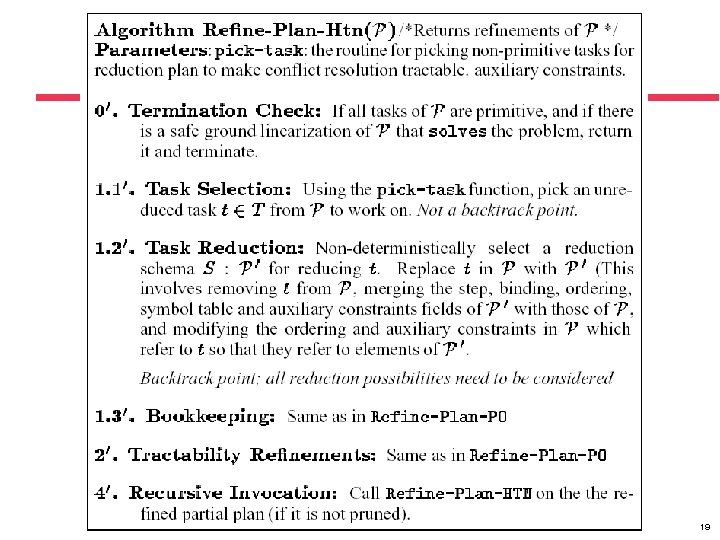
HTN Planning Algorithm (intuition) Problem reduction: § Decompose tasks into subtasks § Handle constraints § Resolve interactions § If necessary, backtrack and try other decompositions 13
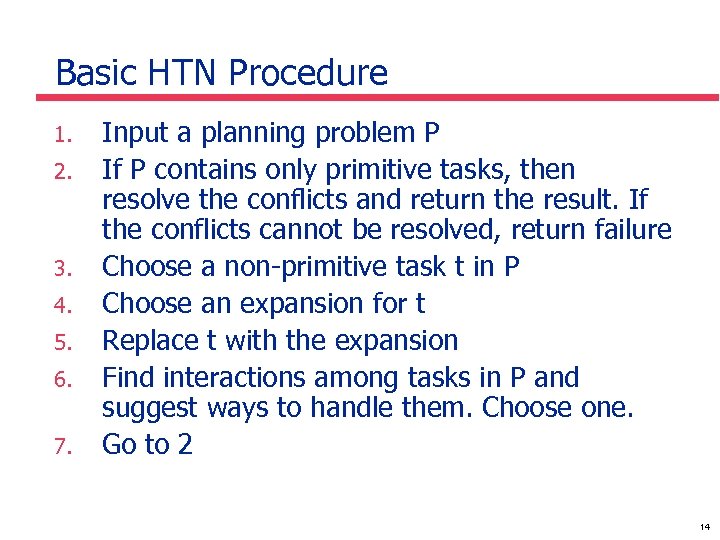
Basic HTN Procedure 1. 2. 3. 4. 5. 6. 7. Input a planning problem P If P contains only primitive tasks, then resolve the conflicts and return the result. If the conflicts cannot be resolved, return failure Choose a non-primitive task t in P Choose an expansion for t Replace t with the expansion Find interactions among tasks in P and suggest ways to handle them. Choose one. Go to 2 14
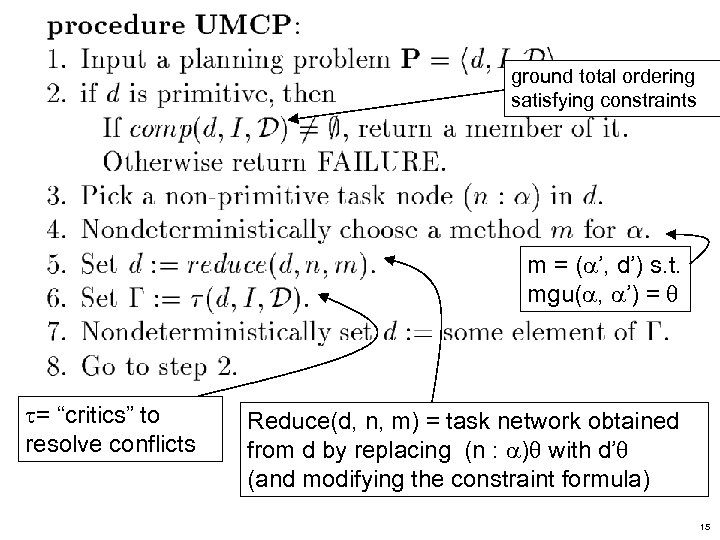
ground total ordering satisfying constraints m = ( ’, d’) s. t. mgu( , ’) = t= “critics” to resolve conflicts Reduce(d, n, m) = task network obtained from d by replacing (n : ) with d’ (and modifying the constraint formula) 15
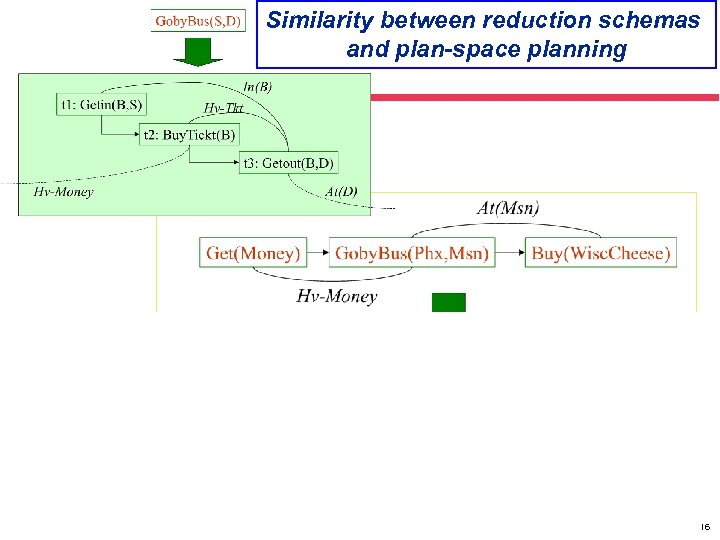
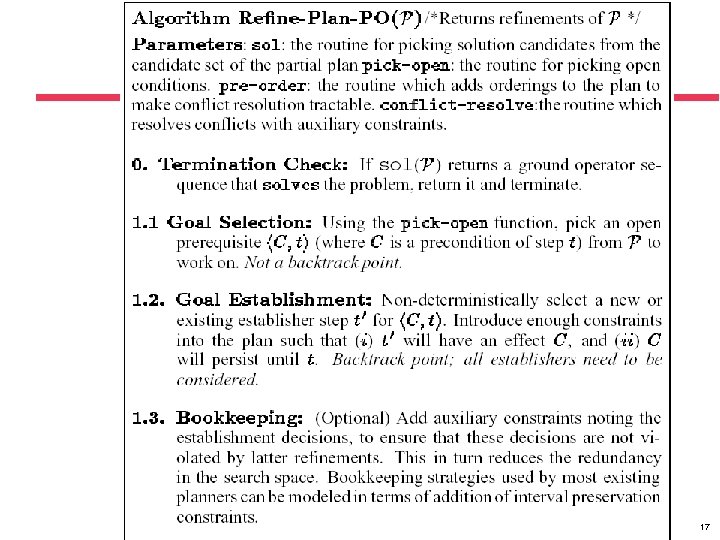
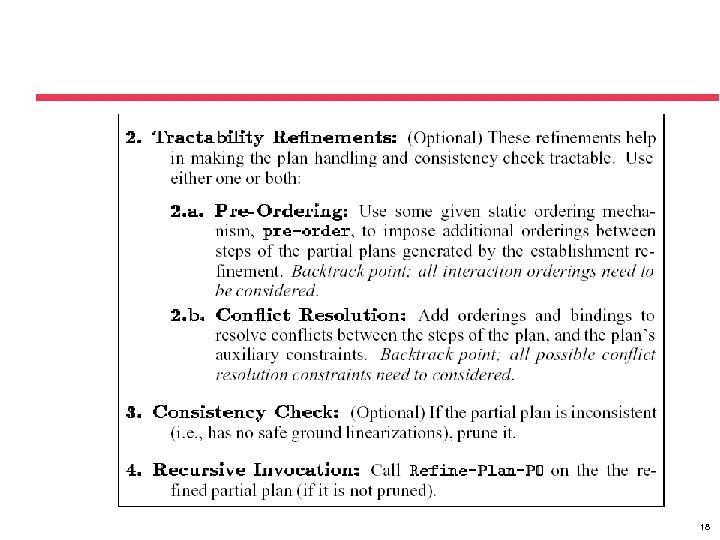
Similarity between reduction schemas and plan-space planning 16
17
18
19
![Refinement Planning [Kambhampati 96] Task reduction 20](https://present5.com/presentation/10718aae512802991479b6eca641ec76/image-20.jpg "Refinement Planning [Kambhampati 96] Task reduction 20")
Refinement Planning [Kambhampati 96] Task reduction 20
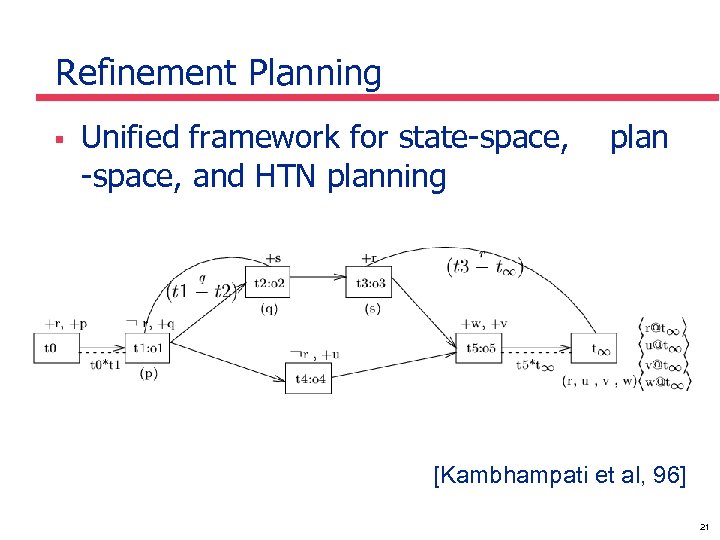
Refinement Planning § Unified framework for state-space, and HTN planning plan [Kambhampati et al, 96] 21
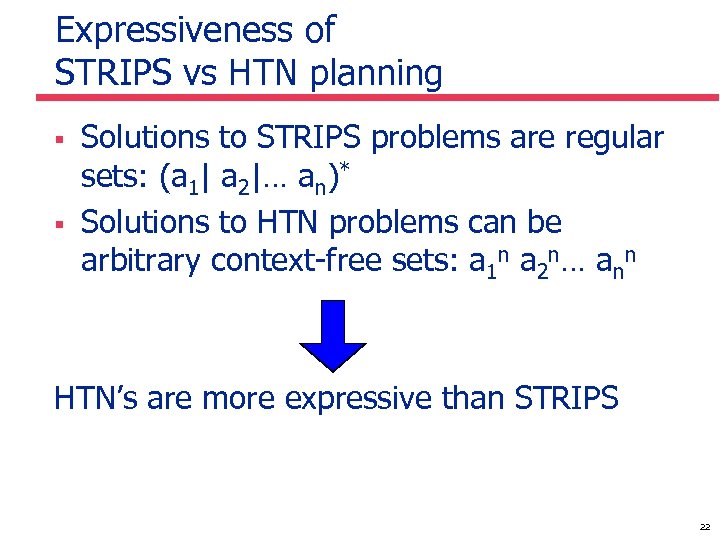
Expressiveness of STRIPS vs HTN planning § § Solutions to STRIPS problems are regular sets: (a 1| a 2|… an)* Solutions to HTN problems can be arbitrary context-free sets: a 1 n a 2 n… ann HTN’s are more expressive than STRIPS 22
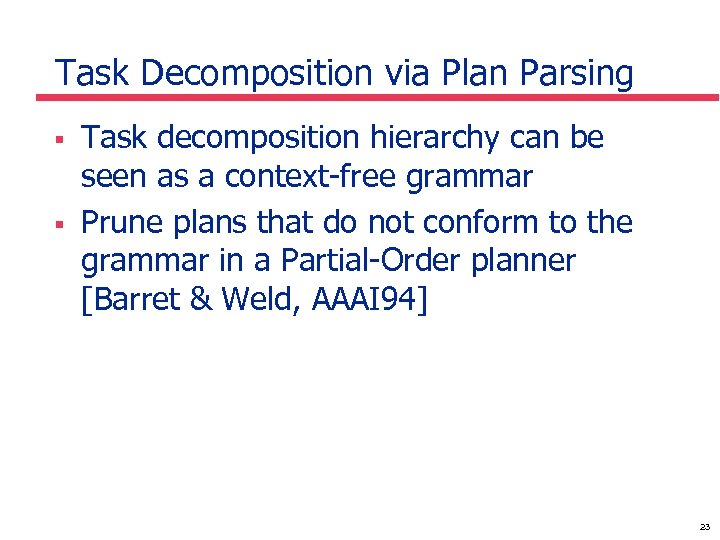
Task Decomposition via Plan Parsing § § Task decomposition hierarchy can be seen as a context-free grammar Prune plans that do not conform to the grammar in a Partial-Order planner [Barret & Weld, AAAI 94] 23
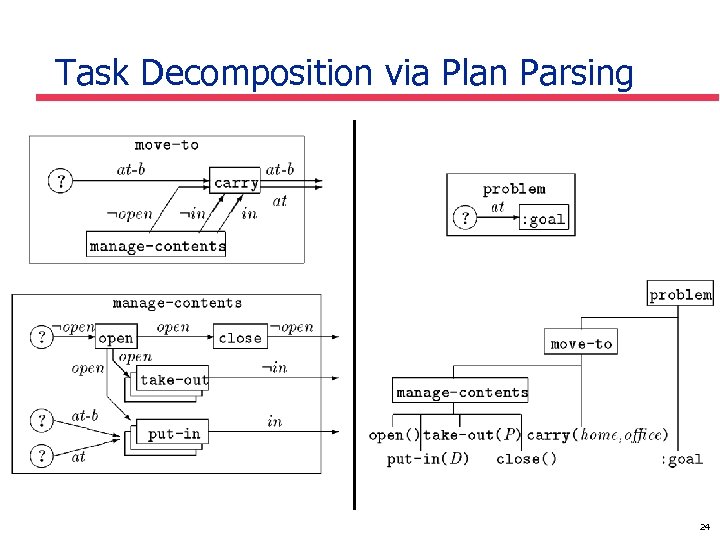
Task Decomposition via Plan Parsing 24
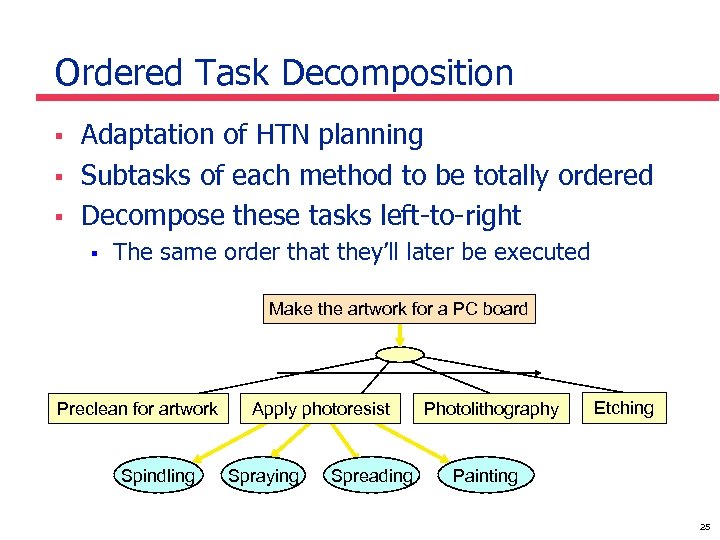
Ordered Task Decomposition § § § Adaptation of HTN planning Subtasks of each method to be totally ordered Decompose these tasks left-to-right § The same order that they’ll later be executed Make the artwork for a PC board Preclean for artwork Spindling Apply photoresist Spraying Spreading Photolithography Etching Painting 25
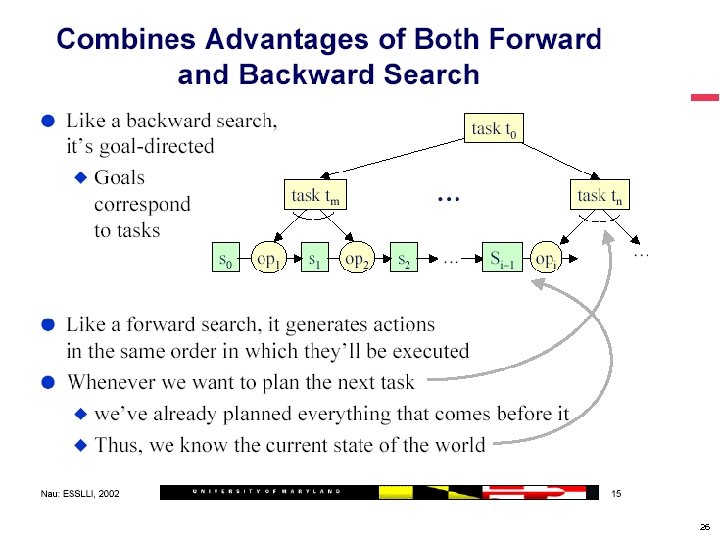
26
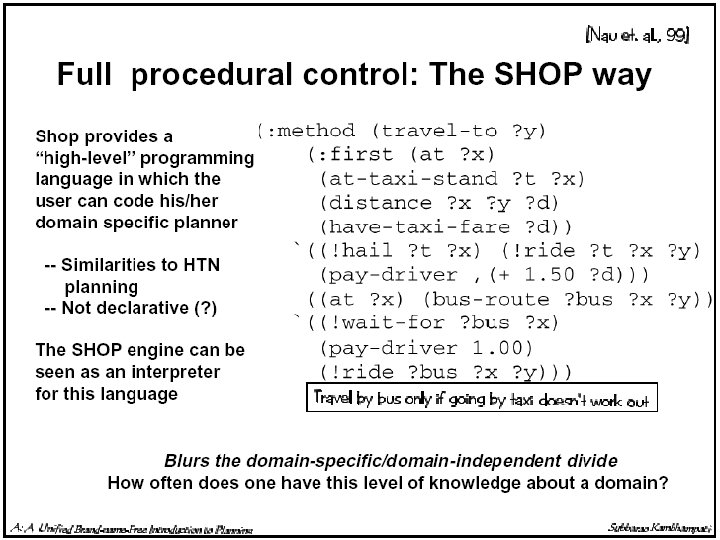
SHOP (Simple Hierarchical Ordered Planner) § Domain-independent algorithm for Ordered Task Decomposition § § Input: § § Sound/complete State: a set of ground atoms Task List: a linear list of tasks Domain: methods, operators, axioms Output: one or more plans, it can return: § § the first plan it finds all possible plans a least-cost plan all least-cost plans 27
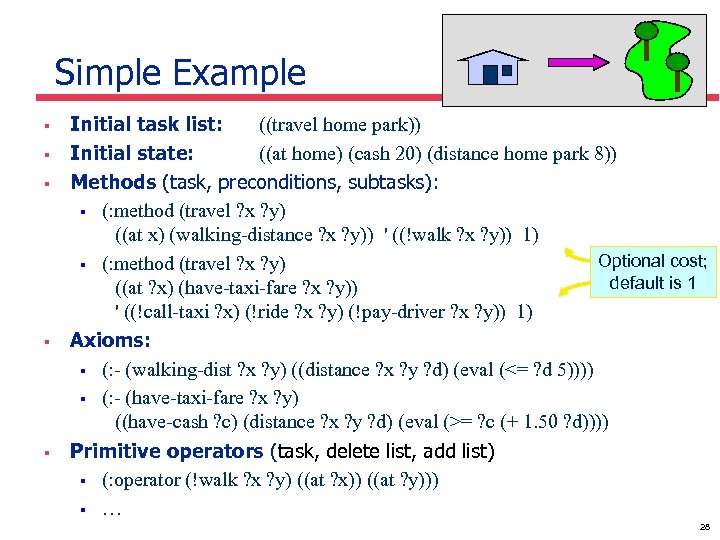
Simple Example § § § Initial task list: ((travel home park)) Initial state: ((at home) (cash 20) (distance home park 8)) Methods (task, preconditions, subtasks): § (: method (travel ? x ? y) ((at x) (walking-distance ? x ? y)) ' ((!walk ? x ? y)) 1) Optional cost; § (: method (travel ? x ? y) default is 1 ((at ? x) (have-taxi-fare ? x ? y)) ' ((!call-taxi ? x) (!ride ? x ? y) (!pay-driver ? x ? y)) 1) Axioms: § (: - (walking-dist ? x ? y) ((distance ? x ? y ? d) (eval (<= ? d 5)))) § (: - (have-taxi-fare ? x ? y) ((have-cash ? c) (distance ? x ? y ? d) (eval (>= ? c (+ 1. 50 ? d)))) Primitive operators (task, delete list, add list) § (: operator (!walk ? x ? y) ((at ? x)) ((at ? y))) § … 28
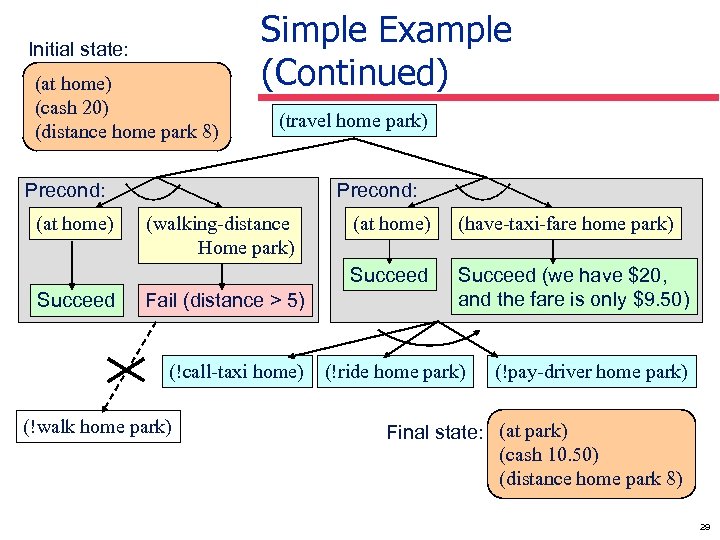
Initial state: (at home) (cash 20) (distance home park 8) Simple Example (Continued) (travel home park) Precond: (at home) Precond: Fail (distance > 5) (!call-taxi home) (!walk home park) (at home) (have-taxi-fare home park) Succeed (walking-distance Home park) Succeed (we have $20, and the fare is only $9. 50) (!ride home park) (!pay-driver home park) Final state: (at park) (cash 10. 50) (distance home park 8) 29
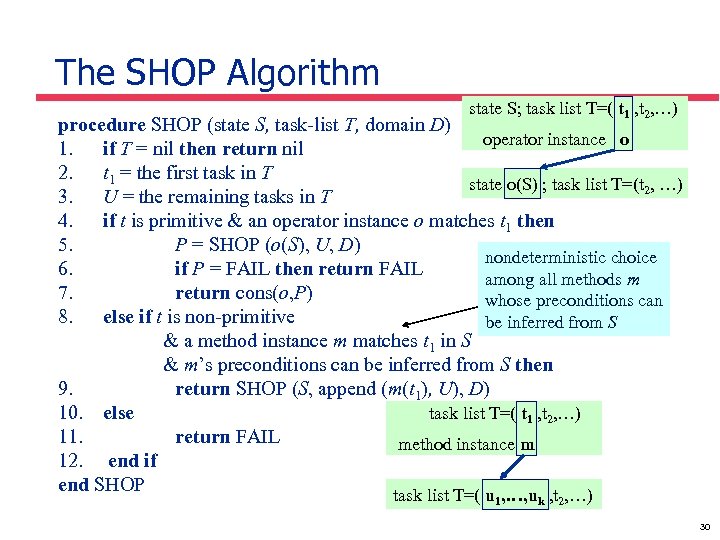
The SHOP Algorithm state S; task list T=( t 1 , t 2, …) procedure SHOP (state S, task-list T, domain D) operator instance o 1. if T = nil then return nil 2. t 1 = the first task in T state o(S) ; task list T=(t 2, …) 3. U = the remaining tasks in T 4. if t is primitive & an operator instance o matches t 1 then 5. P = SHOP (o(S), U, D) nondeterministic choice 6. if P = FAIL then return FAIL among all methods m 7. return cons(o, P) whose preconditions can 8. else if t is non-primitive be inferred from S & a method instance m matches t 1 in S & m’s preconditions can be inferred from S then 9. return SHOP (S, append (m(t 1), U), D) 10. else task list T=( t 1 , t 2, …) 11. return FAIL method instance m 12. end if end SHOP task list T=( u , …, u , t , …) 1 k 2 30
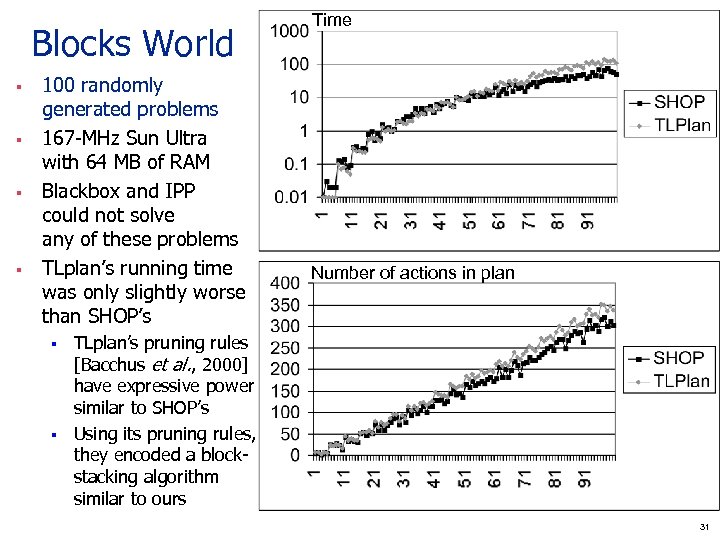
Blocks World § § 100 randomly generated problems 167 -MHz Sun Ultra with 64 MB of RAM Blackbox and IPP could not solve any of these problems TLplan’s running time was only slightly worse than SHOP’s § § Time Number of actions in plan TLplan’s pruning rules [Bacchus et al. , 2000] have expressive power similar to SHOP’s Using its pruning rules, they encoded a blockstacking algorithm similar to ours 31
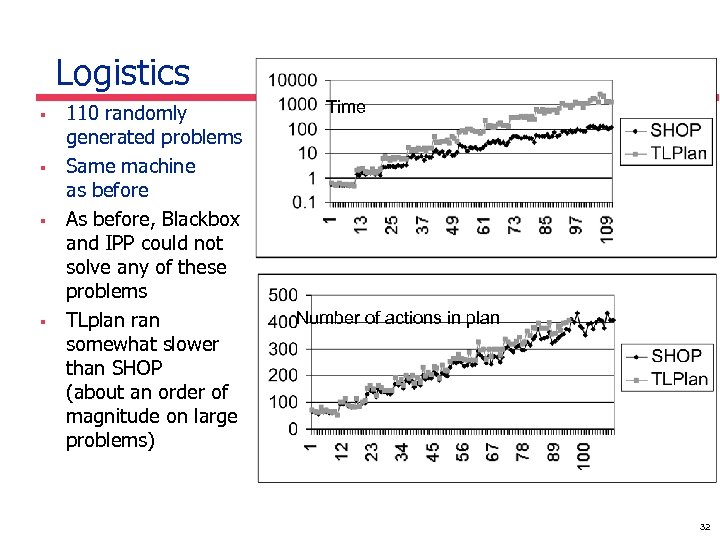
Logistics § § 110 randomly generated problems Same machine as before As before, Blackbox and IPP could not solve any of these problems TLplan ran somewhat slower than SHOP (about an order of magnitude on large problems) Time Number of actions in plan 32
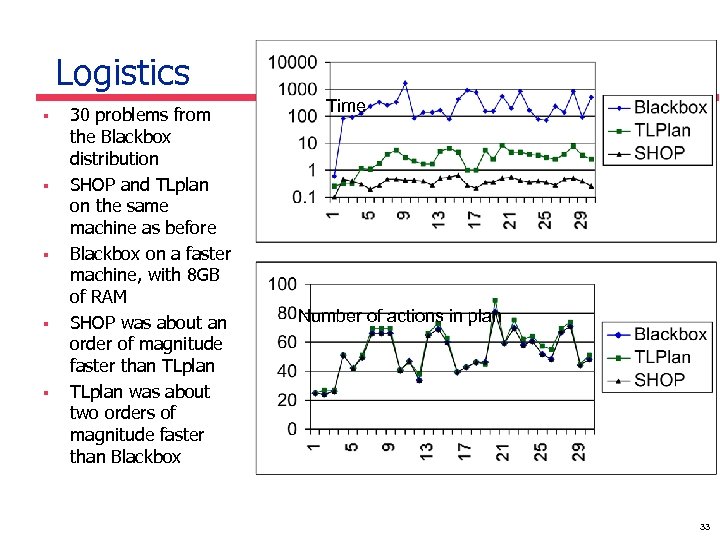
Logistics § § § 30 problems from the Blackbox distribution SHOP and TLplan on the same machine as before Blackbox on a faster machine, with 8 GB of RAM SHOP was about an order of magnitude faster than TLplan was about two orders of magnitude faster than Blackbox Time Number of actions in plan 33

SHOP demo 34
35
Скачать презентацию Hierarchical Task Network HTN Planning José Luis Ambite
10718aae512802991479b6eca641ec76.ppt