


 Скачать презентацию Hi Grade WP 2 WP 4 Coordination
bfcde0a977a40352f02d8c0db228439f.ppt
- Количество слайдов: 17
 Hi. Grade WP 2 & WP 4 Coordination & Governance Brian Foster (Oxford & GDE) Hi. Grade Meeting DESY 22/11/10
 WP 2 activity • NW as one of three PMs plays major role in coordinate of global effort. Tracking effort in Europe and collecting data carried out by NW, BF et al. • We both contribute to the way in which the European efforts feed into the global project. • I also make regular trips to the major science funding agencies and to the national groups working on ILC to discuss ILC R&D and their plans. B. Foster - ILC-Hi. Grade - 11/10 Global Design Effort 2
 WP 2 activity • In the last year I visited M. Spiro and had brief initial meeting with new head of IN 2 P 3, J. Martino. I saw R. Petronzio of INFN at the ECFA meeting in June. • In October I attended the annual meeting of the Spanish LC community in Valencia. • I make regular presentations on ILC plans to plenary ECFA, European bodies such as RAMIRI symposium etc. B. Foster - ILC-Hi. Grade - 11/10 Global Design Effort 3
 WP 2 activity • Major European event of the year was joint ILC-CLIC workshop in CERN last month. • Despite very complex logistics, it was a great success with 479 registrants. • Marks increasing collaboration between CLIC and ILC communities to produce a linear collider community. • FR will report on this to the next ECFA meeting at CERN. B. Foster - ILC-Hi. Grade - 11/10 Global Design Effort 4
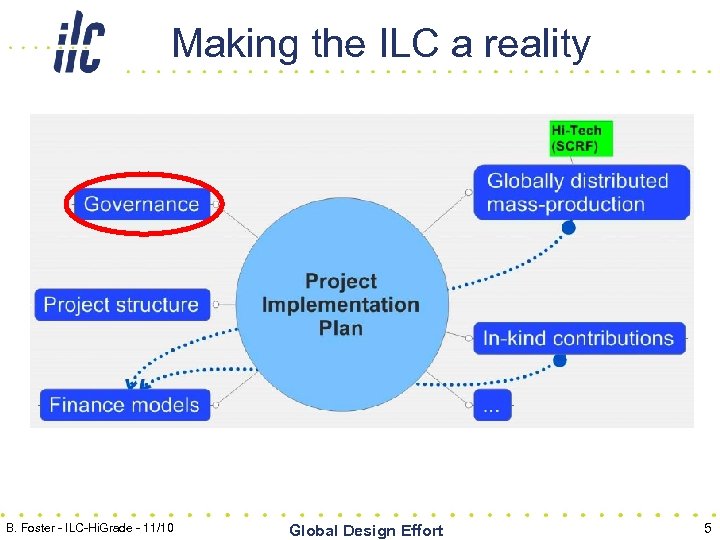 Making the ILC a reality B. Foster - ILC-Hi. Grade - 11/10 Global Design Effort 5
 WP 4 activity • Major milestone was production of Governance interim report by the ILCHi. Grade governance group jointly with the EC governance group. • This was presented to various stakeholders, including ILCSC and FALC, in the late spring and early summer. • BF presented the conclusions at the ICHEP conference in Paris. • Write-up of this talk represents official version of the interim report. B. Foster - ILC-Hi. Grade - 11/10 Global Design Effort 6
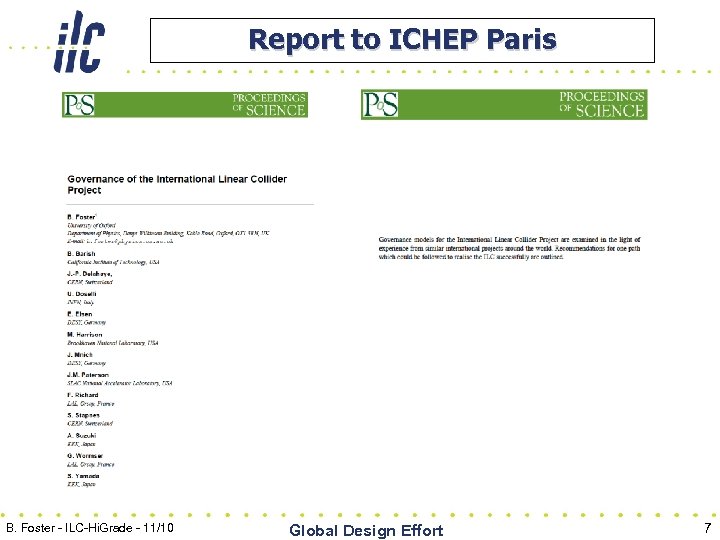 Report to ICHEP Paris B. Foster - ILC-Hi. Grade - 11/10 Global Design Effort 7
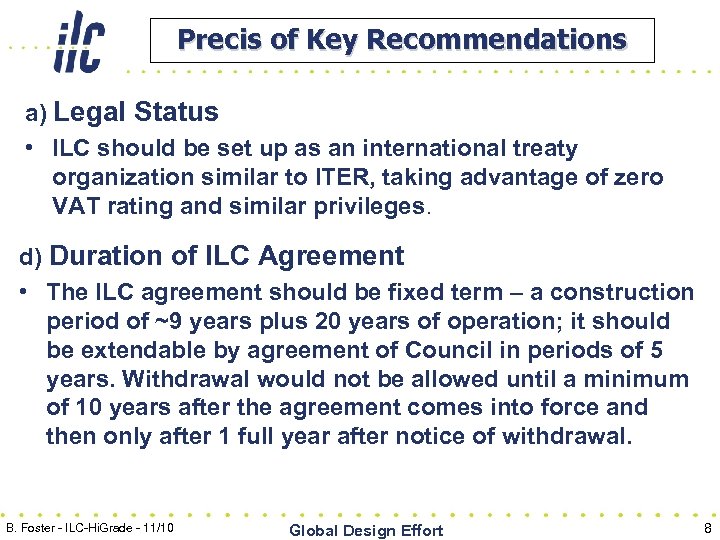 Precis of Key Recommendations a) Legal Status • ILC should be set up as an international treaty organization similar to ITER, taking advantage of zero VAT rating and similar privileges. d) Duration of ILC Agreement • The ILC agreement should be fixed term – a construction period of ~9 years plus 20 years of operation; it should be extendable by agreement of Council in periods of 5 years. Withdrawal would not be allowed until a minimum of 10 years after the agreement comes into force and then only after 1 full year after notice of withdrawal. B. Foster - ILC-Hi. Grade - 11/10 Global Design Effort 8
 Precis of Key Recommendations e) Attribution of in-kind, etc. • There should be an adequate Common Fund (of at least 20%) in order to give management enough flexibility. There should be no strict “juste retour” – (on the Common Fund – but see later). f) Contingency • Central contingency with a maximum of 10% of the total project cost. Increases in costs to produce a WBS item beyond 25% or some other agreed ceiling in cash should be referred to and considered by a standing Board and either referred back to the submitting country or referred to Council for release of central contingency, as appropriate. • Exhaustion of the central contingency should lead to appropriate descoping of the project to be decided by management with Council’s agreement. B. Foster - ILC-Hi. Grade - 11/10 Global Design Effort 9
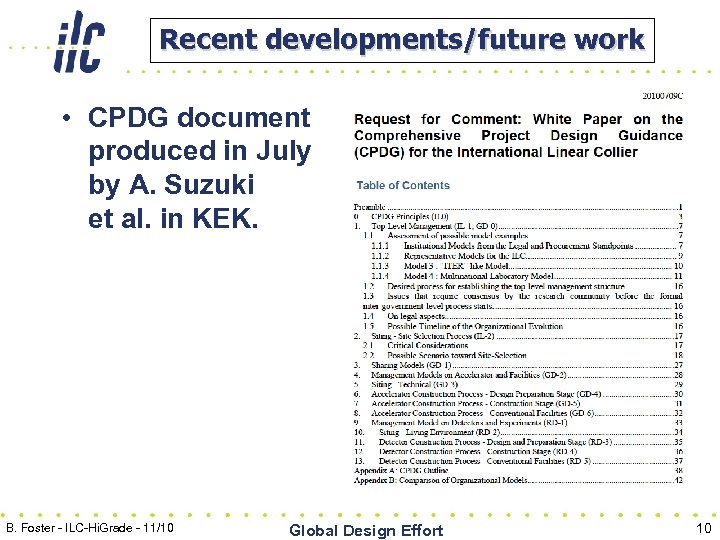 Recent developments/future work • CPDG document produced in July by A. Suzuki et al. in KEK. B. Foster - ILC-Hi. Grade - 11/10 Global Design Effort 10
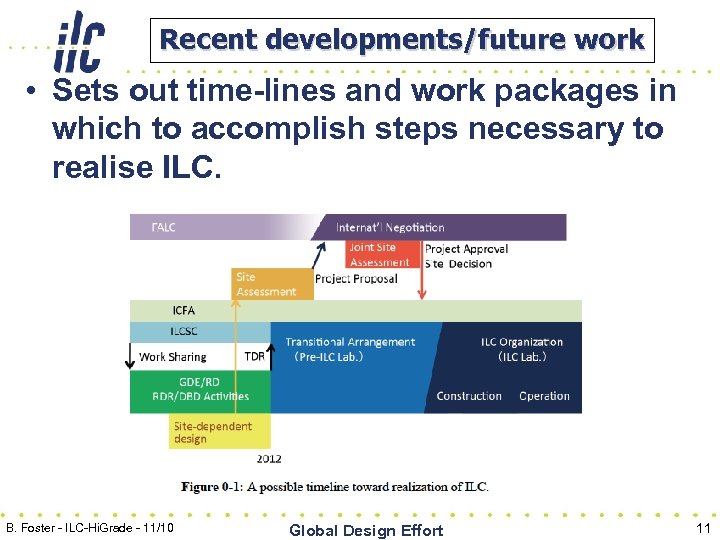 Recent developments/future work • Sets out time-lines and work packages in which to accomplish steps necessary to realise ILC. B. Foster - ILC-Hi. Grade - 11/10 Global Design Effort 11
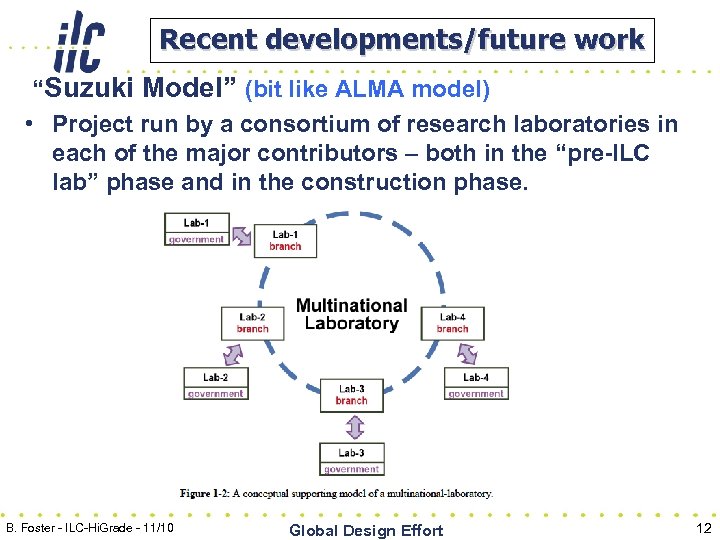 Recent developments/future work “Suzuki Model” (bit like ALMA model) • Project run by a consortium of research laboratories in each of the major contributors – both in the “pre-ILC lab” phase and in the construction phase. B. Foster - ILC-Hi. Grade - 11/10 Global Design Effort 12
 Recent developments/future work For the “pre-ILC” phase this seems like an reasonable plan – just more formal expansion of current system, without ILCSC for the Directors to hide behind. • For the construction phase, major open issues: – do labs have the infrastructure to cope with $Bs of construction funds flowing through them and required management? – will governments trust labs to administer these funds? – what do we do with countries without such labs & infrastructure – e. g. UK? – what sort of governance structures can make governments & labs work together easily? …. etc. B. Foster - ILC-Hi. Grade - 11/10 Global Design Effort 13
 Recent developments/future work Funding models • Concluded that GDP-related models don’t work – the share that would imply would be politically unacceptable for some of the largest GDP countries for an offshore laboratory. Regional models don’t work since although Americas is US dominated and EU is an entity that can in principle work & negotiate, Asia is much more complicated. • Use ”buy-in” share model a la ITER – can be individual countries or formal or informal groups of countries. This might allow a “regional” model to emerge, but as a result of multi-lateral negotiations not being imposed from above. B. Foster - ILC-Hi. Grade - 11/10 Global Design Effort 14
 Recent developments/future work Funding models • Wide recognition that “in-kind” contribution model fraught with danger in terms of management flexibility and ability to “fire-fight” problems as they arise. Perhaps that means that for ILC, governments will be happy to pay cash – then no problem. • We have to plan for worst case. Two strategies: – minimum 20% cash fund inside an “in-kind” model similar to ITER and XFEL; – 100% cash fund with “juste retour” on ~80% of it (variation of suggestion from S. Ozaki idea at last ILCSC); – Need to think through implications of latter and how it might work in practice. Not aware of another project that has done this. Possible joint work with e. g. OECD. B. Foster - ILC-Hi. Grade - 11/10 Global Design Effort 15
 Recent developments/future work More generally: • OECD Global Science Forum report on establishment of large infrastructures being finalised. I went to final meeting last month in Bologna. Ideas pretty similar to ours with no startling new insights! Significant scepticism about the “Suzuki Model” when I brought it up in conversations. I requested they initiate further study into “in-kind” – if they do I will interact with them. • Continued need to interact with ERIC and EU. • Ongoing problem with interaction with Atsuto’s group on governance and the ILCSC. Somewhat more communication since KEK meeting. The GDE-Suzuki. ILCSC triangle will need a lot of attention in the next year or so. B. Foster - ILC-Hi. Grade - 11/10 Global Design Effort 16
 Summary • European contribution continues to be coherent and strong – substantially through XFEL – costings, technical, etc. • Need to follow developments in ITER, EU and elsewhere. Go back to ALMA and talk to colleagues as example of Suzuki-type model. Some other ideas on e. g. mechanisms for in-kind contribution need to be explored. • Work for next year will I think be centered around interactions with A. Suzuki and ILCSC – and to a lesser extent FALC. Joint meeting EC-FALC may be useful to explore issues. B. Foster - ILC-Hi. Grade - 11/10 Global Design Effort 17