 Скачать презентацию HI 224 Raffael Scheck Colby College 4
300c556417bfcef45ffcaf49599dbb14.ppt
- Количество слайдов: 42



HI 224 Raffael Scheck Colby College (4)
Establishing a Dictatorship
The Hitler Cabinet: Success of Papen’s Taming Strategy? n Only three Nazis and ten conservative allies – BUT: Nazis have important posts (chancellor, interior, Goering as minister without portfolio, soon Prussian interior minister) Papen as vice-chancellor n Hugenberg (DNVP-leader) as coalition partner n Hindenburg still President n
Terror n Goering’s measures as Prussian Interior Minister – – – Fires 22 of 32 police presidents Hires SA as “auxiliary police” Result: massive wave of terror particularly against communists (25, 000 arbitrary arrests) Reichstag fire n Concentration camps n
Legal Measures n n n n Reichstag Fire Decree (23 February 1933) New Elections (5 March 1933) Enabling Act (23 March 1933); opposed only by SPD (Otto Wels) Dissolution of all other parties until July 1933 Gleichschaltung (Synchronization) Konkordat with Papacy Dismissal of all Jews in the civil service
Election Results March 1933
Why did the Hitler Dictatorship Win Much Public Acceptance? Massive reduction of unemployment and rapid economic recovery n Semblance of order, stability, and peace once the wave of terror subsides (July 1933) n Many non-Nazis collaborated in hopes of having a mitigating influence on Hitler n There is no alternative n
Building up German Hegemony in Central Europe 1933 -39
Final Steps Toward a Legal Dictatorship Elimination of the SA leadership, 30 June 1934 („night of long knives“) n Hitler appoints himself „Führer of the German People“ after Hindenburg‘s death (2 August 1934) n Plebiscites n
Unemployment 1932 -39
Military Spending 1932 -39
Hitler’s Foreign Policy Goals n The REAL goal: Lebensraum in Eastern Europe; huge and crude genetic engineering project (upgrading the “Aryan” race) Do NOT write „liebensraum“! The professor n The PERCEIVED goal: revision of the wrongs of Versailles
Hitler‘s Foreign Policy 1933 -39 Defiance of Versailles, but with limited risk n Mixed messages: declaration of peaceful intentions mixed with threats and bullying n Search for allies n Massive rearmament n Decisive step: break of Munich Agreement through the invasion of Czechoslovakia, March 1939 n
Main Events of German Foreign Policy 1933 -39
Reasons for Hitler‘s Success? Remorse about Versailles among the victors n Longer economic crisis and slower economic recovery in France and Britain n Disillusionment with war among the victors n British concern about Italy and Japan n
The International Reaction n Containment (1933 -35): efforts to build anti. German alliances (Stresa Front with Italy, April 1935; pact between France and the Soviet Union) Appeasement (1935 -38): concessions to Hitler hoping that he would voluntarily recognize a just revision of Versailles Confrontation (1939): recognition that Hitler cannot be appeased. Rapid rearmament and guarantee treaties for Poland Rumania
Blitz Victories 1939 -1941
The Start of the World War II Hitler‘s desire for war n The Hitler-Stalin Pact (August 1939) n The German Attack on Poland (1 September 1939) n British and French declarations of war (3 September 1939) n
Blitzkrieg n Rapid Victories: – – n Poland (Sept. 1939) Denmark and Norway (April-May 1940) France and Benelux countries (May-June 1940) Yugoslavia and Greece (April-May 1941) What was Blitzkrieg? – – – Rapid move of concentrated motorized forces Air attacks to support these moves Breakthrough at strategically crucial points Element of surprise Economic benefits
Total War 1941 -1945
Why did Hitler Attack the Soviet Union? Hope to bring Britain to the peace table n Conflicts with the Soviet Union (Finland; Rumania) n Ideological motivation (Lebensraum) n Expectation of quick victory n
Why did the Attack on the Soviet Union Fail? Depth of territory n Determined resistance n Underestimation of Soviet industrialization n German treatment of civilian population n
The German Defeat n n n n No compromise peace Decisive: vast numerical inferiority and massively overextended fronts Defeat in the Soviet Union War with the United States Defeat of the submarines, March-May 1943 Defeat in North Africa, May 1943 Allied landings in France, June 1944 Bombing campaign against Germany
The Nazi State, Industry, and Society
The State n n Hitler: a strong dictator - „Working toward the Führer“ (Kershaw). Charismatic rule with a radicalizing dynamic Primary instrument of Hitler‘s power: the SS under Heinrich Himmler Corruption at the lower levels of the party and state administration (Gauleiter) Crucial: Hitler was always much more popular than the party and Nazi ideology. He was often liked for things he did not condone and dissociated from unpopular measures („if only the Führer knew“). HITLER MYTH
Industry n n Promotion of cars. The Volkswagen - Germany‘s answer to Ford Heavy focus on rearmament. Hence: financial shortages and weak consumer sector
Society n n The claim of Volksgemeinschaft (people‘s community): practicing social solidarity The realities of Volksgemeinschaft – – – n Discontent among the peasants The workers: working hard for little money Women: pushed out of the labor market, and then begged to come back Boys and girls: focus on athletics The churches (Lutherans: official church and Confessing Church; Konkordat with the Pope) Priorities: war preparation and racial policy
The Dark Sides of the Volksgemeinschaft Not everybody is equal n Discrimination against Jews n – – n 2000 anti-Jewish laws 1933 -1945 April boycott 1933 Dismissal from public service jobs and industry (1933) Nürnberg Laws (1935) Discrimination against Sinti and Roma
Upgrading the Germans Forced sterilization and abortion n Euthanasia, 1939 -45; protest by Bishop von Galen n
Slave Labor n n n Seven million forced laborers in Nazi Germany in 1944 1. 5 million French POWs „Voluntary“ laborers from France Italian „Military Internees“ after 1943 (ca. 600, 000) Concentration camp inmates (altogether 2. 5 -3. 5 million) with high mortality (around half a million) Separation of foreigners from Germans
Racial Murder
The Three Phases on the Road to Mass Murder 1. Restriction and Segregation 1933 -38 (Nürnberg Laws, 1935) n 2. Expulsion and exclusion 1938 -41 (Night of Broken Glass, 1938) n 3. Extermination 1939/41 -45 (Euthanasia program; genocide) n
Questions Why did this happen? n Who was responsible? n Discussion? n
The End of the War
The Allied Bombing Campaign against Germany n n n British aim: to „de-house“ the working class and inspire uprisings: area bombardment of large cities by night American aim: to hit industrial plant and infrastructure: precision bombing by day Ultimately: terror bombing by both air forces Hamburg firestorm, July 1943 Destruction of all German and Austrian cities. Example: Dresden, February 1945
Bombing of Germany
Bombing by Month 1944 -45
Yearly Average by Month *1945: January through April
The German Reaction Indifference of Hitler and the other Nazi leaders n Priority on „revenge weapons“ n Delayed development of ME 262 n Crumbling of Hitler Myth, but also new field for NSDAP support activity and propaganda n
The End: Inferno n n n n Hitler incapable of averting defeat and fanatically unwilling to surrender Soviet atrocities Giant refugee movement from east to west Wilhelm Gustloff disaster Attacks on civilians by low-flying fighter planes Local resistance to national suicide German POWs
The German Resistance
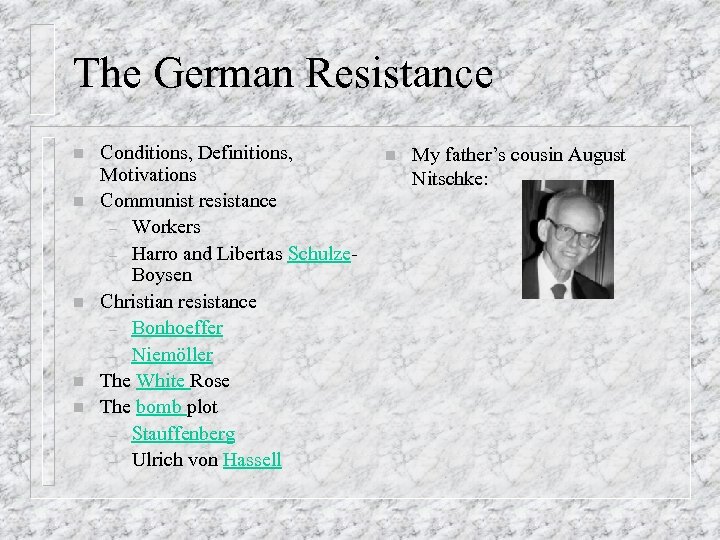
The German Resistance n n n Conditions, Definitions, Motivations Communist resistance – Workers – Harro and Libertas Schulze. Boysen Christian resistance – Bonhoeffer – Niemöller The White Rose The bomb plot – Stauffenberg – Ulrich von Hassell n My father’s cousin August Nitschke:
Скачать презентацию HI 224 Raffael Scheck Colby College 4
300c556417bfcef45ffcaf49599dbb14.ppt