 Скачать презентацию HHSC Base Hospital Program EMS Pharmacology unit
870252af53acff220b55d5ac664cf1f7.ppt
- Количество слайдов: 72



HHSC Base Hospital Program EMS Pharmacology – unit 1 Reading Between the Lines By; Neil Freckleton March, 2006 HHSC Paramedic Base Hospital Program Press “ENTER” to advance slide Press “Backspace” to return to previous slide
Acknowledgement l York Region Base Hospital Pharmacology Package and Niagara Base Hospital program l l Jason Primrose Jim Harris, Program Manager David Austin, MD FRCP (C) Medical Director March, 2006, Niagara Base Hospital, Rick Ferron, A/Education Coordinator Press “ENTER” to advance slide Press “Backspace” to return to previous slide
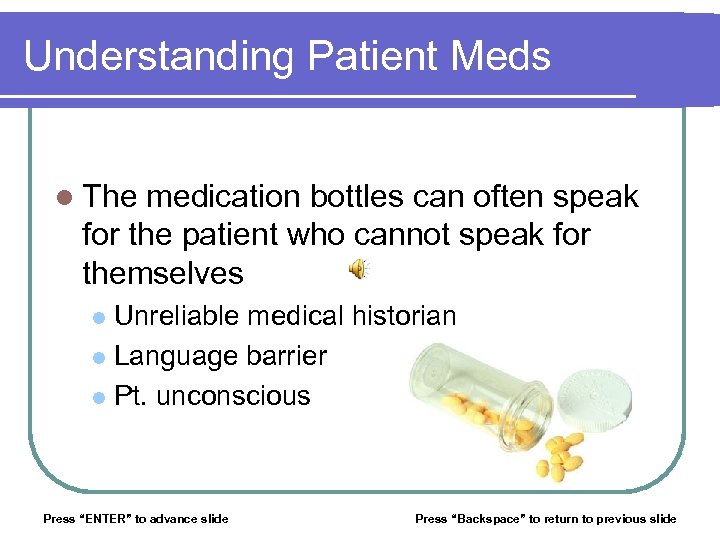
Understanding Patient Meds l The medication bottles can often speak for the patient who cannot speak for themselves Unreliable medical historian l Language barrier l Pt. unconscious l Press “ENTER” to advance slide Press “Backspace” to return to previous slide
Didacticogenic Craniomyalgia l Education-caused head pain. When you learn so much that your head starts to hurt. Press “ENTER” to advance slide Press “Backspace” to return to previous slide
Reading Between the Lines l What medical history might the patient whose med list includes the following medications have? lanoxin l metoprolol l Allopurinol l Click here for the answer l Press “ENTER” to advance slide Press “Backspace” to return to previous slide
Reading Between the Lines l Even when you know the patient’s medical history, their medications might tell you how severe a patient’s illness is. Press “ENTER” to advance slide Press “Backspace” to return to previous slide
Reading Between the Lines l Medications often alter physiological response. l Can cause patient presentation to be misleading Press “ENTER” to advance slide Press “Backspace” to return to previous slide
Reading Between the Lines l At least 10% of hospital admissions from medication side effects, allergic reactions and overdoses. l Knowing actions of drugs can help increase index of suspicion for medication effects Press “ENTER” to advance slide Press “Backspace” to return to previous slide
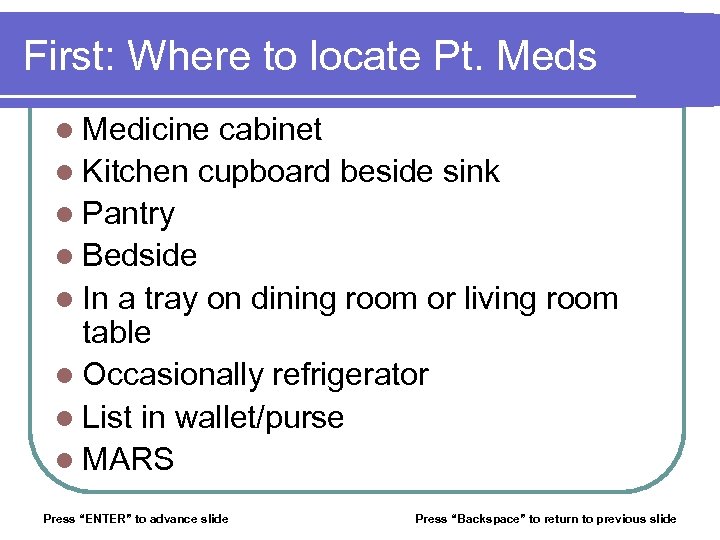
First: Where to locate Pt. Meds l Medicine cabinet l Kitchen cupboard beside sink l Pantry l Bedside l In a tray on dining room or living room table l Occasionally refrigerator l List in wallet/purse l MARS Press “ENTER” to advance slide Press “Backspace” to return to previous slide
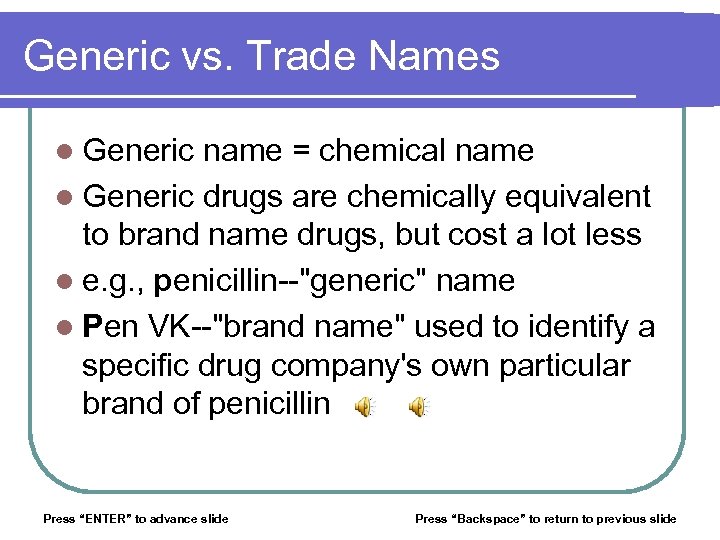
Generic vs. Trade Names l Generic name = chemical name l Generic drugs are chemically equivalent to brand name drugs, but cost a lot less l e. g. , penicillin--"generic" name l Pen VK--"brand name" used to identify a specific drug company's own particular brand of penicillin Press “ENTER” to advance slide Press “Backspace” to return to previous slide
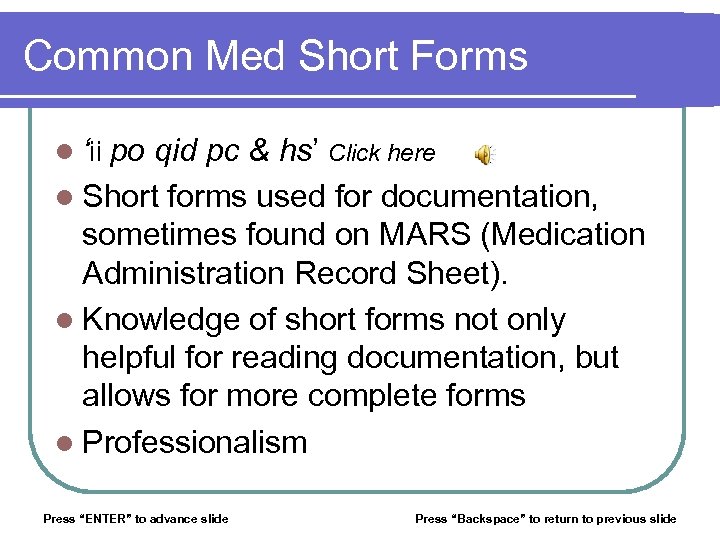
Common Med Short Forms l ‘ii po qid pc & hs’ Click here l Short forms used for documentation, sometimes found on MARS (Medication Administration Record Sheet). l Knowledge of short forms not only helpful for reading documentation, but allows for more complete forms l Professionalism Press “ENTER” to advance slide Press “Backspace” to return to previous slide
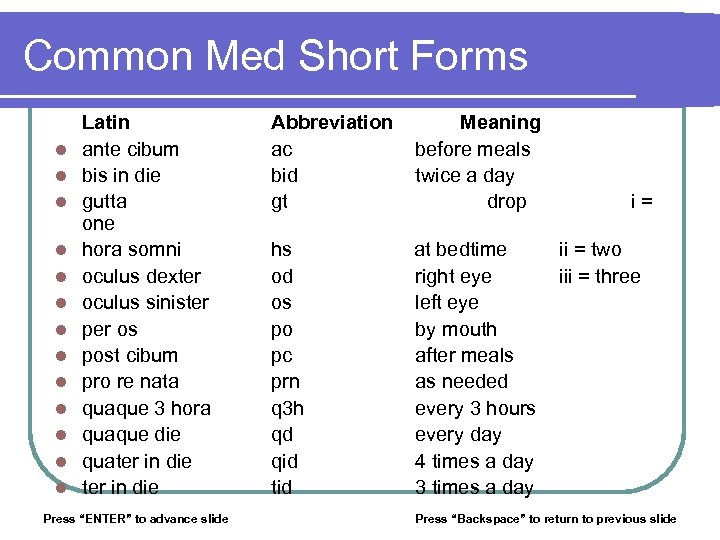
Common Med Short Forms l l l l Latin ante cibum bis in die gutta one hora somni oculus dexter oculus sinister per os post cibum pro re nata quaque 3 hora quaque die quater in die Press “ENTER” to advance slide Abbreviation ac bid gt Meaning before meals twice a day drop hs od os po pc prn q 3 h qd qid tid at bedtime right eye left eye by mouth after meals as needed every 3 hours every day 4 times a day 3 times a day i= ii = two iii = three Press “Backspace” to return to previous slide
Pharmacokinetics l The study of the basic processes that determine the duration and intensity of a drug’s effect. Four processes are: Absorption l Distribution l Biotransformation l Elimination l Press “ENTER” to advance slide Press “Backspace” to return to previous slide
Pharmacodynamics l The study of the mechanisms by which specific drug dosages act to produce biochemical or physiological changes in the body. Press “ENTER” to advance slide Press “Backspace” to return to previous slide
Pharmacodynamics Mechanisms of action: binding to a receptor site, l changing physical properties, l chemically combining with other substances, l altering a normal metabolic pathway l Drug Potency and Efficacy Therapeutic Index Factors Altering Drug Response Press “ENTER” to advance slide Press “Backspace” to return to previous slide
Factors Altering Drug Response l Age l Body Mass l Gender l Environment (e. g. antianxiety meds) l Time of administration l Pathologic state l Genetic factors l Psychological factors Press “ENTER” to advance slide Press “Backspace” to return to previous slide
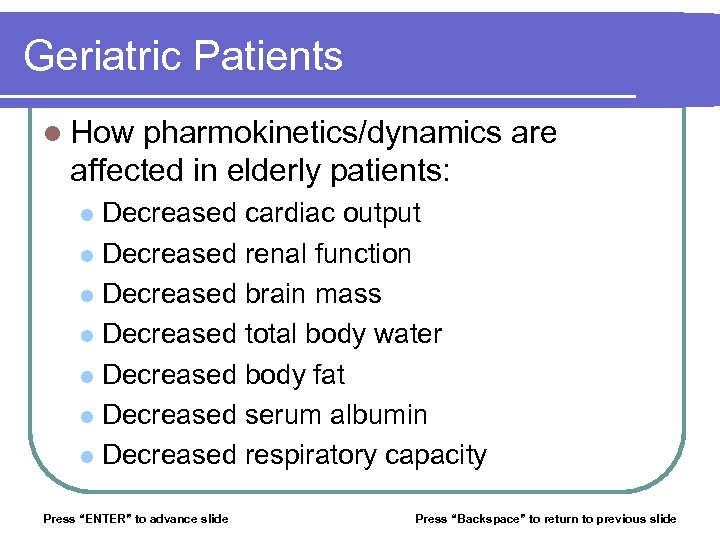
Geriatric Patients l How pharmokinetics/dynamics are affected in elderly patients: Decreased cardiac output l Decreased renal function l Decreased brain mass l Decreased total body water l Decreased body fat l Decreased serum albumin l Decreased respiratory capacity l Press “ENTER” to advance slide Press “Backspace” to return to previous slide
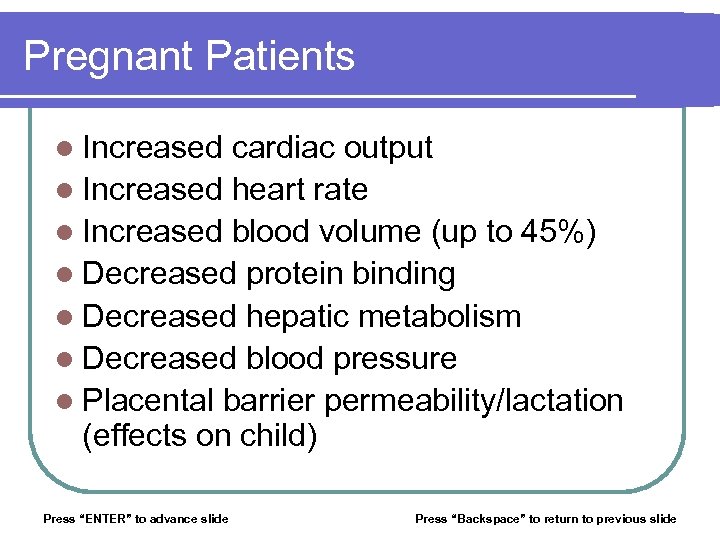
Pregnant Patients l Increased cardiac output l Increased heart rate l Increased blood volume (up to 45%) l Decreased protein binding l Decreased hepatic metabolism l Decreased blood pressure l Placental barrier permeability/lactation (effects on child) Press “ENTER” to advance slide Press “Backspace” to return to previous slide
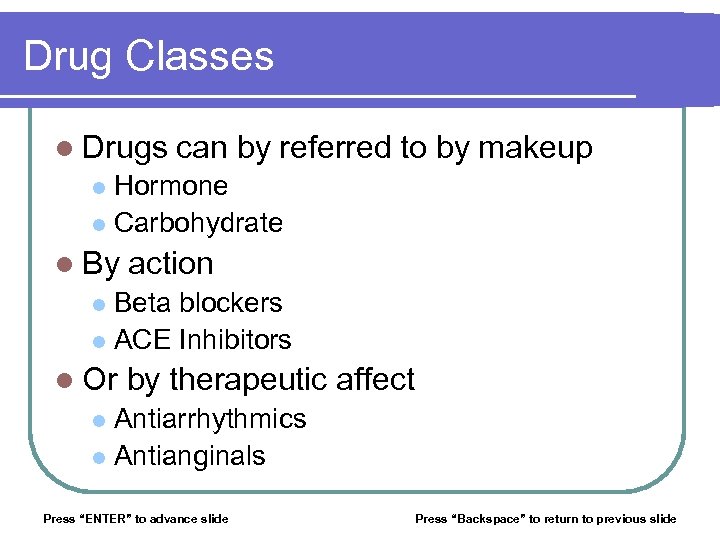
Drug Classes l Drugs can by referred to by makeup Hormone l Carbohydrate l l By action Beta blockers l ACE Inhibitors l l Or by therapeutic affect Antiarrhythmics l Antianginals l Press “ENTER” to advance slide Press “Backspace” to return to previous slide
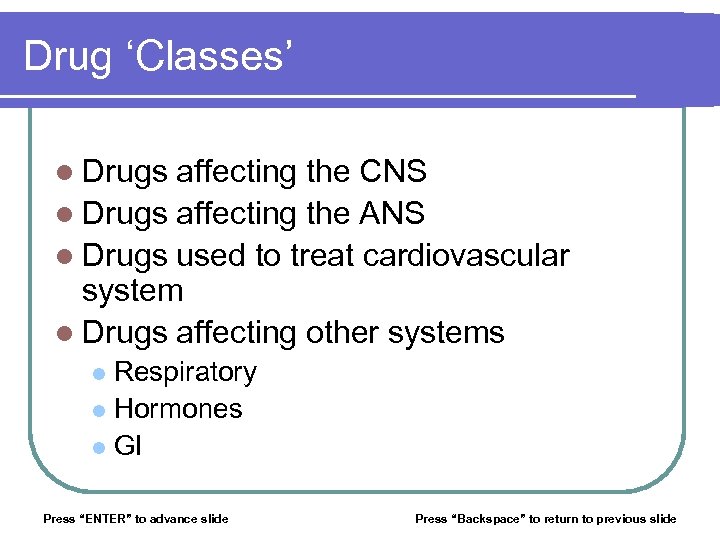
Drug ‘Classes’ l Drugs affecting the CNS l Drugs affecting the ANS l Drugs used to treat cardiovascular system l Drugs affecting other systems Respiratory l Hormones l GI l Press “ENTER” to advance slide Press “Backspace” to return to previous slide
Drugs affecting the Central Nervous System l Anxiolytic/hypnotics* l CNS stimulants l Anaesthetics l Antidepressants* l Neuroleptics* l Opioid analgesics and antagonists l Anticonvulsants* Press “ENTER” to advance slide Press “Backspace” to return to previous slide
Drugs Affecting the ANS l Cholinergic Agonists l Cholinergic Antagonists l Adrenergic Antagonists Press “ENTER” to advance slide Press “Backspace” to return to previous slide
Drugs Affecting Cardiovascular System l Antiarrhythmics l Antihypertensives l Antianginals l Anticoagulants l Treatment of CHF l Antihyperlipidemics Press “ENTER” to advance slide Press “Backspace” to return to previous slide
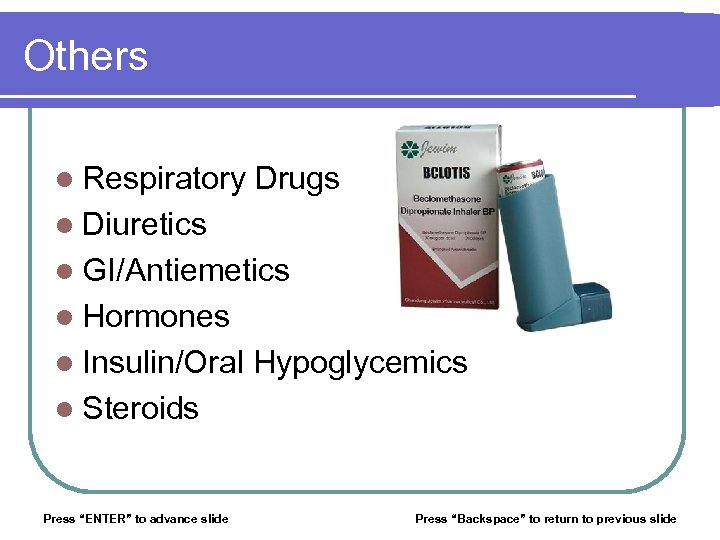
Others l Respiratory Drugs l Diuretics l GI/Antiemetics l Hormones l Insulin/Oral Hypoglycemics l Steroids Press “ENTER” to advance slide Press “Backspace” to return to previous slide
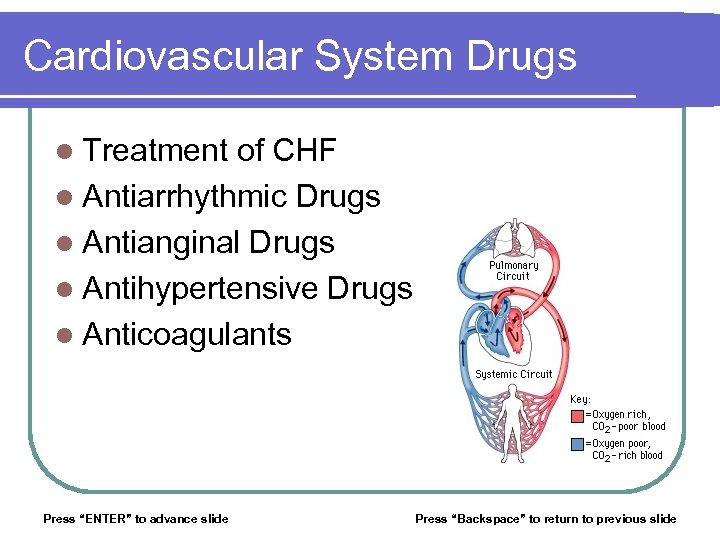
Cardiovascular System Drugs l Treatment of CHF l Antiarrhythmic Drugs l Antianginal Drugs l Antihypertensive Drugs l Anticoagulants Press “ENTER” to advance slide Press “Backspace” to return to previous slide
Aims of Heart Failure Management l To achieve improvement in symptoms l l l Nitro Digoxin ACE inhibitors Diuretics To achieve improvement in survival l ACE inhibitors ß blockers (for example, carvedilol and bisoprolol) Oral nitrates plus hydralazine Press “ENTER” to advance slide Press “Backspace” to return to previous slide
Treatment of CHF l Vasodilators ACE inhibitors (ramipril-Altace) l hydralazine (Apresoline) l isosorbide (Isordil, Nitrobid) l minoxidil (Loniten-also Rogaine) l sodium nitroprusside (Nipride) l l Diuretics l Inotropic l agents digoxin (Lanoxin) Press “ENTER” to advance slide Press “Backspace” to return to previous slide
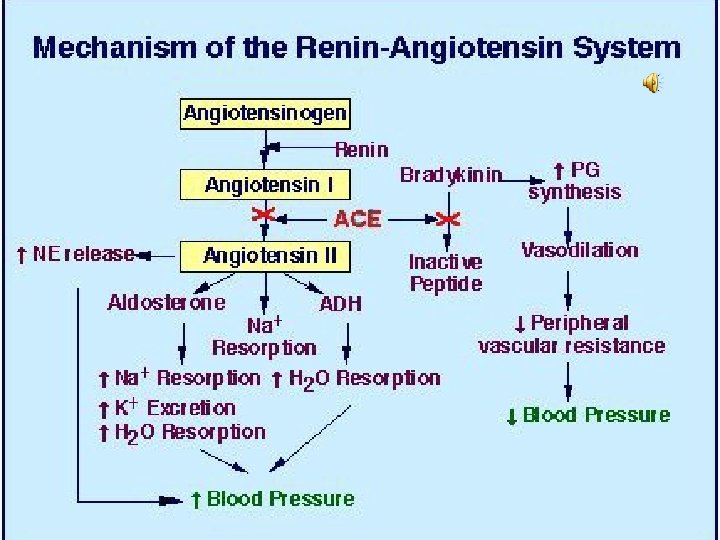
Vasodilators l Increase heart rate l Postural hypotension/syncope l MUST be used with diuretic—some activate renin release, can lead to compensatory water retention l Angioedema-edema involving face, larynx—stridor, etc. !! Press “ENTER” to advance slide Press “Backspace” to return to previous slide
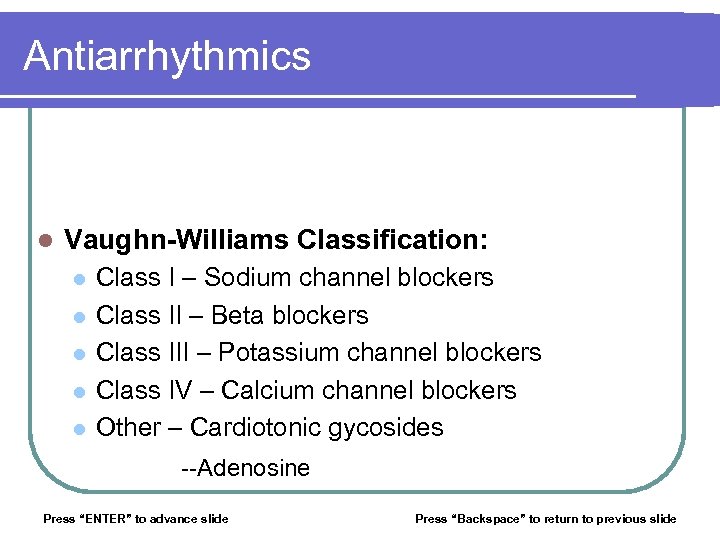
Antiarrhythmics l Vaughn-Williams Classification: l l l Class I – Sodium channel blockers Class II – Beta blockers Class III – Potassium channel blockers Class IV – Calcium channel blockers Other – Cardiotonic gycosides --Adenosine Press “ENTER” to advance slide Press “Backspace” to return to previous slide
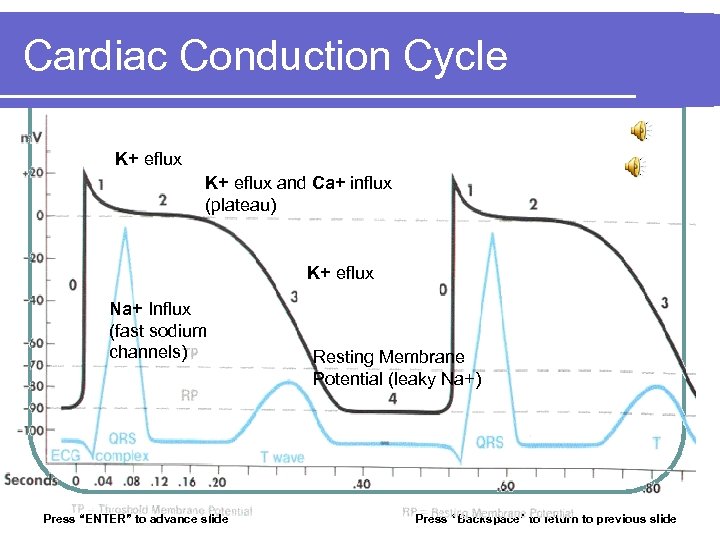
Cardiac Conduction Cycle K+ eflux and Ca+ influx (plateau) K+ eflux Na+ Influx (fast sodium channels) Press “ENTER” to advance slide Resting Membrane Potential (leaky Na+) Press “Backspace” to return to previous slide
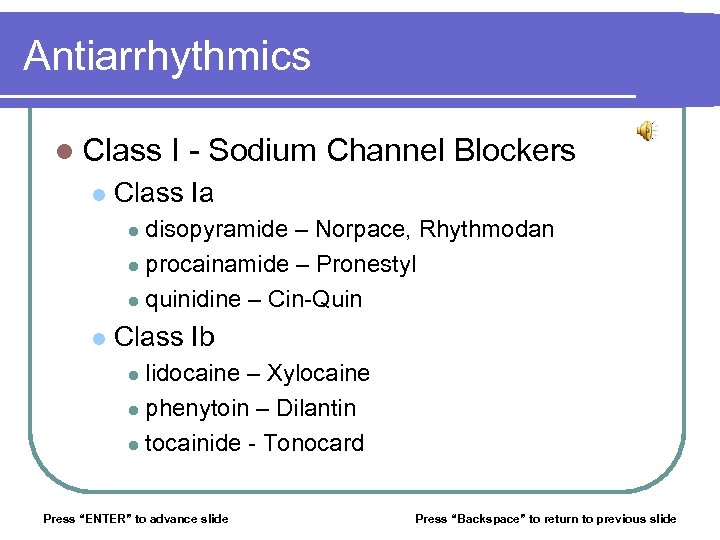
Antiarrhythmics l Class l I - Sodium Channel Blockers Class Ia disopyramide – Norpace, Rhythmodan l procainamide – Pronestyl l quinidine – Cin-Quin l l Class Ib lidocaine – Xylocaine l phenytoin – Dilantin l tocainide - Tonocard l Press “ENTER” to advance slide Press “Backspace” to return to previous slide
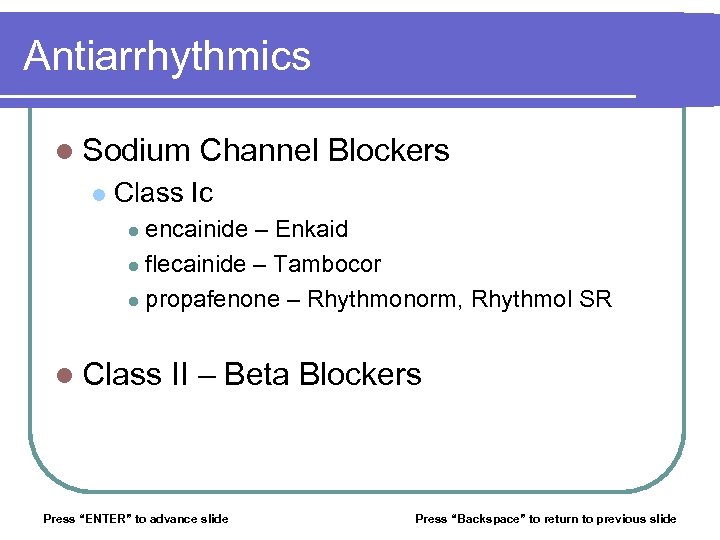
Antiarrhythmics l Sodium l Channel Blockers Class Ic encainide – Enkaid l flecainide – Tambocor l propafenone – Rhythmonorm, Rhythmol SR l l Class II – Beta Blockers Press “ENTER” to advance slide Press “Backspace” to return to previous slide
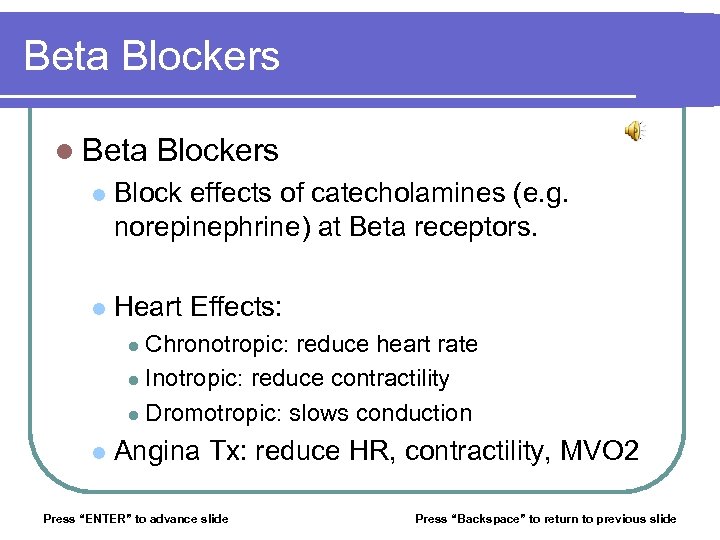
Beta Blockers l Block effects of catecholamines (e. g. norepinephrine) at Beta receptors. l Heart Effects: Chronotropic: reduce heart rate l Inotropic: reduce contractility l Dromotropic: slows conduction l l Angina Tx: reduce HR, contractility, MVO 2 Press “ENTER” to advance slide Press “Backspace” to return to previous slide
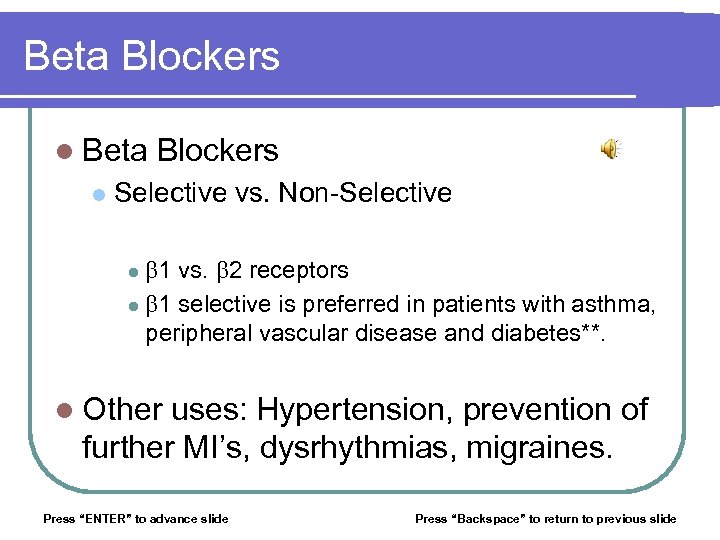
Beta Blockers l Beta l Blockers Selective vs. Non-Selective b 1 vs. b 2 receptors l b 1 selective is preferred in patients with asthma, peripheral vascular disease and diabetes**. l l Other uses: Hypertension, prevention of further MI’s, dysrhythmias, migraines. Press “ENTER” to advance slide Press “Backspace” to return to previous slide
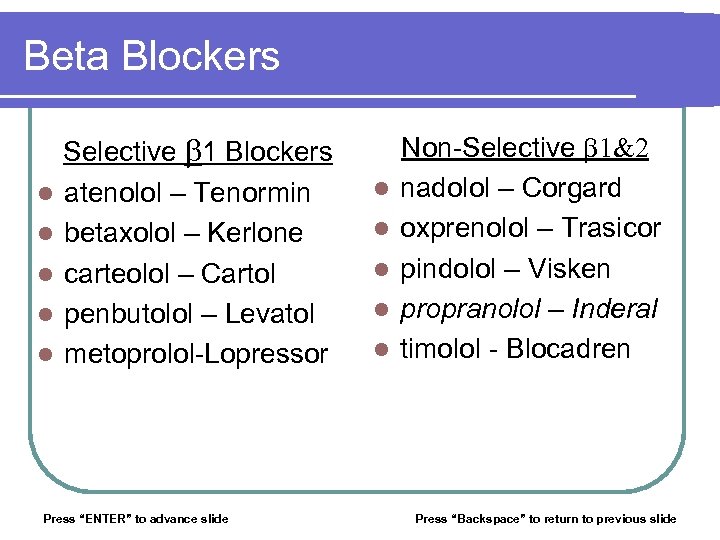
Beta Blockers l l l Selective b 1 Blockers atenolol – Tenormin betaxolol – Kerlone carteolol – Cartol penbutolol – Levatol metoprolol-Lopressor Press “ENTER” to advance slide l l l Non-Selective b 1&2 nadolol – Corgard oxprenolol – Trasicor pindolol – Visken propranolol – Inderal timolol - Blocadren Press “Backspace” to return to previous slide
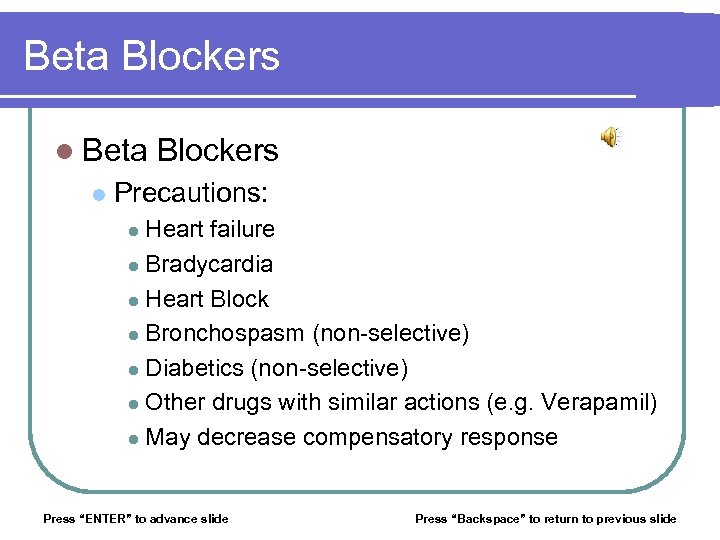
Beta Blockers l Beta l Blockers Precautions: Heart failure l Bradycardia l Heart Block l Bronchospasm (non-selective) l Diabetics (non-selective) l Other drugs with similar actions (e. g. Verapamil) l May decrease compensatory response l Press “ENTER” to advance slide Press “Backspace” to return to previous slide
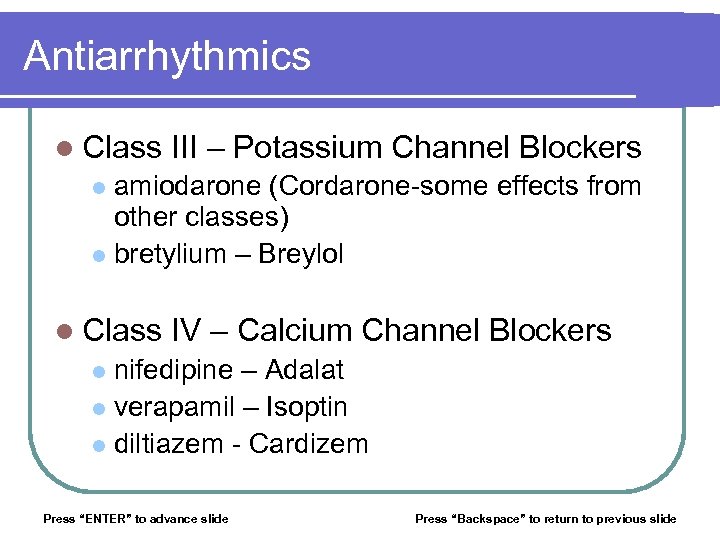
Antiarrhythmics l Class III – Potassium Channel Blockers amiodarone (Cordarone-some effects from other classes) l bretylium – Breylol l l Class IV – Calcium Channel Blockers nifedipine – Adalat l verapamil – Isoptin l diltiazem - Cardizem l Press “ENTER” to advance slide Press “Backspace” to return to previous slide
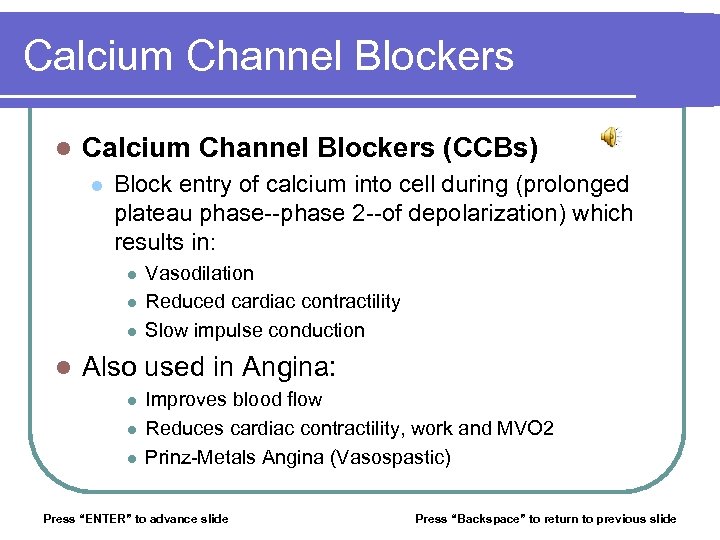
Calcium Channel Blockers l Calcium Channel Blockers (CCBs) l Block entry of calcium into cell during (prolonged plateau phase--phase 2 --of depolarization) which results in: l l Vasodilation Reduced cardiac contractility Slow impulse conduction Also used in Angina: l l l Improves blood flow Reduces cardiac contractility, work and MVO 2 Prinz-Metals Angina (Vasospastic) Press “ENTER” to advance slide Press “Backspace” to return to previous slide
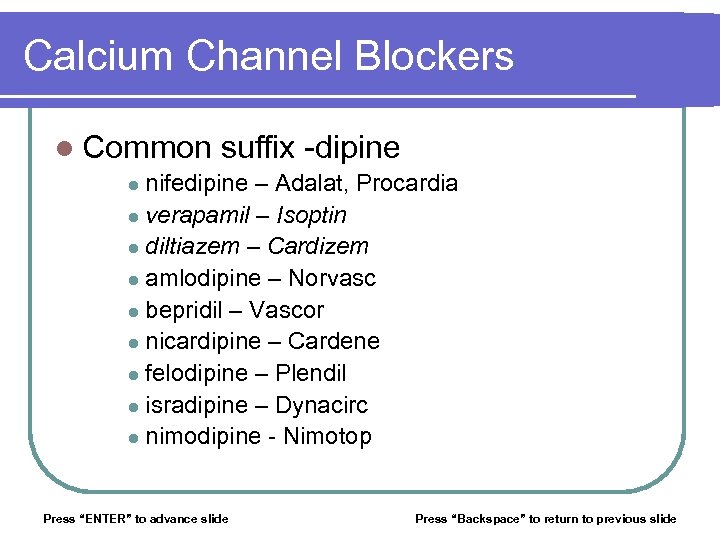
Calcium Channel Blockers l Common suffix -dipine nifedipine – Adalat, Procardia l verapamil – Isoptin l diltiazem – Cardizem l amlodipine – Norvasc l bepridil – Vascor l nicardipine – Cardene l felodipine – Plendil l isradipine – Dynacirc l nimodipine - Nimotop l Press “ENTER” to advance slide Press “Backspace” to return to previous slide
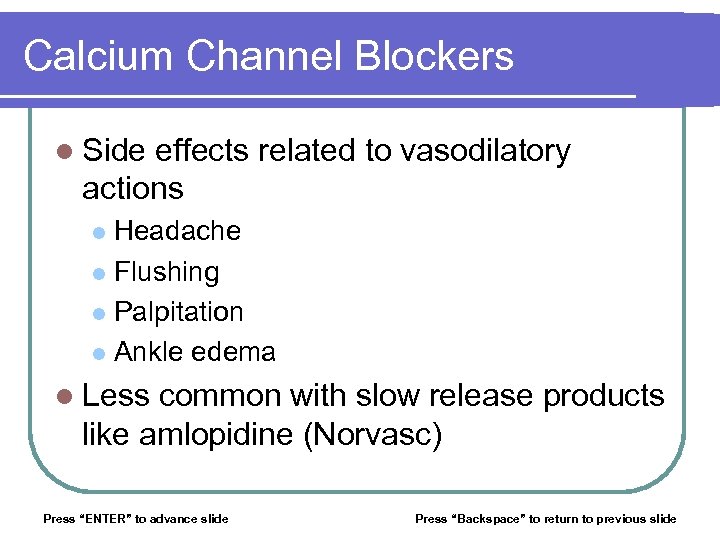
Calcium Channel Blockers l Side effects related to vasodilatory actions Headache l Flushing l Palpitation l Ankle edema l l Less common with slow release products like amlopidine (Norvasc) Press “ENTER” to advance slide Press “Backspace” to return to previous slide
CCB Overdose l CCBs have replaced TCAs as one of most common potentially lethal prescription drug overdoses l The most commonly prescribed cardiovascular drugs in the United States l Designated by poison control centres as a member of the ‘one pill can kill’ club, especially for peds. Press “ENTER” to advance slide Press “Backspace” to return to previous slide
CCB Overdose l Treatment plan includes airway management and fluid replacement, control arrhythmias and BP (dopamine? ). l Patient requires calcium supplementation, high dose glucagon l Possible high-dose insulin, pacemaker placement, aortic balloon pump Press “ENTER” to advance slide Press “Backspace” to return to previous slide
Cardiac Glycosides l digoxin (Lanoxin) l digitalis Inhibits Na+, K+-ATPase. Increase inward current of Ca++ Positive Inotrope (contractility) l Negative Chronotrope (rate) l Negative Dromotrope (speed of conduction) l l Controls ventricular response rate in Afib and A-flutter Press “ENTER” to advance slide Press “Backspace” to return to previous slide
Digoxin Special note: also strengthens cardiac contraction; sometimes used for CHF, in combination with diuretics, especially furosemide and potassium, e. g. , Slow-K. * l Toxicity and accidental overdose happen fairly often. Becomes toxic easily if potassium is low. l Signs of toxicity include bradycardia, confusion, fatigue, abdominal pain, and visual disturbances (halos around lights, yellowed colour vision). Also vertigo and anorexia possible. l Press “ENTER” to advance slide Press “Backspace” to return to previous slide

Press “ENTER” to advance slide Press “Backspace” to return to previous slide
Digoxin l ‘dig toxicity’ also look for: l Rhythm disturbances (2 nd degree Type IWenckeback, PVCs, PAT, MAT with block, atrial or junctional bradycardias with AV dissociation—Atropine! l ‘digitalis effect’--Characteristic ‘slurring’ of s-t segment on 12 -lead normal for digoxin use. Press “ENTER” to advance slide Press “Backspace” to return to previous slide
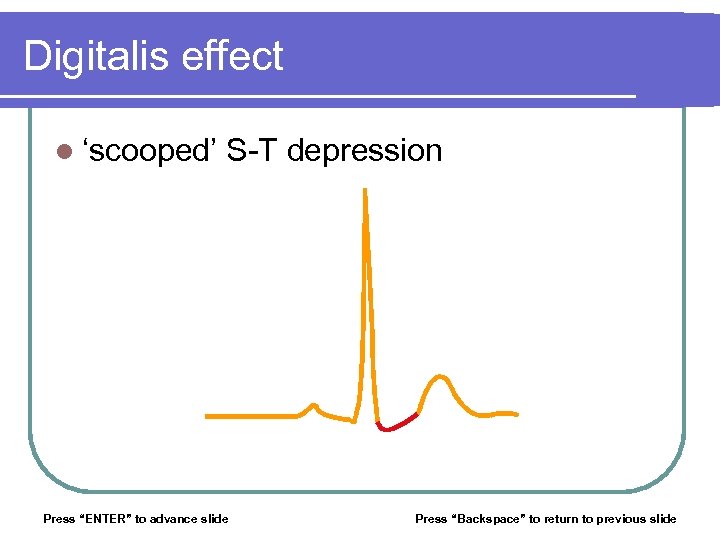
Digitalis effect l ‘scooped’ S-T depression Press “ENTER” to advance slide Press “Backspace” to return to previous slide
Drugs used to treat Hypertension l Diuretics l Beta Blockers l ACE Inhibitors l Angiotensin Receptor Blockers l Calcium Channel Blockers l Aldosterone Antagonists l Alpha-1 Antagonists (covered in ANS drugs) Press “ENTER” to advance slide Press “Backspace” to return to previous slide
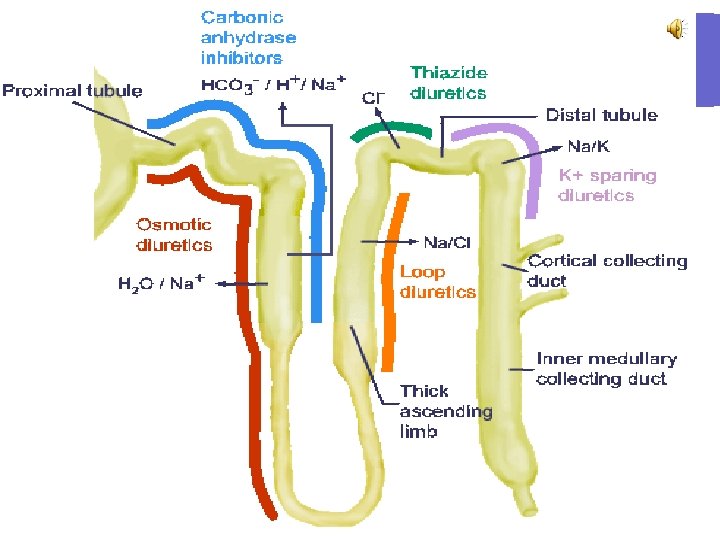
Diuretics l Thiazides l Potassium Sparing l Loop Diuretics Press “ENTER” to advance slide Press “Backspace” to return to previous slide
Thiazide Diuretics l inhibit Na+ and Cl- transport in the cortical thick ascending limb and early distal tubule. l They have a milder diuretic action than do the loop diuretics because this nephron site reabsorbs less Na+ than the thick ascending limb--appropriate for long-term use Press “ENTER” to advance slide Press “Backspace” to return to previous slide
Thiazide Diuretics hydrochlorothiazide (Novo-Hydrazide, Apo. Hydro, Diuchlor H, Hydro. DIURIL, Neo. Codema, Urozide) l methyclothiazide (Duretic), l chlorthalidone (Hygroton, Uridon, Novo. Thalidone, Apo-Chlorthalidone) l bendroflumethiazide (Naturetin) l metolazone (Zaroxolyn) l Press “ENTER” to advance slide Press “Backspace” to return to previous slide
Potassium-Sparing Diuretics l spironolactone (Novospiroton, Aldactone) is a competitive antagonist of aldosterone l triamtrene, amiloride affect absorption of Na+ in nephron where it has less influence on K+ transport (late distal tubule) Press “ENTER” to advance slide Press “Backspace” to return to previous slide
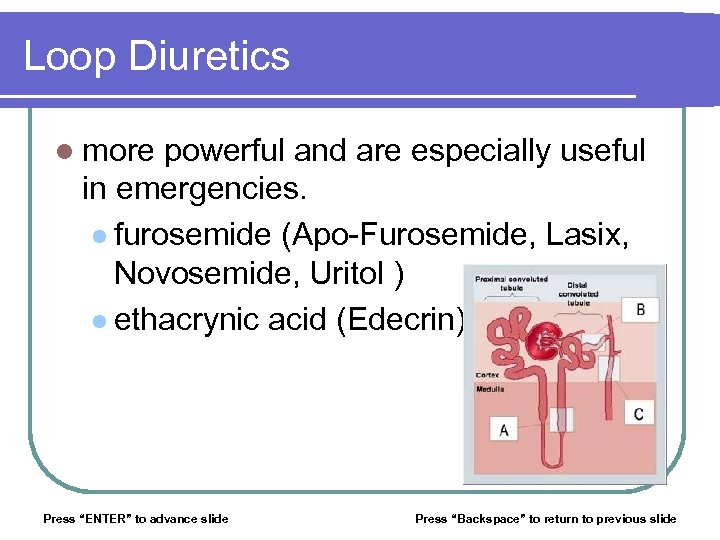
Loop Diuretics l more powerful and are especially useful in emergencies. l furosemide (Apo-Furosemide, Lasix, Novosemide, Uritol ) l ethacrynic acid (Edecrin) Press “ENTER” to advance slide Press “Backspace” to return to previous slide
Press “ENTER” to advance slide Press “Backspace” to return to previous slide
Beta Blockers l Used with caution in presence of CHF— can exacerbate CHF. l Discussed under ‘Antiarrhythmics’ Press “ENTER” to advance slide Press “Backspace” to return to previous slide
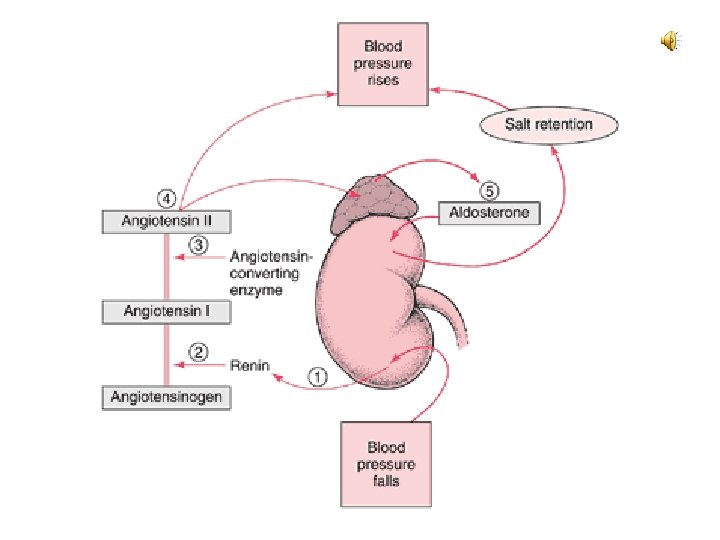
ACE Inhibitors l Angiontensin-Converting Enzyme Inhibitors l Inhibit conversion of Angiotensin I to Angtiotensin II (= vasodilation) l Used for Tx of Hypertension without altering myocardial function l Also used to treat CHF Press “ENTER” to advance slide Press “Backspace” to return to previous slide
ACE Inhibitors (cont’d) l Often indicated with suffix –pril captopril (Capoten) l enalapril (Vasotec) l fosinopril (Monopril) l lisinopril (Zestril) l ramipril (Altace) l quinapril (Accupril) l moexipril (Unipril) l Press “ENTER” to advance slide Press “Backspace” to return to previous slide
Press “ENTER” to advance slide Press “Backspace” to return to previous slide
Press “ENTER” to advance slide Press “Backspace” to return to previous slide
Common Side Effects l May cause BP to be too low = fatigue, syncope l Inhibits compensatory response = very sensitive to fluid drops l Overdose-hypotension, especially if mixed with diuretic. Possible tachycardic response (compensating). Press “ENTER” to advance slide Press “Backspace” to return to previous slide
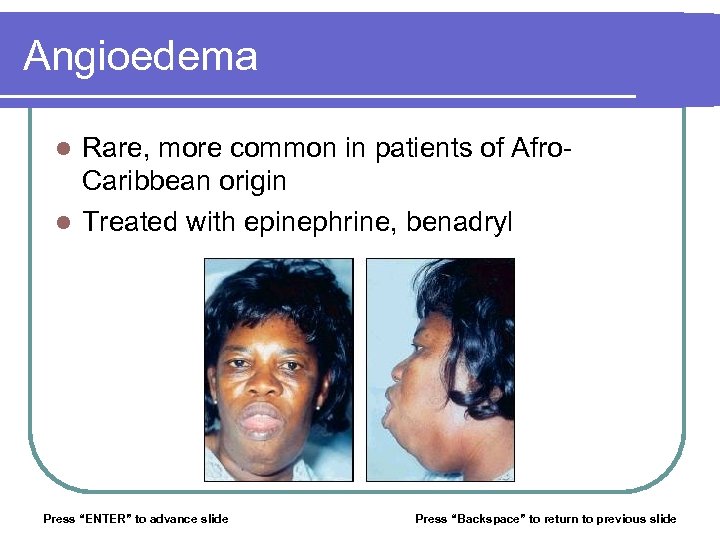
Angioedema Rare, more common in patients of Afro. Caribbean origin l Treated with epinephrine, benadryl l Press “ENTER” to advance slide Press “Backspace” to return to previous slide
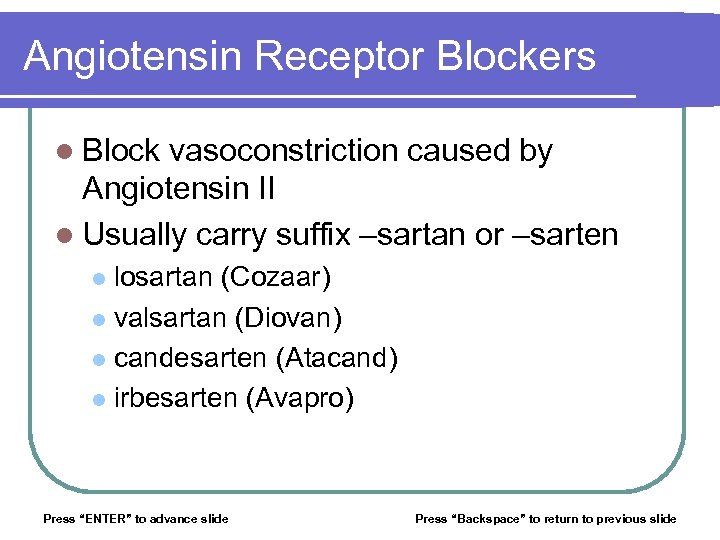
Angiotensin Receptor Blockers l Block vasoconstriction caused by Angiotensin II l Usually carry suffix –sartan or –sarten losartan (Cozaar) l valsartan (Diovan) l candesarten (Atacand) l irbesarten (Avapro) l Press “ENTER” to advance slide Press “Backspace” to return to previous slide
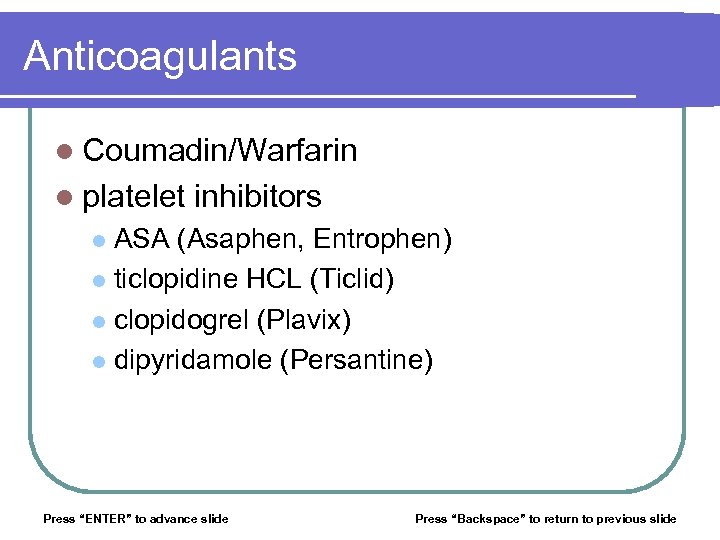
Anticoagulants l Coumadin/Warfarin l platelet inhibitors ASA (Asaphen, Entrophen) l ticlopidine HCL (Ticlid) l clopidogrel (Plavix) l dipyridamole (Persantine) l Press “ENTER” to advance slide Press “Backspace” to return to previous slide
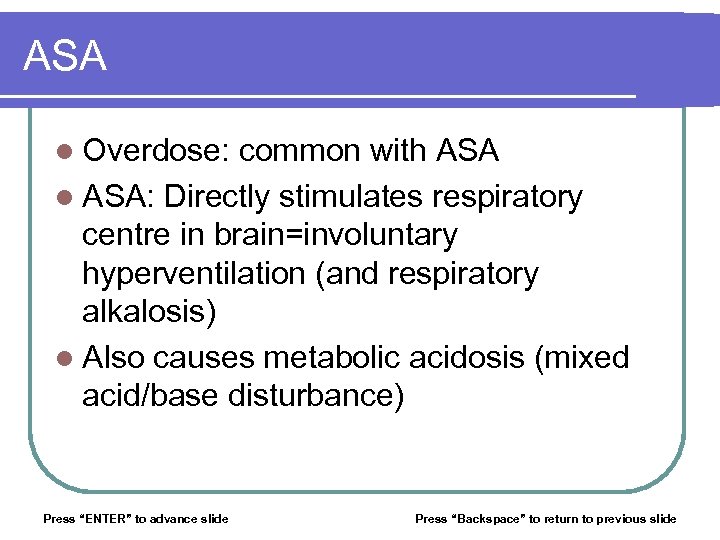
ASA l Overdose: common with ASA l ASA: Directly stimulates respiratory centre in brain=involuntary hyperventilation (and respiratory alkalosis) l Also causes metabolic acidosis (mixed acid/base disturbance) Press “ENTER” to advance slide Press “Backspace” to return to previous slide
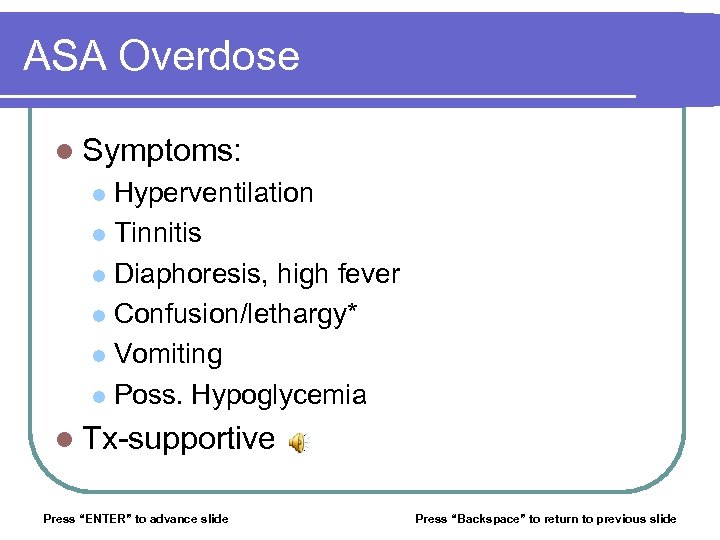
ASA Overdose l Symptoms: Hyperventilation l Tinnitis l Diaphoresis, high fever l Confusion/lethargy* l Vomiting l Poss. Hypoglycemia l l Tx-supportive Press “ENTER” to advance slide Press “Backspace” to return to previous slide
Hypoglycemic agents Press “ENTER” to advance slide Press “Backspace” to return to previous slide
metformin (Glucophage) l Only drug of its type l Causes less glucose to be released from storage in liver l Does not increase insulin secretion, so risk of hypoglycemia less than glyburide Press “ENTER” to advance slide Press “Backspace” to return to previous slide
Carbohydrate Absorption Inhibitor l acarbose (Prandase) l Interferes with carbohydrate absorption from the GI tract—blood glucose levels do not rise as quickly l Does not cause hypoglycemia—does not increase insulin levels or sensitivity l Reduces effectiveness of oral glucose l Acts synergistically with insulin and ADB Press “ENTER” to advance slide Press “Backspace” to return to previous slide
Oral Hypoglycemics l All oral hypoglycemics have long half-life —effect is maintained for days l Pt. who takes OD or who becomes symptomatically hypoglycemic needs to be transported/monitored closely Press “ENTER” to advance slide Press “Backspace” to return to previous slide
Acetaminophen (Tylenol) l Non-Narcotic Analgesic, Antipyretic l Preferred fever med. for pediatrics l Midol, also combined with narcotic analgesics in Darvocet, Hydrocet, Oxycocet and Percocet l Common source of overdose—readily accesible and common in ”pseudosuicides” (where pt. perceives drug as relatively safe) Press “ENTER” to advance slide Press “Backspace” to return to previous slide
acetaminophen Overdose Pt. asymptomatic; by the time symptoms appear, irreversible liver damage has occurred. l NO CNS depressant properties; if pt. presents with altered LOC, look for other causes l Dose of 6 g (12 extra strength, 15 -18 reg. strength) considered serous in adult. For child, any dose over 150 mg/kg serious. l EMS treatment: supportive. ** l Press “ENTER” to advance slide Press “Backspace” to return to previous slide
Pharmacology Thank You! Press “ENTER” to advance slide Press “Backspace” to return to previous slide
Скачать презентацию HHSC Base Hospital Program EMS Pharmacology unit
870252af53acff220b55d5ac664cf1f7.ppt