 Скачать презентацию HF SYSTEM SIMULATION TECHNIQUES by Richard P Buckner
6423e0f21eaeea108f86985db3f71613.ppt
- Количество слайдов: 22



HF SYSTEM SIMULATION TECHNIQUES by Richard P. Buckner, P. E. HFSystem. Simulation 1. PPT 1 Copyright © 2003 by Richard P. Buckner, P. E.
BRIEFING CONTENT • WHY SIMULATION? • SYSTEM FACTORS. • SYSTEM PREDICTIONS. HFSystem. Simulation 1. PPT 2 Copyright © 2003 by Richard P. Buckner, P. E.
WHY SIMULATION? • TO UNDERSTAND PROPAGATION. Simulations are great teaching tools. • TO PREDICT THE FUTURE. Contesters can see when bands will open. • TO SAVE MONEY AND TIME. Try before Buy – simulate antennas/hardware. • BECAUSE IT’S FUN. You can work smarter in your favorite hobby. HFSystem. Simulation 1. PPT 3 Copyright © 2003 by Richard P. Buckner, P. E.
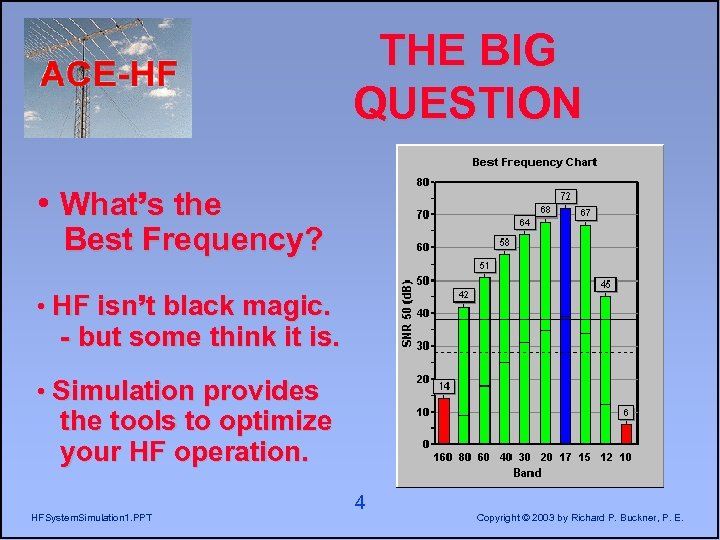
THE BIG QUESTION • What’s the Best Frequency? • HF isn’t black magic. - but some think it is. • Simulation provides the tools to optimize your HF operation. HFSystem. Simulation 1. PPT 4 Copyright © 2003 by Richard P. Buckner, P. E.
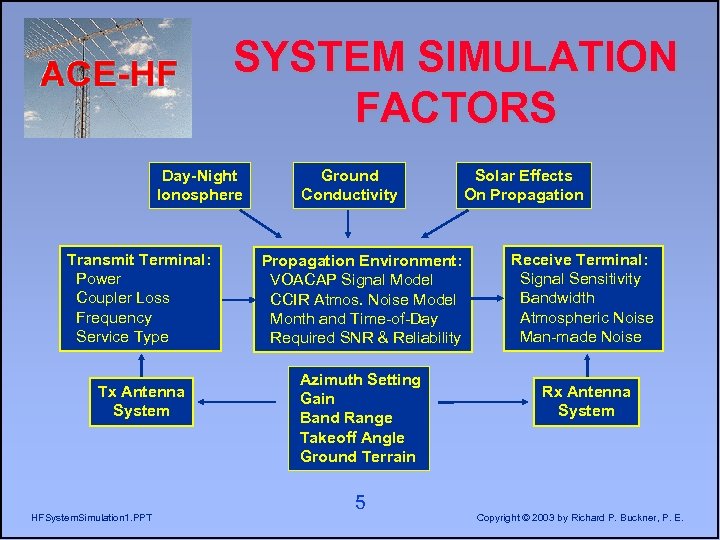
SYSTEM SIMULATION FACTORS Day-Night Ionosphere Transmit Terminal: Power Coupler Loss Frequency Service Type Tx Antenna System HFSystem. Simulation 1. PPT Ground Conductivity Propagation Environment: VOACAP Signal Model CCIR Atmos. Noise Model Month and Time-of-Day Required SNR & Reliability Azimuth Setting Gain Band Range Takeoff Angle Ground Terrain 5 Solar Effects On Propagation Receive Terminal: Signal Sensitivity Bandwidth Atmospheric Noise Man-made Noise Rx Antenna System Copyright © 2003 by Richard P. Buckner, P. E.
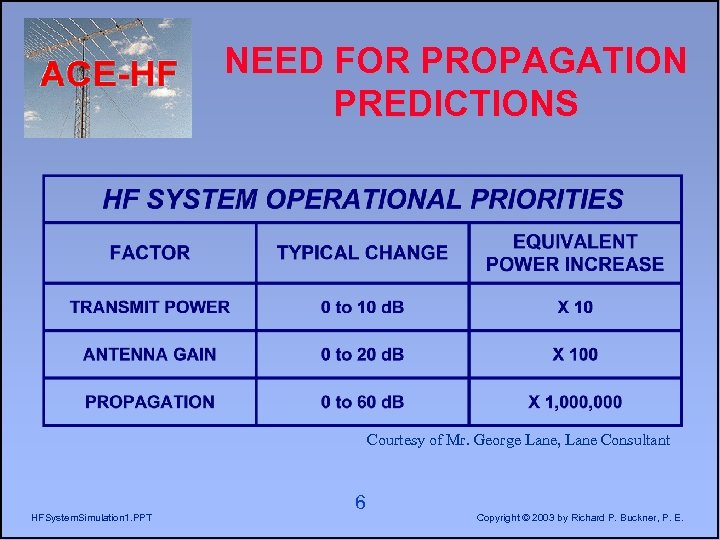
NEED FOR PROPAGATION PREDICTIONS Courtesy of Mr. George Lane, Lane Consultant HFSystem. Simulation 1. PPT 6 Copyright © 2003 by Richard P. Buckner, P. E.
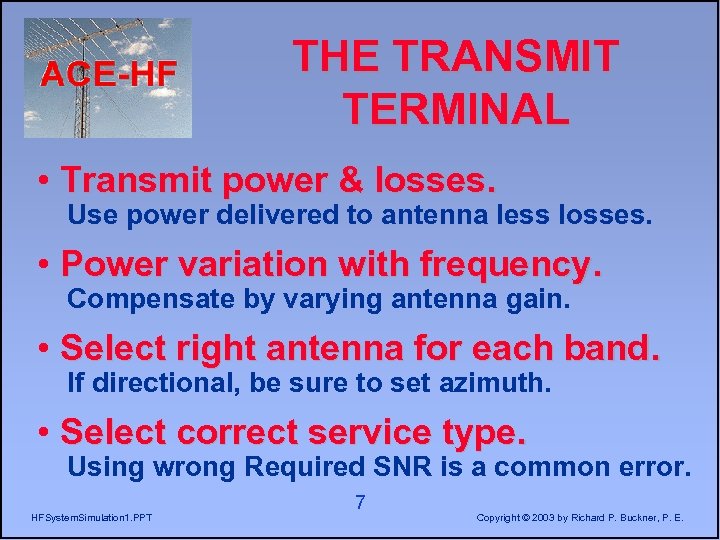
THE TRANSMIT TERMINAL • Transmit power & losses. Use power delivered to antenna less losses. • Power variation with frequency. Compensate by varying antenna gain. • Select right antenna for each band. If directional, be sure to set azimuth. • Select correct service type. Using wrong Required SNR is a common error. HFSystem. Simulation 1. PPT 7 Copyright © 2003 by Richard P. Buckner, P. E.
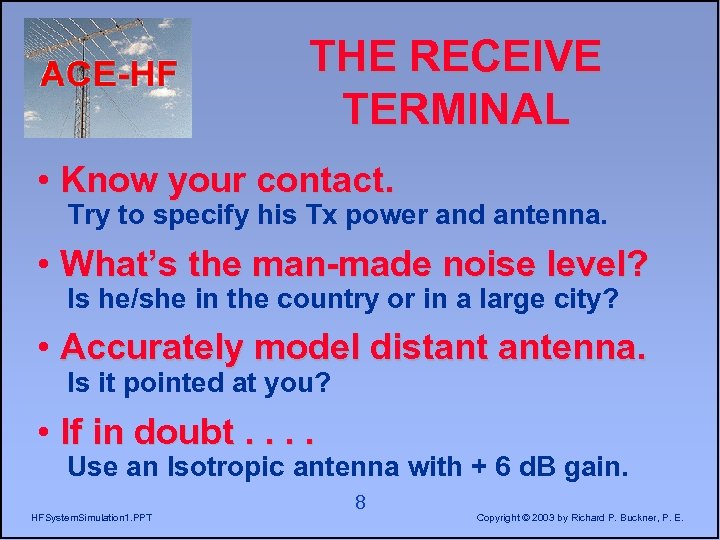
THE RECEIVE TERMINAL • Know your contact. Try to specify his Tx power and antenna. • What’s the man-made noise level? Is he/she in the country or in a large city? • Accurately model distant antenna. Is it pointed at you? • If in doubt. . Use an Isotropic antenna with + 6 d. B gain. HFSystem. Simulation 1. PPT 8 Copyright © 2003 by Richard P. Buckner, P. E.
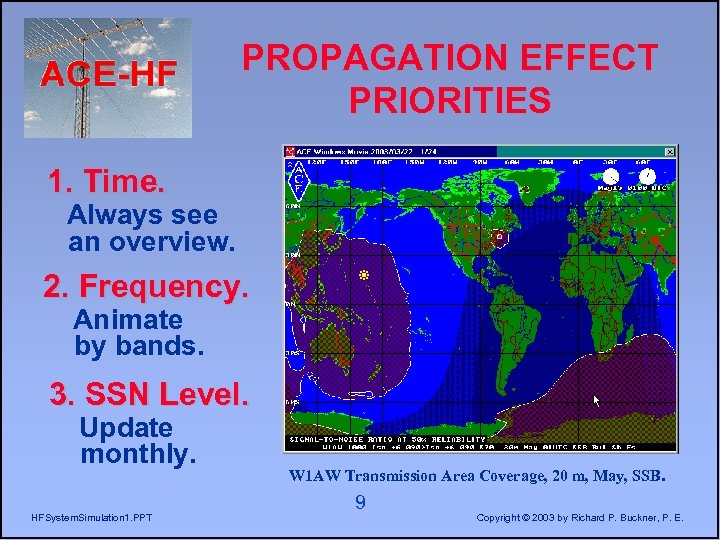
PROPAGATION EFFECT PRIORITIES 1. Time. Always see an overview. 2. Frequency. Animate by bands. 3. SSN Level. Update monthly. HFSystem. Simulation 1. PPT W 1 AW Transmission Area Coverage, 20 m, May, SSB. 9 Copyright © 2003 by Richard P. Buckner, P. E.
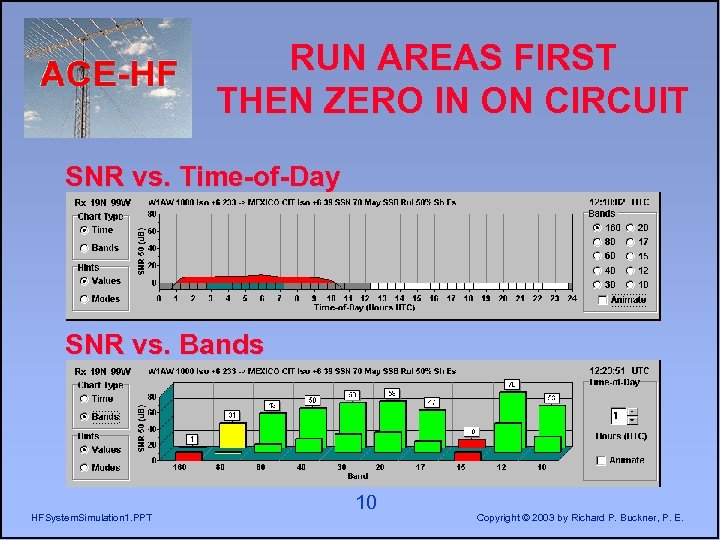
RUN AREAS FIRST THEN ZERO IN ON CIRCUIT SNR vs. Time-of-Day SNR vs. Bands HFSystem. Simulation 1. PPT 10 Copyright © 2003 by Richard P. Buckner, P. E.
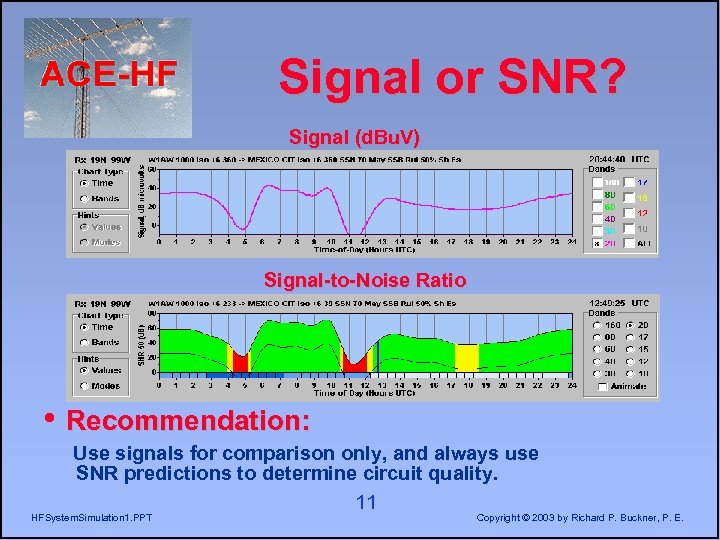
Signal or SNR? Signal (d. Bu. V) Signal-to-Noise Ratio • Recommendation: Use signals for comparison only, and always use SNR predictions to determine circuit quality. 11 HFSystem. Simulation 1. PPT Copyright © 2003 by Richard P. Buckner, P. E.
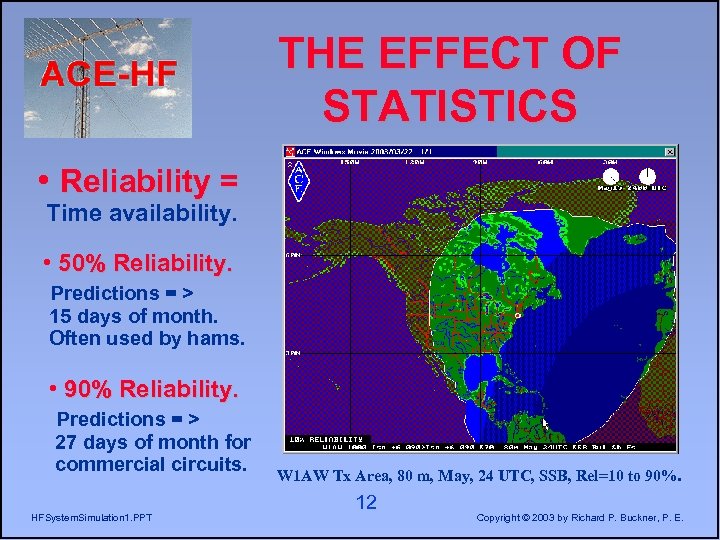
THE EFFECT OF STATISTICS • Reliability = Time availability. • 50% Reliability. Predictions = > 15 days of month. Often used by hams. • 90% Reliability. Predictions = > 27 days of month for commercial circuits. HFSystem. Simulation 1. PPT W 1 AW Tx Area, 80 m, May, 24 UTC, SSB, Rel=10 to 90%. 12 Copyright © 2003 by Richard P. Buckner, P. E.
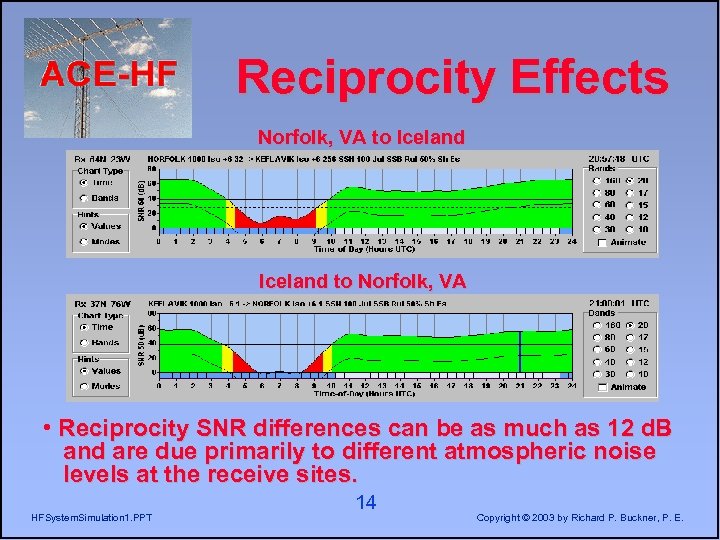
Reciprocity Effects Norfolk, VA to Iceland to Norfolk, VA • Reciprocity SNR differences can be as much as 12 d. B and are due primarily to different atmospheric noise levels at the receive sites. HFSystem. Simulation 1. PPT 14 Copyright © 2003 by Richard P. Buckner, P. E.
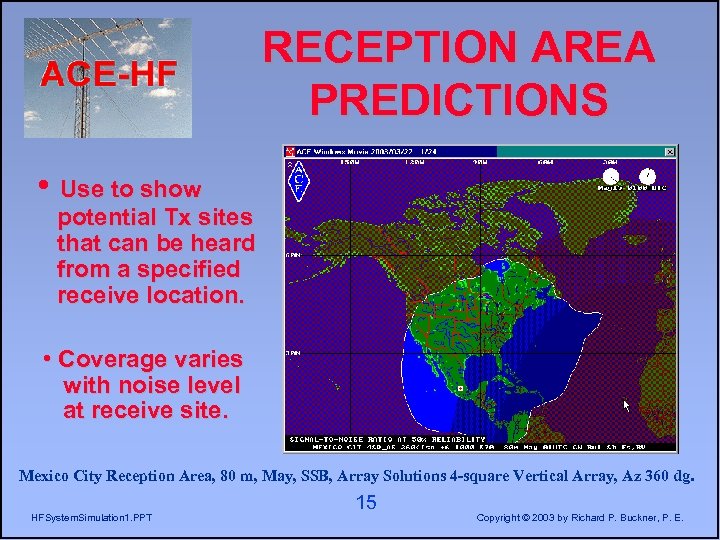
RECEPTION AREA PREDICTIONS • Use to show potential Tx sites that can be heard from a specified receive location. • Coverage varies with noise level at receive site. Mexico City Reception Area, 80 m, May, SSB, Array Solutions 4 -square Vertical Array, Az 360 dg. HFSystem. Simulation 1. PPT 15 Copyright © 2003 by Richard P. Buckner, P. E.
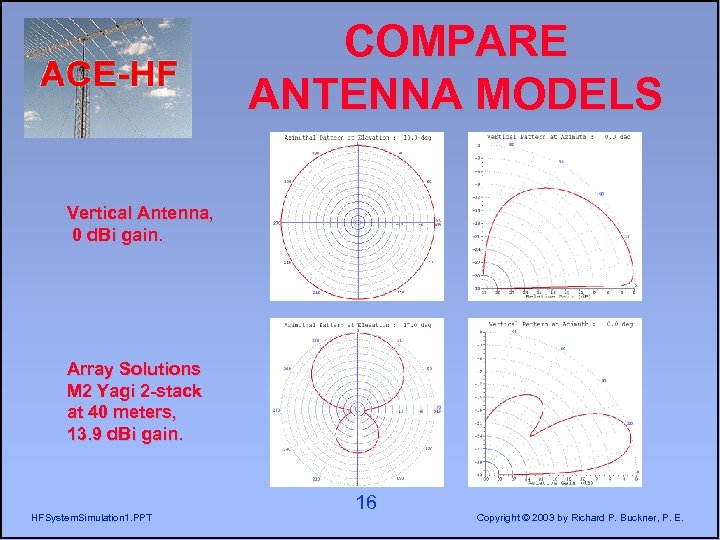
COMPARE ANTENNA MODELS Vertical Antenna, 0 d. Bi gain. Array Solutions M 2 Yagi 2 -stack at 40 meters, 13. 9 d. Bi gain. HFSystem. Simulation 1. PPT 16 Copyright © 2003 by Richard P. Buckner, P. E.
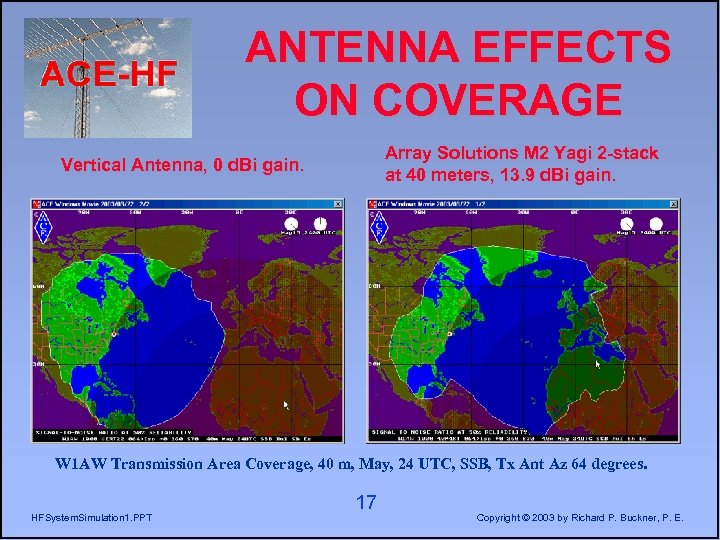
ANTENNA EFFECTS ON COVERAGE Array Solutions M 2 Yagi 2 -stack at 40 meters, 13. 9 d. Bi gain. Vertical Antenna, 0 d. Bi gain. W 1 AW Transmission Area Coverage, 40 m, May, 24 UTC, SSB, Tx Ant Az 64 degrees. HFSystem. Simulation 1. PPT 17 Copyright © 2003 by Richard P. Buckner, P. E.
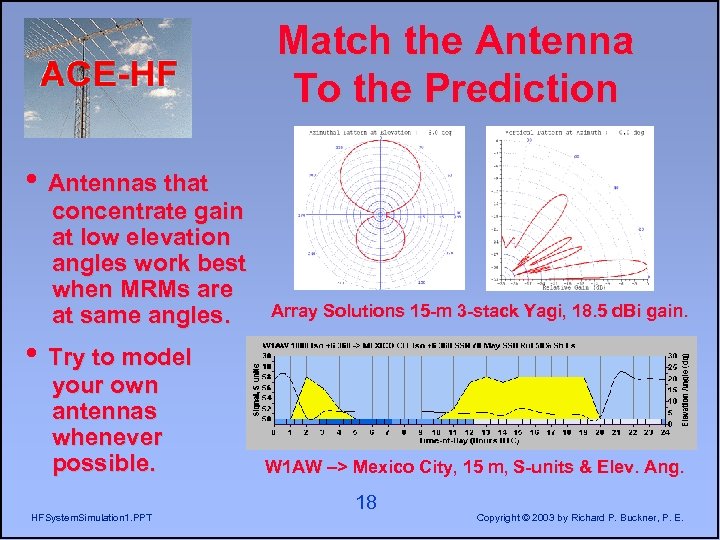
Match the Antenna To the Prediction • Antennas that concentrate gain at low elevation angles work best when MRMs are at same angles. Array Solutions 15 -m 3 -stack Yagi, 18. 5 d. Bi gain. • Try to model your own antennas whenever possible. HFSystem. Simulation 1. PPT W 1 AW –> Mexico City, 15 m, S-units & Elev. Ang. 18 Copyright © 2003 by Richard P. Buckner, P. E.
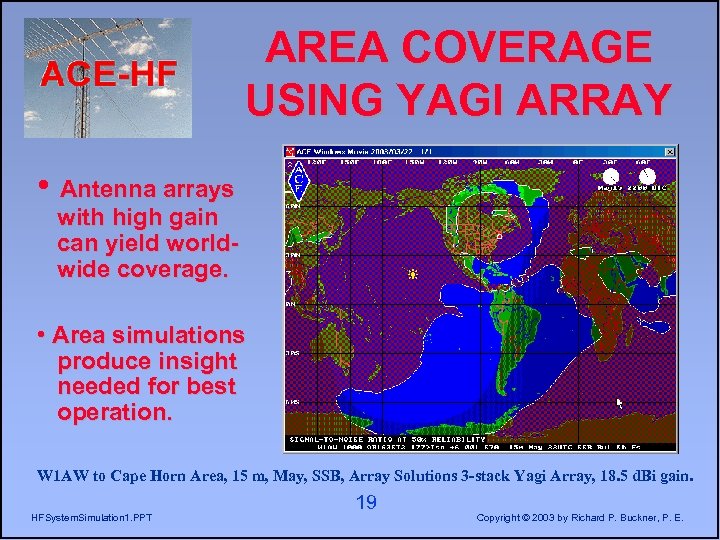
AREA COVERAGE USING YAGI ARRAY • Antenna arrays with high gain can yield worldwide coverage. • Area simulations produce insight needed for best operation. W 1 AW to Cape Horn Area, 15 m, May, SSB, Array Solutions 3 -stack Yagi Array, 18. 5 d. Bi gain. HFSystem. Simulation 1. PPT 19 Copyright © 2003 by Richard P. Buckner, P. E.
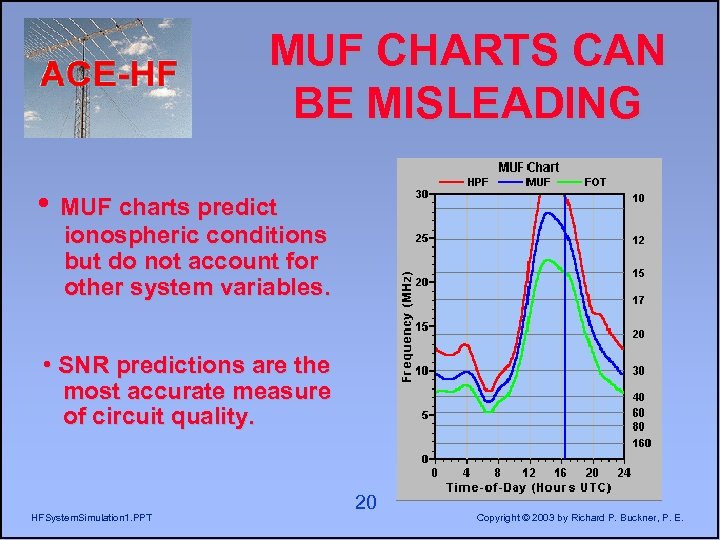
MUF CHARTS CAN BE MISLEADING • MUF charts predict ionospheric conditions but do not account for other system variables. • SNR predictions are the most accurate measure of circuit quality. HFSystem. Simulation 1. PPT 20 Copyright © 2003 by Richard P. Buckner, P. E.
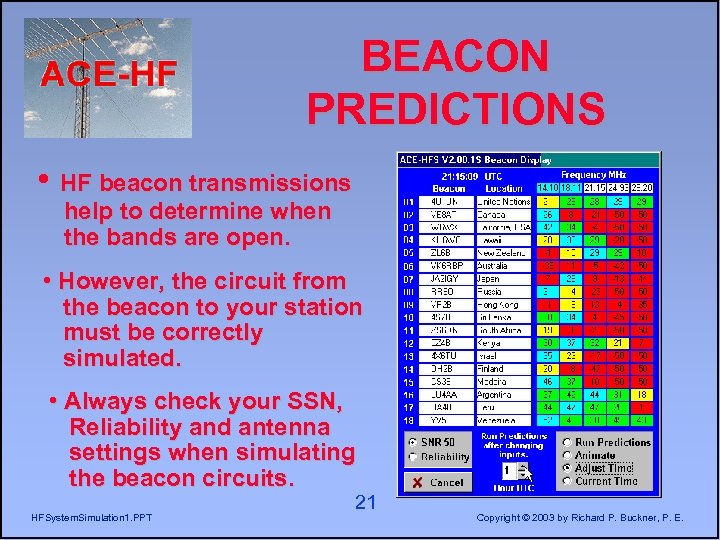
BEACON PREDICTIONS • HF beacon transmissions help to determine when the bands are open. • However, the circuit from the beacon to your station must be correctly simulated. • Always check your SSN, Reliability and antenna settings when simulating the beacon circuits. HFSystem. Simulation 1. PPT 21 Copyright © 2003 by Richard P. Buckner, P. E.
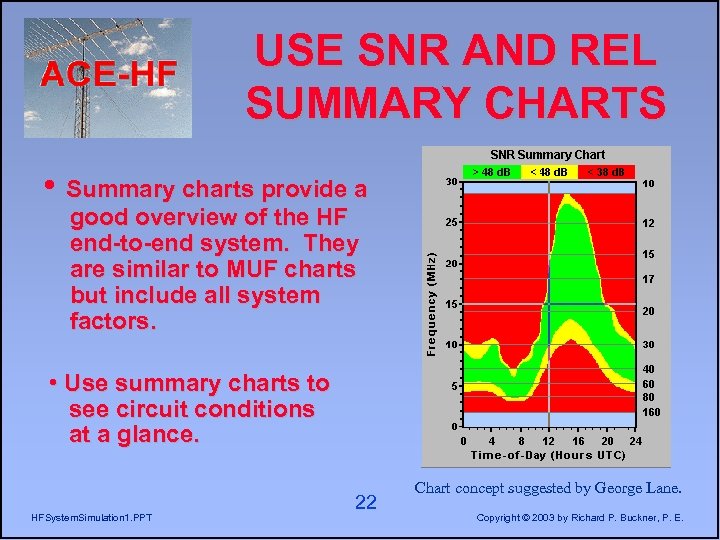
USE SNR AND REL SUMMARY CHARTS • Summary charts provide a good overview of the HF end-to-end system. They are similar to MUF charts but include all system factors. • Use summary charts to see circuit conditions at a glance. HFSystem. Simulation 1. PPT 22 Chart concept suggested by George Lane. Copyright © 2003 by Richard P. Buckner, P. E.
CONCLUSION THE SYSTEM IS THE SOLUTION™. ™Bell Telephone System Copies of this briefing may be downloaded from www. acehf. com. HFSystem. Simulation 1. PPT 23 Copyright © 2003 by Richard P. Buckner, P. E.
Скачать презентацию HF SYSTEM SIMULATION TECHNIQUES by Richard P Buckner
6423e0f21eaeea108f86985db3f71613.ppt