


 Скачать презентацию Heuristic Optimization Methods Genetic Algorithms Agenda
d112bc5dda5b0dd498e468e18a6bd31f.ppt
- Количество слайдов: 74
 Heuristic Optimization Methods Genetic Algorithms
 Agenda • Short overview of Local Search and Local Search-based Metaheuristics • Introduction to Genetic Algorithms 2
 Local Search (1) • Basic Idea: Improve the current solution • Start with some solution • Find a set of solutions (called neighbors) that are ”close” to the current solution • If one of these neighbors are better than the current solution, move to that solution • Repeat until no improvements can be made 3
 Local Search (2) • Variations – Best Improvement (always select the best neighbor) – First Improvement (select the first improving neighbor) – Random Descent (select neighbors at random) – Random Walk (move to neighbors at random) • Problem: Gets stuck in a local optimum – (except Random Walk, which isn’t a good method anyway) 4
 Local Search Based Metaheuristics (1) • Main goal – To avoid getting stuck in local optima • Additional goals – Explore a larger part of the search space – Attempt to find the global (not just a local) optimum – Give a reasonable alternative to exact methods (especially for large/hard problem instances, and where the solution time is important) 5
 Local Search Based Metaheuristics (2) • The different methods employ very different techniques in order to escape local optima – Simulated Annealing relies on controlled random movement – Tabu Search relies on memory structures, recording enough information to prevent looping between solutions 6
 Local Search Based Metaheuristics (3) • The different methods employ very different techniques in order explore a larger part of the search space – Simulated Annealing relies on controlled random movement – Tabu Search relies on memory structures, recording enough information to guide the search to different areas of the search space (e. g. , frequency based diversification) 7
 Local Search Based Metaheuristics (4) • Which method is better? • Depends on your needs – SA is easier to implement? – SA is easier to use/understand? – TS is more flexible and robust? – TS requires a better understanding of the problem? – TS requires more ”tuning”? – TS produces better overall results? 8
 Genetic Algorithms • We have now studied many Metaheuristics based on the idea of a Local Search • It is time to look at methods that are based on different mechanisms • The first such method will be the Genetic Algorithm 9
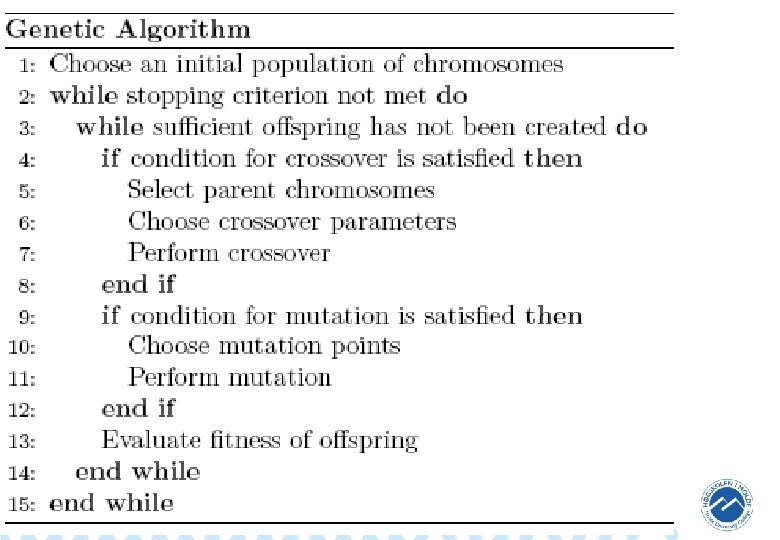
 The Genetic Algorithm • Directed search algorithms based on the mechanics of biological evolution • Developed by John Holland, University of Michigan (1970’s) – To understand the adaptive processes of natural systems – To design artificial systems software that retains the robustness of natural systems 10
 Genetic Algorithms • Provide efficient, effective techniques for optimization and machine learning applications • Widely-used today in business, scientific and engineering circles 11
 Genetic Algorithms (GA) • • Function Optimization AI (Games, Pattern recognition. . . ) OR after a while Basic idea: – intelligent exploration of the search space based on random search – analogies from biology 12
 GA - Analogies with biology • Representation of complex objects by a vector of simple components • Chromosomes • Selective breeding • Darwinistic evolution • Classical GA: Binary encoding 13
 Components of a GA A problem to solve, and. . . • Encoding technique (gene, chromosome) • Initialization procedure (creation) • Evaluation function (environment) • Selection of parents (reproduction) • Genetic operators (mutation, recombination) • Parameter settings (practice and art) 14
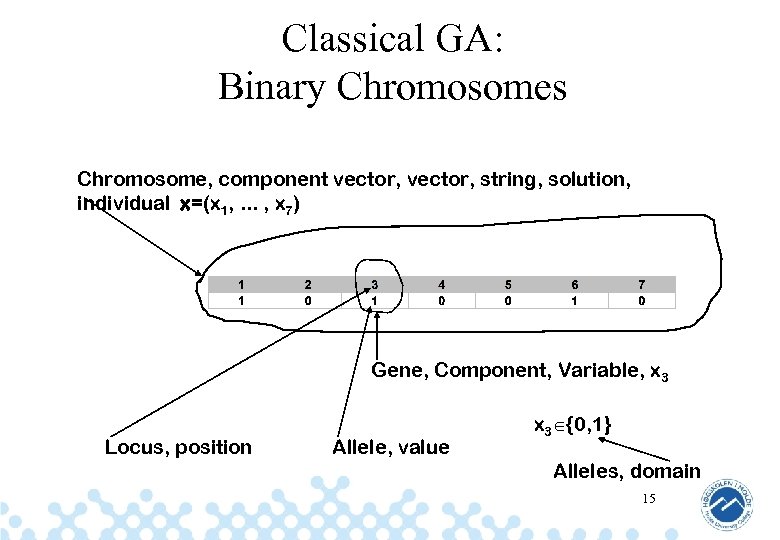 Classical GA: Binary Chromosomes Chromosome, component vector, string, solution, individual x=(x 1, . . . , x 7) Gene, Component, Variable, x 3 Locus, position Allele, value x 3 {0, 1} Alleles, domain 15
 Genotype, Phenotype, Population • Genotype – chromosome – Coding of chromosomes – coded string, set of coded strings • Phenotype – The physical expression – Properties of a set of solutions • Population – a set of solutions 16
 17
17
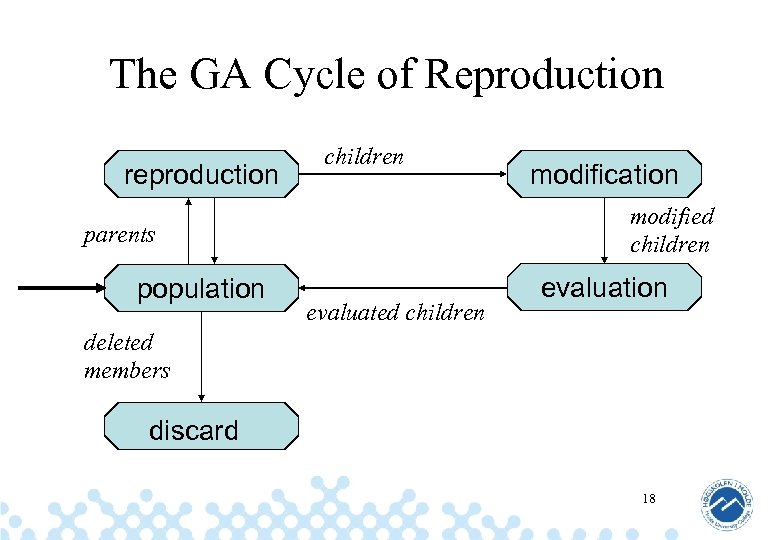 The GA Cycle of Reproduction reproduction children modified children parents population modification evaluated children evaluation deleted members discard 18
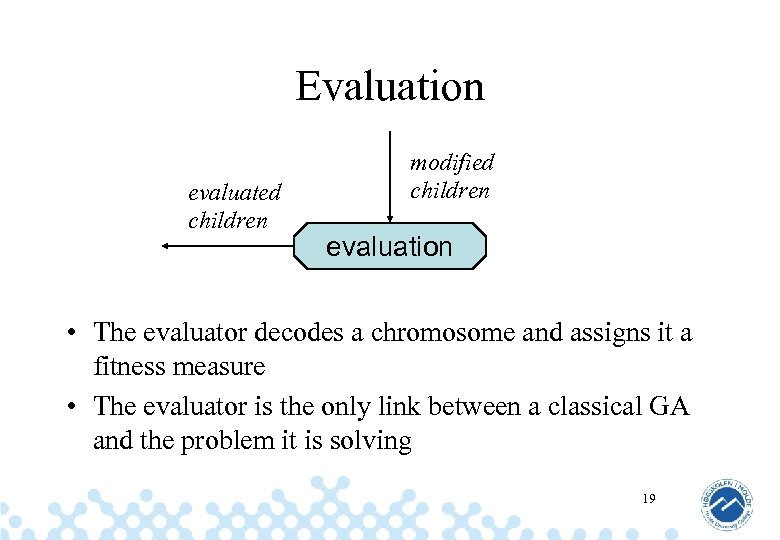 Evaluation evaluated children modified children evaluation • The evaluator decodes a chromosome and assigns it a fitness measure • The evaluator is the only link between a classical GA and the problem it is solving 19
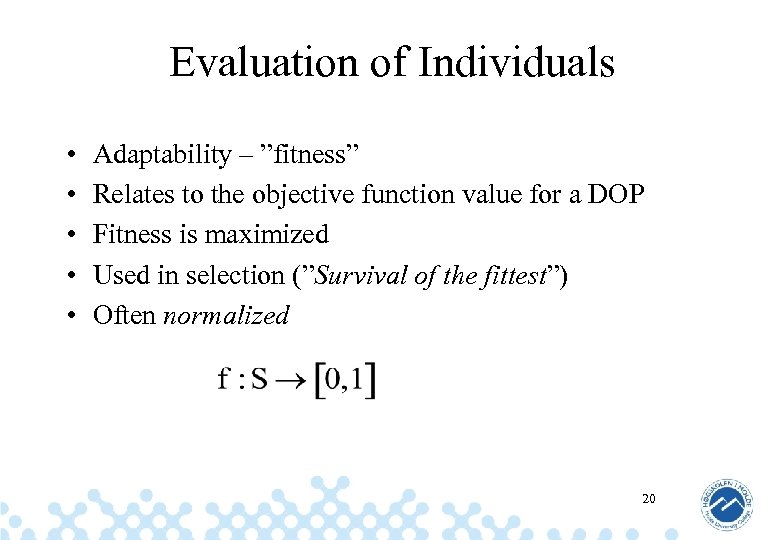 Evaluation of Individuals • • • Adaptability – ”fitness” Relates to the objective function value for a DOP Fitness is maximized Used in selection (”Survival of the fittest”) Often normalized 20
 Genetic Operators • Manipulates chromosomes/solutions • Mutation: Unary operator – Inversions • Crossover: Binary operator 21
 GA - Evolution • N generations of populations • For every step in the evolution – Selection of individuals for genetic operations – Creation of new individuals (reproduction) – Mutation – Selection of individuals to survive • Fixed population size M 22
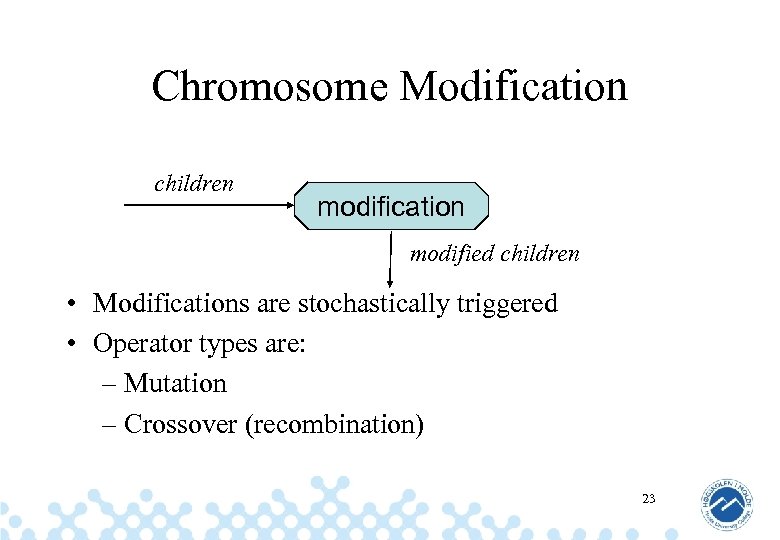 Chromosome Modification children modification modified children • Modifications are stochastically triggered • Operator types are: – Mutation – Crossover (recombination) 23
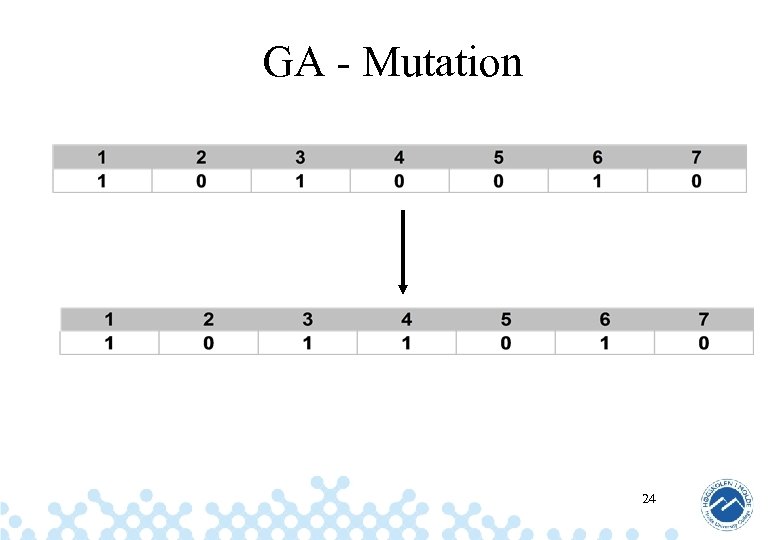 GA - Mutation 24
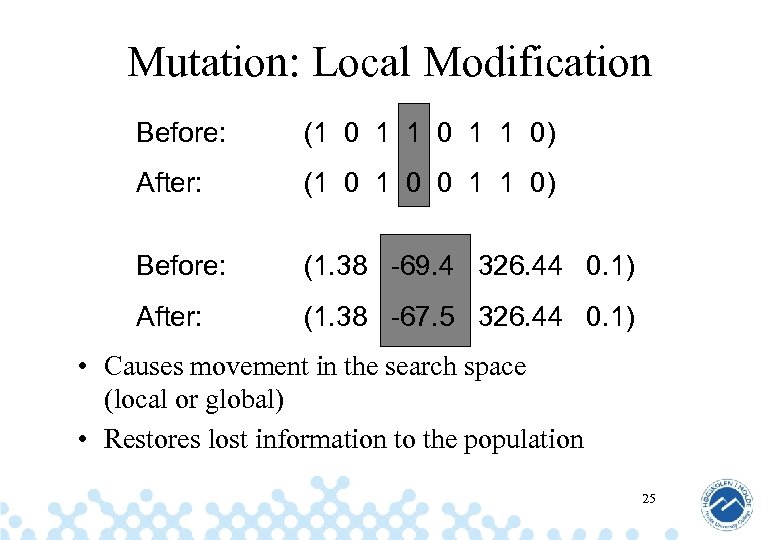 Mutation: Local Modification Before: (1 0 1 1 0) After: (1 0 0 1 1 0) Before: (1. 38 -69. 4 326. 44 0. 1) After: (1. 38 -67. 5 326. 44 0. 1) • Causes movement in the search space (local or global) • Restores lost information to the population 25
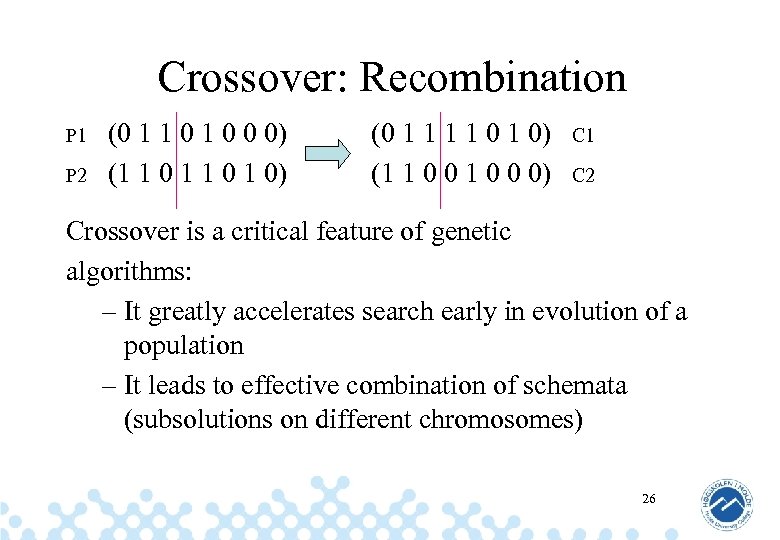 Crossover: Recombination P 1 P 2 (0 1 1 0 0 0) (1 1 0 1 0) (0 1 1 0 1 0) (1 1 0 0 0) C 1 C 2 Crossover is a critical feature of genetic algorithms: – It greatly accelerates search early in evolution of a population – It leads to effective combination of schemata (subsolutions on different chromosomes) 26
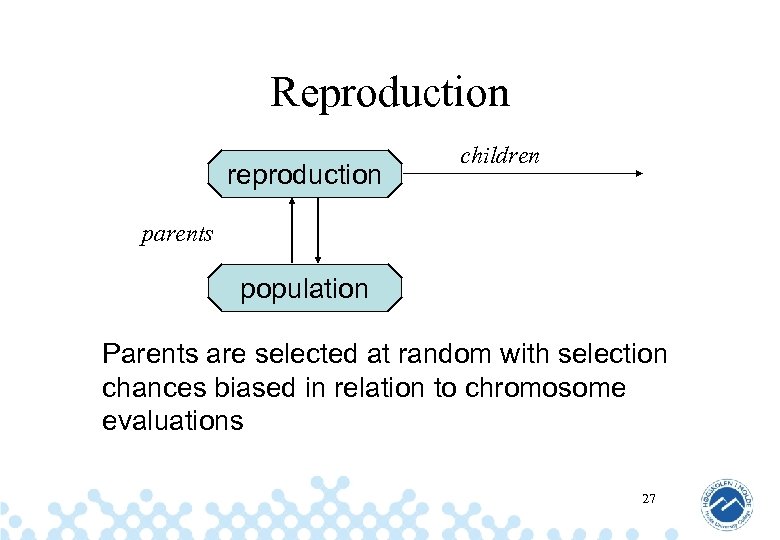 Reproduction reproduction children parents population Parents are selected at random with selection chances biased in relation to chromosome evaluations 27
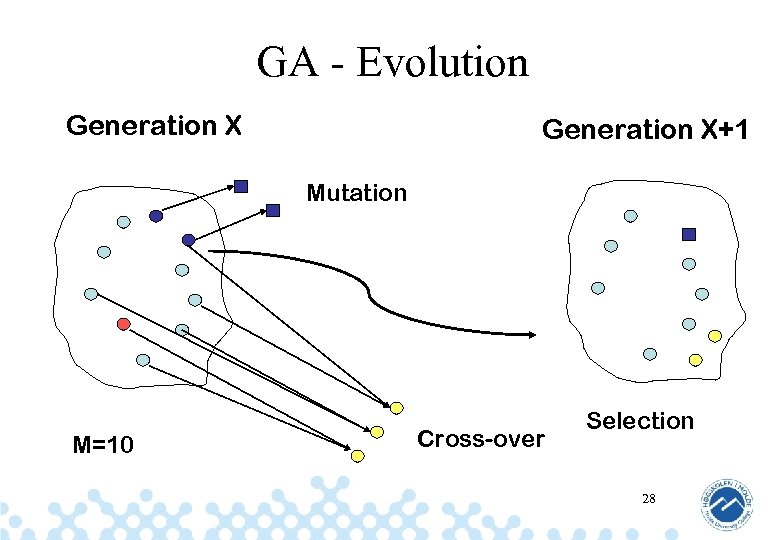 GA - Evolution Generation X+1 Mutation M=10 Cross-over Selection 28
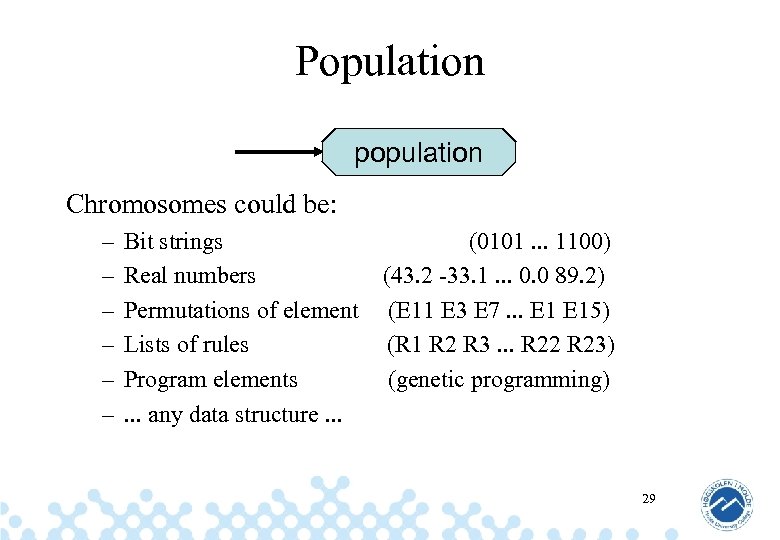 Population population Chromosomes could be: – – – Bit strings Real numbers Permutations of element Lists of rules Program elements. . . any data structure. . . (0101. . . 1100) (43. 2 -33. 1. . . 0. 0 89. 2) (E 11 E 3 E 7. . . E 15) (R 1 R 2 R 3. . . R 22 R 23) (genetic programming) 29
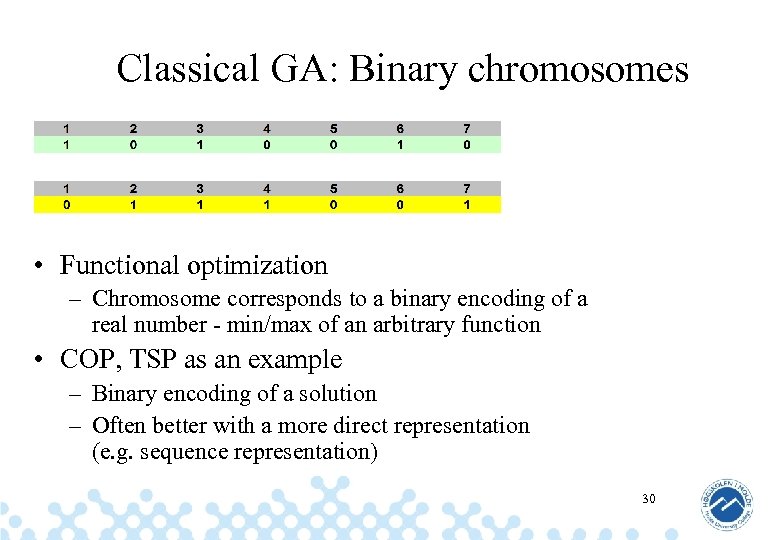 Classical GA: Binary chromosomes • Functional optimization – Chromosome corresponds to a binary encoding of a real number - min/max of an arbitrary function • COP, TSP as an example – Binary encoding of a solution – Often better with a more direct representation (e. g. sequence representation) 30
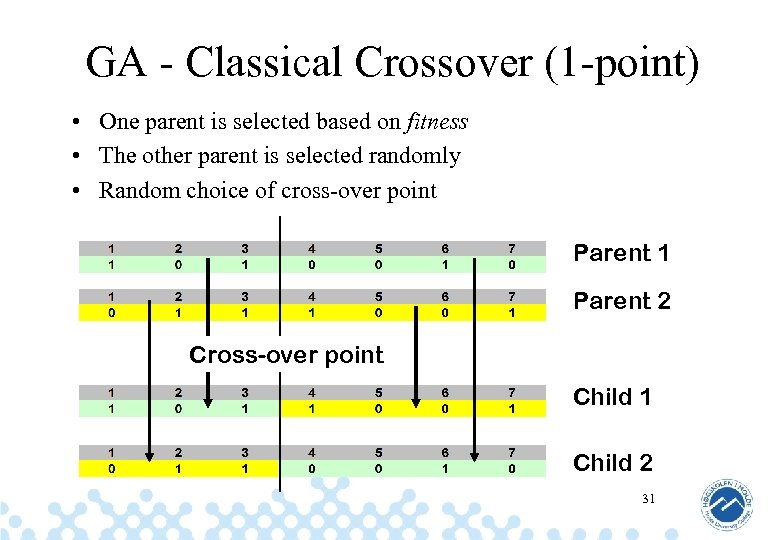 GA - Classical Crossover (1 -point) • One parent is selected based on fitness • The other parent is selected randomly • Random choice of cross-over point Parent 1 Parent 2 Cross-over point Child 1 Child 2 31
 GA – Classical Crossover • Arbitrary (or worst) individual in the population is changed with one of the two offspring (e. g. the best) • Reproduce as long as you want • Can be regarded as a sequence of almost equal populations • Alternatively: – One parent selected according to fitness – Crossover until (at least) M offspring are created – The new population consists of the offspring • Lots of other possibilities. . . • Basic GA with classical crossover and mutation often works well 32
 GA – Standard Reproduction Plan • Fixed population size • Standard cross-over – – One parent selected according to fitness The other selected randomly Random cross-over point A random individual is exchanged with one of the offspring • Mutation – A certain probability that an individual mutate – Random choice of which gene to mutate – Standard: mutation of offspring 33
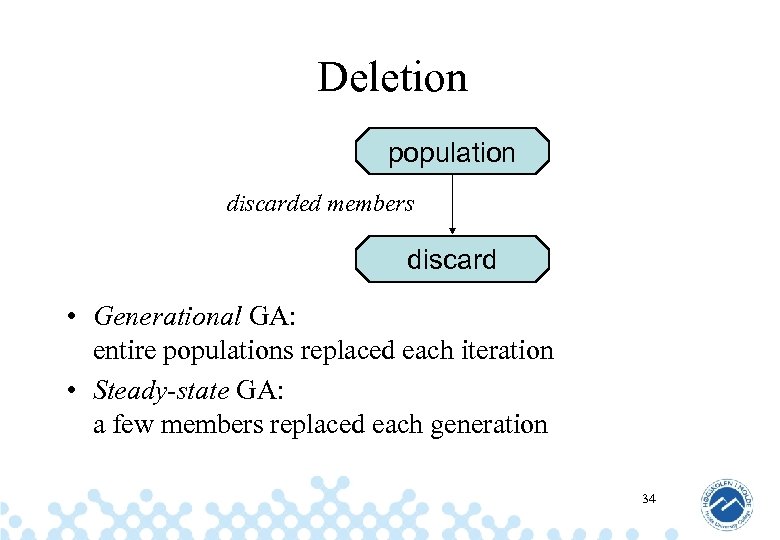 Deletion population discarded members discard • Generational GA: entire populations replaced each iteration • Steady-state GA: a few members replaced each generation 34
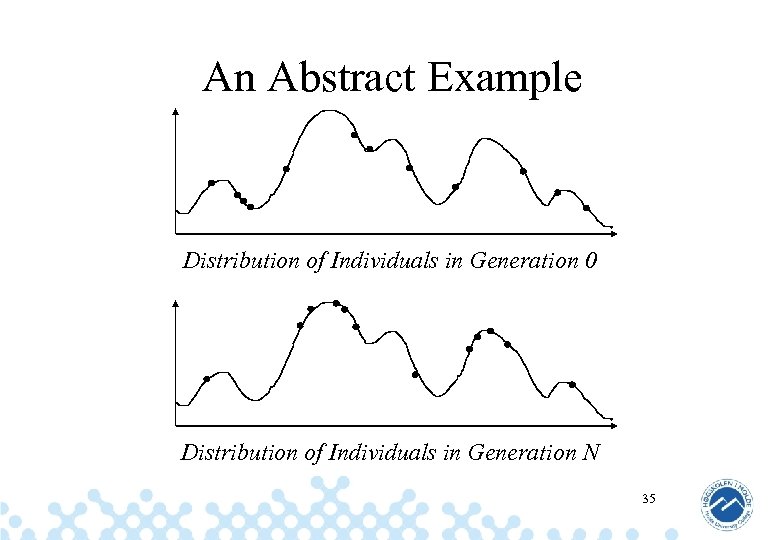 An Abstract Example Distribution of Individuals in Generation 0 Distribution of Individuals in Generation N 35
 A Simple Example The Traveling Salesman Problem: Find a tour of a given set of cities so that – each city is visited only once – the total distance traveled is minimized 36
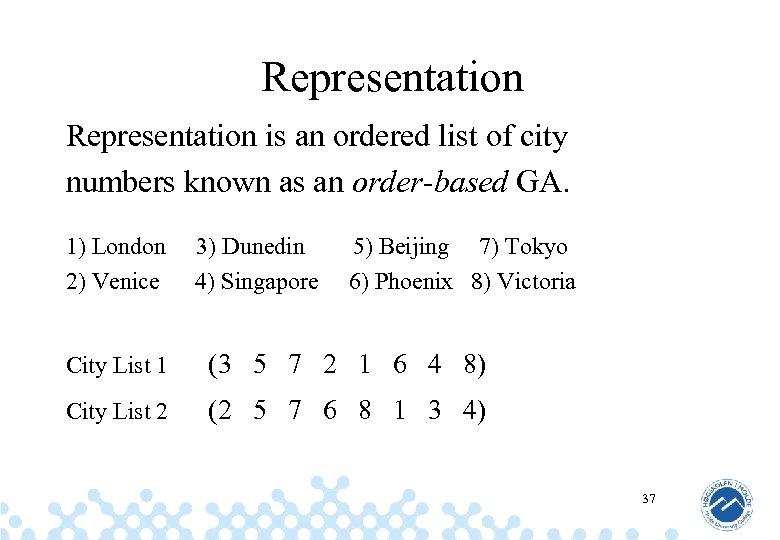 Representation is an ordered list of city numbers known as an order-based GA. 1) London 2) Venice 3) Dunedin 4) Singapore 5) Beijing 7) Tokyo 6) Phoenix 8) Victoria City List 1 (3 5 7 2 1 6 4 8) City List 2 (2 5 7 6 8 1 3 4) 37
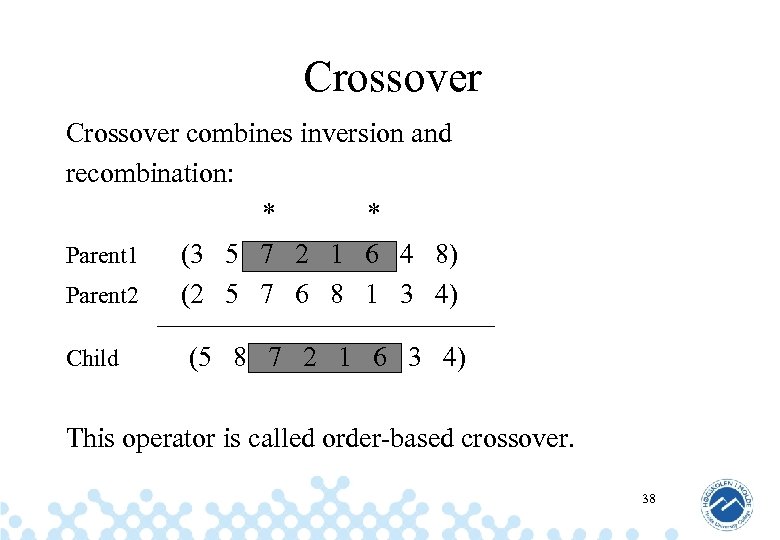 Crossover combines inversion and recombination: * * Parent 1 (3 5 7 2 1 6 4 8) Parent 2 (2 5 7 6 8 1 3 4) Child (5 8 7 2 1 6 3 4) This operator is called order-based crossover. 38
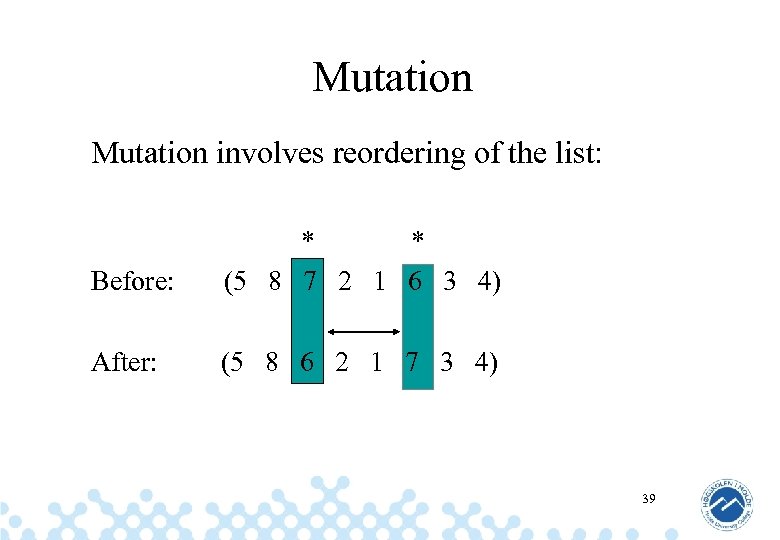 Mutation involves reordering of the list: Before: * * (5 8 7 2 1 6 3 4) After: (5 8 6 2 1 7 3 4) 39
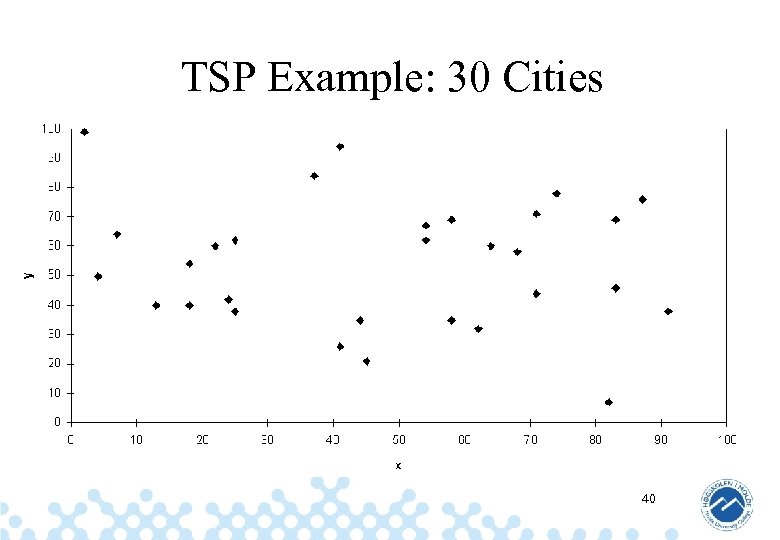 TSP Example: 30 Cities 40
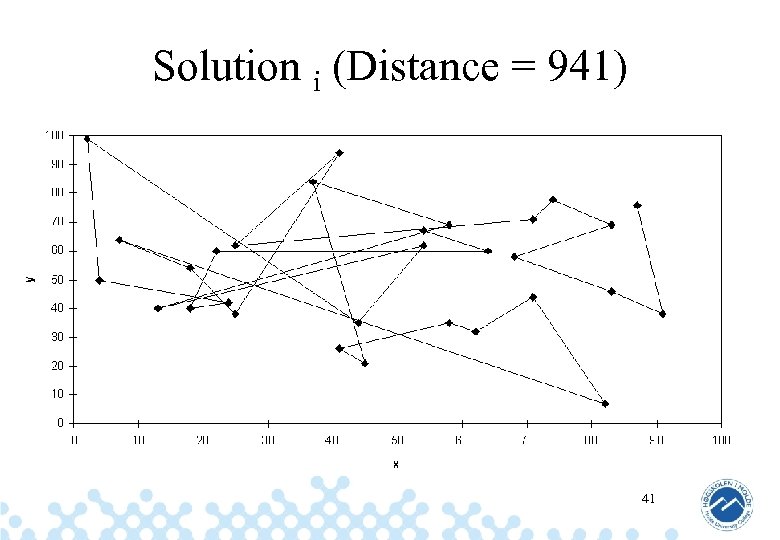 Solution i (Distance = 941) 41
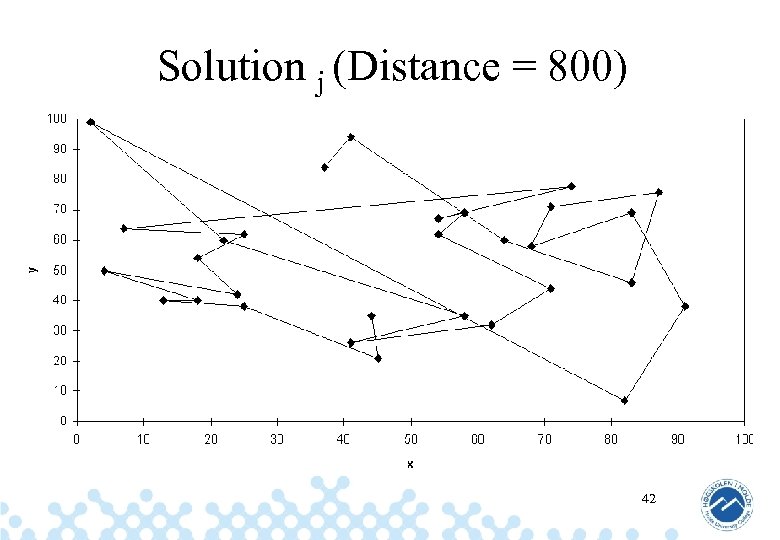 Solution j (Distance = 800) 42
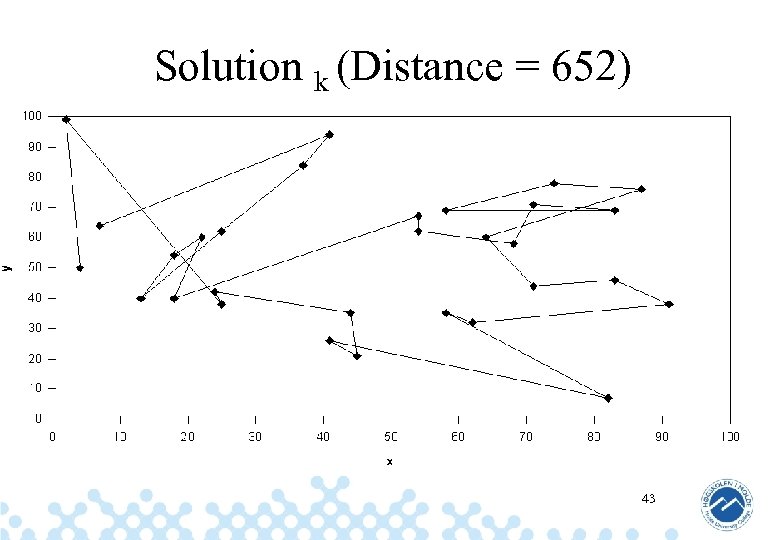 Solution k (Distance = 652) 43
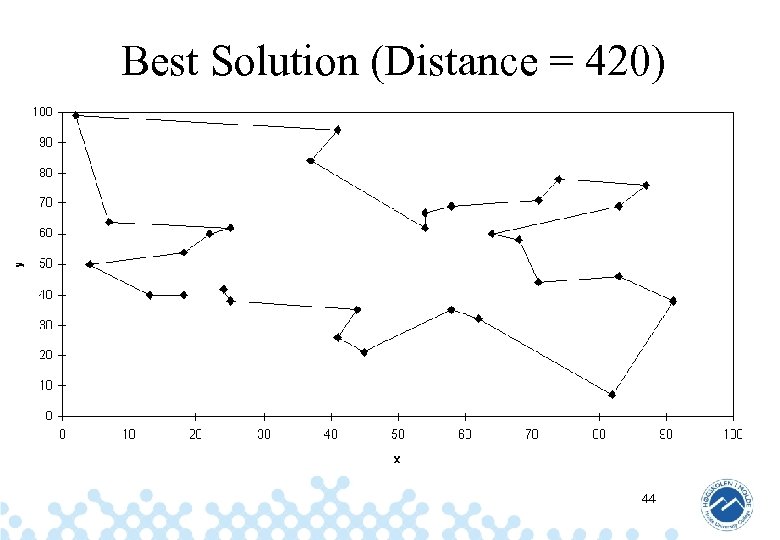 Best Solution (Distance = 420) 44
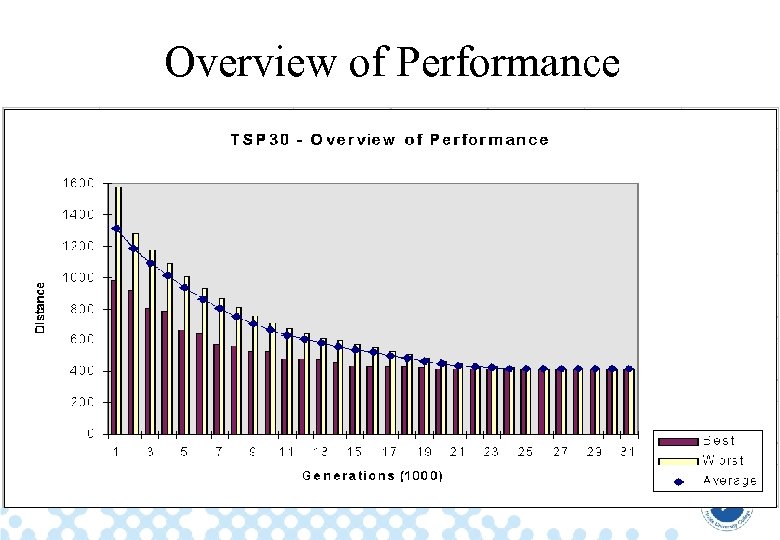 Overview of Performance 45
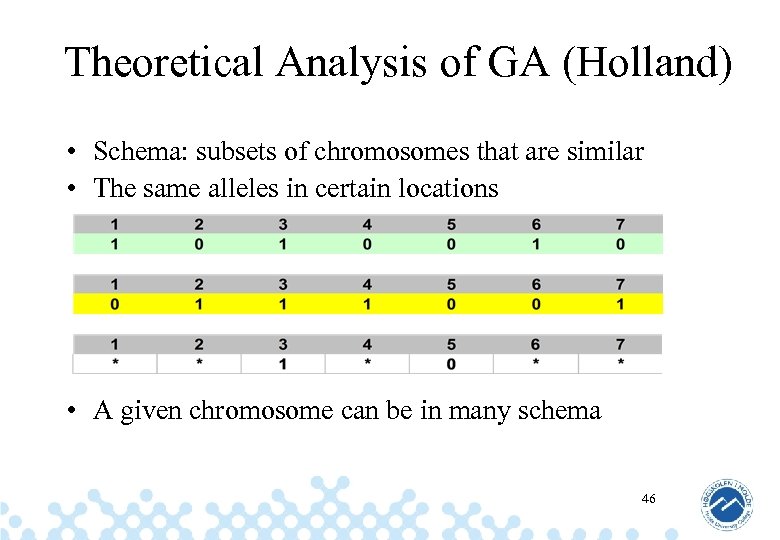 Theoretical Analysis of GA (Holland) • Schema: subsets of chromosomes that are similar • The same alleles in certain locations • A given chromosome can be in many schema 46
 Schema - Fitness • Every time we evaluate the fitness of a chromosome we collect information about average fitness to each of the schemata • Theoretically: population can contain (M*2 n) schemata • In practice: overlap 47
 GA – Inherently Parallel • Many schemata are evaluated in parallel • Under reasonable assumptions: O(M 3) schemata • When using the genetic operators, the schemata present in the population will increase or decrease in numbers according to their relative fitness • Schema theorem 48
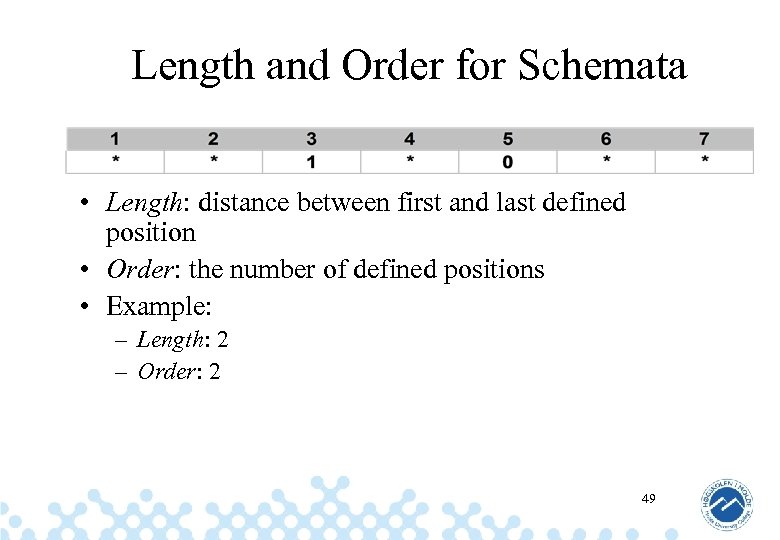 Length and Order for Schemata • Length: distance between first and last defined position • Order: the number of defined positions • Example: – Length: 2 – Order: 2 49
 Fitness Ratio • The relation between the average fitness of a schema and the average fitness of the population • F(S) is the fitness of schema S • F(t) is the average fitness of the population at _ time t • Let f(S, t) be the fitness ratio for schema S at time t 50
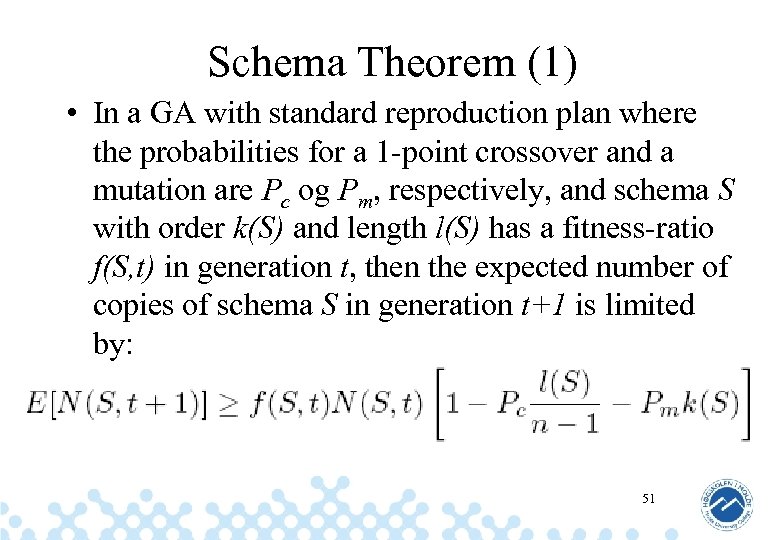 Schema Theorem (1) • In a GA with standard reproduction plan where the probabilities for a 1 -point crossover and a mutation are Pc og Pm, respectively, and schema S with order k(S) and length l(S) has a fitness-ratio f(S, t) in generation t, then the expected number of copies of schema S in generation t+1 is limited by: 51
 Schema Theorem (2) • The theorem states that short, low-order, above average schemata receive exponentially increasing trials in subsequent generations of a GA – Such schemata are called building blocks • This is the basis of the Building Block Hypothesis: – Combining short, low-order, above average schemata yields high order schemata that also demonstrate above average fitnesses – This is the fundamental theorem of GAs, showing how GAs explore similarities as a basis for the search procedure 52
 Later Development of Theory • Schema theorems for – Uniform choice of parents in a crossover – Choice of both parents based on fitness • Exact expressions in the schema theorem • Analysis by using Walsh-functions (from signal analysis) • Generalization of schema – design of operators 53
 GA - Extensions and Modifications • • Many possibilities for variations A lot of literature, chaotic Unclear terminology Modifications regarding: – Population – Encoding – Operators – Hybridization, parallellization 54
 GA: Population Size • Small populations: undercoverage • Large population: computationally demanding • Optimal size increases exponentielly with the string -length in binary encodings • A size of 30 can often work – OK with 10 -100 • Between N and 2 N (Alander) 55
 GA: Initial Population • Usually: random strings • Alternative: seed with good solutions – faster convergence – premature convergence • Sophisticated statistical methods – Latin hypercubes • Often problems with infeasibility 56
 GA: Population Updates • Generation gap – Replace the whole population each iteration • Steady state – Add and remove one individual each generation – Only use part of the population for reproduction – The offspring can replace • Parents • Worst member of population • Randomly selected individuals (doubtful if this works better) • • Avoid duplicates Uncertain if the best solution so far will survive Elitism – e. g. have a small set of ”queens” Selectiv death 57
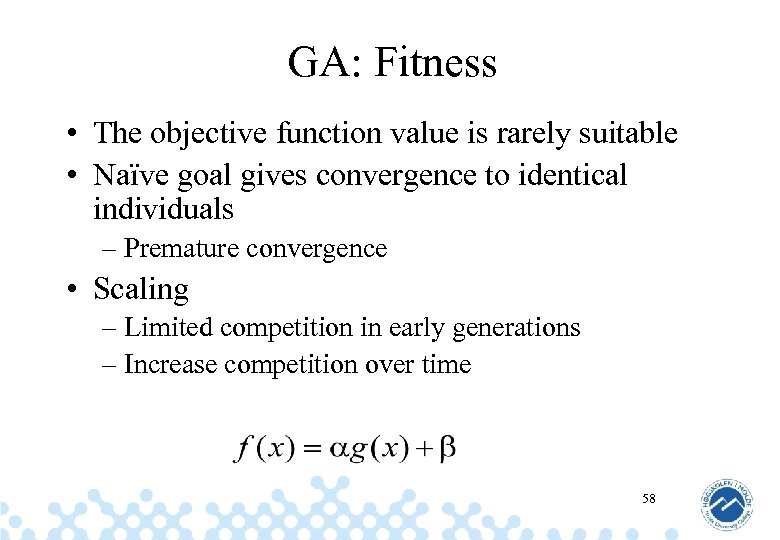 GA: Fitness • The objective function value is rarely suitable • Naïve goal gives convergence to identical individuals – Premature convergence • Scaling – Limited competition in early generations – Increase competition over time 58
 GA: Fitness/Selection • Use ranking instead of objective function value • Tournament selection – Random choice of groups – The best in the group advances to reproduction 59
 GA: Operators • Mutation – upholds diversity – Choice of mutation rate not critical • Crossover – often effective – Late in the search: crossover has smaller effect – Selective choice of crossover point • N-point crossover – 2 -points has given better performance – 8 -point crossover has given best results 60
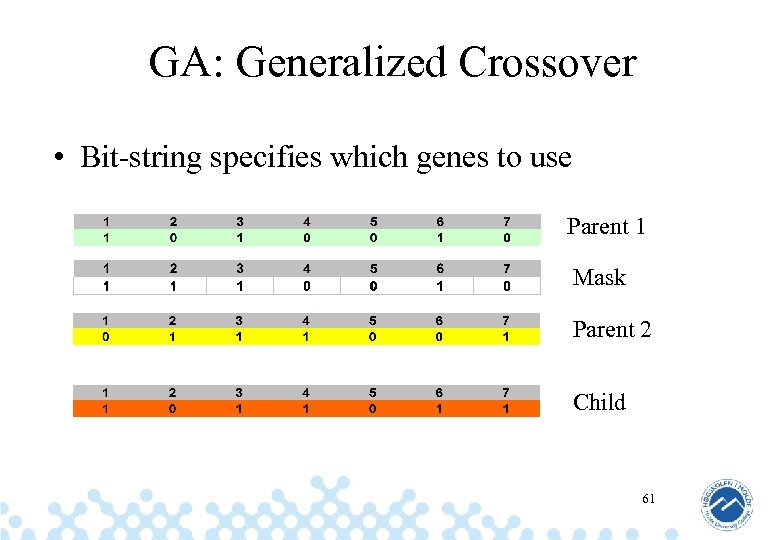 GA: Generalized Crossover • Bit-string specifies which genes to use Parent 1 Mask Parent 2 Child 61
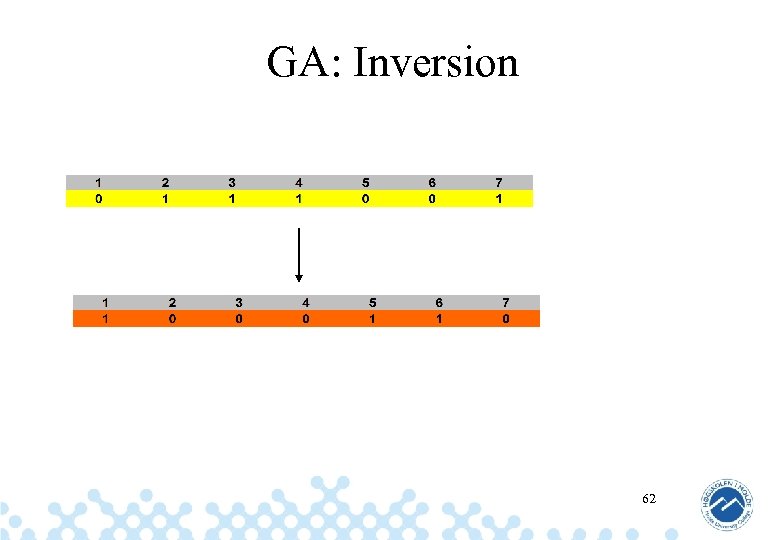 GA: Inversion 62
 GA: Hybridization and Parallelization • GAs strengths and weaknesses: – Domain independence • Hybridization – Seed good individuals in the initial population – Combine with other Metaheuristics to improve some solutions • Parallelization – Fitness-evaluation – Sub-populations – The Island Model 63
 Issues for GA Practitioners • Basic implementation issues: – – Representation Population size, mutation rate, . . . Selection, deletion policies Crossover, mutation operators • Termination Criteria • Performance, scalability • Solution is only as good as the evaluation function (often hardest part) 64
 Benefits of Genetic Algorithms • • • Concept is easy to understand Modular, separate from application Supports multi-objective optimization Good for “noisy” environments Always an answer; answer gets better with time Inherently parallel; easily distributed 65
 Benefits of Genetic Algorithms (cont. ) • Many ways to speed up and improve a GAbased application as knowledge about the problem domain is gained • Easy to exploit previous or alternate solutions • Flexible building blocks for hybrid applications • Substantial history and range of use 66
 When to Use a GA • Alternate methods are too slow or overly complicated • Need an exploratory tool to examine new approaches • Problem is similar to one that has already been successfully solved by using a GA • Want to hybridize with an existing method • Benefits of the GA technology meet key problem requirements 67
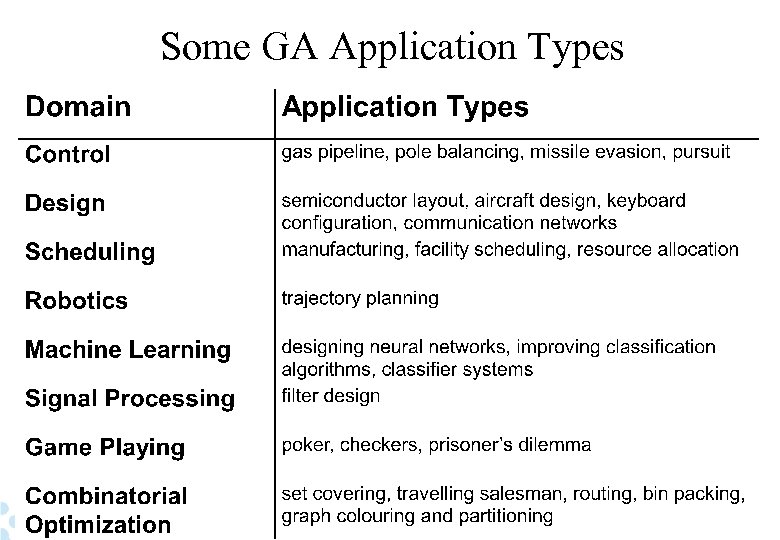 Some GA Application Types 68
 GA: Overview • Important characteristics: – Population av solutions – Domaine independence – encoding – Structure is not exploited – Inherent parallell – schema, vocabulary – Robust – Good mechanisms for intensification – Lacking in diversification 69
 Genetic Algorithms • Bit-string encoding is inappropriate for many combinatorial problems. In particular, crossover may lead to infeasible or meaningless solutions. • Pure GAs are usually not powerful enough to solve hard combinatorial problems. • Hybrid GAs use some form of local search as mutation operator to overcome this. 70
 Memetic Algorithms (1) • Basically, a Memetic Algorithm is a GA with Local Search as improvement mechanism – Also known under different names – An example of hybridization • A meme is a unit of cultural information transferable from one mind to another – Sounds like gene: the unit carrying inherited information 71
 Memetic Algorithms (2) • The experience is that GAs do not necessarily perform well in some problem domains • Using Local Search in addition to the population mechanisms proves to be an improvement • In a sense this elevates the population search to a search among locally optimal solutions, rather than among any solution in the solution space 72
 Summary of Lecture • Local Search – Short summary • Genetic Algorithms – Population based Metaheuristic – Based on genetics: • Mutation • Combination of chromosomes from parents – Hybridization: Memetic Algorithm 73
 Topics for the next Lecture • Scatter Search (SS) – For Local Search based Metaheuristics: • SA based on ideas from nature • TS based on problem-solving and learning – For population based Metaheuristics: • GA based on ideas from nature • SS based on problem-solving and learning – Nature works, but usually very slowly – Being clever is better than emulating nature? 74