


 Скачать презентацию Here ENZ enzyme OPH a k
f87c4efbc9050ef651f96bbf0c32fea2.ppt
- Количество слайдов: 21
 Here, ENZ = enzyme = OPH (a. k. a. phosphotriesterase) M. M. Benning, J. M. Kuo, F. M. Raushel and H. M. Holden, Biochemistry, Vol. 33 pp. 15001 -15007 (1994). The kinetics can be monitored by following the production of p-nitrophenol, a yellow colored chemical, spectroscopically. Enzyme kinetics can be used to determine the efficiency of OPH when it is integrated into a polymeric foam compared to OPH’s efficiency in solution. evaluate KM and Vmax and compare
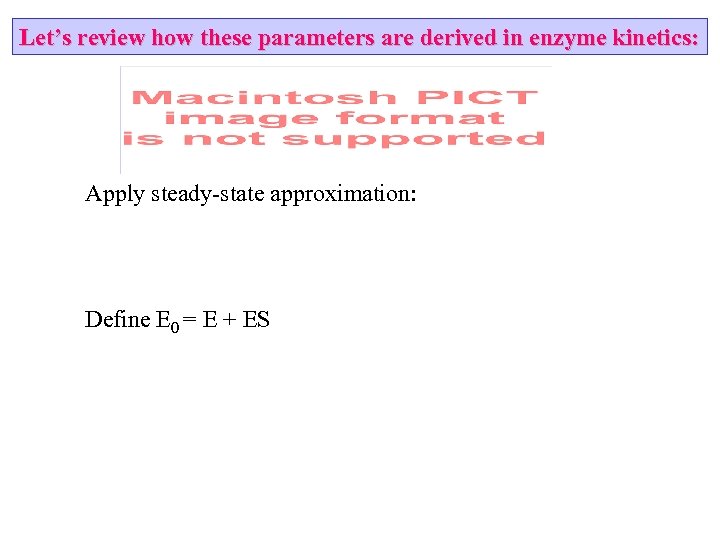 Let’s review how these parameters are derived in enzyme kinetics: Apply steady-state approximation: Define E 0 = E + ES
![V = rate = k 2[ES]](https://present5.com/presentation/f87c4efbc9050ef651f96bbf0c32fea2/image-3.jpg "V = rate = k 2[ES]") V = rate = k 2[ES]
V = rate = k 2[ES]
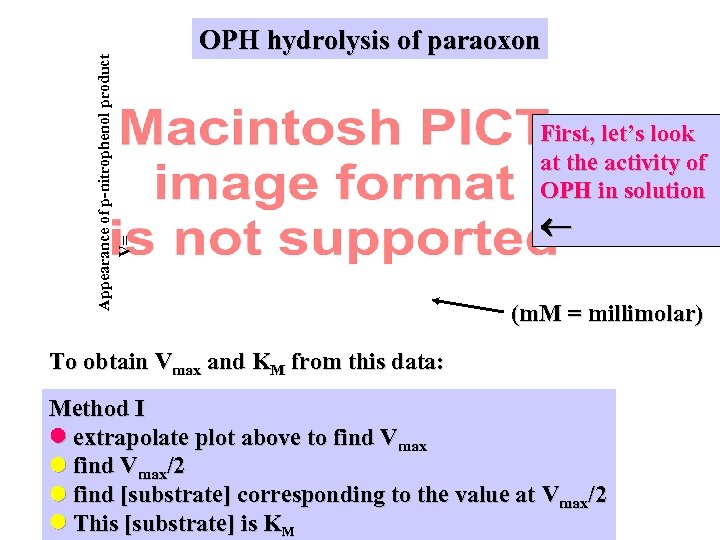 Appearance of p-nitrophenol product V= OPH hydrolysis of paraoxon First, let’s look at the activity of OPH in solution (m. M = millimolar) To obtain Vmax and KM from this data: Method I extrapolate plot above to find Vmax/2 find [substrate] corresponding to the value at Vmax/2 This [substrate] is KM
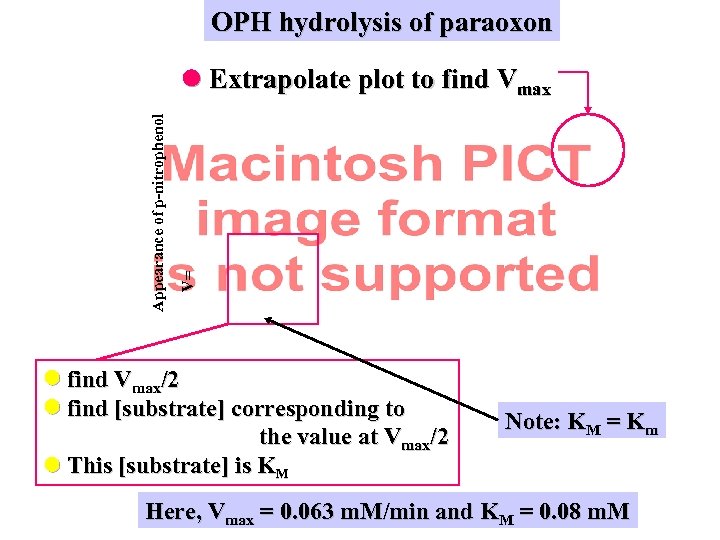 OPH hydrolysis of paraoxon V= Appearance of p-nitrophenol Extrapolate plot to find Vmax/2 find [substrate] corresponding to the value at Vmax/2 This [substrate] is KM Note: KM = Km Here, Vmax = 0. 063 m. M/min and KM = 0. 08 m. M
![Method II: plot 1/V versus 1/[substrate] (Lineweaver-Burke Plot) The line that fits the data](https://present5.com/presentation/f87c4efbc9050ef651f96bbf0c32fea2/image-6.jpg "Method II: plot 1/V versus 1/[substrate] (Lineweaver-Burke Plot) The line that fits the data") Method II: plot 1/V versus 1/[substrate] (Lineweaver-Burke Plot) The line that fits the data has the following form: y = 14. 3 min/m. M + 1. 4 min • x Obtained from V vs [S] plot V This yields Vmax = 1/[14. 3(min/m. M)] = 0. 07 m. M/min, and KM = [1. 4 (min)] • Vmax = 0. 098 m. M vs (0. 08) vs (0. 063)
Method II: plot 1/V versus 1/[substrate] (Lineweaver-Burke Plot) The line that fits the data has the following form: y = 14. 3 min/m. M + 1. 4 min • x Obtained from V vs [S] plot V This yields Vmax = 1/[14. 3(min/m. M)] = 0. 07 m. M/min, and KM = [1. 4 (min)] • Vmax = 0. 098 m. M vs (0. 08) vs (0. 063)
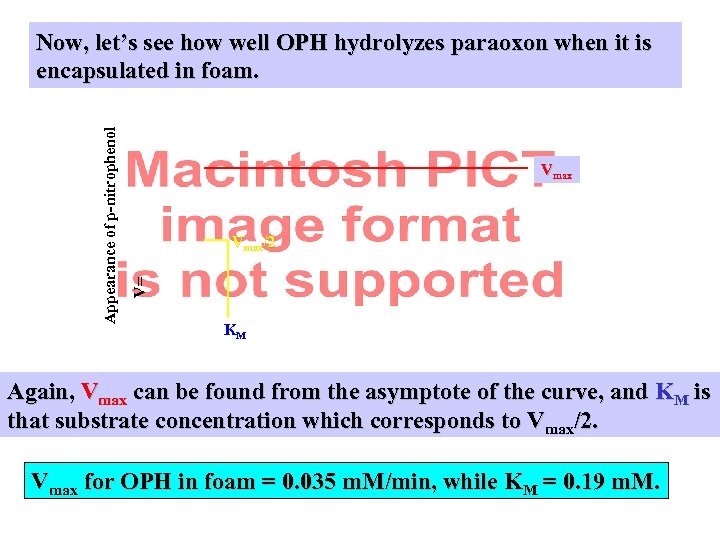 Vmax/2 V= Appearance of p-nitrophenol Now, let’s see how well OPH hydrolyzes paraoxon when it is encapsulated in foam. KM Again, Vmax can be found from the asymptote of the curve, and KM is that substrate concentration which corresponds to Vmax/2. Vmax for OPH in foam = 0. 035 m. M/min, while KM = 0. 19 m. M.
![We get similar results from a Lineweaver-Burke plot: Obtained from V vs [S] plot](https://present5.com/presentation/f87c4efbc9050ef651f96bbf0c32fea2/image-8.jpg "We get similar results from a Lineweaver-Burke plot: Obtained from V vs [S] plot") We get similar results from a Lineweaver-Burke plot: Obtained from V vs [S] plot from the y-intercept, Vmax = 0. 040 m. M/min; (vs 0. 035) from the slope, KM = 0. 24 m. M (vs 0. 19) This comes from: V Now, we can compare these parameters for the cases where OPH is in solution and integrated into foam:
We get similar results from a Lineweaver-Burke plot: Obtained from V vs [S] plot from the y-intercept, Vmax = 0. 040 m. M/min; (vs 0. 035) from the slope, KM = 0. 24 m. M (vs 0. 19) This comes from: V Now, we can compare these parameters for the cases where OPH is in solution and integrated into foam:
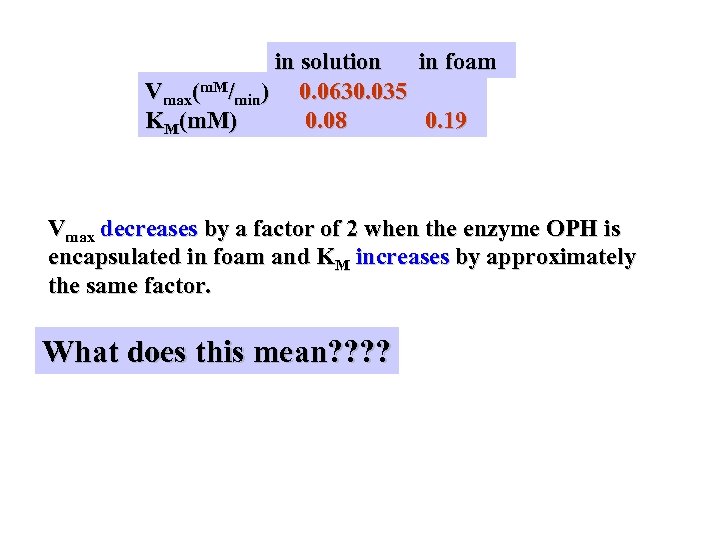 in solution in foam Vmax(m. M/min) 0. 0630. 035 KM(m. M) 0. 08 0. 19 Vmax decreases by a factor of 2 when the enzyme OPH is encapsulated in foam and KM increases by approximately the same factor. What does this mean? ?
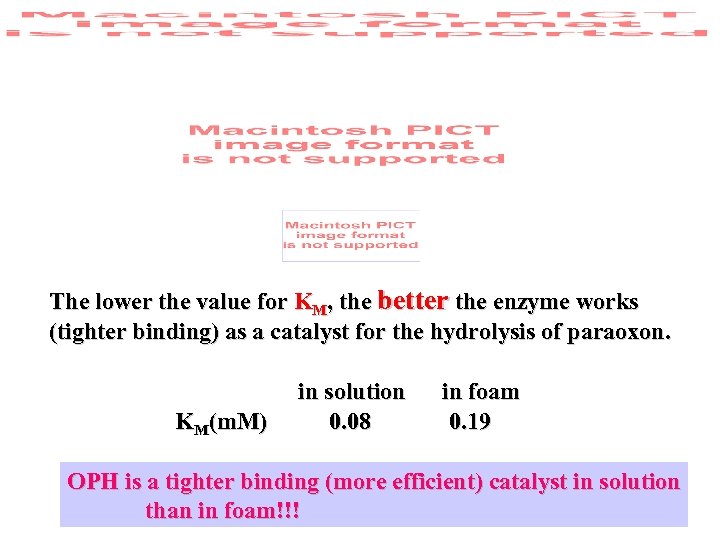 The lower the value for KM, the better the enzyme works (tighter binding) as a catalyst for the hydrolysis of paraoxon. KM(m. M) in solution 0. 08 in foam 0. 19 OPH is a tighter binding (more efficient) catalyst in solution than in foam!!!
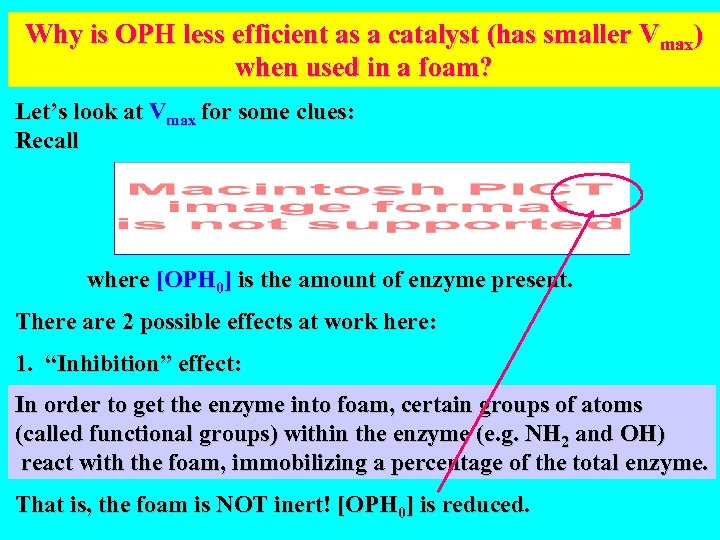 Why is OPH less efficient as a catalyst (has smaller Vmax) when used in a foam? Let’s look at Vmax for some clues: Recall where [OPH 0] is the amount of enzyme present. There are 2 possible effects at work here: 1. “Inhibition” effect: In order to get the enzyme into foam, certain groups of atoms (called functional groups) within the enzyme (e. g. NH 2 and OH) react with the foam, immobilizing a percentage of the total enzyme. That is, the foam is NOT inert! [OPH 0] is reduced.
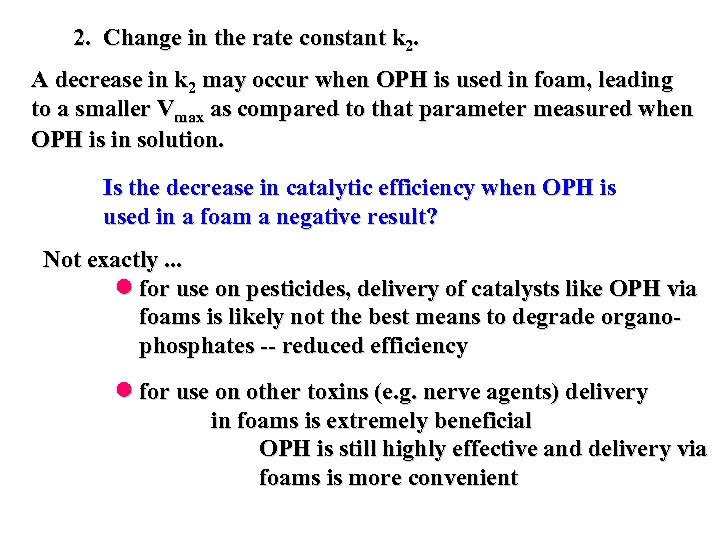 2. Change in the rate constant k 2. A decrease in k 2 may occur when OPH is used in foam, leading to a smaller Vmax as compared to that parameter measured when OPH is in solution. Is the decrease in catalytic efficiency when OPH is used in a foam a negative result? Not exactly. . . for use on pesticides, delivery of catalysts like OPH via foams is likely not the best means to degrade organophosphates -- reduced efficiency for use on other toxins (e. g. nerve agents) delivery in foams is extremely beneficial OPH is still highly effective and delivery via foams is more convenient
 References K. E. Le. Jeune and A. J. Russell, Biotechnology and Bioengineering, Vol. 51, pp. 450 -457 (1996) K. E. Le. Jeune and J. R. Wild, Nature, Vol. 395, pp. 27 -28 (1998) K. E. Le. Jeune, A. J. Mesiano, S. B. Bower, J. K. Grimsley, J. R. Wild and A. J. Russell, Biotechnology and Bioengineering, Vol. 54 pp. 105 -114 (1997) S. E. Manahan, Environmental Chemistry (5 th ed), Lewis Publishers: Chelsea, MI (1991) D. J. Hanson, Chemical and Engineering News, pp. 20 -22 (Sept. 28, 1998) M. M. Benning, J. M. Kuo, F. M. Raushel and H. M. Holden, Biochemistry, Vol. 33 pp. 15001 -15007 (1994).
 Remarks by Arrhenius The April issue of the ACS Chicago Section’s Chemical Bulletin carries excerpts from a talk by Svente Arrhenius on May 11, 1912, when he received the section’s first Willard Gibbs Award. The full address appears in J. Am. Chem. Soc. , 36, 353 (1912). A few lines follow: “I came to my professor, Cleve, and I said, ‘I have a new theory of electrical conductivity as a cause of chemical reactions. ’ He said, ‘That is very interesting, ’ and then he said ‘Goodbye’. He explained to me later, when he had to pronounce the reason for my receiving the Nobel Prize for that work, that he knew very well that there are so many different theories formed, and that they are all almost certain to be wrong, for after a short time they disappear; and therefore, by using the statistical manner of forming his ideas, he concluded that my theory also would not exist very long. ”
 “I was not very content with that opinion, and then I thought, in foreign countries there are such prominent scientist they might look at it differently; it might appeal to them. Then I wrote to Clausius, and said, ‘What do you think of that? ’ I wrote to Ostwald – he worked on the same line. I wrote to Thomsen. I received friendly answers … they were very glad to make my acquaintance, and so on, but it was not very much more. The only exception was Ostwald, and he describes how it was that he got on the same day this dissertation, a toothache, and a nice daughter, and that was too much for one day, and the worst was the dissertation. ” Wag (9) a humorous person; joker (Am. College Dictionary, Random House, NY, 1961)
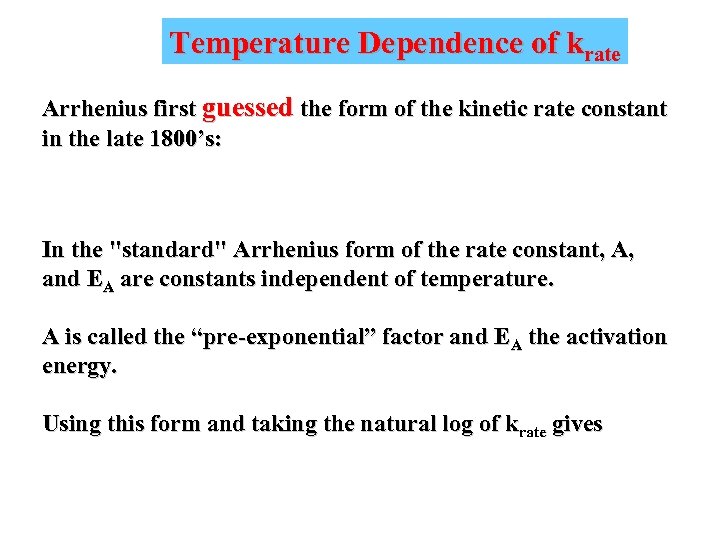 Temperature Dependence of krate Arrhenius first guessed the form of the kinetic rate constant in the late 1800’s: In the "standard" Arrhenius form of the rate constant, A, and EA are constants independent of temperature. A is called the “pre-exponential” factor and EA the activation energy. Using this form and taking the natural log of krate gives
![Taking the derivative with respect to T: (Because A is assumed d {ln[krate]} /d.](https://present5.com/presentation/f87c4efbc9050ef651f96bbf0c32fea2/image-17.jpg "Taking the derivative with respect to T: (Because A is assumed d {ln[krate]} /d.") Taking the derivative with respect to T: (Because A is assumed d {ln[krate]} /d. T = d {- EA/RT} /d. T Constant in this model. ) d {ln[krate]} = [-EA/R] d(1/T) This expression predicts that a plot of ln[krate] vs 1/T will be a a straight line with a slope of -EA/R
Taking the derivative with respect to T: (Because A is assumed d {ln[krate]} /d. T = d {- EA/RT} /d. T Constant in this model. ) d {ln[krate]} = [-EA/R] d(1/T) This expression predicts that a plot of ln[krate] vs 1/T will be a a straight line with a slope of -EA/R
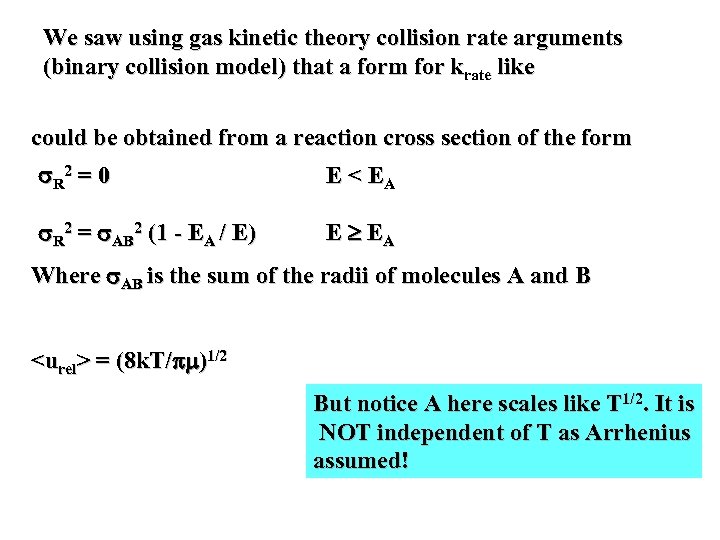 We saw using gas kinetic theory collision rate arguments (binary collision model) that a form for krate like could be obtained from a reaction cross section of the form R 2 = 0 E < EA R 2 = AB 2 (1 - EA / E) E EA Where AB is the sum of the radii of molecules A and B
![If we write A=(const) T 1/2, then krate becomes ln[krate] = ln(const)+ln[T 1/2] -](https://present5.com/presentation/f87c4efbc9050ef651f96bbf0c32fea2/image-19.jpg "If we write A=(const) T 1/2, then krate becomes ln[krate] = ln(const)+ln[T 1/2] -") If we write A=(const) T 1/2, then krate becomes ln[krate] = ln(const)+ln[T 1/2] - EA/RT d {ln[krate]} /d. T = [(1/(2 T)] + EA/RT 2 Define [(1/2)RT + EA] = A
If we write A=(const) T 1/2, then krate becomes ln[krate] = ln(const)+ln[T 1/2] - EA/RT d {ln[krate]} /d. T = [(1/(2 T)] + EA/RT 2 Define [(1/2)RT + EA] = A
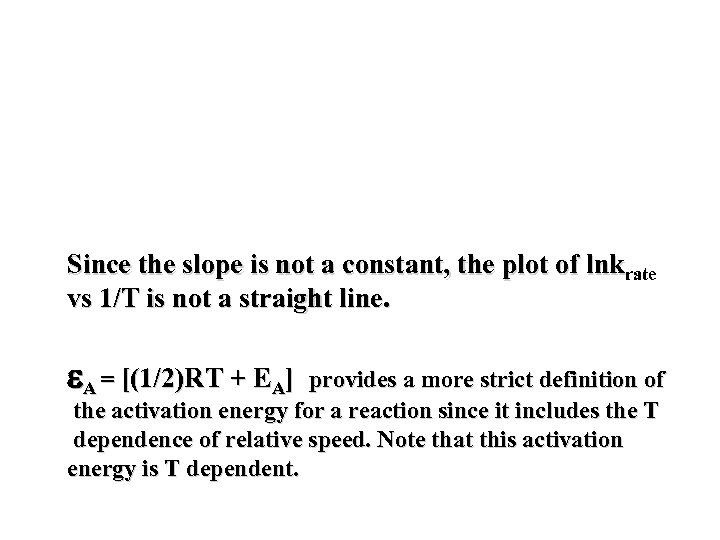 Since the slope is not a constant, the plot of lnkrate vs 1/T is not a straight line. A = [(1/2)RT + EA] provides a more strict definition of the activation energy for a reaction since it includes the T dependence of relative speed. Note that this activation energy is T dependent.
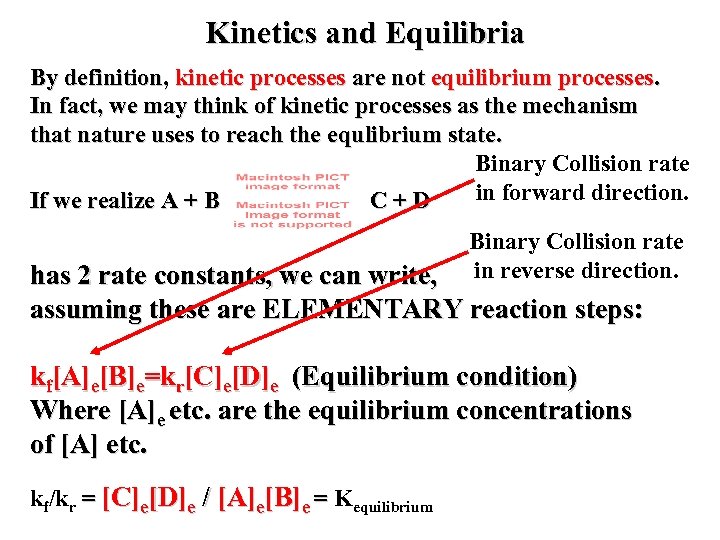 Kinetics and Equilibria By definition, kinetic processes are not equilibrium processes. In fact, we may think of kinetic processes as the mechanism that nature uses to reach the equlibrium state. Binary Collision rate in forward direction. If we realize A + B C+D Binary Collision rate in reverse direction. has 2 rate constants, we can write, assuming these are ELEMENTARY reaction steps: kf[A]e[B]e=kr[C]e[D]e (Equilibrium condition) Where [A]e etc. are the equilibrium concentrations of [A] etc. kf/kr = [C]e[D]e / [A]e[B]e = Kequilibrium