


 Скачать презентацию Herding Cats Leverage Points for Geriatric Medical Education
ae320ac673e2147d70f95c1366909cbb.ppt
- Количество слайдов: 87
 Herding Cats: Leverage Points for Geriatric Medical Education in 2011 Rosanne M. Leipzig, MD, Ph. D Brookdale Department of Geriatrics and Palliative Medicine Mount Sinai School of Medicine
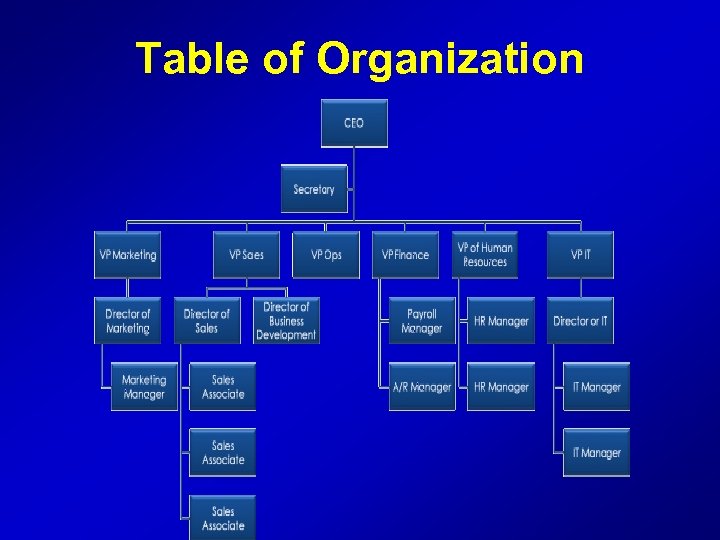 Table of Organization
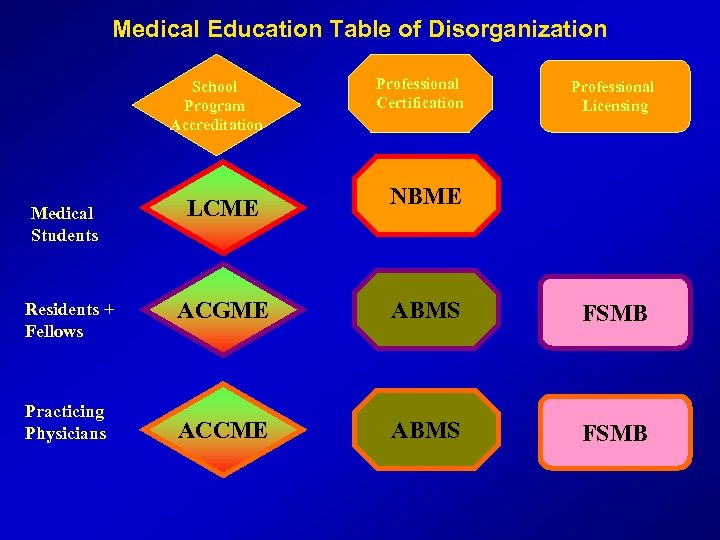 Medical Education Table of Disorganization School Program Accreditation Professional Certification Professional Licensing NBME Medical Students LCME Residents + Fellows ACGME ABMS FSMB ACCME ABMS FSMB Practicing Physicians
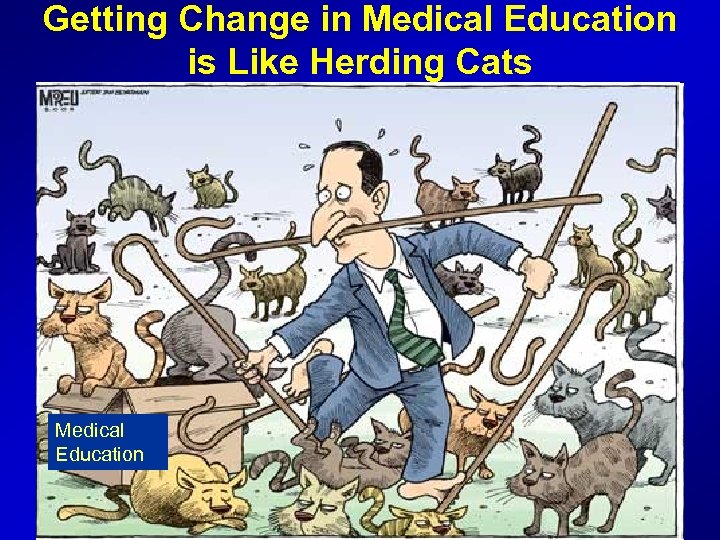 Getting Change in Medical Education is Like Herding Cats Medical Education
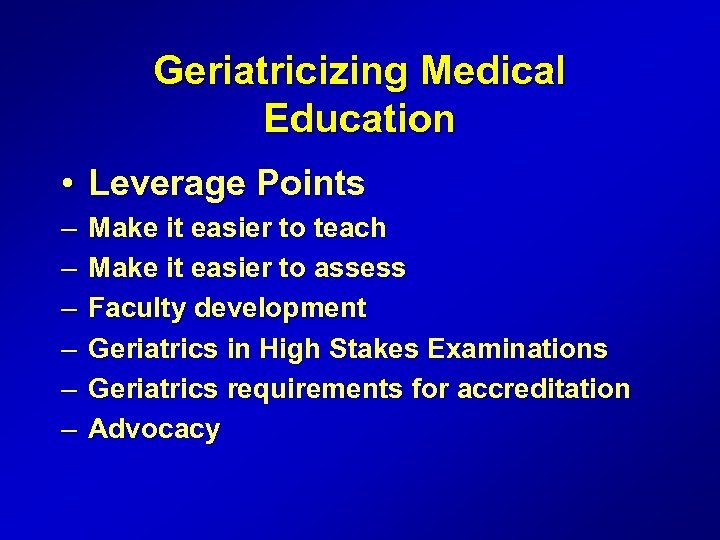 Geriatricizing Medical Education • Leverage Points – – – Make it easier to teach Make it easier to assess Faculty development Geriatrics in High Stakes Examinations Geriatrics requirements for accreditation Advocacy
 That Was the Year That Was 2010 Leveraging Geriatrics Medical Education
 Leverage Point Making it Easier to Teach
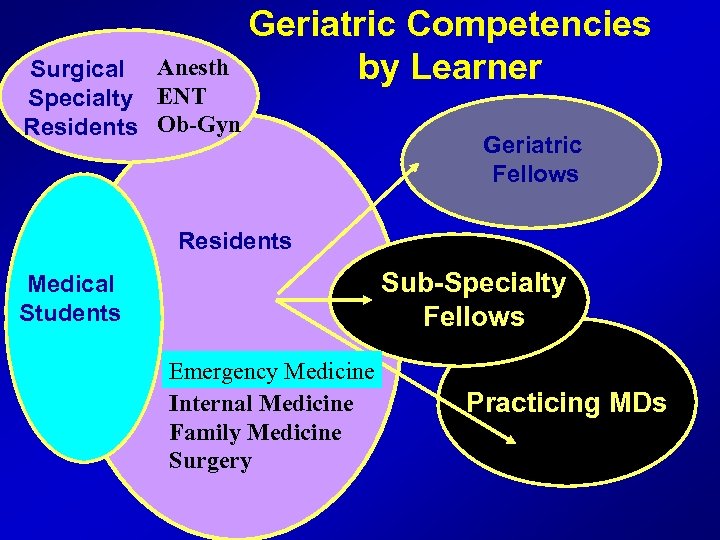 Surgical Anesth Specialty ENT Residents Ob-Gyn Geriatric Competencies by Learner Geriatric Fellows Residents Sub-Specialty Fellows Medical Students Emergency Medicine Internal Medicine Family Medicine Surgery Practicing MDs
 Falls Competencies Med Student: Ask about falls, watch the patient rise from a chair and walk, record and interpret In a faller, construct a differential diagnosis and evaluation plan to address the multiple etiologies identified. IM/FM Resident: Yearly screen all ambulatory elders for falls or fear of falling. If positive, assess gait and balance, evaluate for potentially precipitating causes, and implement interventions In hospitalized medical and surgical patients, evaluate at admission and regularly for fall risk……and institute appropriate corrective measures
 Falls competencies Geriatric Fellow: • Recognize abnormal gaits associated with specific conditions, and perform and interpret common gait and balance assessments. • Conduct an appropriate evaluation of patients who fall, implement strategies to reduce future falls, fear of falling, injuries, and fractures, and followup on referrals. • Implement strategies to reduce falls in patients in all health care settings.
 Partnership for Health in Aging (PHA) Competencies • • • Dentistry Medicine Nursing Nutrition Occupational Therapy • Pharmacy • Physical Therapy • Physician Assistants • Psychology • Social Work
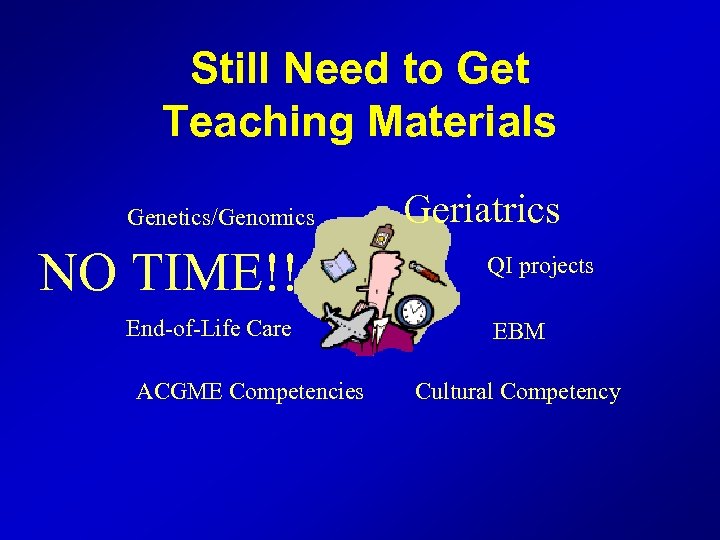 Still Need to Get Teaching Materials Genetics/Genomics NO TIME!! End-of-Life Care ACGME Competencies Geriatrics QI projects EBM Cultural Competency
 Blended Learning • LEARNERS: acquire knowledge prior to face time with faculty • FACULTY: with student on knowledge application – Direct observation and modeling – Formative feedback on performance – Iterative performance till competency achieved
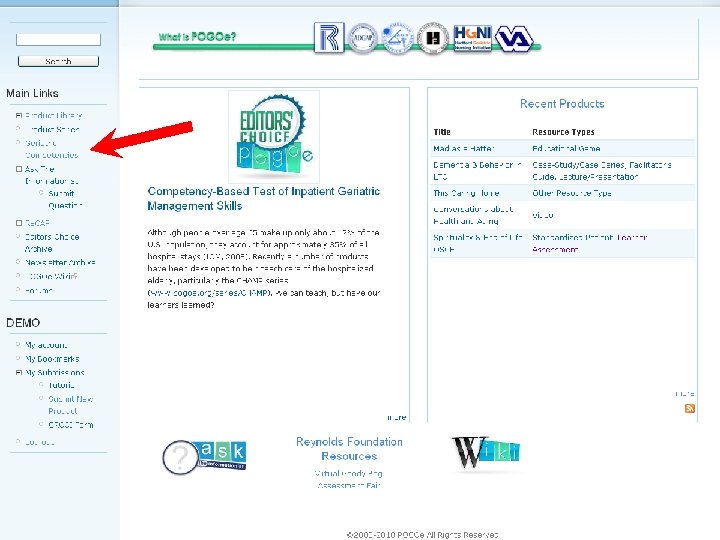
 The Portal of Geriatric Online Education www. POGOe. org “One-Stop Shopping” for Geriatric Education Materials Sponsored by the Association of Directors of Geriatric Academic Programs through a grant from the Donald W. Reynolds Foundation, managed by the Mount Sinai School of Medicine
 POGOe Products
 POGOe Collaborations • Hartford Geriatrics Nursing Initiative (HGNI) – formalized 2010 – 11 products posted, more to come (113 potential) • Geriatrics-for-Specialists Initiative (GSI) – began 2003 – 7 posted products thus far
 G-Wiz (Geriatric Wizard) • Identifies the best POGOe products for each medical student competency
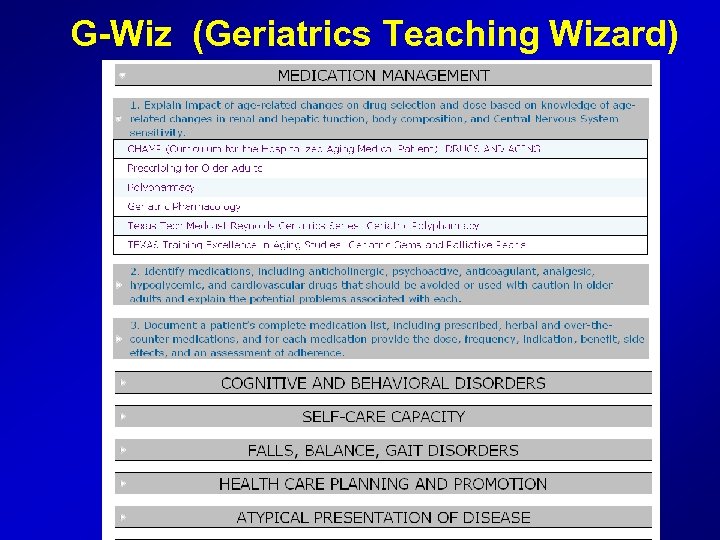 G-Wiz (Geriatrics Teaching Wizard)
 POGOe Product Reviews • JAGS e-learning section – Examples: • New Mexico's Health Care Decision Making • Harvard’s Web-Based Module to Train and Assess Competency in Systems-Based Practice • Arizona’s Elder Care Provider Fact Sheets • Editor’s Choice on POGOe and in monthly newsletter
 Video Library
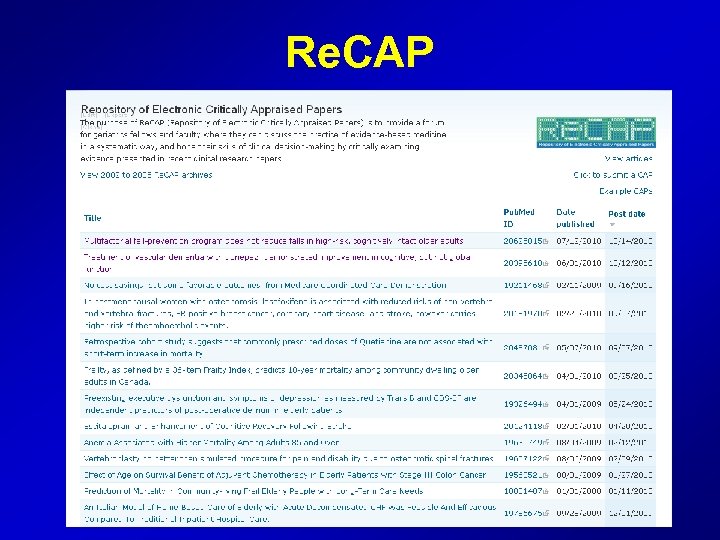 Re. CAP
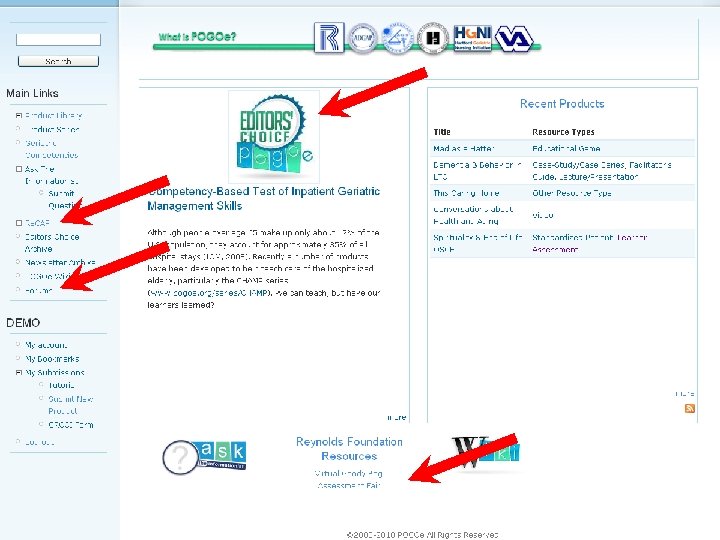
 POGOe Works in Progress
 Virtual Clerkship • • Medical student curriculum that students can use independently Clerkship Directors will be able to: • Customize or use as pre-packaged curriculum (plug and play) • Track student usage • View statistics page capturing student activity • Pilot funded to develop 1 domain
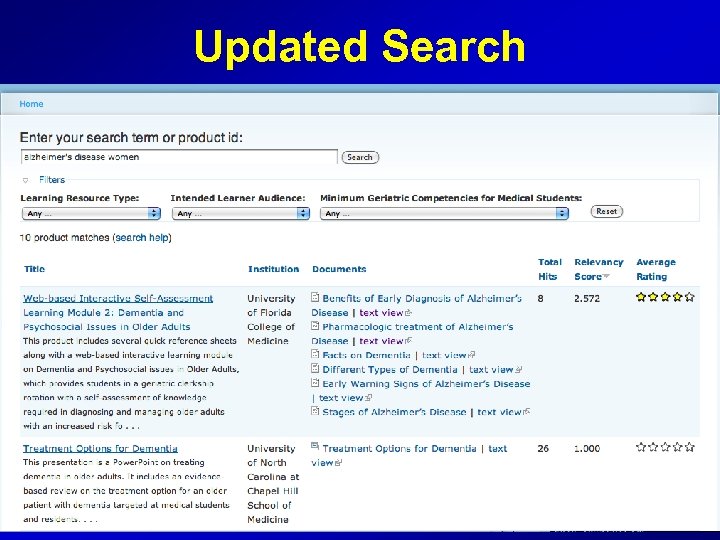 Updated Search
 At This Meeting • Town Halls – Geriatric Fellows Competencies – POGOe Users Group • Feedback on POGOe: help make it suit your needs • Input on virtual clerkship and other features • POGOe booth: (Beta) Test drive new search engine and get a chocolate treat!
 Leverage Point: Making it Easier to Assess
 The Reynolds Trans. Institutional Evaluation Group (R-TIEG) • Anne Fabiny (Harvard) • Jim Powell (Vanderbilt) • Donna Rosenstiel (Vanderbilt) • Renee Porier (Vanderbilt) Porier • Gail Sullivan (U Conn) • Brent Williams (Michigan)
 R-TIEG: ‘Best’ ways to assess each student competency • Spearheaded by U Cal consortium – Knowledge: shelf-like exam. – Performance in practice • Direct observation: mini-clinical exam (Cex) checklists. – Clinical skills • Objective Structured Clinical Exams (OSCEs), standardized patients, simulations, etc.
 TIREG: Assessment Tool Rating • Developed an assessment rating instrument • Beta tested the instrument • Now- Using the instrument to evaluate existing assessment tools (Looking for volunteers) • Next steps: Map tools to competencies • Will be available (and searchable) on POGOe (estimated date: AGS 2011)
 POGOe Assessment Tools • Mostly Knows, Knows How, Shows • Policy for securing and releasing assessment materials • • Some materials not directly accessible on POGOe “Human Firewall” • released upon request and • verification of requester’s faculty status
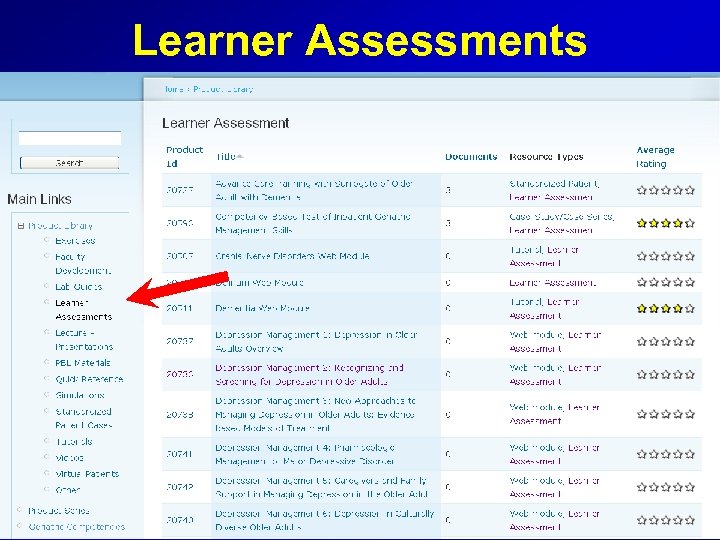 Learner Assessments
 ACGME Milestones • ACGME mandate • Develop milestones of competency – Help to interpret the ACGME core competencies for each specialty – Assist with the assessment of competency – Provide specific feedback to learners regarding progression towards competence.
 IM Milestones • ACGME Competency – Patient Management • Developmental milestone – Provide appropriate preventive care and teach patient regarding self-care • Approximate timeframe by which this should be achieved – 6 months • General Evaluation Strategies – Chart review
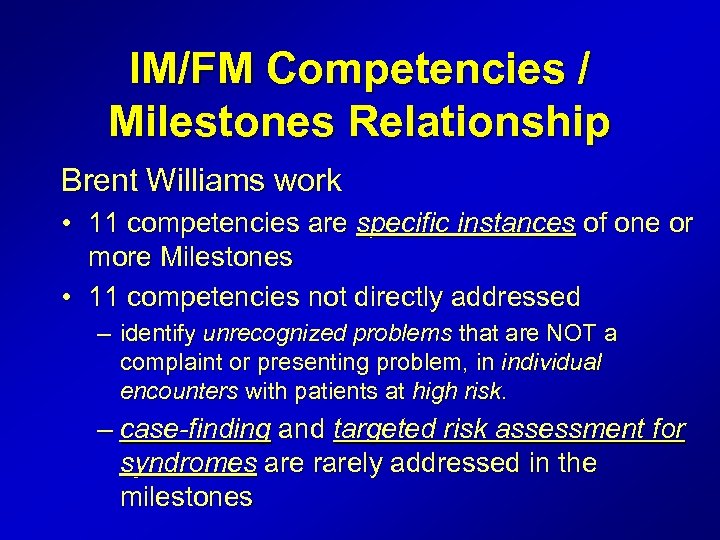 IM/FM Competencies / Milestones Relationship Brent Williams work • 11 competencies are specific instances of one or more Milestones • 11 competencies not directly addressed – identify unrecognized problems that are NOT a complaint or presenting problem, in individual encounters with patients at high risk. – case-finding and targeted risk assessment for syndromes are rarely addressed in the milestones
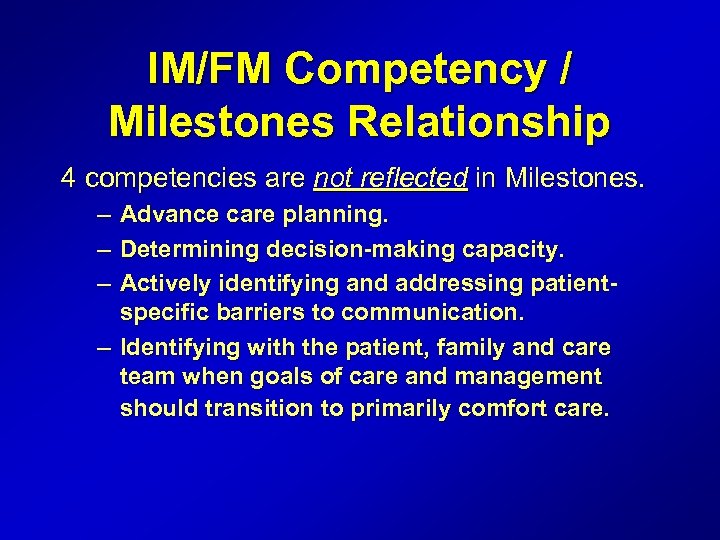 IM/FM Competency / Milestones Relationship 4 competencies are not reflected in Milestones. – – – Advance care planning. Determining decision-making capacity. Actively identifying and addressing patientspecific barriers to communication. – Identifying with the patient, family and care team when goals of care and management should transition to primarily comfort care.
 How does the milestone crosswalk make it easier to teach and assess geriatrics? ABIM interested in having residency programs pilot this as competency-based learning
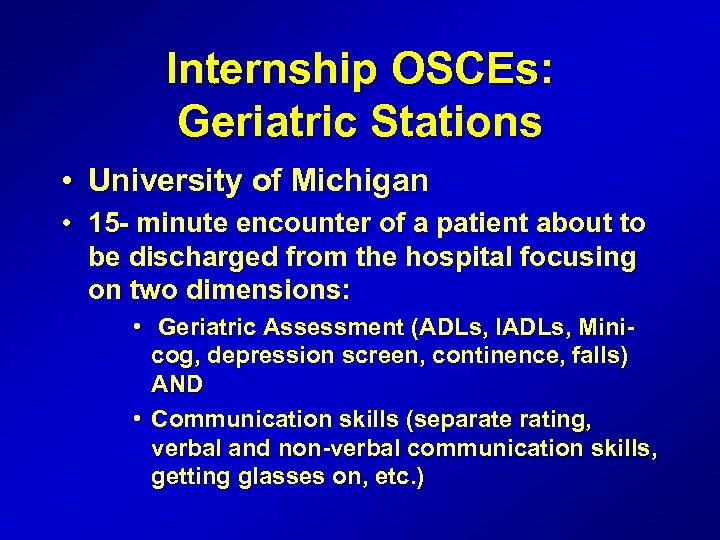 Internship OSCEs: Geriatric Stations • University of Michigan • 15 - minute encounter of a patient about to be discharged from the hospital focusing on two dimensions: • Geriatric Assessment (ADLs, IADLs, Minicog, depression screen, continence, falls) AND • Communication skills (separate rating, verbal and non-verbal communication skills, getting glasses on, etc. )
 At This Meeting • Evaluator’s Toolbox working group • Assessment Fair • NBME workshops • Clinical Skills sessions • Learner Assessments 101 • 360 assessments • DDx of Delirium: training to competence Speak with Anne Fabiny or Brent Williams if interested in reviewing Assessment tools with the new rating instrument
 Leverage Point Faculty Development
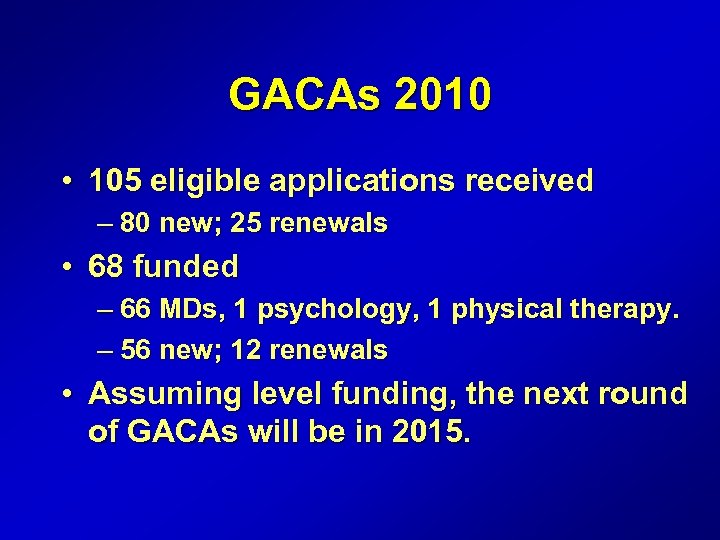 GACAs 2010 • 105 eligible applications received – 80 new; 25 renewals • 68 funded – 66 MDs, 1 psychology, 1 physical therapy. – 56 new; 12 renewals • Assuming level funding, the next round of GACAs will be in 2015.
 Faculty Development Possibility • Adapting ABIM Faculty Development course in assessment to geriatric competencies
 Leverage Point Geriatrics in High-Stakes Examinations
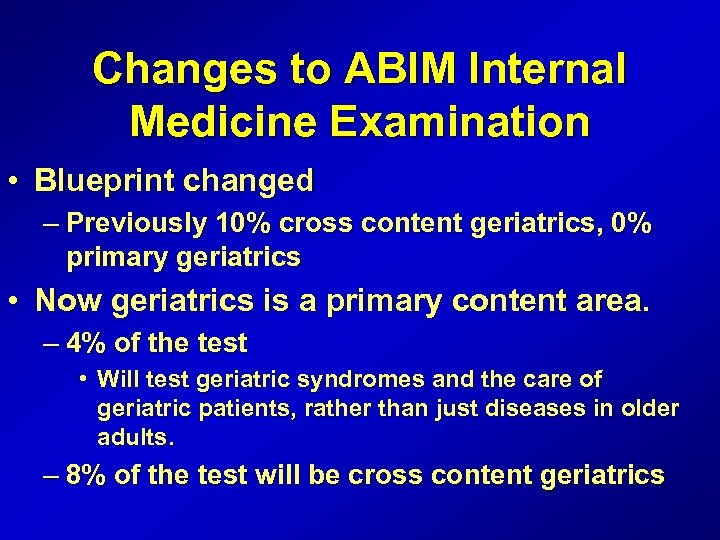 Changes to ABIM Internal Medicine Examination • Blueprint changed – Previously 10% cross content geriatrics, 0% primary geriatrics • Now geriatrics is a primary content area. – 4% of the test • Will test geriatric syndromes and the care of geriatric patients, rather than just diseases in older adults. – 8% of the test will be cross content geriatrics
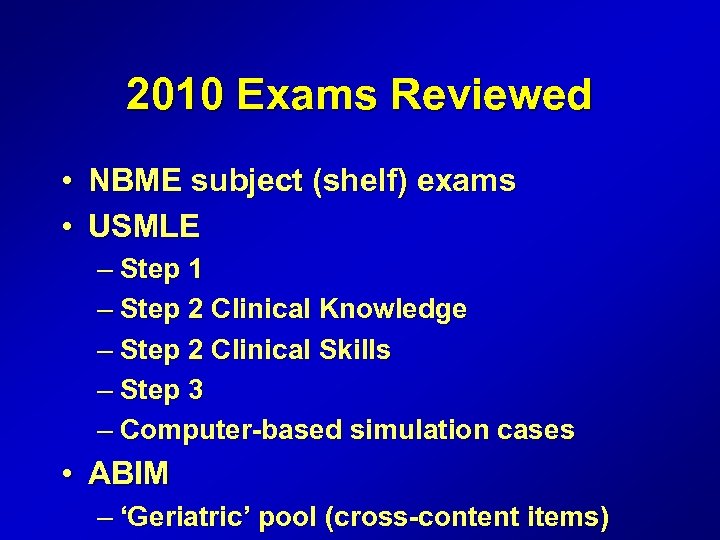 2010 Exams Reviewed • NBME subject (shelf) exams • USMLE – Step 1 – Step 2 Clinical Knowledge – Step 2 Clinical Skills – Step 3 – Computer-based simulation cases • ABIM – ‘Geriatric’ pool (cross-content items)
 2010: Exam Reviewers • • • Christine Arenson Lynn Bickley Jan Busby-Whitehead Danelle Cayea Anne Fabiny Lisa Granville Funded by AMA • • Bree Johnston Reena Karani Rosanne Leipzig Sharon Levine Joanne Schwartzberg Amit Shah Gail Sullivan
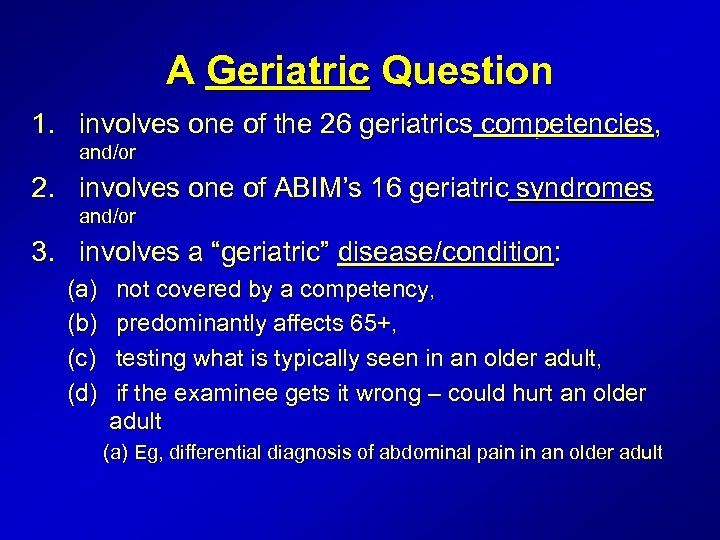 A Geriatric Question 1. involves one of the 26 geriatrics competencies, and/or 2. involves one of ABIM’s 16 geriatric syndromes and/or 3. involves a “geriatric” disease/condition: (a) (b) (c) (d) not covered by a competency, predominantly affects 65+, testing what is typically seen in an older adult, if the examinee gets it wrong – could hurt an older adult (a) Eg, differential diagnosis of abdominal pain in an older adult
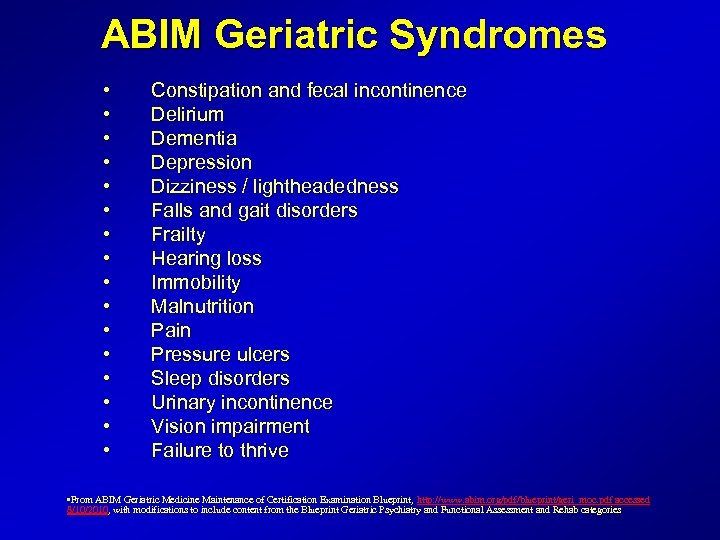 ABIM Geriatric Syndromes • • • • Constipation and fecal incontinence Delirium Dementia Depression Dizziness / lightheadedness Falls and gait disorders Frailty Hearing loss Immobility Malnutrition Pain Pressure ulcers Sleep disorders Urinary incontinence Vision impairment Failure to thrive • From ABIM Geriatric Medicine Maintenance of Certification Examination Blueprint, http: //www. abim. org/pdf/blueprint/geri_moc. pdf accessed 8/10/2010, with modifications to include content from the Blueprint Geriatric Psychiatry and Functional Assessment and Rehab categories
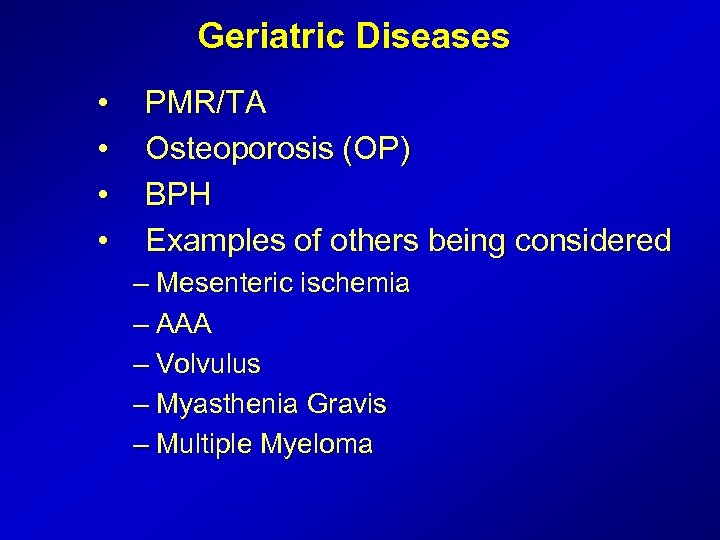 Geriatric Diseases • • PMR/TA Osteoporosis (OP) BPH Examples of others being considered – Mesenteric ischemia – AAA – Volvulus – Myasthenia Gravis – Multiple Myeloma
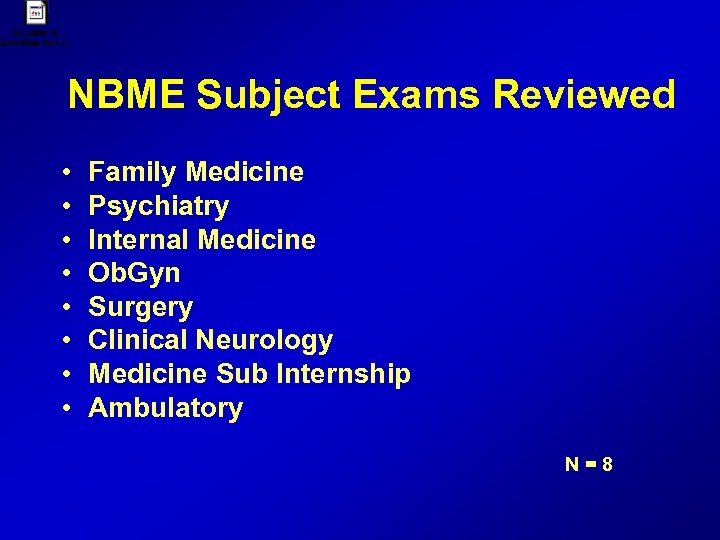 NBME Subject Exams Reviewed • • Family Medicine Psychiatry Internal Medicine Ob. Gyn Surgery Clinical Neurology Medicine Sub Internship Ambulatory N = 8
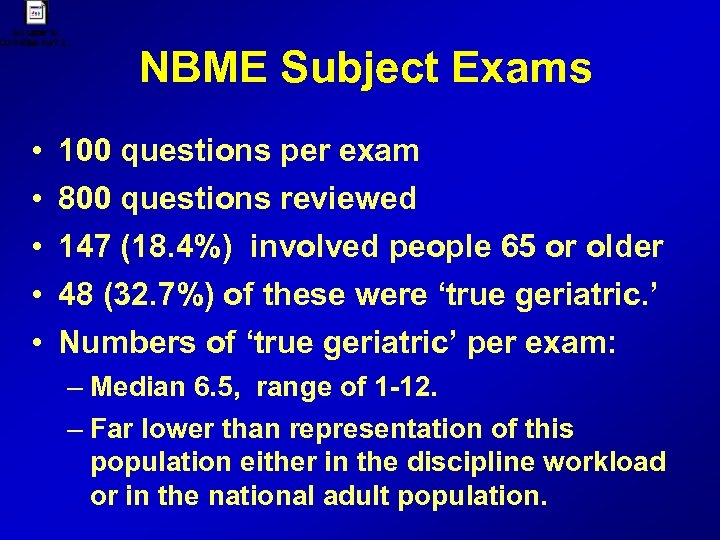 NBME Subject Exams • • • 100 questions per exam 800 questions reviewed 147 (18. 4%) involved people 65 or older 48 (32. 7%) of these were ‘true geriatric. ’ Numbers of ‘true geriatric’ per exam: – Median 6. 5, range of 1 -12. – Far lower than representation of this population either in the discipline workload or in the national adult population.
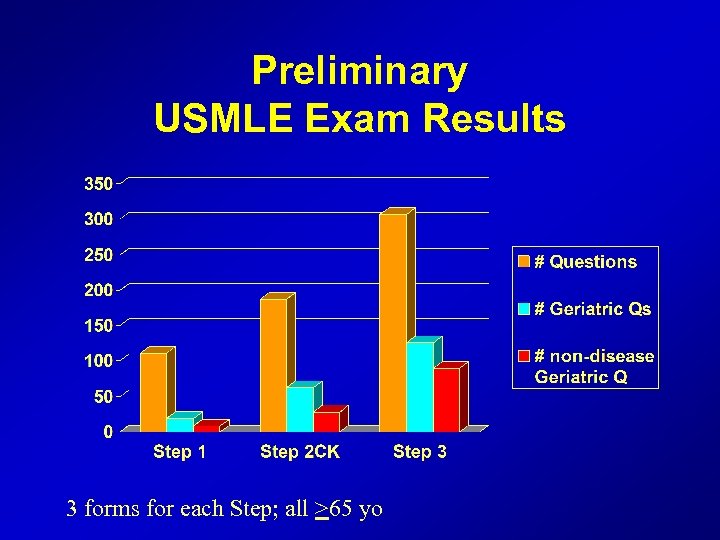 Preliminary USMLE Exam Results 3 forms for each Step; all >65 yo
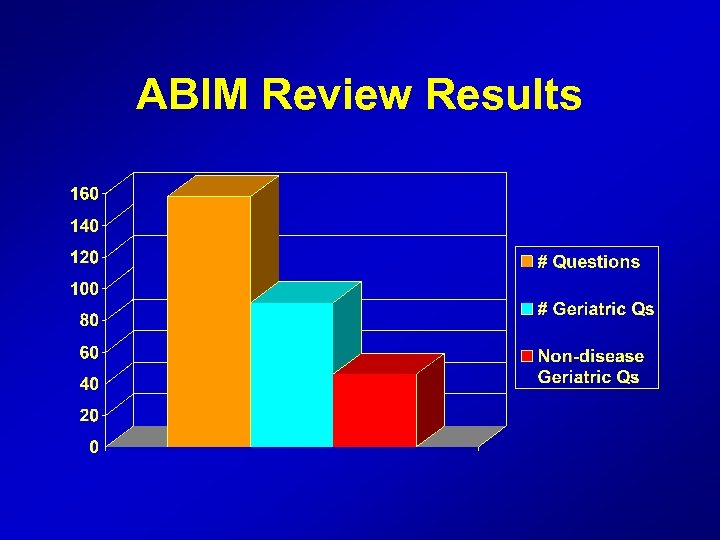 ABIM Review Results
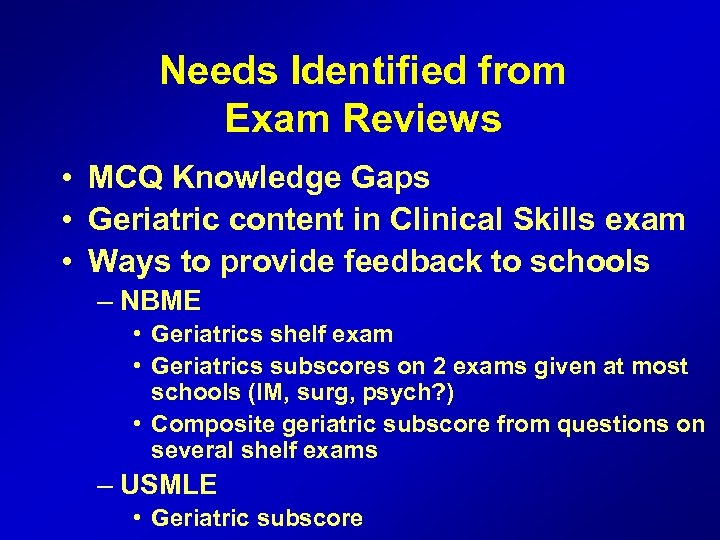 Needs Identified from Exam Reviews • MCQ Knowledge Gaps • Geriatric content in Clinical Skills exam • Ways to provide feedback to schools – NBME • Geriatrics shelf exam • Geriatrics subscores on 2 exams given at most schools (IM, surg, psych? ) • Composite geriatric subscore from questions on several shelf exams – USMLE • Geriatric subscore
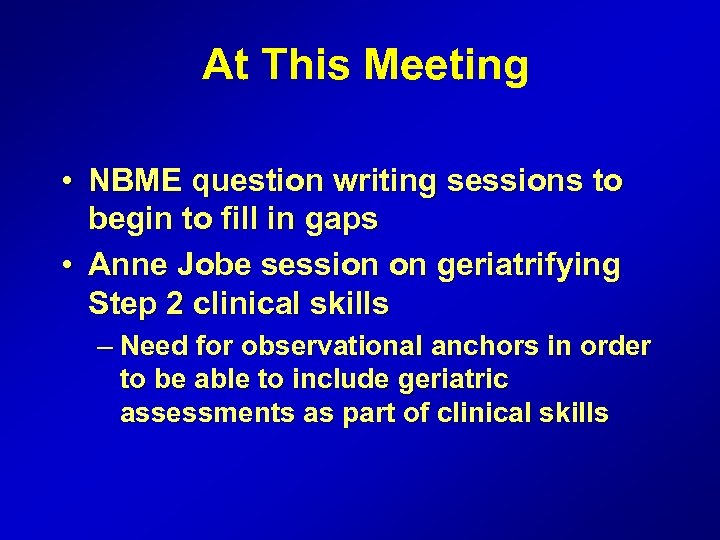 At This Meeting • NBME question writing sessions to begin to fill in gaps • Anne Jobe session on geriatrifying Step 2 clinical skills – Need for observational anchors in order to be able to include geriatric assessments as part of clinical skills
 Leverage Point Geriatrics Requirements in Accreditation
 LCME Revised Standard ED-15 The curriculum of a medical education program must prepare students to enter any field of graduate medical education and include content and clinical experiences related to each phase of the human life cycle
 LCME Revised Standard ED-15 Commentary It is expected that the curriculum will be guided by the contemporary content from and the clinical experiences associated with, among others, the disciplines and related subspecialties that have traditionally been titled family medicine, internal medicine, obstetrics and gynecology, pediatrics, preventive medicine, psychiatry, and surgery. REFUSED request to add geriatrics to this list!
 AAMC Graduation Questionnaire (GQ) • 2001 -2009: specific geriatrics questions • 2010: Geriatrics questions eliminated • Currently lobbying for reinstatement in 2011
 Residency Review Committees • Dr. George Drach has appeared before the RRC Chairs committee and discussed the need for geriatric competency. • Each RRC is reviewing their geriatric requirements • Next steps unclear
 Internal Medicine RRC • Removed requirement for 1 month geriatric rotation • New language Faculty with credentials appropriate to the care setting must supervise all clinical experiences. These experiences must include: – exposure to each of the internal medicine subspecialties and neurology; – an assignment in geriatric medicine
 Why the Change to Fewer Requirements • Medical education moving to outcomes, getting away from process • Carnegie Pillar 1: – Standardization of learning outcomes – Individualization of the learning process • No longer telling schools/programs HOW to teach. • Increases influence of the Certification and Licensing bodies
 Encouraging Signs
 Med. PAC 2009 concerns • • Communication Care Coordination Multidisciplinary Teamwork Patient Safety Judicious Resource Use Nonhospital Experiences (Basic geriatric instruction)
 Congress and $$$ • $9 billion to GME from CMS • June, 2009 Med. PAC report to Congress – Concern that our health professionals are not learning certain skills necessary to work optimally in delivery systems that focus on care coordination, quality, or judicious resource use
 June 2010 Med. PAC Report to Congress Gaps in medical education, including physician prep to care for older adults, be addressed by: (1) Making a significant portion of Medicare’s GME payments contingent on reaching desired educational outcomes and standards, and (2) Making information about Medicare’s payments & teaching costs available to the public - also fosters greater accountability for educational activities within the GME community
 June 2010 Med. PAC Report to Congress An educational goal that is particularly pertinent to Medicare is the growing need for basic geriatric competency among almost all our physicians, as called for by many experts, clinicians, and researchers (Boult et al. 2010, Institute of Medicine 2008, Leipzig et al. 2009). While many specialties require some form of geriatric instruction for ACGME accreditation, and several organizations have collaborated to develop a set of geriatric competencies for all medical students and residents, Medicare’s GME financing does not place any requirements on geriatric skills and experience. Encouraging basic knowledge in geriatric care among graduating residents would have important benefits for elderly Medicare beneficiaries.
 AMA: House of Delegates Resolution sponsored by AGS • Co-sponsored by: – – – – American Academy of Child and Adolescent Psychiatry American Academy of Family Physicians American Academy of Hospice and Palliative Medicine American Academy of Physical Medicine and Rehabilitation American Academy of Psychiatry and the Law American College of Physicians American Medical Directors Association American Psychiatric Association
 Ensuring Physician Competence in the Care of Older Adults • RESOLVED, That Our AMA recognize the critical need to ensure that all physicians who care for older adults, across all specialties, are competent in geriatric care, and encourage all appropriate specialty societies to identify and implement the most expedient and effective means to ensure adequate education in geriatrics at the medical school, graduate, and continuing medical education levels for all relevant specialties • Directive to Take Action.
 Other Encouraging Actions • JAMA series on geriatric care • Elder Workforce Alliance (EWA): Health reform – Geriatrics recognized as Primary Care • Our field’s strengths are the new ‘buzz’ words for health care – Systems of care – Transitions – Interprofessional care….
 2011: What’s Next?
 Geriatricizing Medical Education • Consensus on what to teach and how to assess • Develop and rate assessment tools • Faculty development • Geriatrics in High Stakes Examinations • Geriatrics requirements for accreditation • Public Policy Continue work as a Geriatrics Learning Community
 Opportunities • NBME – Geriatrics subscore? • USMLE – MCQ question writers – Geriatrics subscore? – Clinical Skills exam • ABIM – New blueprint for certification exam
 Advocate for: • Increasing numbers of GACAs and decreasing time interval between RFAs • Geriatrics to be seen as primary care by the PCMH & HRSA • Hospital recognition (systems, transitions, medical errors) • Continued collaboration with EWA to increase and raise the bar for the workforce involved in geriatric care • CMS dollars for nursing homes to cover residents and attending’s time • CMS requiring geriatric competence for GME payments. • Developing a matrix for Medicare Physician Quality Reporting Initiative (PQRI)
 Why do we doing this? • So older patients will get safer, better care • Remember— – Don’t Kill Granny!

 Clinical Skills Session
 Assessment Gaps: • NEEDED: Consensus on markers for direct observation – What tool to use? • Gait and balance assessment – Get Up and Go? – POMA? – Tandem Stance? – Checklist of critical behaviors – Faculty Development to use checklists to get consistent ratings of competency (interrater reliability)
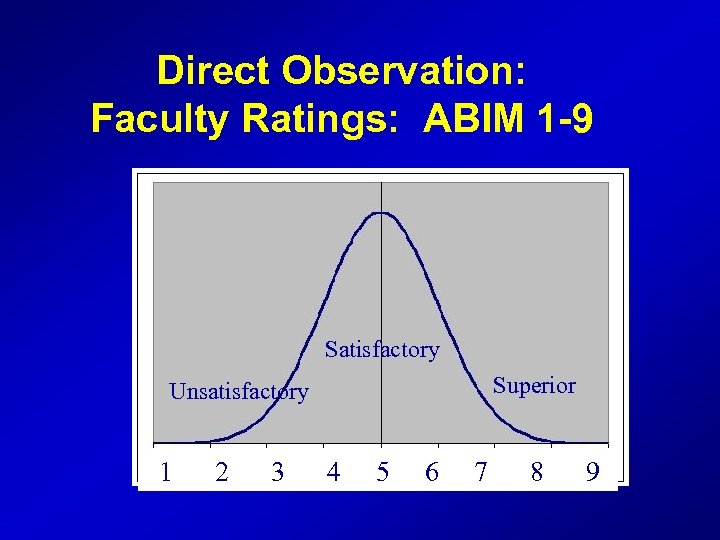 Direct Observation: Faculty Ratings: ABIM 1 -9 Satisfactory Superior Unsatisfactory 1 2 3 4 5 6 7 8 9
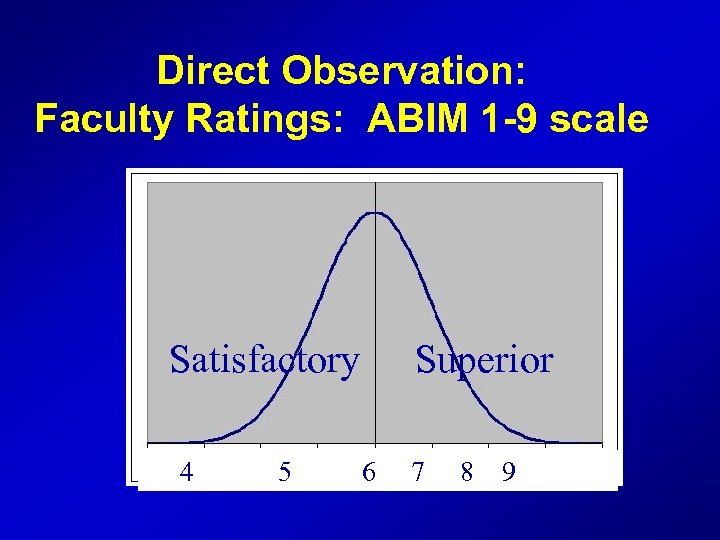 Direct Observation: Faculty Ratings: ABIM 1 -9 scale Satisfactory 4 5 Superior 6 7 8 9
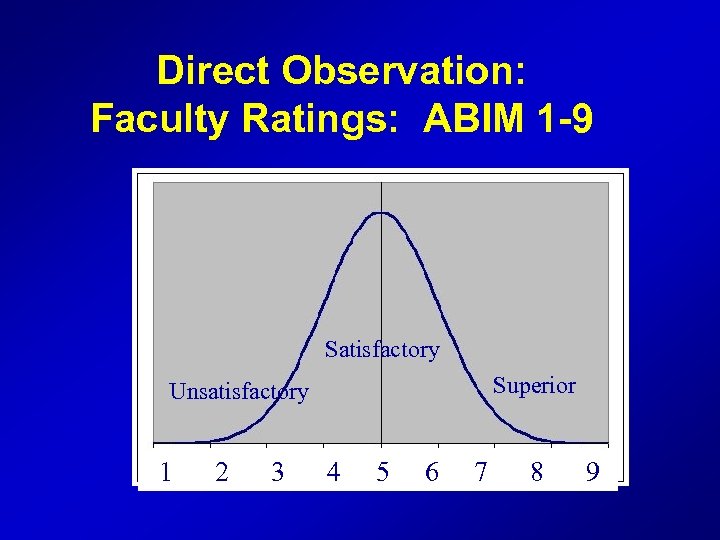 Direct Observation: Faculty Ratings: ABIM 1 -9 Satisfactory Superior Unsatisfactory 1 2 3 4 5 6 7 8 9
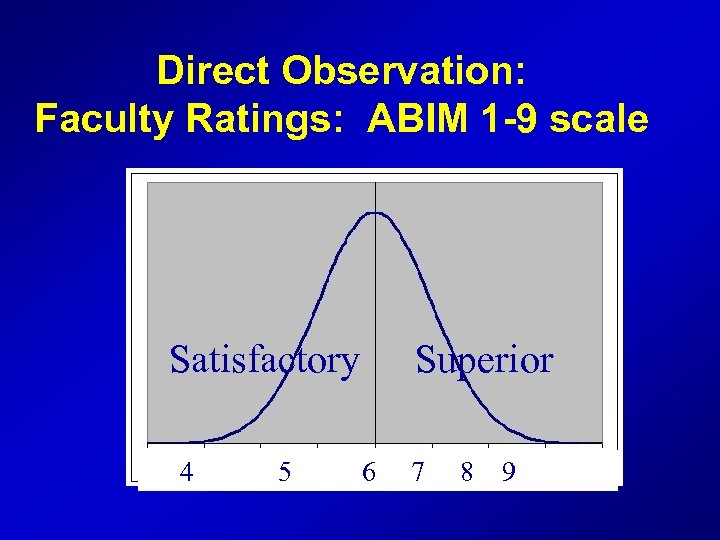 Direct Observation: Faculty Ratings: ABIM 1 -9 scale Satisfactory 4 5 Superior 6 7 8 9
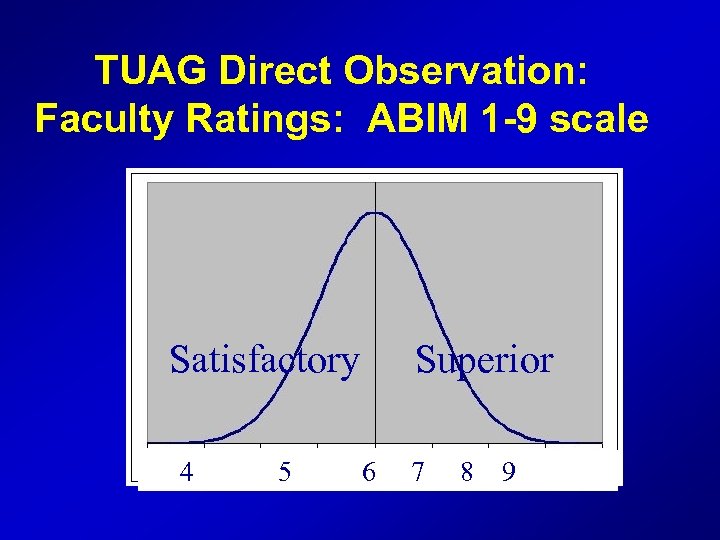 TUAG Direct Observation: Faculty Ratings: ABIM 1 -9 scale Satisfactory 4 5 Superior 6 7 8 9
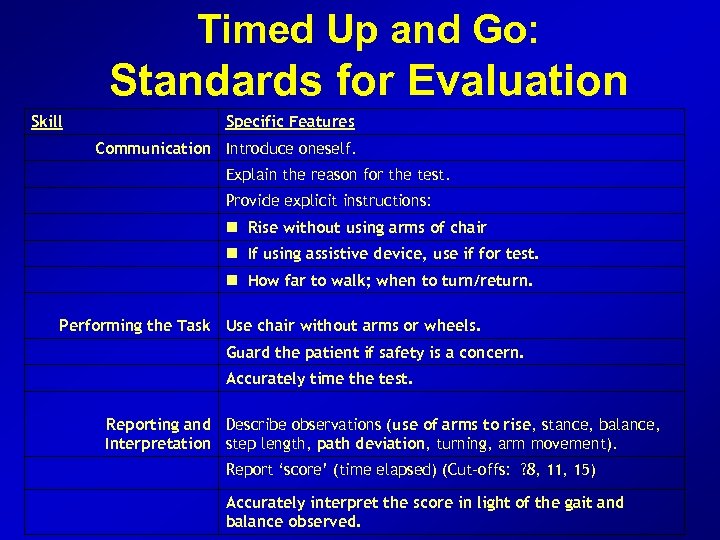 Timed Up and Go: Standards for Evaluation Skill Specific Features Communication Introduce oneself. Explain the reason for the test. Provide explicit instructions: Rise without using arms of chair If using assistive device, use if for test. How far to walk; when to turn/return. Performing the Task Use chair without arms or wheels. Guard the patient if safety is a concern. Accurately time the test. Reporting and Describe observations (use of arms to rise, stance, balance, Interpretation step length, path deviation, turning, arm movement). Report ‘score’ (time elapsed) (Cut-offs: ? 8, 11, 15) Accurately interpret the score in light of the gait and balance observed.
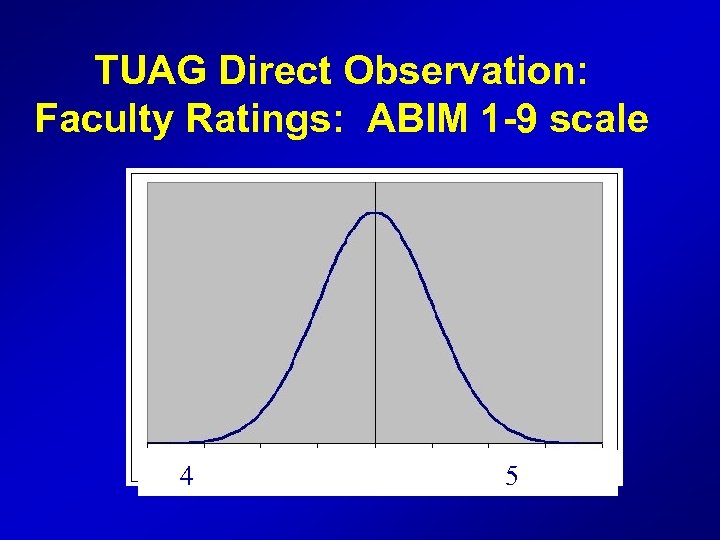 TUAG Direct Observation: Faculty Ratings: ABIM 1 -9 scale 4 5
 How Do We Get There?