 Скачать презентацию Hepatitis B Virus Drugs in Pregnancy Findings from
becc5f9d87aec7658921e31ceb3d6a05.ppt
- Количество слайдов: 25



Hepatitis B Virus Drugs in Pregnancy: Findings from the Antiretroviral Pregnancy Registry RS Brown, Jr 1, M Buti 2, D Goodwin 3, S Zhang 3, E Fagan 3 1 Columbia University College of Physicians and Surgeons, New York, NY, USA 2 Hospital Vall d’Hebron, Barcelona, Spain 3 Gilead Sciences, Inc. , Foster City, CA, USA 44 th Annual Meeting of the European Association for the Study of the Liver April 22 – 26, 2009 Copenhagen, Denmark Oral #
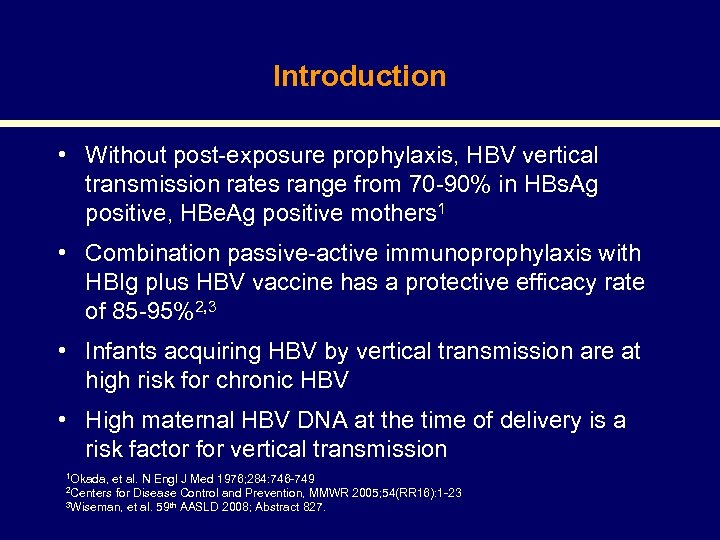
Introduction • Without post-exposure prophylaxis, HBV vertical transmission rates range from 70 -90% in HBs. Ag positive, HBe. Ag positive mothers 1 • Combination passive-active immunoprophylaxis with HBIg plus HBV vaccine has a protective efficacy rate of 85 -95%2, 3 • Infants acquiring HBV by vertical transmission are at high risk for chronic HBV • High maternal HBV DNA at the time of delivery is a risk factor for vertical transmission 1 Okada, et al. N Engl J Med 1976; 284: 746 -749 for Disease Control and Prevention, MMWR 2005; 54(RR 16): 1 -23 3 Wiseman, et al. 59 th AASLD 2008; Abstract 827. 2 Centers
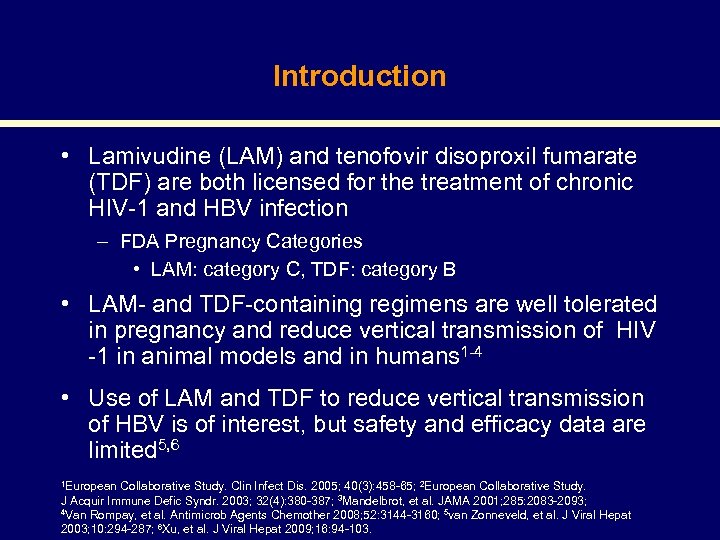
Introduction • Lamivudine (LAM) and tenofovir disoproxil fumarate (TDF) are both licensed for the treatment of chronic HIV-1 and HBV infection – FDA Pregnancy Categories • LAM: category C, TDF: category B • LAM- and TDF-containing regimens are well tolerated in pregnancy and reduce vertical transmission of HIV -1 in animal models and in humans 1 -4 • Use of LAM and TDF to reduce vertical transmission of HBV is of interest, but safety and efficacy data are limited 5, 6 1 European Collaborative Study. Clin Infect Dis. 2005; 40(3): 458 -65; 2 European Collaborative Study. J Acquir Immune Defic Syndr. 2003; 32(4): 380 -387; 3 Mandelbrot, et al. JAMA 2001; 285: 2083 -2093; 4 Van Rompay, et al. Antimicrob Agents Chemother 2008; 52: 3144 -3160; 5 van Zonneveld, et al. J Viral Hepat 2003; 10: 294 -287; 6 Xu, et al. J Viral Hepat 2009; 16: 94 -103.
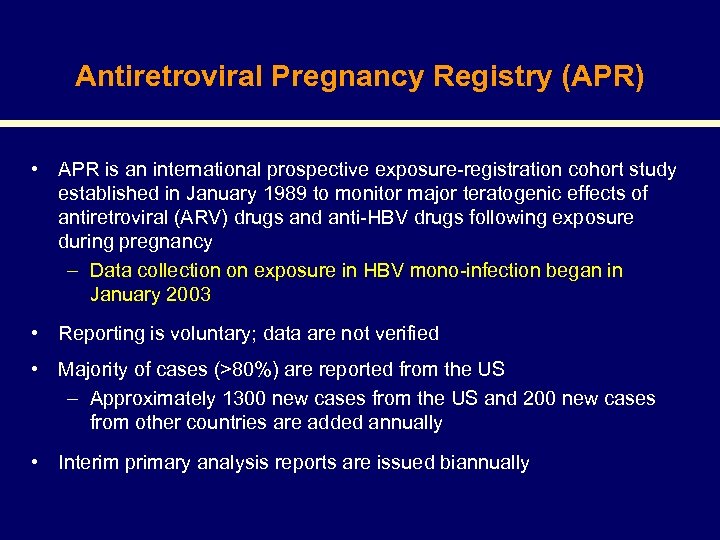
Antiretroviral Pregnancy Registry (APR) • APR is an international prospective exposure-registration cohort study established in January 1989 to monitor major teratogenic effects of antiretroviral (ARV) drugs and anti-HBV drugs following exposure during pregnancy – Data collection on exposure in HBV mono-infection began in January 2003 • Reporting is voluntary; data are not verified • Majority of cases (>80%) are reported from the US – Approximately 1300 new cases from the US and 200 new cases from other countries are added annually • Interim primary analysis reports are issued biannually
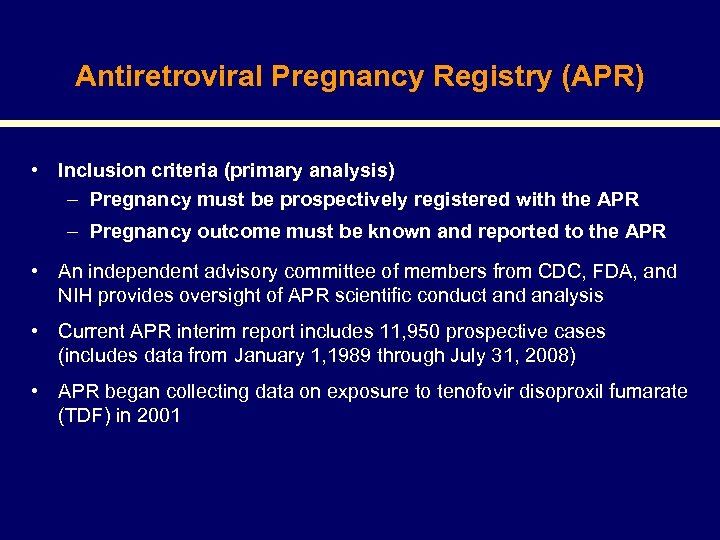
Antiretroviral Pregnancy Registry (APR) • Inclusion criteria (primary analysis) – Pregnancy must be prospectively registered with the APR – Pregnancy outcome must be known and reported to the APR • An independent advisory committee of members from CDC, FDA, and NIH provides oversight of APR scientific conduct and analysis • Current APR interim report includes 11, 950 prospective cases (includes data from January 1, 1989 through July 31, 2008) • APR began collecting data on exposure to tenofovir disoproxil fumarate (TDF) in 2001
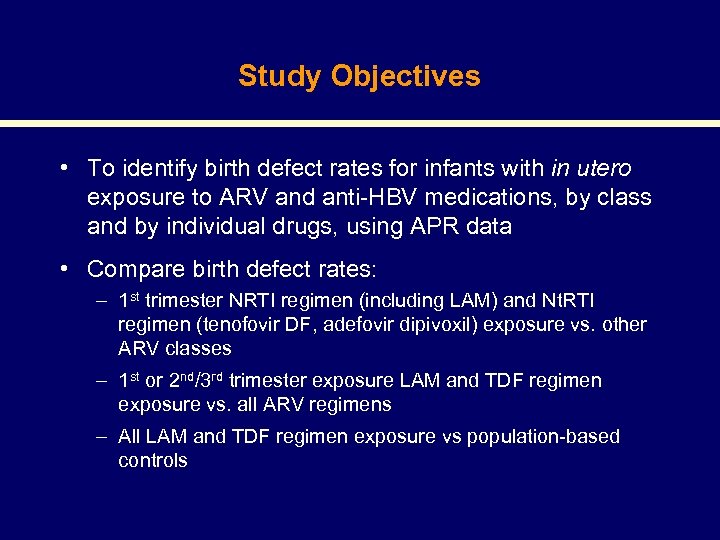
Study Objectives • To identify birth defect rates for infants with in utero exposure to ARV and anti-HBV medications, by class and by individual drugs, using APR data • Compare birth defect rates: – 1 st trimester NRTI regimen (including LAM) and Nt. RTI regimen (tenofovir DF, adefovir dipivoxil) exposure vs. other ARV classes – 1 st or 2 nd/3 rd trimester exposure LAM and TDF regimen exposure vs. all ARV regimens – All LAM and TDF regimen exposure vs population-based controls
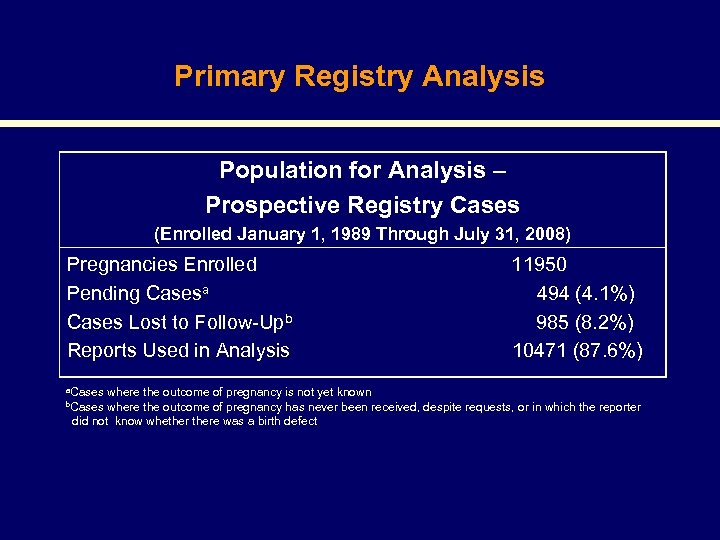
Primary Registry Analysis Population for Analysis – Prospective Registry Cases (Enrolled January 1, 1989 Through July 31, 2008) Pregnancies Enrolled Pending Casesa Cases Lost to Follow-Upb Reports Used in Analysis a. Cases 11950 494 (4. 1%) 985 (8. 2%) 10471 (87. 6%) where the outcome of pregnancy is not yet known where the outcome of pregnancy has never been received, despite requests, or in which the reporter did not know whethere was a birth defect b. Cases
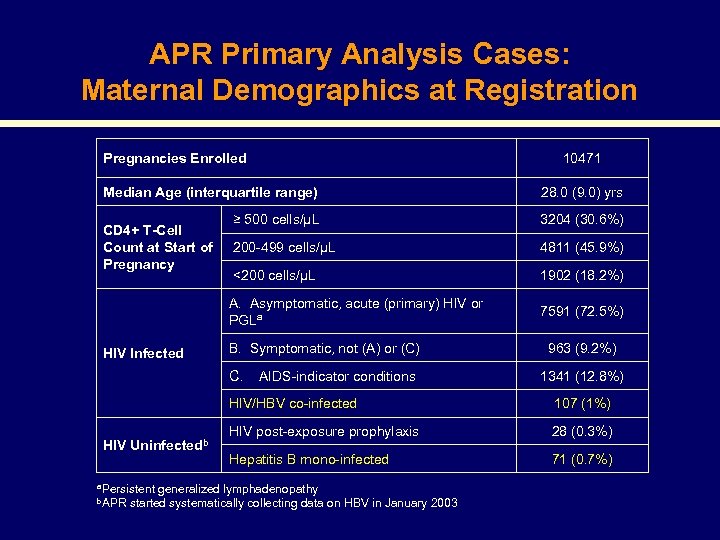
APR Primary Analysis Cases: Maternal Demographics at Registration Pregnancies Enrolled 10471 Median Age (interquartile range) 28. 0 (9. 0) yrs ≥ 500 cells/µL 3204 (30. 6%) 200 -499 cells/µL 4811 (45. 9%) <200 cells/µL 1902 (18. 2%) A. Asymptomatic, acute (primary) HIV or PGLa 7591 (72. 5%) CD 4+ T-Cell Count at Start of Pregnancy HIV Infected B. Symptomatic, not (A) or (C) C. AIDS-indicator conditions 963 (9. 2%) 1341 (12. 8%) HIV/HBV co-infected HIV Uninfectedb a. Persistent b. APR 107 (1%) HIV post-exposure prophylaxis 28 (0. 3%) Hepatitis B mono-infected 71 (0. 7%) generalized lymphadenopathy started systematically collecting data on HBV in January 2003
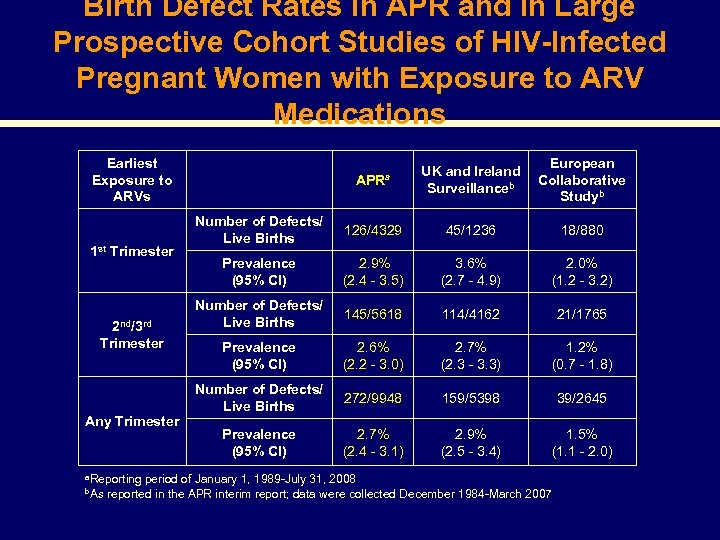
Birth Defect Rates in APR and in Large Prospective Cohort Studies of HIV-Infected Pregnant Women with Exposure to ARV Medications Earliest Exposure to ARVs 1 st Trimester 2 nd/3 rd Trimester Any Trimester a. Reporting b. As APRa UK and Ireland Surveillanceb European Collaborative Studyb Number of Defects/ Live Births 126/4329 45/1236 18/880 Prevalence (95% CI) 2. 9% (2. 4 - 3. 5) 3. 6% (2. 7 - 4. 9) 2. 0% (1. 2 - 3. 2) Number of Defects/ Live Births 145/5618 114/4162 21/1765 Prevalence (95% CI) 2. 6% (2. 2 - 3. 0) 2. 7% (2. 3 - 3. 3) 1. 2% (0. 7 - 1. 8) Number of Defects/ Live Births 272/9948 159/5398 39/2645 Prevalence (95% CI) 2. 7% (2. 4 - 3. 1) 2. 9% (2. 5 - 3. 4) 1. 5% (1. 1 - 2. 0) period of January 1, 1989 -July 31, 2008 reported in the APR interim report; data were collected December 1984 -March 2007
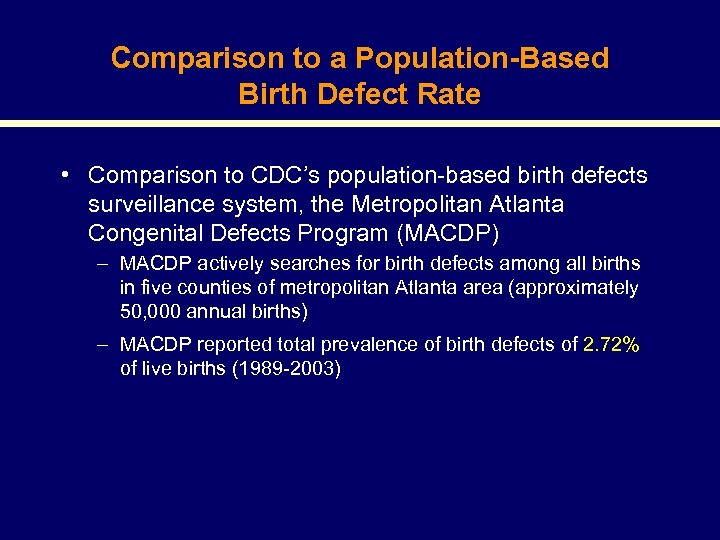
Comparison to a Population-Based Birth Defect Rate • Comparison to CDC’s population-based birth defects surveillance system, the Metropolitan Atlanta Congenital Defects Program (MACDP) – MACDP actively searches for birth defects among all births in five counties of metropolitan Atlanta area (approximately 50, 000 annual births) – MACDP reported total prevalence of birth defects of 2. 72% of live births (1989 -2003)
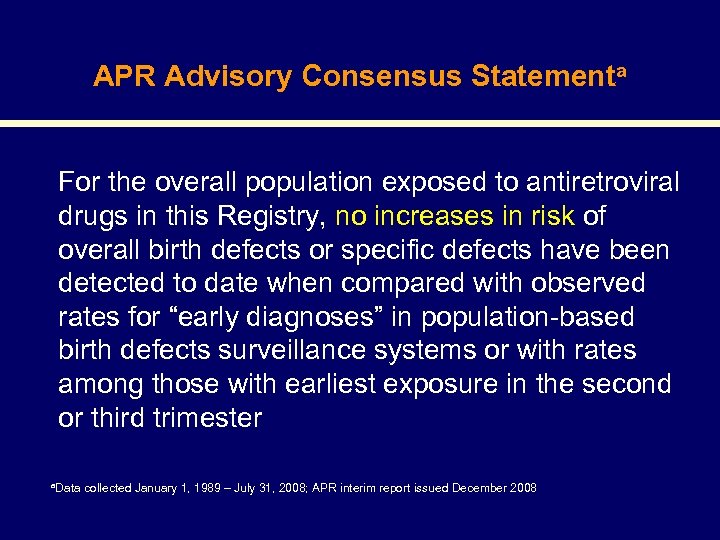
APR Advisory Consensus Statementa For the overall population exposed to antiretroviral drugs in this Registry, no increases in risk of overall birth defects or specific defects have been detected to date when compared with observed rates for “early diagnoses” in population-based birth defects surveillance systems or with rates among those with earliest exposure in the second or third trimester a. Data collected January 1, 1989 – July 31, 2008; APR interim report issued December 2008
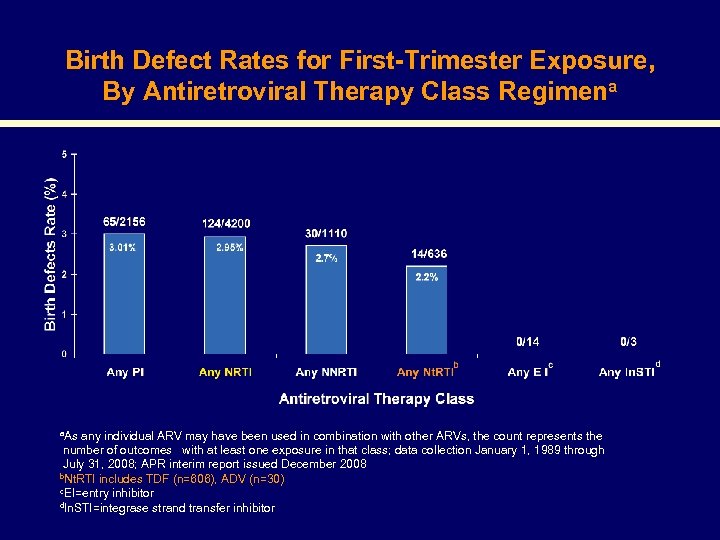
Birth Defect Rates for First-Trimester Exposure, By Antiretroviral Therapy Class Regimena a. As any individual ARV may have been used in combination with other ARVs, the count represents the number of outcomes with at least one exposure in that class; data collection January 1, 1989 through July 31, 2008; APR interim report issued December 2008 b. Nt. RTI includes TDF (n=606), ADV (n=30) c. EI=entry inhibitor d. In. STI=integrase strand transfer inhibitor
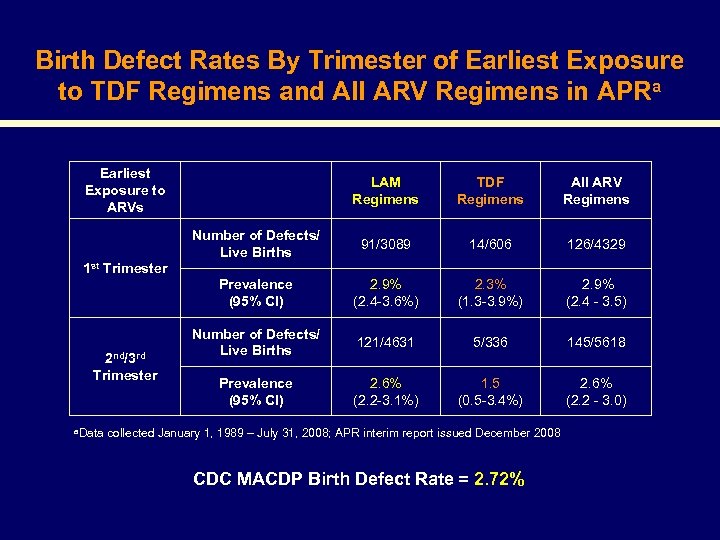
Birth Defect Rates By Trimester of Earliest Exposure to TDF Regimens and All ARV Regimens in APRa Earliest Exposure to ARVs LAM Regimens TDF Regimens All ARV Regimens Number of Defects/ Live Births 91/3089 14/606 126/4329 Prevalence (95% CI) 2. 9% (2. 4 -3. 6%) 2. 3% (1. 3 -3. 9%) 2. 9% (2. 4 - 3. 5) Number of Defects/ Live Births 121/4631 5/336 145/5618 Prevalence (95% CI) 2. 6% (2. 2 -3. 1%) 1. 5 (0. 5 -3. 4%) 2. 6% (2. 2 - 3. 0) 1 st Trimester 2 nd/3 rd Trimester a. Data collected January 1, 1989 – July 31, 2008; APR interim report issued December 2008 CDC MACDP Birth Defect Rate = 2. 72%
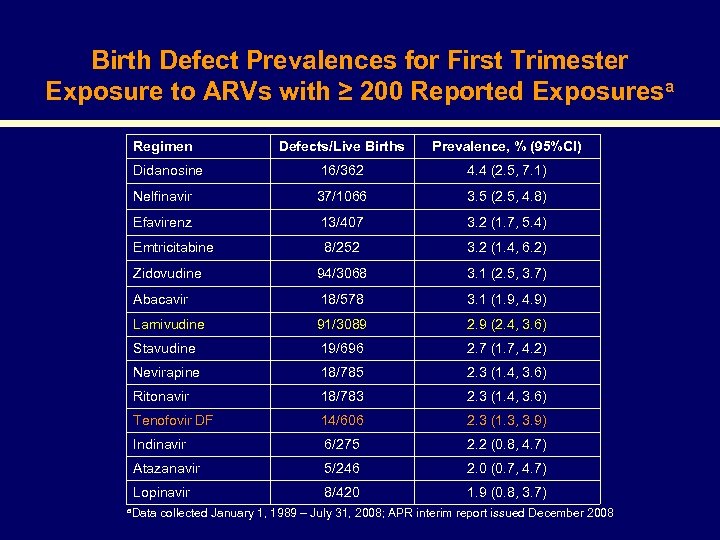
Birth Defect Prevalences for First Trimester Exposure to ARVs with ≥ 200 Reported Exposuresa Regimen Defects/Live Births Prevalence, % (95%CI) Didanosine 16/362 4. 4 (2. 5, 7. 1) Nelfinavir 37/1066 3. 5 (2. 5, 4. 8) Efavirenz 13/407 3. 2 (1. 7, 5. 4) Emtricitabine 8/252 3. 2 (1. 4, 6. 2) Zidovudine 94/3068 3. 1 (2. 5, 3. 7) Abacavir 18/578 3. 1 (1. 9, 4. 9) Lamivudine 91/3089 2. 9 (2. 4, 3. 6) Stavudine 19/696 2. 7 (1. 7, 4. 2) Nevirapine 18/785 2. 3 (1. 4, 3. 6) Ritonavir 18/783 2. 3 (1. 4, 3. 6) Tenofovir DF 14/606 2. 3 (1. 3, 3. 9) Indinavir 6/275 2. 2 (0. 8, 4. 7) Atazanavir 5/246 2. 0 (0. 7, 4. 7) Lopinavir 8/420 1. 9 (0. 8, 3. 7) a. Data collected January 1, 1989 – July 31, 2008; APR interim report issued December 2008
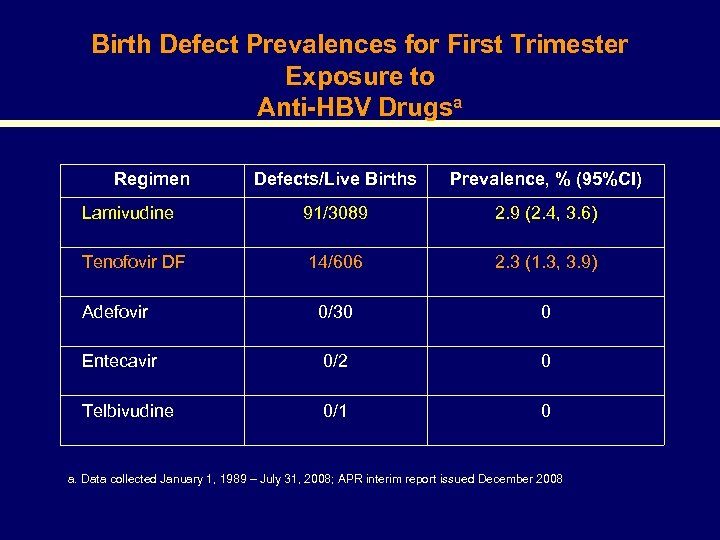
Birth Defect Prevalences for First Trimester Exposure to Anti-HBV Drugsa Regimen Defects/Live Births Prevalence, % (95%CI) Lamivudine 91/3089 2. 9 (2. 4, 3. 6) Tenofovir DF 14/606 2. 3 (1. 3, 3. 9) Adefovir 0/30 0 Entecavir 0/2 0 Telbivudine 0/1 0 a. Data collected January 1, 1989 – July 31, 2008; APR interim report issued December 2008
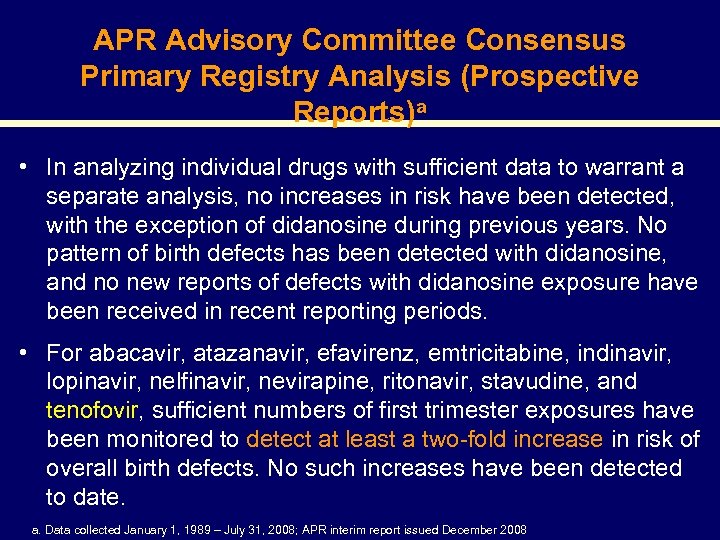
APR Advisory Committee Consensus Primary Registry Analysis (Prospective Reports)a • In analyzing individual drugs with sufficient data to warrant a separate analysis, no increases in risk have been detected, with the exception of didanosine during previous years. No pattern of birth defects has been detected with didanosine, and no new reports of defects with didanosine exposure have been received in recent reporting periods. • For abacavir, atazanavir, efavirenz, emtricitabine, indinavir, lopinavir, nelfinavir, nevirapine, ritonavir, stavudine, and tenofovir, sufficient numbers of first trimester exposures have been monitored to detect at least a two-fold increase in risk of overall birth defects. No such increases have been detected to date. a. Data collected January 1, 1989 – July 31, 2008; APR interim report issued December 2008
APR Advisory Committee Consensus Primary Registry Analysis (Prospective Reports)a • For lamivudine and zidovudine, sufficient numbers of first trimester exposures have been monitored to detect at least a 1. 5 -fold increase in risk of overall birth defects and a 2 fold increase in risk of birth defects in the more common classes, cardiovascular and genitourinary systems. No such increases have been detected to date, with the exception of hypospadias following first trimester exposure to zidovudine from the addition of the Women and Infants Transmission Study (WITS) data. With additional accrual of first trimester exposures, this finding has not persisted. a. Data collected January 1, 1989 – July 31, 2008; APR interim report issued December 2008
Other Anti-HBV Drugs • There are insufficient numbers of pregnancy exposures to adefovir dipivoxil, entecavir and telbivudine to draw conclusions on exposure risk
Limitations of APR Data • Limitations of the APR include, but are not limited to: – Underreporting (i. e. , not every report of an exposure is obtained) – Differential reporting (e. g. , there may be reasons why one report would be provided to the Registry and another would not) – Under-ascertainment of birth defects (e. g. , not every birth defect is identified, reporter may not see the defect at birth) – Differential ascertainment of birth defects (e. g. , variable use of diagnostic tests) – Loss to follow up (e. g. , no outcome information is obtained) – Small number of cases of HBV mono-infection or co-infection
Conclusions • APR overall birth defect prevalence (2. 7%) is comparable to other large prospective cohort studies of newborns with prenatal exposure to ARVs (2. 9% and 1. 5%) and to CDC population-based surveillance data (2. 72%) • Prevalence of birth defects with 1 st-trimester exposure to ARVs (2. 9 per 100 live births) is similar to prevalence of defects with the first exposure during the 2 nd/3 rd trimesters (2. 6 per 100 live births) • No specific patterns of birth defects were observed • The APR contains a larger number of LAM and TDF cases, compared to other HBV drugs • Birth defect prevalence with 1 st-trimester exposure to NRTI class (including LAM) and Nt. RTI class (TDF or adefovir regimens) is similar to other ARV classes
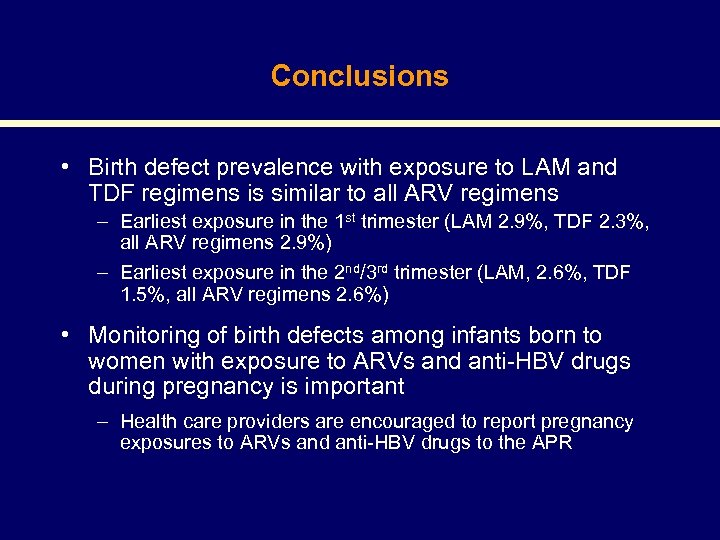
Conclusions • Birth defect prevalence with exposure to LAM and TDF regimens is similar to all ARV regimens – Earliest exposure in the 1 st trimester (LAM 2. 9%, TDF 2. 3%, all ARV regimens 2. 9%) – Earliest exposure in the 2 nd/3 rd trimester (LAM, 2. 6%, TDF 1. 5%, all ARV regimens 2. 6%) • Monitoring of birth defects among infants born to women with exposure to ARVs and anti-HBV drugs during pregnancy is important – Health care providers are encouraged to report pregnancy exposures to ARVs and anti-HBV drugs to the APR
APR Contact Information APR Website: www. APRegistry. com Phone/Fax Contacts: US, Canada: (800) 258 -4263 (Phone) (800) 800 -1052 (Fax) International: +1 -910 -256 -0238 (Phone) +1 -910 -256 -0637 (Fax) UK, Germany, France: (00800) 5913 -1359 (Phone) (00800) 5812 -1658 (Fax) Europe: +32 -2 -714 -5028 (Phone) +32 -2 -714 -5024 (Fax) Brazil: (888) 259 -5618 (Fax)

Back-Up Slides
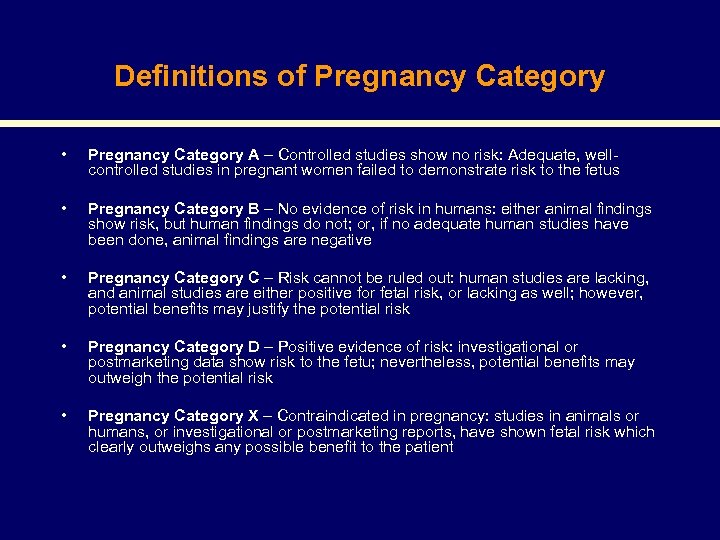
Definitions of Pregnancy Category • Pregnancy Category A – Controlled studies show no risk: Adequate, wellcontrolled studies in pregnant women failed to demonstrate risk to the fetus • Pregnancy Category B – No evidence of risk in humans: either animal findings show risk, but human findings do not; or, if no adequate human studies have been done, animal findings are negative • Pregnancy Category C – Risk cannot be ruled out: human studies are lacking, and animal studies are either positive for fetal risk, or lacking as well; however, potential benefits may justify the potential risk • Pregnancy Category D – Positive evidence of risk: investigational or postmarketing data show risk to the fetu; nevertheless, potential benefits may outweigh the potential risk • Pregnancy Category X – Contraindicated in pregnancy: studies in animals or humans, or investigational or postmarketing reports, have shown fetal risk which clearly outweighs any possible benefit to the patient
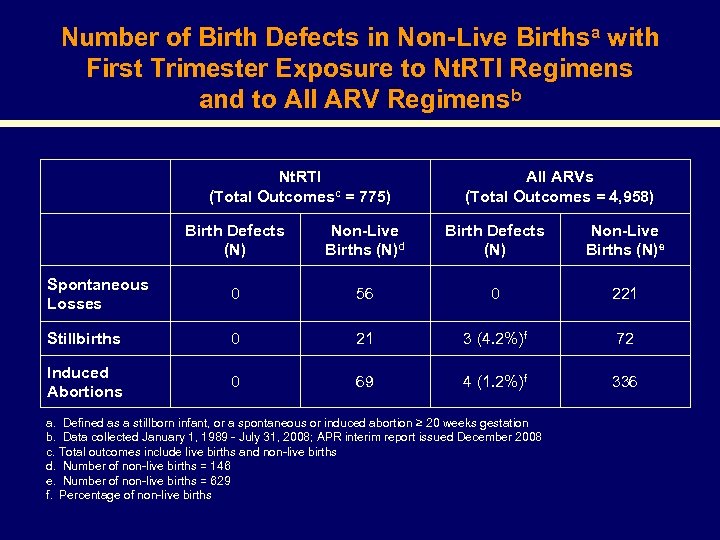
Number of Birth Defects in Non-Live Birthsa with First Trimester Exposure to Nt. RTI Regimens and to All ARV Regimensb Nt. RTI (Total Outcomesc = 775) All ARVs (Total Outcomes = 4, 958) Birth Defects (N) Non-Live Births (N)d Birth Defects (N) Non-Live Births (N)e Spontaneous Losses 0 56 0 221 Stillbirths 0 21 3 (4. 2%)f 72 Induced Abortions 0 69 4 (1. 2%)f 336 a. Defined as a stillborn infant, or a spontaneous or induced abortion ≥ 20 weeks gestation b. Data collected January 1, 1989 - July 31, 2008; APR interim report issued December 2008 c. Total outcomes include live births and non-live births d. Number of non-live births = 146 e. Number of non-live births = 629 f. Percentage of non-live births
Скачать презентацию Hepatitis B Virus Drugs in Pregnancy Findings from
becc5f9d87aec7658921e31ceb3d6a05.ppt