


 Скачать презентацию Henry County School Psychologists From our family to
b13804b05d01b33076be93475a35f969.ppt
- Количество слайдов: 24
 Henry County School Psychologists From our family to yours we are here to provide collaborative and compassionate services to help your children thrive academically, behaviorally, and socially.
 What is a school psychologist? School Psychologists are trained professionals with experience and expertise in psychology and education. School psychologists are trained in child development, mental health and educational interventions, learning, behavior, motivation, curriculum and instruction, assessment, collaboration, consultation, system level analysis, and school law. School Psychologists help children and adolescents succeed academically, behaviorally, emotionally, and socially. Copyright © 2013 http: //www. nasponline. org/
 What Roles do School Psychologists have in schools? Identify learning and behavior problems that interfere with school success Help parents and teachers to implement research based interventions that address students' academic, behavioral, and social needs Provide counseling instruction and mentoring for those struggling with emotional, behavioral, and social challenges Encourage understanding and acceptance of diverse cultures and backgrounds Conduct psychoeducational assessments that are used to make team decisions regarding eligibility for special education services Promote positive classroom environments Help to design and implement student progress monitoring systems Implement school wide prevention programs Respond to crises by providing direct service and leadership Promote school policies and procedures that ensure the safety of all students Copyright © 2013 http: //www. nasponline. org/
 Copyright © 2013 http: //www. nasponline. org/
 Attention-Deficit Hyperactivity Disorder • • The essential feature of attention-deficit/hyperactivity disorder (ADHD) is a persistent pattern of inattention and/or hyperactivity-impulsivity that interferes with functioning or development. Copyright © 2013 American Psychiatric Association • Taking Charge of ADHD: The Complete Authoritative Guide for Parents- Third Edition. By: Dr. Russell Barkley • Driven to Distraction by: Dr. Edward Hallowell • Delivered from Distraction: Getting the most out of life with Attention Deficit Disorder by: Dr. Edward Hallowell • www. chadd. org; www. samgoldstein. com; www. russellbarkley. com; www. schoolpsychologistfiles. com • http: //www. cdc. gov/ncbddd/ADHD/facts. html • Some Kids Just Can't Sit Still by: Dr. Sam Goldstein; A Walk in the Rain With A Brain by: Dr. Edward Hallowell •
 Attention-Deficit/Hyperactivity Disorder • Service options in schools: • Some students with ADHD will benefit from academic and behavioral supports through regular education through the Multi-Tiered System of Supports. • Students with ADHD with severe behavioral and academic challenges may benefit from accommodations through a Section 504 plan while in regular education, or they may benefit from accommodations, daily individualized educational plan goals, and classroom setting adjustments through placement in special education. • Section 504 and special education decisions are always committee decisions. Parents, teachers, administrators, and school psychologists are all possible participants in committee decisions.
 Tips for Improving reading comprehension 1) Establish a purpose for reading 2) Identify the title and author 3) Comment on the cover illustration 4) Scan through the pages 5) Establish the W’s (who, what, where, when, why) 6) Relate the story and events to your child’s existing knowledge and interests 7) Predict future events (read a passage, pause, comment, and ask your child to predict what will happen next Copyright © 2003 by Sally Shaywitz, M. D. from the book Overcoming Dyslexia: A New and Complete Science-Based Program for Reading Problems at any Level
 Tips for Improving Reading Comprehension 8) Summarize the main ideas 9) Generate questions as you read 10) Make inferences 11) Clarify difficult words or confusing concepts 12) Use imagery or visualization 13) Organize ideas, perhaps graphically on paper 14) Retell the sequence of events 15) Enjoy the story Copyright © 2003 by Sally Shaywitz, M. D. from the book Overcoming Dyslexia: A New and Complete Science-Based Program for Reading Problems at any Level
 What happens during an eligibility meeting? • Parents speak about child's strengths and challenges • Classroom teacher speaks about interventions and child's progress through progress monitoring data • School Psychologist reviews psychoeducational evaluation results with the committee • The committee determines if the child meets eligibility criteria for special education • If the child is found eligible for special education, then IEP goals, classroom and testing accommodations, and classroom settings will be discussed. • If the committee decides that the child is not eligible for special education the child will be returned to the student support team in regular education to be monitored by the Multi- Tiered System of Supports.
 Specific Learning Disorder is a neurodevelopmental disorder with a biological origin that is the basis for abnormalities at a cognitive level that are associated with the behavioral signs of the disorder. One essential feature of specific learning disorder is persistent difficulties learning keystone academic skills with onset during the years of formal schooling. Key academic skills include reading of single words accurately and fluently, reading comprehension, written expression and spelling, arithmetic calculation, and mathematical reasoning. Copyright © 2013 American Psychiatric Association • • • Resources: Overcoming Dyslexia by: Dr. Sally Shaywitz www. allkindsofminds. org; www. interventioncentral. org The Dyscalculia Toolkit: Supporting Learning Difficulties in Math by: Ronit Bird My Thirteenth Winter: A Memoir by: Samantha Abeel www. ncld. org; www. ldonline. org; www. ldworldwide. org
 Autism Spectrum Disorder • • The essential features of autism spectrum disorder are persistent impairment in reciprocal social communication and social interaction, and restricted, repetitive patterns of behavior, interests, or activities. These symptoms are present from early childhood and limit or impair everyday functioning. Copyright © 2013 American Psychiatric Association • Resources The Complete Guide to Asperger's Syndrome by: Tony Attwood • www. autismspeaks. org • www. tonyattwood. com. au • www. autism-society. org and TEACCH program -www. autismsociety-nc. org • The New Social Story Book, Revised and Expanded 10 th Anniversary Edition: Over 150 Social Stories that Teach Everyday Social Skills to Children with Autism or Asperger's Syndrome, and their Peers. By: Carol Gray • The Autistic Brain: Thinking Across the Spectrum By: Temple Grandin and Richard Panek •
 Autism Spectrum Disorder Resources: Skillstreaming the Elementary School Child. New Strategies and Perspectives for Teaching Prosocial Skills-Revised Edition by: Ellen Mc. Ginnis and Arnold P. Goldstein Nonverbal Learning Disorder: Understanding and Coping with NLD and Asperger’s-What Parents and Teachers Need to Know by: Rondalyn Varney-Whitney, MOT, OTR/L
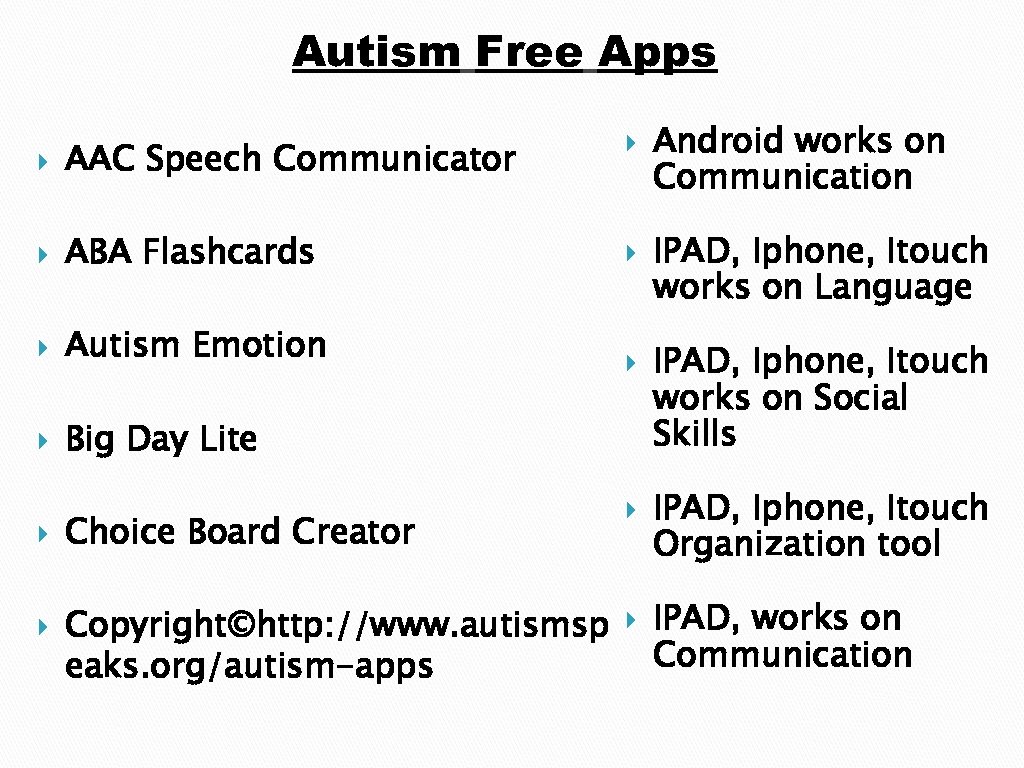 Autism Free Apps AAC Speech Communicator ABA Flashcards Autism Emotion Big Day Lite Choice Board Creator Copyright©http: //www. autismsp eaks. org/autism-apps Android works on Communication IPAD, Iphone, Itouch works on Language IPAD, Iphone, Itouch works on Social Skills IPAD, Iphone, Itouch Organization tool IPAD, works on Communication
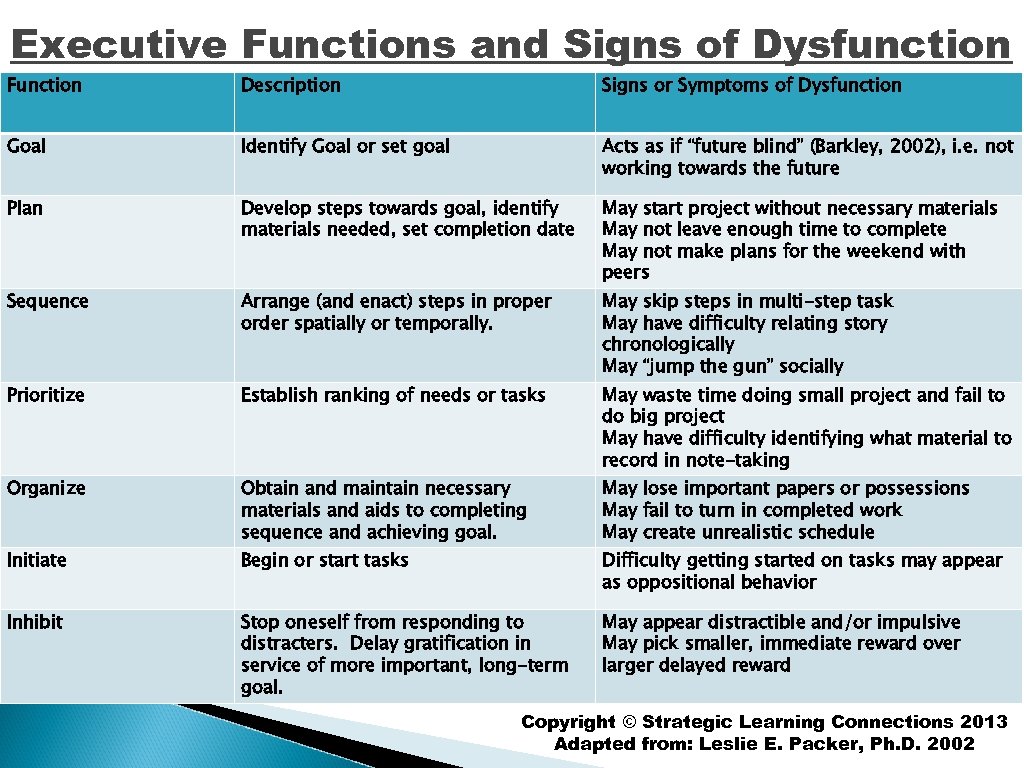 Executive Functions and Signs of Dysfunction Function Description Signs or Symptoms of Dysfunction Goal Identify Goal or set goal Acts as if “future blind” (Barkley, 2002), i. e. not working towards the future Plan Develop steps towards goal, identify materials needed, set completion date May start project without necessary materials May not leave enough time to complete May not make plans for the weekend with peers Sequence Arrange (and enact) steps in proper order spatially or temporally. May skip steps in multi-step task May have difficulty relating story chronologically May “jump the gun” socially Prioritize Establish ranking of needs or tasks May waste time doing small project and fail to do big project May have difficulty identifying what material to record in note-taking Organize Obtain and maintain necessary materials and aids to completing sequence and achieving goal. May lose important papers or possessions May fail to turn in completed work May create unrealistic schedule Initiate Begin or start tasks Difficulty getting started on tasks may appear as oppositional behavior Inhibit Stop oneself from responding to distracters. Delay gratification in service of more important, long-term goal. May appear distractible and/or impulsive May pick smaller, immediate reward over larger delayed reward Copyright © Strategic Learning Connections 2013 Adapted from: Leslie E. Packer, Ph. D. 2002
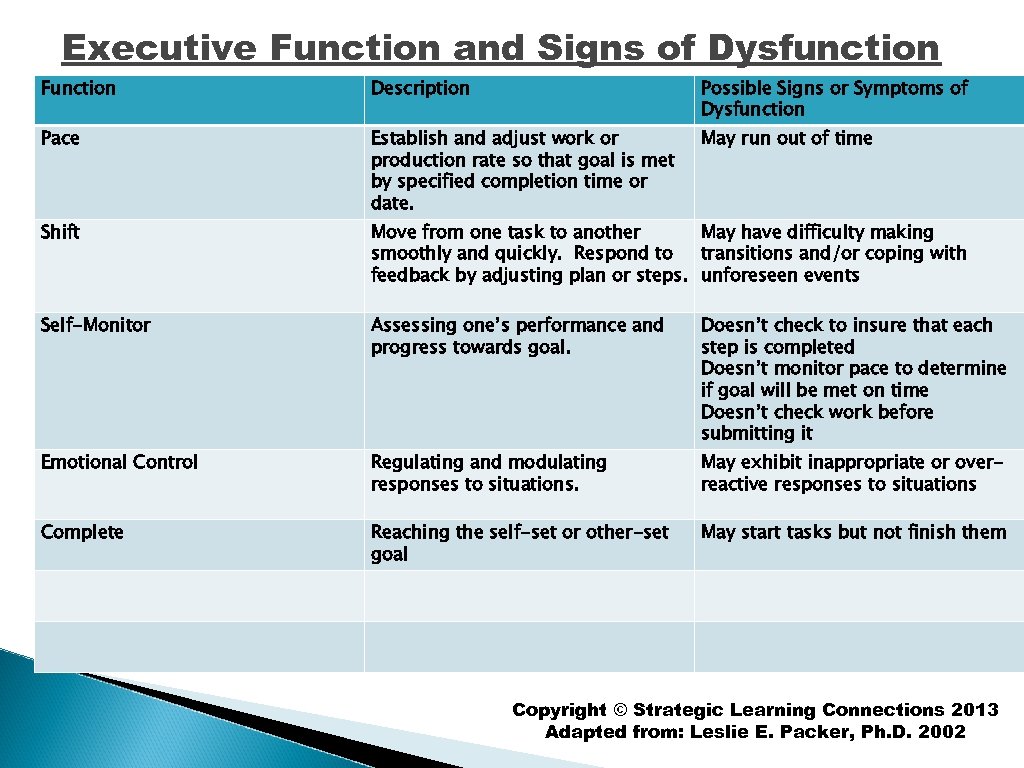 Executive Function and Signs of Dysfunction Function Description Possible Signs or Symptoms of Dysfunction Pace Establish and adjust work or production rate so that goal is met by specified completion time or date. May run out of time Shift Move from one task to another May have difficulty making smoothly and quickly. Respond to transitions and/or coping with feedback by adjusting plan or steps. unforeseen events Self-Monitor Assessing one’s performance and progress towards goal. Doesn’t check to insure that each step is completed Doesn’t monitor pace to determine if goal will be met on time Doesn’t check work before submitting it Emotional Control Regulating and modulating responses to situations. May exhibit inappropriate or overreactive responses to situations Complete Reaching the self-set or other-set goal May start tasks but not finish them Copyright © Strategic Learning Connections 2013 Adapted from: Leslie E. Packer, Ph. D. 2002
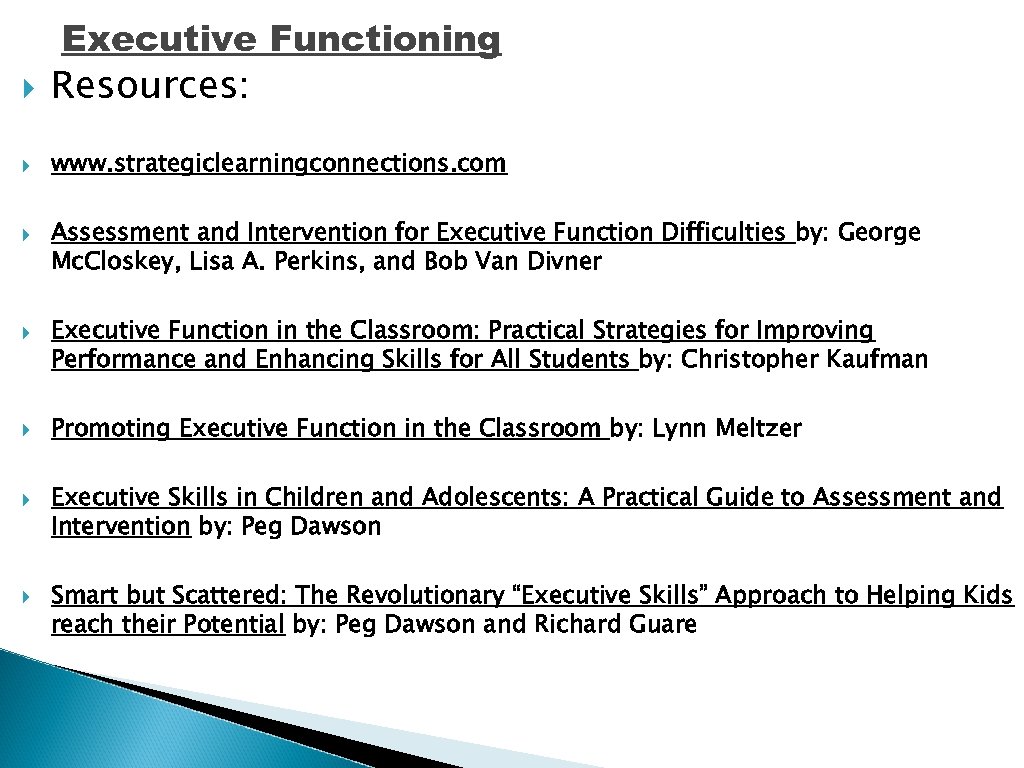 Executive Functioning Resources: www. strategiclearningconnections. com Assessment and Intervention for Executive Function Difficulties by: George Mc. Closkey, Lisa A. Perkins, and Bob Van Divner Executive Function in the Classroom: Practical Strategies for Improving Performance and Enhancing Skills for All Students by: Christopher Kaufman Promoting Executive Function in the Classroom by: Lynn Meltzer Executive Skills in Children and Adolescents: A Practical Guide to Assessment and Intervention by: Peg Dawson Smart but Scattered: The Revolutionary “Executive Skills” Approach to Helping Kids reach their Potential by: Peg Dawson and Richard Guare
 Disruptive Mood Dysregulation Disorder The core feature of disruptive mood dysregulation disorder is chronic, severe persistent irritability. Temper outbursts typically occur in response to frustration and can be verbal or behavioral (the latter in the form of aggression against property, self or others). Resources: Lost at School: Why are children with behavioral challenges are falling through the cracks and how we can help them By: Dr. Ross Greene www. livesinthebalance. org (web-site for Collaborative Problem Solving)
 Oppositional Defiant Disorder The essential feature of oppositional defiant disorder is a frequent and persistent pattern of angry/irritable mood, argumentative/defiant behavior, or vindictiveness. The symptoms of the disorder often are part of a pattern of problematic interactions with others. Resources www. livesinthebalance. org Lost at School by: Dr. Ross Greene The Explosive Child: A New Approach for Understanding and Parenting the Chronically Inflexible Child by: Dr. Ross Greene Your Defiant Child: Eight Steps to Better Behavior: 2 nd Edition by: Dr. Russell Barkley and Christine M. Benton
 Helpful Web-sites Psychology www. apa. org Web-site for the American Psychological Association. Helpful assessment and treatment information can be found at this site about all psychological disorders. www. nasponline. org Web-site for the National Association of School Psychologists. Helpful information can be found at this site about children and adolescent mental health, school resources and interventions, and information about school psychology www. gaspnet. org Web-site for the Georgia Association of School Psychologists (GASP). Helpful information can be found at this site about school safety, crisis intervention, and student mental health.
 Helpful Web-sites Reading http: //www. starfall. com/ Phonics, phonemic awareness, sequencing, reading fluency, repeated readings http: //specialed. about. com/od/wordwalls/a/families. htm Word families flashcards already prepared http: //specialed. about. com/od/literacy/a/dolch. htm Dolch words flashcards already prepared divided by categories (preprimer, 1 st, 2 nd, and 3 rd) http: //www. vocabulary. co. il/ Building vocabulary through match game using flashcards www. freerice. com Learn vocabulary, math, science, social studies, chemistry, geography, and foreign languages through answering multiple-choice questions. Correct answers lead to rice being donated to third world countries.
 Helpful Web-sites Language Arts http: //www. literacycenter. net/lessonview_de. htm Capital/lowercase letters Handwriting http: //www. bgfl. org/bgfl/custom/resources_ftp/client_ftp/ks 1/english/beatri x/index. htm Creating sentences Chronological order of words http: //www. gigglepotz. com/writingone. htm Writing prompts by month/theme Short sentences fill in the blank
 Helpful Web-sites Math http: //www. funbrain. com/kidscenter. html Educational games to enrich basic math facts by grade level http: //www. internet 4 classrooms. com/skills_1 st. htm Counting by two’s, by ten’s, etc. . http: //www. toonuniversity. com/flash. asp? err=569&engine= http: //www. aplusmath. com/cgi-bin/flashcards/money Counting coins www. khanacademy. org Excellent teaching of math concepts across elementary, middle, and high school concepts
 Helpful Web-sites- Math www. learnzillion. com Free tutorial videos on various math topics. www. ixl. com Free web-site where children can practice specific math skills for each grade level www. ricksmath. com/ Pre-kindergarten to high school students looking for a better understanding of math will find over 4, 800 problems to help them improve their skills. Problems can be printed in worksheet form.
 Helpful Web-sites Behavior Intervention Central www. interventioncentral. org Collaborative Problem-Solving www. livesinthebalance. org What Works Clearinghouse Http: //ies. ed. gov/ncee/wwc/ Positive Behavior Support http: //flpbs. fmhi. usf. edu/ http: //www. pbisworld. com/ http: //specialed. about. com/cs/behaviordisorders/a/behaviorcontrac. htm Behavior contracts http: //drwilliampmartin. tripod. com/classm. html Compilation of behavior management resources