


 Скачать презентацию Help Age International How cash transfers can support
06a90977d789943a4cb79b6842a54872.ppt
- Количество слайдов: 16
 Help. Age International How cash transfers can support the poorest older people and children Sylvia Beales June 2005
 Help. Age International
 Help. Age International The case for cash transfers and social protection § Social protection is a right; regular cash supports access to health, education and nutrition § Cash transfers reduce absolute poverty and hunger and support MDG achievement Evidence shows: § Cash transfers helps poor households manage risk, including that of HIV/AIDS § Cash transfers enhance assets and more secure livelihoods § Regular cash supports family cohesion and life chances of children § Poor (older) people prefer regular transfers of cash to other interventions
 Help. Age International Development policy, social protection and cash transfers § Call for better and more effective aid – as well as increased aid – to reach the billions still trapped in poverty § Recognition that targeting the poorest is required for MDGs § Greater emphasis is needed on frameworks for equity & redistribution to reach the poorest § More equitable and rights based poverty programmes deliver better development outcomes § Outcomes of the Commission for Africa report; all African countries to have social protection strategies for 2007, a rights and inclusion framework to support them and predictable funding streams
 Help. Age International Targeting the poorest The poorest include both children & older people (CPRC, World Bank) § Estimates of poverty rates by age groups generally conclude that poverty is higher among the young & the old § Later life poverty is increasingly difficult to escape with increasing age § Older people tend to live in households with less potential for economies of scale § Older women and men are often children’s primary carers § Approx 100 million older people live on less than US$1. 00 a day
 Help. Age International Rationale for cash to support HIV/AIDS affected households § Across SSA an average of 30% of households are headed by a person aged 55+ § Over 65% of older-headed households have at least one child under the age of 15 § In southern Africa 59% of double orphans live in an older-headed household, compared with 30% of non-orphaned children § Although a growing concern, numbers of orphan-headed households remain very low, with less than 1% of orphans being a household head § Households headed by older women are twice as likely to include orphans as households headed by older men § 80% of older people who are primary carers do not receive a regular income (Source: UNICEF/HAI 2004)
 Help. Age International Intergenerational approaches to poverty reduction Recognise and support existing interdependence, contributions and reciprocity; and help us recognise issues of difference, the dynamics of power relations and how decisions are made § in households § between carers and dependants § within and between age groups § within & between formal & informal support networks They foster mutual support and accountability at community and government level.
 Help. Age International Intergenerational approaches to poverty reduction: examples Brazil and South Africa – established pension schemes § Poverty headcount would be 5. 3% larger in Brazil, 1. 9% larger in South Africa § Poverty gap would be one-third larger in Brazil, two-thirds larger in South Africa without the non-contributory pension § A non-contributory pension recipient reduces the probability of household poverty by 21% in Brazil, 11% in South Africa (Source: Barrientos et al/HAI 2003) Zambia; Pilot scheme, Kalomo District, monthly cash transfers of US$6 -8 to 1, 000 households § Improved school attendance, clothing and appearance § Positive changes in self esteem, social status, assessment of livelihood security and hope for the children § Disabled, sick and children benefit over the average (Source: Bernd Schubert, advisor to Kalomo scheme. Email: bernd. schubert@agrar. hu-berlin. de)
 Help. Age International Lessons from Kalomo on identifying and targeting the poorest § § § § Absolute poverty in Zambia already estimated at 73% Pilot scheme is attempt to reach the chronically poor – lowest 10% – affected by HIV/AIDS Conventional poverty measurements did not suffice for targeting poorest 10% of households Food poverty line chosen – this was determined at 1800 kcal Extreme poverty line (hunger) calculated at 1400 kcal and under – illustrated by one meal a day, begging, destitution Typical households under this line have children and older people with no ‘able bodied adult fit for productive work’ Typical households also have older people caring for orphans (HIV) and other vulnerable children; the children also support sick and disabled older people (Source: B Schubert the Pilot Social cash transfer scheme Kalomo District CPRC Working Paper 52)
 Help. Age International Reflections from Kalomo: ‘The poor are not irresponsible, and grannies are excellent economists’ Use of transfers: US$6 a month without children, US$8 a month with children § § § Food (maize) Soap, blankets, clothing, school items, transport to health facilities Investments in animals seed and labour Support to others – ‘chilimba’ Children and sick and disabled benefit more than others Beneficiary household composition § § 84% of households headed by older persons and females 50% of households are HIV/AIDS affected 60% of household members are children 71% of the children are orphans (Source: B. Schubert, presentation to DFID 3. 6. 05)
 Help. Age International HAI/DI Survey of attitudes to social protection and cash transfers in Africa § § § Social transfers -in the form of child and foster care grants, school support programs and social pensions for older carers - are already recognised as effective mechanisms to support households dealing with increasing poverty and the impact of HIV/AIDS Regional institutions and national governments described enhanced social protection - and cash transfers - as components of a strategy to combat social exclusion and deliver rights, which they are profiling as important in overall poverty reduction National governments are concerned that social protection and cash transfers lack donor profile and funding Greater support, financing, capacity building and recognition is needed for Social Welfare Ministries A number of African countries are introducing and developing social protection strategies
 Help. Age International The case for a universal cash transfer paid to those 65 and above § Is transparent § Simplifies administration § Removes stigma § Reduces opportunities for corruption § Minimises work disincentives § Is gender-neutral § Is affordable (2 -4% of GDP – ILO 2005 estimates) § Protects against risk § Is a right
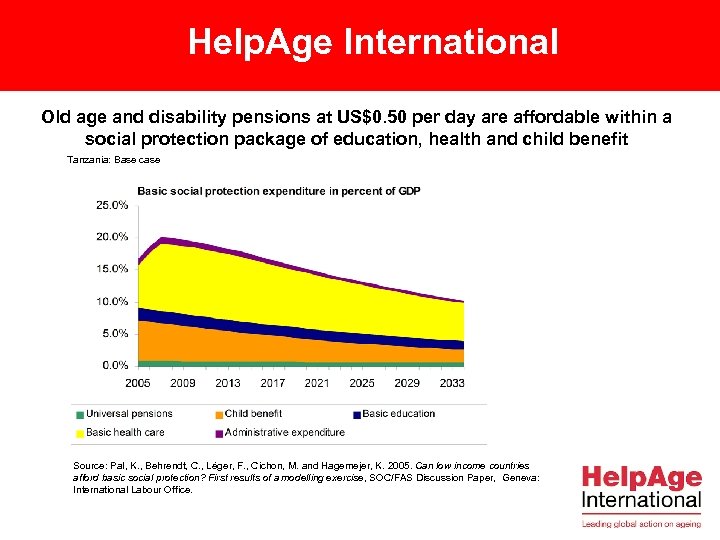 Help. Age International Old age and disability pensions at US$0. 50 per day are affordable within a social protection package of education, health and child benefit Tanzania: Base case Source: Pal, K. , Behrendt, C. , Léger, F. , Cichon, M. and Hagemejer, K. 2005. Can low income countries afford basic social protection? First results of a modelling exercise, SOC/FAS Discussion Paper, Geneva: International Labour Office.
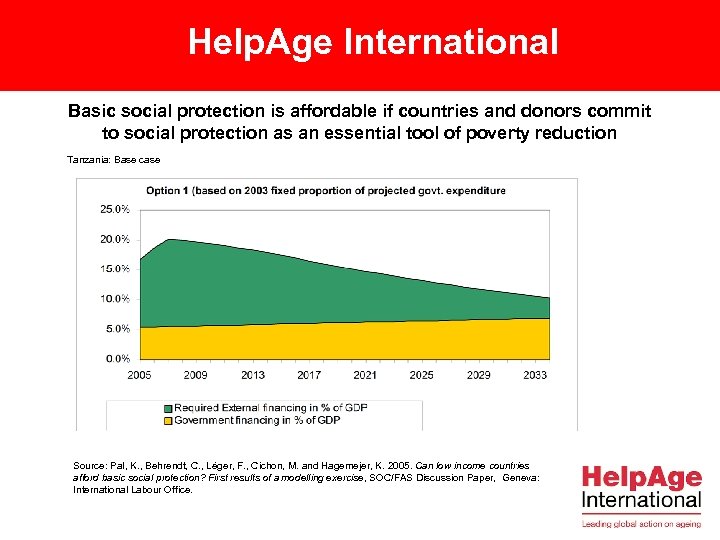 Help. Age International Basic social protection is affordable if countries and donors commit to social protection as an essential tool of poverty reduction Tanzania: Base case Source: Pal, K. , Behrendt, C. , Léger, F. , Cichon, M. and Hagemejer, K. 2005. Can low income countries afford basic social protection? First results of a modelling exercise, SOC/FAS Discussion Paper, Geneva: International Labour Office.
 Help. Age International What is needed Greater Political Will; enhanced social protection and cash transfers are possible and affordable Donors and national and international NGOs can § Support developing country governments to explore options, and support national political debate and expenditure to target the poorest § Support the scaling up of pilots such as Kalomo, Zambia and new pilots (Tanzania) to build experience National governments can § Identify Social Protection and cash transfers in policy and funding mechanisms, including PRSPs and donor budget support § Explore impact of SP through social budgets and PSIAs
 Help. Age International Questions for discussion § How to measure social protection benefits as well as the costs? § Should we be measuring the costs of not extending social protection and cash transfers? § How do universal cash transfer schemes fit with existing provision (e. g. contributory schemes) and informal savings schemes? § How can administration – delivery, records - be supported? § How to target effectively and minimise corruption? § How to secure community engagement including monitoring? § How to secure donor policy and funding engagement to support national social protection schemes? § Conditional as opposed to universal transfers? § Are the poor to be trusted?