


 Скачать презентацию Helium survey identification of sweet spots locations for exploratory
5a52c4179e4b1c22f0d9b9209d89a766.ppt
- Количество слайдов: 16
 Helium survey—identification of “sweet spots” locations for exploratory, appraisal and production drilling November, 2009
 Executive summary • During exploration, appraisal and development of oil and gas fields with complex geology, such as fracturing permeability, low continuity of thickness and porosity formations, energy companies face an ever present problem of low drilling success. • Traditional exploration technologies such as seismic do not always accurately predict hydrocarbons saturation. • In a review of more than 2600 US and international wildcat wells – all drilled after completion of geochemical or non-seismic hydrocarbon detection surveys- more than 80% of wells drilled on prospects associated with positive hydrocarbon anomalies resulted in commercial discoveries; and only 11% of wells drilled on prospects not associated with such anomalies resulted in discoveries*. • Actual Geology can identify an active petroleum system in the exploration area, generate unique nonseismic leads for further geological and seismic evaluation and identify “sweet spots”. • Our methods are non-invasive and have a minimal environmental impact. * presentation at 2008 AAPG International Conference and Exhibition, Cape Town, South Africa, October 26 -29, 2008 1
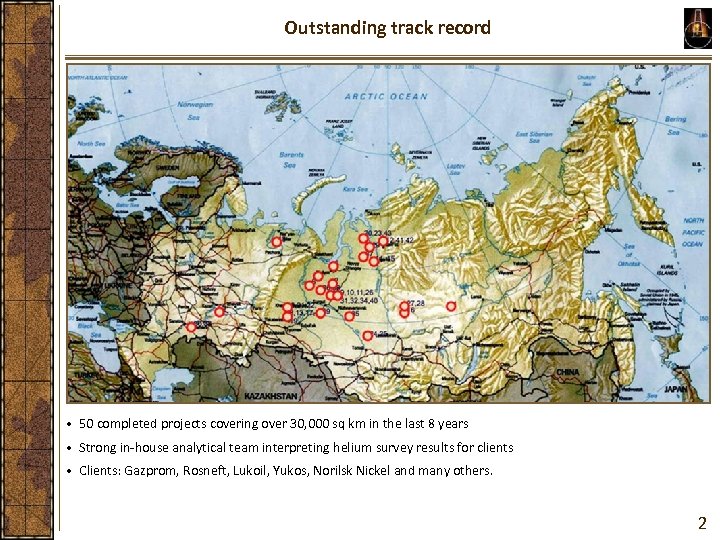 Outstanding track record • 50 completed projects covering over 30, 000 sq km in the last 8 years • Strong in-house analytical team interpreting helium survey results for clients • Clients: Gazprom, Rosneft, Lukoil, Yukos, Norilsk Nickel and many others. 2
 Our services • Actual Geology services fit well into an integrated exploration strategy by detecting occurrences of hydrocarbons’ by-products, such as helium, which serve as indicators to the location of undiscovered oil and gas accumulations. • Actual Geology provides: − Mapping of helium concentration and subsequent forecasting of reservoir properties. − Prediction of section saturation before drilling. − Determination of areas with improved fractured permeability in prospective reservoirs or producing deposits. − Prediction of reservoir distribution, delineation of oil and gas accumulations. − Determination of residual reserves at mature fields with declining production. − Identification of prospective drilling targets, cut off of the low prospects and high risk zones. 3
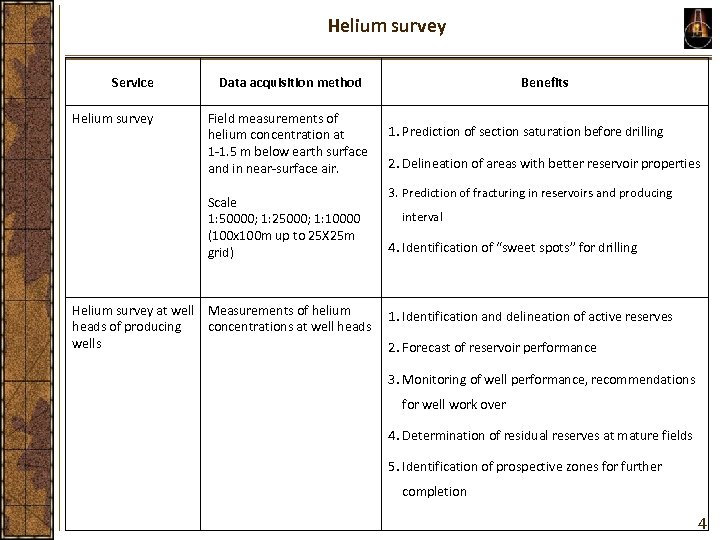 Helium survey Service Helium survey Data acquisition method Field measurements of helium concentration at 1 -1. 5 m below earth surface and in near-surface air. Scale 1: 50000; 1: 25000; 1: 10000 (100 x 100 m up to 25 X 25 m grid) Helium survey at well Measurements of helium heads of producing concentrations at well heads wells Benefits 1. Prediction of section saturation before drilling 2. Delineation of areas with better reservoir properties 3. Prediction of fracturing in reservoirs and producing interval 4. Identification of “sweet spots” for drilling 1. Identification and delineation of active reserves 2. Forecast of reservoir performance 3. Monitoring of well performance, recommendations for well work over 4. Determination of residual reserves at mature fields 5. Identification of prospective zones for further completion 4
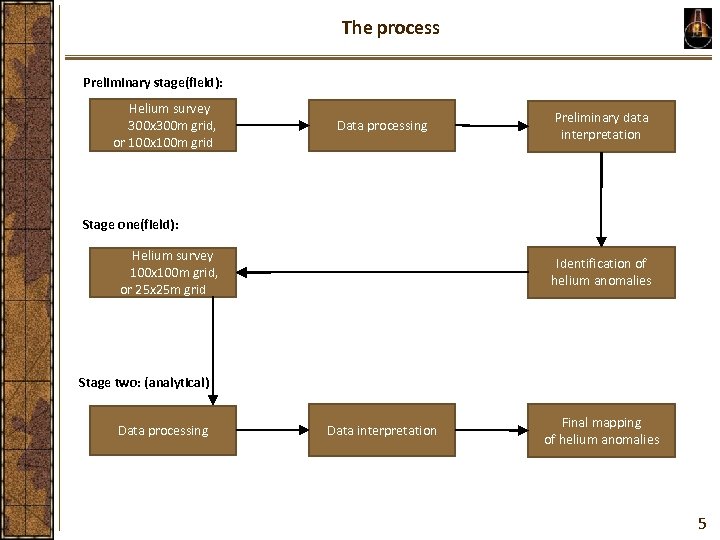 The process Preliminary stage(field): Helium survey 300 x 300 m grid, or 100 x 100 m grid Data processing Preliminary data interpretation Stage one(field): Helium survey 100 x 100 m grid, or 25 x 25 m grid Identification of helium anomalies Stage two: (analytical) Data processing Data interpretation Final mapping of helium anomalies 5
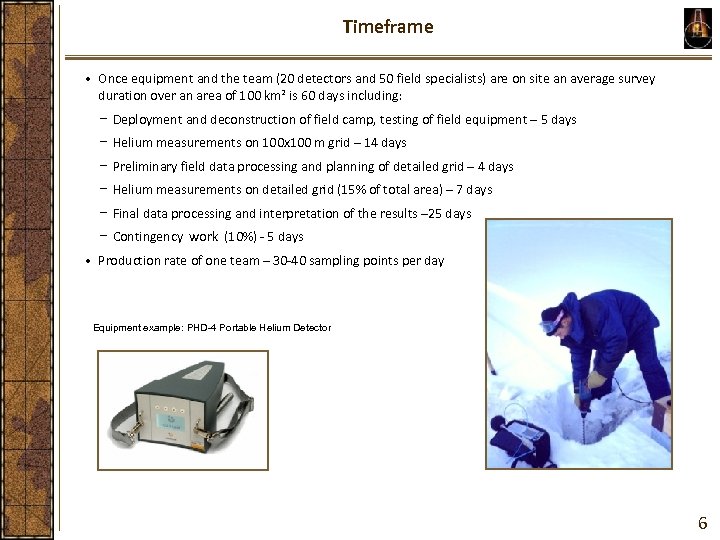 Timeframe • Once equipment and the team (20 detectors and 50 field specialists) are on site an average survey duration over an area of 100 km² is 60 days including: − Deployment and deconstruction of field camp, testing of field equipment – 5 days − Helium measurements on 100 х100 m grid – 14 days − Preliminary field data processing and planning of detailed grid – 4 days − Helium measurements on detailed grid (15% of total area) – 7 days − Final data processing and interpretation of the results – 25 days − Contingency work (10%) - 5 days • Production rate of one team – 30 -40 sampling points per day Equipment example: PHD-4 Portable Helium Detector 6
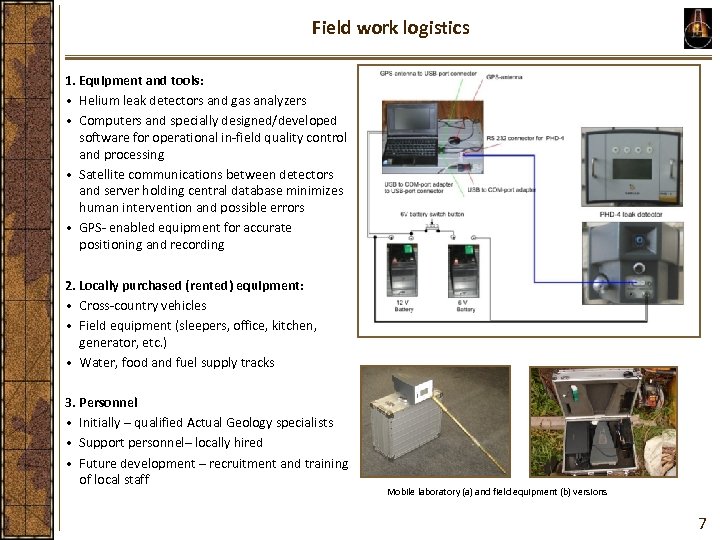 Field work logistics 1. Equipment and tools: • Helium leak detectors and gas analyzers • Computers and specially designed/developed software for operational in-field quality control and processing • Satellite communications between detectors and server holding central database minimizes human intervention and possible errors • GPS- enabled equipment for accurate positioning and recording 2. Locally purchased (rented) equipment: • Cross-country vehicles • Field equipment (sleepers, office, kitchen, generator, etc. ) • Water, food and fuel supply tracks 3. Personnel • Initially – qualified Actual Geology specialists • Support personnel– locally hired • Future development – recruitment and training of local staff Mobile laboratory (a) and field equipment (b) versions 7
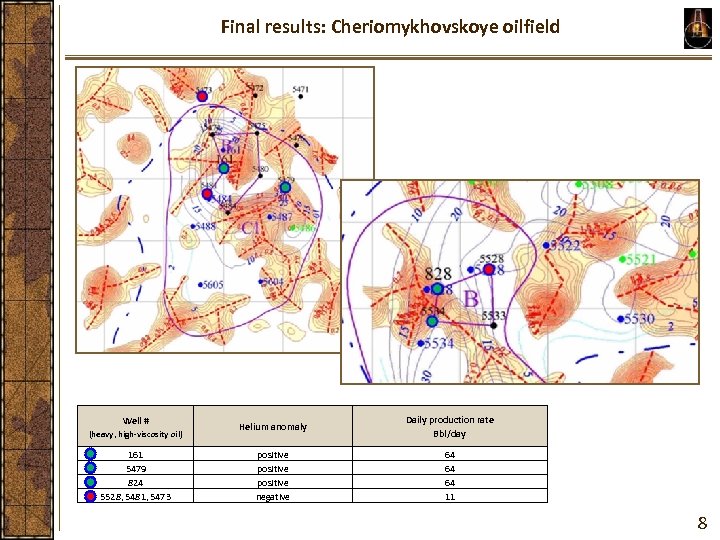 Final results: Cheriomykhovskoye oilfield Well # (heavy, high-viscosity oil) 161 5479 824 5528, 5481, 5473 Helium anomaly Daily production rate Bbl/day positive negative 64 64 64 11 8
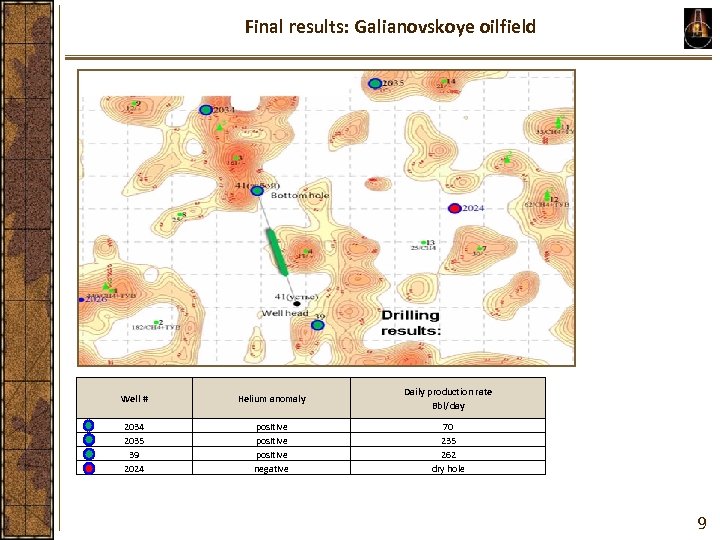 Final results: Galianovskoye oilfield Well # Helium anomaly Daily production rate Bbl/day 2034 2035 39 2024 positive negative 70 235 262 dry hole 9
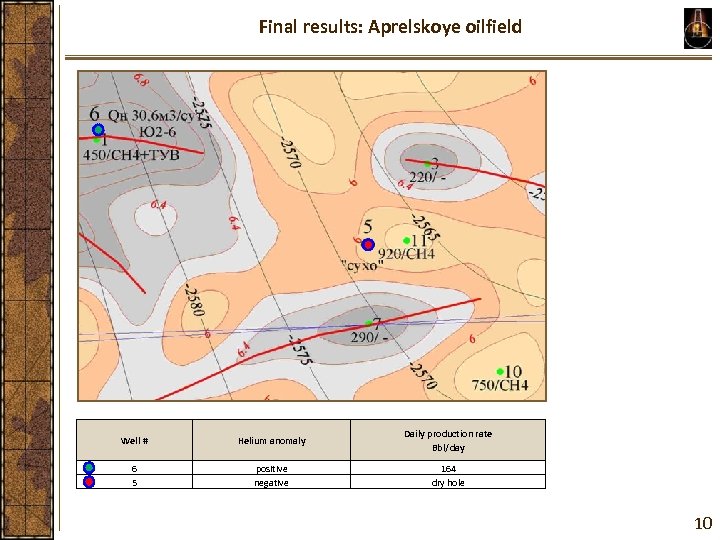 Final results: Aprelskoye oilfield Well # Helium anomaly Daily production rate Bbl/day 6 5 positive negative 164 dry hole 10
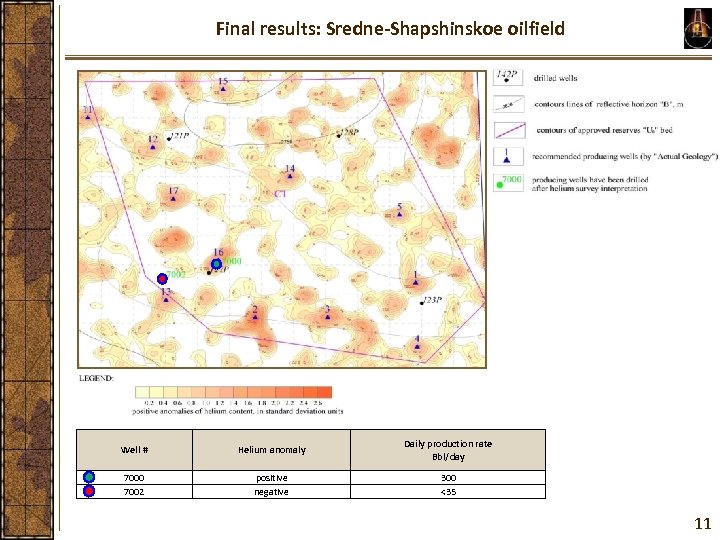 Final results: Sredne-Shapshinskoe oilfield Well # Helium anomaly Daily production rate Bbl/day 7000 7002 positive negative 300 <35 11
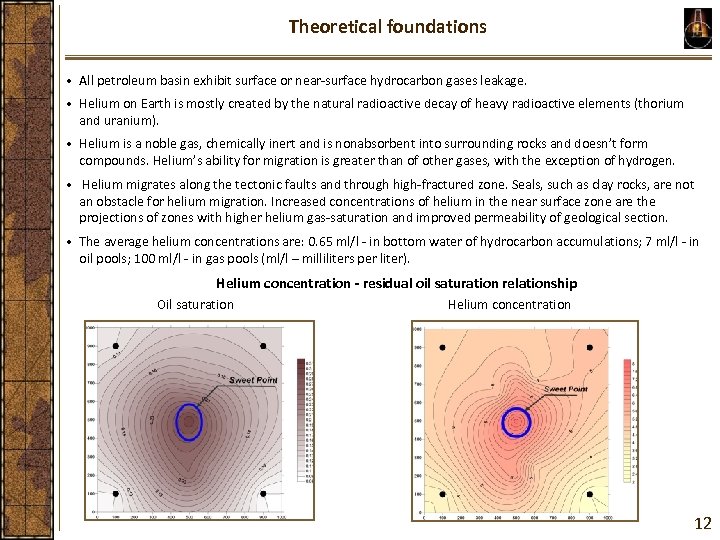 Theoretical foundations • All petroleum basin exhibit surface or near-surface hydrocarbon gases leakage. • Helium on Earth is mostly created by the natural radioactive decay of heavy radioactive elements (thorium and uranium). • Helium is a noble gas, chemically inert and is nonabsorbent into surrounding rocks and doesn’t form compounds. Helium’s ability for migration is greater than of other gases, with the exception of hydrogen. • Helium migrates along the tectonic faults and through high-fractured zone. Seals, such as clay rocks, are not an obstacle for helium migration. Increased concentrations of helium in the near surface zone are the projections of zones with higher helium gas-saturation and improved permeability of geological section. • The average helium concentrations are: 0. 65 ml/l - in bottom water of hydrocarbon accumulations; 7 ml/l - in oil pools; 100 ml/l - in gas pools (ml/l – milliliters per liter). Helium concentration - residual oil saturation relationship Oil saturation Helium concentration 12
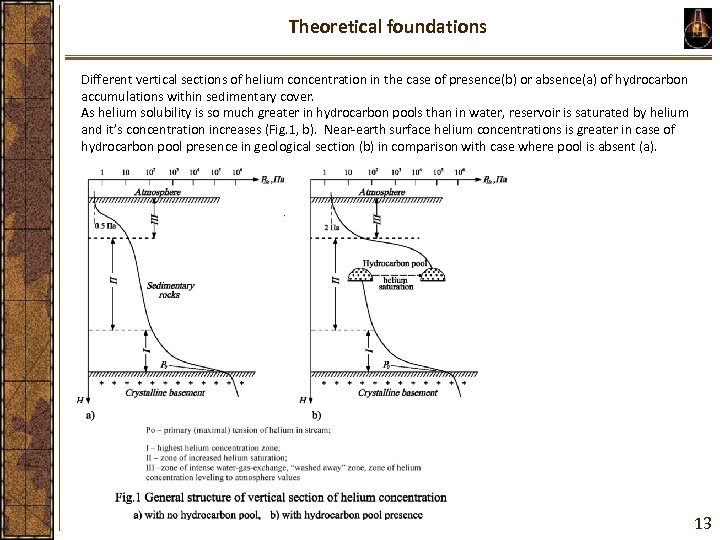 Theoretical foundations Different vertical sections of helium concentration in the case of presence(b) or absence(a) of hydrocarbon accumulations within sedimentary cover. As helium solubility is so much greater in hydrocarbon pools than in water, reservoir is saturated by helium and it’s concentration increases (Fig. 1, b). Near-earth surface helium concentrations is greater in case of hydrocarbon pool presence in geological section (b) in comparison with case where pool is absent (a). 13
 Conclusions • The results of helium surveying leads to significantly better prediction, therefore risk and cost reduction • Helium surveying is a powerful complement to conventional exploration methods. • Further integration with available seismic, logging and production data can help companies to identify residual reserves, enhance potential of declining production or flooded fields, better plan drilling operations (especially horizontal wells) during exploration, appraisal and development stages • In order to assess and prove effectiveness of its methods Actual Geology can conduct a pilot survey on an already explored field where a number of wells have been drilled in order to compare helium survey results with company’s existing information • Helium surveying is a reliable and proven (by a number of successful projects in various geological settings) technique for accurate identification of the best drilling locations. Our experienced specialists are able to work in practically any complex terrain, traditionally off-limits due to restricted accessibility 14
 Contacts London St Petersburg Vlad Sinani Viktor Chistiakov Project Manager General Director Suite 3, Barkat House 36 Rubinstein street, office 35, 116 -118 Finchley Road St. Petersburg London, England NW 3 5 HT 191002 Russia Tel. +44 (0)20 7433 2512 Tel. +7 (812) 347 78 19 Fax. +44 (0)20 7692 7957 Fax. +7(812) 571 83 98 E-mail: vlad@actualgeology. com E-mail: v. chistyakov@actualgeology. ru 15