 Скачать презентацию Helioseismic and Magnetic Imager for Solar Dynamics Observatory
5c98405080358af0eb8a406492b926a6.ppt
- Количество слайдов: 1



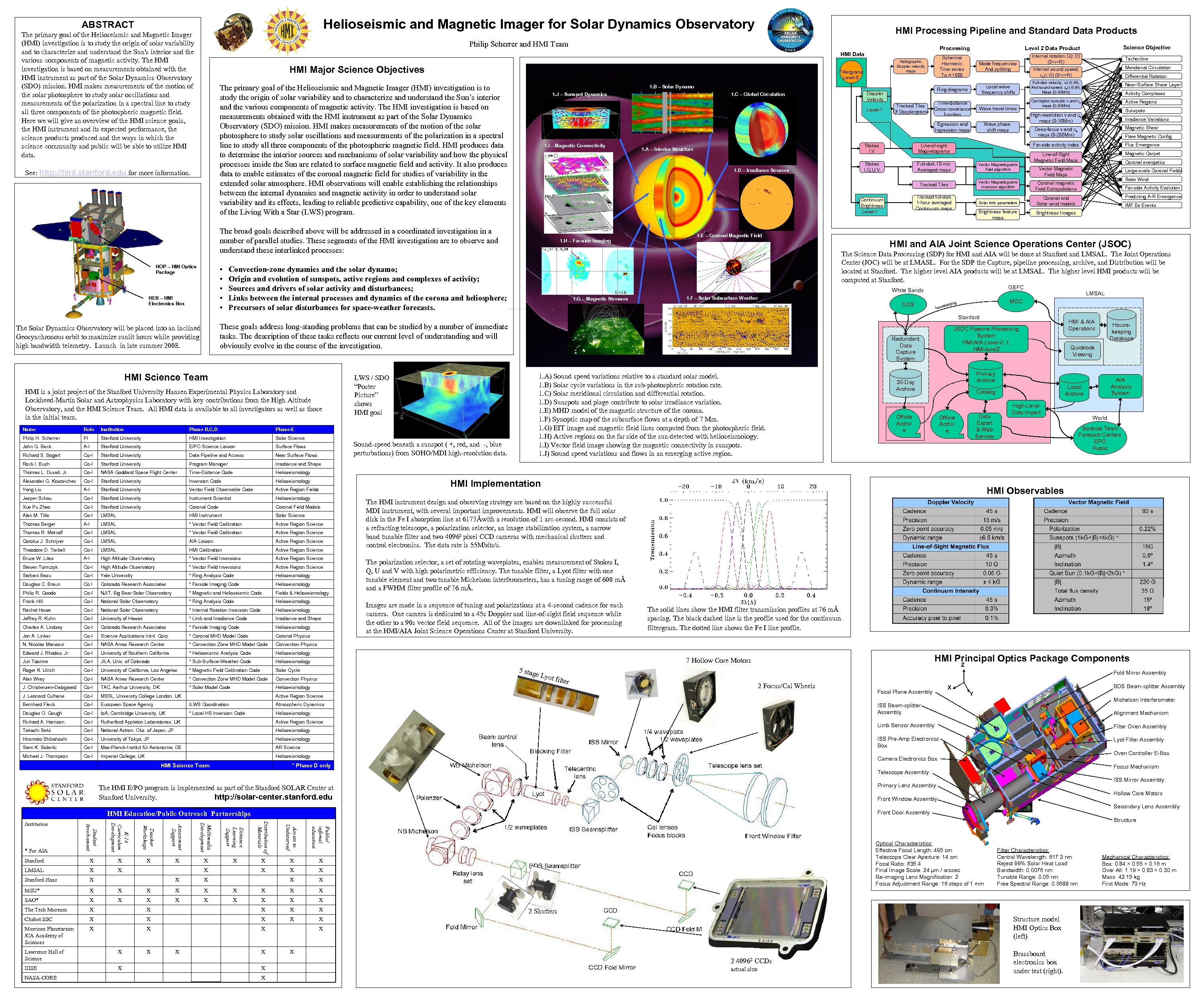
Helioseismic and Magnetic Imager for Solar Dynamics Observatory ABSTRACT The primary goal of the Helioseismic and Magnetic Imager (HMI) investigation is to study the origin of solar variability and to characterize and understand the Sun's interior and the various components of magnetic activity. The HMI investigation is based on measurements obtained with the HMI instrument as part of the Solar Dynamics Observatory (SDO) mission. HMI makes measurements of the motion of the solar photosphere to study solar oscillations and measurements of the polarization in a spectral line to study all three components of the photospheric magnetic field. Here we will give an overview of the HMI science goals, the HMI instrument and its expected performance, the science products produced and the ways in which the science community and public will be able to utilize HMI data. HMI Processing Pipeline and Standard Data Products Philip Scherrer and HMI Team HMI Data Processing HMI Data HMI Major Science Objectives The primary goal of the Helioseismic and Magnetic Imager (HMI) investigation is to study the origin of solar variability and to characterize and understand the Sun’s interior and the various components of magnetic activity. The HMI investigation is based on measurements obtained with the HMI instrument as part of the Solar Dynamics Observatory (SDO) mission. HMI makes measurements of the motion of the solar photosphere to study solar oscillations and measurements of the polarization in a spectral line to study all three components of the photospheric magnetic field. HMI produces data to determine the interior sources and mechanisms of solar variability and how the physical processes inside the Sun are related to surface magnetic field and activity. It also produces data to enable estimates of the coronal magnetic field for studies of variability in the extended solar atmosphere. HMI observations will enable establishing the relationships between the internal dynamics and magnetic activity in order to understand solar variability and its effects, leading to reliable predictive capability, one of the key elements of the Living With a Star (LWS) program. See: http: //hmi. stanford. edu for more information. 1. B – Solar Dynamo 1. J – Sunspot Dynamics • • • HEB – HMI Electronics Box Tracked Tiles Of Dopplergrams Data Product Level 2 Data Product Global Mode frequencies Helioseismology And splitting Processing Ring diagrams Doppler Velocity 1. C – Global Circulation Level-1 Time-distance Cross-covariance function Local wave Local frequency shifts Helioseismology Processing Wave travel times Stokes I, V 1. D – Irradiance Sources Line-of-sight Magnetograms Stokes I, Q, U, V 1. A – Interior Structure Full-disk 10 -min Averaged maps Vector Magnetograms Vector Fast algorithm Magnetograms Vector Magnetograms Inversion algorithm Continuum Brightness Tracked full-disk 1 -hour averaged Continuum maps Continuum Brightness Level-1 Internal sound speed, cc(r, Θ) (0<r<R) s s(r, Θ) (0<r<R) Full-disk velocity, v(r, Θ, Φ), And sound speed, s(r, Θ, Φ), And sound speed, cs(r, Θ, Φ), Maps (0 -30 Mm) Meridional Circulation Carrington synoptic v and cscs Carrington synoptic v and maps (0 -30 Mm) Active Regions 1. H – Far-side Imaging Name Role Institution Phase B, C, D PI Stanford University HMI Investigation Solar Science John G. Beck A-I Stanford University E/PO Science Liaison Surface Flows Richard S. Bogart Co-I Stanford University Data Pipeline and Access Near Surface Flows Rock I. Bush Co-I Stanford University Program Manager Co-I NASA Goddard Space Flight Center Time-Distance Code Solar limb parameters Brightness feature maps Flux Emergence Line-of-Sight Magnetic Field Maps Magnetic Carpet Co-I Stanford University Inversion Code Helioseismology Yang Liu A-I Stanford University Vector Field Observable Code Active Region Fields Jesper Schou Co-I Stanford University Instrument Scientist Helioseismology Xue Pu Zhao Co-I Stanford University Coronal Code Coronal Field Models Alan M. Title Co-I LMSAL HMI Instrument Solar Science Thomas Berger A-I LMSAL * Vector Field Calibration Active Region Science Thomas R. Metcalf Co-I LMSAL * Vector Field Calibration Active Region Science Carolus J. Schrijver Co-I LMSAL AIA Liaison Active Region Science Theodore D. Tarbell Co-I LMSAL HMI Calibration Active Region Science Bruce W. Lites A-I High Altitude Observatory * Vector Field Inversions Active Region Science Steven Tomczyk Co-I High Altitude Observatory * Vector Field Inversions Active Region Science Sarbani Basu Co-I Yale University * Ring Analysis Code Helioseismology Douglas C. Braun Co I Colorado Research Associates * Farside Imaging Code Helioseismology Philip R. Goode Co-I NJIT, Big Bear Solar Observatory * Magnetic and Helioseismic Code Fields & Helioseismology Frank Hill Co-I National Solar Observatory * Ring Analysis Code Helioseismology Rachel Howe Co-I National Solar Observatory * Internal Rotation Inversion Code Helioseismology Jeffrey R. Kuhn Co-I University of Hawaii * Limb and Irradiance Code Irradiance and Shape Charles A. Lindsey Co-I Colorado Research Associates * Farside Imaging Code Helioseismology Jon A. Linker Co-I Science Applications Intnl. Corp. * Coronal MHD Model Code Coronal Physics N. Nicolas Mansour Co-I NASA Ames Research Center * Convection Zone MHD Model Code Co-I University of Southern California * Helioseismic Analysis Code Vector Magnetic Field Maps Large-scale Coronal Fields Coronal magnetic Field Extrapolations Far-side Activity Evolution Co-I JILA, Univ. of Colorado * Sub-Surface-Weather Code 1. G – Magnetic Stresses 1. F – Solar Subsurface Weather Co-I University of California, Los Angeles * Magnetic Field Calibration Code Solar Cycle Alan Wray Co-I NASA Ames Research Center * Convection Zone MHD Model Code Convection Physics J. Christensen-Dalsgaard Co-I TAC, Aarhus University, DK * Solar Model Code Co-I MSSL, University College London, UK Bernhard Fleck Co-I European Space Agency ILWS Coordination Atmospheric Dynamics Douglas O. Gough Co-I Io. A, Cambridge University, UK * Local HS Inversion Code Helioseismology Richard A. Harrison Co-I Rutherford Appleton Laboratories, UK Active Region Science Takashi Sekii Co-I National Astron. Obs. of Japan, JP Helioseismology Hiromoto Shibahashi Co-I University of Tokyo, JP Helioseismology Sami K. Solanki Co-I Max-Planck-Institut für Aeronomie, DE AR Science Michael J. Thompson Co-I Imperial College, UK 1. A) Sound speed variations relative to a standard solar model. 1. B) Solar cycle variations in the sub-photospheric rotation rate. 1. C) Solar meridional circulation and differential rotation. 1. D) Sunspots and plage contribute to solar irradiance variation. 1. E) MHD model of the magnetic structure of the corona. 1. F) Synoptic map of the subsurface flows at a depth of 7 Mm. 1. G) EIT image and magnetic field lines computed from the photospheric field. 1. H) Active regions on the far side of the sun detected with helioseismology. 1. I) Vector field image showing the magnetic connectivity in sunspots. 1. J) Sound speed variations and flows in an emerging active region. LWS / SDO “Poster Picture” shows HMI goal Helioseismology J. Leonard Culhane Predicting A-R Emergence Coronal and Solar wind models IMF Bs Events Brightness Images Helioseismology LMSAL MOC ing DDS p ekee hous JSOC Pipeline Processing System HMI/AIA Level-0, 1, HMI-level 2 Redundant Data Capture System Helioseismology Roger K. Ulrich Solar Wind GSFC White Sands HMI & AIA Operations Housekeeping Database Quicklook Viewing Primary Archive 30 -Day Archive Data Export & Web Service Offline Archiv e AIA Analysis System Local Archive Catalog Offsite Archiv e Helioseismology Juri Toomre Coronal energetics High-Level Data Import World Science Team Forecast Centers EPO Public Convection Physics Edward J. Rhodes, Jr. Flare Magnetic Config. Helioseismology Alexander G. Kosovichev Irradiance Variations Irradiance and Shape Thomas L. Duvall, Jr. Sunspots The Science Data Processing (SDP) for HMI and AIA will be done at Stanford and LMSAL. The Joint Operations Center (JOC) will be at LMASL. For the SDP the Capture, pipeline processing, archive, and Distribution will be located at Stanford. The higher level AIA products will be at LMSAL. The higher level HMI products will be computed at Stanford. Phase-E Philip H. Scherrer Activity Complexes HMI and AIA Joint Science Operations Center (JSOC) These goals address long-standing problems that can be studied by a number of immediate tasks. The description of these tasks reflects our current level of understanding and will obviously evolve in the course of the investigation. HMI is a joint project of the Stanford University Hansen Experimental Physics Laboratory and Lockheed-Martin Solar and Astrophysics Laboratory with key contributions from the High Altitude Observatory, and the HMI Science Team. All HMI data is available to all investigators as well as those in the initial team. Near-Surface Shear Layer 1. E – Coronal Magnetic Field Convection-zone dynamics and the solar dynamo; Origin and evolution of sunspots, active regions and complexes of activity; Sources and drivers of solar activity and disturbances; Links between the internal processes and dynamics of the corona and heliosphere; Precursors of solar disturbances for space-weather forecasts. HMI Science Team Differential Rotation Magnetic Shear Stanford The Solar Dynamics Observatory will be placed into an inclined Geosynchronous orbit to maximize sunlit hours while providing high bandwidth telemetry. Launch in late summer 2008. Tachocline Far-side activity index Line-of-sight Magnetograms Tracked Tiles Internal rotation Ω(r, Θ) (0<r<R) Deep-focus vvand ccs Deep-focus and s maps (0 -200 Mm) Ingression maps Doppler shift maps Velocity 1. I – Magnetic Connectivity Science Objective High-resolution vvand ccs High-resolution and s maps (0 -30 Mm) Observables phase Egression and Wave The broad goals described above will be addressed in a coordinated investigation in a number of parallel studies. These segments of the HMI investigation are to observe and understand these interlinked processes: HOP – HMI Optics Package Spherical Harmonic Time series To l=1000 Filtergrams Heliographic Doppler velocity maps Filtergrams Level-0 Processing Sound-speed beneath a sunspot ( +, red, and -, blue perturbations) from SOHO/MDI high-resolution data. HMI Implementation HMI Observables The HMI instrument design and observing strategy are based on the highly successful MDI instrument, with several important improvements. HMI will observe the full solar disk in the Fe I absorption line at 6173Åwith a resolution of 1 arc-second. HMI consists of a refracting telescope, a polarization selector, an image stabilization system, a narrow band tunable filter and two 4096² pixel CCD cameras with mechanical shutters and control electronics. The data rate is 55 Mbits/s. The polarization selector, a set of rotating waveplates, enables measurement of Stokes I, Q, U and V with high polarimetric efficiency. The tunable filter, a Lyot filter with one tunable element and two tunable Michelson interferometers, has a tuning range of 600 mÅ and a FWHM filter profile of 76 mÅ. Images are made in a sequence of tuning and polarizations at a 4 -second cadence for each camera. One camera is dedicated to a 45 s Doppler and line-of-sight field sequence while the other to a 90 s vector field sequence. All of the images are downlinked for processing at the HMI/AIA Joint Science Operations Center at Stanford University. The solid lines show the HMI filter transmission profiles at 76 mÅ spacing. The black dashed line is the profile used for the continuum filtergram. The dotted line shows the Fe I line profile. HMI Principal Optics Package Components 7 Hollow Core Motors 5 stag e Lyo Z Fold Mirror Assembly t filte r 2 Focus/Cal Wheels Active Region Science HMI Science Team Focal Plane Assembly BDS Beam-splitter Assembly X Y Michelson Interferometer ISS Beam-splitter Assembly Alignment Mechanism Limb Sensor Assembly Filter Oven Assembly ISS Pre-Amp Electronics Box Lyot Filter Assembly Oven Controller E-Box Camera Electronics Box * Phase D only Focus Mechanism Telescope Assembly The HMI E/PO program is implemented as part of the Stanford SOLAR Center at Stanford University. http: //solar-center. stanford. edu Multimedia Development X X LMSAL X X Stanford-Haas X MSU* X X SAO* X X The Tech Museum X Chabot SSC Morrison Planetarium /CA Academy of Sciences X X X X X X X X X Filter Characteristics: Central Wavelength: 617. 3 nm Reject 99% Solar Heat Load Bandwidth: 0. 0076 nm Tunable Range: 0. 05 nm Free Spectral Range: 0. 0688 nm X X Optical Characteristics: Effective Focal Length: 495 cm Telescope Clear Aperture: 14 cm Focal Ratio: f/35. 4 Final Image Scale: 24 µm / arcsec Re-imaging Lens Magnification: 2 Focus Adjustment Range: 16 steps of 1 mm X Lawrence Hall of Science X IIISE X NASA-CORE Public/ infomal education Assessment Support X Access to Undeserved Teacher Workshops X Structure Distribution of Materials K-14 Curriculum Development X Secondary Lens Assembly Front Door Assembly Distance Learning Support Student Involvement Stanford * For AIA Hollow Core Motors Front Window Assembly HMI Education/Public Outreach Partnerships Institution ISS Mirror Assembly Primary Lens Assembly X X X 2 Shutters Structure model HMI Optics Box (left) X X 2 40962 CCDs actual size Brassboard electronics box under test (right). Mechanical Characteristics: Box: 0. 84 × 0. 55 × 0. 16 m Over All: 1. 19 × 0. 83 × 0. 30 m Mass: 42. 15 kg First Mode: 73 Hz
Скачать презентацию Helioseismic and Magnetic Imager for Solar Dynamics Observatory
5c98405080358af0eb8a406492b926a6.ppt