 Скачать презентацию Hedging Speculation or Both Brent Henderson Travis Harlan
76ed5264a9a40689e035976f2e17f16c.ppt
- Количество слайдов: 36



Hedging, Speculation, or Both Brent Henderson Travis Harlan Sulaiman Habeebulla FIN 570 – International Financial Management FEMBA, Fall 2008 California State University, Fullerton
The Company n 1926: Founded following a merger between “Deutsche Aero Lloyd” (DAL) and “Junkers Luftverkehr”, originally named as “Deutsche Luft Hansa Aktiengesellschaft” n 1927 – 1934: Mostly European routes n 1933: Named as “Lufthansa” n 1934: Opened Trans-Atlantic routes n 1939 – 1945: Routes limited to neutral countries due to WWII n 1945: Suspended all services following Germany’s defeat n 1953: Reborn (different from pre-war Lufthansa) as flagship airline of West Germany with majority shares held by Government n 1955 - 1956: Service started to Europe/Trans-Atlantic n 1960: Started Jet-powered expansion n 1980: Started modernized expansion program
The Company (Contd. ) As of 1985 n Corporate HQ: Cologne, West Germany n Primary Hub: Frankfurt, West Germany n Secondary Hub: Munich, West Germany n Market Position: Germany’s largest, World’s 6 th largest n Core Business: Passenger Transportation n National Corporation: q q q 74. 31% held by Federal Government 7. 85% held by Government Agencies 17. 84% held by Private Ownership
The Airline Industry As of Early 1980 s n October 1978, Airline Deregulation Act signed in US n Access to deregulated countries opened up to all airlines n Price fixing was eliminated n Ticket pricing became equally important as customer service n Stimulus of deregulation created highly competitive market n Caused global smaller airline meltdown n Forced massive restructuring in most international airlines q q Undertaken aggressive expansion plans Fleet modernization
The Chairman Herr Heinz Ruhnau n A career bureaucrat: q q q 1963 -1976: Member of the Hamburg State Parliament 1976 -1982: Undersecretary of the Federal Transport Ministry Former chief assistant to the head of West Germany’s largest trade Union, IG Matall n Strongly affiliated with the West German Democratic Party n No private enterprise experience n Assumed post since July 1, 1982
Global Finance Market As of Jan 1985 n US Dollar was rising steadily and rapidly against DM since 1980 n Spot rate reached approximately DM 3. 2/$ n Forwards were primary hedging tool n Futures options were considered new and complicated hedging tool
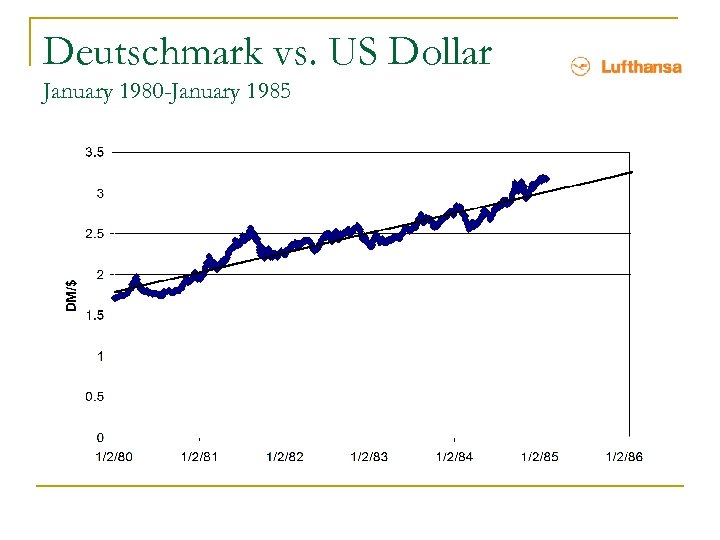
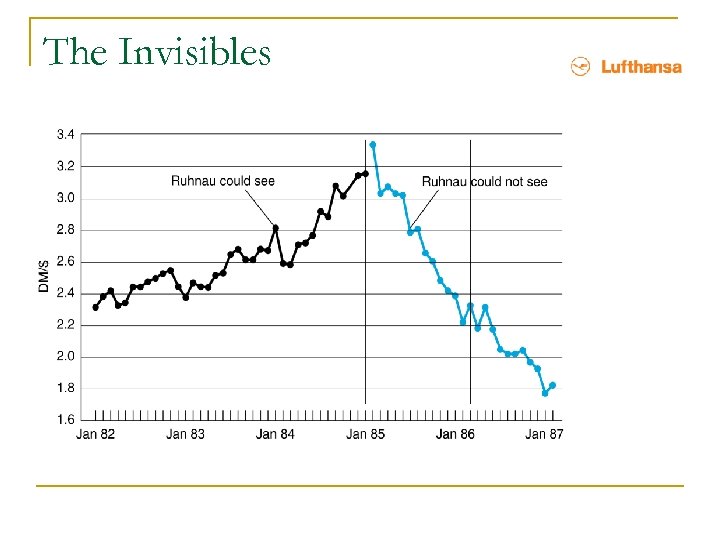
Deutschmark vs. US Dollar January 1980 -January 1985
Lufthansa Fleet As of Jan 1985 n Lufthansa maintained a balanced mix of Airbus, Boeing, and other smaller aircrafts n Lufthansa believed that having more than one supplier creates competition and better for purchaser n Global pressures posed Lufthansa to expand routes, efficiency, and cost cutting n Highly leveraged Lufthansa started fleet modernization program
The Case In Jan 1985 n Lufthansa, purchased twenty 737 jets from Boeing. n Total cost = $500 million n Payable in US$ n Payments due in January 1986 upon delivery.
Why now (Jan 1985)? n Facts q q n US Dollar was rising steadily and rapidly against DM since 1980 In Jan 1985 spot rate was approximately DM 3. 2/$ Lufthansa’s decision based on: q q q Purchase of operating assets must be based on current/expected market conditions Delay may adversely affect its operations Price could be increased to offset decline in the dollar, If purchased when the dollar was weakening n Foreign currency will fluctuate based on the host country’s economic and political conditions and policy changes
Why not Airbus? n Facts q q n Subsidized price for European countries No foreign currency exposure Boeing was chosen for q q Lufthansa’s policy was to maintain a fleet of both Boeing and Airbus aircrafts Prior to this deal, Lufthansa acquired 15 aircrafts from Airbus with option to acquire 7 more Having more than one supplier creates competition Better for purchaser
Foreign Currency Exposure n Definition q n Measure Exposure q q n Impact of unexpected exchange rate changes upon the cash flows from existing (and typically short-term) contractual obligations Use best measurement techniques Calculate expected future exchange rates Manage Exposure q Consider all available methods to mitigate exposure n n n Countertrade Hedging Simulate all methods (alternatives)
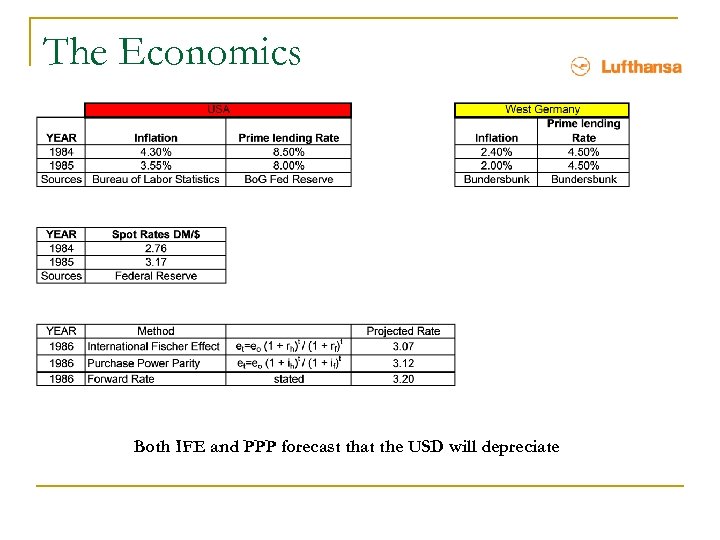
The Economics Both IFE and PPP forecast that the USD will depreciate
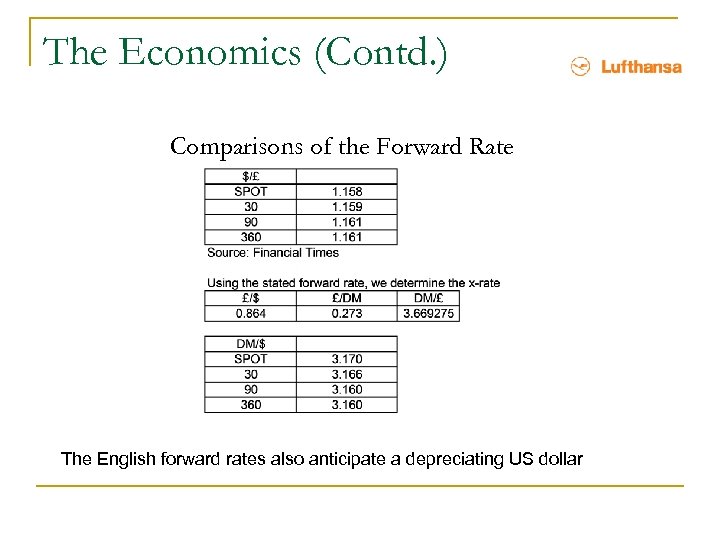
The Economics (Contd. ) Comparisons of the Forward Rate The English forward rates also anticipate a depreciating US dollar
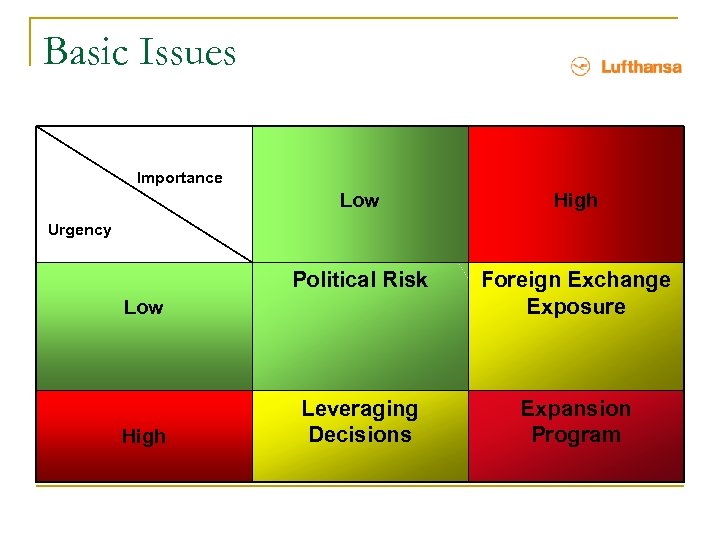
Basic Issues Importance Low High Political Risk Foreign Exchange Exposure Leveraging Decisions Expansion Program Urgency Low High
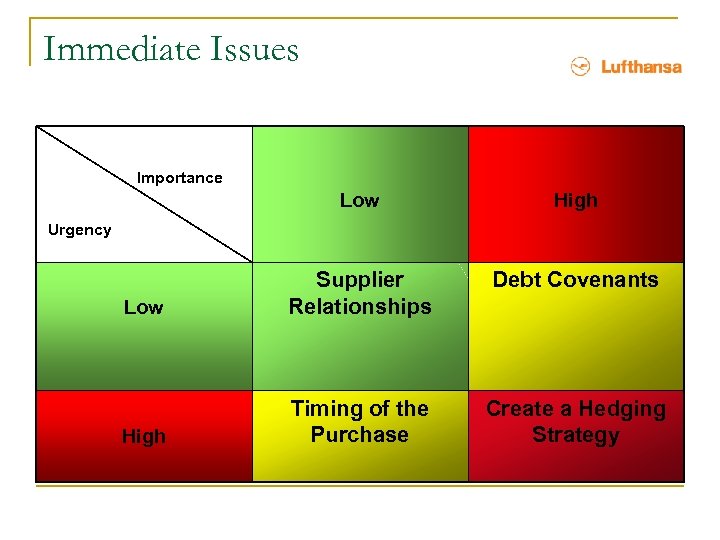
Immediate Issues Importance Low High Debt Covenants Low Supplier Relationships High Timing of the Purchase Create a Hedging Strategy Urgency
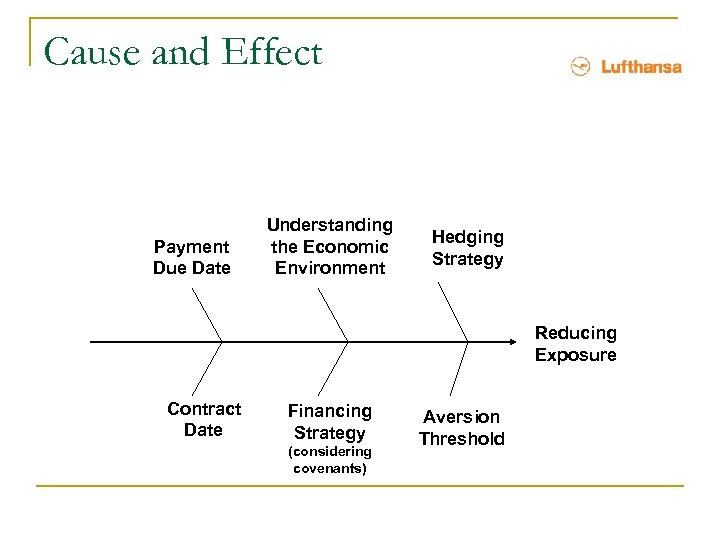
Cause and Effect Payment Due Date Understanding the Economic Environment Hedging Strategy Reducing Exposure Contract Date Financing Strategy (considering covenants) Aversion Threshold
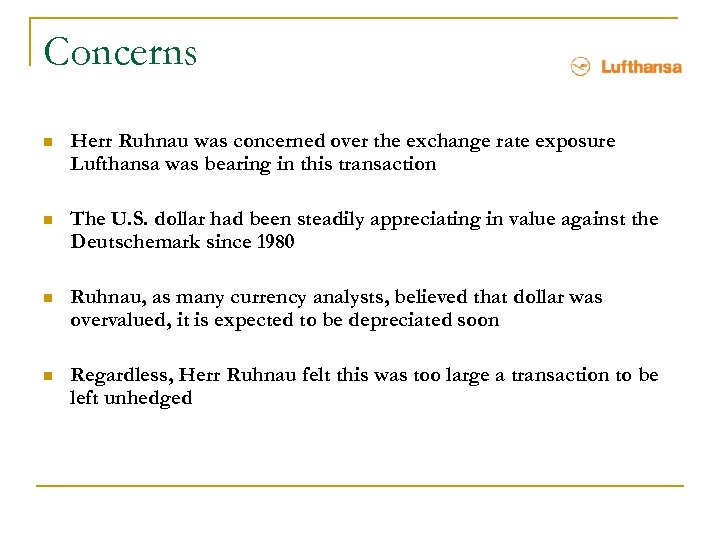
Concerns n Herr Ruhnau was concerned over the exchange rate exposure Lufthansa was bearing in this transaction n The U. S. dollar had been steadily appreciating in value against the Deutschemark since 1980 n Ruhnau, as many currency analysts, believed that dollar was overvalued, it is expected to be depreciated soon n Regardless, Herr Ruhnau felt this was too large a transaction to be left unhedged
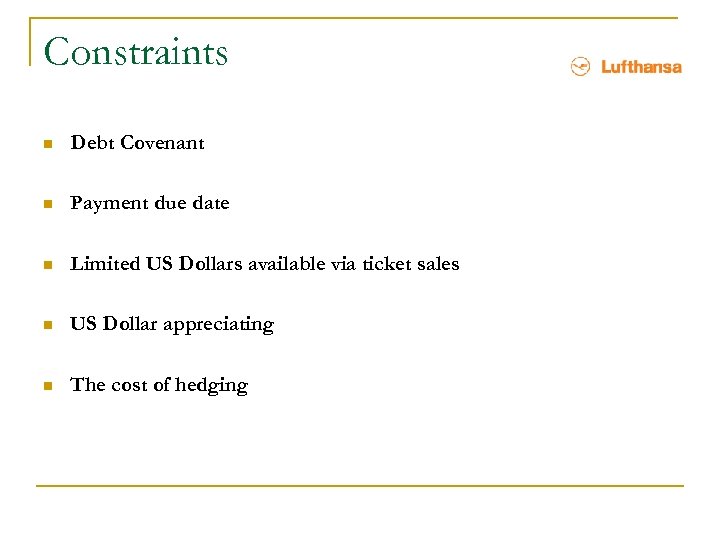
Constraints n Debt Covenant n Payment due date n Limited US Dollars available via ticket sales n US Dollar appreciating n The cost of hedging
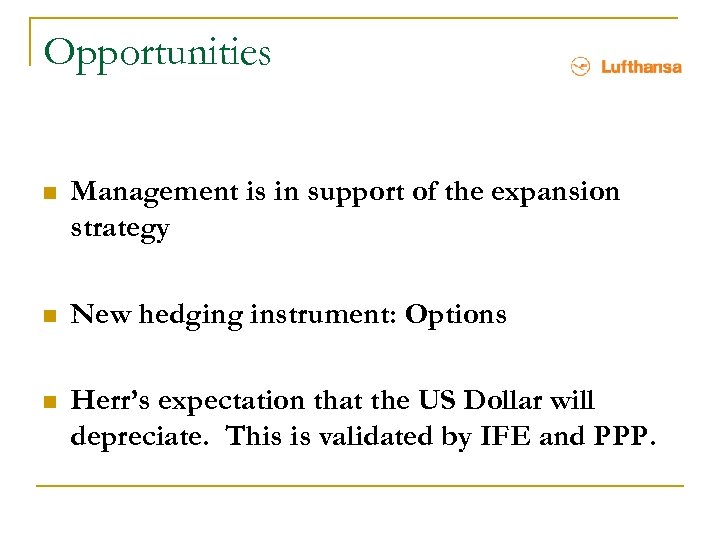
Opportunities n Management is in support of the expansion strategy n New hedging instrument: Options n Herr’s expectation that the US Dollar will depreciate. This is validated by IFE and PPP.
Decision Criteria Choose the hedging alternative that is the lowest mix of the Following: Cost: What is the cost based on our worst case calculation Risk: How much exposure risk remains by implementing this alternative
Alternatives · Remain uncovered · 100% forward cover · 50% forward cover – 50% uncovered · 100% Option cover · 100% Option Straddle
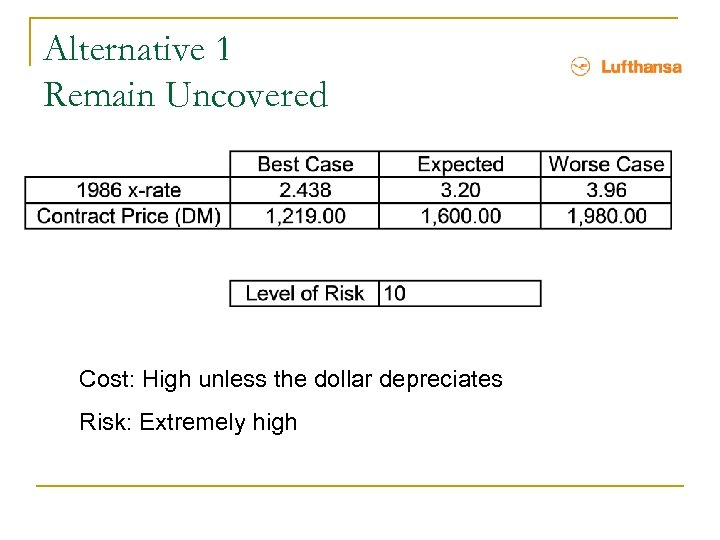
Alternative 1 Remain Uncovered Cost: High unless the dollar depreciates Risk: Extremely high
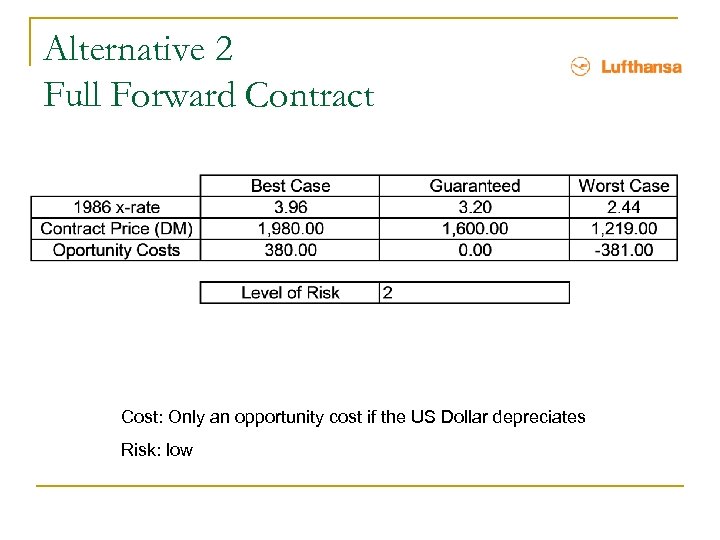
Alternative 2 Full Forward Contract Cost: Only an opportunity cost if the US Dollar depreciates Risk: low
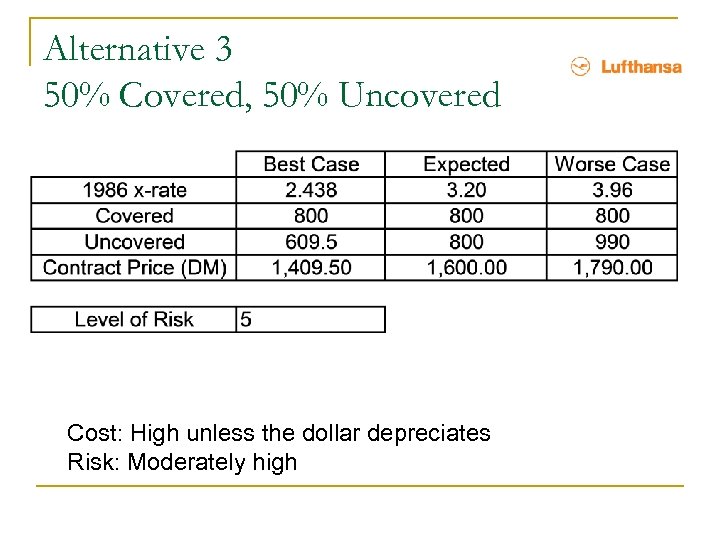
Alternative 3 50% Covered, 50% Uncovered Cost: High unless the dollar depreciates Risk: Moderately high
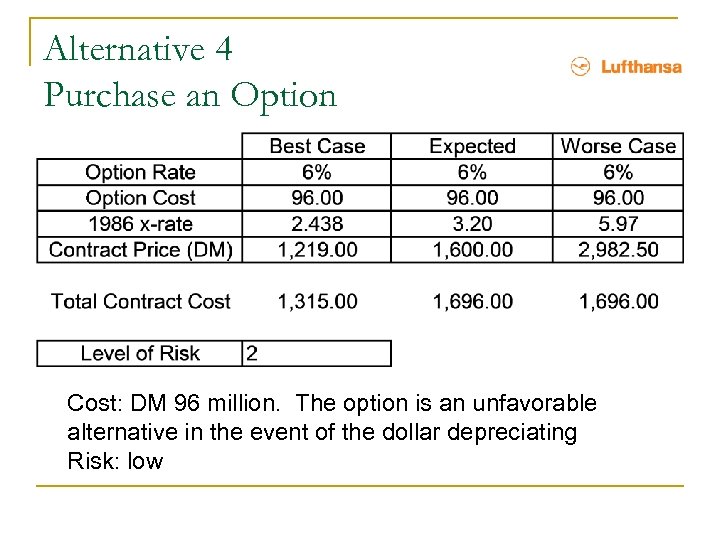
Alternative 4 Purchase an Option Cost: DM 96 million. The option is an unfavorable alternative in the event of the dollar depreciating Risk: low
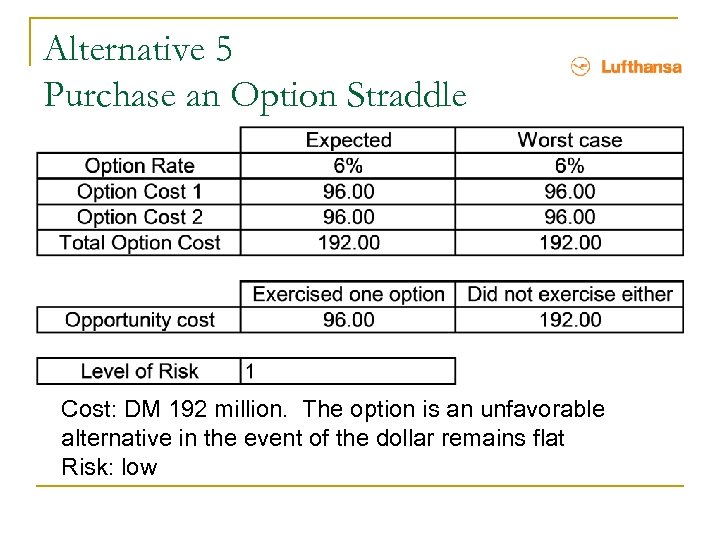
Alternative 5 Purchase an Option Straddle Cost: DM 192 million. The option is an unfavorable alternative in the event of the dollar remains flat Risk: low
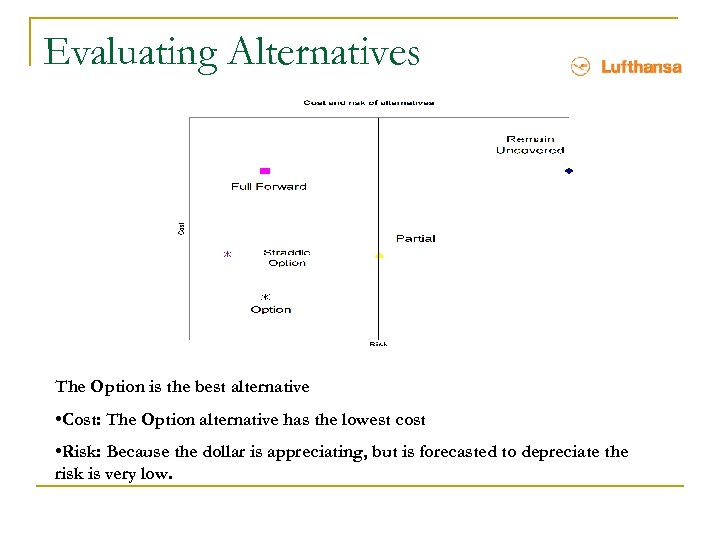
Evaluating Alternatives The Option is the best alternative • Cost: The Option alternative has the lowest cost • Risk: Because the dollar is appreciating, but is forecasted to depreciate the risk is very low.
The Decision & Outcome n Ruhnau covered forward $250 million at DM 3. 2/$, and left the remaining $250 million uncovered. n The dollar weakened from DM 3. 2/$ to DM 2. 3/$. n Ruhnau was summoned to meet with Lufthansa’s Board and West German Transportation Ministry on February 14, 1986 to explain his speculative exposure management decision on this transaction
The Invisibles
The Accusations • Purchasing the Boeing aircrafts at the wrong time. • Choosing to hedge half of the exposure when he expected the dollar to fall. • Choosing forward hedging over options • Purchasing Boeing jets at all
The Rationale n Purchase of Boeing aircrafts was mandated according to the expansion program n Ruhnau took a middle ground approach by half covered and half uncovered, looks better in this case, but risky n He considered the upfront cost of option premium (6% - DM 96 m) is expensive and the tool was relatively new to market and complicated n To comply Lufthansa’s policy for a mix of Boeing and Airbus aircrafts
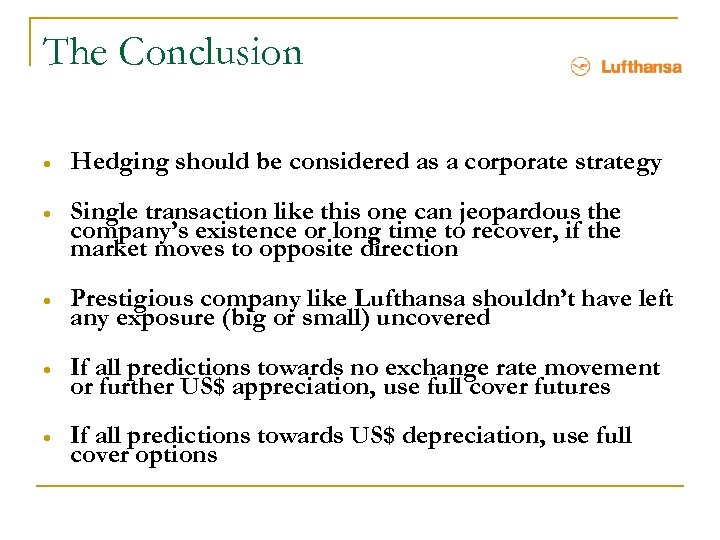
The Conclusion · Hedging should be considered as a corporate strategy · Single transaction like this one can jeopardous the company’s existence or long time to recover, if the market moves to opposite direction · Prestigious company like Lufthansa shouldn’t have left any exposure (big or small) uncovered · If all predictions towards no exchange rate movement or further US$ appreciation, use full cover futures · If all predictions towards US$ depreciation, use full cover options
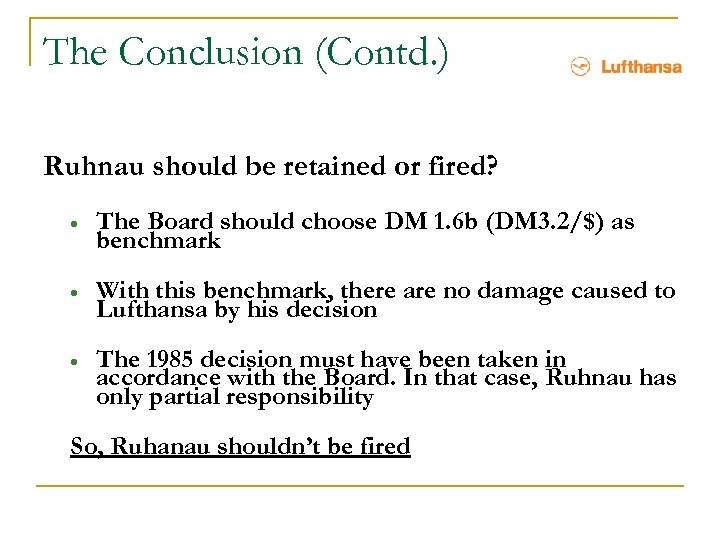
The Conclusion (Contd. ) Ruhnau should be retained or fired? · The Board should choose DM 1. 6 b (DM 3. 2/$) as benchmark · With this benchmark, there are no damage caused to Lufthansa by his decision · The 1985 decision must have been taken in accordance with the Board. In that case, Ruhnau has only partial responsibility So, Ruhanau shouldn’t be fired
The Concept Speculation is generally a trading strategy In the event of exposure management, corporations should rather consider a full cover hedging strategy than speculation
Questions Please? ? ?
Скачать презентацию Hedging Speculation or Both Brent Henderson Travis Harlan
76ed5264a9a40689e035976f2e17f16c.ppt