 Скачать презентацию Heat Energy Read Textbook Meteorology Today
fc78c9e6cea69f7b67b437e26c4be8eb.ppt
- Количество слайдов: 67



Heat Energy • Read Textbook: Meteorology Today – Chapter 2, Appendix G • Homework Problems Chapter 2 – Questions for Review: 1, 3 -5, 7, 8, 12 -14, 17, 21 – Questions for Thought: 2, 7, 9 -11 – Problems and Exercises: 1, 2, 4
Heat Energy Temperature is our measurement of the average kinetic energy found in the random motions and vibrations of countless atoms and molecules. Temperature is a way of quantifying the kinetic energy of countless atoms and molecules. Temperature is Energy.
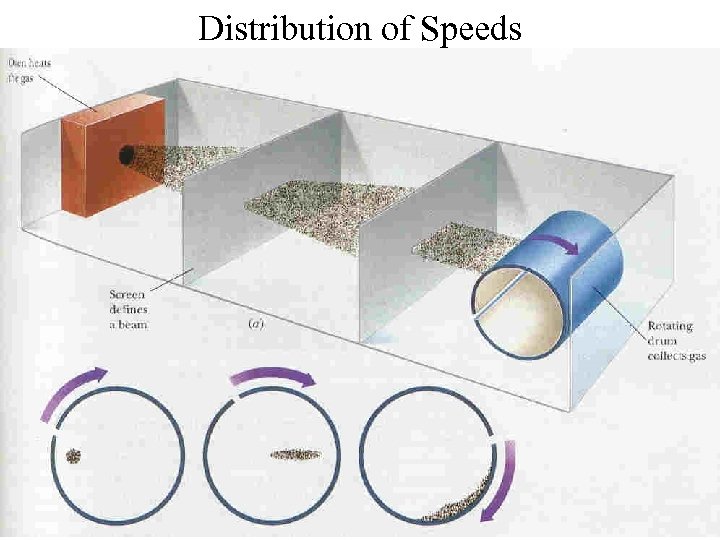
Distribution of Speeds
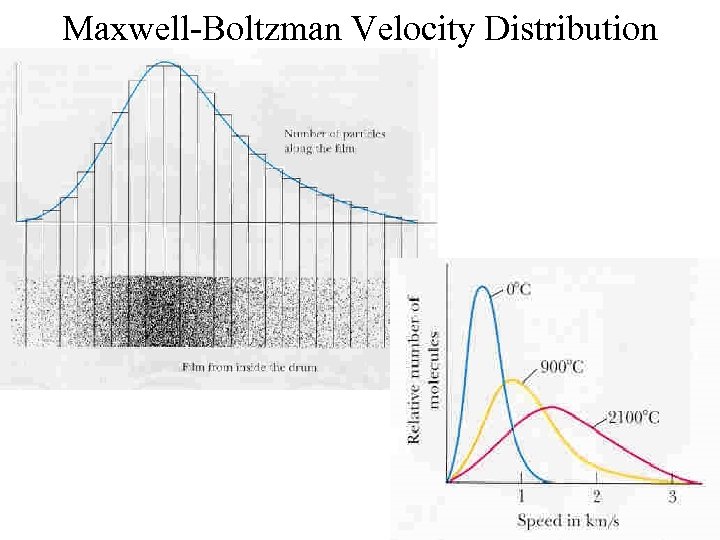
Maxwell-Boltzman Velocity Distribution
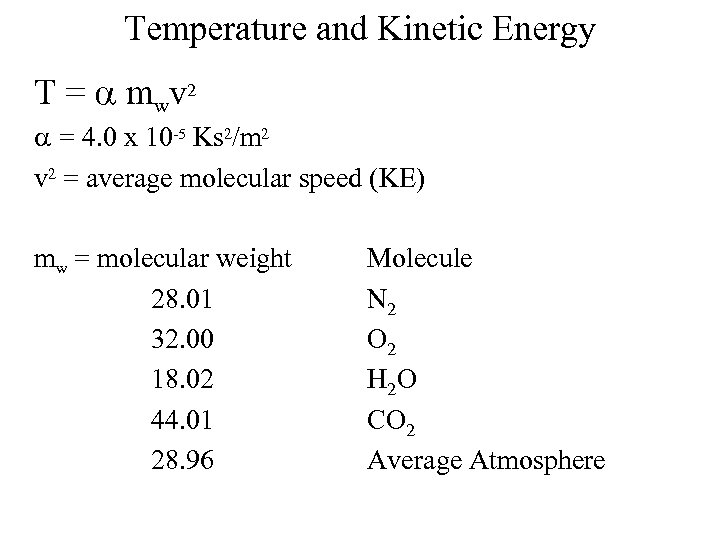
Temperature and Kinetic Energy T = a mwv 2 a = 4. 0 x 10 -5 Ks 2/m 2 v 2 = average molecular speed (KE) mw = molecular weight 28. 01 32. 00 18. 02 44. 01 28. 96 Molecule N 2 O 2 H 2 O CO 2 Average Atmosphere
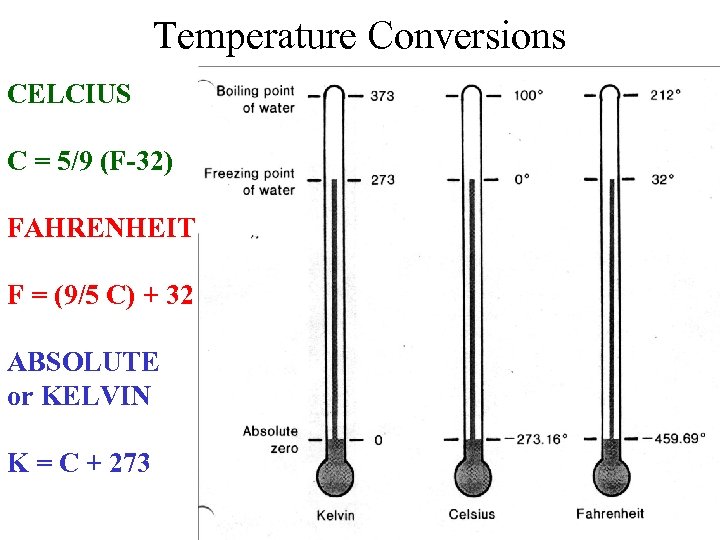
Temperature Conversions CELCIUS C = 5/9 (F-32) FAHRENHEIT F = (9/5 C) + 32 ABSOLUTE or KELVIN K = C + 273
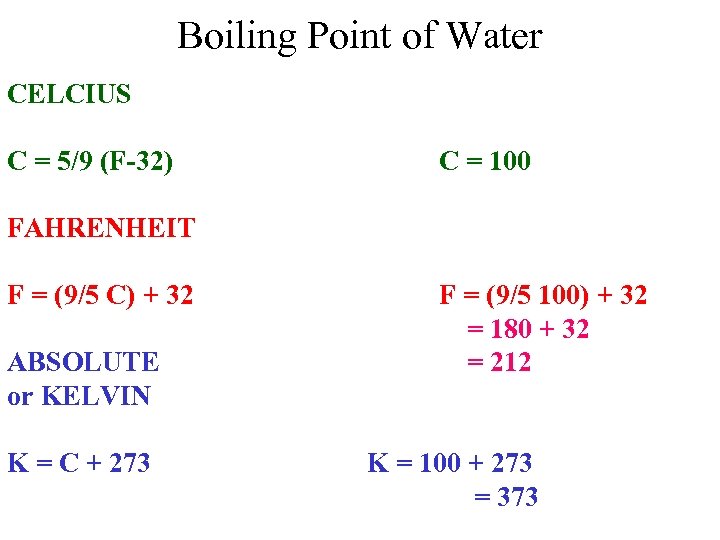
Boiling Point of Water CELCIUS C = 5/9 (F-32) C = 100 FAHRENHEIT F = (9/5 C) + 32 ABSOLUTE or KELVIN K = C + 273 F = (9/5 100) + 32 = 180 + 32 = 212 K = 100 + 273 = 373
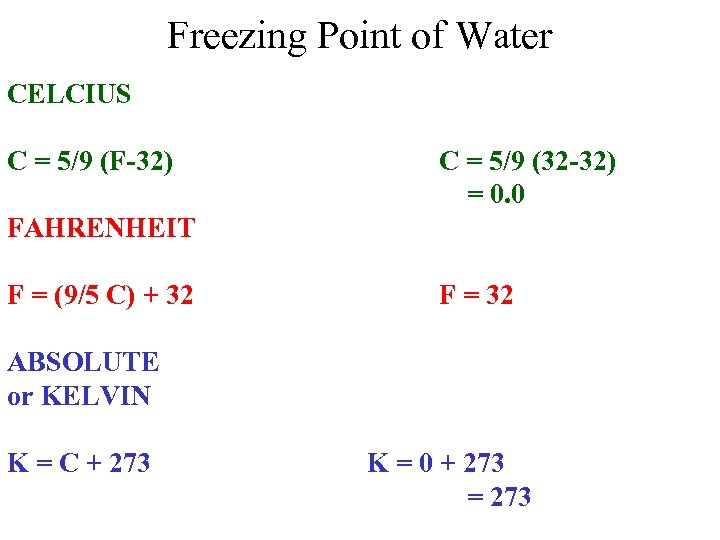
Freezing Point of Water CELCIUS C = 5/9 (F-32) C = 5/9 (32 -32) = 0. 0 FAHRENHEIT F = (9/5 C) + 32 F = 32 ABSOLUTE or KELVIN K = C + 273 K = 0 + 273 = 273
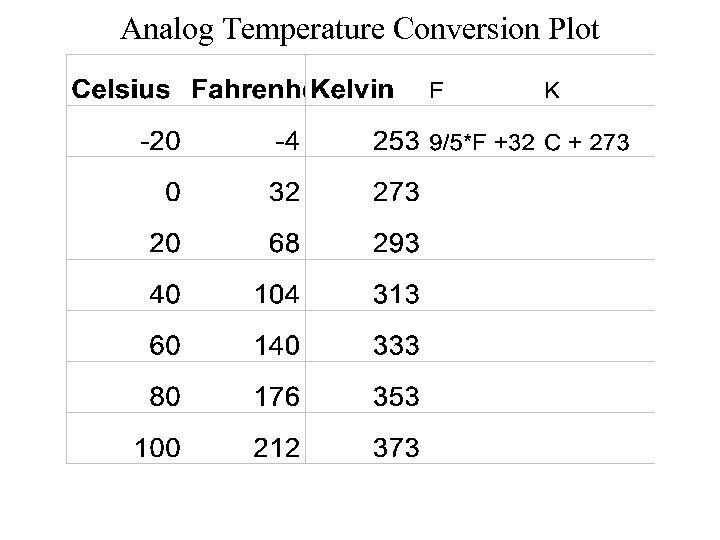
Analog Temperature Conversion Plot
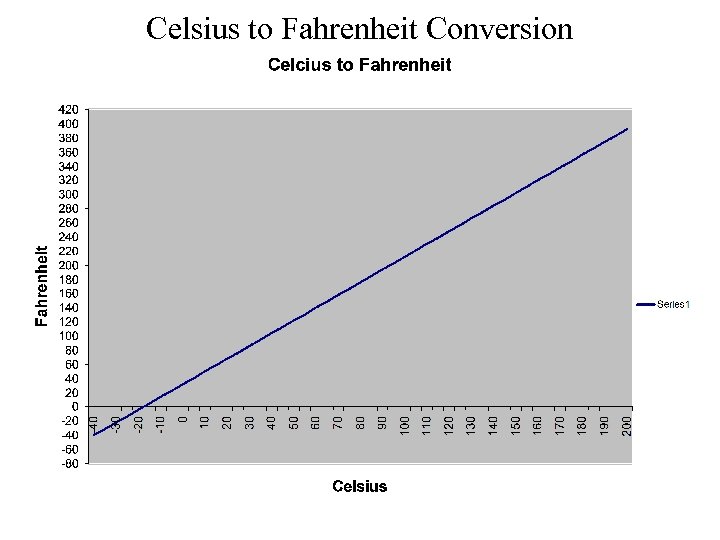
Celsius to Fahrenheit Conversion
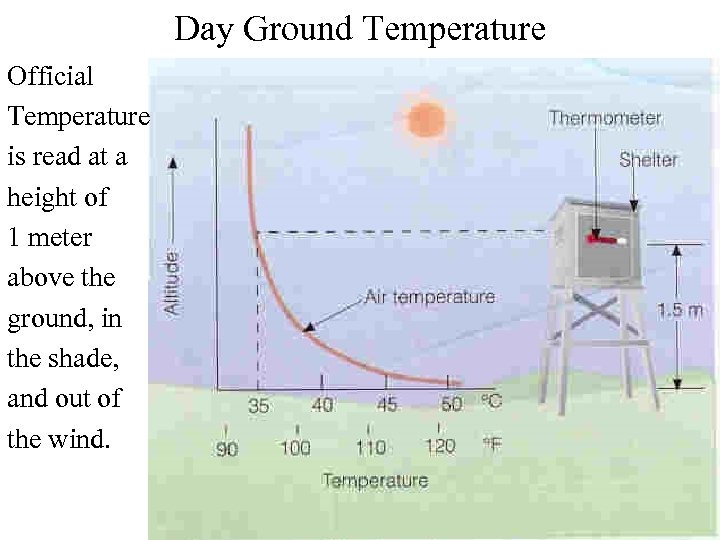
Day Ground Temperature Official Temperature is read at a height of 1 meter above the ground, in the shade, and out of the wind.
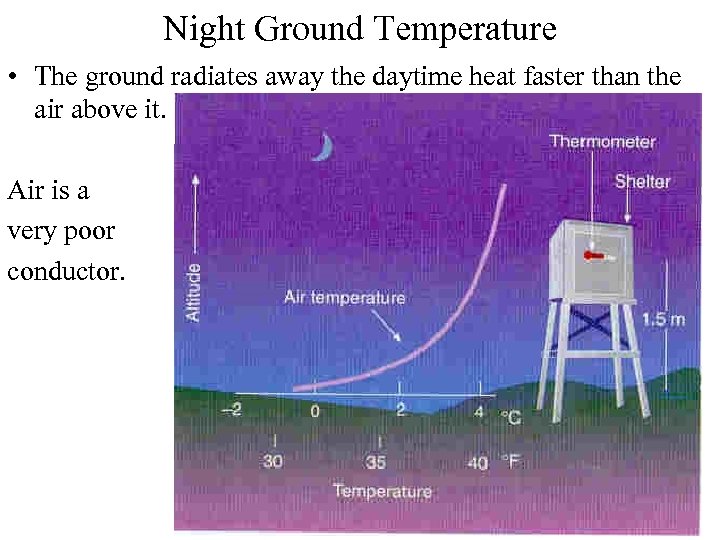
Night Ground Temperature • The ground radiates away the daytime heat faster than the air above it. Air is a very poor conductor.
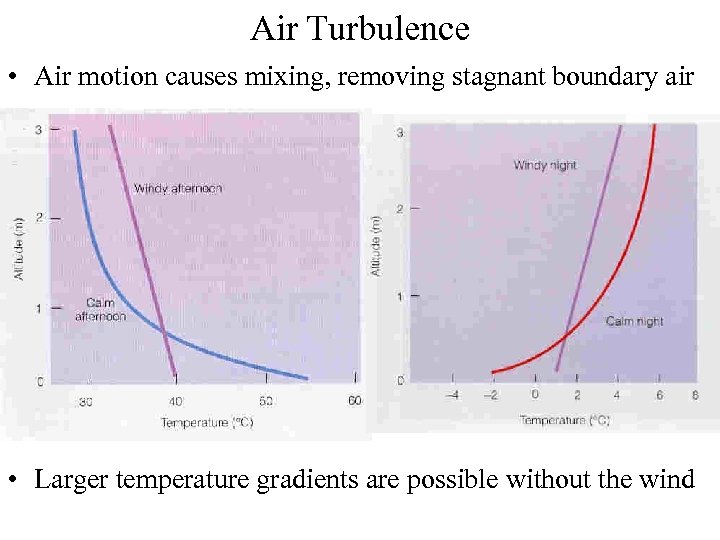
Air Turbulence • Air motion causes mixing, removing stagnant boundary air • Larger temperature gradients are possible without the wind
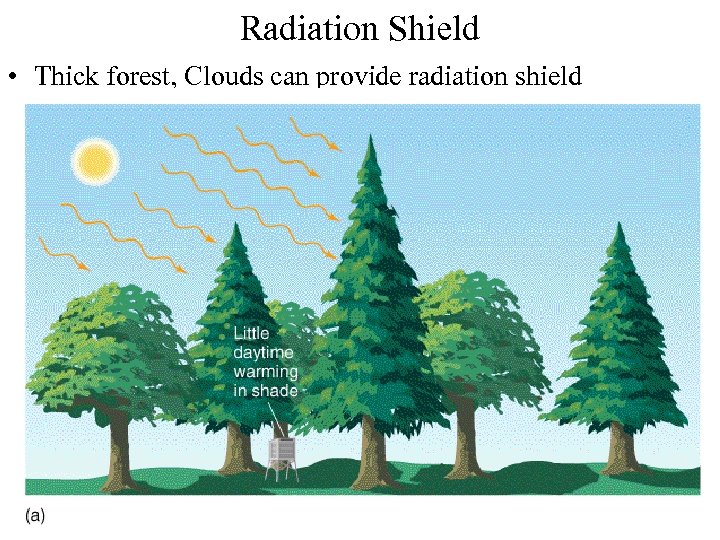
Radiation Shield • Thick forest, Clouds can provide radiation shield
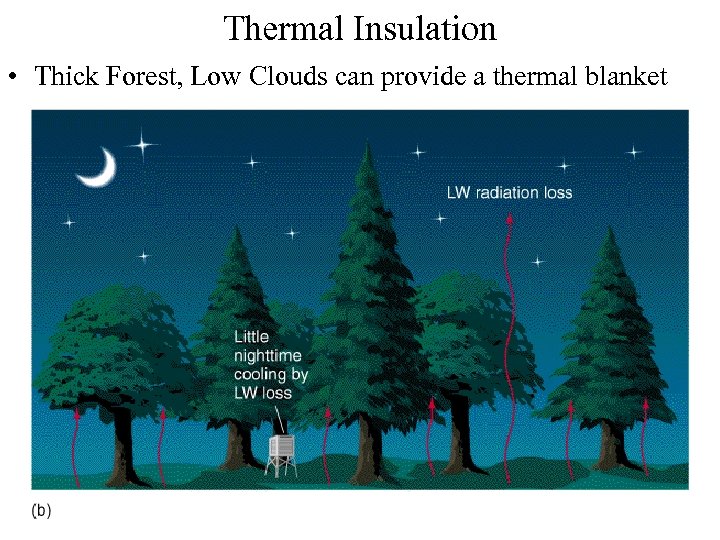
Thermal Insulation • Thick Forest, Low Clouds can provide a thermal blanket
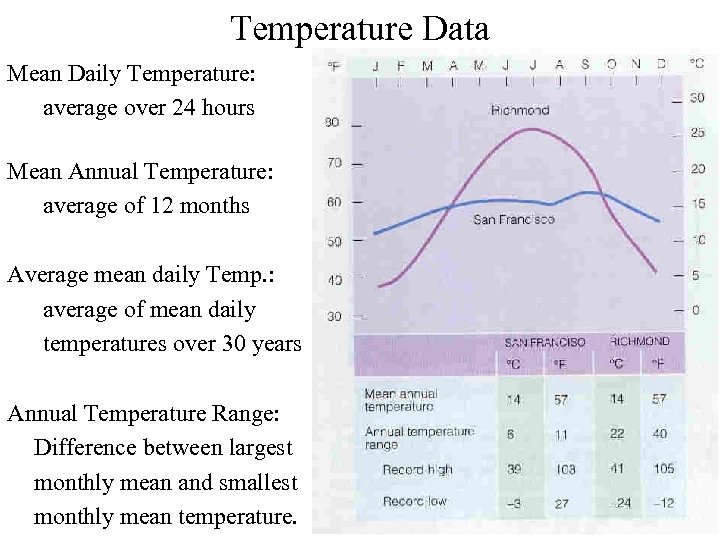
Temperature Data Mean Daily Temperature: average over 24 hours Mean Annual Temperature: average of 12 months Average mean daily Temp. : average of mean daily temperatures over 30 years Annual Temperature Range: Difference between largest monthly mean and smallest monthly mean temperature.
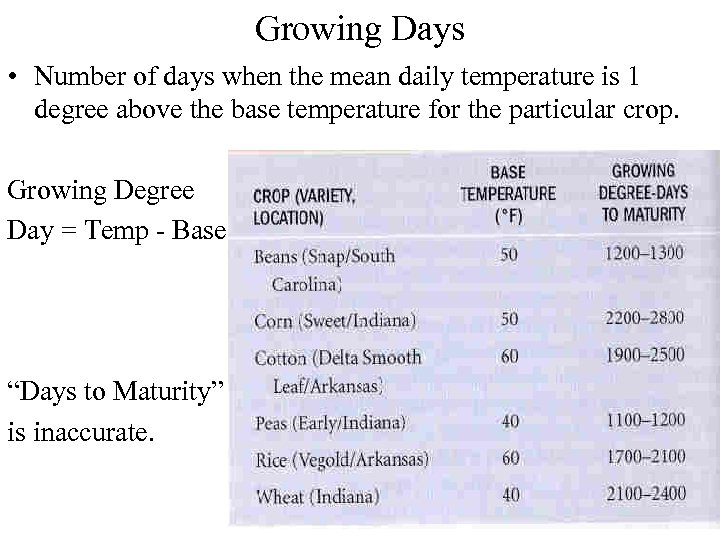
Growing Days • Number of days when the mean daily temperature is 1 degree above the base temperature for the particular crop. Growing Degree Day = Temp - Base “Days to Maturity” is inaccurate.
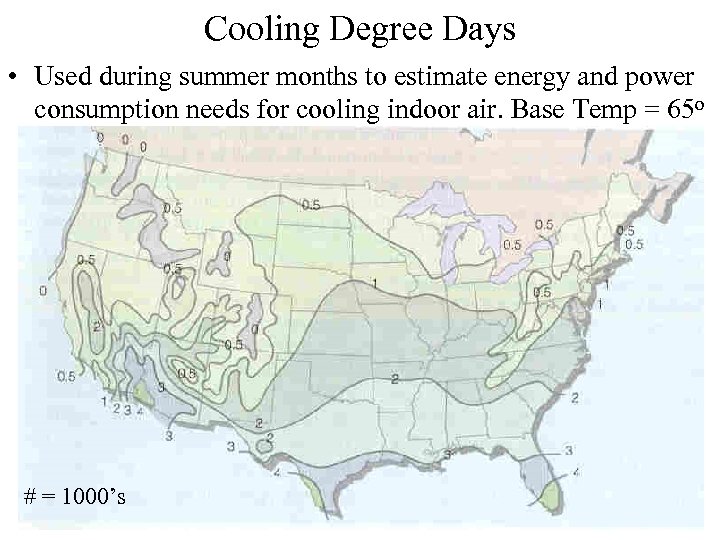
Cooling Degree Days • Used during summer months to estimate energy and power consumption needs for cooling indoor air. Base Temp = 65 o # = 1000’s
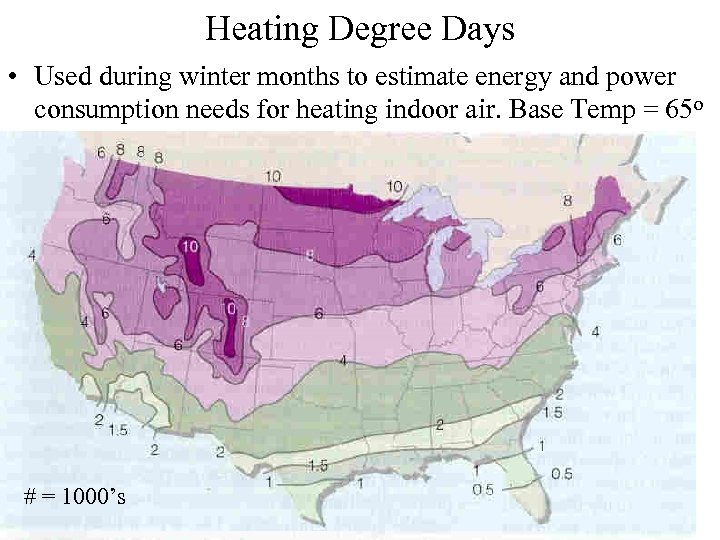
Heating Degree Days • Used during winter months to estimate energy and power consumption needs for heating indoor air. Base Temp = 65 o # = 1000’s
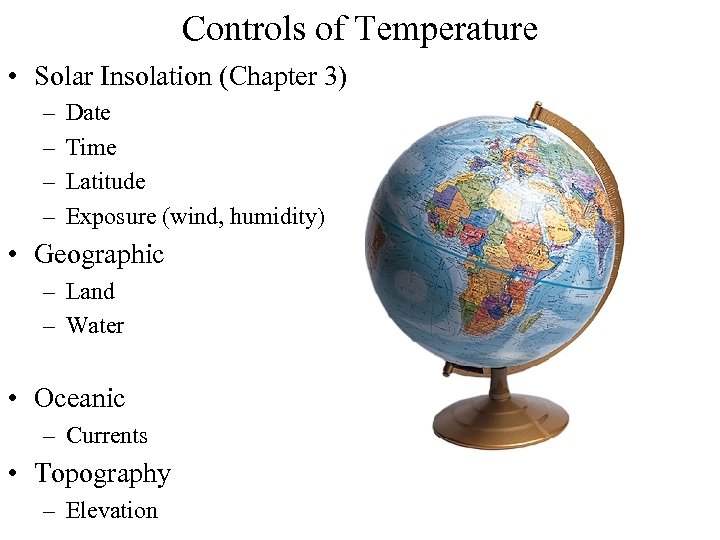
Controls of Temperature • Solar Insolation (Chapter 3) – – Date Time Latitude Exposure (wind, humidity) • Geographic – Land – Water • Oceanic – Currents • Topography – Elevation
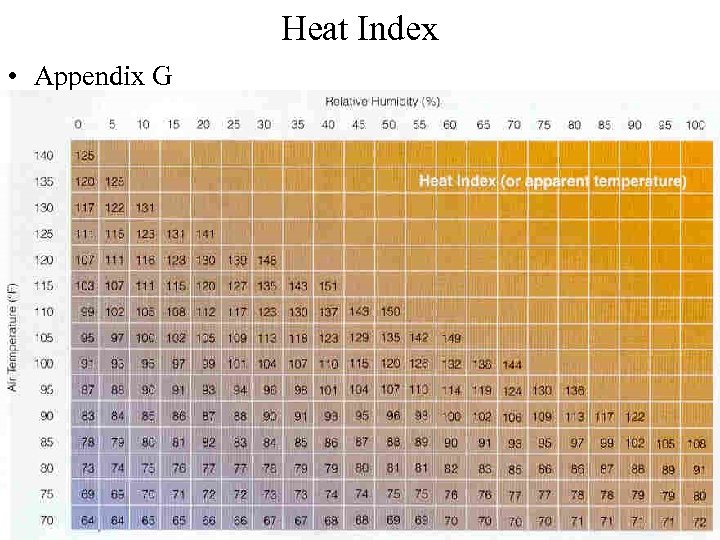
Heat Index • Appendix G
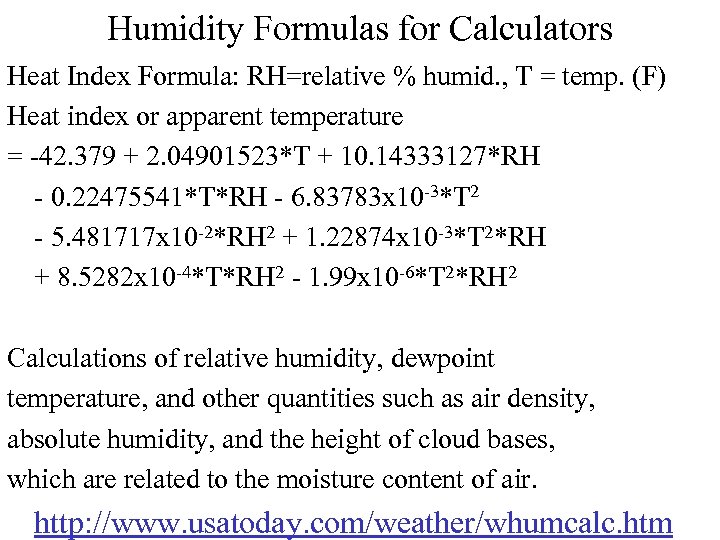
Humidity Formulas for Calculators Heat Index Formula: RH=relative % humid. , T = temp. (F) Heat index or apparent temperature = -42. 379 + 2. 04901523*T + 10. 14333127*RH - 0. 22475541*T*RH - 6. 83783 x 10 -3*T 2 - 5. 481717 x 10 -2*RH 2 + 1. 22874 x 10 -3*T 2*RH + 8. 5282 x 10 -4*T*RH 2 - 1. 99 x 10 -6*T 2*RH 2 Calculations of relative humidity, dewpoint temperature, and other quantities such as air density, absolute humidity, and the height of cloud bases, which are related to the moisture content of air. http: //www. usatoday. com/weather/whumcalc. htm
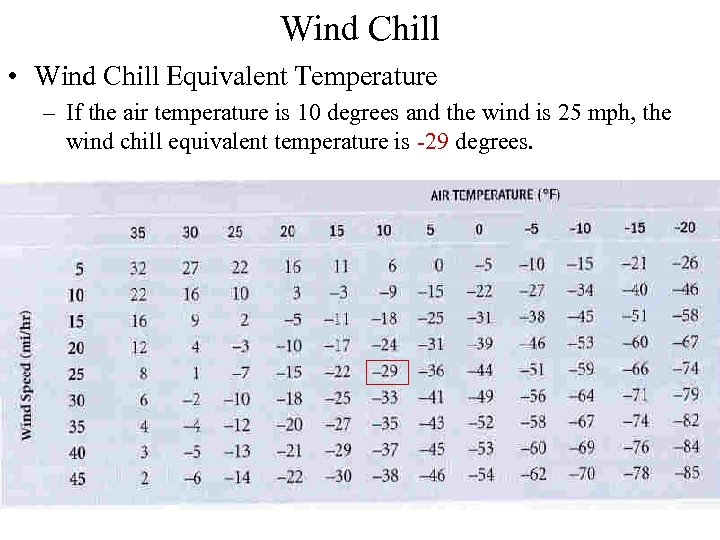
Wind Chill • Wind Chill Equivalent Temperature – If the air temperature is 10 degrees and the wind is 25 mph, the wind chill equivalent temperature is -29 degrees.
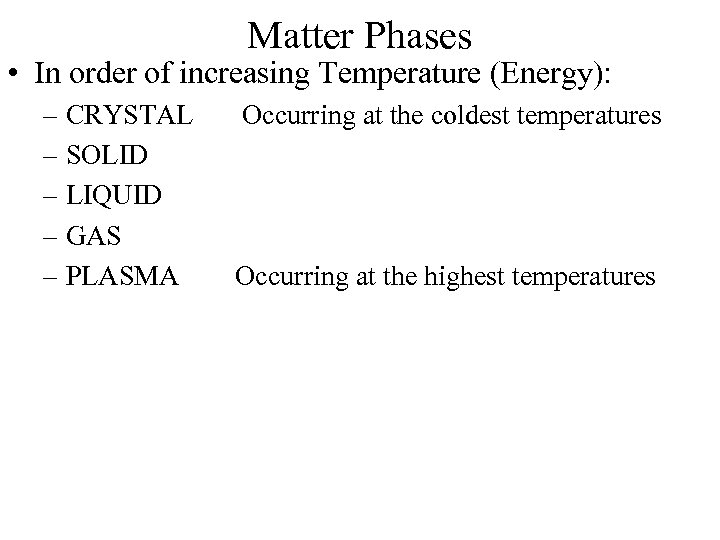
Matter Phases • In order of increasing Temperature (Energy): – CRYSTAL – SOLID – LIQUID – GAS – PLASMA Occurring at the coldest temperatures Occurring at the highest temperatures
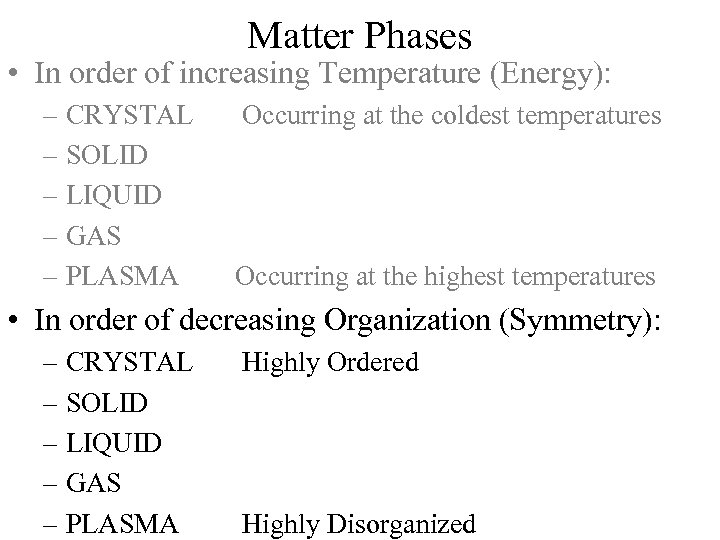
Matter Phases • In order of increasing Temperature (Energy): – CRYSTAL – SOLID – LIQUID – GAS – PLASMA Occurring at the coldest temperatures Occurring at the highest temperatures • In order of decreasing Organization (Symmetry): – CRYSTAL – SOLID – LIQUID – GAS – PLASMA Highly Ordered Highly Disorganized
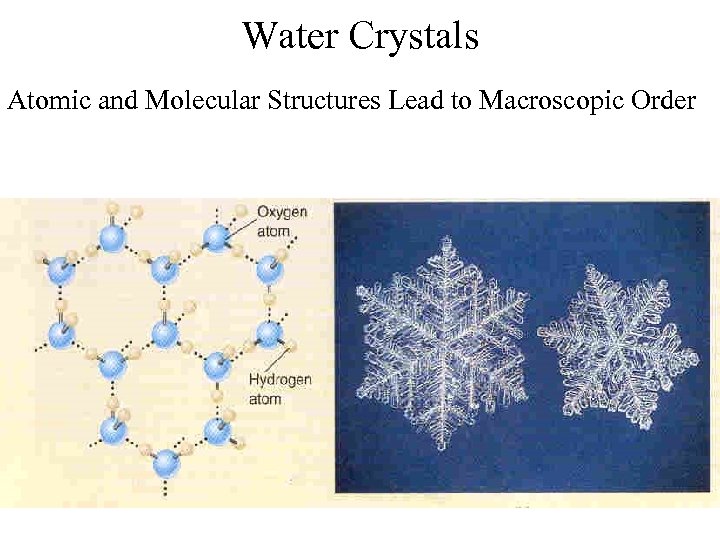
Water Crystals Atomic and Molecular Structures Lead to Macroscopic Order
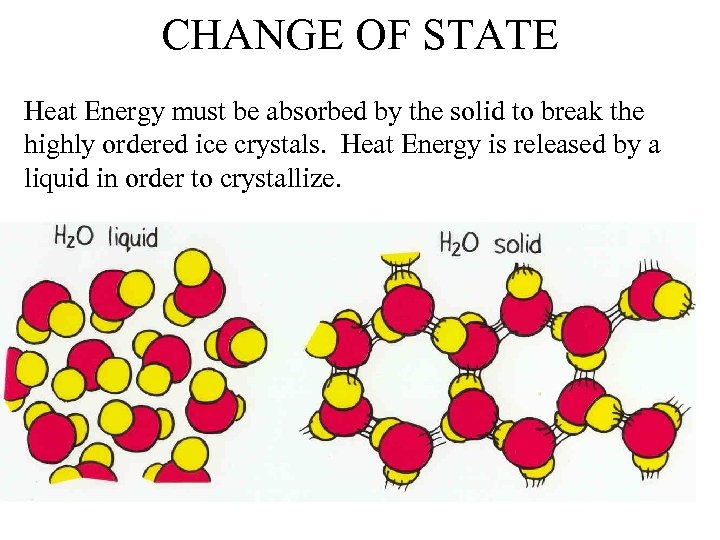
CHANGE OF STATE Heat Energy must be absorbed by the solid to break the highly ordered ice crystals. Heat Energy is released by a liquid in order to crystallize.
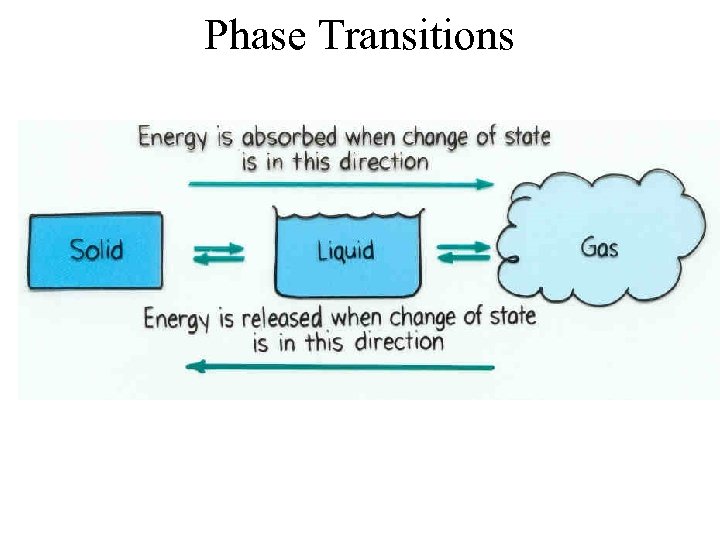
Phase Transitions
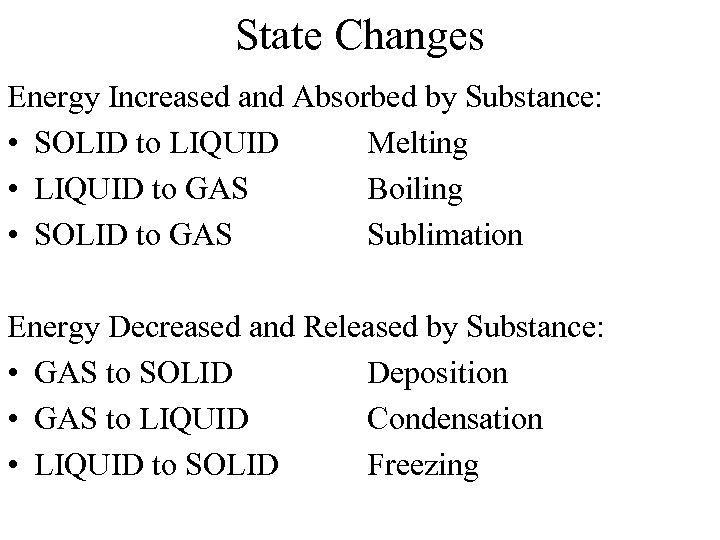
State Changes Energy Increased and Absorbed by Substance: • SOLID to LIQUID Melting • LIQUID to GAS Boiling • SOLID to GAS Sublimation Energy Decreased and Released by Substance: • GAS to SOLID Deposition • GAS to LIQUID Condensation • LIQUID to SOLID Freezing
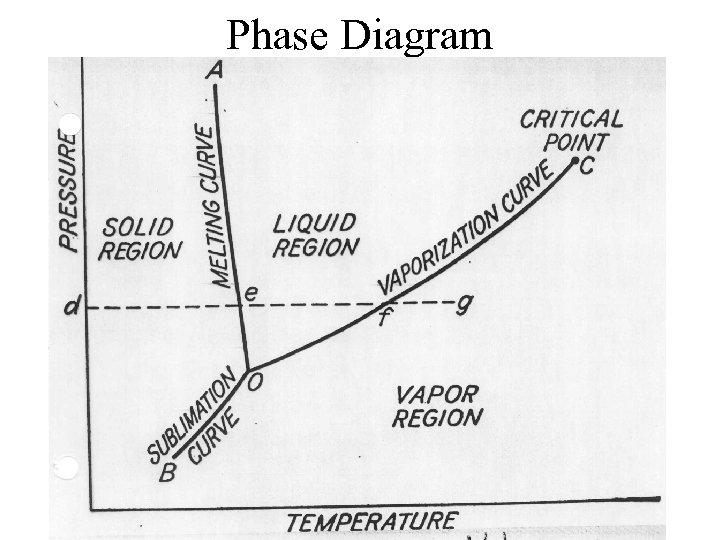
Phase Diagram
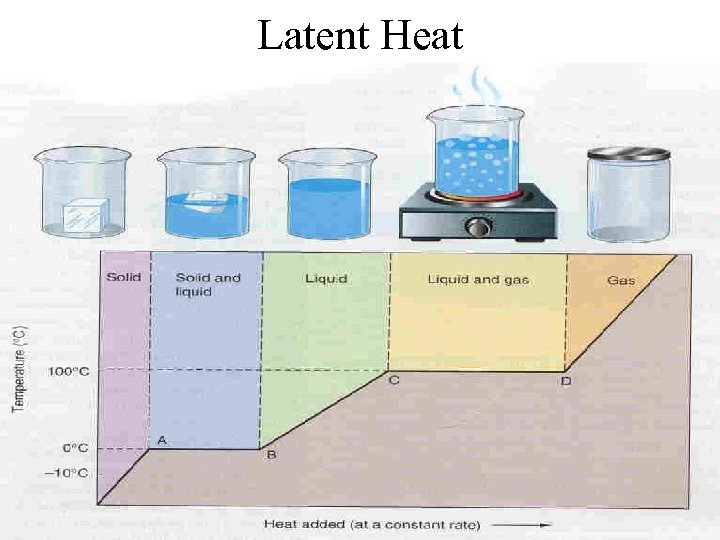
Latent Heat
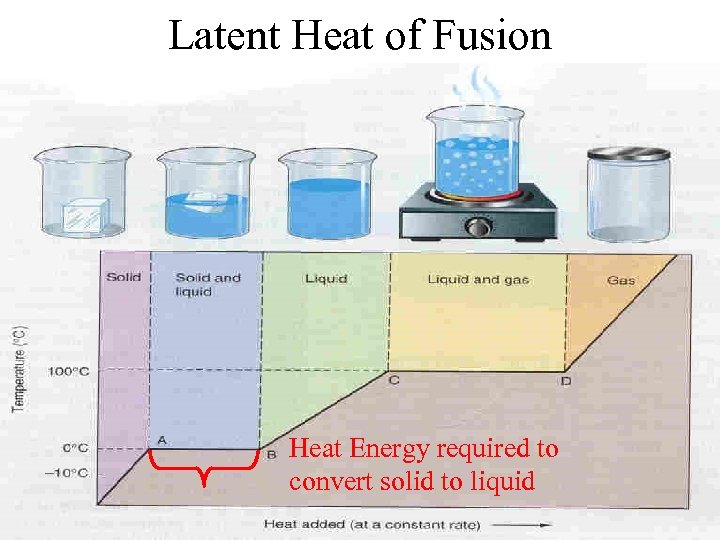
Latent Heat of Fusion Heat Energy required to convert solid to liquid
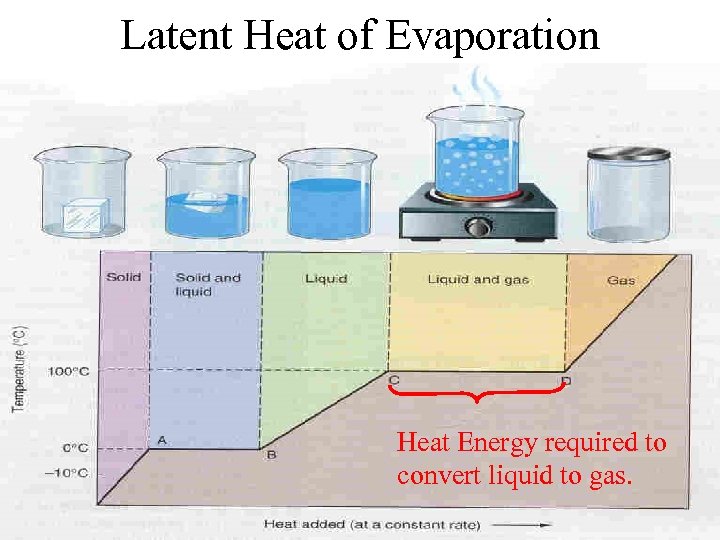
Latent Heat of Evaporation Heat Energy required to convert liquid to gas.
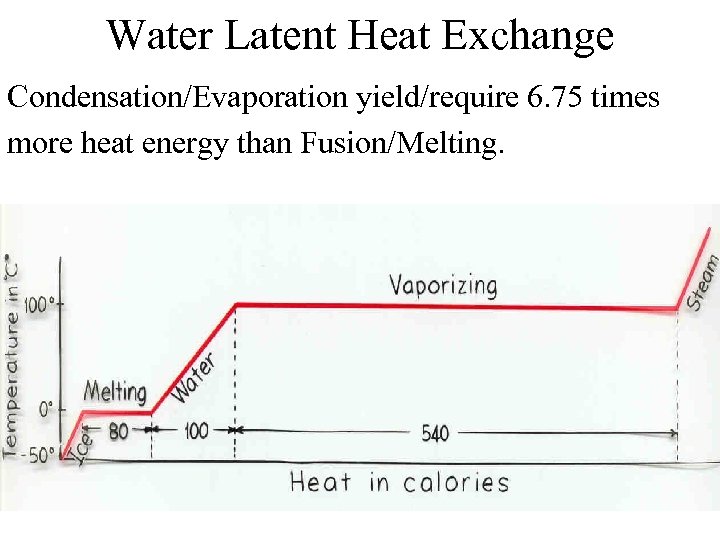
Water Latent Heat Exchange Condensation/Evaporation yield/require 6. 75 times more heat energy than Fusion/Melting.
Heat Units • CALORIE: the amount of heat required to raise the temperature of 1 kg of water by 1 degree Celsius. • (1 Food calorie = 1, 000 calories = 4. 184 Joules)
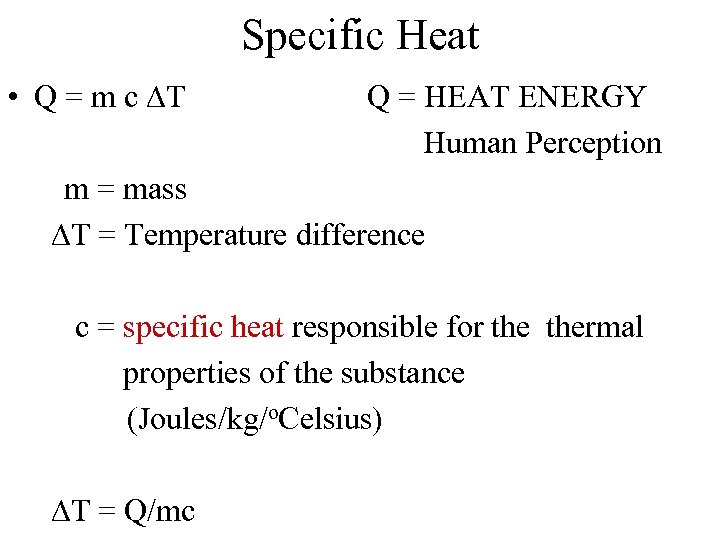
Specific Heat • Q = m c DT Q = HEAT ENERGY Human Perception m = mass DT = Temperature difference c = specific heat responsible for thermal properties of the substance (Joules/kg/o. Celsius) DT = Q/mc
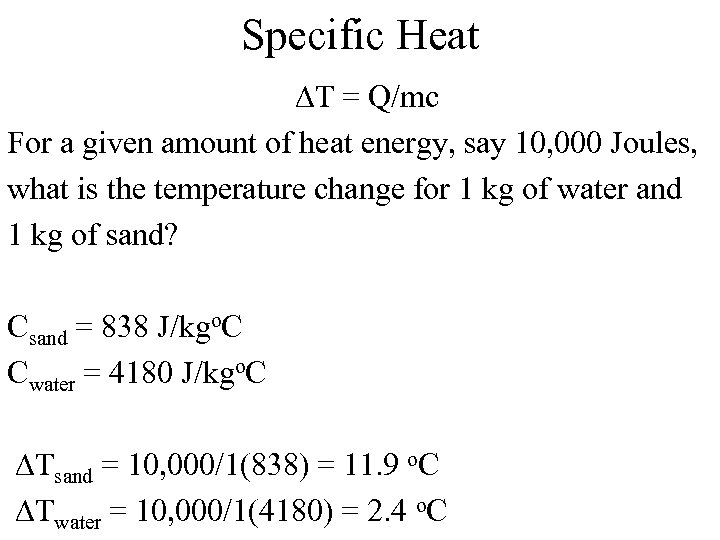
Specific Heat DT = Q/mc For a given amount of heat energy, say 10, 000 Joules, what is the temperature change for 1 kg of water and 1 kg of sand? Csand = 838 J/kgo. C Cwater = 4180 J/kgo. C DTsand = 10, 000/1(838) = 11. 9 o. C DTwater = 10, 000/1(4180) = 2. 4 o. C
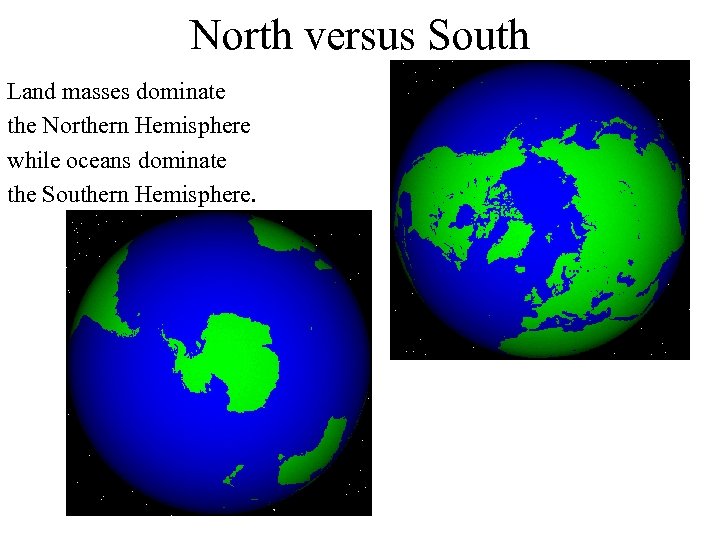
North versus South Land masses dominate the Northern Hemisphere while oceans dominate the Southern Hemisphere.
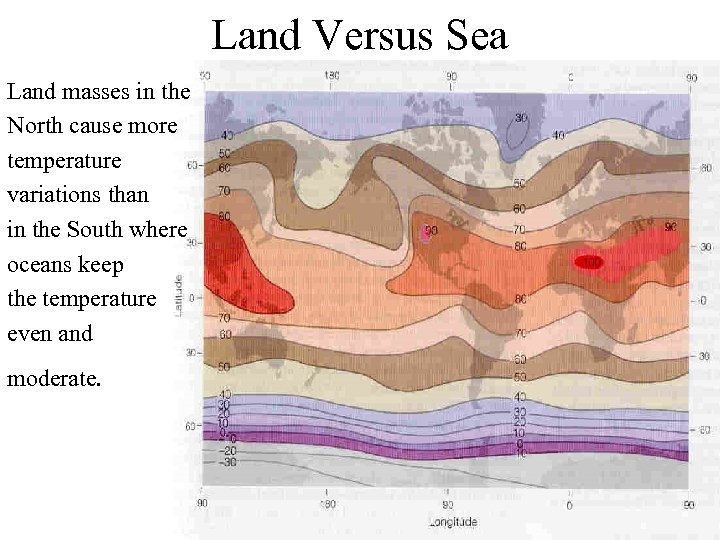
Land Versus Sea Land masses in the North cause more temperature variations than in the South where oceans keep the temperature even and moderate.
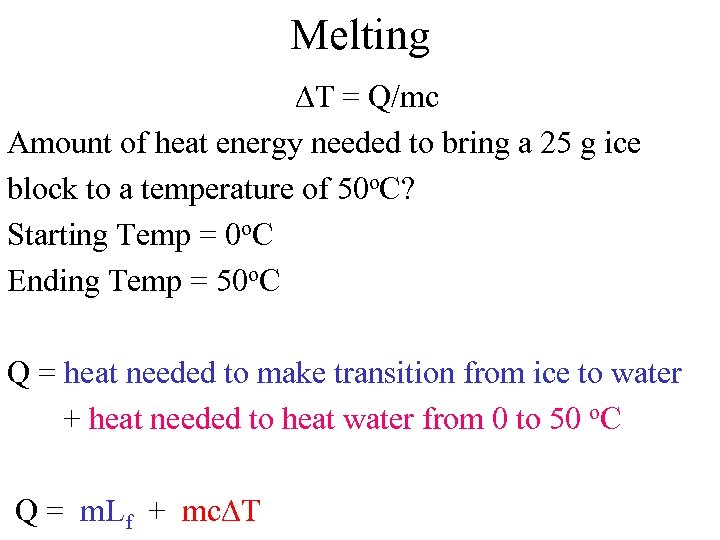
Melting DT = Q/mc Amount of heat energy needed to bring a 25 g ice block to a temperature of 50 o. C? Starting Temp = 0 o. C Ending Temp = 50 o. C Q = heat needed to make transition from ice to water + heat needed to heat water from 0 to 50 o. C Q = m. Lf + mc. DT
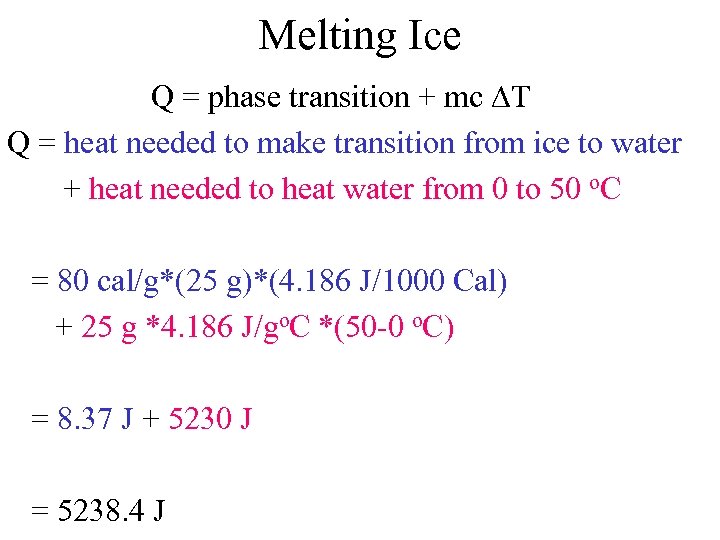
Melting Ice Q = phase transition + mc DT Q = heat needed to make transition from ice to water + heat needed to heat water from 0 to 50 o. C = 80 cal/g*(25 g)*(4. 186 J/1000 Cal) + 25 g *4. 186 J/go. C *(50 -0 o. C) = 8. 37 J + 5230 J = 5238. 4 J
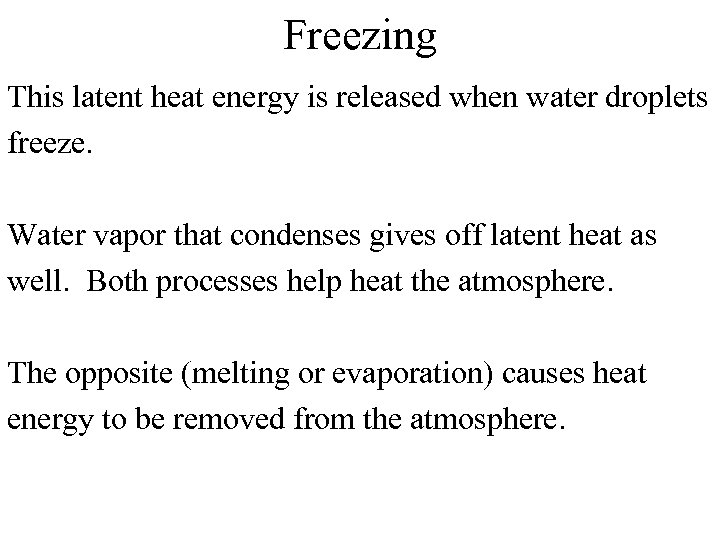
Freezing This latent heat energy is released when water droplets freeze. Water vapor that condenses gives off latent heat as well. Both processes help heat the atmosphere. The opposite (melting or evaporation) causes heat energy to be removed from the atmosphere.
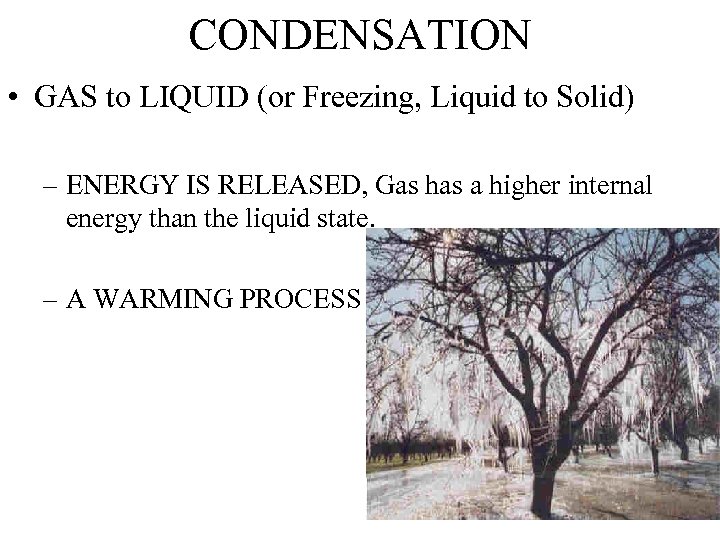
CONDENSATION • GAS to LIQUID (or Freezing, Liquid to Solid) – ENERGY IS RELEASED, Gas has a higher internal energy than the liquid state. – A WARMING PROCESS
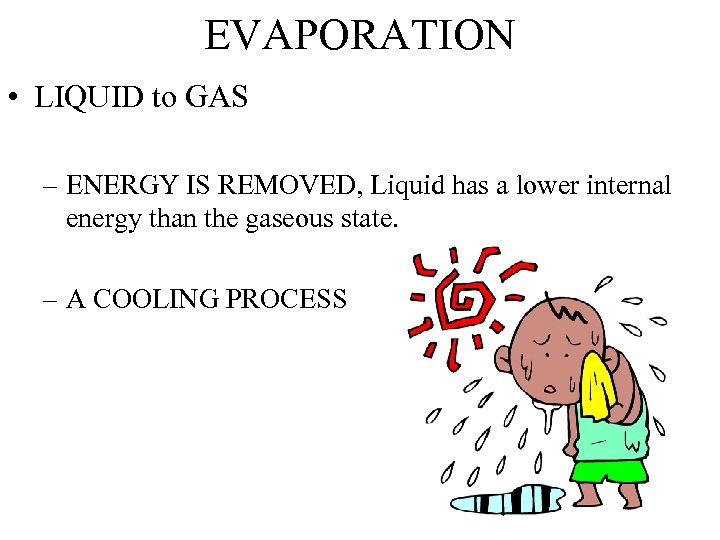
EVAPORATION • LIQUID to GAS – ENERGY IS REMOVED, Liquid has a lower internal energy than the gaseous state. – A COOLING PROCESS
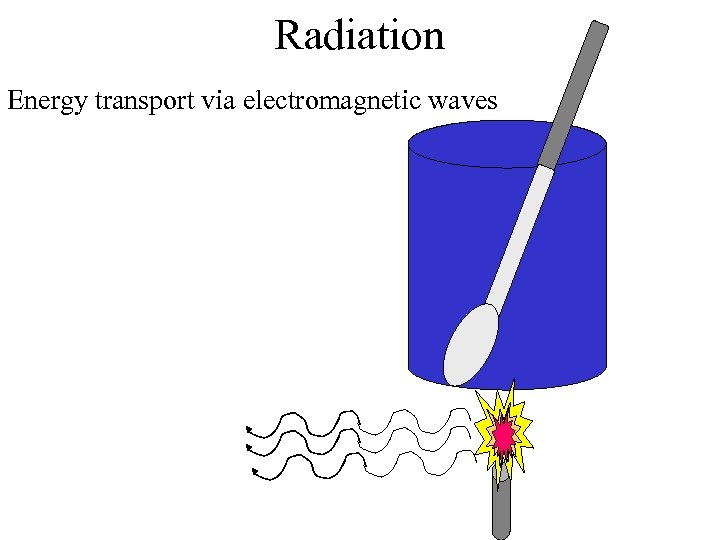
Radiation Energy transport via electromagnetic waves
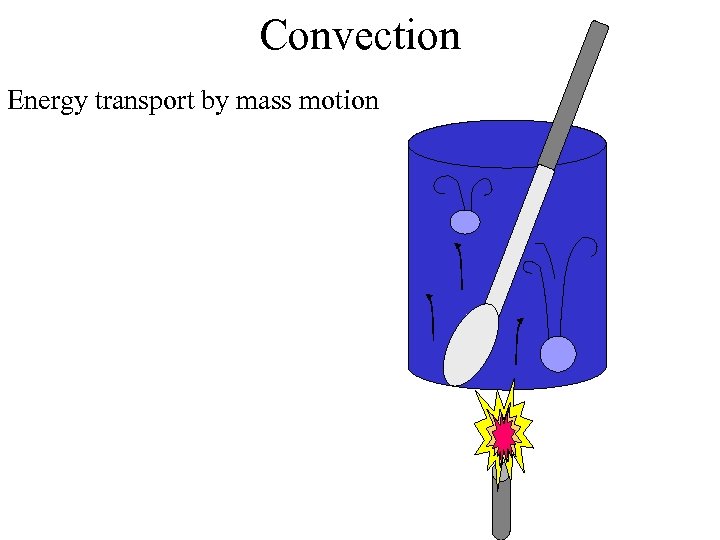
Convection Energy transport by mass motion
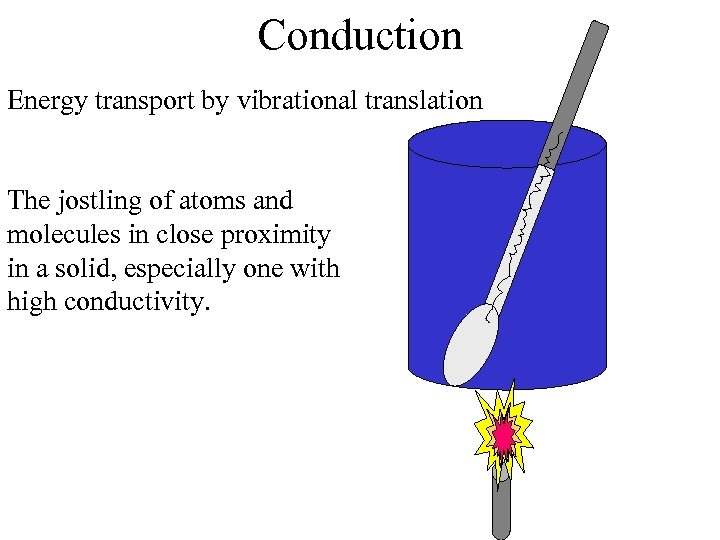
Conduction Energy transport by vibrational translation The jostling of atoms and molecules in close proximity in a solid, especially one with high conductivity.
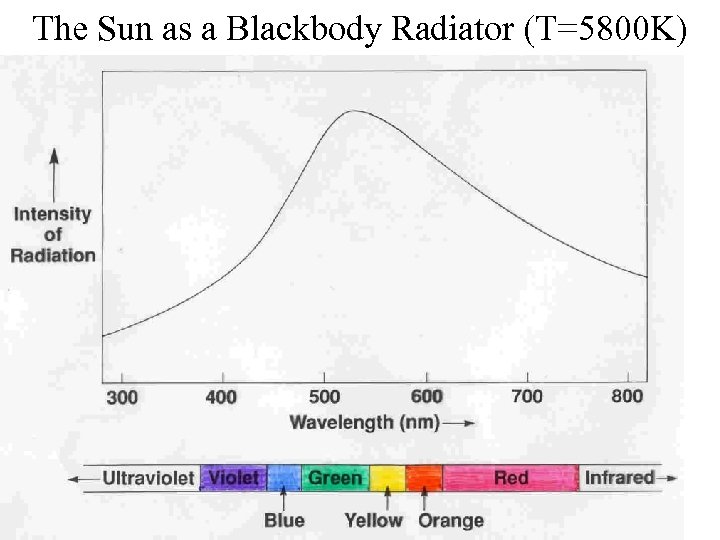
The Sun as a Blackbody Radiator (T=5800 K)
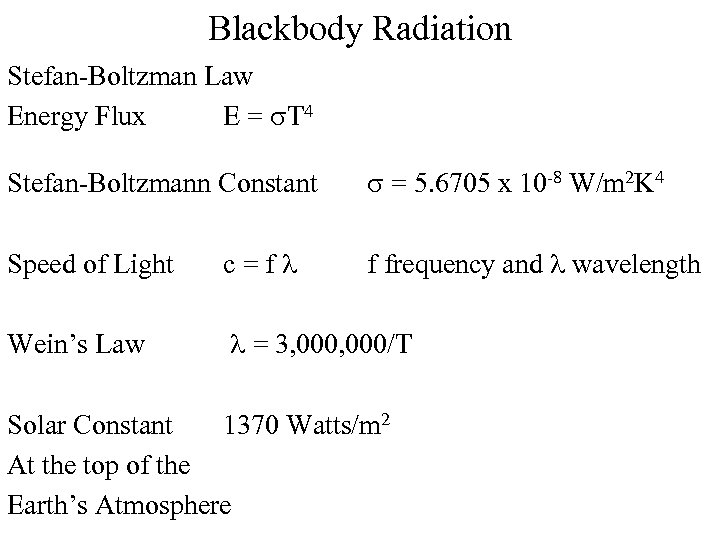
Blackbody Radiation Stefan-Boltzman Law Energy Flux E = s. T 4 Stefan-Boltzmann Constant s = 5. 6705 x 10 -8 W/m 2 K 4 Speed of Light c=fl f frequency and l wavelength Wein’s Law l = 3, 000/T Solar Constant 1370 Watts/m 2 At the top of the Earth’s Atmosphere
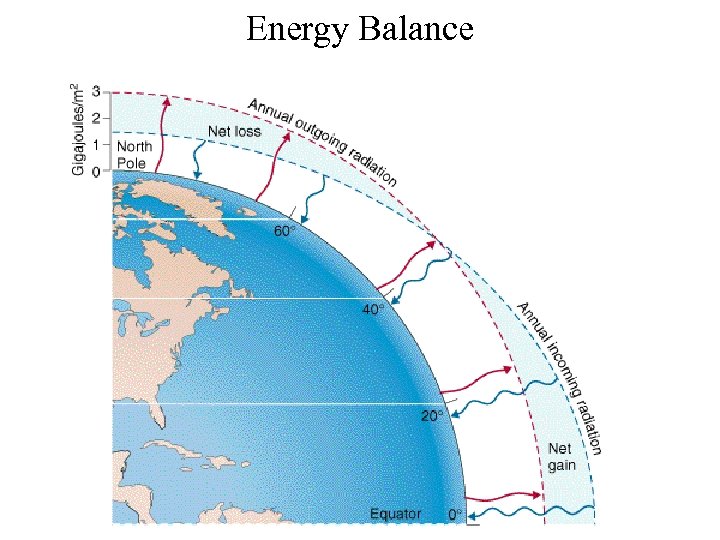
Energy Balance
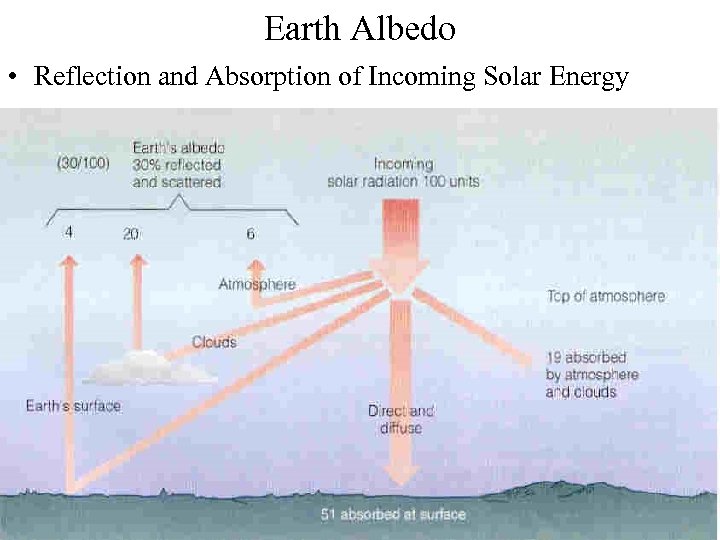
Earth Albedo • Reflection and Absorption of Incoming Solar Energy
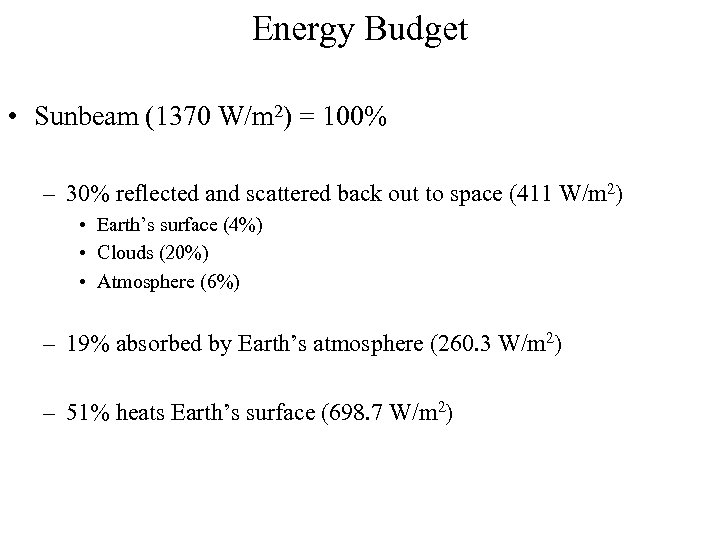
Energy Budget • Sunbeam (1370 W/m 2) = 100% – 30% reflected and scattered back out to space (411 W/m 2) • Earth’s surface (4%) • Clouds (20%) • Atmosphere (6%) – 19% absorbed by Earth’s atmosphere (260. 3 W/m 2) – 51% heats Earth’s surface (698. 7 W/m 2)
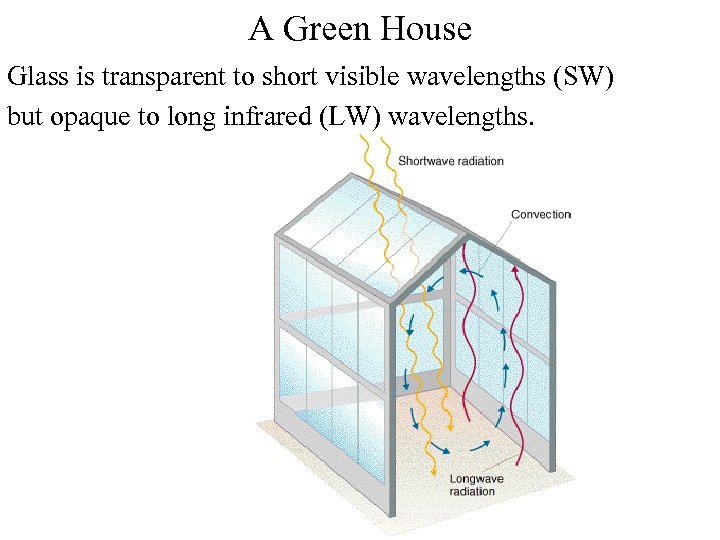
A Green House Glass is transparent to short visible wavelengths (SW) but opaque to long infrared (LW) wavelengths.
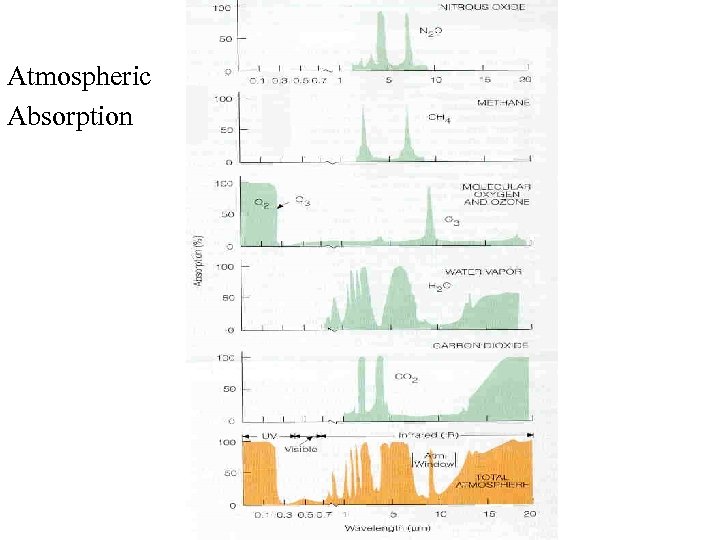
Atmosphere Absorption Atmospheric Absorption
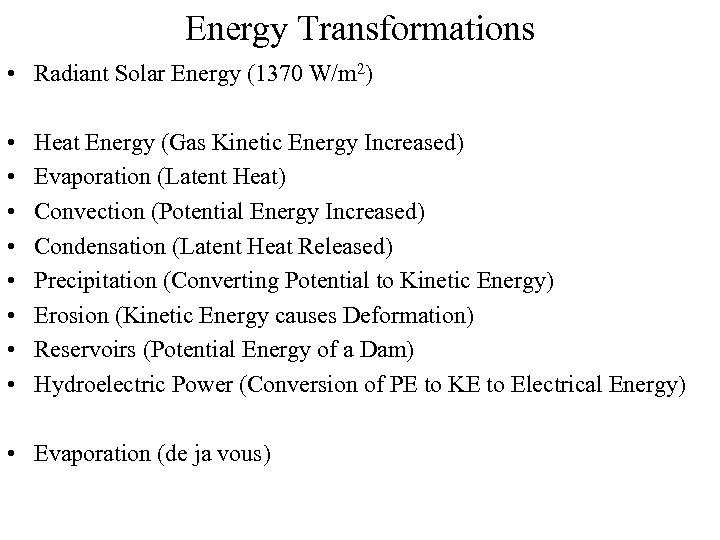
Energy Transformations • Radiant Solar Energy (1370 W/m 2) • • Heat Energy (Gas Kinetic Energy Increased) Evaporation (Latent Heat) Convection (Potential Energy Increased) Condensation (Latent Heat Released) Precipitation (Converting Potential to Kinetic Energy) Erosion (Kinetic Energy causes Deformation) Reservoirs (Potential Energy of a Dam) Hydroelectric Power (Conversion of PE to KE to Electrical Energy) • Evaporation (de ja vous)
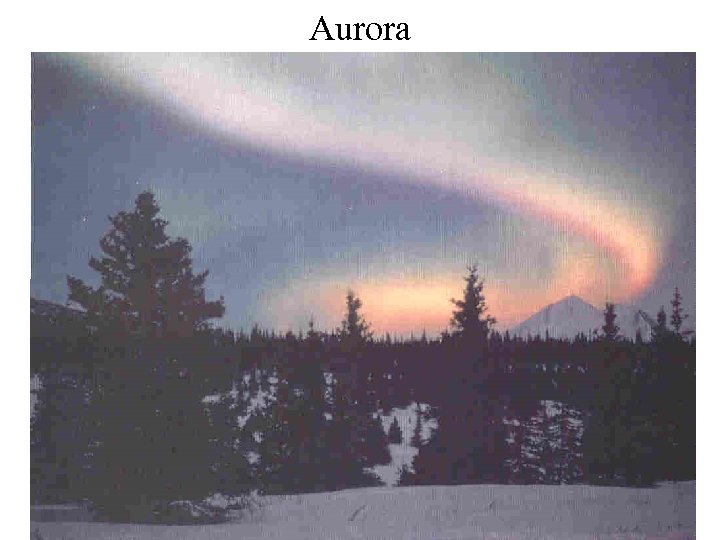
Aurora
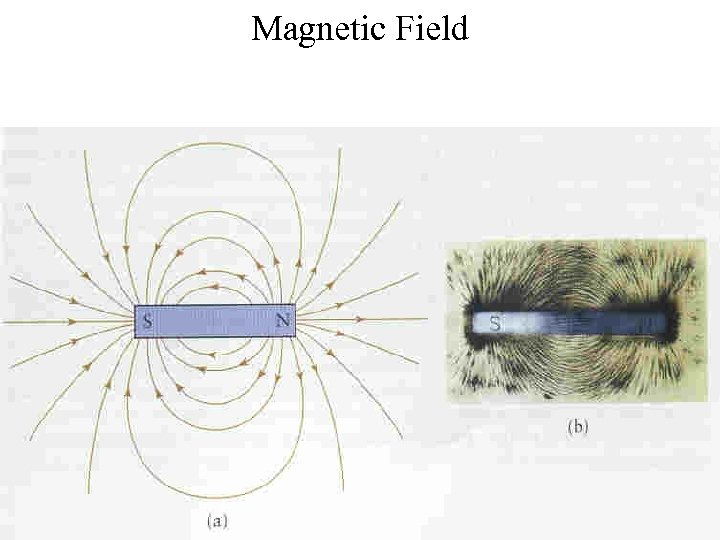
Magnetic Field
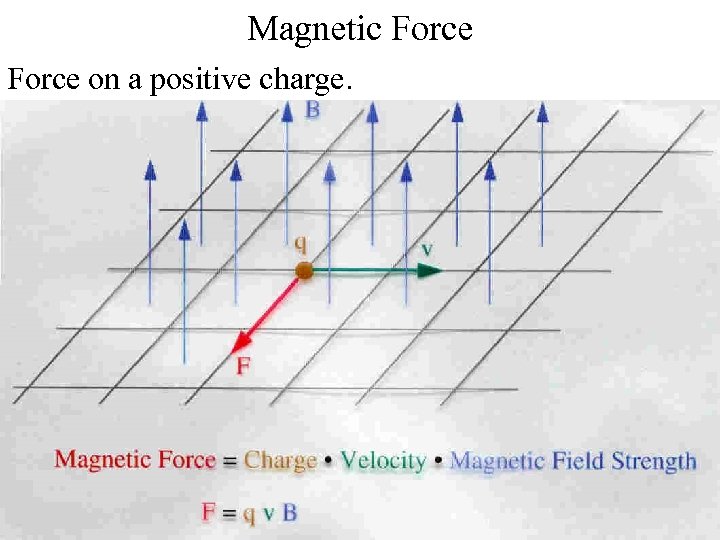
Magnetic Force on a positive charge.
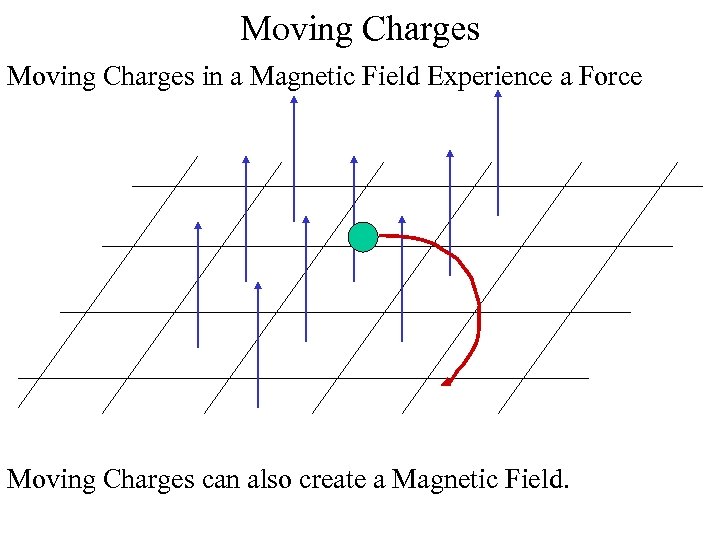
Moving Charges in a Magnetic Field Experience a Force Moving Charges can also create a Magnetic Field.
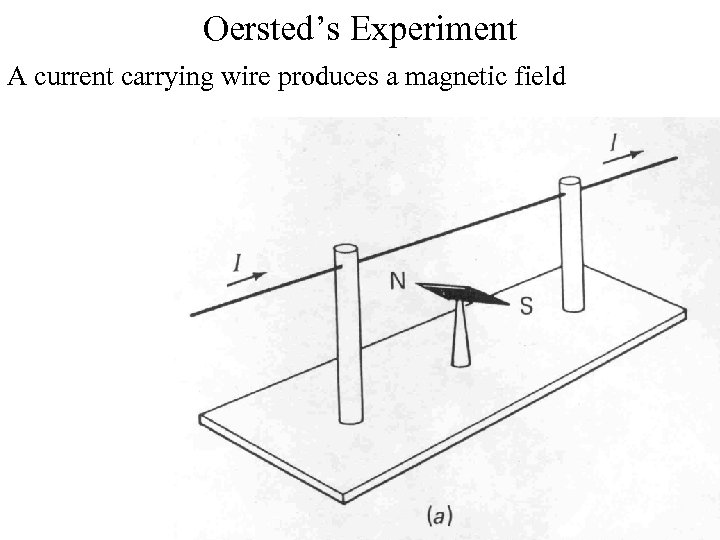
Oersted’s Experiment A current carrying wire produces a magnetic field
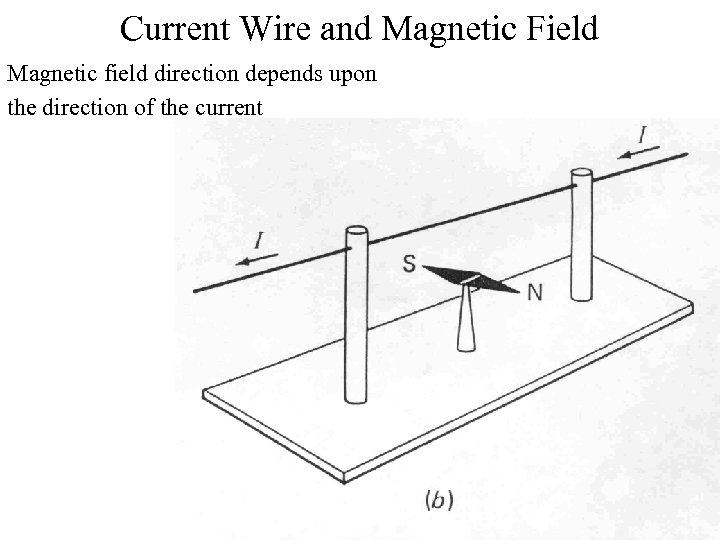
Current Wire and Magnetic Field Magnetic field direction depends upon the direction of the current
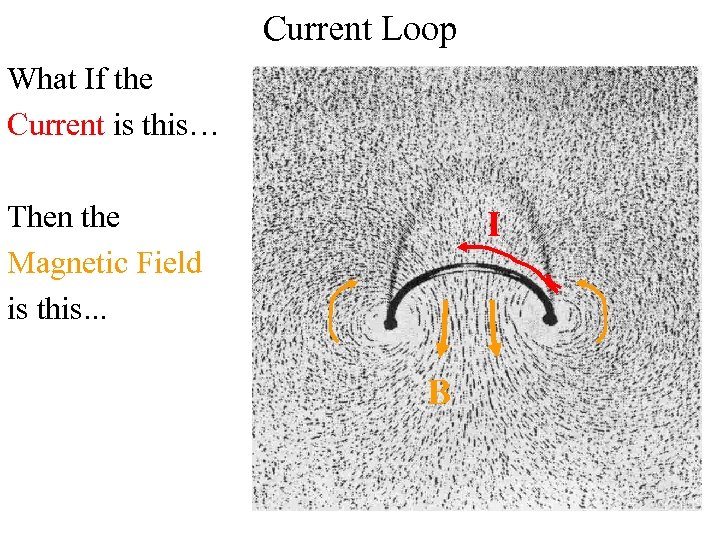
Current Loop What If the Current is this… Then the Magnetic Field is this. . . I B
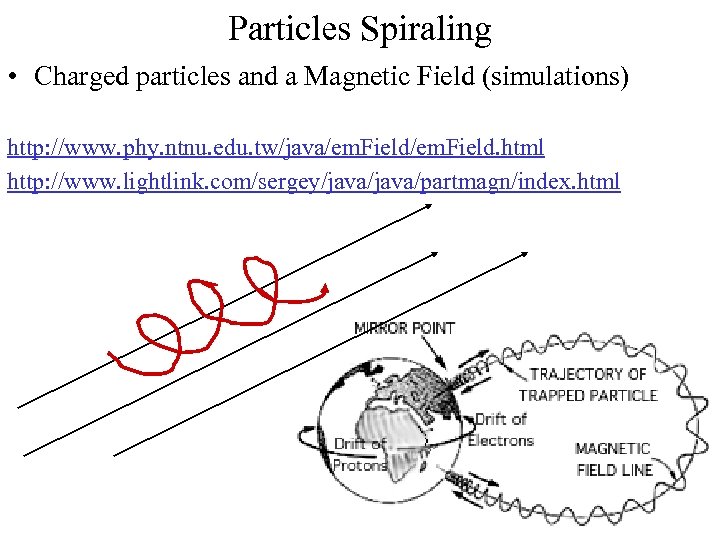
Particles Spiraling • Charged particles and a Magnetic Field (simulations) http: //www. phy. ntnu. edu. tw/java/em. Field. html http: //www. lightlink. com/sergey/java/partmagn/index. html
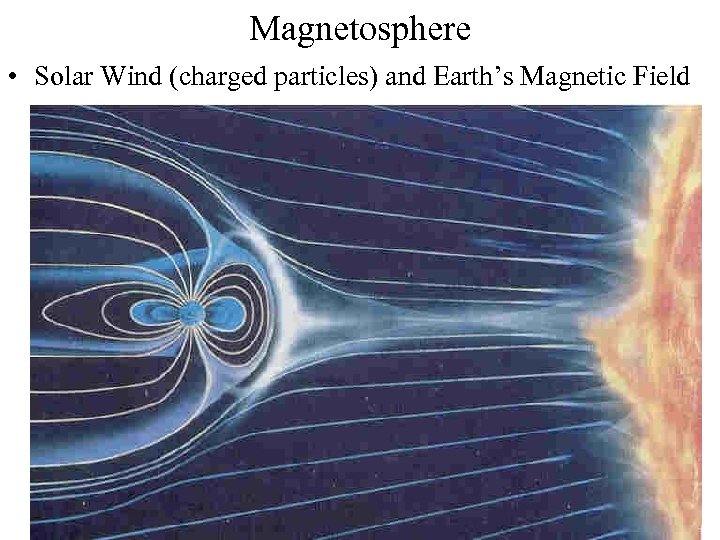
Magnetosphere • Solar Wind (charged particles) and Earth’s Magnetic Field
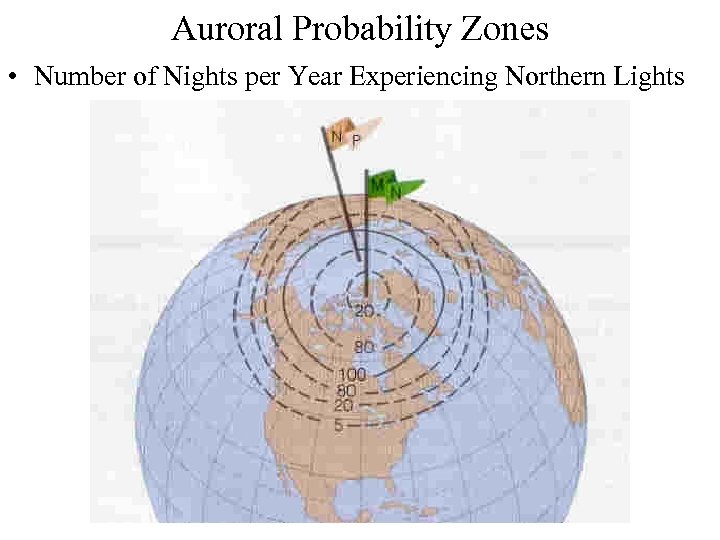
Auroral Probability Zones • Number of Nights per Year Experiencing Northern Lights
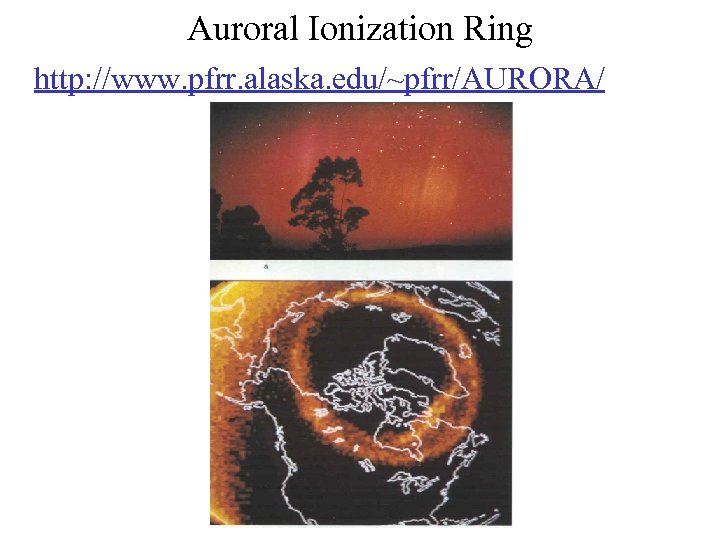
Auroral Ionization Ring http: //www. pfrr. alaska. edu/~pfrr/AURORA/
Summary • Temperature and Kinetic Energy • Temperature Scales – Kelvin – Celsius – Fahrenheit • Physical Changes of State – Latent Heat – Specific Heat • Energy Balance and Heating – Radiation, Convection, Conduction – Albedo – Greenhouse Effect • Aurora
Скачать презентацию Heat Energy Read Textbook Meteorology Today
fc78c9e6cea69f7b67b437e26c4be8eb.ppt